Introduction
Adenoidectomy is one of the most effective treatments for adenoid hypertrophy, which is associated with a poor quality of life.Reference Powell, Tremlett and Bosman1 Currently, most adenoidectomies are performed via transnasal or transoral approaches.Reference Pagella, Pusateri, Canzi, Caputo, Marseglia and Pelizzo2 Adenoid tissue regrowth after adenoidectomy is reported to be associated with clinical symptoms related to the nose, pharynx and ear, necessitating reoperation.Reference Duval, Chung and Vaccani3 Joshua et al. reported a regrowth rate of 19 per cent.Reference Joshua, Bahar, Sulkes, Shpitzer and Raveh4 It is therefore necessary to develop a surgical technique that enables the complete removal of adenoid tissue, thereby reducing the rates of regrowth and reoperation. However, it is unknown which layer of the posterior nasopharyngeal wall would serve as the optimal ‘surgical boundary’. Identification of this layer could ensure complete excision and prevent regrowth while sparing structures deep to the posterior nasopharyngeal wall and thereby ensuring surgical safety.Reference Dearking, Lahr, Kuchena and Orvidas5
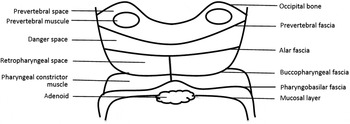
From the lumen outwards, the posterior nasopharyngeal wall comprises the mucous, fibrous, muscular and fascial layers. The adenoids are lymphoid tissues within the mucous layer of the posterior nasopharyngeal wall, located in the midline towards the roof of the nasopharynx. The pharyngobasilar fascia is the thickened upper part of the fibrous layer, where the muscular layer is absent; the upper end of this fascia tightly adheres to the basilar portion of the occipital and petrous portions of the temporal bones.Reference Williams and Bannister6 The superior pharyngeal constrictor is located posterior to the fibrous layer. The fascial layer comprises (from innermost to outermost) the buccopharyngeal fascia, the retropharyngeal space, the alar fascia, the danger space, the prevertebral fascia and the prevertebral space. The retropharyngeal space is formed between the buccopharyngeal fascia, which encloses the pharyngeal constrictor, and the alar fascia; by joining at the midline, they divide the retropharyngeal space into left and right parts (Fig. 1).Reference Hoang, Branstetter, Eastwood and Glastonbury7, Reference Macoveanu, Costinescu and Hamarsheh8
Diagram showing an anatomical representation of the posterior nasopharyngeal wall at the level of the adenoids.

In this study, adenoidectomy was performed using a power-assisted system and all adenoid tissue was resected down to the pharyngobasilar fascial surface, which served as the surgical boundary.
Materials and methods
Clinical information
A total of 39 patients (25 boys and 14 girls), with a mean age of 7.36 ± 4.56 years (range 2–17 years), were recruited from the Affiliated Zhongshan Hospital of Dalian University and the First Affiliated Hospital of Dalian Medical University. All patients underwent surgery for adenoid hypertrophy between January 2010 and June 2012. Written consent was obtained from the parents or legal guardians. This study was approved by the ethics committee of the Affiliated Zhongshan Hospital of Dalian University and the First Affiliated Hospital of Dalian Medical University.
Diagnostic criteria
Adenoid hypertrophy was confirmed by fibre-optic nasopharyngoscopy or lateral radiography in association with clinical findings, such as symptoms of nasal obstruction, snoring, sleep apnoea, mouth breathing, closed rhinolalia and secretory otitis media.Reference Cassano, Gelardi, Cassano, Fiorella and Fiorella9–Reference Fujioka, Young and Girdany11
Exclusion criteria
Exclusion criteria were haematopoietic diseases and blood coagulation disturbances; systemic diseases, including rheumatic heart disease, arthritis and nephritis; menstrual and premenstrual periods; acute infectious diseases, including poliomyelitis, influenza and acute pneumonia; neutropenia; and localised diseases, such as velopharyngeal insufficiency, submucous cleft and acute tonsillitis.
Instrumentation
Surgery was performed using a 70° endoscope fitted with a camera, a video recording system with a cold light source (Ackermann, Rietheim-Weilheim, Germany), a powered microdebrider (Medtronic XPS3000, Minneapolis, Minnesota, USA), a 40° curved blade (18-84006, Medtronic, USA) and a monopolar high-frequency coagulator (Hutong, Shanghai, China).
Surgical procedure
General anaesthesia was induced via transoral tracheal intubation. When anaesthesia was established, the oropharyngeal cavity was exposed using a mouth gag, and the soft palate was lifted to fully expose the nasopharynx. A 70° endoscope was inserted transorally to observe the adenoids and surrounding structures and assess the position of the adenoids relative to the choana, eustachian cushion and pharyngeal opening of the eustachian tube. Adenoidal tissues were excised layer by layer using a cutting aspirator; these could be sucked and lifted with the power-assisted system before cutting because they are soft and fragile, unlike the pharyngobasilar fascia, which is firm and robust. During this step, the aspirator tip should not be held close to the pharyngobasilar fascia. Next, the pharyngobasilar fascia was exposed from the centre because the thick pharyngeal raphe and the colour and texture of this tissue make it easy to recognise. The upper rim of the choana, eustachian cushion and pharyngobasilar fascia were then fully exposed. It is important to keep the pharyngobasilar fascia intact during surgery because this helps to protect the posterior structures. Haemostasis was carried out by compression with dry gauze and electrocautery. Finally, the mouth gag was removed.
Follow up
All patients were re-examined in the out-patient clinic after 3 months and were followed up for 18–36 months. All patients underwent anterior rhinoscopy at follow up. Fibre-optic nasopharyngoscopy and lateral radiography were not performed again unless there were symptoms of obstruction, snoring, sleep apnoea, mouth breathing, closed rhinolalia or secretory otitis media.
Observed indices
Blood loss was estimated by subtracting the volume of the rinsing solution from the volume of the mixture in the aspirator, and then roughly correcting for the amount of haemostatic gauze used. Iatrogenic injury complications (pharyngalgia, haemorrhage and rhinolalia aperta) and regrowth rates were determined based on patient complaints, reports of the parents and nurses, and follow-up assessments.
Results
All patients included in this study underwent complete adenoidectomies. The mean intra-operative blood loss was 15 ml (range 5–50 ml). Complications had occurred in 2.6 per cent of patients by 1 week after surgery (one case of pharyngalgia, but no bleeding, rhinolalia aperta or residual adenoid tissue). No long-term (i.e. 18–36 months) complications occurred. The success rate was 97.4 per cent (38 patients; there was a non-significant change in 1 patient with otalgia and hearing loss) at 1 week after surgery. No recurrence was observed during the follow-up period.
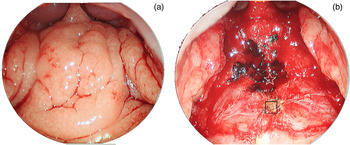
The pharyngobasilar fascia was left intact in each patient. Bleeding sites were mainly located in the pharyngeal tubercle and could be easily controlled by electrocautery (Fig. 2).
Photographs showing (a) pre-operation and (b) post-operation adenoidectomy images. The pharyngobasilar fascia (box) is left intact on the posterior nasopharyngeal wall after power-assisted adenoidectomy. Bleeding sites were mainly located in the pharyngeal tubercle (star).

Discussion
The surgical boundary is a key factor affecting the outcome and complications of adenoidectomy. Despite extensive studies, the optimal surgical boundary for adenoidectomy is yet to be identified; currently, the area of excision is considered difficult to delimit.Reference Joshua, Bahar, Sulkes, Shpitzer and Raveh4, Reference Dearking, Lahr, Kuchena and Orvidas5, Reference Buchinsky, Lowry and Isaacson12 In this study, the use of the pharyngobasilar fascia as the surgical boundary was found to minimise the occurrence of residual adenoid tissue and the incidence of regrowth after adenoidectomy.
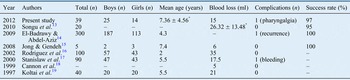
The findings of this study were compared with those of seven studies identified from the PubMed database, in terms of the mean blood loss, complication rates and recurrence rates after power-assisted adenoidectomy.Reference Songu, Altay, Adibelli and Adibelli13–Reference Koltai, Kalathia, Stanislaw and Heras19 Adenoid resection down to the pharyngobasilar fascial surface was found to be as safe as the surgical methods used in other studies. The mean blood loss was not significantly higher in our study (15 ml) than in the others (5–35 ml; Table I). Furthermore, the complication and success rates were similar between this and other studies (Table I).
• Reported adenoid regrowth rates after adenoidectomy vary widely
• Identification of the optimal surgical boundary during adenoidectomy could reduce adenoid regrowth rates
• Removing adenoid tissue to the level of the pharyngobasilar fascia allows complete adenoid removal and prevents regrowth
Data from studies of adenoidectomies

*Mean ± standard deviation. – = not reported
Although different surgical techniques have been used in primary operations, revision adenoidectomies have been reported frequently.Reference Wong, Moxham and Ludemann20–Reference Ozturk and Polat22 Moreover, regrowth rates after adenoidectomy have varied widely. Cannon et al. reported no evidence of adenoid tissue regrowth up to 12 months after electrosurgical adenoid ablation.Reference Cannon, Replogle and Schenk18 Monroy et al. also reported that in children younger than five years, adenoid regrowth was rare at follow up more than two years after surgery.Reference Monroy, Behar and Brodsky23 In one 4.5-year study, the revision rate was 0.84 per cent after microdebridement and 1.50 per cent after suction coagulation.Reference Sapthavee, Bhushan, Penn and Billings24 Although most authors have reported adenoid regrowth rates of only 0.55–2 per cent, these low rates cannot be overlooked.Reference Dearking, Lahr, Kuchena and Orvidas5, Reference Liapi, Dhanasekar and Turner25, Reference Skilbeck, Tweedie, Lloyd-Thomas and Albert26
In contrast, Kim et al. reported the regrowth rate after coblation adenoidectomy to be as high as 13.3 per cent within a year.Reference Kim, Lee, Rhee, Lee and Kim21 In a study by Jonas et al., 12 out of 44 patients had grade 3 adenoid hypertrophy (more than two-thirds of the posterior choanae obstructed) after curettage, while 7 out of 47 patients had grade 3 hypertrophy 6 months after suction diathermy.Reference Jonas, Sayed and Prescott27 In a meta-analysis, adenoid regrowth was objectively evaluated in 116 out of 2132 patients (5.4 per cent); the observed regrowth rate was 2.8 per cent.Reference Reed, Sridhara and Brietzke28 It has been proposed that minor remnants of adenoid tissue after adenoidectomy might gradually atrophy as a consequence of improved immune system function after removal of the nasopharyngeal obstruction.Reference Lesinskas and Drigotas29 Nevertheless, 13 patients had adenoid regrowth (19.1 per cent), and only 3 of these had a grade 1 obstruction (affecting less than one-third of the posterior choanae) at 12–24 months after surgery.Reference Lesinskas and Drigotas29 Moreover, in a cross-sectional follow-up study of 175 children, adenoid regrowth within 2–5 years of adenoidectomy was rare; nevertheless, at least 25 children (14.3 per cent) had a nasopharyngeal obstruction of more than 10 per cent.Reference Buchinsky, Lowry and Isaacson12 Based on these reports, we speculated that the lack of a standardised surgical boundary for adenoidectomy could contributes to post-operative adenoid regrowth. We proposed that total resection of the adenoids down to the pharyngobasilar fascial surface could be the key to ensuring low adenoid regrowth rates.
This study had inherent biases associated with the absence of a control group and the small sample size. In addition, the follow-up period was quite short. More importantly, the inexact relationship between the surgical boundary and adenoid regrowth needs to be clarified in a future study.
Conclusion
The pharyngobasilar fascia was shown to be an effective surgical boundary in adenoidectomy because it ensured the complete removal of adenoid tissues and helped prevent post-operative complications and adenoid regrowth.
Acknowledgements
This manuscript was edited and proofread by Dr D-Z Wang, Harvard Medical School and Boston Children's Hospital, Dr Y Ding, Broad Institute of Harvard and MIT, and Mr J Song, Foreign Language Department of Dalian Medical University. This study was supported by the LiaoNing S&T Project ‘Pathogenesis Research of OSAHS’ (number 2009225015).