INTRODUCTION
Galicia is an autonomous region located in north-western Spain, with over 1200 km of coastline and an important fishery and shellfishing sector. The marine fauna of the coasts of Galicia has been subjected to important changes due to the amount of exotic species established as a consequence of anthropogenic and climatic factors (Bañón et al., Reference Bañón, Villegas-Ríos, Serrano, Mucientes and Arronte2010; Bañón, Reference Bañón2012). Along these lines, Mollusca, as well as Pisces and Algae are the most intensively studied and best known groups. Among molluscs, 23 aquatic and benthic exotic species have been reported in Galician waters (Bañón et al., Reference Bañón, Rolán and García-Tasende2008). Six of these listed species are bivalves: Anadara polii (Mayer, 1868), Chama gryphoides (Linnaeus, 1758), Corbicula fluminea (Müller, 1774), Crassostrea gigas (Thunberg, 1793), Ruditapes philippinarum (Adams & Reeve, 1850) and Limnoperna securis (Lamarck, 1819).
Arcidae Lamarck, 1809 is a large and diverse family of marine bivalves distributed worldwide in warm and shallow tropical seas. It is represented by 12 living genera and between 200 and 250 species inhabiting a wide array of benthic environments from the lower intertidal to sublittoral zones (Francisco et al., Reference Francisco, De Barros and De Lima2012). The family Arcidae is represented in Galician waters by about five species with only one of them, A. polii, belonging to the genus Anadara (Rolán et al., Reference Rolán, Pérez-Sixto and García-Caballero1994).
The subcrenate ark shell Anadara kagoshimensis (Tokunaga, 1906) is a bivalve inhabiting intertidal to subtidal zones. The native distribution includes the coasts of the central Indian Ocean and the western Pacific, from India, Sri Lanka, Indonesia, Korea, China, Japan and northern Australia (Poutiers, Reference Poutiers, Carpenter and Niem1998; Yurimoto et al., Reference Yurimoto, Mori, Ito and Maeno2008).
The invasive process of A. kagoshimensis began in the Mediterranean Sea where it was introduced accidentally, most likely by shipping. It was first reported as Scapharca cf. cornea off Ravenna (Adriatic Sea, Italy) in 1969 and invaded the Venice Lagoon in the mid-1970s (Nolf, Reference Nolf2010). The present distribution includes the western and eastern Mediterranean, the Catalan, Adriatic, Aegean, Marmara and Azov Seas, as well as along the coasts of Bulgaria, Romania, Ukraine, Russia, Georgia and Turkey in the Black Sea (Zaitsev & Oztiirk, Reference Zaitsev and Oztiirk2001; Sánchez et al., Reference Sánchez, Sartor, Recasens, Ligas, Martin, Ranieri and Demestre2007). In the Atlantic European waters, it was first reported in the Eo estuary (north of Spain) in 1993–1994 (Cigarria & Valdés, Reference Cigarría and Valdés1996) and in 2003 in St. Philibert (Morbihan, West France) (Nolf, Reference Nolf2010).
Previously, in grey literature, the presence of A. kagoshimensis, as Anadara inaequivalvis (Bruguière, 1789), had been reported in Galician waters among the European flat oyster Ostrea edulis cultured on floating platforms in the Ría de Vigo, together with specimens of A. transversa (Say, 1822) reported as A. demiri (Pérez, Reference Pérez2003).
Aquaculture has been identified, along with shipping, as one of the main leading vectors of aquatic invasive species (Molnar et al., Reference Molnar, Gamboa, Revenga and Spalding2008). The unintentional co-transport of larvae and/or juveniles of exotic species into commercial bivalve cultures, mainly clams and oysters from the Mediterranean Sea, is the generally accepted hypothesis to explain the arrival of many exotic marine species in the Galician waters (Bañón et al., Reference Bañón, Rolán and García-Tasende2008). The presence of several other exotic marine molluscs such as R. philippinarum, C. gigas, Bolinus brandaris (Linnaeus, 1758) and Hexaplex trunculus (Linnaeus, 1758), has been related to intentional or non-intentional aquaculture activities (Bañón, Reference Bañón2012).
Anadara kagoshimensis is listed among the hundred worst invasive species in the Mediterranean Sea (Streftaris & Zenetos, Reference Streftaris and Zenetos2006). The haemolymph of A. kagoshimensis contains nucleated erythrocytes packed with haemoglobin, which enables this clam to bind oxygen in oxygen-deficient conditions, and haematin, which is involved in the removal of sulphides (Morello et al., Reference Morello, Solustri and Froglia2004). Due to the presence of haemoglobin in its tissues, this species is capable of long-term existence under the hypoxic conditions in the near-bottom layer of water, when other molluscs die (Shiganova, Reference Shiganova, Kostianoy and Kosarev2008). Moreover, a further competitive advantage of this mollusc could be its ability to attach itself to all types of hard substrata by means of a byssus (Ghisotti & Rinaldi, Reference Ghisotti and Rinaldi1976), acting indistinctly as an epifaunal or infaunal species. In the Adriatic and Black Seas, enormous proliferations of A. kagoshimensis have ousted autochthonous bivalves such as Chamelea gallina (Linnaeus, 1758), Mya arenaria Linnaeus, 1758 and Cerastoderma glaucum (Bruguière, 1789) from their habitats (Streftaris & Zenetos, Reference Streftaris and Zenetos2006; Kolyuchkina & Miljutin, Reference Kolyuchkina and Miljutin2013).
MATERIALS AND METHODS
The density of A. kagoshimensis per square metre was calculated at the Carril site, at 42°37.260′ N 8°46.790′W, by inspecting an intertidal culture park of 3885.6 m2 on 28 May 2013. Within this area, a total of 21 samples were collected using a circular corer of 25 cm in diameter. The sediment was dug out to a depth of about 20 cm and washed through a 6 mm square mesh screen on which the bivalves were collected. Finally, the density was calculated with the statistic application ARouSA (https://sites.google.com/site/arousa09aen/).
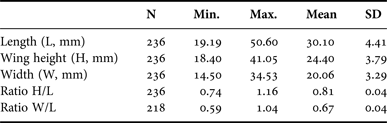
The A. kagoshimensis specimens were identified following Nolf (Reference Nolf2010) and Huber (Reference Huber2010). Morphological analysis was performed describing diagnostic characters and measuring morphometric parameters. A total of 236 collected specimens were measured in the laboratory using a digital calliper to the nearest 0.01 mm. Specimen body wet weight (Wt) was measured to 0.01 g accuracy. The biometric parameters under consideration are total length (L), wing/top ventral edge height (H) and width (W). Radial ribs were counted in the left valve of 21 specimens. Linear models were performed to investigate the relationships between length, height, width and weight. All variables were log-transformed to meet normality assumptions.
In order to infer the evolutionary relationships of the Galician specimens, DNA was extracted from samples of individuals of A. kagoshimensis, which had been preserved in 95% ethanol, by means of the DNA tissue kit from Omega-Biotek. For each specimen, an amplicon of about 700 bp of the 5′ region of the mitochondrial gene for the cytochrome c oxidase subunit I (COI) was obtained using the primers LCO1490 5′-GGTCAACAAATCATAAAGATATTGG-3′ and HCO2189 5′-TAAACTTCAGGGTGACCAAAAAATCA-3′ (Folmer et al., Reference Folmer, Black, Hoeh, Lutz and Vrijenhoek1994). Amplification reactions were performed using 3 µl of DNA from each genomic extraction as template in a final reaction volume of 50 µl containing 1U of BioTaq DNA polymerase (Bioline), 0.5 mM MgCl2, 1 mM dNTPs and 20 pmol of each primer. The PCR protocol consisted of 35 cycles of 95°C for 30 s, 50°C for 45 s and 72°C for 1 min preceded by 95°C for 5 min and followed by 72°C for 5 min. Five microlitre aliquots were purified by ExoSAP-IT treatment according to the manufacturer's instructions. The double-stranded DNA molecules were sequenced in both senses using the same primers and the BigDye v3.1 Cycle Sequencing Kit and resolved in an ABI 3130 Genetic Analyzer. For each specimen a consensus sequence was obtained by employing SeqScape v2.5.
Six A. kagoshimensis specimens out of 10 attempted were successfully sequenced. COI partial sequences were deposited in the GenBank repository under accession numbers KF417435–KF417440.
To support the taxonomic identification and explore the evolutionary relationships, BLAST searches were performed using the Galician A. kagoshimensis sequences as query. Also, six COI sequences of specimens of A. demiri and A. transversa, collected at different locations of the Mediterranean Sea, were generously donated by Paolo Albano (University of Bologna, Italy) and labelled according to the original publication (Albano et al., Reference Albano, Rinaldi, Evangelisti, Kuan and Sabelli2009). One A. transversa COI sequence was mined from GenBank (GQ166572) and, finally, an Arca ventricosa Lamarck, 1819 sequence (AB076935) was used as outgroup; the analysis involved 18 COI nucleotide sequences. Since the nucleotide sequences from the species had not been obtained from the same region of the mitochondrial COI gene, there were only 305 positions in the final dataset once the alignment had been performed.
Evolutionary analyses were conducted using MEGA5 (Tamura et al., Reference Tamura, Peterson, Peterson, Stecher, Nei and Kumar2011). Estimates of evolutionary divergence between sequences were calculated by means of the number of base differences per site (p-distances). The evolutionary relationships were estimated using the Maximum likelihood (ML) method based on the Tamura–Nei model of nucleotide substitution pattern (Tamura & Nei, Reference Tamura and Nei1993). To estimate the reliability of the constructed phylogenetic tree, a non-parametric bootstrap analysis (Felsenstein, Reference Felsenstein1985) was carried out using 100 replicates.
Bayesian Inference (BI) analysis was conducted with MrBayes version 3.2 (Ronquist et al., Reference Ronquist, Teslenko, Van der Mark, Ayres, Darling, Höhna, Larget, Liu, Suchard and Huelsenbeck2012) using the same substitution model. The initial 25% of the Markov chain Monte Carlo (MCMC) sampled trees were discarded before computing the consensus tree and posterior probabilities. The frequency with which a particular clade occurs within the collection of trees after burn-in was interpreted as a measure of node support (posterior probability values). The phylogenetic tree was edited using TreeGraph2 (Stöver & Müller, Reference Stöver and Müller2010).
RESULTS
Taxonomic account
Family: Arcidae Lamarck, 1809
Genus: Anadara Gray, 1847
Species: Anadara kagoshimensis (Tokunaga, 1906) Figure 1
Different views of A. kagoshimensis L. 25.6 mm, H. 21.6 mm, W. 18.3 mm. (A) left valve exterior view; (B) right valve interior view; (C) dorsal view.

Synonyms: Arca amygdalum Philippi, 1845; Arca (Scapharca) kagoshimensis Tokunaga, 1906.
Material examined
In 2013, two batches of living specimens totalling 236 individuals, tentatively identified as A. kagoshimensis, were collected in the Ría de Arousa (Galicia, NW Spain). The first batch, composed of 218 specimens, was collected on 22 May 2013 by shellfish gatherers and from several intertidal culture parks of molluscs located between the villages of Vilagarcía de Arousa and Carril, between 42°37.578′N 8°465.756′W and 42°36.301′ 8°46.407W, either by hand or by sieving the sediments. The second batch of 18 specimens was caught on 13 June 2013 with a teethed basket rake used to harvest clams in a subtidal park called ‘A Fangueira’, in Carril at 42° 37.6203′N 8° 46.657′W.
A sub-sample of 10 specimens was deposited in the Museo de Historia Natural da Universidade de Santiago de Compostela (MHNUSC, Santiago de Compostela, Spain) with collection numbers 25040–1 to 25040–10. The other 226 individuals were stored in the laboratory of ADC at the University of Vigo.
Description
Shell thick and solid, ovate, inflated, slightly longer than high and feebly nonequilateral, left valve being slightly larger and domed than right valve. Shell length ranging from 19 to 50 mm, the intertidal specimens being of a lower size than subtidal specimens, 19–34 by 37–50 mm in shell length respectively. Slightly protruding umbones. Sculpture consisting of 30–34 flat-topped radial ribs (X = 31.80; SD = 0.90) with wide interstices at each valve. Ribs stout and distinctly wrinkled, bearing regular, almost rectangular nodules. Velvety, dark brown periostracum covering most of valve surface. Internal margins with strong crenulations corresponding with external radial ribs. Outside of shell whitish under greenish brown periostracum. Inner side white. Live animals orange to reddish. Alcohol preserved animals have turned light yellow.
Remarks
Anadara kagoshimensis is the correct name for an alien species recorded from the Mediterranean and Black Seas. This species has been misidentified and reported under the misnomer names Scapharca cornea (Reeve, 1844), S. subcrenata or A. inaequivalvis (Lutaenko, Reference Lutaenko2008; Huber, Reference Huber2010). However, Anadara cornea (Reeve, 1844) and A. inaequivalvis are two valid species that do not occur in the Mediterranean and Black Seas and S. subcrenata is a synonym of A. sativa, which is also synonymized by some Russian authors with A. kagoshimensis (Huber, Reference Huber2010).
Density and morphometric parameters
The obtained density was 8.73 individuals m−2. The main morphological characteristics and their relationship to specimens from Galician waters are shown in Table 1. The mean length and weight values of A. kagoshimensis in Galicia were reported as 39.28 ± 0.261 mm and 24.84 ± 0.372 g, respectively. All the relationships between morphometric variables (length–weight, length–width and length–height) were positive and significant (Table 2).
Main morphometric characteristics and relationships of Anadara kagoshimensis specimens from Galician waters
Summary of the linear models between the morphometric variables (log transformed) of A. kagoshimensis specimens

L, length; H, height; W, width; Wt, weight; a and b, parameters of the equation.
Molecular identification
Six COI gene partial sequences were obtained from specimens of A. kagoshimensis. A multiple sequence alignment of 657 bp was constructed in which only six variable sites were observed and where two of the sequences were identical (KF417435 and KF417436) resulting in five different haplotypes. The translation of these sequences did not result in stop codons and produced a 219 amino acids polypeptide, indicating that the amplified domains could be functional.
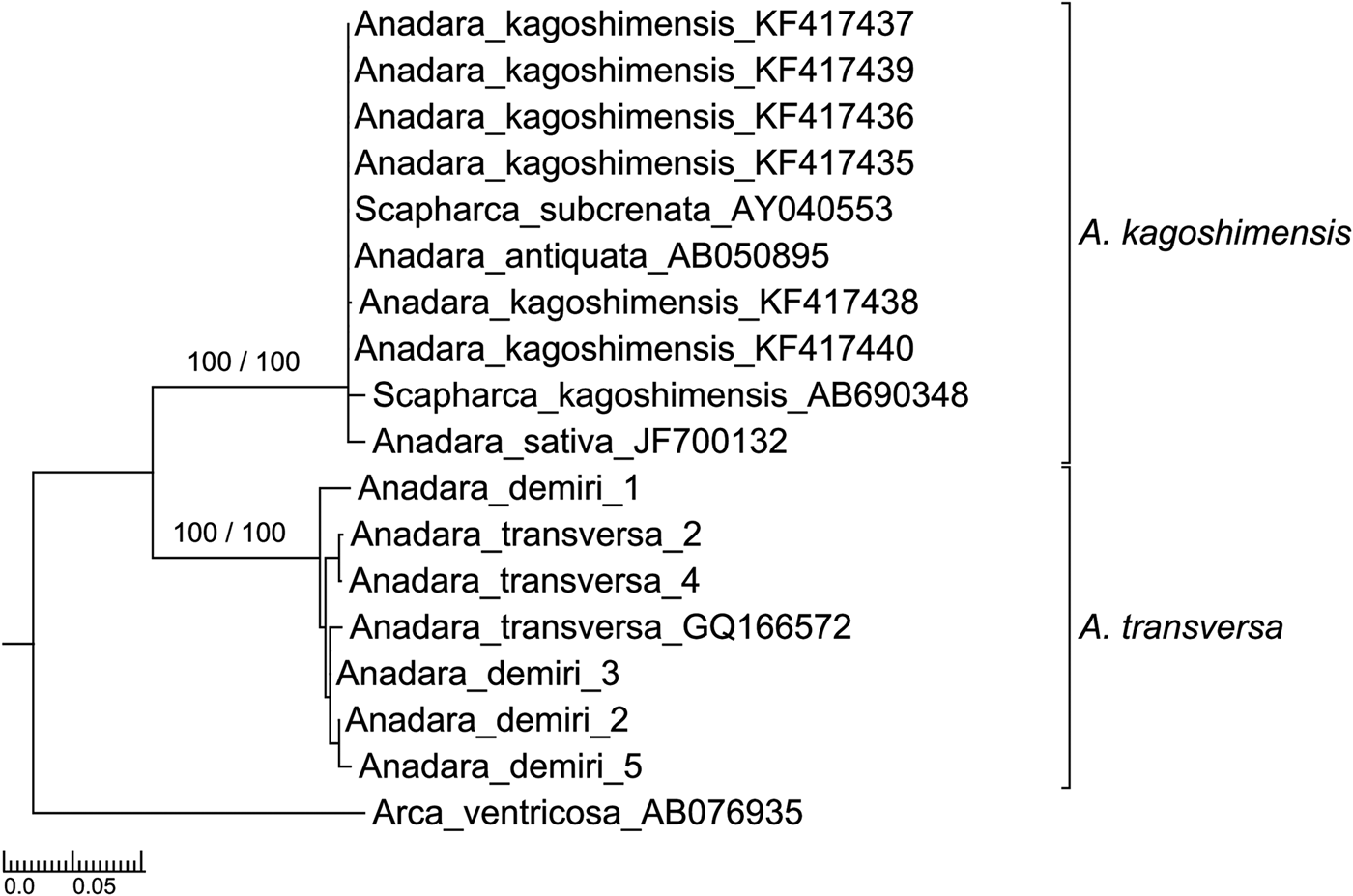
In order to support the taxonomic identification and infer the evolutionary relationships of the Galician specimens with other Anadara bivalves, molecular analysis was performed. Based on a 98% sequence identity with a Galician A. kagoshimensis specimen, one record of each Anadara antiquata (Linnaeus, 1758) from the Philippines (GenBank accession number AB050895), Anadara sativa (Bernard, Cai & Morton, 1993) from China (JF700132), Scapharca kagoshimensis Tokunaga, 1906 from Japan (AB690348) and Scapharca subcrenata (Lischke, 1869) from Korea (AY040553) were selected from the GenBank repository to perform an evolutionary analysis. Figure 2 shows the result of a phylogeny reconstruction in which the resulting tree was estimated after applying ML and BI analyses. Both methods correlated strongly and the result shows that two solid monophyletic clades, clustering A. kagoshimensis and A. transversa respectively, can be observed.
Maximum likelihood phylogram of COI gene sequences from two exotic Anadara species. The tree with the highest log likelihood is shown. Numbers by the nodes indicate ML bootstrap support/Bayesian posterior probabilities. A sequence of the related clam Arca ventricosa Lamarck, 1819 was employed as outgroup. The tree is drawn to scale, with branch lengths measured in the number of substitutions per site. Source of sequences without an accession number was Albano et al. (Reference Albano, Rinaldi, Evangelisti, Kuan and Sabelli2009).
The Galician specimens, identified as A. kagoshimensis, clustered together with COI sequences obtained from GenBank, identified as S. kagoshimensis, S. subcrenata, A. antiquata and A. sativa forming a monophyletic clade in the ML phylogram (Figure 2). The genetic distance among the members within the A. kagoshimensis clade ranged between 0 and 0.016.
The A. transversa clade includes COI sequences from specimens collected in the Mediterranean Sea and originally labelled as A. demiri and A. transversa (Albano et al., Reference Albano, Rinaldi, Evangelisti, Kuan and Sabelli2009), together with one A. transversa sequence mined from GenBank. The genetic distance within this monophyletic clade ranged from 0.006 to 0.058. Both clades were clearly separated and exhibited a mean genetic distance value of 0.222 between them.
DISCUSSION
According to their main morphometric characteristics and genetic analysis, the identification of the Galician specimens corresponds to the invasive bivalve A. kagoshimensis. These can easily be distinguished from other Anadara species as their valves are different in length in all sizes, whereas in other species the shells become equivalve with increasing age (Nolf, Reference Nolf2010). Anadara kagoshimensis can be differentiated from the other two Anadara species reported in Galician waters, A. polii and A. transversa; from A. polii by the greater number of ribs, 28–34, as opposed to 26–28. Although A. transversa has a similar number of ribs (29–36), it has a narrower and less globose shell and is smaller, not exceeding 38 mm in length (Morello et al., Reference Morello, Solustri and Froglia2004) whereas A. kagoshimensis can grow to a maximum length of 95 mm (Acarli et al., Reference Acarli, Lok and Yigitkurt2012).
The obtained density of 8.73 sp. m−2 is very low compared with the high densities found in the Mediterranean and Black Seas. Densities of 120 sp. m−2 were found on the western coast of the middle Adriatic Sea (Ghisotti & Rinaldi, Reference Ghisotti and Rinaldi1976), up to 476 sp. m−2 in the Romanian Black Sea (Micu & Micu, Reference Micu, Micu, Öztürk, Mokievsky and Topaloğlu2004) and up to 3000 sp. m−2 of juveniles in the north Caucasian coast of the Black Sea (Chikina & Kucheruk, Reference Chikina, Kucheruk, Öztürk, Mokievsky and Topaloğlu2004). The comparatively low densities in Galician waters could be indicative of either an initial invasive phase or unfavourable conditions for settlement, probably due to oceanographic factors, which did not allow high densities to be reached.
The evolutionary relationships inferred using the ML and BI methods are coherent with the findings from the taxonomic analysis, reinforcing the correct identification of A. kagoshimensis. The two monophyletic clades resulting from the molecular analysis identify the Galician specimens as A. kagoshimensis and distinguish them from their exotic congeners, the species A. transversa (Figure 2). The intraspecific genetic distance (measured as p-distance) found in A. kagoshimensis clade, ranging between 0 and 0.016, and the congeneric distance of 0.222 are in the same order as the genetic distances (measured as K2P distances) exhibited by three Anadara species from the coast of China, with values of 0–0.07 and 0.212–0.228 respectively (Feng et al., Reference Feng, Li, Kong and Zheng2011) and by several Anadara species from Japan (as Scapharca sp.) with intraspecific values ranging from 0.032 to 0.176 (Tanaka & Aranishi, Reference Tanaka and Aranishi2013). However, the intraspecific distance exhibited by the A. transversa cluster, ranging from 0.006 to 0.058, could perhaps indicate a higher genetic variation within this species.
On the other hand, this molecular analysis seems to reflect a high level of synonymy and/or misidentification among species of the genus Anadara. The A. kagoshimensis cluster is composed of several species of distinct geographic origin showing low genetic p-distances, from 0 to 0.016, suggesting that all of them could be the same species. If we examine the species composition of this clade, S. subcrenata is a synonym of A. sativa and it is, at the same time, a misidentification of A. kagoshimensis; Scapharca kagoshimensis is a synonym of A. kagoshimensis, and the presence of A. antiquata could correspond to a misidentification of A. kagoshimensis.
As expected, the second clade clusters sequences from A. transversa and A. demiri, as had previously been reported (Albano et al., Reference Albano, Rinaldi, Evangelisti, Kuan and Sabelli2009).
The phenotypic variation could make some Anadara species difficult to distinguish using only morphology and this could be the origin of possible misidentifications in literature. The COI marker can be efficient in arcoid species identification, including Anadara species (Lee & Kim, Reference Lee and Kim2003; Feng et al., Reference Feng, Li, Kong and Zheng2011; Tanaka & Aranishi, Reference Tanaka and Aranishi2013), and in this investigation A. kagoshimensis is clearly distinguished from A. transversa. Therefore, biological barcoding is a useful tool for differentiating members of the Anadara genus and could be used to better understand the distribution area of these two exotic species out of their native area. Moreover, COI analysis should be used together with morphology in future revisions of this genus, in an integrative context.
Aquaculture seems to be the most probable hypothesis to explain the presence of A. kagoshimensis in Galician waters, introduced accidentally as clam spat together with R. philippinarum from the Italian Adriatic, where A. kagoshimensis is a well-established invasive species (Crocetta et al., Reference Crocetta, Macali, Furfaro, Cooke, Villani and Valdés2013). The importation of clam spat of R. philippinarum has been reported as the most probable way of introduction in the other two Atlantic areas, north of Spain and French Brittany, where this species had previously been reported (Cigarría & Valdés, Reference Cigarría and Valdés1996; Nolf, Reference Nolf2010). Moreover, the specimens from the north of Spain had also been collected in the intertidal culture parks of R. philippinarum, which would seem to reinforce these hypotheses.
The ecological impact of A. kagoshimensis on native bivalve species of Galicia is unknown. It is a potential threat to commercial bivalve culture. This species can compete for food (filter-feeder) and space with other bivalves, not only with another alien species grown in Galicia such as the Manila clam R. philippinarum, but also with native species such as Venerupis decussata (Linnaeus, 1758), C. glaucum or Scrobicularia plana (da Costa, 1778), which have been found cohabiting together.
ACKNOWLEDGEMENTS
We are grateful to Paolo Albano and Francesca Evangelisti (University of Bologna, Italy) for providing COI sequences of Anadara transversa, to David Villegas, Alex Alonso and Fran Saborido (IIM-CSIC, Vigo) for the assistance with the statistical analysis and figures and to Andrés Arias (University of Oviedo) for his valuable and constructive suggestions.
FINANCIAL SUPPORT
This study was partially supported by the Action PGIDIT-CIMA 13/07 from Xunta de Galicia.