INTRODUCTION
In the United States, Evangelical Protestants have increasingly identified with the Republican Party since the 1980s, largely as a response to the party's conservative agenda. Members of this religious group hold staunchly conservative attitudes on a variety of political issues — including those most directly related to issues of morality (such as abortion) as well as those that are not (such as economic issues). These consistently conservative attitudes have been largely attributed to this group's theological beliefs, which stress doctrinal orthodoxy (Fowler et al. Reference Fowler, Hertzke, Olson and den Dulk2010; Layman Reference Layman1997; Reference Layman2001; Wald and Smidt Reference Wald, Smidt, Leege and Kellstedt1993; Wuthnow Reference Wuthnow, Green and Neusner1996).
While Evangelical Protestant support for conservative issues is widely taken for granted in the United States, it is less clear whether this religion leads to similar attitudes outside of that country. As Evangelical Protestantism has grown substantially throughout the world (Pew Forum on Religion and Public Life 2006), there has been surprisingly little research that places Evangelicals' political attitudes into comparative perspective, leading some scholars to urge the comparative politics subfield to “take religion (more) seriously” as an influence on these attitudes and behaviors (Grzymala-Busse Reference Grzymala-Busse2012). As a result, much of the evidence regarding the ways in which religion impacts Evangelicals' political attitudes has been based on the American experience alone.
However, this experience may not be generalizable to other countries and contexts. In Brazil, for example, Evangelical Protestants identify with a variety of political parties, including those that are leftist, and most support greater government intervention in society and the economy (Bohn Reference Bohn2004). A study of Evangelicals in Brazil, Argentina, and Chile found significantly higher levels of support among this group for the civil service and unions compared to the rest of the population (Gill Reference Gill, Jelen and Wilcox.2002), while another finds that Evangelicals are just as supportive of political and economic liberalization as are Catholics in four Latin American countries, including Brazil (Gill Reference Gill2004).
This unexpected pattern of political attitudes outside of the United States presents an anomaly. If theological beliefs are expected to directly impact political attitudes, then Evangelical Protestants — regardless of their country of residence — should be expected to have similar (conservative) attitudes, particularly if their religious beliefs are comparable. This article thus compares the religious and political attitudes of Evangelical Protestants in the United States and Brazil and investigates three potential explanations for their divergent attitudes to determine which component of religion — if any — impacts these attitudes. Analyzing data from the 2006 Pew Forum on Religion and Public Life's Multi-Country Religion Survey, this article specifically compares levels of doctrinal orthodoxy and religious commitment of Evangelicals in both countries and examines the relative impact of these religious factors on their self-identified ideology, attitudes toward issues related to morality, and economic attitudes.
THEORETICAL FOUNDATIONS: VARYING APPROACHES FOR UNDERSTANDING EVANGELICAL PROTESTANTS' POLITICAL ATTITUDES
The scholarship on religion and politics that has emerged over the past 35 years contains several theoretical debates regarding the way in which individuals' religion impacts their political attitudes and behaviors (for an excellent general review, see Djupe and Olson (Reference Djupe and Olson2007)). Psychological approaches, for example, emphasize individual identity, suggesting that one's identification with a particular religious group shapes his or her political values, particularly in motivating social and political activism (Green Reference Green, Freeman and Johnson.1999; Wilcox and Robinson Reference Wilcox and Robinson2010), while cultural approaches emphasize the use of politically salient symbols in the mobilization of religious groups in elections (Leege et al. Reference Leege, Wald, Krueger and Mueller2002). Other research, however, tends to focus on the religious or political environment in which individuals find themselves. Some scholars emphasize economic approaches, such that greater competition in the context of a “religious marketplace” yields cohesive, yet distinctive, attitudes among those within religious groups (Finke and Stark Reference Finke and Stark2005; Jelen and Wilcox Reference Jelen and Wilcox2002). Contextual approaches, on the other hand, emphasize the social elements of religion, such as formal and informal social networks and clergy cues, in the dissemination and reinforcement of political messages that shape individuals' opinions (Wald, Owen, and Hill Reference Wald, Owen and Hill1988; Djupe and Gilbert Reference Djupe and Gilbert2009).
In contrast, one dominant strain of the literature emphasizes the role of individual-level beliefs, behaviors and membership of individuals in a particular religious tradition, and a great deal of the conclusions reached regarding Evangelicals' political attitudes has been rooted in this latter approach. Largely based on studies in the United States, one strain of this social-psychological approach suggests that individuals' religious beliefs directly motivate their political attitudes and behaviors (Wald and Smidt Reference Wald, Smidt, Leege and Kellstedt1993; Guth et al. Reference Guth, Kellstedt, Smidt and Green2005). In this sense, the most important element of religion, politically speaking, is the content of one's beliefs, particularly for pietist religious traditions such as Evangelical Protestantism (Wald and Smidt Reference Wald, Smidt, Leege and Kellstedt1993). Although some theological differences exist among members of this group, Evangelicals are generally united by a common doctrinal core that is orthodox in nature (Wilcox and Robinson Reference Wilcox and Robinson2010). The direct influence of one's religious beliefs suggests that higher levels of doctrinal orthodoxy will yield greater political conservatism, particularly on issues most commonly associated with morality (Kellstedt Reference Kellstedt, Leege and Kellstedt.1993; Layman Reference Layman1997; Guth et al. Reference Guth, Kellstedt, Smidt and Green2005).
However, even on issues not often labeled as “religious,” a high level of doctrinal orthodoxy has also been found to yield consistently conservative attitudes. Religion often provides guidance on a variety of issues encountered in society and, as a result, one's theological beliefs can also impact political attitudes on any issue that is perceived by that individual to incorporate an element of morality. Doctrinally orthodox beliefs have been found to yield conservative attitudes on issues of racial prejudice, social justice, military intervention and diplomacy, and the free enterprise system (Kellstedt Reference Kellstedt, Leege and Kellstedt.1993). And this is particularly true for Evangelical Protestants. Higher levels of doctrinal orthodoxy directly translate to greater support for individualistic economic policies, and, as Wilcox and Robinson (Reference Wilcox and Robinson2010) demonstrate, Evangelical Protestant groups often provide Biblical justifications for a support of capitalism and conservative economic policies.
Like their American counterparts, Brazilian Evangelicals tend to support more traditional views on social values and, in general, support more conservative positions on abortion and gay marriage (Bohn Reference Bohn2004). Similar to Evangelicals in the United States, Brazilian Evangelicals began to participate in politics to a greater degree during the early 1980s, as the military dictatorship in Brazil began to cede power to democratic authorities. The political involvement of Evangelical churches, such as the Igreja Universal do Reino de Deus (Universal Church of the Kingdom of God), has also resulted in large numbers of Evangelical members serving in Congress (Oro Reference Oro2003).
There are, however, two important differences between the political attitudes and behavior of Evangelical Protestants in Brazil and the United States. First, Brazil's multi-party democracy prevents Brazilian Evangelicals from being mobilized by one political party, and many are members of political parties with divergent ideological beliefs. Although Evangelicals in Brazil had a political party closely affiliated to them, the Partido Liberal (PL), they tend to identify with a variety of political parties, including those on the left of the political spectrum. Moreover, the PL became notably centrist over time, eventually merging into a centrist party in 2006 (Power and Zucco Reference Power and Zucco2009). Notable Evangelical politicians, such as Anthony Garontinho (the 2002 Socialist Party presidential candidate) and Benedita da Silva (the first Afro-Brazilian female in the Senate), are members of left-wing political parties that support an active role for the state in solving social problems as well as a separation of church and state.
Second, Brazilian Evangelicals are significantly more liberal on a number of issues, particularly those related to the role of the state in the economy. As presented by Bohn (Reference Bohn2004), evidence from the 2002 Brazilian National Election Study demonstrates that Brazilian Evangelicals' political views are more similar to those of Brazilian Catholics on the proper role of the government in education, health care, and social security. In fact, on each issue, Brazilian Evangelicals overwhelmingly agreed that government had a responsibility to provide those services. On other issues, Brazilian Evangelicals appear exceedingly liberal in comparison to those in the United States. For example, 86% of Brazilian Evangelicals report that the government should help businesses that are in a difficult position (Bohn Reference Bohn2004). Such numbers would be unthinkable in the United States.
Three potential explanations might account for the divergence in political attitudes among these two groups. First, assuming that doctrinal orthodoxy yields more conservative political attitudes in accordance with the “religion as belief” approach outlined above, then perhaps Evangelicals in the United States have more doctrinally orthodox beliefs than do those in Brazil. It would then logically follow that Evangelicals in the United States would be more conservative than their Brazilian counterparts. In fact, although a great deal of Evangelical denominations were imported to Brazil through American televangelism and missionary work, many Evangelical denominations in the country have become “Brazilianized” and are now largely independent from their North American organizations, including the Assemblies of God and the Foursquare Gospel Church (Serbin Reference Serbin and Sigmund1999; Gill Reference Gill, Jelen and Wilcox.2002). One of the largest Evangelical denominations in Brazil — the Universal Church of the Kingdom of God — combines theological doctrine from Pentecostalism, Umbanda, and Catholicism (Serbin Reference Serbin and Sigmund1999; Gill Reference Gill, Jelen and Wilcox.2002). It may be expected, then, that the core belief structure of Brazilian and American Evangelicals differ, and these differences may account for any divergence in political attitudes as well.
A second potential explanation for the divergence in Brazilian and American Evangelicals' political attitudes is that doctrinal orthodoxy may not be the component of religion that is most relevant in the formation of political attitudes — rather, according to social-psychological approaches, the behavioral elements of religion may be driving this impact. A great deal of this literature has relied on the assumption that individuals within the same religious tradition tend to maintain similar political attitudes because they are exposed to homogenous political messages that are consistent with the religious tradition's theological doctrine; the more exposure to those messages, the more consistent individuals' political attitudes would be with the doctrinal core of their religious tradition (Kellstedt et al. Reference Kellstedt, Green, Guth, Smidt, Green, Guth, Smidt and Kellstedt.1996; Layman Reference Layman2001). In this approach, the impact of religion on political attitudes is less direct and dependent upon individuals' adherence to religious practices or behaviors. Specifically:
Participating in worship services and other religious activities exposes individuals to cues from clergy on moral and political issues, to social interaction with fellow congregants that may shape and reinforce moral and political views, and to appeal by groups seeking to use religious groups and congregations as a basis for political mobilization (Layman and Hussey Reference Layman, Hussey and Campbell2007, 183).
Moreover, this approach assumes that greater religious commitment — particularly among Evangelical Protestants — yields greater political conservatism; because this religious tradition is generally more doctrinally orthodox, then those belonging to this religious tradition are expected to be exposed to consistently conservative messages (Guth et al. Reference Guth, Kellstedt, Smidt and Green2005; Layman Reference Layman2001; Wuthnow Reference Wuthnow, Green and Neusner1996). This would indicate that the political differences between Evangelicals in the United States and Brazil are due to differences in their levels of religious commitment.
Other scholars have critiqued the underlying logic of this approach, particularly its assumption of uniformity within religious traditions regardless of congregation-level characteristics (Wald, Owen, and Hill Reference Wald, Owen and Hill1988; Jelen Reference Jelen1992; Djupe and Gilbert Reference Djupe and Gilbert2009). From this alternative perspective, “people with similar religious commitment levels do not hold identical political opinions across congregations, because the local congregation shapes the political consequences of the content and expression of those beliefs and behaviors” (Djupe and Gilbert Reference Djupe and Gilbert2009, 18–19). In other words, stronger levels of religious commitment (due to greater exposure to political messages at one's congregation) merely encourage an individual to adhere to the dominant opinion of the congregation — whether that is in a liberal, conservative, or moderate direction. Thus, even if Evangelicals in the United States and Brazil maintain identical levels of religious commitment, they may still result in diverse political opinions that may not be detected using individual-level data.
As noted above, Evangelical Protestantism in Brazil has become uniquely Brazilian, often incorporating elements of Catholicism as well as Afro-Brazilian religions (Serbin Reference Serbin and Sigmund1999). Moreover, Brazilian Evangelicals may adhere to the behavioral components of the religion more strongly than the doctrinal elements due to their own personal experiences with Catholicism. According to the Pew Forum's 2006 Multi-Country Religion Survey, 63% of the Brazilian Evangelicals surveyed reported that they previously belonged to another religious tradition. Of these individuals who had converted, a substantial majority (72%) reported that their former denomination had been Roman Catholic. As a result, Evangelicals in Brazil may participate in their religion at high rates and be exposed to different types of cues (i.e., not necessarily conservative ones) from their interactions with others in their churches, which may explain why their political attitudes are less conservative than their American counterparts, particularly on economic or social justice issues.
A final explanation of the divergent political attitudes among Evangelicals in the United States and Brazil is that religion may not influence all Evangelicals' political attitudes in the same way. In this sense, the political context of the country in question, particularly the way in which each country's political environment has defined and approached various political issues, is key. In the United States, the emphasis given to the connections between religion and politics in recent elections may reinforce the impact that religion has on these political attitudes. However, due to obvious differences in the political environments of these two countries, Brazilians may not connect or associate many political issues with moral arguments or religion per se. Rather than be driven by either religious component, Brazilian Evangelicals' political attitudes — particularly regarding the economy — may be driven by other political, economic or socio-demographic pressures. Certainly, in many cases, religion should not necessarily be expected to be a contributor to individuals' political attitudes.
Similarly, the composition of Brazilian and American Evangelical Protestant churches may be considerably different — again, due to the unique political environments with which each are confronted. Although American political culture is more individualistic in general, Brazilians tend to stress more communal values, and they are generally more supportive of governmental intervention in society (Bohn Reference Bohn2004). As a result, we should expect their baseline political attitudes — especially on issues not typically associated with religion or morality — to differ between the two countries, regardless of whether individuals are Evangelical or not. In other words, religion may shape Evangelicals' political attitudes, but differences in the political environment of the countries in question may cause the specific content of these attitudes to move in opposing directions.
The goal of this article is thus two-fold: first, to provide evidence as to how similar the political attitudes of Evangelical Protestants in Brazil and the United States are; and second, to examine which of these three potential explanations best account for any divergence in attitudes found. The comparative nature of the data examined here can thus provides a greater contribution to the understanding of how religion impacts political attitudes. Given that Evangelicals in both countries adhere to not only the same religion — but the same branch of that religion — any differences between them due to differences in doctrine and practice provides a valuable avenue for better understanding the relationship between religion and politics. Moreover, should these differences be attributable to contextual factors rather than religious ones, such as levels of doctrinal orthodoxy, this provides more powerful evidence of the ways in politics may be driving religion.
A COMPARISON OF EVANGELICAL PROTESTANTS IN THE UNITED STATES AND BRAZIL
To address these questions, data are examined from the 2006 Pew Forum on Religion and Public Life's Multi-Country Religion Survey, which includes survey data from a random sample of the general population in the United States and Brazil as well as over-samples of Evangelical Protestants in both countries. In the United States, the surveys were based on telephone interviews with 739 adults in the general public who had been selected via a national probability sample; in addition, 335 interviews were completed through an oversample of Evangelical Protestants for a total sample size of 1,074. The survey data for Brazil was obtained through 700 face-to-face interviews with adults selected through a probability sample of urban cities; 300 additional interviews with Evangelical Protestants were obtained in the over-sample for a total sample size of 1,000.Footnote 1 The surveys included questions related to religious membership and denominational affiliation as well as religious self-identification with the following labels: Evangelical; born-again; charismatic; or Pentecostal. The survey also gauged respondents' theological beliefs, frequency of religious practices and activities, and political and social attitudes. Questions to measure respondents' social and demographic characteristics were also included.
The determination of those in the samples who can be classified as Evangelical Protestants can be difficult, especially because the translation of this term in Portuguese (Evangélico) is used in Brazil to denote identification with any Protestant religion (Sigmund Reference Sigmund1999). As a result, the samples were limited to those who reported belonging to a Protestant religion and who reported a denominational affiliation with a Baptist, Pentecostal, neo-charismatic, non-denominational or independent church, or “something else.”Footnote 2 The American sample was then limited to whites who self-identified as either Evangelical, born-again, charismatic or Pentecostal,Footnote 3 and the Brazilian sample was limited to any respondent who self-identified as born-again, charismatic, or Pentecostal.Footnote 4 The resulting sample sizes were 330 Evangelical Protestants in Brazil and 308 white Evangelical Protestants in the United States.Footnote 5
A COMPARISON OF POLITICAL ATTITUDES
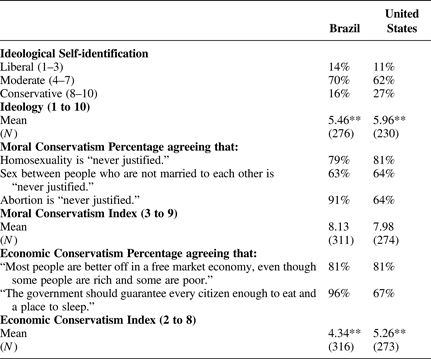
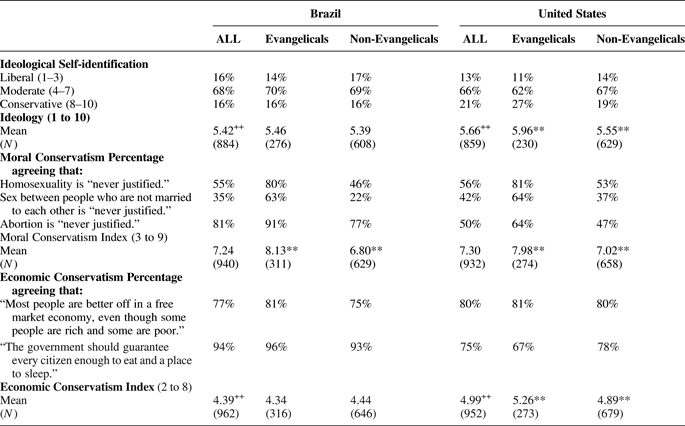
The survey's questions allow for a comparison of these groups' ideology and political attitudes to determine how politically divergent these groups are. The survey asked all respondents to place themselves on an ideological scale, ranging from 1 (“extreme left”) to 10 (“extreme right”). As Table 1 reports, Brazilian Evangelicals tend to self-identify as moderate or liberal in comparison with their American counterparts. In fact, while more than one-fourth (27%) of Evangelicals in the United States identify as conservative, only 16% of Brazilian Evangelicals do so. Also reported are the means on the 10-point ideological scale for each group. On average, American Evangelicals are more conservative than Brazilian Evangelicals, and an independent samples t-test confirms that the means on this scale are significantly different between these two groups.
A comparison of political attitudes of Evangelical Protestants in the United States and Brazil (2006)

Source: 2006 Multi-Country Religion Survey, Pew Forum on Religion & Public Life.
** Independent samples t-test confirms that the means on this variable are significantly different between these groups (p < 0.05, two-tailed).
Table 1 also reports how conservative Brazilian and American Evangelicals are on moral issues by examining the percentage of Brazilian and American Evangelicals who believe that abortion, homosexuality, and pre-marital sex is “never justified.” While similar percentages agree regarding homosexuality and pre-marital sex, nearly all (91%) of Brazilian Evangelicals agree that abortion is never justified, in comparison to 64% of American Evangelicals. However, on average, these groups hold similar attitudes toward these issues of morality. The responses to these issues, which range from 1 (“always justified”) to 3 (“never justified”) were combined to create a seven-point Moral Conservatism Index (ɑ = 0.637). As the means in Table 1 demonstrate, Brazilian Evangelicals are, on average, more conservative on these issues than are their American counterparts, although that is largely a function of the divergence on the issue of abortion. An independent samples t-test also confirms that the means on this index are not statistically significant between these two groups.
However, on economic issues, Brazilian and American Evangelicals do diverge significantly from one another. Although the same proportion (81%) of Brazilian and American Evangelicals support a free-market economy, Brazilian Evangelicals tend to agree that governmental intervention should ensure “every citizen enough to eat and a place to sleep” at a much higher rate than Evangelicals from the United States do. In fact, nearly all of the Brazilian Evangelicals in this sample (96%) agreed to this statement. Responses to these two statements (which ranged from 1 (“completely agree”) to 4 (“completely disagree”)) were combined to create an Economic Conservatism Index, such that higher responses indicate a greater level of conservatism (ɑ = 0.432). As Table 1 reports, American Evangelicals are, on average, more conservative on economic issues than their Brazilian counterparts and an independent samples t-test confirms that the average scores on this index are statistically significant between these groups.
A COMPARISON OF RELIGIOUS BELIEFS AND BEHAVIORS
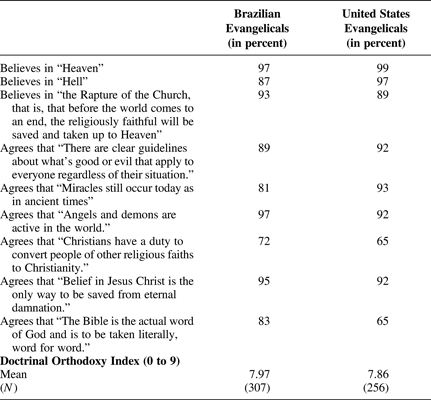
As noted above, two explanations for these divergent attitudes may be rooted in differences in their religious beliefs and behaviors. As Table 2 reports, a comparison of nine different theological beliefs demonstrates considerable similarities between Brazilian and American Evangelical Protestants. It should be noted that Brazilian Evangelicals report believing in the Rapture of the Church, the presence of angels and demons, the duty to evangelize to those of other faiths and the literacy of the Bible at slightly higher rates, while American Evangelicals report believing in heaven, hell and the occurrence of miracles at slightly higher rates. However, their religious beliefs are fairly similar overall.
A comparison of doctrinal orthodoxy of Evangelical Protestants in the United States and Brazil (2006)
Source: 2006 Multi-Country Religion Survey, Pew Forum on Religion & Public Life.
Note: An independent t-test confirms that the means are not significantly different between these two groups on this index.
Furthermore, there is no significant difference, on average, between these groups' levels of doctrinal orthodoxy. The responses to each of these nine dichotomous theological measures were combined to create a Doctrinal Orthodoxy Index such that belief in each element was coded as doctrinally orthodox (ɑ = 0.717). The index thus ranges from zero (0) to nine (9), and Table 2 also reports the mean for each group on this index. An independent samples t-test confirms that the means on this Doctrinal Orthodoxy Index are not significantly different between Brazilian and American Evangelicals. This suggests that the differences found in their political attitudes are not directly attributable to differences in their theological beliefs.
However, as noted above, religion can impact political attitudes in more than one way. Rather than being driven by doctrinally orthodox beliefs, the level of religious commitment — as expressed through behavior and interaction with others in the religious community — may be a more politically important element of religion. In this sense, the social influence of religion may influence one's political attitudes by providing cues as to how an individual should respond to a political issue or event. A stronger adherence to the behavioral observance of one's religion helps to reinforce the religious group's political agenda. Again, this can yield either conservative or liberal views, depending on the cues provided by the religious group. In other words, the differences in political attitudes between Brazilian and American Evangelical Protestants may be the result of contextual differences in the religious messages that each group receives.
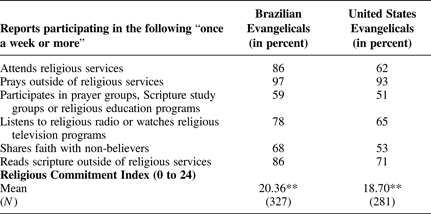
Table 3 provides the percentages of Evangelical Protestants in Brazil and the United States who report engaging in various religious practices “once a week or more.” Each of these practices is intended to gauge the amount of religious commitment in terms of behavioral observance, and nearly all capture elements of social interaction with others in their religious community. Table 3 indicates that a higher percentage of Brazilian Evangelicals reports participating in each of these activities “once a week or more” than American Evangelicals do. In other words, more Brazilian Evangelicals attend religious services, pray and read the Bible outside of religious services, participate in religious groups and programs, listen or watch religious programs and share their faith with non-believers to a greater extent than do their counterparts in the United States.
A comparison of religious commitment of Evangelical Protestants in the United States and Brazil (2006)
Source: 2006 Multi-Country Religion Survey, Pew Forum on Religion & Public Life.
** Independent samples t-test confirms that the means on this variable are significantly different between these groups (p < 0.05, two-tailed).
As with doctrinal orthodoxy, a Religious Commitment Index was created by combining the responses on each of these six items, which range from 0 (“never”), 1 (“several times a year or less often”), 2 (“at least once a month”), 3 (“once a week”), to 4 (“more than once a week); and the mean score on this index is reported for both groups (ɑ = 0.826). Brazilian Evangelicals tend, on average, to participate in these social practices of religion to a greater extent than American Evangelicals, and an independent samples t-test confirms that the means on this index are significantly different between these two groups. In other words, Evangelical Protestants in the United States and Brazil are similar in terms of their levels of doctrinal orthodoxy, but significant differences exist in their levels of religious commitment. As a result, if religion is significantly impacting their respective political attitudes, the divergence in their attitudes and ideology may be the result of the different impacts that religious commitment may have on these opinions.Footnote 6
ANALYSIS AND RESULTS
To more substantially investigate the impact of religion on Brazilian and American Evangelical Protestants' political attitudes, three sets of ordinary least squares (OLS) regression analyses were conducted on ideology and attitudes related to moral and economic conservatism of Evangelicals in each country. In the first analysis, the dependent variable is respondents' self-identified placement on the 10-point ideological scale in which higher scores reflect greater conservatism. The key independent variables are the Doctrinal Orthodoxy and Religious Commitment indices described above. In addition, the analyses includes key social and demographic controls, such as gender, age, marital status, region, and education.Footnote 7 It is expected that respondents who are male, older, married, residents of Recife (in Brazil) or the South (in the United States) and less educated will tend to be more conservative. (Located in the Northeast of Brazil, Recife is included as a control variable because this region is significantly poorer than the rest of the country. This region also tends to be considerably more conservative than the rest of the country, much like the South is in the United States.) Each of these regression analyses was conducted separately for Evangelical Protestants in the United States and in Brazil for comparative purposes.
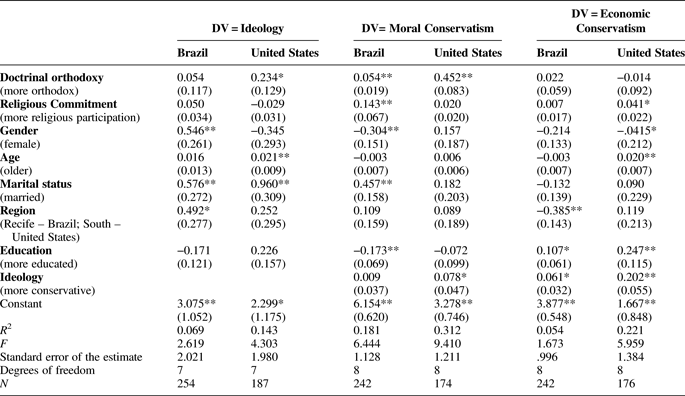
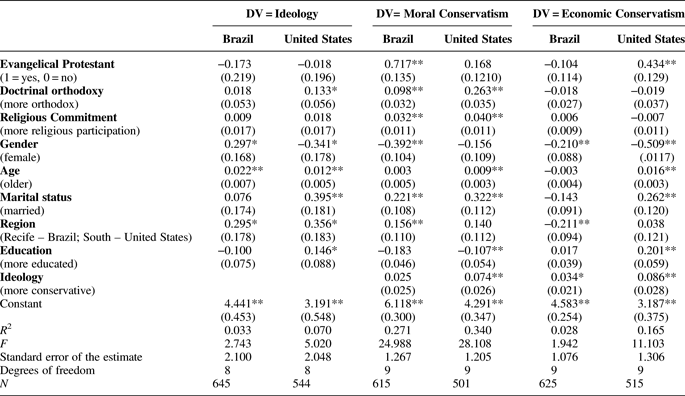
As Table 4 demonstrates, neither religious index significantly predicts Brazilian Evangelicals' ideology, indicating that neither doctrinal orthodoxy nor religious practices impact their self-identification on this scale. Female Brazilian Evangelicals are predicted to have a significantly more conservative ideology, as are those who are married and residents of Recife. In general, however, the low R 2 for this model indicates that these predictors overall do not explain much variance in Brazilian Evangelicals' ideology.
Predicting Evangelical Protestants' conservative attitudes in Brazil and the United States (2006) (OLS regression)
Table 4 reports unstandardized coefficients with standard errors in parentheses.
**p < 0.05, two-tailed; *p < 0.10, two tailed.
In contrast, American Evangelicals' ideology is significantly predicted by their doctrinal orthodoxy, although the extent of their religious commitment — as measured by their participation in religious practices — has no impact. Specifically, the more doctrinally orthodox Evangelicals in the United States are, the more conservative they are ideologically.Footnote 8 However, in Brazil, religion — whether in terms of theological beliefs or religious practices — does not significantly impact Evangelicals' ideology. Thus, it appears that religion may be impacting Evangelicals in the United States differently than in Brazil, which may partially be due to differences in the ways in which religion is connected to ideology in each country. Given the incorporation of Evangelicals in the United States into the Republican Party, a party that is consistently conservative, as well as the explicit links that religious issues have had in recent elections in that country, it may be that moral considerations are central to the ways in which American Evangelicals perceive the left-right ideological spectrum in general, while Brazilian Evangelicals — who have been courted by multiple parties across the political spectrum in elections that lack salient religious issues — are less likely to explicitly link moral or religious issues with their own ideological self-identification.
Despite these patterns, it is expected that doctrinal orthodoxy and religious commitment would better predict attitudes toward issues of morality. A second series of OLS regression analyses were conducted on Evangelicals' scores on the Moral Conservatism Index, described above. As with the previous analyses, doctrinal orthodoxy, religious commitment, and socio-demographic control variables were included in the analyses. In addition, individuals' self-placed ideology was also included as an explanatory variable to control for any independent impact that one's ideological predispositions may have on their political attitudes. The results are also presented in Table 4.
In contrast to the findings for ideology, doctrinal orthodoxy has a significant impact on both Brazilian and American Evangelicals' attitudes toward these issues of morality, but religious commitment only significantly impacts Brazilians' levels of moral conservatism — suggesting that these religious factors influence attitudes differently depending on one's context. In addition, attitudes on these moral issues for Evangelicals in the United States are also significantly determined by their ideological predispositions, such that those who self-identify as being more conservative are also more likely to be more conservative on these moral issues. Thus, not only do increased levels of doctrinal orthodoxy directly increase American Evangelicals' moral conservatism, but doctrinal orthodoxy also indirectly impacts their attitudes on these issues as well via its impact on ideology. Again, religious commitment does not significantly impact these attitudes for Americans, demonstrating that the ways in which religion impacts politics attitudes varies with the political context.
For Brazilian Evangelicals, not only do higher levels of participation in religious activities significantly increase their conservatism on these moral issues, a comparison of the magnitudes of the standardized coefficients (not shown) suggests that participation in religious activities is an even more important predictor of Brazilian Evangelicals' moral conservatism than their levels of doctrinal orthodoxy. Thus, while theological beliefs remain a key determinant of American Evangelicals' political attitudes, the social aspects of religion better explain the political attitudes of Evangelicals in Brazil — even on issues directly related to morality.Footnote 9 One possible reason for this divergence is the ways in which Evangelicals in the United States and Brazil perceive and participate in their own religions. Although pietist religions, such as Evangelical Protestantism, have been found to be best characterized by a “religion as belief” approach, individuals who belong to religions that are more ritualist in nature tend to be influenced more by the behavioral or social elements of their religion (Wald and Smidt Reference Wald, Smidt, Leege and Kellstedt1993). As noted above, due to many Brazilian Evangelicals' previous experiences belonging to a ritualist religion such as the Catholic Church, the “Brazilianization” of Evangelical Protestantism has emphasized a religion that is more social in nature. As a result, behavioral elements — as demonstrated via religious commitment — are more readily shared among adherents and likely have a greater impact on their attitudes in comparison with their American counterparts, who continue to emphasize the importance of beliefs to one's salvation.
While it is more likely that religious factors influence individuals' attitudes on moral issues, religion can also impact attitudes on issues that are not as commonly linked with religious concerns per se. To examine whether religion impacts Evangelicals' economic attitudes in the United States and Brazil, another set of OLS regression analyses were conducted on respondents' scores on the Economic Conservatism Index with the same independent variables as above. As the third column in Table 4 demonstrates, differences remain in the ways in which religion impacts Evangelicals in each country. Neither religious factor significantly predicts Brazilian Evangelicals' levels of economic conservatism. In fact, only region, education, and ideology emerge as significant predictors of their economic attitudes, although the low R 2 for this model indicates that these predictors overall do not explain much variance in this group's economic attitudes.
In contrast, religion does have a significant impact on American Evangelicals' economic attitudes, although the impact is limited to their religious commitment. Specifically, higher levels of religious commitment tend to predict higher levels of economic conservatism for this group, suggesting that greater participation in these religious activities reinforces exposure to economically conservative viewpoints. While doctrinal orthodoxy does not directly impact their economic attitudes, it does play an indirect role via its impact on ideology, which does significantly predict their attitudes on economic issues. As expected, those who report greater conservatism also tend to be significantly more conservative on these economic issues.Footnote 10
The analyses thus far suggest that significant differences exist between American and Brazilian Evangelicals' attitudes with varying impacts of these key religious factors. As demonstrated above, the religious beliefs and behaviors of these two groups are fairly similar, so the source of these political differences cannot simply be rooted in disparities in the level of orthodoxy or religious commitment as the logic of some social-psychological approaches would assume. Rather, these political differences may be rooted in the distinct political context in which Brazilian and American Evangelicals are placed. One potential reason for this difference could be that Brazilians' political attitudes are just generally more liberal than those of their American counterparts. Simply put, what if American Evangelicals are more conservative than their Brazilian counterparts on some issues because Americans in general are more conservative on those issues?
To further investigate whether such contextual factors come into play, we compared the demographic characteristics of Brazilian and American Evangelicals with those of the rest of their countries' populations in the sample (see Appendix). The comparison suggests that, while Evangelicals in both countries tend to be slightly less educated and are more likely to be married than their non-Evangelical counterparts, the differences with the rest of their countries' populations are not dramatic. However, there are a few key differences between the populations of Brazil and the United States overall that might suggest why Americans might be more conservative — those in the American sample are more likely to have a high school or college education and are considerably older than those in Brazil, traits commonly associated with more conservative attitudes.Footnote 11
Table 5 compares Americans and Brazilians' self-identified ideology, moral conservatism and economic conservatism, relying on independent samples t-tests to examine whether significant differences exist between Evangelicals and non-Evangelicals within each country as well as whether significant differences exist between the populations of each country as a whole, thus capturing whether the country in which individuals live might be driving these attitudes. On ideology and economic issues, Brazilians are, on average, significantly more liberal than Americans, although no within-country difference in Brazil exists. In fact, nearly all Brazilians — Evangelical or not — agree that “the government should guarantee every citizen enough to eat and a place to sleep,” although a slightly higher percentage of Evangelicals in Brazil agree with this statement in comparison with their counterparts.
A comparison of political attitudes of Evangelical and Non-Evangelical Protestants in the United States and Brazil (2006)
Source: 2006 Multi-Country Religion Survey, Pew Forum on Religion & Public Life.
** Independent samples t-test confirms that the means on this variable are significantly different between Evangelical Protestants and Non-Evangelical Protestants within this country (p < 0.05, two-tailed).
++ Independent samples t-test confirms that the means on this variable are significantly different between Brazilians and Americans (full sample),(p < 0.05, two tailed.
Predicting conservative attitudes in Brazil and the United States (2006)
Table 6 reports unstandardized coefficients with standard errors in parentheses.
**p < 0.05, two-tailed; *p < 0.10, two tailed.
Again, Americans in general are more conservative than Brazilians, but in contrast with Brazil, there are religious differences within the United States as well. American Evangelicals are significantly more conservative, on average, than their non-Evangelical counterparts on these two dimensions. These results suggest that, for ideology and economic issues, context may be an important factor in explaining the differences in Evangelicals' attitudes in Brazil and the United States, with religion only having an important influence in the United States. As noted above, the political environment may play a large role in these differences; while American Evangelicals have been mobilized into the political system by one political party that consistently pursues conservative positions on a variety of issues, Brazilian Evangelicals have been courted by several political parties across the political spectrum. Furthermore, salient political issues differ in each country; no party in Brazil, for example, is actively considering the legalization of abortion, which likely makes that issue less salient to Brazilian Evangelicals' ideology. It appears, then, that Brazilians in general are less likely to connect religion with issues beyond the moral realm.Footnote 12
In terms of moral conservatism, no clear difference between the American and Brazilian populations in general exists, although a much higher percentage of Brazilians agree that abortion is never justified. Within each country, there is a significant difference between Evangelicals and non-Evangelicals on these moral issues. In both countries, Evangelicals are significantly more conservative, on average, than their non-Evangelical counterparts, suggesting that some religious factor — rather than a country-specific one — may be driving attitudes on issues most closely related to morality. Since religion tends to offer more guidance on moral issues, it is not necessarily surprising that members of Evangelical churches — regardless of country — tend to be more conservative on such issues given the nature of their doctrinal beliefs.
To more fully determine whether the variance in the religious effects holds even when controlling for the political environment of each country, a final series of regression analyses were conducted on each country's full sample to predict the three key dependent variables: ideological self-identification; moral conservatism; and economic conservatism. As with the previous analyses, the models included doctrinal orthodoxy and religious commitment as key independent variables as well as demographic controls. Because these are conducted on the full samples for each country, an additional independent variable representing whether an individual is Evangelical (coded as 1) or not (coded as 0) was also included. The inclusion of these independent variables (Evangelical Protestant, doctrinal orthodoxy, and religious commitment) also provide an opportunity to test the relative impact of religious “belonging” (or membership in this religious tradition), “belief” and “behavior.” Presented in Table 6, the results again demonstrate varied effects depending on the issue dimension investigated.
None of the religious factors influences Brazilians' ideology or economic conservatism in any significant manner, and the impact of these religious factors on Americans' attitudes on these two dimensions vary considerably. Doctrinal orthodoxy has a significant (and positive) effect on Americans' ideology, but only membership in the Evangelical religious tradition significantly increases Americans' economic conservatism. Clearly, when it comes to general ideology and economic considerations, religion only has an impact in the United States, and its influence varies by the issue dimension being examined.Footnote 13
On moral considerations, however, religious factors play an important role on both Brazilians and Americans. All three variables — being an Evangelical Protestant, doctrinal orthodoxy, and religious commitment — significantly increase Brazilians' conservatism on issues of morality, although only doctrinal orthodoxy and religious commitment do the same in the United States, regardless of one's religious affiliation.Footnote 14 Because these issues are arguably the most commonly associated with religion, this finding is not surprising. Again, depending on the issue in question, religion drives individuals to more conservative attitudes, although which specific component of religion impacts these attitudes vary greatly in different political environments.
DISCUSSION AND CONCLUSION
These findings suggest that the impact of religion on Evangelicals' political attitudes vary significantly between Brazil and the United States. Consistent with much of the literature, doctrinal orthodoxy and religious commitment are strong predictors of moral conservatism for Evangelical Protestants, regardless of one's country. Membership as an Evangelical also influences these views for Brazilian Evangelicals, although not for those in the United States, suggesting that — even when controlling for one's level of orthodoxy or religious participation — those who belong to this religion in Brazil are receiving further reinforcement to be conservative on issues related to homosexuality, pre-marital sex and (especially) abortion.
In contrast, for issues less commonly associated with religion, the findings suggest that context is much more important than these religious factors outside of the American experience — which presents a considerable challenge to the logic of many social-psychological approaches. In fact, none of the religious components significantly predicts Brazilian Evangelicals' ideology or economic attitudes — nor do they do so in the full sample models. In Brazil, ideology is better explained by other factors (in particular, marriage and gender), and none of the religious factors examined help to explain their economic attitudes. The low goodness-of-fit measures of these two analyses also suggest that — at least for issues not explicitly related to religion — these religion measures do not impact the ideology and economic attitudes of Brazilians.
Even among Americans, though, it may not necessarily be the religion itself that is impacting economic conservatism; only membership as an Evangelical Protestant significantly increases Americans' economic conservatism, suggesting that perhaps the particular way in which this group was mobilized into the American political environment by an economically conservative party is driving these attitudes — rather than something core to the religion itself. Indeed, Brazilian and American Evangelicals' incorporation into the political sphere — while occurring at roughly the same time — demonstrates that other differences in the political environment may also explain the differences in the ways that religion does (and, for Brazilians, does not) impact their ideological and economic attitudes. Evangelicals in the United States have been actively courted by the Republican Party since the 1980s, whereas Evangelicals in Brazil were not actively courted by any major political party until the presidential election in 2002. In that election, Luiz Inácio “Lula” da Silva, the candidate of the Worker's Party that had espoused center-left policies, gained the support of Evangelicals by choosing José Alencar of the Liberal Party as his running mate. As a result, the political environment in Brazil — as well as the unique politicization process of Evangelicals in that country — may prevent individuals from connecting moral arguments with economic issues in a way that would lead to greater conservatism.
It is possible, however, that Brazilian Evangelicals could be mobilized on behalf of a conservative political party, particularly if more religiously oriented issues became salient. In the 2010 presidential run-off election in Brazil, for example, the issue of abortion came to the forefront as Jose Serra of the centrist Social Democratic Party accused the candidate of the leftist Workers' Party of wavering on this issue in an attempt to win over Evangelicals in the country (BBC News 2010). But unless issues that are explicitly religious in nature — such as this — are salient and a central part of a conservative political party's agenda, Brazilian Evangelicals will likely remain distinctive in their electoral behavior from their American counterparts. While the data and results we present are too limited to definitively confirm an alternative theoretical explanation for this divergence, it appears as if something more akin to a social movement approach is more valid in the Brazilian context (Wald, Silverman, and Fridy Reference Wald, Silverman and Fridy2005). In this regard, it is only under threat from more moderate forces in Brazilian politics that Evangelicals have begun to hold more influence in Brazilian elections, a situation exacerbated in the 2010 election when the two main challengers were close to one another on economic policy and differed on social issues.
Although preliminary, these results suggest that — even within one religious tradition — religion may be impacting individuals' political attitudes in different ways and, in many regards, this evidence indicates that the political context as well as the personal experiences of those within these churches are shaping the political commitments of their religious group by providing cues as to which issues are best connected to religion as well as what appropriate attitudes on those issues should be. For the Evangelicals in the United States, being mobilized by a consistently conservative party means that merely being Evangelical is enough to “teach” those individuals to adhere to conservative values beyond the directly moral or religious realm. But the personal and political experiences of those in Brazil results in contrasting cues. Corresponding with work by other scholars (Wald, Owen, and Hill Reference Wald, Owen and Hill1988; Djupe and Gilbert Reference Djupe and Gilbert2009), these results suggest that politics may be driving religion in important ways, which further demonstrates the importance of greater comparative research in this field. Future research should continue to examine the conditions under which religious factors may impact individuals' political views as well as the ways in which the political environment influences the attitudes of religious groups to provide a deeper understanding of religion's impact beyond the American experience.
APPENDIX: A COMPARISON OF DEMOGRAPHIC CHARACTERISTICS OF THE UNITED STATES AND BRAZIL (2006)