Our understanding of the work of William Harvey has been much altered and enhanced since the late 1960s. There has been a move away from the view that Harvey discovered the full circulation of the blood because of his supposed adherence to the new mechanical and mathematical trends of the early seventeenth century.Footnote 1 The view pioneered by Pagel and Debus,Footnote 2 that Harvey was deeply influenced by the ideas of Aristotle, has now become standard in writers such as French, Frank, Wear, Cunningham, Fuchs and Rossi.Footnote 3 There has also been some recognition of the relation of Harvey's ideas to the natural magic tradition, but no one has yet investigated Harvey's views on astrology. The older historiography sought to place a mechanical and mathematical Harvey within a rational scientific revolution, excluding any influence from the supposedly irrational magical tradition.Footnote 4 This historiography also focused tightly on Exertatio Anatomica de Motu Cordis et Sanguis in Animalibus (Anatomical Exercises on the Motion of the Heart and Blood in Animals – DMC), when Harvey's comments on astrology are in other works and are not prominent even there. More recent Harvey historiography has allowed some influence on the formulation and presentation of Harvey's ideas about the circulation from the natural magic tradition, without seeing those ideas as fundamental to Harvey's views. This historiography has undoubtedly been more successful at placing Harvey in his intellectual milieu and within the anatomical and rhetorical practices of his time, but has not examined Harvey's views in relation to the natural magic tradition away from his views on the circulation.
I argue that Harvey believed in a form of astrology which was related to his views on generation. This is critical to understanding some comments he makes in Exercitationes de Generatione Animalium (Exercises on the Generation of Animals – EGA) and in On Parturition. It is important to recognize that the astrology of the time was an extremely broad phenomenon, encompassing a very wide range of beliefs and practices. Why, then, did Harvey choose these particular views on astrology? I argue that Harvey's position in the spectrum of astrological views was largely determined by his adherence to Aristotle's natural philosophy and his Christian beliefs. In the second section of this paper I attempt to show that, whether we should consider Aristotle to be interested in astrology or not, there was a foundation within Aristotle's cosmology which allowed the transmission of an influence from the heavens to the terrestrial realm in an entirely natural manner and that this had an important influence on some later traditions in astrology.
In this I hope to illustrate that it is far more helpful to treat astrology as a very broad spectrum of views and practices, some of which involved the supernatural but many of which did not, rather than simply to group all astrological beliefs together. Older historiographies of science and magic tended to treat them in bipolar terms, contrasting empirical, rational, natural science against metaphysical, irrational, supernatural magical belief. This obscured many interesting gradations of thought here, especially in relation to the natural magic tradition.
I will also advance a more general thesis, that wherever Harvey was interested in ideas that we associate with the natural magic tradition, he was interested in these as far as they fitted with his Aristotelian and Christian views. Later in this paper I argue that this is the case in relation to Harvey's use of the macrocosm–microcosm analogy and of alchemical terminology, and, as far as we can rely on the evidence, this informs his attitudes towards witches as well. Again it is important to recognize that these phenomena had a very broad range of formulation, and it was Harvey's Aristotelianism which determined where he stood in the spectra of belief here.
I argue, then, for a Harvey who was more tightly related to ideas we associate with the natural magic tradition than has previously been supposed, both in the breadth of ideas he is willing to accept and in that those ideas are not mere symbolism for Harvey, but form an important and integral part of his views on both generation and the circulation. This Harvey is also more Aristotelian than has previously been supposed, in that the natural magic ideas he accepted were entirely in accord with his Aristotelian influences.
Harvey's belief
What evidence do we have for Harvey's belief in astrology? There are three significant locations, at EGA Exercises 50 and 71, and in On Parturition. The context of EGA Exercise 50 is that Harvey is seeking the ‘efficient cause of animals, and what its conditions are’.Footnote 5 Harvey's simplest statement in Exercise 50 is that ‘The generation of all things is derived from heaven and follows the movement of the sun and the moon.’Footnote 6 Harvey also gives a fuller account of his position:
And therefore it will be that male and female are both but an instrumental efficient subservient to the Creator of all things, the Father omnipotent. And in this sense it is truly said that the Sun and a man beget a man, because spring and autumn follow the sun as it approaches or recedes, and at these seasons, for the most part, happens the generation of animals and their decay. So Aristotle, the chief of Philosophers, wrote thus:
‘Primary motion is not the cause of coming to be and passing away, but motion along the inclined circle, for this is both continuous and made up of two movements. If generation and corruption are always to be continuous, it is necessary for some body to be always moved to prevent these changes from failing, and moved with two movements lest only one of the changes should come to pass. The cause of the continuity of this movement, therefore, is the motion of the universe, but the cause of the approach and recession of the moving body is the inclination. For it comes to pass that the moving body, namely the Sun, is sometimes afar off and sometimes near at hand. And since its distance is thus unequal, it movements will be unequal. Wherefore, if it generates because it approaches and is near, it causes corruption because it goes away and stays afar off from the earth, and if it generates often, it is because it approaches often, and if it often cause corruption, it is because it often recedes. For contrary effects have contrary causes.’
And therefore, in the Spring, all things flourish and grow (that is, as the Sun draws near, the Sun who is the common father and begetter of all things, or at least the immediate and universal instrument of the supreme Creator in generation), and not only plants but animals also, and no less those which arrive spontaneously than those which are begotten by the male and female working together.Footnote 7
The passage quoted by Harvey here is from Aristotle, On Generation and Corruption II/10, and is a perfectly serviceable translation and understanding of that passage. The ‘primary motion’ for Aristotle is that of the stars, a twenty-four-hour circular motion which is shared with all the other heavenly bodies. ‘Motion along the inclined circle’ is the motion of the second sphere which moves the Sun, and effectively generates motion of the sun along the ecliptic, as viewed from Earth. It is this motion which produces the changes in where the sun sets along the western horizon throughout the year, which defines the seasons and leads to the expression that the sun approaches and recedes. It was common in the ancient world, and in Aristotle,Footnote 8 to refer to the sun as approaching as it moved from winter solstice to summer solstice (days are longer and warmer) and receding as it moved from summer solstice to winter solstice.
It is clear that Harvey not only associated the generation of animals with the motions of the heavens, particularly the Sun, he also gives the motion of the heavens some part as the causation of the generation of animals. The influence from Aristotle is also evident. Here Harvey seeks the ‘efficient cause’ of generation (part of the Aristotelian scheme of teleological, formal, material and efficient explanations) and places that in the context of Aristotle's cosmology. Aristotle says,
The cause of man is (1) the elements in man (viz. fire and earth as matter, and the peculiar form), and further (2) something else outside, i.e. the father, and (3) besides these the sun and its oblique course.Footnote 9
The only significant difference from Aristotle here is that Harvey has brought in an omnipotent, creator god in line with his own Christian views. This replaces Aristotle's rather more passive god whose only activity is to think about thinking.
Exercise 71 of EGA has a somewhat different context, with Harvey discussing the nature of the innate heat of animals. Also prominent throughout is a theme which occurs in several places in EGA, that the phenomena of nature cannot be understood solely in terms of their material constituents.Footnote 10 The most significant passage for us is this:
The heat of the blood is an animal heat, inasmuch as it is governed in its operations by the soul. And it is also a celestial heat, as being subservient to the heavens, and a divine heat because it is a subservient of Almighty God as I said before when I showed how the male and the female are the instruments of the sun, of heaven, or of God himself, as servants of the generation of the more perfect animals. According to Aristotle this lower world is so continuous with the superior realms, that all its changes seem to take their origin from thence and be governed by them.Footnote 11
The final sentence here is an allusion to Aristotle, Meteorology I/2.Footnote 12 A key aspect of Aristotle's cosmology was that the motions of the celestial bodies change what is happening in the terrestrial realm, and in the meteorology passage Aristotle traces all change in the terrestrial realm to the influence of the heavens. Aristotle does say that all that happens in the terrestrial realm is ‘governed by’ the celestial motions. The verb Aristotle uses is a passive construction of kubernao. Kubernao is not a simple verb of motion (which Aristotle could easily have used here), but means ‘to steer’, as in to steer a boat, or to guide or govern in a political sense. This verb has a significant past and future usage relative to Aristotle. Presocratic thinkers had commonly used it in cosmogony, describing how the world had been ‘steered’ into being an ordered cosmos from a primordial chaotic state. Later astrologers used it for the influence the heavens had on human affairs. In one sense this gives Harvey quite a strong astrology if all physical changes in the terrestrial realm can be traced back to motions in the celestial realm.
We can add to this evidence of Harvey's belief in astrology passages from On Parturition, the lead example being ‘Just as the birth of animals depends on the course of the sun and the moon, so they have various seasons for copulation and different terms of utero-gestation.’Footnote 13 One can find similar passages in Aristotle relating the moon to the menstrual cycle and to the fertility of animals.Footnote 14 From this evidence we can conclude that Harvey did believe in a form of astrology. It was very strongly influenced by Aristotle; indeed Harvey even quotes Aristotle extensively on the subject. Like Aristotle, Harvey did not seem to be interested in horoscopic astrology. Harvey's views on astrology are mediated by his Christian belief and we find a much more active role for a creator God than we do with Aristotle. Harvey's astrology was not strongly deterministic, at least not as far as the souls of humans are concerned. That is important from a Christian perspective as St Augustine and St Thomas Aquinas had argued against deterministic astrology on the grounds that it denied free will and moral choice to humans. Aquinas' solution was effectively to allow astrological influence of the body but not of the soul.Footnote 15 We find no mention in Harvey of the zodiac, of the macrocosm–microcosm analogy in relation to astrology, or of any treatment selected on astrological grounds or having astrologically favourable times.
Aristotle and astrology
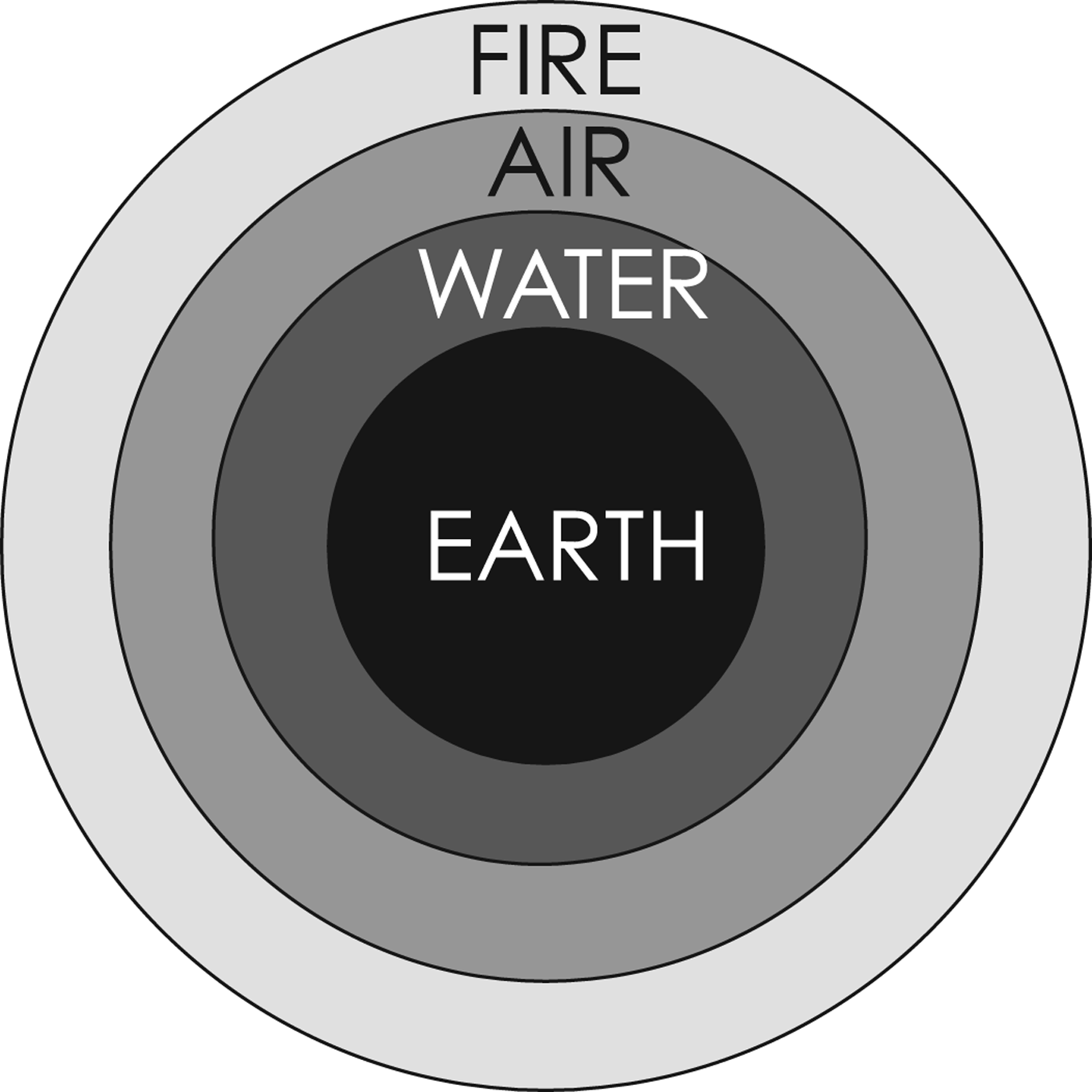
We need to examine Aristotle's own views a little more closely here, as they are important for the historiography of astrology and significant in showing astrology to be a diverse discipline. Harvey followed these views tightly and they give limits to Harvey's belief. There was an important tradition in astrology which based itself on two groups of passages in Aristotle, On Generation and Corruption, Book II, Chapters 10 and 11, and in Meteorology, Book I, Chapters 1–3. In On Generation and Corruption Aristotle conducts a thought experiment. The issue is that the elements – earth, water, air and fire – all have natural motions, earth and water towards the centre of the cosmos, air and fire away from it.Footnote 16 Left to themselves, they would separate out with earth in the centre and the other elements in concentric shells, as in Figure 1. As Aristotle believed that there was no beginning to the cosmos, there had been ample time for this to have already occurred. It had not; therefore there was something which opposed this tendency. Aristotle's examples of elements changing into one another are air from water, fire from air and water from fire.Footnote 17 How is this actually mediated? Aristotle says, ‘The circular motion of the primary element and the bodies which are in it, are by their motion always separating, setting on fire and making hot the contiguous bodies in the lower realm.’Footnote 18 There are notorious difficulties with how the heavens affect the upper reaches of the terrestrial realm in Aristotle, but it is clear that Aristotle believed that there is such an effect.Footnote 19 Precisely how we describe Aristotle's views here is difficult and depends on how we think of astrology. Certainly one can argue that Aristotle makes no mention of the zodiac, no mention of birth/conception dates, and does not see human fate or character as influenced or determined by the heavens. This is a purely cosmological thesis with purely astrophysical, not astrological, effects. Alternatively, one might argue that Aristotle believed that the heavens determine not only the seasons, but also the behaviour and lifespan of animals. More strongly, Aristotle may have believed that all generation and destruction is related to the position of the sun. Furthermore, in Meteorology I/2 the ultimate reason for motion in the terrestrial realm is motion in the celestial realm and the celestial motions ‘steer’ the terrestrial motions. An important consideration here is that Aristotle did not recognize astrology as a discipline. The passages we have examined here come from his general theory of change (On Generation and Corruption) and his work on meteorological phenomena (Meteorology). Aristotle's goal in these passages does not seem to be to establish a basis for astrology but rather to solve a paradox in his theory of motion given the eternity of the cosmos.
Aristotle: Concentric shells of the elements.

However, later thinkers, notably Claudius Ptolemy in his Tetrabiblos, did generate a fully developed horoscopic astrology using an essentially Aristotelian cosmology. Ptolemy distinguished between the disciplines of astronomy and astrology in the opening passage of the Tetrabiblos and says that astrology is ‘that through which we investigate the configurations themselves and the specific changes they bring about in what they surround’.Footnote 20 On that definition of astrology, Aristotle is doing astrology in his Meteorology I/2 (how the terrestrial elements are affected by the motions of the heavens). Ptolemy also says,
The sun is always in some way arranging all that is on earth, not only through the changes of the seasons of the year bringing about the generation of animals, the growth of fruit-bearing plants, the flowing of waters and the returning of bodies, but also through its daily cycle producing heat, moisture, dryness and cold in a regular manner.Footnote 21
Ptolemy's Tetrabiblos was one of the key texts for the development of astrology in the West. While later systems of astrology involving the supernatural or ideas of sympathy and harmony took inspiration from it and used Ptolemaic ideas, Ptolemy's system itself is free of those ideas.
The effects of the heavens on the terrestrial realm are entirely natural for both Aristotle and Ptolemy. Both claim empirical support for their views.Footnote 22 That is important to point out, as it is often said that astrology is fundamentally grounded in the ‘ancient's magical world view’, and this has considerable implications for the historiography of astrology.Footnote 23
Whether we call Aristotle an astrologer or not is relatively unimportant.Footnote 24 It is important to recognize, though, that within Aristotle there is a cosmological basis for astrology, developed into a full astrological system by Ptolemy.
One reason for developing this comparison between Aristotle and Ptolemy is to emphasize the wide range of possible belief in astrology, from Aristotle's relatively minimal view through to the full system of Ptolemy. This entirely natural approach is only one version of astrology, there being many formulations of natural magic astrology (involving sympathy, harmony, macrocosm–microcosm etc., with these relations being considered natural but magical) as well as magical, supernatural and mystical astrologies.Footnote 25
In relation to Harvey, and in contrast to Ptolemy and a great deal of later astrology (including medical astrology), it is important to note that in both Aristotle and Harvey there was no mention of the zodiac, no mention of birth/conception dates and no sense of human fate or character influenced or determined by the heavens. Nor is there any sense in Harvey that therapy was either indicated or influenced by astrological considerations.
Harvey and Aristotle
As my general thesis here is that Harvey's views on astrology, and on magical topics in general, are informed and limited by his Aristotelian views and that he does not break significantly with Aristotle on these matters, I will briefly say why I do not think that Harvey breaks significantly with Aristotle on supposed mechanical analogies and quantification.Footnote 26 Harvey likened the heart to a pair of water bellows (and not a pump), and did so only in his lecture notes.Footnote 27 He said, ‘From the structure of the heart it is clear that the blood is constantly carried through the lungs in to the aorta as by two clacks of a water bellows to raise water.’Footnote 28 Clacks were leather flaps nailed across the inlet and outlet to improve the efficiency of the bellows. Does this constitute any sort of break with Aristotle? Aristotle said, ‘It is necessary to regard the structure of this organ [the lung] as very similar to the sort of bellows used in a forge, for both lung and heart take this form.’Footnote 29 So while Harvey refers us to a slightly more sophisticated type of bellows, I see nothing here which makes this specifically a mechanical analogy and nothing which differentiates Harvey's view from that of Aristotle in any important manner. Harvey's quantitative argument for the circulation of the blood is that the ‘beat of the heart is continuously driving through that organ more blood than the ingested food can supply, or all the veins together at any given time contain’.Footnote 30 Aristotle, in his Meteorology, argues against the view that the rivers have their source in huge underground reservoirs which fill in the winter and empty during the summer. He says,
It is clear that, if anyone should wish to make the calculation of the amount of water flowing in a day and picture the reservoir, he will see that it would have to be as great as the size of the earth or not fall far short of it to receive all the water flowing in a year.Footnote 31
The structure of this argument is similar to that of Harvey's. The amount of fluid flowing (water/blood) is too great for the opposed hypothesis (reservoirs/Galen) to be able to account for. Harvey did not attempt to quantify blood flow precisely. He used significant underestimates for ventricle volume, amount passed and heartbeat rates.Footnote 32 There is nothing else in Harvey's work which suggests that he believed precise quantification to be important or that he believed the world to be primarily a quantitative rather than a qualitative place. It is not necessary, then, to see either Harvey's analogy with a bellows or his quantification of blood flow as significant breaks with Aristotle.
Macrocosm and microcosm
I have argued elsewhere about the centrality of the macrocosm–microcosm relationship in Harvey's account of the circulation of the blood. This is no mere circular symbolism and the relationship is given extensive treatment in the pivotal Chapter 8 of DMC. Two aspects of the macrocosm–microcosm analogy allow Harvey to circumvent key difficulties for his theory. If there are two types of blood within one circulatory system, it is vital to be able to explain how arterial blood becomes venous blood and vice versa.Footnote 33 Harvey in DMC says,
So in all likelihood it comes to pass in the body, that all the parts are nourished, cherished, and quickened with blood, which is warm, perfect, vaporous, full of spirit, and, that I may so say, alimentative; in the parts the blood is refrigerated, coagulated, and made as it were barren, from thence it returns to the heart, as to the fountain or dwelling house of the body, to recover its perfection, and there again by naturall heat, powerfull and vehement, it is melted and is dispens'd again through the body from thence, being fraught with spirits, as with balsam, and that all the things do depend upon the motional pulsation of the heart.Footnote 34
If the lungs are now part of the full circulation, it is important to be able to explain how the full flow of the blood gets through the lungs from the pulmonary artery to the pulmonary vein. Harvey says, ‘It is well enough known that this may be, and that there is nothing which can hinder, if we consider which way the water, passing through the substance of the earth doth procreate Rivulets and Fountains.’Footnote 35 These aspects of Harvey's work were important for his acceptance at the time and there is interesting iconography both in Sachs von Lowenheim and in Nathaniel Highmore.Footnote 36 How does Harvey's employment of a macrocosm–microcosm analogy relate to what we find in Aristotle? Aristotle does not discuss a relationship between macrocosm and microcosm in the abstract at any point. The closest he comes to this terminology is in the Physics, when discussing self-motion he says, ‘If this can happen to a living thing, what prevents the same thing happening to the universe? If this can happen in the small world [mikrô kosmô] it can happen in the large [megalô].Footnote 37 Aristotle's Greek uses two separate words for the microcosm and only one, ‘large’ for the macrocosm, though in Greek (and especially in Aristotle's somewhat elliptical Greek) ‘large’ in this context would readily be understood to mean ‘large world’. While later macrocosm–microcosm analogies focus on the relationship between man and the cosmos, it is perhaps significant here that Aristotle phrases this in terms of living things and the cosmos, especially as Harvey buys into the Aristotelian research programme of discovering the use of the heart and blood in animals, rather than simply in man.Footnote 38 In Aristotle's On Generation and Corruption II/10 and 11 we do find the comparison of the cycle of the heavenly motions and the weather cycle, the weather cycle being said to ‘imitate’ the heavens. Harvey then suggests a similar relationship between the weather cycle and the circulation of the blood.
Is Harvey's use of macrocosm–microcosm analogies any more ‘magical’ than what we find in Aristotle? There was a wide range of macrocosm–microcosm theories. One can, as an elementary explanatory device, say that the electrons of an atom orbit the nucleus as planets orbit the Sun and vice versa. One can draw this analogy without suggesting that there is any special relationship between planets and atoms or Sun and nucleus. There is no necessity to suggest any causation from planets to electrons, or any harmonic atunement shared by them, or any sympathetic interaction. On the other hand, at the other end of the scale we might cite a contemporary of Harvey's, Robert Fludd, whose view of the macrocosm–microcosm relation did involve harmonic atunement and sympathetic interaction.Footnote 39 Fludd was one of Harvey's earliest supporters on the circulation issue and had his own view on how astrology related to this.Footnote 40 Fludd held that the ‘spirit of life’ retained an impression of the heavens and the zodiac and that the circular motions of the Moon and the Sun produce the motion of the blood, just as the tides of the sea obey the Sun and Moon.Footnote 41 For Fludd, unlike Harvey, therapy is very tightly related to astrological considerations.Footnote 42
Where should we place Harvey in this spectrum? Harvey actually uses four macrocosm–microcosm analogies. First, there are the motions of the heavens and the weather cycle, where the only difference between Harvey and Aristotle is the macrocosm–microcosm terminology. Harvey invokes no special relationship here, but merely repeats Aristotle's imitation metaphor. Second, there is the weather cycle and the circulation, and Harvey seems to envisage a similar imitation relation between the circulation and the weather cycle as between the weather cycle and the heavens. There is no special causation between the weather and the circulation, nor are there any relationships of harmony or sympathy. Third, Harvey's preface to the king is a fairly mundane invocation of the macrocosm–microcosm analogy, merely comparing the power and importance of the Sun and the sovereign.Footnote 43 Fourth, Harvey likens an egg to the macrocosm, in that the earthiest part (the yolk) is at the centre, surrounded by the watery part, with the air sac close to the shell, like the distribution of earth, water and air in the cosmos. Once more there is no sense of any form of causation between macrocosm and microcosm.Footnote 44 So while Harvey uses the language of macrocosm and microcosm and employs the analogy in more situations than Aristotle did, there is no evidence to suggest that Harvey had a different, more magical, conception of the macrocosm–microcosm relation than Aristotle did. In particular, while many had used the macrocosm–microcosm analogy as a basis for astrology, it is notable here that Harvey did not. So I would disagree with Hall when she says of macrocosm and microcosm in Harvey, ‘It is all very mystic.’Footnote 45 There was a broad spectrum of macrocosm–microcosm analogies and this one does not show the mystical qualities of many others.
It is perhaps worth noting a parallel here, which is the Kepler–Fludd debate.Footnote 46 Kepler claimed that there was nothing mystical in his geometric–harmonic account of the universe and dissociated himself from Fludd's views, which he felt were too symbolic, too mystical and insufficiently precise.
Pagel refers to Harvey's ‘circular symbolism’, a phrase which tends to mask the differences between Fludd and Harvey. As argued above, Harvey derived two important explanations from his use of the macrocosm–microcosm analogy, the interconversion of the two blood types and the full flow of blood through organs. Harvey's use of the macrocosm–microcosm analogy is concrete both in the description of the analogy and in its consequences, where Fludd's use was symbolical and mystical. This sort of difference was picked up by Gassendi in his 1630 work attacking Fludd for his mysticism and suggesting that he should have ‘listened to Harvey, his countryman’.Footnote 47 It is in the concrete interpretation of these ideas that Kepler and Harvey differ from Fludd, even if the Neoplatonic Kepler would disagree with the Neoaristotelian Harvey on issues of quantification.
A further useful, though more general, comparison would be with Simon Forman, the sixteenth-century astrologer, alchemist and physician. Kassell comments that he ‘espoused a radical astrology’,Footnote 48 and that ‘Information about the patient was important, but it was not the basis of the diagnosis; rather, it was the basis on which the astrological rules were consulted and the stars read.’Footnote 49 She quotes Forman as saying, ‘There is no true way to knowe a mans disease by his water, pulse, sedge or talk, but by arte Astronomicalle.’Footnote 50 Harvey, in comparison, would seem to espouse an extremely conservative astrology. Kassell also comments that Forman ‘thought himself destined to discover the philosophers' stone’, and I now turn to Harvey's views on alchemy.Footnote 51
Harvey and alchemical terminology
It has long been known that Harvey used alchemical terminology in his description of how one type of blood changes into the other. Quite what language he was supposed to use instead in the context of the early seventeenth century is usually left unquestioned. One might reasonably ask, though, how far Harvey's use of alchemical terminology committed him to anything that did not have a basis in Aristotle's views on matter. As we have seen in the macrocosm–microcosm quote from DMC Chapter 8, Harvey says that arterial blood is ‘warm, perfect, vaporous, full of spirit, and … alimentative’; it becomes ‘refrigerated, coagulated, and made as it were barren’ and on its return to the heart it is heated and becomes ‘fraught with spirits, as with balsam’. In the Latin version of De Motu Cordis Harvey uses the term ‘circulation’, circulatio, for the circulation, a term commonly used by alchemists for the process of distillation. It is also significant that in his lectures on anatomy, Harvey compared how the lung works to an alembic, an important piece of alchemical apparatus.Footnote 52 In EGA Exercise 71 Harvey speaks of alchemists producing changes by ‘Sublimating, fusing, concocting, corrupting, coagulating and in countless other ways.’Footnote 53 Certainly the alchemical interpretation of Harvey was significant in the acceptance of the circulation thesis in some quarters. Walleus tells us, ‘Hence a kind of circulation operates, not unlike that by means of which chemists utterly refine and perfect their spirits.’Footnote 54 We should also take into consideration Aubrey's comment concerning Harvey: ‘He did not care for Chymistrey and was wont to speak against them with undervalue.’Footnote 55
Do these passages take Harvey beyond Aristotle? The view I want to take here is analogous to what I have argued in relation to astrology. Aristotle's cosmology provided a non-magical theoretical basis for astrology. Aristotle's views on matter similarly provided a non-magical theoretical basis for alchemy. Aristotle's theory of the four terrestrial elements of earth, water, air and fire allows for the transmutation of these elements. These transformations are commonplace, entirely natural and non-magical events. So as part of the weather cycle, for both Aristotle and Harvey, water (characterized by the qualities of cold and wet) on being heated becomes air (hot and wet) and air when cooled becomes water.Footnote 56 As all the elements can transmute into each other and all objects are combinations of the four elements, a wide range of transmutations are possible. With Aristotle's theory of matter, any object can be thought of as a combination of prime matter and qualities such as colour, hardness, shape, etc. All of these qualities are mutable; so to use a simple example, if we change the qualities which characterize water to those which characterize air we now have air instead of water. More complex would be the transmutation of one metal into another, but this would still be a theoretical possibility. Indeed, a great deal of subsequent alchemy will talk of the qualitative changes required to bring about such a transformation. Further, in terms of geology Aristotle believed that all metals were formed in the ground and that there was a process by which these metals (including gold) are formed from non-metals.Footnote 57 For Aristotle, these are all ways of thinking about entirely natural, commonplace changes and there is no recourse to anything supernatural. One can talk of transmutation and of change of quality without being committed to anything magical. There is no evidence that Harvey's comments commit him to anything supernatural, mystical or esoteric in alchemy. He simply uses the language of the time to describe physical changes, a language derived from Aristotle which stresses the processes of heating and cooling and talks of change of quality. This was not a theologically charged issue, as St Thomas Aquinas, for example, had declared alchemy to be ‘a true art’.Footnote 58
Harvey and witches
There are several stories of Harvey in relation to witchcraft, the best account of these being in Keynes's biography of Harvey.Footnote 59 There was a widespread belief in the existence of witches in early seventeenth-century England.Footnote 60 James I had a strong belief in the existence of witches and even wrote on the subject:Footnote 61 ‘The fearful abounding at this time in this country of these detestable slaves of the devil, the Witches or enchanters, who are never so rife in these parts as they are now.’Footnote 62 Kramer and Sprenger, who published the notorious work Hammer of the Evildoers, effectively a manual of witch-hunting, said of witches, ‘We dare not refrain from inquiring into them lest we imperil our own salvation.’Footnote 63 The supposed evidence for believing someone to be a witch was well known. In cases where Harvey investigated supposed witchcraft, he found this evidence but interpreted it otherwise, in a purely natural manner.
In the case of the Pendle witches of 1634 Harvey was asked to supervise the examination of four women accused of witchcraft. Nothing of interest was found in the examination of the first three of these women. However, with the fourth it was discovered that she had ‘a teat like that of a bitch’ which was ‘between her secrets’. Witches were supposed to have an insensitive spot on their bodies, possibly hidden, which could be a callous or a mole or some form of third nipple for suckling their familiar. The interpretation, though, was that this was nothing that would not be expected from piles (haemorrhoids) or the application of leeches. It was also found that she had a spot which was like ‘like the nipple or teat of a woman's breast’, but that it was the same colour as the rest of the skin, without any hollowness, and did not produce any blood or other juice. These four women were duly acquitted. Had Harvey been a believer in witchcraft, he could easily have construed what had been seen on the body of the fourth woman as the signs of a witch.
The second story is less well attested, in that it comes from what purported to be a copy of a seventeenth-century manuscript sent to a magazine for publication in 1832.Footnote 64 It does, though, give a clear statement of Harvey's views on witchcraft, as the narrator says, concerning Harvey, ‘I once asked him what his opinion was concerning Whitchcraft; whether there was any such thing? Hee told mee there was not.’Footnote 65 The document contains an anecdote about Harvey's investigation of a witch. He attempted to discover if a woman living on the edge of Newmarket Heath, who kept a toad as a pet, really was a witch. Women living alone, particularly those keeping pets which might be construed as familiars, were vulnerable to accusations of witchcraft. Harvey visited her, pretending to be a wizard, and asked her to summon her familiar. The women called her pet toad by making a clucking sound, and gave it some milk. Harvey got the woman out of the house for a while by a ruse and dissected the toad. The toad was entirely normal and its stomach was full of milk, showing it actually had drunk the milk (familiars were supposed to have strange powers). The narrator concludes by saying, ‘I am certayne this, for an argument against Spirits or witchcraft, is the best and most experimentall I ever heard, and as logically managed as I ever expect to have any.’Footnote 66 People were executed for witchcraft on far less evidence than this. A woman was hanged in Cambridge in 1645 on the sole basis that she kept a frog as a pet.Footnote 67 Harvey could simply have taken the fact that the Newmarket woman kept a toad as positive proof of witchcraft. It would have been very easy, at a time when belief in witches was rife and when it was formally heretical to deny that there were such things as witches, to interpret any suspicious behaviour or mark on the body as positive evidence of witchcraft.
Harvey and the magical tradition
I have been careful so far to use the neutral phrase ‘ideas we associate with the natural magic tradition’. It is easy to assume that the Aristotelian Harvey was influenced in the formulation and presentation of his ideas on the circulation by aspects of the natural magic tradition, most notably by the work of Bruno and Fludd.Footnote 68 One question we might then ask is, to what extent did Harvey himself see these ideas as associated with the natural magical tradition, or as straightforward expressions of his commitment to Aristotelian ideas? It is easy from the modern point of view to classify these ideas as magical. However, this would not do justice to the Aristotelian nature of some natural magic beliefs. Nor would rigidly classifying these ideas as magical do justice to the Aristotelian nature of Harvey's beliefs.
Rossi has argued that Harvey's insistence on the primacy of the heart and his reference to the heart as the sun of the microcosm is reminiscent of Renaissance solar literature and Marsilo Ficino.Footnote 69 He comments that in relation to Harvey, ‘Today we find the thought of an Aristotelian drawn to Hermetic ideas as disconcerting.’Footnote 70 There is nothing exclusively Hermetic about these ideas, though. The microcosm–macrocosm analogy is in Aristotle, as we have seen, and can also be found in Plato and Hippocrates outside later magical traditions.Footnote 71 Harvey did have give the sun an important role in his macrocosm–microcosm analogies,Footnote 72 but that is so for Aristotle as well, where the sun drives the weather cycle.Footnote 73 It is significant that when Harvey gave his major discussions of macrocosm–microcosm and astrology, he did so by referring to Aristotle and not to anyone in the magical tradition.Footnote 74 This is how Harvey introduced his key macrocosm–microcosm analogy:
We may call circular, after the same manner that Aristotle sayes that the rain and the air do imitate the motion of the superiour bodies. For the earth being wet, evaporates by the heat of the Sun, and the vapours being rais'd aloft are condens'd and descend in showrs, and wet the ground, and by this means here are generated, likewise, tempests, and the beginnings of meteors, from the circular motion of the Sun, and his approach and removal.Footnote 75
It is also significant that Harvey's formulations of macrocosm–microcosm and of astrology lack any notion of sympathy as would be found in many hermetic writings. So it is possible, indeed even likely, that Harvey did not consider his views on the macrocosm–microcosm analogy and on astrology to be magical at all, but saw them as part of his Aristotelian beliefs. If so, a historiography which tries to explain Harvey's views on these topics simply by an influence of the magical tradition on Harvey will be too simple and may underestimate how important these beliefs are within Harvey's thought. There is no straightforward flow of external magical ideas affecting Harvey's non-magical Aristotelian beliefs. Nor does Harvey's commitment to ideas which we see as magical affect only the formulation and presentation of his ideas. Harvey's use of the macrocosm–microcosm analogy is fundamental to his view on the circulation, his views on astrology are fundamental to his views on generation, and recognizing this deeper commitment is important for Harvey historiography. None of this is to deny that the context of the natural magic tradition in the late sixteenth and early seventeenth centuries was conducive to allowing Harvey to hold these ideas. We should not, however, seek to explain why Harvey held those ideas solely in terms of the influence of that natural magic tradition.
Conclusion
It is clear that Harvey did indeed believe in a form of astrology. However, it was an astrology very tightly tied to Aristotelian views about the nature of the cosmos, mediated by his Christian beliefs. Harvey made important use of the macrocosm–microcosm analogy and he expressed the interconversion of the two types of blood in alchemical terms. Here it is important to recognize that such ideas had enormous diversity in their expression and that it is critical to understand how and why someone positioned themselves within this spectrum. So while Harvey did employ a macrocosm–microcosm analogy, he did so concretely, without the use of sympathies or harmonies. Harvey did not propose a type of macrocosm–microcosm relation that the Aristotle of Physics VIII/2 and On Generation and Corruption II/10 and 11 would not accept, although he did apply it in a new setting. Harvey did use alchemical terminology, but that in itself did not commit him to anything more than a metaphysics of qualitative changes, something that Aristotle's theory of matter was very happy with. Harvey viewed witchcraft critically in situations where it would have been very easy to have interpreted the evidence otherwise. These ideas were not put to merely symbolic use by Harvey, but were an integral part of his thinking, not only for his views on the circulation but for his views on generation as well.
There has quite rightly been considerable analysis of Harvey's relation to Fludd. It is possible, though, to overestimate Fludd's influence on Harvey and Harvey's commitment to magical ideas beyond what would be sanctioned by his Aristotelianism. It is important to remember that Harvey was a friend of Hobbes, a debunker of mysticism and magic and someone who believed that witchcraft was a crime of attempt only, as well as a friend of the mystic Fludd, even if he would have had fundamental disagreements with both of them.