Implications
Research shows that local anaesthetics and non-steroidal anti-inflammatory drugs can improve the welfare of calves undergoing castration. However, much of this research does not consider the practical issues associated with injectable forms of pain relief. Topical anaesthetic (TA) and buccal meloxicam (BM) offer practical options for producers to improve the welfare of calves undergoing castration. As assessed through behaviour, TA and BM appear to reduce post-operative pain associated with surgical castration of calves for at least 5 h. Buccal meloxicam also appears to have an anti-inflammatory effect on day 2 following surgical castration in calves, observed as reduced maximum wound temperature.
Introduction
Castration of cattle is a common procedure performed in the beef industry to manage unwanted aggression and sexual behaviour (Fisher et al., Reference Fisher, Crowe, Varga and Enright1996) resulting in a reduced incidence of stressed and injured cattle and a lower risk of dark cutting carcasses at slaughter (Fisher et al., Reference Fisher, Crowe, Varga and Enright1996; Earley and Crowe, Reference Earley and Crowe2002; Coetzee, Reference Coetzee2013). The meat from castrated cattle (steers) is of a higher quality than that from bulls due to superior tenderness and marbling, hence steers provide a premium price for producers (Coetzee, Reference Coetzee2013). Castration facilitates handling, simplifying management and increasing the safety of stockpersons (Petherick, Reference Petherick2005; Amatayakul-Chantler et al., 2013) and is especially useful in systems where separation of males and females is not always feasible in order to prevent unwanted breeding (Petherick, Reference Petherick2005).
Numerous studies have shown that castration causes pain and distress, as indicated by physiological, neuroendocrine and behavioural changes (Coetzee, Reference Coetzee2011). The Australian Animal Welfare Standards and Guidelines for Cattle states that pain relief should be used for all surgical procedures (Animal Health Australia (AHA), Reference Amatayakul-Chantler, Hoe, Jackson, Roca, Stegner, King, Howard, Lopez and Walker2014), although this is not legislated. Despite this recommendation, castration of Australian beef cattle is generally performed without any form of pain relief, mainly due to the additional time and costs required for administration of conventional drugs (Petherick, Reference Petherick2005; Coetzee, Reference Coetzee2011). This is accentuated in northern Australia where the properties and herd sizes are extremely large and highly seasonal rainfall results in infrequent musters of cattle. In this setting, routine husbandry procedures, including castration, are conducted on large numbers of cattle that are unaccustomed to confinement and handling. The use of standard injectable pain relief drugs for these procedures would increase restraint and handling times and could pose additional welfare issues for such cattle (Petherick, Reference Petherick2005).
A topical anaesthetic and antiseptic gel, Tri-Solfen® (Bayer Animal Health, Pymble, NSW, Australia), and a buccal transmucosal meloxicam gel, Ilium® Buccalgesic OTM (Troy Laboratories, Glendenning, NSW, Australia), have recently been registered for use on calves undergoing surgical castration. The TA is designed for post-operative application to open wounds and the BM is designed for pre-operative administration into the buccal cavity. Topical anaesthetic applied during surgical castration has been shown to reduce post-surgical wound sensitivity for at least 24 h and pain-related behaviours for at least 4 h in beef calves (Lomax and Windsor, Reference Lomax, Dickson, Sheil and Windsor2014). Buccal meloxicam has been shown to reduce pain-related behaviours for at least 24 h following knife castration and hot-iron tail docking in lambs (Small et al., Reference Small, Belson, Holm and Colditz2014).
We evaluated the effects of pre-operative BM and post-operative TA, alone or in combination, on average daily gain (ADG), behaviour and wound inflammation, following surgical castration of beef calves. Observations included: BWs to determine ADG; changes in calf behaviour to assess pain; and scrotal diameter, maximum scrotal temperature and scrotal morphology were recorded to assess inflammation. We predicted that TA and BM would reduce pain and BM would reduce inflammation following surgical castration of calves.
Material and methods
Animals
A total of 50 unweaned Angus bull calves (2 to 4 months old) requiring routine castration were used in the trial. These calves were sourced from a commercial herd on a property in the southern tablelands of NSW, Australia, owned by the University of Sydney. Calves had previously been ear tagged and ear notched 1 week before the trial. As the calves were unweaned, they were kept with their mothers during the experimental period as per normal practice. Cows and calves were kept in a 10 ha paddock adjacent to the cattle handling facilities where they had ad libitum access to water and pasture. On each day of the trial, calves were drafted from their mothers into the cattle yards, and held in pens that led into the cattle race. Calves were released back into the paddock with their mothers upon conclusion of data collection each trial day.
Experimental design and treatments
The trial was conducted over 7 days, with all calves treated on day 0 and observations recorded on days 0, 1, 2 and 6 relative to treatment. To facilitate animal handling, calves were drafted through the race and then restrained in lateral recumbency in a swing away calf cradle (Arrow Farmquip, Tamworth, NSW, Australia) for treatment on day 0, and for data collection on days 1, 2 and 6.
The calves were randomly allocated to one of five treatment groups in the order that they came through the race by use of computer-generated random numbers using Microsoft Office Excel 2010, version 15.0.4569.1506: (1) sham castration (SHAM, n=10); (2) surgical castration (C, n=10); (3) surgical castration with pre-operative administration of BM (Ilium® Buccalgesic OTM) (CBM, n=10); (4) surgical castration with post-operative application of TA (Tri-Solfen®) (CTA, n=10); and (5) surgical castration with pre-operative administration of BM and post-operative application of TA (CBMTA, n=10). On day 0, calves were drafted through the race twice.
The initial draft included collection of BW data and administration of BM to CBM and CBMTA calves. This enabled administration of BM 25 min before castration as per label instructions. Calves were also spray painted with an identification number (1 to 50) on both sides and the back of the body at this point. On the second draft, calves were sham castrated or castrated. Topical anaesthetic was applied to the wounds of CTA and CBMTA calves at this point. On other days, calves were drafted through the race once for data collection.
The BM used was a gel formulation containing 10 mg/ml meloxicam. It was administered (0.5 mg/kg BW) via a hook nozzle placed into the oral cavity adjacent to the upper molar teeth for absorption through the buccal mucosa. The TA used was a gel formulation containing lignocaine (40.6 g/l), bupivacaine (4.2 g/l), cetrimide (5 g/l) and adrenaline (24.8 mg/l). This product was applied directly to the wound via a spray nozzle. In CTA and CBMTA calves, TA was applied following initial exposure of the testes by inserting the nozzle into the tunica vaginalis and delivering ~2 ml of the product into the inguinal canal. Approximately 2 ml of TA was also applied to the cut skin edge of the scrotum. This method of application aimed to cover all incised tissue with TA, including the spermatic cord before retraction.
Sham castration was performed by physically manipulating the scrotum without surgery. Castration technique involved an initial transverse excision of the distal third of the scrotum with a sharpened, sterilised knife, then applying downward pressure to expose the testes and spermatic cord from the tunica vaginalis. The spermatic cord was incised ~12 cm proximal to the head of the epididymis, using a scraping motion.
Measurements and observations
Average daily gain
Calves were weighed in a cattle crush using weigh scales and a data recorder (model: W810, Gallagher Group Ltd, Hamilton, New Zealand), before restraint in the calf cradle. Average daily gain was calculated for each calf using the difference from the pre-treatment weight collected on day 0 and dividing by the number of days since day 0.
Behaviour
Each calf was released into a yard (10×25 m) adjacent to the cattle handling facilities immediately following treatment on day 0 for 5 h and provided ad libitum access to water and lucerne hay. Six video cameras, HD 1080p Sports Action Cam (Sony Australia Ltd, North Sydney, NSW, Australia), were attached at various points around the yard to record the calves from numerous angles. The videos were later analysed using continuous sampling of the frequency or duration of specified behaviours displayed by each calf within a 5-min focal period. This was repeated every hour for 5 h following treatment, resulting in a total of 25 min of observation for each calf. The frequency or duration of specific behaviours was recorded by two trained observers blinded to treatment, using an observational data software package, The Observer® XT 12 (Noldus Information Technology, Wageningen, Gelderland, The Netherlands), with an ethogram designed using this software. Each observer recorded the behaviour of five calves from each treatment group, to minimise any potential effect of observer bias. The ethogram was derived from previous published studies on surgical castration (Ting et al., Reference Ting, Earley and Crowe2003; Petherick et al., Reference Petherick, Small, Mayer, Colditz, Ferguson and Stafford2015). Behaviours were categorised as states or points (Table 1); behavioural states were recorded as the total duration (s) and point behaviours were recorded as the total frequency.
Ethogram for continuous observations conducted on each calf during 5-min focal periods every hour for 5 h following treatment

1 States are behaviours with measurable duration and are quantified by duration of time (s).
2 Points are behaviours without measurable duration and are quantified by frequency.
Scrotal diameter
Scrotal diameters (mm) of all castrated calves were measured on days 1, 2 and 6 of the trial using Budget 150 mm digital vernier calipers (Jaycar Electronics, Alexandria, NSW, Australia) to evaluate oedema as an indicator of inflammation. The tips of the calipers were adjusted to measure the lateral distance between the two points of raised tissue furthest from the midline of the scrotum.
Maximum scrotal temperature
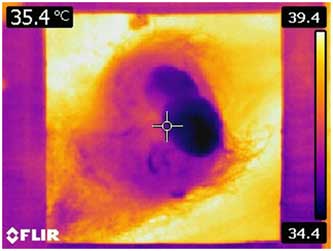
To measure scrotal surface temperature, IR photographs of the scrotal area were captured from all castrated calves on days 1, 2 and 6 of the trial using a handheld IR camera, FLIRE50 (FLIR Systems Australia Pty Ltd, Mulgrave, Vic, Australia), with a thermal range of −20°C to 120°C and a sensitivity of 0.045°C. A 10×10 cm cardboard frame was used to standardise the image area for each photograph. The camera frame was aligned with the cardboard frame and held above the scrotal area with the scrotum in the centre for each photograph. This ensured the camera lens was at a consistent distance of 0.5 m from the scrotal area for each image. This distance, along with an emissivity value of 0.95, was entered into the IR camera for calibration. The camera lens was focused appropriately for each photograph. The quality of each photograph was checked by the operator on the screen of the camera immediately after it was taken, allowing for additional photographs to be taken if necessary. Ambient temperature and humidity were monitored and recorded at the time each photograph was captured and were entered into the IR camera for calibration every 30 min during the data collection period. Images were analysed for maximum temperature using a thermal imaging software program, FLIR Tools Software (FLIR Systems Australia Pty Ltd) (Figure 1). This software allowed for analysis of a specific area using a geometric figure drawn on the photograph. A square was drawn immediately inside the cardboard frame in each photograph and the maximum temperature within this area was calculated.
Infrared image of a calf castration wound analysed for maximum surface temperature using a thermal imaging software program, FLIR Tools Software (FLIR Systems Australia Pty Ltd).

Wound morphology score
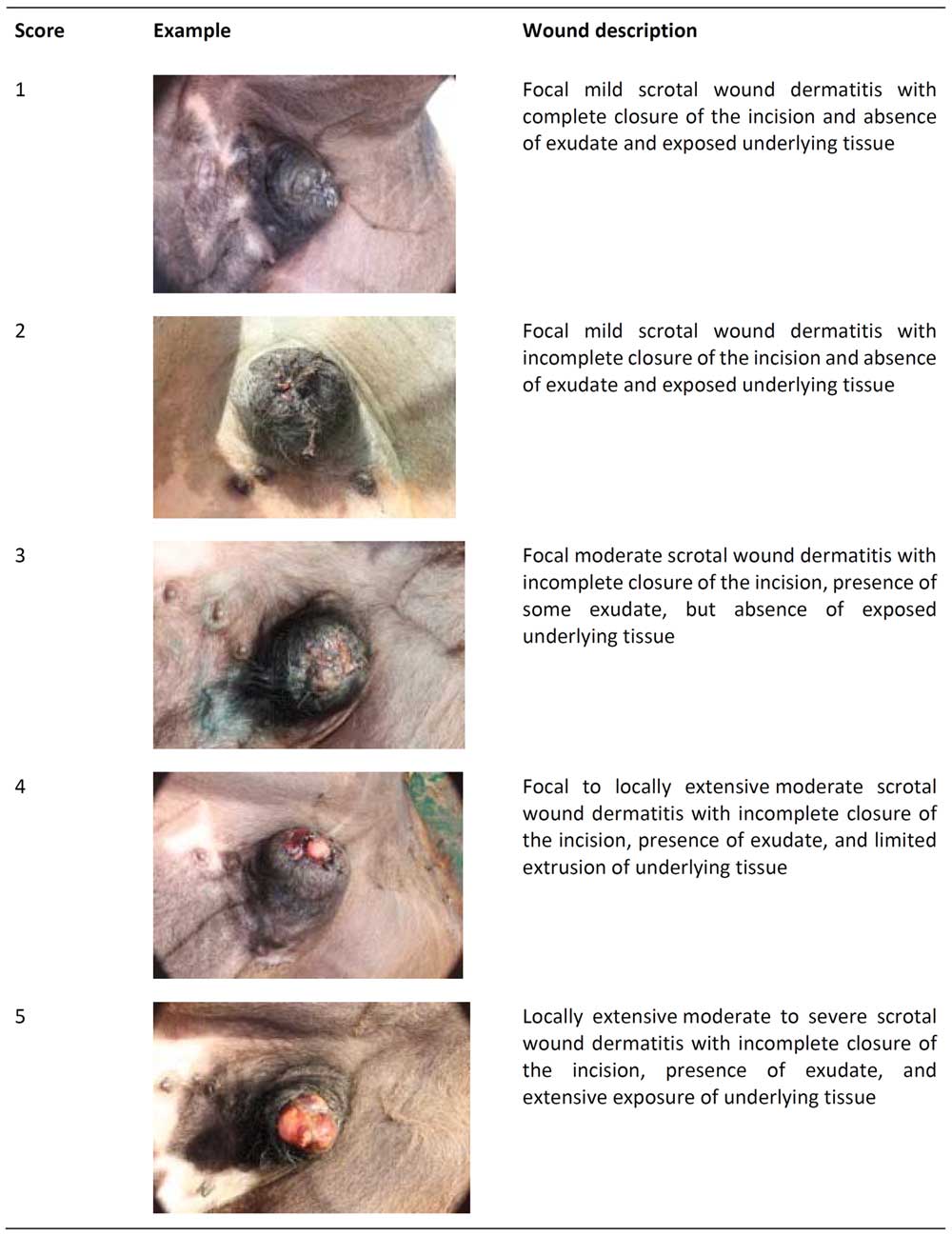
Digital photographs of the scrotal area were taken from all castrated calves on days 1, 2 and 6. These photographs were later scored for visible evidence of inflammation and healing using a customised numerical rating scale of 1 to 5 as described in Figure 2.
Customised numerical rating scale used to score calf castration wound morphology.

Statistical analysis
Data on ADG, each behavioural state (Table 1), scrotal diameter and maximum scrotal temperature were subjected to restricted maximum likelihood (REML) for repeated measures using the linear mixed models procedure in Genstat® 17th Edition statistical software (VSN International Ltd, Hemel Hempstead, Hertfordshire, UK). Data on each point behaviour (Table 1) was subjected to REML using the generalised linear mixed models procedure with a Poisson distribution. For ADG, the fixed effects of the model were treatment×day, treatment and day. For each behaviour (Table 1), the fixed effects of the model were treatment×time-point, treatment, time-point and BW (day 0). Data on ambient temperature and ambient humidity was subjected to a non-parametric Spearman’s rank correlation. A strong negative correlation (R=−0.84) was identified, therefore only ambient temperature was included in the model for scrotal diameter and maximum scrotal temperature. For scrotal diameter and maximum scrotal temperature, the fixed effects of the model were treatment×day, treatment, day, BW (day 0) and ambient temperature. The reason BW (day 0) and ambient temperature were included in the models as fixed effects, was because the assumption was made that there may be a correlation between these variates and the independent variables measured. The random effect of all models was calf ID. Due to the significance of BW in the models for scrotal diameter and maximum scrotal temperature, data on BW and scrotal diameter or maximum scrotal temperature were subjected to a non-parametric Spearman’s rank correlation. Wound appearance scores were subjected to ordinal logistic regression (OLR) in ASReml® 3.0 statistical software (VSN International Ltd). The fixed effects of the model were treatment×day, treatment, day and BW (day 0) and the random effect of the model was calf ID. Insignificant fixed effects were dropped from all models in Genstat® and ASReml® using a backward elimination approach. Data from the REML analyses are presented as predicted means±SEM. Data from the OLR analysis are presented as cumulative odds ratios with the statistical probabilities of wounds having inflammation scores of Y=1, 2, 3, 4 and 5. For all statistical calculations P values⩽0.05 were considered statistically significant and P values >0.05 and ⩽0.06 were considered trends. Where significant effects were found, post hoc pair-wise comparisons using LSDs were conducted to analyse differences between groups.
Results
Animals and environment
Calves had a mean initial BW of 107.68±26.30 kg. Mean ambient temperature and humidity during data collection on days 1, 2 and 6 were as follows: 33.99±0.28°C (range 31.10°C to 38.60°C), 15.37±0.16% (range 12.40% to 16.90%); 24.32±0.30°C (range 22.60°C to 30.90°C), 48.73±1.05% (range 33.90% to 60.00%); and 38.76±0.21°C (range 36.80°C to 41.70°C), 18.66±0.52% (range 13.60% to 27.00%), respectively.
Average daily gain
There was a significant effect of day (P<0.001), with ADG lower on day 1 (−1.29±0.56 kg) than on days 2 (0.75±0.56 kg) and 6 (0.94±0.56 kg). There was no significant effect of treatment (P=0.7).
Behaviour
The behaviours, eating, walking with a limp, lying abnormally, back arching and kicking occurred too infrequently for statistical analysis. Behaviours influenced by time only are neither presented nor discussed.
There was a significant effect of treatment on the frequency of foot stamps (P=0.005), with SHAM calves displaying less (0.19±0.03), and C calves displaying more (1.11±0.20) foot stamps than CBM, CTA and CBMTA calves (0.85±0.15, 0.68±0.12 and 0.56±0.10, respectively). There was a trend for treatment to have a significant effect on duration of time spent walking with hypometria, observed as a ‘stiff gait’ (P=0.06), with SHAM calves spending no time (0±0.93 s), C calves spending the greatest duration of time (4.08±1.00 s), and CBM, CTA and CBMTA calves spending an intermediate duration of time (0.99±0.92, 1.18±0.97 and 1.85±0.99 s, respectively) walking with a stiff gait. There was no significant effect of treatment on the frequency or duration of any other behaviour. There was no significant effect of BW on the frequency or duration of any of the behaviours.
Scrotal diameter
There was a significant effect of BW (P<0.001), with a strong positive correlation (R=0.73) between BW and scrotal diameter. There was no significant effect of treatment (P=0.09), day (P=1) or ambient temperature (P=1) on scrotal diameter.
Maximum scrotal temperature
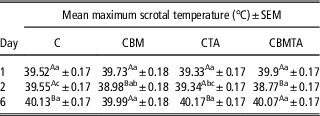
There was a significant treatment×day interaction (P=0.004) for maximum scrotal temperature. Maximum scrotal temperatures were lower in CBM and CBMTA calves than C calves on day 2. Maximum scrotal temperatures were also lower in CBMTA calves than CTA calves on day 2. Maximum scrotal temperatures of C and CTA calves were greater on day 6 than on days 1 and 2. Maximum scrotal temperatures of CBM and CBMTA calves were lower on day 2 than on days 1 and 6 (Table 2). There was a significant effect of BW (P<0.001), with a weak negative correlation (R=−0.43) between BW and maximum wound temperature. There was no significant effect of ambient temperature (P=0.8).
Mean maximum scrotal temperature of castrated calves in each treatment group on days 1, 2 and 6 following treatment

C=surgical castration; CBM=surgical castration with pre-operative buccal meloxicam; CTA=surgical castration with post-operative topical anaesthetic; CBMTA=surgical castration with pre-operative buccal meloxicam and post-operative topical anaesthetic.
A significant effect of day×treatment was found (P=0.004).
A,BValues within a column with different superscripts differ significantly at P⩽0.05.
a,b,cValues within a row with different superscripts differ significantly at P⩽0.05.
Wound morphology score
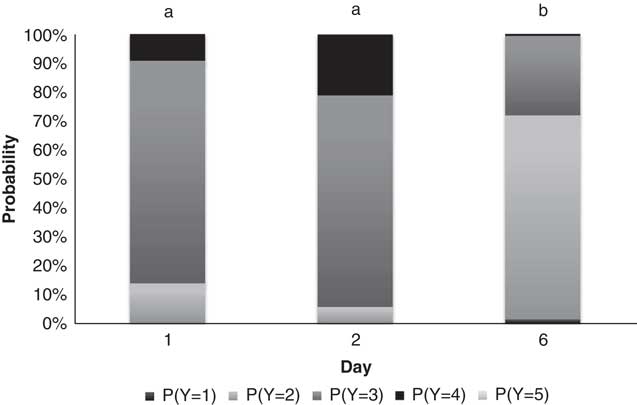
There was a significant effect of day (P<0.001), with wounds having lower scores on day 6 than on days 1 and 2 (Figure 3). There was no significant effect of treatment (P=0.5) or BW (P=0.5).
Probability of wounds of all castrated calves displaying wound morphology scores (Y; 1, 2, 3, 4, 5) on days 1, 2 and 6 following treatment. A significant effect of day was found (P<0.001). a,bDays with different letters differ significantly at P⩽0.05.

Discussion
We evaluated the effects of TA and BM formulations, alone and in combination, on ADG, behaviour, scrotal diameter, maximum scrotal temperature and wound appearance score following surgical castration in beef calves. Our results suggest that TA and BM reduced post-operative pain and that BM reduced wound inflammation of calves that had been surgically castrated. This was demonstrated through a reduction in some pain-related behaviours within a 5-h period following castration when TA, BM or a combination of TA and BM had been administered. The anti-inflammatory effect of BM was shown through reduced maximum scrotal temperature 2 days following treatment when BM or a combination of TA and BM had been administered.
In this study, there was no effect of treatment on ADG, suggesting the low ADG on day 1 was most likely due to the long (5 h) separation of calves from their mothers on day 0 and therefore reduced milk intake and increased stress experienced (Perez-Torres et al., Reference Perez-Torres, Orihuela, Corro, Rubio, Alonso and Galina2016). In addition, these calves were unaccustomed to human handling. Therefore, processing of animals through handling facilities may have been an additional stressor potentially contributing to reduced ADG (Petherick et al., Reference Petherick, Doogan, Venus, Holroyd and Olsson2009). Significantly reduced weight gain following surgical castration has been shown to occur in calves (Fisher et al., Reference Fisher, Crowe, Varga and Enright1996; Ting et al., Reference Ting, Earley and Crowe2003; Bretschneider, Reference Bretschneider2005; Petherick et al., Reference Petherick, Small, Mayer, Colditz, Ferguson and Stafford2015). However, this is not always the case (Molony et al., Reference Molony, Kent and Robertson1995; Stafford et al., Reference Stafford, Mellor, Todd, Bruce and Ward2002; Webster et al., Reference Webster, Morin, Jarrell, Shipley, Brown, Green, Wallace and Constable2013). As the calves in the current study were unweaned, they had a readily available source of nutrients provided in their mothers’ milk, and therefore did not need to actively source feed through grazing. This may be why there was no effect of castration on ADG. In addition, calves may suckle more as a response to pain, as suckling of milk in mammals has been suggested to have an analgesic effect via activation of the endogenous opioid system (Noonan et al., Reference Noonan, Rand, Priest, Ainscow and Blackshaw1994; Landa, Reference Landa2003). This could be why there was no apparent effect of castration on ADG. Furthermore, larger treatment group sizes may have been necessary to demonstrate potential differences due to individual variability of weight gain as an outcome (Webster et al., Reference Webster, Morin, Jarrell, Shipley, Brown, Green, Wallace and Constable2013).
Behaviour has been used extensively to evaluate pain following castration of calves (Ting et al., Reference Ting, Earley and Crowe2003; Petherick et al., Reference Petherick, Small, Mayer, Colditz, Ferguson and Stafford2015). As in the current study, an increase in the frequency of foot stamps has previously been observed in surgically castrated cattle (Fisher et al., Reference Fisher, Knight, Cosgrove, Death, Anderson, Duganzich and Matthews2001; Sutherland et al., Reference Sutherland, Ballou, Davis and Brooks2013) and is indicative of irritation, possibly due to pain sensation, following the surgical castration procedure (Fisher et al., Reference Fisher, Knight, Cosgrove, Death, Anderson, Duganzich and Matthews2001). Abnormal standing and walking have also been shown to occur following surgical castration of calves (Molony et al., Reference Molony, Kent and Robertson1995; Webster et al., Reference Webster, Morin, Jarrell, Shipley, Brown, Green, Wallace and Constable2013) and this behaviour is considered likely to reduce stimulation of injured tissue (Prunier et al., Reference Prunier, Mounier, Neindre, Leterrier, Mormede, Paulmier, Prunet, Terlouw and Guatteo2013). In our study, there were behavioural indications that both TA and BM reduced the pain of surgical castration during the 5-h post-operative period, observed as a significant reduction in the frequency of foot stamps and a tendency for reduced duration of time spent walking with a stiff gait. This is consistent with previous findings in beef calves (Lomax and Windsor, Reference Lomax, Dickson, Sheil and Windsor2014) and lambs (Lomax et al., Reference Lomax and Windsor2010; Small et al., Reference Small, Belson, Holm and Colditz2014). Topical anaesthetic has been shown to reduce pain-related behaviour for at least 4 h following surgical castration of beef calves (Lomax and Windsor, Reference Lomax, Dickson, Sheil and Windsor2014) and for at least 5 h following combined surgical castration and tail docking of lambs (Lomax et al., Reference Lomax and Windsor2010), as scored using a numerical rating scale. Buccal meloxicam has previously been shown to reduce the amount of time lambs spend standing in a normal posture, standing in a hunched posture, standing in a stretched posture and walking with a stiff gait in an 8-h period following combined surgical castration and tail docking. It also reduced the amount of time lambs spent in combined abnormal postures and behaviours during the 8-h period (Small et al., Reference Small, Belson, Holm and Colditz2014).
In the current study, post-treatment differences between groups were not detected for many behaviours, considered likely due to the overall limited expression of these during the observation period. Temporary separation of calves from their mothers during the experimental period may have attenuated pain-related behavioural responses. Calves appeared to be motivated to reunite with their mothers, as suggested by an increased degree of vocalisation expressed during the behavioural observation period. This motivation to reunite with their mothers possibly shifted the calves’ attention from the experience of pain (Petherick et al., Reference Petherick, Small, Mayer, Colditz, Ferguson and Stafford2015).
Scrotal size has been used to measure wound inflammation and healing following surgical castration (Mintline et al., Reference Mintline, Varga, Banuelos, Walker, Hoar, Drake, Weary, Coetzee, Stock and Tucker2014; Petherick et al., Reference Petherick, Small, Reid, Colditz and Ferguson2014 and Reference Petherick, Small, Mayer, Colditz, Ferguson and Stafford2015; Olson et al., Reference Olson, Ralston, Burwash, Matheson-Bird and Allan2016), as extravasation of blood and onset of inflammation following surgical tissue injury is often observed visually (Gregory, Reference Gregory2004). Physiological processes following tissue injury include hyperaemia, due to production of vasoactive metabolites and the release of histamine from mast cells, causing vasodilatation, an increase in vascular permeability, and extravasation of plasma and inflammatory cells into the extracellular space surrounding the wound to prevent infection and regulate wound healing (Harper et al., Reference Harper, Young and McNaught2014). In the current study, there was no significant effect of treatment on scrotal size. This was also the case for a previous study that found no effect of the non-steroidal anti-inflammatory drug (NSAID) flunixin, on scrotal size (Mintline et al., Reference Mintline, Varga, Banuelos, Walker, Hoar, Drake, Weary, Coetzee, Stock and Tucker2014). However, in another previous study, oral meloxicam was shown to reduce the increase in scrotal diameter of calves for the first 3 days following surgical castration (Olson et al., Reference Olson, Ralston, Burwash, Matheson-Bird and Allan2016). It is possible that differences in methodology may have contributed to the contrasting results. The previous study investigating oral meloxicam measured the mid-scrotal diameter whilst calves were standing (Olson et al., Reference Olson, Ralston, Burwash, Matheson-Bird and Allan2016), as opposed to measurement of the base of the scrotum whilst calves were in lateral recumbency in the current study. With calves standing, it could be assumed that gravity would have caused swollen tissue and fluid to collect towards the distal scrotum and perhaps provide a measurement of standing rather than recumbent scrotal oedema. This may also explain why differences in scrotal size were not detected across experimental days in the current study. The effect of BW on scrotal diameter showed heavier calves to have a larger scrotal diameter, likely due to a pre-treatment difference in scrotal and testicular development.
Infrared thermography has been used as a non-invasive, indirect measure of inflammation (Wright et al., Reference Wright, Kroner and Draijer2006; Celeste et al., Reference Celeste, Deschesne, Riley and Theoret2013). Skin temperature is influenced by cutaneous cell metabolism and blood flow, with an increase in temperature considered reflective of an increase in these factors (Celeste et al., Reference Celeste, Deschesne, Riley and Theoret2013). Infrared thermography has previously been used to correlate an increase in scrotal temperature due to the presence of inflammation caused by surgical and band castration in beef calves (Moya et al., Reference Moya, Gonzalez, Janzen, Caulkett, Fireheller and Schwartzkopf-Genswein2014). The effect of NSAIDs on scrotal temperature following castration has also previously been investigated (Mintline et al., Reference Mintline, Varga, Banuelos, Walker, Hoar, Drake, Weary, Coetzee, Stock and Tucker2014; Moya et al., Reference Moya, Gonzalez, Janzen, Caulkett, Fireheller and Schwartzkopf-Genswein2014), with no effect found. In the current study, BM reduced maximum scrotal temperature on day 2 following surgical castration. This may be attributable to the NSAID used; previous studies used ketoprofen (Moya et al., Reference Moya, Gonzalez, Janzen, Caulkett, Fireheller and Schwartzkopf-Genswein2014), with a half-life of 0.42 h (Coetzee, Reference Coetzee2011), or flunixin (Mintline et al., Reference Mintline, Varga, Banuelos, Walker, Hoar, Drake, Weary, Coetzee, Stock and Tucker2014), with a half-life of 3 to 8 h (Coetzee, Reference Coetzee2011). In comparison, meloxicam is considered to have an extended half-life of 27 h (range 19.97 to 43.29 h) (Coetzee et al., Reference Coetzee, KuKanich, Mosher and Allen2009; Coetzee, Reference Coetzee2011) and may explain the apparent reduction in inflammation on day 2 following castration. The increase in maximum scrotal temperature on day 6 from days 1 and 2 in C and CTA calves and from day 2 in CBM and CBMTA calves may be due to loss of the initial scab or re-vascularisation of the tissue, as day 6 was when lower wound morphology scores were detected (Figure 3). This correlation between greater surface temperatures and healing has previously been shown for castration wounds in beef calves (Mintline et al., Reference Mintline, Varga, Banuelos, Walker, Hoar, Drake, Weary, Coetzee, Stock and Tucker2014) and cutaneous wounds in horses (Celeste et al., Reference Celeste, Deschesne, Riley and Theoret2013). Although the present study found an effect of BW on scrotal temperature, the correlation was weak with no obvious trend identified. This may require further research to clarify individual animal effects on wound surface temperature.
Wound inflammation and healing following surgical castration of calves has previously been assessed using numerical rating scales based on visual assessment (Mintline et al., Reference Mintline, Varga, Banuelos, Walker, Hoar, Drake, Weary, Coetzee, Stock and Tucker2014; Petherick et al., Reference Petherick, Small, Reid, Colditz and Ferguson2014 and Reference Petherick, Small, Mayer, Colditz, Ferguson and Stafford2015). Wound healing was investigated in the current study, as an increased rate of contraction in wound surface area over an extended period of healing has been shown to occur following application of TA to mulesing wounds in lambs (Lomax et al., Reference Lomax, Sheil and Windsor2008). In the current study, TA did not appear to affect inflammation and healing of surgical castration wounds in calves, as assessed visually over a 6-day period. Buccal meloxicam also had no effect on this outcome and is consistent with findings from previous studies showing no effect of the NSAIDs ketoprofen (Petherick et al., Reference Petherick, Small, Reid, Colditz and Ferguson2014) and flunixin (Mintline et al., Reference Mintline, Varga, Banuelos, Walker, Hoar, Drake, Weary, Coetzee, Stock and Tucker2014) on wound morphology following surgical castration in calves. In the present study, the effect of day on wound morphology scores was consistent with the stages of wound inflammation and healing. At early stages from 1 to 3 days post-wounding, lesions are characterised by formation of a fibrin-blood, activation of epidermal edges, and influx of inflammatory cells dominated by neutrophils. From 4 to 7 days post-wounding, lymphocytes and macrophages are present, epidermal edges migrate, granulation tissue commences to proliferate, and a scab begins to form (Braiman-Wiksman et al., Reference Braiman-Wiksman, Solomonik, Spira and Tennenbaum2007). This latter stage of healing was observed for most calves by day 6, hence the improvement in wound morphology scores.
In conclusion, surgical castration resulted in an increased frequency of foot stamps and a tendency for an increased duration of time spent walking with a stiff hypometric gait. The frequency or duration of these behaviours was reduced by TA and BM, alone and in combination, suggesting both alleviated pain to some degree during the post-operative period. Buccal meloxicam reduced maximum scrotal temperature 2 days following surgical castration, consistent with an anti-inflammatory effect.
Acknowledgements
The authors gratefully acknowledge the financial support of Meat and Livestock Australia and the provision of TA from Bayer Animal Health, Australia and BM from Troy Laboratories Pty Ltd. The authors thank Steve Burgun and his staff at ‘Arthursleigh Farm’ and students from the University of Sydney, including Charissa Harris, Anna Cooper, Sarah Legge and Esteban Martinez, for their technical assistance.
Declaration of interest
There are no conflicts of interest to declare.
Ethics statement
The experimental protocol was approved by the Animal Ethics Committee of the University of Sydney and conformed to the Australian animal welfare standards and guidelines for cattle (AHA, Reference Amatayakul-Chantler, Hoe, Jackson, Roca, Stegner, King, Howard, Lopez and Walker2014). Animals were sourced from a commercial beef herd and were due to undergo routine castration, as per normal practice on the property.
Software and data repository resources
Experimental data are not deposited in an official repository.