

Introduction
Sweet potato stem nematode disease is one of the three serious diseases of sweet potatoes in China. This disease usually decreases sweet potato yield by 20–50% and, in seriously diseased fields, no yield at all may be obtained (Xie et al., Reference Xie, Yin, Dai and Qiu2004). Using sweet potato varieties that are resistant to stem nematode disease is one economical and efficient approach to control the disease. There is a significant negative correlation between disease resistance and the starch and soluble sugar contents of sweet potatoes, and the major objectives of sweet potato breeding in China are to improve these three characteristics (Ma et al., Reference Ma, Li, Xie, Li, Zhu and Jiang1997). Thus, it is necessary to develop molecular markers closely linked to a gene for stem nematode resistance and to combine conventional breeding techniques and marker-assisted breeding for sweet potato varieties with high quality, high yield and high resistance to stem nematode disease.
There are some reports of molecular markers linked to nematode disease resistance genes. Ukoskit et al. (Reference Ukoskit, Thompson, Watson and Lawrence1997) obtained a marker linked to sweet potato root knot nematode disease gene by using a bulked segregant analysis (BSA)–random amplified polymorphic DNA (RAPD) method and this study provided an approach for marker-assisted selective breeding of sweet potato. Using an amplified fragment length polymorphism (AFLP)–analysis of molecular variance (AMOVA) method, Mcharo et al. (Reference Mcharo, LaBonte, Clark, Hoy and Oard2005) obtained five and four markers linked to sweet potato root knot nematode disease gene, with two F1 segregations, respectively. Zhou et al. (Reference Zhou, Wang, Ma, Li, Xie and Li2005) and Jiang et al. (2007) developed one RAPD marker linked to sweet potato stem nematode disease resistance gene in an F1 single-cross population of Xu781 (resistant parent)×Xushu18 (susceptible parent). But the genetic distances between these molecular markers and the resistance gene were all over 17.9 cM, so it was therefore necessary to develop molecular markers more closely linked to the resistance gene in sweet potato.
In the present study we developed two AFLP markers closely linked to the sweet potato stem nematode disease resistance gene by using the F1 population of Xu781×Xushu18, and these two markers were shown to be common in ten main sweet potato cultivars from China.
Materials and methods
Plant materials
Sweet potato cv. Xu781, resistant to stem nematode disease, cv. Xushu18, susceptible to this disease, the 186 F1 individuals, and ten main cultivars from China were employed in this study. Of the ten main cultivars, Lushu 3, Ji 15, Ji 16 and Yushu 13 are resistant to stem nematode disease, and Lizixiang, Nanshu 88, Beijing 553, Jishu 4, Jishu 98 and Wanshu 1 are susceptible. Identification of the resistance of the F1 population was conducted in the sweet potato stem nematode nursery of Xuzhou Sweet Potato Research Centre, Xuzhou, Jiangsu, according to the method of Xie et al. (Reference Xie, Ma, Li, Li, Li and Ma2002). The plants with control of stem nematode disease ≥60% were resistant, and the plants with a control effect <60% were susceptible.
DNA extraction and AFLP procedure
Total genomic DNA was isolated from bulked leaf tissues from the plants, using the modified CTAB (hexadecyltrimethyl ammonium bromine) method (Li et al., Reference Li, Jie and Liu2007), and the quality and amount of DNA were tested by electrophoresis on 1% agarose gel stained with ethidium bromide and visualized under UV illumination.
The AFLP procedure was conducted according to the protocol developed by Vos et al. (Reference Vos, Hogers, Bleeker, Reijans, Van de Lee and Hornes1995). Genomic DNA was digested with EcoRI and MseI at 37°C for 7 h. Digested DNA fragments were ligated to EcoRI and MseI adapters with T4 DNA ligase at 16°C for 12 h. After ligation, the reaction mixture was used as template DNA for pre-amplification. Pre-amplification was performed using primers with one selective nucleotide, followed by selective amplification using primers with three selective nucleotides. The reactions were conducted in a 20 μl reaction solution containing 2 μl 10×PCR buffer, 0.5 μl dNTPs (10 mmol/l), 0.2 μl Taq polymerase (5 U/μl), 2 μl EcoRI primer and 2 μl MseI primer. AFLP primers were provided by Shanghai Sangon Biological Engineering Technology Service Company, China.
Development of AFLP markers
Bulked segregant analysis (BSA) was performed as described by Michelmore et al. (Reference Michelmore, Paran and Kesseli1991). The eight most resistant and eight most susceptible F1 single-cross progenies, which displayed a consistent disease index over 3 years, were selected to construct resistant bulk and susceptible bulk, respectively, with a final concentration of 50 ng/μl. The two DNA bulks and the two parental DNAs were subjected to PCR to screen the polymorphic primer combinations, which were used to develop AFLP markers linked to stem nematode disease resistance with eight individuals from each of the bulks and 186 F1 progenies. Selective amplification was first performed for 13 cycles at 94°C for 5 min, 65°C for 30 s and 72°C for 1 min, and then performed for 25 cycles at 94°C for 30 s, 56°C for 30 s, 72°C for 1 min and a final extension at 72°C for 10 min. PCR products were analysed on a 5% polyacrylamide gel and stained using silver nitrate (He et al., Reference He, Liu, Ishiki, Zhai and Wang2006). The genetic distance between the obtained markers and the resistance gene was calculated using Mapmaker 3.0 software ( http://www-genome.wi.mit.edu/genome-software) and maximum likelihood estimation (MLE) to construct a linkage map. The ten sweet potato varieties widely planted in China were used to test the developed AFLP markers.
Results and analysis
Inheritance of stem nematode resistance
The identification of stem nematode resistance in 2003–2005 showed that of 186 F1 progeny, 96 were classified as resistant and 90 as susceptible. The ratio of resistant to susceptible progenies fitted a 1:1 ratio by chi-square test (=0.19<χ20.05=3.84). Consequently, single hexasomic inheritance was proposed, with genotypes of resistant and susceptible parents represented as Rrrrrr and rrrrrr, respectively.
Development of AFLP markers and construction of a linkage map
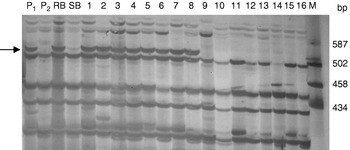
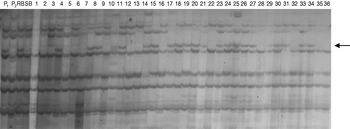
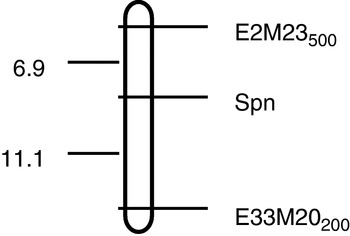
Using bulked segregant analysis, 800 AFLP primer combinations were screened with the resistant and susceptible bulked DNA, and 245 of them showed polymorphic bands between the two bulks. Primer combinations detecting polymorphism between the resistant and susceptible bulks were used to amplify the two parents and eight individuals from each of the bulks (Fig. 1). The results indicated that primers E2M23 and E33M20 produced specific bands of about 500 bp and 200 bp in length, respectively, in the resistant plants but not in the susceptible plants, suggesting that the markers, named E2M23500 and E33M20200, linked to a gene for stem nematode resistance. The sequences of E2M23 were 5′-GACTGCGTACCAATTCACA-3′ and 5′-GATGAGTCCTGAGTAACCC-3′ and the sequences of E33M20 were 5′-GACTGCGTACCAATTCGAG-3′ and 5′-GACTGCGTACCAATTCTGT-3′. The amplified analysis of the 186 F1 progenies using E2M23 and E33M20 showed that the number of crossing-over resistant and susceptible progenies was 13 and 20, respectively (Fig. 2). The genetic distances between the two markers and the stem nematode resistance gene were 6.9 cM and 11.1 cM, respectively, measured using Mapmaker 3.0 (Fig. 3).
PCR amplification of the parents, two bulks, eight resistant plants and eight susceptible plants with primer combination E2M23. The arrow shows the band of interest. Lanes: P1, Xu781; P2, Xushu18; RB, resistant bulk; SB, susceptible bulk; 1–8, resistant plants; 9–16, susceptible plants; M, DNA marker.

PCR amplification of F1 segregation population with primer combination E2M23. The arrow shows the band of interest. Lanes: P1, Xu781; P2, Xushu18; RB, resistant bulk; SB, susceptible bulk; 3, 7, 8, 10, 11, 14, 15, 17–20, 23–27, 30 and 31, resistant plants; 1, 2, 4–6, 9, 12, 13, 16, 21, 22, 28, 29, 32 and 33–36, susceptible plants.

The genetic linkage map of AFLP markers linked to the sweet potato stem nematode resistance gene (Spn).

Identification of AFLP markers in sweet potato varieties
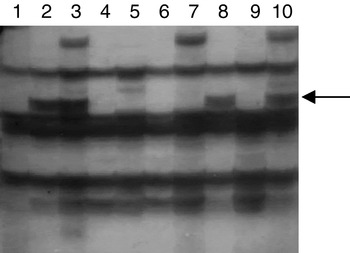
The two markers, E2M23500 and E33M20200 were used to test ten sweet potato varieties widely planted in China and the results showed that four resistant varieties (Lushu 3, Ji 15, Ji 16 and Yushu 13) amplified the specific bands, but the specific bands were not found in six susceptible varieties (Lizixiang, Nanshu 88, Beijing 553, Jishu 4, Jishu 98 and Wanshu 1) (Fig. 4). These results indicated that the two markers are closely linked to the sweet potato stem nematode resistance gene, suggesting that they can be applied in molecular marker-assisted breeding for stem nematode resistance in the sweet potato.
PCR amplification of the ten main Chinese sweet potato varieties with primer combination E2M23. The arrow shows the band of interest. Lanes: 1, Lizixiang; 2, Lushu 3; 3, Ji 16; 4, Nanshu 88; 5, Beijing 553; 6, Jishu 4; 7, Jishu 98; 8, Ji 15; 9, Wanshu 1; 10, Yushu 13.

Discussion
It is a challenge for a sweet potato breeder using conventional breeding techniques to breed new varieties with high yield and quality and resistance to stem nematode disease because of the characteristics of this crop, including its hexaploid nature, incompatibility, natural heterozygosity and a significantly negative correlation between disease resistance and the content of starch. Molecular marker techniques can not only enhance selection efficiency but also lay a foundation for map-based cloning of a resistance gene. To date, there is no high-density molecular linkage map of sweet potato, so BSA is one of the best methods to develop molecular markers linked to the sweet potato stem nematode resistance gene. Several molecular markers linked to the sweet potato nematode disease resistance gene have been preliminarily obtained by using the BSA method (Ukoskit et al., Reference Ukoskit, Thompson, Watson and Lawrence1997; Mcharo et al., Reference Mcharo, LaBonte, Clark, Hoy and Oard2005; Zhou et al., Reference Zhou, Wang, Ma, Li, Xie and Li2005; Jiang et al., 2007), but the genetic distances between these molecular markers and the resistance gene were all over 17.9 cM, so it was therefore necessary to develop molecular markers closely linked to the resistance gene in sweet potato.
AFLP is a more stable, reliable, effective, polymorphic technique than other DNA fingerprints [RAPD, restriction fragment length polymorphism (RFLP) and short sequence repeats (SSR)]. This technique has been used in the germplasm evaluation, fingerprint analysis, genetic map construction and molecular marker screening of sweet potato (Zhang et al., Reference Zhang, Rossel, Kriegner and Hijmans1994; Kriegner et al., Reference Kriegner, Cervantes, Burg, Mwanga and Zhang2003; Mcharo et al., Reference Mcharo, LaBonte, Clark, Hoy and Oard2005; He et al., Reference He, Liu, Ishiki, Zhai and Wang2006). In the present study two AFLP markers linked to the sweet potato stem nematode resistance gene have been developed and the distance between them and the resistance gene is the shortest to date. These two AFLP markers were used to identify ten sweet potato varieties widely planted in China and results consistent with conventional resistance identification were obtained, indicating that the two markers can be applied in molecular marker-assisted breeding for stem nematode resistance in sweet potato.
Acknowledgements
This work was supported by The National Natural Science Foundation of China (No. 30671321), the ‘863 Project’ of China (No. 2006AA100107), the National Science and Technology Project of China (No. 2006BAD01A06) and the ‘948 Project’ for Chinese Agriculture (No. 2006-G21).