

Introduction
Heros managuense and Cichlasoma trimaculatum, belonging to family Cichlidae of the order Perciformes and class Actinopterygii, are well-known ornamental fish introduced to China. H. managuense possesses characteristics including a large form, quick growth, strong resistance to disease and wide adaptability (Ye, Reference Ye2000), and C. trimaculatum is of great ornamental value due to its beautiful pattern and brilliant colour (Wang et al., Reference Wang, Fang, Chen and Li2002). In this research the method of hybridization was used to breed a new variety. Crossbreeding of fish has been commonplace in recent years (Ou et al., Reference Ou, Li and Zhou2000; Lin et al., Reference Lin, Li, Cui and Cao2001; Ma et al., Reference Ma, Wang and Chen2002; Wang et al., Reference Wang, You, Ni, Zhang and Li2003; Yu et al., Reference Yu, Xia, Yang, He and Wu2003; Ji et al., Reference Ji, Chen, Zhao and Deng2005; Cao et al., Reference Cao, Ding, Jia, Xia and Wu2006). However, the main focus of earlier studies was concerned with early embryonic development, hatching rate, survival rate and growth rate. In the present paper, the F1 hybrid offspring of the distant hybridization between C. trimaculatum (male) and H. managuense (female) were successfully cultivated through artificial fertilization. The karyotypes, silver–nucleolar organizer regions (Ag–NORs) and C-bands of the hybrid parents and their offspring were observed, and their genetic relation is discussed.
Materials and methods
Sample collection
Adult C. trimaculatum (4 males) and H. managuense (4 females) were obtained from Fuzhou Flower Bird Market, China, and five individuals (4 females and 1 male) of F1 hybrid offspring were bred by artificial fertilization in the laboratory.
Karyotype analysis
The chromosome metaphases were prepared according to the methods described by Lin (Reference Lin1982), with some modification. A pericardial injection of active polyhydroxyalkanoic acid (PHA) was used. All fishes in the experiment were injected with PHA at a dose of 4–5 μg/g of bodyweight. After being treated for 24 h, the animals received an intraperitoneal injection of colchicine at a dose of 3–4 μg/g of bodyweight. Fifty metaphases were analysed for karyotype. Chromosomes were classified morphologically according to Levan (Reference Levan1964) .
Silver staining
Quick Ag–NOR staining was carried out according to the method of Howell and Black (Reference Howell and Black1980), with some modification. A combination of 50% AgNO3 and 2% gelatin (with 1% content of formic acid) were evenly mixed in a ratio of 2:1 and added to the newly prepared specimens. After covering with a coverslip, they were incubated at 60°C for 15–20 min on a hotplate, until the solution had turned a golden-brown colour. The slides were rinsed thoroughly in distilled water, and observed under a microscope after the specimens had been dried.
C-banding
A C-band staining technique for chromosomes was performed using the method of Sumner (Reference Sumner1972), with some modification. The aged slides were put into a solution of 0.2 mol/l HCl and treated for 15 min at room temperature, then taken out and rinsed in distilled water, treated for 15 min at a temperature of 60°C in 5% Ba(OH)2, rinsed in 0.2 mol/l HCl, rinsed in distilled water, treated for 1 h in 2× Standard Saline Citrate (SSC) at a temperature of 60°C, and stained with 1:10 Giemsa for 40 min. The dried specimens were observed under the microscope.
Results
Karyotypes
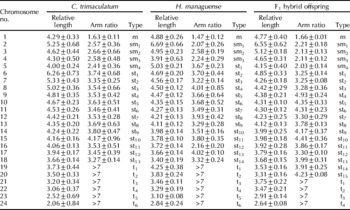
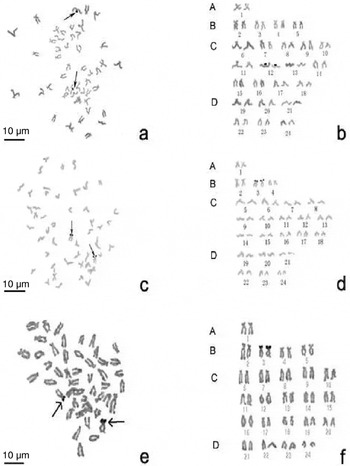
The chromosomes of 50 metaphase cells were counted, respectively, for C. trimaculatum, H. managuense and their hybrid offspring. More than 90%, 80% and 82% of the counted cells had 48 chromosomes, which confirmed that the diploid numbers of the two parents and their offspring were all 2n=48. The 24 pairs of chromosomes could be divided into four groups: A, B, C and D. In each group, the chromosomes showed a gentle gradation in size (Table 1, Fig. 1).
The metaphases (a, c, e) and karyotypes (b, d, f) of male Cichlasoma trimaculatum (a, b), female Heros managuense (c, d) and their F1 hybrid offspring (e, f). A, group of metacentric chromosomes; B, group of submetacentric chromosomes; C, group of subtelocentric chromosomes; D, group of telocentric chromosomes. (For details of 1–24 see Table 1.) The arrow indicates the satellite.

The karyotype data of Cichlasoma trimaculatum, Heros managuense and their F1 hybrid offspring

m, metacentric chromosome; sm, submetacentric chromosome; st, subtelocentric chromosome; t, telocentric chromosome.
In C. trimaculatum, groups A, B, C and D included one pair of metacentric (m), four pairs of submetacentric (sm), 13 pairs of subtelocentric (st) and six pairs of telocentric (t) chromosomes, respectively. Its karyotype formula was 2n=2m+8sm+26st+12t, and the number of chromosome arms was NF=58. In H. managuense, groups A, B, C and D included one pair of metacentric, three pairs of submetacentric, 14 pairs of subtelocentric and six pairs of telocentric chromosomes, respectively. The karyotype formula was 2n=2m+6sm+28st+12t, NF=56. In the hybrid offspring, groups A, B, C and D included one pair of metacentric, four pairs of submetacentric, 15 pairs of subtelocentric and four pairs of telocentric chromosomes, respectively, and the karyotype formula was 2n=2m+8sm+30st+8t, NF=58.
Neither satellite nor secondary constriction was discovered in either of the parents. In the hybrid offspring, however, a satellite was discovered on the tip of the long arm of one homologous chromosome of the pair sm1 (Fig. 1e,f). No heteromorphic sex chromosomes were observed in the two parents or in their offspring.
Ag–NORs
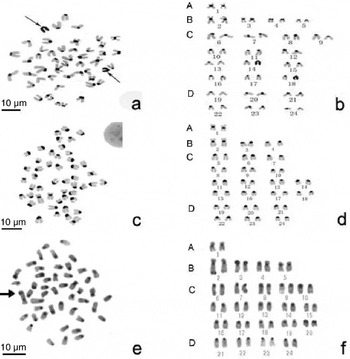
There were two Ag–NORs in the metaphase of the two parents and their offspring. The two Ag–NORs of C. trimaculatum were seen on the tips of the short arm of chromosome st7 (Fig. 2a,b). The two Ag–NORs of H. managuense were located on the tips of the short arm of chromosome sm2 (Fig. 2c,d). The two Ag–NORs of the F1 hybrid offspring were seen on the tips of the short arm of chromosome sm2 (Fig. 2e,f).
The metaphase (a, c, e) and karyotype (b, d, f) with NORs of male Cichlasoma trimaculatum (a, b), female Heros managuense (c, d) and their F1 hybrid offspring (e, f). A, group of metacentric chromosomes; B, group of submetacentric chromosomes; C, group of subtelocentric chromosomes; D, group of telocentric chromosomes. The arrows indicate Ag–NORs.

C-bands
Most chromosomes presented positive C-bands, and the size, position and staining intensity of C-bands were slightly different among the chromosomes. In C. trimaculatum, one homologous chromosome of the pair t1 was C-band negative, one of the pair st9 and one of st13 were C-band positive throughout all their length, and the others showed positive centromeric C-bands. On the short arms of chromosome st7, C-bands were darkly stained in the regions where the Ag–NORs were located (Fig. 3a,b).
The C-banded metaphase (a, c, e) and C-banded karyotype (b, d, f) of male Cichlasoma trimaculatum (a, b), female Heros managuense (c, d) and their F1 hybrid offspring (e, f). A, group of metacentric chromosomes; B, group of submetacentric chromosomes; C, group of subtelocentric chromosomes; D, group of telocentric chromosomes. The thin arrows indicate the C-band of whole chromosome st9 and st13, and the thick arrow indicates the C-banded satellite.

In H. managuense, all 48 chromosomes showed centromeric C-bands. In the silver-staining region on the short arm of chromosome sm2 the C-band was deeply stained (Fig. 3c,d).
In the F1 hybrid offspring, the chromosome sm1 presented both centromeric and satellite C-bands. The C-bands of chromosome sm2 were positive not only in the centromere but also in the short arms where Ag–NORs were located. The chromosome st15 showed a positive telomeric C-band on the short arm. Moreover, the other 43 chromosomes showed centromeric C-bands (Fig. 3e,f).
Discussion
Of the more than 2000 cytogenetically analysed species of fish, about 100 are known to possess sex chromosomes. However, only 40 show well differentiated sex chromosomes cytogenetically (Desprez et al., Reference Desprez, Melard, Hoareau, Bellemene, Bosc and Baroiller2003; Yang and Yu, Reference Yang and Yu2006). This reflects that most fish have not yet been possessed of the sex chromosome mechanism (Chen et al., Reference Chen, Wang, Wu and Xiao2005). In the present paper, no heteromorphic sex chromosome was found in either F1 hybrid offspring or the two parents. The diploid number of the F1 hybrid offspring was equal to that of its parents, and their chromosomes were all dominantly telocentric and subtelocentric. The F1 hybrid offspring had the same number of chromosome arms (NF=58) as the male parent, but this differed from the female parent (NF=56). Satellites were found in chromosome sm1 of F1 hybrid offspring, but not in either parent.
The number, position and characteristics of NORs can reflect the genetic relationship and chromosome evolution of species (Chang and Yu, Reference Chang and Yu1993). The NORs of both F1 hybrid offspring and the female parent were located in sm2, indicating that the F1 hybrid offspring inherit genetic characteristics of the female parent. Most C-bands were centromeric, and all the regions on which the NORs were located were deeply stained C-bands, revealing the parallelism between C-bands and Ag–NORs. For C. trimaculatum, the entire chromosomes of one of the st9 and st13 chromosomes stained darkly, indicating heterochromatin activation.
The filial generations of blue tilapia Oreochromis aureus (female) and mandarin fish Siniperca chuatsi (male) have the same diploid number (2n=44) and karyotype as the female parent, but different from the male parent (2n=48). This suggested that the filial generations arise from gynogenesis (Cao et al., Reference Cao, Ding, Jia, Xia and Wu2006). In the present paper, the filial generations have similar characteristics to the parents in diploid chromosome numbers and most centromeric C-bands. Moreover, the filial generations have an equal number of chromosome arms as the male parent, and the same locus of NORs as the female parent. This suggests that the filial generation inherited from both parents rather than by gynogenesis.
The chromosome study has great significance for analysing and forecasting the compatibility of distant hybridization of fish. The chromosome number and karyotype of crucian carp Carassius auratus and common carp Cyprinus carpio were more similar, and more than ten varieties of hybrid offspring of Carassius auratus and Cyprinus carpio were successfully produced (Xiao and Chen, Reference Xiao and Chen2002). Owing to the grass carp Ctenopharyngodon idellus (2n=48) being more different from the common carp Cyprinus carpio (2n=100) in chromosomes, no hybrid offspring can really survive (Ye et al., Reference Ye, Wu and Chen1989). Both grass carp Ctenopharyngodon idellus and Wuchang bream Megalobrama amblycephala have diploid chromosome numbers 2n=48, but they are more different from each other in chromosome morphology; the hybrid offspring express obvious differences in morphology. The vigour of the offspring was completely different (Lou, Reference Lou1999). The same was observed in the hybridization between mud carp Cirrhinus molitorella and Hunan Chinese mud carp Sinilabeo decorus tungting (Zhang et al., Reference Zhang, Liu, Wang and Jin1984; Wang et al., Reference Wang, Zhang and Jin1986). It is considered that the hybrid rate is higher when the karyotypes of the hybrid parents are more similar to each other.
Acknowledgements
This study was supported by the Scientific Research Program of the Science and Technology Department of Fujian, China (no. 2006F5033).