INTRODUCTION
Cocoyam (Xanthosoma sagittifolium (L.) Schott), a member of the Araceae family, is a subsistence and emergency food source in many parts of the world, but a major staple food crop in Nigeria (a leading producer of cocoyam), South Pacific Islands and some parts of Asia (Uwah et al., Reference Uwah, Udoh and Iwo2011). The corms and cormels are eaten boiled, fried, baked and roasted. In West Africa, the boiled cocoyam is sometimes pounded to produce a paste similar to pounded yam and eaten in the same manner. The corms and cormels may be peeled, dried and ground into flour and thus stored in a semi-processed form. The young leaves and petioles are made into soup, while the corms, cormels and leaves after curing can also be used as animal feed (Onwueme and Sinha, Reference Onwueme and Sinha1991). Cocoyams are the cheapest and most handy source of carbohydrate in meals that are recommended for aged people, diabetics, convalescents and most gastro-intestinal disorder patients and a good carbohydrate base for infant foods on account of their small-sized starch grains which are easily digested compared to yam (Dioscorea spp), cassava (Manihot spp) or sweet potato (Ipomoea batatas) (Som, Reference Som2007; Uwah et al., Reference Uwah, Udoh and Iwo2011). However, the crop has not received research attention particularly concerning its tillage and manure requirements.
Tillage and use of organic manure are important agronomic practices that sustain high crop and soil productivity. Studies on tillage requirement for cocoyam are few and gave differing results (Adekiya et al., Reference Adekiya, Ojeniyi and Agbede2011). Hence, there is need to study the tillage requirement and soil conditions influencing cocoyam in order to raise production level from the average yield of 5.1 Mt ha−1 to the potential yields of 8.0 Mt ha−1 and meet the demand for the corms and cormels. Also, previous studies were short-termed; aside from being inconclusive. Villanueva (Reference Villanueva1986) studied the effect of tillage intensity on production of upland taro (cocoyam) and found no significant differences between ploughing and harrowing once or twice. Ghosh et al. (Reference Ghosh, Ramanujam, Jos, Moorthy and Nair1988) recommended ploughing once with the incorporation of farmyard manure, followed by harrowing, and if necessary, either mounding or ridging. In the Philippines, Pardales and Villamayor (Reference Pardales and Villamayor1983) also found that ploughing and harrowing once was sufficient for taro (cocoyam) production. Enyi (Reference Enyi1967 cited by Onwueme, Reference Onwueme1978) reported that the yield of cocoyam (Xanthosoma spp.) is higher and corm shape is better when planted on ridges. Also, research information is quite scarce on the effect of organic wastes on soil chemical properties and performance of cocoyam. In Hawaii, taro (cocoyam) is usually grown in puddled-flooded soils with high inputs of fertilizers, resulting in very high yields of up to 60 t ha−1 (Plucknett et al., Reference Plucknett, Ezumah and de la Pena1973 cited by Agbede, Reference Agbede2008). Ogbonna and Nweze (Reference Ogbonna and Nweze2012) found that the application of the recommended N, P and K fertilizer rates of 200 and 250 kg ha−1 at Nsukka (Enugu State) and Umudike (Abia State), respectively on Ultisol grown to cocoyam in the southeast of Nigeria is not sustainable due to scarcity and high cost of chemical fertilizer. Moreover, the fertilizer did not lead to expected yield levels due to leaching of nutrients. Obasi et al. (Reference Obasi, Mbanaso and Ano2005), in their two-year study, found that in the second year PM applied up to 120 kg N ha−1 increased corm plus cormel yield from 8.4 to 18.7 t ha−1, but above this rate decreased the yield of cocoyam. Also, swine and cow manures increased yield up to 180 kg N ha−1. Nyakatawa et al. (Reference Nyakatawa, Reddy and Sistani2001) observed that it is possible to increase yield of crops on physically degraded soils by using organic resources such as manure for soil fertility improvement after adopting appropriate tillage practices. To this end, this paper reports a three-year study conducted at two sites to determine the effects of different tillage methods, PM and tillage cum PM treatments on soil and plant nutrients composition, growth and yield of cocoyam on an Alfisol in southwest Nigeria.
MATERIALS AND METHODS
Site description and experimental design
Field experiments were conducted at Owo (site 1 - latitude 7° 13′N, longitude 5° 32′E) and Obasooto (site 2 - latitude 7° 12′N, longitude 5° 32′E) in forest-savanna zone of southwest Nigeria. Obasooto is located 10 km from Owo. The soils at Owo and Obasooto belongs to the broad group Alfisol classified as Oxic Tropuldalf or Luvisol (FAO, 1998). The experimental sites had been under bush fallow for two years after arable cropping to a variety of crops such as yam (Dioscorea rotundata Poir), maize (Zea mays L.), groundnut (Arachis hypogaea L.), cassava (Manihot esculenta Crantz), melon (Colosynthis citrullus L.) etc. The predominant weeds at Owo (site 1) and Obasooto (site 2) were Siam weed (Chromolaena odorata L. King and Robinson), Water leaf (Talinum triangulare Jacq. Wild), Guinea grass (Panicum maximum Jacq.) and Haemorrhage plant (Aspilia africana Pers. Adams), interspersed with shrubs. The experiments were conducted to assess the long term effect (at year three) of cropping and soil management method on soil and plant nutrients composition, growth and yield of cocoyam.
The experiments consisted of a 2 × 5 × 5 factorial experiment with two sites (Owo – site 1 and Obasooto – site 2, five tillage methods: MC, MR, MM, P+H and P+2H and five PM levels (0, 2.5, 5.0, 7.5 and 10.0 t ha−1). The rate of 7.5–10.0 t ha−1 was recommended for cocoyam production (Adekiya et al., Reference Adekiya, Ojeniyi and Agbede2012; Hamma et al., Reference Hamma, Mahmoud, Wakili and Hayatuddeen2014). The 25 treatment combinations were arranged in a randomized complete block design and replicated thrice. Each block comprised 25 plots, each of which measured 12 m × 10 m. Tillage was followed by initial MC with cutlass. The same treatment was allotted to each plot at the two sites.
Crop establishment
Tillage was done in April each year (2007, 2008 and 2009). Cocoyam cormels weighing about 150 g are planted each year. A cormel was planted per hill at 1 m × 1 m to give 10 000 plants per ha. PM was applied three weeks after planting by ring method. Weeding was done manually at 45 and 110 days after planting (DAP). The same treatment was applied to each plot for three years.
Soil analysis
Prior to the commencement of the experiment in 2007, soil samples were taken from 0 to 15 cm depth at each site using steel core tubes. Ten core samples collected at each site were used for determination of bulk density after oven drying at 100°C for 24 h. Total porosity was calculated from bulk density using particle density of 2.65 Mg m−3. Mechanical analysis was done using hydrometer method. Surface samples collected over each site were bulked, air dried with 2 mm sieved for chemical analysis. Also, samples collected over each plot at harvest of cocoyam in 2009 were analysed for chemical properties (AOAC, Reference Horwitz and Latimer2006). The organic matter (OM) was determined by Walkley and Black procedure using dichromate wet oxidation method, total N by micro-Kjeldahl digestion method, available P by Bray 1 extraction followed by molybdenum colourimetry. Exchangeable K, Ca and Mg were extracted with 1M ammonium acetate. Thereafter, K was determined using flame photometer, and Ca and Mg by EDTA titration method. Soil pH was determined in soil water medium at ratio of 1:2 using the digital electronic pH metre.
Leaf analysis
In 2009, two to three weeks old cocoyam leaves were collected at 168 DAP when the cocoyam plant reached its peak growth (Agbede, Reference Agbede2008; Hulugalle et al., Reference Hulugalle, Lal and Opara-Nadi1985; Ndon et al., Reference Ndon, Ndulaka and Ndaeyo2003). The leaves were collected from ten plants per plot for chemical analysis. The samples were oven-dried for 24 hr at 70°C and ground. Leaf N was determined by micro-Kjeldahl approach. Samples were dry ashed at 500°C for 6 hr in a furnace and extracted using nitric–perchloric–sulphuric acid mixture for the determination of P, K, Ca and Mg. Leaf P was determined using vanadomolybdate colourimetry method. K was determined using a flame photometer, and Ca and Mg were determined by EDTA titration method (AOAC, Reference Horwitz and Latimer2006).
Growth and yield parameters
Twenty plants were selected per plot for determination of plant height and leaf area per plant at 168 DAP when the cocoyam plant reached its peak growth in 2009. Plant height was measured from the ground level to the shoot apex. Leaf area was estimated using the mathematical model developed by Agueguia (Reference Agueguia1993) between linear measurements of leaves. It relates leaf area (Y) to the product of length (L) and breadth (B).
 $$\begin{equation}
Y = k({\rm LB}),\end{equation}$$
where the constant, k = 0.923 + 0.004.
The corm and cormel yields were determined by harvesting twenty cocoyam plants per plot and separated them into corms and cormels. They were washed and cleaned to remove traces of sand before weighing on a top loading balance to determine their fresh weights.
Preparation and analysis of manure
The PM used each year was stacked a week under a shed to allow for mineralization, samples were analysed for nutrient composition after being air-dried and crushed to pass through a 2 mm sieve. Analysis was done for organic carbon (OC), N, P, K, Ca and Mg (AOAC, Reference Horwitz and Latimer2006).
Statistical analysis
Data collected in 2009 were subjected to analysis of variance test and treatment means were compared using the Duncan's multiple range test (DMRT) and Least significant different (LSD) at p = 0.05.
RESULTS AND DISCUSSION
Initial soil fertility status
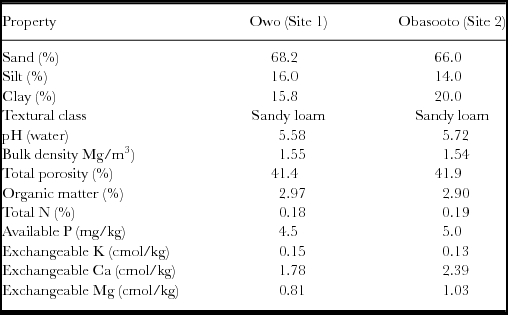
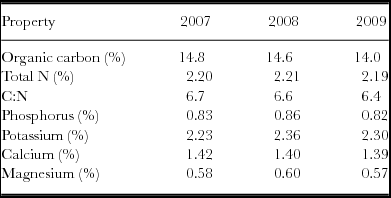
The properties of the soils at the experimental sites in 2007 are shown in Table 1. The soils at both sites 1 (Owo) and 2 (Obasooto) are slightly acidic, sandy loam in texture with high bulk density. The soils at sites 1 and 2 had low OM, total N, available P and exchangeable K. The exchangeable Ca was deficient at site 1, but adequate at site 2. The exchangeable Mg was adequate at both sites 1 and 2. Chemical analysis of PM utilized in 2007, 2008 and 2009 (Table 2) indicates that it contains nutrient elements (N, P, K, Ca and Mg) required for the growth of a tuber crop such as cocoyam. The OC was the highest. It is expected that the nutrients will be released into the soil for the uptake of the crop (Makinde et al., Reference Makinde, Ayeni and Ojeniyi2011).
Soil properties (0–15 cm depth) of sites before experimentation in 2007.

Nutrient composition of the poultry manure used.

Effect of tillage and poultry manure on yield and growth parameters of cocoyam
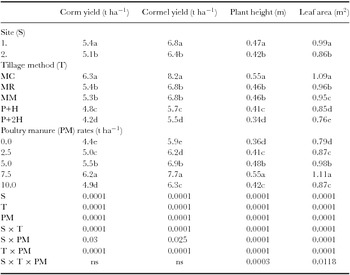
The effect of tillage and PM on yield and growth parameters of cocoyam at Owo (site 1) and Obasooto (site 2) at the end of the third year (2009) are presented in Table 3. Owo (site 1) had significantly higher corm and cormel yields, plant height and leaf area compared with Obasooto (site 2). This can be adduced to better soil nutrients especially K at Owo site compared to Obasooto site. Among the tillage treatments, MC and minimally tilled MR and MM soils had higher values of corm and cormel yields, plant height and leaf area, respectively compared with mechanically tilled soils. The mean corm yield for MC, MR, MM, P+H and P+2H were 6.3, 5.4, 5.3, 4.8 and 4.2 t ha−1 respectively, values for cormel yield were 8.2, 6.8, 6.8, 5.7 and 5.5 t ha−1 respectively. The values for mean plant height were 0.55, 0.46, 0.46, 0.41 and 0.34 m respectively and the values for mean leaf area were 1.10, 0.96, 0.95, 0.85 and 0.76 m2 per plant respectively. Therefore, relative to intensive repetitive mechanized tillage (P+2H), MC increased corm and cormel yields by 50 and 49% respectively. The lower performance of cocoyam in mechanically tilled soils especially in soil with highest number of passes of implement (P+2H) was due to lower nutrient content. The lower nutrient content in the intensively tilled plots (P+2H) could be adduced to a number of processes such as leaching, increased biological activity and oxidation. Agbede and Ogundele (Reference Agbede and Ogundele2015) reported rapid mineralization of soil OM, N, P, K, Ca and Mg for Alfisol in Nigeria due to intensive tillage. This indicates that tillage degrades soil properties with time and the degradation depends on the frequency or intensity of tillage imposed on soil (Agbede, Reference Agbede2008; Agbede and Ogundele, Reference Agbede and Ogundele2015). The growth and yield of tuber crops such as yam and cocoyam is limited by soil nutrients (Agbede, Reference Agbede2008; Agbede et al., Reference Agbede, Adekiya and Ogeh2013; Hamma et al., Reference Hamma, Mahmoud, Wakili and Hayatuddeen2014). Agbede (Reference Agbede2008) observed that availability of soil nutrients dictated performance of cocoyam and that soil quality was degraded by conventional tillage (CT) which gave the lowest nutrient content and moisture content compared with zero tillage with mulch (ZTM), zero tillage without mulch (ZTOM), MM and MR.
Effect of tillage and poultry manure on yield and growth parameters of cocoyam in 2009 at Owo (Site1) and Obasooto (Site 2).

Values followed by similar letters under the same column are not significantly different at p = 0.05 according to Duncan's multiple range test (DMRT); ns = not significant at 5% and 1% level of probability; MC = Manual clearing; MR = Manual ridging; MM = Manual mounding; P+H = Ploughing plus harrowing; P+2H = Ploughing plus harrowing twice; S = Site; T = Tillage method; PM = Poultry manure.
Irrespective of tillage method, corm and cormel yields, plant height and leaf area of cocoyam increased with application of PM up to 7.5 t ha−1. The increases dropped at 10.0 t ha−1 (Table 3). The overall mean corm yield were 4.4, 5.0, 5.5, 6.2 and 4.9 t ha−1 for 0, 2.5, 5.0, 7.5 and 10.0 t ha−1 PM respectively, while mean cormel yield were 5.9, 6.2, 6.9, 7.7 and 6.3 t ha−1 respectively. The mean values of plant height were 0.36, 0.41, 0.48, 0.55 and 0.42 m for 0, 2.5, 5.0, 7.5 and 10.0 t ha−1 PM, respectively. The values for leaf area per plant were 0.79, 0.87, 0.98, 1.11 and 0.87 m2 per plant respectively. The increase in performance of cocoyam is consistent with increase in soil and plant nutrients associated with PM application. The finding that the 7.5 t ha−1 PM most increased leaf K, Ca and Mg, yield and growth parameters of cocoyam suggests that uptake of these nutrients most dictate performance of cocoyam since increase in soil K, Ca and Mg also terminated at 7.5 t ha−1 PM. Potassium is particularly important for carbohydrate synthesis in tuber crops (Agbede et al., Reference Agbede, Adekiya and Ogeh2013).
When studied as individual factors, site (S), tillage (T) and PM significantly influenced yield and growth parameters of cocoyam (Table 3). The interactive effect of S × T, S × PM and T × PM were significant for yield and growth parameters of cocoyam. When all the three factors (S × T × PM) were considered together, interactions were significant for growth parameters of cocoyam, but not significant for yield of cocoyam. At both sites, the MC+7.5 t ha−1 PM gave the highest corm and cormel yields, plant height and leaf area of cocoyam, while the 7.5 t ha−1 PM gave the highest values of yield and growth parameters. The 7.5 t ha−1 PM also gave the highest soil and leaf K, Ca and Mg. It is affirmed that N supply and availability of the cations dictated the cocoyam performance, but at a certain soil organic N threshold or rather at rates exceeding 7.5 t ha−1 PM ammonium concentration causes toxic effects.
Tillage effect on soil chemical properties
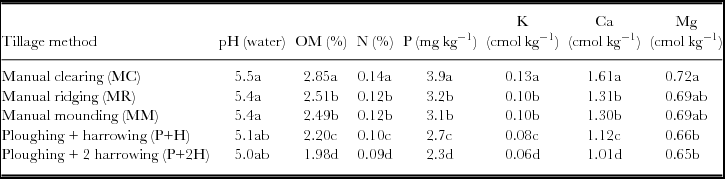
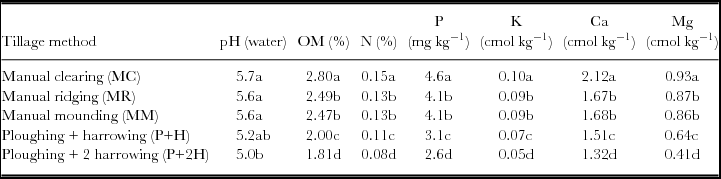
The effect of tillage on soil chemical properties at Owo (site 1) and Obasooto (site 2) at the end of the third year (2009) are shown in Tables 4 and 5. In 2009 (third year), soil OM and nutrients contents reduced with increase in tillage intensity. The MC most conserved soil OM, N, P, K, Ca and Mg and the manual tillage (MR, MM) had higher values of soil OM and nutrients compared with mechanized tillage methods (P+H and P+2H). The most intensive tillage given by three passes of implement (P+2H) gave least values of nutrients. Hence, soil OM and nutrients reduced in the order (MC > MR = MM > P+H > P+2H). Also, the mechanized tillage methods gave least soil pH which is consistent with the least values recorded for the cations K, Ca and Mg. Reduction in soil OM and nutrients due to tillage is attributable to loss and oxidation of OM (Ojeniyi and Adekayode, Reference Ojeniyi and Adekayode1999, Reference Ojeniyi and Adekayode2002) which is natural source of nutrients. Also, the initially porous nature of tilled soils especially in the first two years (Agbede and Ojeniyi, Reference Agbede and Ojeniyi2010) might have enhanced leaching of nutrients to subsoil. The MC, form of zero tillage, had highest soil OM and nutrients content. Zero tillage is known to conserve soil fertility in the long-run (Agbede and Ojeniyi, Reference Agbede and Ojeniyi2010). It gave highest concentration of nutrients under cocoyam in the third year of cropping compared with manual and mechanized tillage methods.
Effect of tillage on chemical properties (0–15 cm) in 2009 at Owo (Site 1).

Values followed by similar letters under the same column are not significantly different at p = 0.05 according to Duncan's multiple range test (DMRT).
Effect of tillage on chemical properties (0–15 cm) in 2009 at Obasooto (Site 2).

Values followed by similar letters under the same column are not significantly different at p = 0.05 according to Duncan's multiple range test (DMRT).
Effect of poultry manure on soil chemical properties
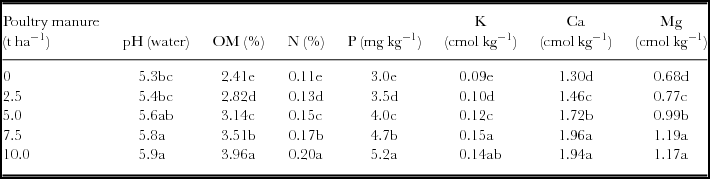
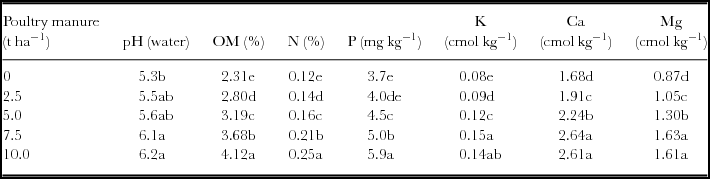
The effect of PM on soil chemical properties at Owo (site 1) and Obasooto (site 2) at the end of the third year (2009) are shown in Tables 6 and 7. Irrespective of tillage method, soil pH, OM, total N, available P, exchangeable K, Ca and Mg increased with level of PM from 0 to 10.0 t ha−1. In case of K, Ca and Mg, however, the 7.5 t ha−1 PM gave highest values in all instances. General increase in soil nutrients content with addition of PM is consistent with the fact that PM is a natural and effective source of nutrients (Agbede and Ojeniyi, Reference Agbede and Ojeniyi2009, Reference Agbede and Ojeniyi2010; Ayeni et al., Reference Ayeni, Omole, Adeleye and Ojeniyi2010; Maerere et al., Reference Maerere, Kimbi and Nonga2001; Odedina et al., Reference Odedina, Ojeniyi and Odedina2011) and its presence also increases cation exchange capacity of soil. It also has liming effect (Odedina et al., Reference Odedina, Ojeniyi and Odedina2011).
Effect of poultry manure on soil chemical properties (0–15 cm) in 2009 at Owo (Site 1).

Values followed by similar letters under the same column are not significantly different at p = 0.05 according to Duncan's multiple range test (DMRT).
Effect of poultry manure on soil chemical properties (0–15 cm) in 2009 at Obasooto (Site 2).

Values followed by similar letters under the same column are not significantly different at p = 0.05 according to Duncan's multiple range test (DMRT).
Effect of tillage on leaf nutrients composition of cocoyam
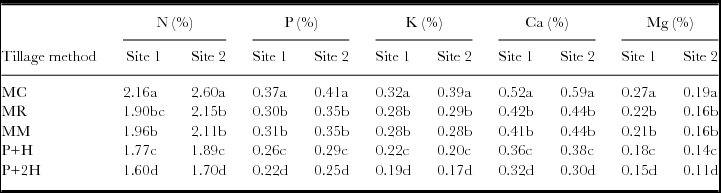
The effect of tillage on leaf nutrients composition of cocoyam at Owo (site 1) and Obasooto (site 2) at the end of the third year (2009) are shown in Table 8. Leaf nutrients content reduced with tillage intensity; hence, leaf N, P, K, Ca and Mg reduced in the order MC > MR = MM > P+H > P+2H. Expectedly, the manual methods (MM, MR) had similar values. The most intense and repetitive tillage method (P+2H) had least values of plant nutrients. This finding is consistent with the finding that tillage reduced soil nutrients content over three years. The reduction led to decrease in nutrients uptake by cocoyam. In their study with sorghum, Agbede and Ojeniyi (Reference Agbede and Ojeniyi2010) also observed that zero tillage gave highest leaf N, P, K, Ca and Mg concentrations in sorghum compared with MC, PL (Ploughing), P+H and P+2H. They also noted that nutrients concentration in sorghum decreased with frequency and intensity of soil manipulation. This was attributed to better soil fertility and water content adduced to zero tillage. The lower leaf nutrients observed by the authors for sorghum plants on mechanically tilled soils was adduced to soil degradation and lower moisture content which adversely affected nutrient uptake. Study by Adekiya et al. (Reference Adekiya, Ojeniyi and Agbede2011) showed that in the first two years, MC gave highest values of soil chemical properties under cocoyam compared with manual and mechanized tillage.
Effect of tillage on leaf nutrients composition in 2009 at Owo (Site 1) and Obasooto (Site 2).

Values followed by similar letters under the same column are not significantly different at p = 0.05 according to Duncan's multiple range test (DMRT). MC = Manual clearing; MR = Manual ridging; MM = Manual mounding; P+H = Ploughing plus harrowing; P+2H = Ploughing plus harrowing twice.
Effect of poultry manure on leaf nutrients composition of cocoyam
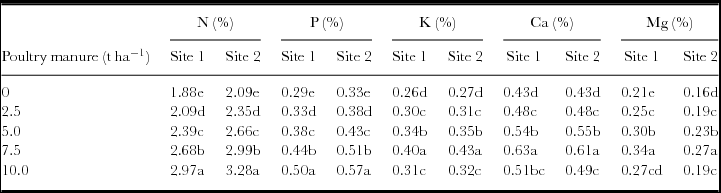
The effect of PM on leaf nutrients composition of cocoyam at Owo (site 1) and Obasooto (site 2) at the end of the third year (2009) are shown in Table 9. Irrespective of tillage method, leaf N and P increased with the level of PM from 0 to 10.0 t ha−1. In case of K, Ca and Mg, the increase persisted up to 7.5 t ha−1 PM and it dropped at 10.0 t ha−1 PM. It is affirmed that PM enhanced uptake of N, P, K, Ca and Mg by cocoyam. Similar observation was made with respect to sorghum (Agbede and Ojeniyi, Reference Agbede and Ojeniyi2010) that PM at 7.5 t ha−1 significantly increased plant N, P, K, Ca and Mg. The decreasing nutrients content in leaves at 10.0 t ha−1 PM is due to some nutrient imbalances between cations which have not been measured (e.g. NH4+, Na+) on the one hand and K, Ca and Mg on the other hand or it is related to ammonium toxicity and hence lower uptake rates. It could be seen that soil pH increased with PM up to 10.0 t ha−1. In the study with cassava, Odedina et al. (Reference Odedina, Ojeniyi and Odedina2011) also found that PM increased leaf N, K and Mg in addition to increasing soil K, Ca and Mg.
Effect of poultry manure on leaf nutrients composition in 2009 at Owo (Site 1) and Obasooto (Site 2).

Values followed by similar letters under the same column are not significantly different at p = 0.05 according to Duncan's multiple range test (DMRT).
CONCLUSIONS
For sustainable and enhanced productivity of cocoyam, soil fertility and nutrient availability, combination of MC and PM at 7.5 t ha−1 is recommended in the study area. MC most preserved soil fertility and sustained higher yield and growth of cocoyam while manure at 7.5 t ha−1 most improved yield and growth of cocoyam and nutrients concentration.