I. INTRODUCTION
Bulk metallic glasses (BMGs) have attracted much attention due to their considerable scientific importance and potential technical applications.Reference Greer1–Reference Pauly, Gorantla, Wang, Kühn and Eckert5 The glassy alloys show very high strength at ambient temperature and viscous flow above glass transition temperature (Tg). They are useful for fabricating microscale devices due to their excellent characteristics such as high strength, isotropic homogeneity, freedom from grain boundary and good thermoplasticity.Reference Kumar, Tang and Schroers6–Reference Pan, Wu, Chen, Chang, Lee and Huang9 The molding and imprinting for conventional metallic glasses have to be performed at high temperature. In contrast, the BMGs with low Tg shows polymer-like thermoplastic formability near room temperature, yet they show clearly metallic properties such as good thermal and electrical conductivity. Such materials with unique combination properties of metals and polymers can be regarded as metallic plastics.Reference Zhang, Zhao, Pan, Wang and Greer10–Reference Zhang, Guo, Chen, Saotome, Qin and Inoue12 They have potential in applications and can facilitate studies of some fundamental issues such as glass transition, slow dynamics in glass and supercooled liquid state. Therefore, the development of low-Tg BMGs is important for both scientists and engineers.
In this work, we report studies of the formation and properties of Sr-based BMGs with ultralow Tg by composition design based on elastic moduli criterion.Reference Wang13 The newly developed Sr-based BMGs have low elastic constants and low glass transition temperature (26 °C, close to room temperature). Besides, the new alloys have other interesting properties such as small Poisson’s ratio, strong liquids behavior in the framework of the fragility concept, tunable water degradation behavior, and room temperature homogeneous flow.
II. EXPERIMENTAL
The Sr-based BMGs with nominal compositions mentioned in this work were prepared by melting base element Sr (99%) with Zn (99.9%), Mg (99.9%), Cu (99.9%), Yb (99.5%), Ca (99%), and Mg–Li alloy (75 wt% Mg) using induction-melting method in a quartz tube under vacuum (better than 3.0 × 10⁻³ Pa). The melt was subsequently cast into the copper mold. All the compositions mentioned in this work can be cast in fully amorphous state at least 3 mm in diameter. The liquid nitrogen-cooled copper mold can enhance glass-forming ability (GFA) significantly. Their structure was examined by x-ray diffraction (XRD) using a MAC M03 diffractometer (Cu Kα radiation; Hiroshima, Japan). Differential scanning calorimetry (DSC) was performed under a purified argon atmosphere in a Mettler Toledo DSC822e (Schwerzenbach, Switzerland). The density ρ was measured by Archimedes’ principle in absolute alcohol. The travel time of ultrasonic wave propagating through the sample was measured using a MATEC 6600 ultrasonic system (MATEC Inc., Northborough, MA) with a measuring sensitivity of 0.5 ns and a carrying frequency of 10 MHz. The physical properties (including the Young’s modulus E, the shear modulus G, the bulk modulus B, Poisson’s ratio ν, and Debye temperature θD) were derived from the acoustic data and density. The compression specimens with gauge aspect ratio of 2:1 cut out of as-cast 2 mm rods were tested using Instron electromechanical testing system 3384 (Norwood, MA) at room temperature in air. The surface patterns of the samples were observed using scanning electron microscopy (SEM: Philips XL 30 instrument; Philips, Eindhoven, The Netherlands).
III. RESULTS AND DISCUSSIONS
A. Composition design
We develop Sr-based BMGs with ultralow glass transition temperature based on the elastic moduli criterion.Reference Wang13–Reference Wang15 Extensive data on elastic moduli and Tg of BMGs exhibit that there is clear correlation between the elastic moduli and Tg. That is, the lower the value of elastic modulus of a BMG is, lower is the value of Tg. It is also found that the elastic constants M of BMGs show a correlation with a weighted average of the elastic constants Mi for the constituent elements as:  $M^{ - 1} = \sum \,\,{f_i } \cdot M_i ^{ - 1} $, where fi denotes the atomic percentage of the constituent. The established correlation between elastic moduli and Tg is our guidelines for the development of the BMGs with much lower Tg by appropriate composition selection of components. Table I lists the shear modulus of Sr and other BMG base elements. Strontium has low elastic constants. Its shear modulus (G: 6.1 GPa) is even lower than that of cerium (Ce), calcium (Ca) and ytterbium (Yb) (The shear moduli of Ce, Ca, and Yb are 14, 7.4, and 9.9 GPa, respectively), which are typical metallic plastic base elements.Reference Li, Wang, Liu, Zhao, Bai, Pan and Wang16 So the strontium is chosen as base element for developing the BMGs with low Tg.
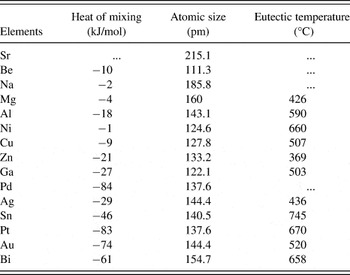
Heat of mixing, atomic size and eutectic temperature of elements with strontium.

Inoue’s three empirical rules offer useful guideline for alloy design and have been used widely for developing new BMG compositions.Reference Inoue2 Deep eutectic is another empirical rule, which was used widely for developing new metallic glasses.Reference Cohen and Turnbull17Table I lists the heat of mixing, atomic radius, and eutectic temperature of other components with strontium. For simplicity’s sake, only elements, which have negative heat of mixing with Sr, are given. Strontium has large atomic radius and significantly different atomic size with listed elements. All the elements listed meet the requirements of Inoue’s empirical rules. Zinc has the deepest eutectic with strontium, and the eutectic temperature is only 369 °C, so, zinc is chosen as one of the doping elements. Magnesium is chosen as another doping element because it has significantly different atomic size ratio with both Sr and Zn, and Mg also has deep eutectic with Sr.
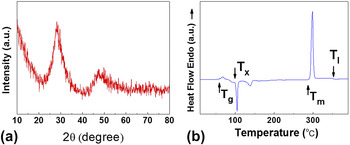
Figure 1(a) shows XRD pattern of the as-cast Sr60Mg18Zn22 alloy. The broad diffraction peaks without any clearly sharp diffraction peaks corresponding to crystalline phases indicate that the as-cast sample is in amorphous state within the detectable limit of the XRD, although there could be some crystalline phase (less than 5%) in it. Figure 1(b) presents the DSC trace of the as-cast Sr60Mg18Zn22BMG, and the heating rate is 10 K/min. It can be seen that an obvious endothermic characteristic of the glass transition followed by crystallization peaks is exhibited. The distinctive glass transition and sharp crystallization event confirmed the glassy state. The endothermic peak corresponds to the melting of the alloy. The shape of the melting peak indicates that the alloy is close to the eutectic point, which is one of the reasons behind its good GFA.
It is notable that the purity of Sr element is 99% (atomic percent). Inclusions or dissolved impurities in the melt are one of the important extrinsic factors, for they may influence the heterogeneous nucleation during solidification.Reference Louzguine-Luzgin, Miracle and Inoue18 The impurities might affect the reproducibility of the results.
B. Composition range
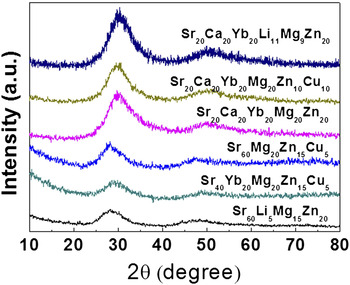
Minor addition provides a powerful tool for the BMG-forming alloys development and design.Reference Wang19 The GFA and properties of the BMGs are quite sensitive to the composition, and the addition technique has already played an effective and important role in GFA, improvement of thermal stability and properties of BMGs since the advent of BMGs. The addition method is applied to explore new Sr-based BMGs composition. Yb, Ca, Li, and Cu can be doped into the Sr-based BMG to improve the properties of the alloy. For example, the Yb can significantly enhance the corrosion resistance of the alloy, while Li addition can further lower the Tg of the alloy. Figure 2 shows the XRD patterns of the Sr-based BMGs with different additions. The broad diffraction peaks without appreciable sharp crystalline peaks in the XRD curves indicate the full amorphous phase of these alloys.
(a) XRD pattern of the as-cast Sr60Mg18Zn22 BMG. (b) DSC curve of the as-cast Sr60Mg18Zn22BMG.

XRD patterns of Sr-based BMGs.

A topological structural model has been developed recently to interpret the composition of the BMG-forming alloys.Reference Senkov, Miracle and Mullens20–Reference Miracle22 Amorphization occurs when local atomic strains generated by size differences between solute and solvent elements attain a critical level. It is supposed that the solute occupies substitutional lattice site in the crystalline lattice of the solvent element. In this case, the critical level of lattice instability is achieved at a lower concentration of a solute element as the difference in atomic size between the solvent and the solute elements increased. However, as the solute atom becomes increasingly smaller relative to the solvent atom, a substitutional occupancy is no longer stable and the smaller solute atoms may occupy alternate sites in the crystalline lattice, such as interstices. For Sr-based BMGs, the solute elements (Li, Mg, Zn, and Cu) are smaller than the solvent atoms (Sr, Ca, and Yb), so the interstitial atoms produce a positive lattice strain and the substitutional atoms create a negative lattice strain. In this case, the concentration of the substitutional atoms (Li and Mg) is the least in the glass-forming alloy, while the concentration of interstitial atoms (Zn and Cu) increases a little. The Sr-based BMGs can be described by the formula:
 $${\rm( \bf Sr,\rm Ca,Yb)}_A ({\rm{Li}},{\rm{Mg}})_B ({\rm{Zn}},{\rm{Cu}})_C ,$$
with A = 40 to 70, B = 5 to 25, C = 10 to 35, and A + B + C = 100. A strong topological basis exists for the compositions represented in Eq. (1).Reference Senkov, Miracle, Keppens and Liaw23 The concentration of the elements and their atomic size are consistent with the densely packed solute-centered cluster model proposed by Miracle et al. Such atomic-concentration arrangement in the Sr-based BMGs provides efficient atomic cluster packing, and this may be another reason why the Sr-based BMGs are good glass-formers.
C. Fragility
The fragility concept, as introduced by Angell, describes the different temperature dependencies of viscosity.Reference Angell24 The change in viscosity or relaxation time reflects an intrinsic property of glass-forming liquids, and classifies liquids between two extremes: the strong extreme, where viscosity and relaxation time behave in an Arrhenius fashion with respect to temperature; and the fragile extreme, where these properties tend toward more non-Arrhenius behavior.Reference Evenson, Gallino and Busch25 Metallic glasses display intermediate or strong fragility strength, as indicated by the fragility parameter, m.Reference Penera26 From the Vogel–Fulcher–Tammann (VFT) fit, the m at a particular Tg can be calculated fromReference Böhmer, Ngai, Angell and Plazek27
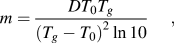 $$m = {{DT_0 T_g } \over {(T_g - T_0 )^2 \ln 10}},$$
where D and T 0are fitting parameters derived from VFT equation.
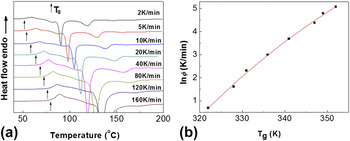
Figure 3(a) shows the DSC curves of the Sr60Mg18Zn22glass with heating rate over three orders of magnitude. The heating rates were 2, 5, 10, 20, 40, 80, 120, and 160 K/min, respectively. The corresponding glass transition temperatures were 332, 328, 331, 336, 341 K, 347, 349, and 352 K, respectively. A functional form of VFT type, which is suitable for fitting the present results, isReference Brüning and Samwer28
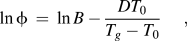 $$\ln \phi \, = \,\ln B - {{DT_0 } \over {T_g - T_0 }},$$
(a) DSC curves of Sr60Mg18Zn22 BMG at different heating rate and (b) VFT relation between glass transition temperature Tg and heating rate ϕ of Sr60Mg18Zn22BMG.

where  $\phi $ is the heating rate, and Tg is the glass transition temperature. B, D, and T 0 are adjustable parameters. From the VFT fit [Fig. 3(b)], D and T 0 of Sr60Mg18Zn22 are determined to be 12.4 and 205 K, respectively. When the heating rate is 20 K/min, the glass transition temperature Tg is 336 K. The value m calculated from Eq. (2) is 21. It can be classified to the strong liquids in the framework of fragility, and the value m is smaller than other common BMGs such as Zr- (m ∼ 34–39), Fe- (m ∼ 32–37), Mg- (m ∼ 39–46), and RE- (m ∼ 21–53) based BMGs.Reference Böhmer, Ngai, Angell and Plazek27, Reference Borrego, Conde, Roth and Eckert29–Reference Luo, Zhao, Pan, Wang and Wang34 It is notable that some values of m are not determined from some of these methods, and it may cause some discrepancy.
It has been reported that the fragility of metallic glass is correlated with the number of components in the alloy.Reference Shadowspeaker and Busch35 In most cases, the metallic glass-forming liquids become stronger with increase in the number of elements. Metallic glass ribbons with two or three elements are more fragile compared with BMGs with three or more elements.Reference Park, Na and Kim30 The value m of the new developed Sr60Mg18Zn22alloy indicates that the Sr-based glass-forming liquids are rather strong. If more elements are added to the alloy, even stronger liquids are to be expected. The metallic glass-forming system is one of the simplest systems where the microstructure units are composed of metallic atoms. The strong metallic glass-forming liquid may facilitate the study of some fundamental issues such as glass transition and relaxation in glass.
High-mixing entropy is a new route for designing novel BMGs.Reference Takeuchi, Chen, Wada, Yokoyama, Kato, Inoue and Yeh36, Reference Gao, Zhao, Ke, Ding, Wang and Bai37 The Sr20Ca20Yb20Mg20Zn20 alloy was determined from the prototype Sr60Mg18Zn22 BMG in accordance with strategic alloy design. The fragility of Sr20Ca20Yb20Mg20Zn20 BMG was determined using the same method as used for Sr60Mg18Zn22. The adjustable parameters D and T 0 were 107 and 80.6 K, respectively. The fragility index m was 17 calculated from Eq. (2) (Tg = 357 K, heating rate 20 K/min). It is the lowest value recorded among known metallic glasses.
D. Low elastic constant and low glass transition temperature
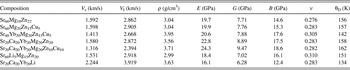
The longitudinal (vl) and transverse (vs) velocities, densities, elastic constants, Poisson’s ratio, and Debye temperature of Sr-based BMGs are listed in Table II. The Sr-based BMGs have relatively low density (ρ ∼ 3.5 g/cm3). The density of Sr-based BMGs is just higher than that of Ca-based BMGs,Reference Senkov, Miracle, Keppens and Liaw23 but much lower than other conventional BMGs such as Zr-, Cu-, and Pd-based BMGs.Reference Wang13 The Sr-based BMGs have the lowest elastic constant among all the known BMGs. For Sr20Ca20Yb20Li11Mg9Zn20 BMG, the Young’s modulus is as low as 16.1 GPa, which is comparable to the human bone (2–18 GPa). The Sr-based BMGs have small value for Poisson’s ratio. For Sr60Mg18Zn22, the Poisson’s ratio ν is just 0.276. Brittleness is expected in metallic glasses with smaller values of Poisson’s ratio.Reference Lewandowski, Wang and Greer38 However, due to the low glass transition temperature, uncommon room temperature rheology is observed. The Sr-based BMGs have low Debye temperature θD. Debye temperature is indicative of the relative strength of the atomic bond. The low Debye temperature implies weak bonding of the alloy atoms, which is consistent with the low elastic constants.Reference Wang13
Acoustic velocity, density, elastic constant, Poisson’s ratio, and Debye temperature of Sr-based BMGs.

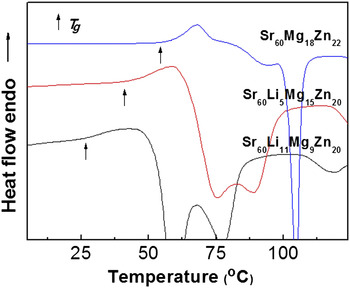
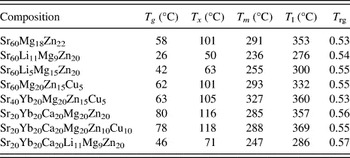
The thermodynamic parameters of Sr-based BMGs derived from DSC curves are listed in Table III. The BMGs have the lowest glass transition temperature among all the known BMGs. For Sr60Li11Mg9Zn20, the Tg is just 26 °C, which is at room temperature. However, due to the ultralow Tg, it is unstable at room temperature. It begins to crystallize at about 1 h after being cast, and will achieve fully crystallized phase in 24 h as indicated by x-ray diffraction. The Sr60Li5Mg15Zn20 with a little higher Tg (42 °C) is much more stable. It remains in amorphous state after 1 wk at room temperature. The Sr-based BMGs was designed by elastic correlations, which also confirm the elastic criterion well. The Li (Young’s modulus E: 4.9 GPa) have the lowest elastic moduli among all BMG-forming elements. The glass transition temperature can be tuned by Li content (Fig. 4). As the Li content increases, the Tg of the BMGs shifts to lower temperature, and finally reaches to room temperature.
DSC curves of Sr-based BMGs with different Li content.

Thermodynamic parameters of Sr-based BMGs.

E. Room temperature rheology
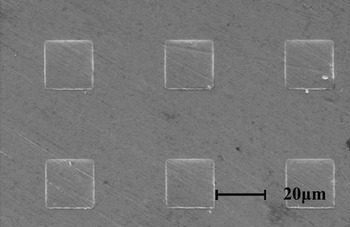
We note that brittleness is expected in metallic glasses with small values of Poisson’s ratio or large values of the ratio of shear modulus to bulk modulus.Reference Lewandowski, Wang and Greer38 The Poisson’s ratio is regarded as indicator of the plastic character for BMGs and this idea was verified in various BMGs. The Sr-based BMGs have small Poisson’s ratio, and it should be attributed to the class of brittle BMGs. However, the BMG could show superplasticity at room temperature due to the ultralow Tg. It is well known that the deformation behavior of metallic glasses scales with glass transition temperature Tg. The transition from inhomogeneous to homogeneous flow occurs at approximately 0.8 T/Tg. For this alloy, room temperature lies within the homogeneous flow regime (T/Tg = 0.93). Figure 5 shows the imprinted pattern on the BMGs. The BMG was under a pressure of 50 MPa for 24 h, and the smooth surface emerged as square array. The imprinting for other BMGs is usually carried out in the supercooled liquid region with much higher temperature, but this BMG can be imprinted at room temperature. The polymer-like thermoplastic behavior is convenient for micro- and nanomanufacture.Reference Kumar, Tang and Schroers6, Reference Kumar and Schroers39
SEM image of square array on the surface of Sr-based BMG imprinted at room temperature.

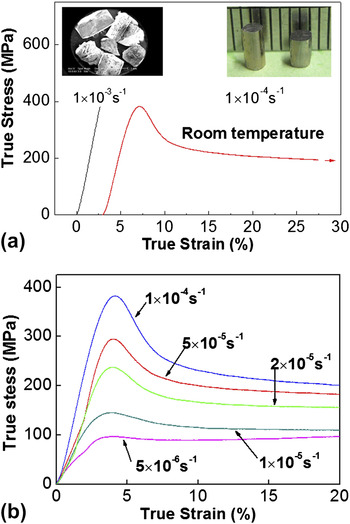
Figure 6(a) shows the stress–strain curves of the Sr20Ca20Yb20Li11Mg9Zn20 BMG. When the strain rate is 1 × 10⁻³ /s, the sample breaks into pieces just after elastic deformation, which resembles Mg- and Ca-based BMGs.Reference Wang, Yu and Bai40, Reference Wang, Liaw, Senkov, Miracle and Morrison41 The inset on the left shows the SEM image of the pieces. However, when the strain rate decreases to a slightly lower value of 1 × 10⁻⁴ /s, the BMG exhibits a complete change in deformation behavior. It shows elastic strain limit of ∼2% before yielding, and then displays superplasticity as observed in the supercooled liquid state for other BMGs.Reference Kato, Kawamura, Inoue and Chen42–Reference Harmon, Demetriou, Johnson and Tao44 The sample can be compressed to 70% of its original height without cracking, and further compression is still possible to extend the deformation. The XRD examination verifies that the severe deformed sample remains fully amorphous state. The scanning electron microscopy (SEM) shows that the severe deformed specimen keeps smooth surface. No primary shear band and other observable shear bands can be found, which confirms the uniform deformation and homogeneous flow of metallic glass at room temperature.Reference Zhao, Xia, Bai, Zhao and Wang45
(a) Different deformation type of Sr20Ca20Yb20Li11Mg9Zn20 BMG at room temperature. The inset at left shows that the BMG is brittle at high strain rate, while the inset at right shows that the BMG is superplastic at low strain rate. (b) Stress–strain curves of Sr20Ca20Yb20Li11Mg9Zn20BMG at different strain rate.

For homogeneous flow in metallic glass, the flow stress changes with different strain rate. Figure 6(b) shows the stress–strain curves of the Sr20Ca20Yb20Li11Mg9Zn20 with wide strain rate region. The yield stress and steady flow stress increase with strain rate. It belongs to Non-Newtonian fluid, which is the characteristic of BMG for homogeneous deformation. The compression behavior of this BMG can be expressed by free volume theory. Spaepen gives the stress–strain relation in metallic glass based on free volume theory. The original equation is written in shear stress and shear strain rate.Reference Spaepen46 For normal stress and normal strain rate, the equation changes to Reference Bletry, Guyot, Blandin and Soubeyroux47:
 $${{ \dot\varepsilon}} = 2c_f v_D \exp \left( { - {{\Delta G^m } \over {kT}}} \right)\sinh \left( {{{{\rm{\sigma }}V} \over {2\sqrt 3 kT}}} \right),$$
where  ${{\dot \varepsilon }}$ is the normal strain rate, cf is the concentration of defect, vD is the Debye frequency, ΔGm is the activation free energy migration, σ is the normal stress, and V is the activation volume.
The experiments were carried out at room temperature. If relatively small variation of the flow defect concentration with strain is assumed, the defect concentration depends only on temperature. Since the experiments were carried out near the glass transition temperature for long duration, the defect concentration when deformation starts is supposed to be equal to its equilibrium value.Reference Bletry, Guyot, Blandin and Soubeyroux47 In such a framework, Eq. (4) can be rewritten:
 $${{\dot \varepsilon }} = {{\dot \varepsilon }}_{\rm{0}} \sinh (a{\rm{\sigma }}),$$
where 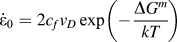 ${{\dot \varepsilon }}_{\rm{0}} = 2c_f v_D \exp \left( { - {{\Delta G^m } \over {kT}}} \right)$ and
 $a = {V \over {kT}}$. Both of them are constant based on the supposition above.
The strain rate and the maximum flow stress follow Eq. (5). At low strain rate, the maximum flow stress grows with strain rate. However, the maximum flow stress will not exceed the fracture stress, which is regarded as the intrinsic character of BMGs at strain rate covering the entire quasistatic range.Reference Schuh, Hufnage and Ramamurty48 When the maximum flow stress reaches fracture stress (for this BMG, the critical strain rate is 1 × 10⁻³/s and the critical stress is 400 MPa as indicated by experiment), the sample breaks into pieces. The deformation behavior of the Sr-based BMGs changes at a critical strain rate, and the transition from homogeneous deformation to inhomogeneous deformation occurs.
F. Corrosion behavior
Strontium is friendly to human body, and it is useful for the treatment and prevention of osteoporosis. However, crystalline Sr is extremely reactive. It reacts with water strongly. The reaction gives a lot of heat, and produces large amounts of gas. Metallic glasses usually have much more desirable corrosion resistance than their crystalline counterparts.Reference Dahlman, Senkov, Scott and Miracle49 Mg- and Ca-based BMGs glasses are regarded as promising biodegradable materials.Reference Zberg, Uggowitzer and Löffler4, Reference Gu, Zheng, Zhong, Xi, Wang and Wang50, Reference Wang, Xie, Li, Wang, Zhao, Zhang, Bai, Zheng and Qing51 Strontium-based BMGs constitute a new class of alkaline earth-based BMGs. The stability of Sr-based BMGs in aqueous environment determines whether the material is suitable for biodegradable application.
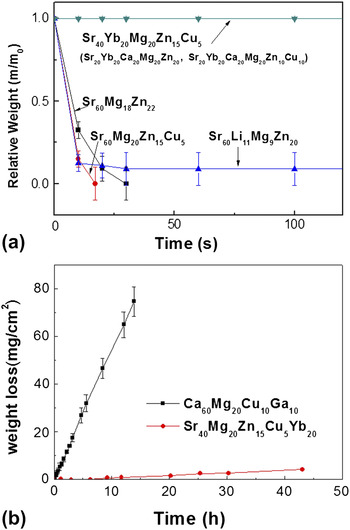
The water degradation of Sr-based BMGs in water can be modulated by minor addition. Figure 7(a) shows the weight change of Sr-based BMGs in deionized water, where m0 represents the original alloy weight, and m represents the weight that the alloy has been immersed in water for some time. For Yb-free Sr-based BMGs, bubbles are produced immediately after the BMGs are immersed in water. The solid alloys dissolved in water in less than 1 min and the water became muddy black due to the violent reaction.Reference Zhao, Li, Zhao, Pan and Wang52 The Yb-doped Sr-based BMGs show totally different behavior in water. They are much more stable than the Yb-free ones in deionized water. They could stay in water for more than a week without observable weight change.
(a) Weight change of Sr-based BMGs in deionized water. (b) Weight loss of Sr40Mg20Zn15Cu5Yb20 and Ca60Mg20Cu10Ga10BMGs in Hanks solution.

Hanks solution is a salt solution usually used as simulated body fluids. The degradation behavior of Sr-based BMG in Hanks solution can help us to evaluate the feasibility of it as biodegradable materials. Figure 7(b) shows the weight loss of Sr- and Ca-based BMGs in Hanks solution. The weight loss of the Sr40Yb20Mg20Zn15Cu5BMG in Hanks solution is much slower than the Ca-based BMG. The slowdown degradation in Hanks solution is favorable for biodegradation materials. Fast degradation rate is harmful to human body because the degradation process is usually accompanied with hydrogen evolution, and it is not conducive for the functional requirement of the human body. The Yb-doped Sr-based BMGs might be potential biodegradation materials, and further studies are needed to prove the supposition.
IV. CONCLUSIONS
We report a class of Sr-based BMGs, which have extremely low glass transition temperature approaching room temperature, good GFA in a wide composition range and strong liquid behavior. Due to the ultralow Tg, the Sr-based BMG shows room temperature homogeneous flow just as other BMGs behave in supercooled liquid region at high temperature. The Sr-based BMGs also have tunable water degradation behavior. The Sr-based BMGs have potential applications and are also model system for scientific issues in glass physics.
ACKNOWLEDGMENTS
Financial support from NSF of China (50921091 and 50731008) and MOST973 of China (2007CB613904 and 2010CB731603) is greatly appreciated. Experimental aid of H.B. Ke, and T. Wang is acknowledged. The provision of Mg-Li master alloy by Prof. M.L. Zhang is acknowledged.