Introduction
The UK has the highest rate of teenage motherhood among western European countries (Moffitt et al. Reference Moffitt2002; Department of Health, 2010). Strong links with health inequality, poverty and social exclusion prompted the government to highlight the importance of this issue by establishing a multi-agency Teenage Pregnancy Strategy (Department for Children, Schools and Families, 2010). In essence this is a preventive initiative, but little is known about what happens to these mothers following the birth of their children, in particular their health outcomes including premature mortality. The only population-based investigation of this topic to date was conducted in Sweden (Otterblad-Olausson et al. Reference Otterblad-Olausson, Haglund, Ringbäck Weitoft and Cnattingius2004). This national registry study examined cause-specific mortality outcomes during 1990–1995 among approximately 61 000 women who became teenage mothers compared to approximately 400 000 women who became first-time mothers at 20–29 years. With adjustment for family size and socio-economic status, significantly elevated risks were observed for both suicide and homicide. Such information highlights an important health inequality that may be overlooked in the context of this well-known social phenomenon. Understanding more about poor health outcomes in this group is likely to facilitate more effective planning of health-care services, and delivery of better mental health and primary care services.
Rates of teenage childbearing are considerably higher in the UK than in Sweden. Social scientists have shown that the likelihood of adverse outcome for this group may vary greatly between countries according to differences in prevalence of teenage motherhood and its acceptability to the wider community (Robson & Berthoud, Reference Robson and Berthoud2003). Teen mothers in the UK may have very different characteristics and associated outcomes than those in Scandinavia. Therefore, we aimed to examine risks of suicide and other types of premature death using data from the Office for National Statistics Longitudinal Study (ONS LS). This freely available national resource provided long-term historical follow-up data from the 1970s until the end of 2006. We hypothesized that, compared with teenage girls and women without children, those who were teenage mothers would have elevated risk of premature mortality, that women who became mothers for the first time in their twenties and thirties would be at lower risk, and that effect sizes would be larger for unnatural than for natural deaths.
Method
Description of the study cohort, exposure classification and potential confounders
This investigation was conducted entirely with data extracted from the ONS LS, which contains linked census and vital event data for a 1.1% representative sample of approximately 0.5 million people from the entire population of England and Wales at each 10-year national census (www.ons.gov.uk/about/who-we-are/our-services/longitudinal-study/index.html). The sample is selected at random by entering into the cohort every person born on one of four index dates each year. Data from the four consecutive national censuses from 1971 onwards, and also national birth, death and emigration/immigration registration systems, are linked routinely to the ONS LS. Tracing of cohort members is done primarily through the National Health Service (NHS) Central Register. Independent searches of mortality registration records for deaths to persons born on an ONS LS sampling date are also conducted to increase linkage completeness, which was around 96% for deaths during the 1970s and is almost complete from the 1980s onwards. Mother–infant linkage through birth registration records is estimated to be around 92% and 94% complete during the 1970s and 1980s ONS LS member cohorts respectively.
For this study we identified all women who were estimated to have reached age 13 years during the 1970s, 1980s and 1990s and who were sampled members of the ONS LS at the 1971, 1981 and 1991 censuses respectively. The study data sets were analysed as three discrete cohorts, although there was overlap between them, in that some members of the 1970s cohort were also members of the 1980s cohort, and likewise for the 1980s versus 1990s cohorts. A generic study exit date of 31 December 2006 was applied for all three cohorts, and a person-years count for each woman was calculated up to that date, or date of emigration or death, whichever came first. We conducted our primary analyses on the 1970s cohort. This enabled long-term follow-up with a potential maximum 37-year observation period (an age range of 13–49 years), and it also maximized statistical power and precision. Additional analyses of suicide risk for the 1980s and 1990s cohorts were conducted for comparative purposes. To enable meaningful comparison of effects across all three cohorts, we assessed risk at age <35 years in these analyses.
Maternal status was treated as a time-dependent variable by stratifying each woman's person-years contribution over time; the methodological details of this approach are explained in the ‘Statistical analyses’ section. The reference group for relative risk estimation consisted of teenage girls and mature women who had not yet experienced motherhood, the exposure group of primary interest was women who became teenage mothers, and for comparative purposes we also examined mortality risks in women who were first-time mothers at ages 20–29 years and at 30 years and older. This particular reference group was chosen because it made the largest contribution to the total person-years denominator (over 50%), and also because we wanted to examine a likely protective effect of first becoming a mother at mature age. We conducted additional analyses (Table 4) directly comparing risks in those who first became mothers in their teens compared with in their twenties and older.
The estimates were adjusted for age group (13–24, 25–34, ⩾35 years) and calendar year period in decades (1970s, 1980s, 1990s, 2000s) as time-dependent variables, and some were further adjusted for socio-economic status using electoral ward-level Carstairs scores at the 1971 Census. This is a widely used composite ecological measure of material deprivation based on four small area-level variables: male unemployment, overcrowding, lack of car ownership, and low occupational social class (Morris & Carstairs, Reference Morris and Carstairs1991; McLeod, Reference McLeod2001). Relative area-level deprivation was assigned to all ONS LS members, categorized into quintiles of equal population size, according to the distribution of Carstairs scores across all wards in England and Wales. We opted to examine only the 1971 Carstairs quintiles because all women in the 1970s cohort were present at that time point. Applying Carstairs values from later censuses in 1981, 1991 or 2001 would have been problematic because women were subsequently lost from the 1970s cohort due to premature death or emigration. For example, 14.8% of all the unnatural deaths to cohort members occurred during the 1970s, and another 33.6% of these deaths happened in the next decade. A recent validation exercise comparing Carstairs data over time has shown that, although areas do change somewhat in their level of deprivation, the relative position of areas stays similar over time (Norman, Reference Norman2010). Furthermore, applying the later Carstairs values would have required much finer stratification of the aggregated person-years data, to such a level that would have prevented their release by the ONS LS. To address the fact that the 1971 Carstairs data become increasingly outdated as the follow-up time lengthened, we conducted two sets of adjusted analyses, one for the entire follow-up period up to 31 December 2006 and the other for follow-up only until 31 December 1989.
Premature mortality outcomes
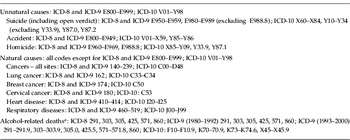
We selected suicide as our primary outcome because of its strong influence on premature mortality by years of potential life lost (YPLL; Gardner & Sanborn, Reference Gardner and Sanborn1990; Gunnell & Middleton, Reference Gunnell and Middleton2003). In line with widely accepted UK convention, we examined suicide and open verdicts as a coalesced category (Linsley et al. Reference Linsley, Schapira and Kelly2001), which is referred to as ‘suicide’ for the remainder of the paper. We also expected to observe higher risk of death due to homicide, heart disease, respiratory diseases, and cancer of the cervix and lung, as shown previously in Sweden (Otterblad-Olausson et al. Reference Otterblad-Olausson, Haglund, Ringbäck Weitoft and Cnattingius2004). We used International Classification of Disease (ICD) codes, 8th, 9th and 10th revisions, to categorize specific causes of death (WHO, 1967, 1977, 1992), as shown in Table 1.
ICD codes used to delineate specific causes of premature mortality

a With the exception of alcohol-related deaths, each specific cause was categorized according to the underlying cause assigned on the death certificate. Contributory causes were also included in the event count for alcohol-related deaths, although the contributory cause codes were unavailable for December 1986 to January 1993.
Statistical analyses
Statistical analyses were conducted using Stata version 10 (StataCorp, 2008). We examined maternal status as a time-dependent explanatory variable so that a woman's exposure status switched from the reference group (no children) to first-time mother as a teenager, or at 20–29 years or at ⩾30 years, at the birth of her first child. Each woman's person-years count started at age 13 years. We stratified the person-years and cause-specific death counts according to the time-dependent maternal status exposure variable, the time-dependent variables age group and decade, and the time-fixed variable 1971 Carstairs quintile (Clayton & Hills, Reference Clayton and Hills1993). These data were then aggregated and analysed by Poisson regression modelling (Gardner et al. Reference Gardner, Mulvey and Shaw1995) to generate mortality rate ratios (MRRs) as our measure of relative risk. The fit of these models was assessed in the equivalent negative binomial model (using the α=0 test), and none of the reported models were overdispersed. The rarity of certain cause-specific mortality outcomes meant that we encountered some sparse event data. For MRRs based on an event count of less than 5, we applied exact Poisson confidence intervals (CIs); for all other effect estimates we used asymptotic Wald approximations to generate the CI. Multivariate models were generated to assess the confounding effect of area-level deprivation using quintiles of ward-level Carstairs index. This was fitted as a categorical variable only, to avoid making any assumptions about the pattern of association between this variable and the premature mortality outcomes.
Results
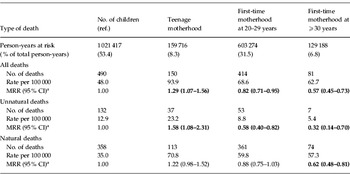
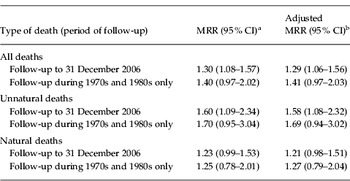
In the ONS LS cohort of girls reaching age 13 years during the 1970s, there were over 1.9 million person-years of follow-up to the end of 2006 and 1135 deaths from all causes (906 natural deaths and 229 unnatural deaths). With the reference group being teenagers and women without children (53.4% of the total denominator), those who became teenage mothers (8.3%) were almost 30% more likely to die from any cause and almost 60% more likely to die from an unnatural cause (Table 2). A smaller increase in risk of natural death was also indicated, although this effect was non-significant (p=0.07). Women who become first-time mothers at age 20–29 years had significantly lower mortality risks from all causes and by unnatural causes, compared with the reference group, and this apparent protective effect was even stronger among women experiencing motherhood for the first time at age ⩾30 years. Adjusted for time-dependent age group and decade of follow-up, the MRRs suggest that these older first-time mothers were far less likely to die than their peers without children, with the protective effect being especially strong against unnatural death. We examined age group (13–34 v. 35–49 years) as a potential effect modifier (results not shown in the tables). For these analyses we collapsed the first-time mothers aged 20–29 and ⩾30 years into a single category because of the sparse data for unnatural deaths. The interaction terms indicated no evidence of variation by age group in relative risks for all unnatural (χ2=2.9, 2 df, p=0.23) and all natural deaths (χ2=0.7, 2 df, p=0.71). However, these results did show that, at age <35 years (MRR 0.46, 95% CI 0.26–0.81) and at 35–49 years (MRR 0.53, 95% CI 0.33–0.84), the risk of these mature first-time mothers dying unnaturally was roughly half that seen in women who did not have children.
Mortality rate ratios (MRRs) for all deaths, and for all unnatural and all natural deaths, before age 50 years: 1970s ONS LS cohort

CI, Confidence interval; ONS LS, Office for National Statistics Longitudinal Study.
a MRRs adjusted for age group (<25, 25–34 , ⩾35 years) and decade as time-dependent variables; statistically significant effects highlighted in bold.
Source: ONS LS.
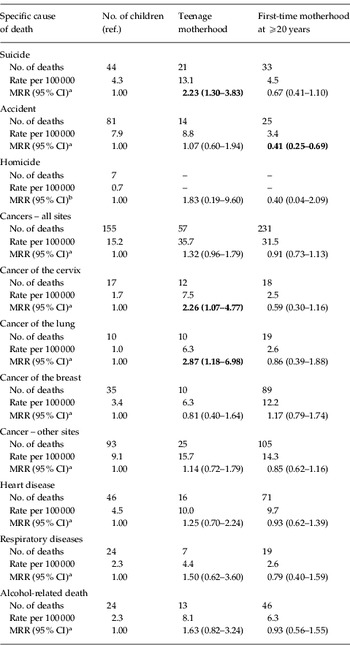
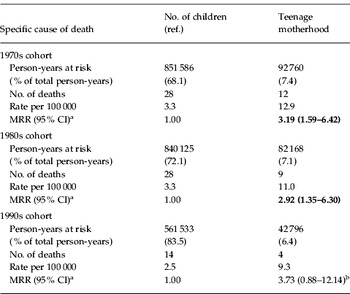
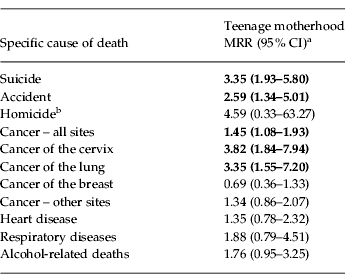
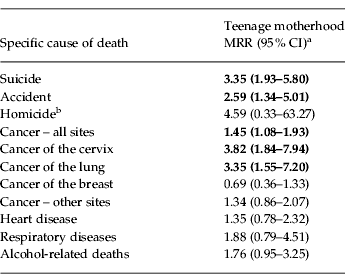
We also examined specific causes of death (Table 3). We found significantly higher risk of death by suicide and by cancer of the cervix and lung among the women who first became mothers as teenagers. There was a trend towards higher risk of alcohol-related death, although this effect was non-significant (p=0.14). The event data were too sparse to examine whether risk of dying by homicide varied significantly according to time-dependent maternal status. Compared to women without children, those who first became mothers in their twenties and at older age had a significantly lower risk of accidental death. To enable better comparison across the three ONS LS cohorts (1970s, 1980s, 1990s), we examined suicide risk at age <35 years. These results are presented in Table 4. A consistent, approximate threefold increase in risk was seen among women who became mothers as teenagers compared to women without children for each cohort. We also recalculated the MRRs for death at any age between 13 and 49 years among women who became teenage mothers, this time using first-time motherhood at age ⩾20 years as an alternative reference category (Table 5). For these analyses we observed significantly greater relative risks for death by suicide, accident, cancer at all sites, cervical cancer and lung cancer. The impact of using this different reference category on the observed relative risk was greatest in relation to accidental death; compared to women with no children there was no evidence of higher risk in the teenage mother group (MRR 1.07, 95% CI 0.60–1.94; Table 3), but compared to women who first became mothers at ⩾20 years, a two- to threefold higher risk was seen (MRR 2.59, 95% C I −1.34 to 5.01; Table 5).
Mortality rate ratios (MRRs) for specific causes of death before age 50 years: 1970s ONS LS cohort

CI, Confidence interval; ONS LS, Office for National Statistics Longitudinal Study.
a Except for homicide, MRRs adjusted for age group (<25, 25–34 , ⩾35 years) and decade as time-dependent variables; statistically significant effects highlighted in bold.
b Homicide MRRs unadjusted due to sparse data; exact Poisson CIs calculated; event cell counts <5: numerators and rates suppressed in line with ONS LS regulations.
Source: ONS LS.
Mortality rate ratios (MRRs) for suicide before age 35 years: 1970s, 1980s and 1990s ONS LS cohorts

CI, Confidence interval; ONS LS, Office for National Statistics Longitudinal Study.
a MRRs adjusted for age group (<25, 25–34 years) and decade as time-dependent variables; statistically significant effects highlighted in bold.
b Exact Poisson CI calculated due to sparse event data.
Source: ONS LS.
Mortality rate ratios (MRRs) re-estimated with first-time motherhood at ⩾20 years as the reference: 1970s ONS LS cohort
CI, Confidence interval; ONS LS, Office for National Statistics Longitudinal Study.
a Except for homicide, MRRs adjusted for age group (<25, 25–34 , ⩾35 years) and decade as time-dependent variables; statistically significant effects highlighted in bold.
b Homicide MRR unadjusted due to sparse event data; exact Poisson CI calculated.
Source: ONS LS.
Finally, we adjusted the estimates for all deaths and for all natural and all unnatural deaths by Carstairs deprivation quintile, as at the 1971 Census. The quintiles showed a clear gradient of increasing prevalence of teenage motherhood by greater level of area-level deprivation, ranging from 6.0% of the total person-years denominator in the least deprived quintile to 10.8% in the most deprived. However, when we fitted Carstairs quintile as a categorical variable in the Poisson models, the MRR estimates for effects linked with teenage motherhood were materially unaltered, as shown in Table 6. This was seen across the whole follow-up period, and also when we restricted the follow-up period to the 1970s and 1980s. In this restricted analysis, almost half of all unnatural deaths, 22.5% of all natural deaths and 27.8% of all deaths from any cause occurred on or before 31 December 1989.
Mortality rate ratios (MRRs) for teenage motherhood adjusted for ward-level Carstairs deprivation quintile at 1971 Census: 1970s ONS LS cohort

CI, Confidence interval; ONS LS, Office for National Statistics Longitudinal Study.
a MRRs adjusted for age group (<25, 25–34 , ⩾35 years) and decade as time-dependent variables.
b MRRs adjusted for age and decade and also for 1971 Carstairs deprivation quintile.
Source: ONS LS.
Discussion
We present novel population-based evidence from England and Wales indicating that women who became mothers during their teen years in the 1970s were almost 30% more likely to die from any cause before reaching age 50 years than women without children, and were almost 60% more likely to die unnaturally. By contrast, mature first-time mothers seemed to be protected against premature death, and this was especially true for unnatural deaths and for those who became first-time mothers in their thirties. We observed a strong protective effect against unnatural death below 35 years of age and also at age 35–49 years among women who were beyond their teen years when they became mothers for the first time. Teenage motherhood was linked with a greater than twofold increased risk of suicide at any time before age 50, and elevated risks of fatal cervical and lung cancer were also found. Switching the reference category to first-time motherhood at age 20 years or older also revealed a significant elevation in risk of accidental death among women who became teenage mothers versus those who first became mothers at mature age. Restricting the analyses to death below 35 years indicated a threefold higher risk of suicide across all three subsequent cohorts of teenage mothers: 1970s, 1980s and 1990s. Finally, we found no evidence that higher risk of premature death linked with teenage motherhood was confounded by area-level deprivation effects.
As the UK has particularly high rates of teenage motherhood, the ONS LS provides an ideal population base for examining adverse health outcomes in this group. The major strength of our study was that we could investigate vital event data in a representative sample of all teenage girls in England and Wales across three consecutive decades, with complete long-term follow-up of cause-specific premature mortality up to age 50 years without any significant selection or attrition biases. However, there were also some important limitations. First, sparse data restricted examination of the rarest cause-specific mortality outcome: homicide. Second, our measure of socio-economic status was area based, and thus subject to ecological error. It was also time-fixed at the 1971 Census, thereby introducing further misclassification for long-term follow-up. However, we sought to minimize the latter problem by restricting our adjusted analyses to the earlier period of follow-up (i.e. the 1970s and 1980s). Third, estimation of reaching age 13 years was based on incrementing subjects' declared age at the preceding census. Thus, some girls will have entered our study up to almost 12 months after their thirteenth birthday should one of the ONS LS index dates fall in May. However, the degree of error introduced by this approximation is likely to be small and unsystematic, thereby creating an immaterial degree of random error with slight attenuation of the observed effect sizes, rather than a significant systematic bias (Copeland et al. Reference Copeland, Checkoway, Holbrook and McMichael1977).
Our results generally concur with those reported by the only other population-based study, from the Swedish national registers (Otterblad-Olausson et al. Reference Otterblad-Olausson, Haglund, Ringbäck Weitoft and Cnattingius2004), which showed approximately twofold increased risks of suicide and accidental death for teenage mothers compared with women who first became mothers in their twenties, in addition to higher risks of fatal cervical and lung cancer. These investigators also reported an imprecise, but statistically significant, 10-fold increased risk of homicide. Our MRR estimates for homicide are also imprecise and, with such sparse event data, are not close to significance. Few other relevant reports have been published on this topic. A study in Georgia, USA, investigated risk of fatal injuries in mothers aged 15–19 years during the first postnatal year (Dietz et al. Reference Dietz, Rochat, Thompson, Berg and Griffin1998). It reported a significantly higher risk of homicide (MRR 2.6) and a reduced risk of accidental motor vehicle deaths (MMR 0.4) in these teenagers in the postpartum period, compared with teenagers who were not mothers. A similar study, using national data for England and Wales during 1973–1984 (Appleby, Reference Appleby1991), showed a much reduced suicide risk for the first postnatal year among mothers aged 15–44 years [standardized mortality ratio (SMR) 0.17] compared with the female general population, with a somewhat weaker protective effect of recent motherhood seen at 15–19 years (SMR 0.36). Our findings indicate that this apparent postnatal protective effect of maternity does not persist in the longer term among teenage mothers. Having adjusted for age and decade at death, teenage mothers had a twofold higher risk of killing themselves before reaching their fiftieth birthday and a threefold higher risk of doing so before age 35, compared to women without children.
That we failed to show any confounding effect by area-level deprivation requires further comment. This was an unexpected finding given that fairly strong confounding of this association by individual-level socio-economic status has been reported from Sweden (Otterblad-Olausson et al. Reference Otterblad-Olausson, Haglund, Ringbäck Weitoft and Cnattingius2004). Furthermore, living in a deprived area has been shown to be a strong predictor of premature mortality in later years by studies conducted using the ONS LS over shorter follow-up periods than in our investigation (Sloggett & Joshi, Reference Sloggett and Joshi1998; Norman et al. Reference Norman, Boyle and Rees2005). We were concerned that the 1971 Carstairs data were increasingly outdated when assessed across the whole follow-up period up to the end of 2006. However, our separate adjusted analysis, with follow-up restricted to the end of 1989, also indicated no evidence of any confounding effect. This indicates that deprivation measured at ward level does not in fact confound this particular association. Recent evidence from Gloucestershire, England, shows that women's perceptions of their own neighbourhood more strongly predict incidence of teenage motherhood than ward-level deprivation measures (Johns, Reference Johns2010). Applying ward-level indices of deprivation may not accurately reflect the degree of social disadvantage experienced by individual women, especially if teenage mothers are highly concentrated in small pockets of deprivation that lie within ward populations that are not deprived as a whole. This notion concurs with earlier research on deprivation and premature mortality conducted by Sloggett & Joshi (Reference Sloggett and Joshi1994). They reported that area-level deprivation effects were entirely explained by individual-level variables, with disadvantaged individuals seeming to receive no protection from risk of earlier death by living in areas that were generally not deprived. Thus, we conclude that socio-economic status measured at the individual level should be assessed in any future investigations this topic.
The long-term effects of teenage motherhood on elevated mortality risk have also been shown in a comparative study of the populations of England and Wales and Austria (Dolhammer, Reference Dolhammer2000), indicating a significantly higher risk of death from all causes at 50–85 years in England and Wales (MRR 1.26) and at 50–94 years in Austria (MRR 1.09). In the same report, having no children was associated with significantly higher risk than being a mother (England and Wales: MRR 1.15; Austria: MRR 1.15). Results reported from a similar study of the England and Wales population alone agreed with those from our study by indicating a protective effect of motherhood per se (Grundy & Tomassini, Reference Grundy and Tomassini2005). Our findings are novel in showing an even more pronounced protective effects against unnatural compared with natural deaths, and for motherhood first experienced at age 30 years and older compared with at 20–29 years. Evidence from the USA suggests that a mother experiencing suicidal ideation may be protected from making suicidal acts by three types of ‘child-related concerns’ (Linehan et al. Reference Linehan, Goodstein, Nielsen and Chiles1983): (i) that suicide would directly harm her children; (ii) that it would be wrong to leave her children in someone else's care; and (iii) a desire to see her children grow up. It seems plausible that such influences would also confer a lower prevalence of risk-taking behaviour among mothers, thereby reducing their risk of premature accidental death.
Why such protective influences fail in the context of teenage motherhood is yet to be understood. Increased risk for these outcomes is likely to be determined largely by a high prevalence of psychopathology and related psychosocial factors. For example, analysis of data from the 1958 British Birth Cohort revealed an increased risk of psychiatric morbidity in adulthood among women who became mothers as teenagers (Maughan & Lindelow, Reference Maughan and Lindelow1997). However, it is unclear whether or not these factors tend to occur as a direct consequence of the economic and social difficulties frequently encountered following childbirth at young age, including lone parenting, restricted educational and career opportunities, subsequent low income and other forms of social isolation and exclusion (Hobcroft & Kiernan, Reference Hobcroft and Kiernan2001; Otterblad-Olausson et al. Reference Otterblad-Olausson, Haglund, Ringbäck Weitoft and Cnattinguis2001). Evidence from the UK, the USA, Australia and New Zealand indicates that girls with antecedent mental illness (Kovacs et al. Reference McGhee and Williams1994; Kessler et al. Reference Kessler, Berglund, Foster, Saunders, Stang and Walters1997) or socio-economic problems (Kiernan, Reference Kiernan1997; Maughan & Lindelow, Reference Maughan and Lindelow1997; Williams et al. Reference Williams, McGhee, Olaman and Knight1997; Quinlivan et al. Reference Quinlivan, Tan, Steele and Black2004) are much more likely to become teenage mothers than their peers. However, we do not know whether these same women would have had a similarly high risk of unnatural premature death if they had not become mothers in their teen years. In other words, are these women at high risk directly because of their young maternal age, or is poor outcome merely a reflection of their own family background predisposing them to experiencing teenage motherhood? Studies of this nature have been conducted among children of teenage mothers (Geronimus et al. Reference Geronimus, Koreman and Hillemeier1994; Turely, Reference Turley2003), but the outcomes of teenage mothers themselves are yet to be examined in this way. The varied mechanisms that explain higher risk of premature unnatural death in these women may act conversely to protect women who first experience motherhood at mature age. Irrespective of their age on becoming mothers, lone mothers have been shown to have much higher rates of psychiatric illness according to national survey or registry data from New Zealand, Sweden, the UK and Australia (Sarfati & Scott, Reference Sarfati and Scott2001; Ringbäck Weitoft et al. Reference Ringbäck Weitoft, Haglund, Anders and Mans2002; Targosz et al. Reference Targosz, Bebbington, Lewis, Brugha, Jenkins, Farrell and Meltzer2003; Butterworth, Reference Butterworth2004). The overlap in social adversity factors between lone and teen mothers may therefore explain some of the elevated risk of premature death that we found in women who became mothers as teenagers.
Higher risks of fatal lung and cervical cancer among those who experienced teenage motherhood, and the lower risks seen in first-time mothers at mature age, are likely to be explained by variation in prevalence of risk factors specific to these cancer types. Thus, smoking is widely known to be the leading cause of lung cancer, and teenage mothers have high baseline rates of smoking and low rates of quitting subsequently, according to longitudinal evidence from New Zealand (McGhee & Williams, Reference McGhee and Williams1996). Smoking also predicts cervical cancer, and the other main risk factors, including poor uptake for screening, age at first intercourse and number of sexual partners, may also have high prevalence among teenage mothers, given that young maternal age at first birth predicts higher risk of disease onset (Bjørge & Øystein, Reference Bjørge and Øystein1996). Even after childbirth, the greater levels of psychosocial adversity that teenage mothers generally encounter may make it harder for them to modify unhealthy lifestyles to improve their chances of experiencing better physical health outcomes in later life. This could explain why the protective effects we observe in the majority of women who become mothers seem not to operate among those who become mothers as teenagers. It was perhaps surprising that we did not find a significantly increased risk of death due to alcohol-related deaths. Studying these deaths using routinely recorded mortality data is problematic because of inconsistency of coding and probable under-reporting, and thus a high level of misclassification and subsequent attenuation of effect size is plausible (Breakwell et al. Reference Breakwell, Baker, Griffiths, Jackson, Fegan and Marshall2007).
This is the first UK longitudinal study of premature death up to age 50 years in mothers who had their first child as a teenager. The psychosocial needs of this vulnerable group require greater attention from policymakers, commissioners and health service planners. Mental health and primary care clinicians, in addition to public health and social services department, need to fully recognize the risk of health inequality that teenage motherhood presents. The difficulties these women encounter, and their associated health risks, persist well beyond the years when they experience being a teenage mother. Before costly preventive strategies can be developed at the population level, further research is needed to identify the complex and time-dependent causal mechanisms that explain these poor outcomes. In particular, it will be important to examine these outcomes among the sisters of teenage mothers, thereby adjusting for antecedent factors in the family and its environment. It is clear that we need to understand the degree to which these poor health outcomes are explained by teenage childbearing per se, as opposed to wider family background influences.
Acknowledgements
The permission of the Office for National Statistics to use the Longitudinal Study is gratefully acknowledged, as is the help provided by staff of the Centre for Longitudinal Study Information and User Support (CeLSIUS). CeLSIUS is supported by the Economic and Social Research Council (ESRC) Census of Population Programme (Award Ref.: RES-348-25-0004). The authors alone are responsible for the interpretation of the data. Census output is Crown copyright and is reproduced with the permission of the Controller of Her Majesty's Stationery Office (HMSO) and the Queen's Printer for Scotland. We are grateful to Dr P. Norman, School of Geography, University of Leeds, UK, who gave us useful advice to help in revising the manuscript, specifically in relation to interpreting our adjustments for area-level deprivation effects.
Declaration of Interest
None.