Introduction
The second largest group of terrestrial plants, commonly known under the joint name bryophytes (Plantae, subkingdom Bryobiotina) has traditionally been divided into liverworts (class Hepaticae), hornworts (class Anthocerotae) and mosses (class Musci). Lately, based on morphological, molecular and phytochemical evidences, the bryophytes (sensu lato) are now divided into three phyla, viz. Bryophyta (comprising mosses, including peat mosses, lantern mosses, haircap mosses), Marchantiophyta (liverworts, both leafy as well as thalloids) and the Anthocerotophyta (hornworts). Besides being diverse, all bryophytes share the same features of having dominant haploid green photosynthetic phase and lack the key steps towards lignin formation (Weng and Chapple, Reference Weng and Chapple2010). Thus, bryophytes are also known as non-vascular plants (atracheophytes), as opposed to vascular plants (tracheophytes) that produce lignin to support their cell wall. Bryophytes occur in all ecosystems except in salt water, although some species inhabit salt rich environment often referred as halophytic bryophytes (Riella sp., Entosthodon hungaricus (Boros) Loeske, Hennediella heimi (Hedw.) Zander). For some non-halophytic species such as Physcomitrella patens (Hedw.) Mitt., it was shown that it could grow well in liquid media with 1.5% salt concentration in laboratory conditions (King et al., Reference King, Vavitsas, Ikram, Schrøder, Scharff, Hamberger, Jensen and Simonsen2016).
The species richness within bryophytes comprises up to 24,000 species worldwide (Hallingbäck and Hodgetts, Reference Hallingbäck and Hodgetts2000). However, due to many discoveries of new species and synonymization of others every year, the number of taxa keeps changing.
Bryophytes are known to be pioneers and quick settlers of empty spaces (Ingimundardottir et al., Reference Ingimundardottir, Weibull and Cronberg2014). They usually compete with lichens for spaces but cannot compete with vascular plants. Bryophytes are still found in microhabitats in every ecosystem and play significant role in each of them, like in nutrient cycling, water economy or providing shelter for other organismal groups to survive harsh periods and reproduce. Although some animals do consume bryophytes, it is generally accepted that due to their interesting chemical constituents, they are usually avoided by animal herbivores. Likewise, some birds, insects and snails will usually change to vascular plants when given the opportunity (Ingimundardottir et al., Reference Ingimundardottir, Weibull and Cronberg2014).
The size of bryophyte species varies from few millimeters in liverwort Monocarpus to 0.7 m in the self-supporting Dawsonia superba Grev., and 2 m as observed in the water habitat supported Fontinalis antipyretica Hedw.
The reason for this is that lignin is rather absent from bryophytes although some traces of lignin-like structures and/or precursors are recorded in some species (Edelmann et al., Reference Edelmann, Neinhuis, Jarvis, Evans, Fischer and Barthlott1998; Ligrone et al., Reference Ligrone, Carafa, Duckett, Renzaglia and Ruel2008). In general, bryophytes do not synthesize lignin, but are widely found to accumulate soluble phenylpropanoids, such as flavonoids and lignans (Basile et al., Reference Basile, Giordano, Lopez-Saez and Cobianchi1999; Umezawa, Reference Umezawa2003). Phenylpropanoid metabolism remains at the level of the acids and are directed to the biosynthesis of flavonoids and lignans, inferring that early steps on the evolutionary path towards lignification were already present in bryophyte ancestors (Weng and Chapple, Reference Weng and Chapple2010).
All bryophytes have pigments, chlorophylls a and b, xanthophyll and carotene and they store starch as energy saver molecule in plastids. Flavonoids are rather common within this group, which is in accordance with their ability to cope with UV radiation.
Bryophytes are indeed the organisms very much dependent on water during sexual reproduction (the biflagellate sperms swim through thin water layer to egg cell), but many bryophytes are necessarily desiccation tolerant, which is an advantage replaced in most vascular plants by drought avoidance. Thus the phenomenon of poikilohydry is rather common among representatives of the subkingdom Bryobiotina, especially mosses.
Within bryophytes, different lineages can be chemically separated. Liverworts often produce oil bodies, a place where synthetized mono-, di- and sesquitepenes and their terpenoids are stored. In hornworts and mosses, triterpenes are produced. These are rather chemically related to those terpenoids of vascular plants compared with the ones in algae. Liverworts commonly have flavonoid glycosides, whereas only about one-fourth of the mosses do.
The evidence of lunularic acid, a molecule acting as a dormancy factor and growth regulator, so far was confirmed in liverworts, but not in mosses. Some hornworts lack lunularic acid and are shown to have different pathway for the degradation of D-methionine, compared with liverworts. Sphagnum (peat-mosses) differ from other mosses, liverworts and tracheophytes in flavonoid species composition and complete acetylization of D-methionine.
The universal signal molecule – ABA (abscisic acid) are confirmed in mosses but not in liverworts, although they react to exogenous ABA (Vujicic et al., Reference Vujicic, Sabovljevic, Milosevic, Segarra-Moragues and Sabovljevic2016).
Besides, the cell wall components differ between mosses and liverworts, so that moss cell walls are staining with aceto-orcein, but not the liverwort ones.
Bryophytes and ethnobotany
In general, the uses of bryophytes by ethnic people, for their healthcare or other needs, have been understudied, because it is generally assumed that bryophytes never play a direct role in human life (Alam et al., Reference Alam, Shrama, Rawat and Verma2015; Chandra et al., Reference Chandra, Chandra, Barh, Pankaj, Pandey and Sharma2016). Although, there are fewer ethnobotanical uses of bryophytes than vascular plants, it is clear that these little plants do have ethnobotanical importance in different cultures around the world. About 136 species of bryophytes have been reported to be used in ethnobotany around the world for a variety of purposes (Harris, Reference Harris2006). Only half of these are used for their medicinal properties (see Table 1). The majority of bryophyte uses as ethnomedicine are reported from traditional Chinese, Indian and Native American medicines (Flowers, Reference Flowers1957). One should be aware that in older literature, bryophytes were often confused with lichens, club-mosses or some vascular plants (Drobnik and Stebel, Reference Drobnik and Stebel2014).
Bryophytes with pharmaceutical potential, their metabolites and related ethnopharcological usage

There could be few reasons why bryophytes were not used as medicinal plants throughout the world. Bryophytes produce little biomass per single species per locality, and thus are not often used as traditional medicinal plants. Another reason for this is that they are small and hard to distinguish. However, in boreo-polar and tropical regions, where the biomass of bryophytes is high, there are evidences of ethnobotanical use of bryophytes by the local people. In contrast, going to dryer areas (small biomass, even though high species diversity) the records on ethnobotanical use of bryophytes decreases. The exceptions were huge and in high biomass yielding species such as water moss Fontinalis antipyretica and species of the genus Polytrichum (haircap mosses).
Historically, physicians from the 18th century were hardly interested in using any bryophytes as medicinal stock (Drobnik and Stebel, Reference Drobnik and Stebel2014). It may be concluded that the competences in pre-Linnaean bryology did not put into practice using moss-derived materia medica of 18th century. In ancient times, medicinal uses of plants were often suggested by the similarity of their shape and structure to some organ in the human or animal body, so some liverworts (e.g. Marchantia polymorpha L.) were believed to cure liver ailments (name of the whole group probably derived from this belief).
Gasuite Indians (Utah, USA) used several species such as Philonotis, Bryum, Mnium or some hypnaceous forms to alleviate the pain from burns. This was rather the consequence of cooling the burn skin, but they went further and made some kind of paste and applied it as a poultice (Sabovljevic et al., Reference Sabovljevic, Bijelovic and Grubisic2001). Cheyenne Indians (Montana, USA) and indigenes from Alaska used the moss Polytrichum juniperinum Hedw. for the same purpose.
Ding (Reference Ding1982) stated that about 40 bryophyte species have been used as crude drugs in Chinese traditional medicine. The thalloid liverworts Conocephalum conicum (L.) Dumort and Marchantia polymorpha, mixed with vegetable oils, are used as ointments for boils, eczema, cuts, bites and burns. Peat-moss Sphagnum teres is very popular among the Chinese for eye diseases, the moss Haplocladium microphyllum (Hedw.) Broth. for tonsillitis, bronchitis, cystitis and timpanitis. Polytrichum commune Hedw. is widely used as a natural cure with antipyretic, diuretic and hemostatic properties. Besides, mentioned species, the liverworts Frullania tamarisci (L.) Dumort, Reboulia hemisphaerica (L.) Raddi and mosses Weissia controversa Hedw., Funaria hygrometrica Hedw., Bryum argenteum Hedw. and Climacium dendroides (Hedw.) Web & Mohr can be seen in the Chinese markets.
Metabolites in bryophytes and their biological activity
Saccharides and lipids
The bryophytes otherwise considered as a neglected group of plants, started to emerge in natural product chemistry studies since the second half of the 20th century. Many compounds new to science have been described since (Asakawa, Reference Asakawa2004).
Oligo- and polysaccharides different from higher plants are widely present within bryophytes (Klavina, Reference Klavina, Ramawat and Merillon2014), along with rare trisaccharides (Pejin et al., Reference Pejin, Sabovljevic, Tesevic and Vajs2012a, Reference Pejin, Iodice, Tommonaro, Sabovljevic, Bianco, Tesevic, Vajs and De Rosab). Lipids in bryophytes are composed of simple and complex structures. Simple lipids include triglycerides and waxes, while complex structured lipids are present as glycolipids and phospholipids. In many bryophytes, various fatty acids with many unsaturated band numbers are present, and they are a characteristic feature in mosses, e.g. eicosapentaenoic acid, arachidonic acid (Pejin et al., Reference Pejin, Vujisic, Sabovljevic, Tesevic and Vajs2011a, Reference Pejin, Vujisic, Sabovljevic, Tesevic and Vajsb, Reference Pejin, Vujisic, Sabovljevic, Sabovljevic, Tesevic and Vajsc; Reference Pejin, Vujisic, Sabovljevic, Tesevic and Vajs2012c, Reference Pejin, Bianco, Newmaster, Sabovljevic, Vujisic, Tesevic, Vajs and De Rosad, Reference Pejin, Vujisic, Sabovljevic, Tesevic and Vajse).
Terpenoids
All classes of terpenoids are isolated from bryophytes i.e. mono-, sesqui- and diterpenoids. The terpenoids isolated from bryophytes are closely related to those of vascular plants. Liverworts are better studied due to the higher accumulation of oil bodies that are rich in terpenoids (He et al., Reference He, Sun and Zhu2013). Hornworts and mosses mainly produce di- and triterpenes (Zhan et al., Reference Zhan, Bach, Hansen, Lunde and Simonsen2015). Some triterpenoids (e.g. hopanoids) are characteristic component of mosses. Only four monoterpenoids have been found in peat-mosses (Sphagnum). In total 18 monoterpenoids, five trinor sesquiterpenoids, 72 sesquiterpenoids, 10 diterpenoids and 9 triterpenoids have been isolated from or detected in the genuine mosses – Bryophyta (Asakawa et al., Reference Asakawa, Ludwiczuk and Nagashima2013).
Regular plant sterols (e.g. sitosterol, stigmasterol, brassicasterol and campesterol) are recorded in bryophytes. Moreover, some leafy liverworts from the genera Scapania, Plagiochila or Chiloscyphus, possess cholesterol. Less is known, but polyacetylenes and mineral compounds are also isolated from bryophytes (Sabovljevic et al., Reference Sabovljevic, Bijelovic and Grubisic2001).
Phenylpropanoids
Phenylpropanoid metabolism remains at the level of the acids and are directed to the biosynthesis of flavonoids, inferring that early steps on the evolutionary path towards lignification were present in bryophyte ancestors (Weng and Chapple, Reference Weng and Chapple2010). The model moss Physcomitrella patens have orthologs gene for the biosynthesis of p-coumaryl alcohol and coniferyl alcohol. This suggests that the biosynthesis of phenylpropanoids was established in the earliest land plants to protect from UV radiation.
Due to the lack of lignin, special attention has been given towards polyphenols (phenolic acids, lignans and complex flavonoids). Some neolignans are unique chemical markers for hornworts. A number of flavonoid glycosides have been detected both in the liverworts and the mosses. Flavonoids such as quercetin, are commonly found in mosses, and have been detected in more than two thirds of entire moss species studied. In contrast, the distribution of flavonoid glycosides has only been detected in about a quarter of all mosses studied so far. This is most likely due to analytical methods used in the research. Flavonoid glycosides are commonly found in liverworts.
Plant hormones (plant growth regulators)
The presence of lunularic acid, a dormancy factor and growth regulator, has been confirmed in liverworts, but not in mosses (Price, Reference Price1971). Some hornworts lack lunularic acid and are shown to have different pathway for the degradation of D-methionine, compared with liverworts. Species of Sphagnum (i.e. peat-mosses) differ from other mosses, liverworts and tracheophytes in flavonoid species composition and complete acetylation of D-methionine.
The universal signal molecule – ABA (abscisic acid) are confirmed in mosses but not in liverworts, although they react to exogenous ABA (Vujicic et al., Reference Vujicic, Sabovljevic, Milosevic, Segarra-Moragues and Sabovljevic2016). Influence of the diterpenoids in spore formation is still being investigated (Vesty et al., Reference Vesty, Saidi, Moody, Holloway, Whitbread, Needs, Choudhary, Burns, McLeod, Bradshaw, Bae, King, Bassel, Simonsen and Coates2016).
Auxins and cytokinins have been studied extensively in mosses compared with other plant growth regulators, but still many elucidation in synthesis, co-action and metabolism remain to be elucidated (Sabovljevic et al., Reference Sabovljevic, Vujicic and Sabovljevic2014a). Gibberellins are hardly reported to have any effects (Sabovljevic et al., Reference Sabovljevic, Sabovljevic and Grubisic2010a), but this can be consequence of understudy of gibberellins in bryophytes. The production of ethylene is documented in both liverworts and mosses, but physiological role in bryophytes is not clear at the moment (von Schwarzenberg, Reference von Schwarzenberg2009).
The other growth regulators salicylic acid, jasmonates, brassinosteroids or strigolactones are rarely directly or indirectly (through the genes-orthologs present in the bryophyte genome) documented in a few species of bryophytes (Sabovljevic et al., Reference Sabovljevic, Vujicic and Sabovljevic2014a).
Other metabolites
The occurrence of nitrogen- and sulphur-containing compounds among the bryophytes is very rare (Asakawa et al., Reference Asakawa, Ludwiczuk and Nagashima2013). There are, however the exceptions, like the nitrogen-containing coriandrins and the methyl tridentatols known in Corsinia coriandrina (Spreng) Lindb.
Activity of the isolated metabolites
The biological activity has been shown for the extracts of many bryophytes. However, the biological activity is often difficult to attribute to one chemical content. The joint chemical contents seem to act also synergistically. Many species from the genus Rhodobryum in Europe or Asia, produce extract that has antihypertensive effect, but fractions separately do not have these effects in hypertensive rats (Pejin et al., Reference Pejin, Newmaster, Sabovljevic, Miloradovic, Grujic-Milanovic, Ivanov, Mihailovic-Stanojevic, Jovovic, Tesevic and Vajs2011d). On the other hand, peat-mosses (Sphagnum) are proven to have extracts with antibiotic properties. However, an unknown extract fraction responsible for this, seems to have fungal endophyte component, which can be responsible for antibacterial activity (Sabovljevic et al., Reference Sabovljevic, Sabovljevic, Vujicic, Ljaljevic-Grbic, Rodda and Girlanda2011b).
Most of the bryophytes with ethnobotanical use have also been studied chemically. As shown in Table 1, there is often a correlation between the isolated compounds and their activity and the ethnopharmacological use. Therefore many of the bryophytes can be promising natural sources of novel drugs and chemicals for other purposes (Dey and Mukherjee, Reference Dey and Mukherjee2015). One should note that in many papers, however, the identity and origin of species are insufficiently described.
Some example of the genes involved in production of secondary metabolites and bio-engineering
The completely sequenced genome of the model moss Physcomitrella patens contains orthologs of all the eight core lignin biosynthetic enzymes required for the biosynthesis of p-coumaryl alcohol and coniferyl alcohol, whereas in the green algae they were not recorded (Silber et al., Reference Silber, Meimberg and Ebel2008).
Beike et al. (Reference Beike, Jaeger, Zink, Decker and Reski2014) reported high contents of polyunsaturated fatty acid in a few species studied. They also reported tissue specific differences in fatty acid contents and fatty acid desaturase encoding gene expression.
The best studied and completely sequenced model-moss Physcomitrella patens bring insights of developing molecular farming by mosses, e.g. implications of plant glycans in the development of innovative vaccines (Rosales-Mendoza et al., Reference Rosales-Mendoza, Salayar-Gonzalez, Decker and Reski2016). Bryophyte haploid genomes, high rate of homologous recombinations and facile foreign genes incorporation enable easy knockin and knockout line productions, following by the green productions of biobetters or biopharmaceuticals (Reski et al., Reference Reski, Parsons and Decker2015).
These examples not only encourage us to search for the new chemical compounds and remedies in bryophytes, but also allow us to develop, through bryo-reactors and molecular farming, green factories for target molecules.
Conclusions and perspectives
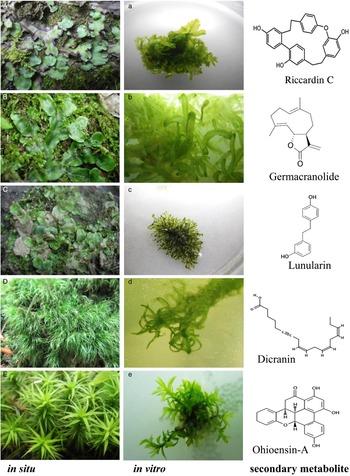
The bryophytes hold great potential for novel chemicals, though links between ethnopharmacology and chemistry has not been revealed among hornworts, but only in liverworts and mosses. Bryophytes are already used to produce chemicals and proteins (Simonsen et al., Reference Simonsen, Drew and Lunde2009; Ikram et al., Reference Ikram, Zhan, Pan, King and Simonsen2015). Along with the studies on novel transformation technology (King et al., Reference King, Vavitsas, Ikram, Schrøder, Scharff, Hamberger, Jensen and Simonsen2016) and bioreactors developments, few companies have started to realize the potential of bryophytes (http://www.greenovation.de, http://www.mosspirationbiotech.dk). Here we also show that not only the moss Physcomitrella patens should be used, but a whole range of bryophytes are of real interest to produce known and novel natural products. In vitro establishment of single species and propagation of clean material can be a useful biotechnological tool for acquiring enough plant material (Rowntree et al., Reference Rowntree, Pressel, Ramsay, Sabovljevic and Sabovljevic2011; Sabovljevic et al., Reference Sabovljevic, Vujicic, Pantovic and Sabovljevic2014b; Figure 1), and also optimizing tool for elicitation of certain secondary metabolite overproduction (Sabovljevic et al., Reference Sabovljevic, Vujicic, Wang, Garaffo, Bewley and Sabovljevic2016).
Pharmaceutically important bryophyte representatives, their in vitro cultivars and secondary metabolites. A and a. Liverwort Reboulia hemisphaerica and its isolated compound Riccardin, B and b. Liverwort Conocephalum conicum, and its sesquiterpene lactone germacranolide, C and c. Liverwort Lunularia cruciata and its isolaed compound Lunularin, D and d. Moss Dicranum scoaprium and its isolated compound Dicranin, E and e. Moss Polytrichum commune and its isolated compound Ohioensin-A.

Acknowledgements
MSS and ADS acknowledged the Serbian Ministry of Education, Science and Technological Development grants Nos. 173030 and 173024.