Introduction
Cold, wet soils and weeds can be problematic for early spring vegetable production in cool, humid climates such as the mid-Atlantic USA. Farmers generally rely on tillage to create a warm, dry and weed-free seedbed, but tillage makes the soil susceptible to erosion and contributes to soil compaction when performed before adequate soil dryingReference Wolfe, Topoleski, Gundersheim and Ingall 1 . Cover crops protect soil from erosion in winter and provide additional environmental benefits including nutrient capture. However, many traditional winter cover crops, e.g., winter rye (Secale cereale L.), hairy vetch (Vicia villosa L.) and oat (Avena sativa L.), hinder spring field work and farmers have cited this as a significant problem with integrating cover crops into their production systemsReference Stivers-Young and Tucker 2 . Some cover crops release allelochemicals that can interfere with early crop establishmentReference Kruidhof, Bastiaans and Kropff 3 , Reference Creamer, Bennett, Stinner, Cardina and Regnier 4 , and cover crops with high carbon/nitrogen (N) ratios can immobilize N in spring. To avoid interfering with cash crop productivity, cover cropping systems can be designed to fill specific cropping nichesReference Snapp, Swinton, Labarta, Mutch, Black, Leep, Nyiraneza and O'Neil 5 in which the benefits to farmers are clearReference Weil and Kremen 6 . By facilitating rather than hindering early spring field work, low-residue winterkilled cover crops such as forage radish (Raphanus sativus L.), hereafter referred to as ‘radish’, may provide a viable alternative to traditional high-residue cover crops prior to early spring vegetables and expand the possibilities for no-till (NT) organic cropping niches.
No-till organic and no-till vegetables
A special issue in Renewable Agriculture and Food Systems (RAFS) devoted to ‘conservation tillage strategies in organic management systems’ (Volume 27 Issue 1, December 2012)Reference Carr, Mader, Creamer and Beeby 7 identified persistent challenges for developing NT organic systems. These challenges include: (1) difficulty managing weeds; (2) timing of cover crop termination; and (3) inadequate N availability or poor synchronization with cash crop demand. To manage weeds, all organic NT systems research has relied on high-residue cover crop mulches, generally from mechanically terminated cover cropsReference Delate, Cwach and Chase 8 – Reference Teasdale and Abdul-Baki 15 . NT vegetable production in non-organic systems has also been limited to the use of high-residue cover crops for cash crops such as pumpkins (Cucurbita pepo L.)Reference Everts 16 , tomatoes (Solanum lycopersicum L.)Reference Abdul-Baki, Watada, Teasdale and Morse 17 – Reference Hoyt 20 , snap beans (Phaseolus vulgaris L.)Reference Abdul-Baki and Teasdale 21 , Reference Rutledge 22 and broccoli (Brassica oleracea L.)Reference Morse 23 , Reference Abdul-Baki, Morse, Devine and Teasdale 24 . For these crops, NT direct seeding and transplanting into cover crop mulch can be effective techniques to manage disease, crop quality and environmental impact. Mulch limits loss of soil moisture in droughty conditions and regulates the daily temperature fluctuationReference Canali, Campanelli, Ciaccia, Leteo, Testani and Montemurro 9 , Reference Teasdale and Mohler 25 , Reference Hoyt, Monks and Monaco 26 .
Winter-hardy cover crops cannot be killed mechanically in time for early vegetable seeding, however, and mulch limits soil warming and drying that is needed for early crop establishment. Furthermore, the period of cash crop N demand for early spring crops such as spinach occurs earlier than it does for most crops investigated using NT mulch systems. Therefore, while weed management, cover crop termination and N synchronization from cover crops are key challenges of all organic NT research, the specific demands of early spring vegetables require an alternative approach that has not been investigated in either organic or non-organic research. Research on low-residue and winterkilled cover crops for NT vegetable production is limited; an unpublished research project in Virginia, USA, reported mixed results for NT vegetables following ‘frost-killed’ cover cropsReference Schonbeck 27 .
Radish as a cover crop
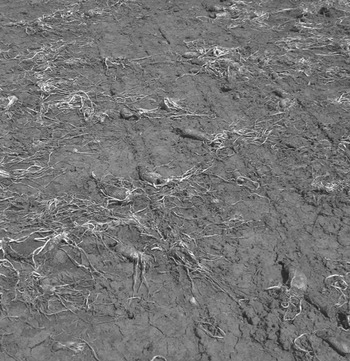
Several characteristics of radish distinguish it from winter-hardy, high-residue cover crops. Radish winterkills when air temperatures reach −4 °C for consecutive daysReference Lawley, Teasdale and Weil 28 and therefore it does not require termination in spring in regions that experience sufficiently low winter temperatures. The residue rapidly decomposes and by March in Maryland, there is very little residue remaining on the surface (Fig. 1). Fukuoka, who pioneered the concept of NT farming without chemicals for vegetables, noted that daikon (R. sativus L.), the vegetable predecessor to radish cover crops, can successfully compete with winter and spring weedsReference Fukuoka 29 , despite a lack of residue or mulch in spring. This observation was also noted by researchers in North America and EuropeReference Kruidhof, Bastiaans and Kropff 30 , Reference Stivers-Young 31 . Fast canopy closure by radish (within 4–6 weeks after seeding in late August) leads to light interception, which prevents initiation of annual weed seed germination in late fall and therefore eliminates early spring weedsReference Lawley, Teasdale and Weil 28 . Because of this mechanism, early fall seeding date and complete canopy closure are necessary to achieve complete weed suppression in spring.
NT seedbed after FR cover crop in late March (Clarksville, MD). Three visible lines 38 cm apart are where spinach was seeded using a NT seeder.

Researchers in Brazil in the 1970s suggested radish might be a beneficial cover crop for NT production because changes in the soil's physical condition following radish were observedReference Kemper and Derpsch 32 . In Ontario, Canada, aggregate stability after oilseed radish (R. sativus L.) was higher than after annual ryegrass (Lolium multiflorum L.) and red clover (Trifolium pretense L.) in spring prior to tillage, indicating that the rapid decomposition of radish exerts a stabilizing effect on the soilReference Dapaah and Vyn 33 . Physical effects are not limited to the soil surface; radish roots penetrate compacted soil layers more efficiently than ryeReference Chen and Weil 34 , and subsequent crops can then take advantage of the root channels createdReference Williams and Weil 35 . With roots reaching as deep as 2.4 m in the soil profile, radish reduces nitrate concentrations well below the 1 m soil depth frequently considered the rooting zone of cropsReference Dean and Weil 36 , Reference Kristensen and Thorup-Kristensen 37 . Nitrogen content of radish cover crops varies dramatically depending on soil N status, seeding date and weather; N capture as high as 310 kg ha−1 in a muck soil has been reportedReference Wang, Ngouajio and Warncke 38 , although values for a late summer/early fall planted crop more typically range from 75 to 200 kg N ha−1 Reference Dean and Weil 36 , Reference Kristensen and Thorup-Kristensen 37 , Reference Schomberg, Endale, Calegari, Peixoto, Miyazawa and Cabrera 39 .
Understanding N dynamics in spring presents more challenges than measuring fall N uptake because transformations are microbially mediated, can be rapid, and the interactions between cover crop, soil and climate are complexReference Thorup-Kristensen, Magid, Jensen and Sparks 40 . From the vegetable farmer's perspective, spring N availability following cover crops is more important than the environmental benefits of fall cover crop N uptake. Ideally, N mineralization from a cover crop will be synchronized with cash crop N demandReference Thorup-Kristensen, Magid, Jensen and Sparks 40 – Reference Dabney, Delgado and Reeves 42 . Currently, N dynamics following radish are poorly understood, but some results point to rapid and early mineralization in springReference Dean and Weil 36 , Reference Magid, Henriksen, Thorup-Kristensen and Mueller 43 , Reference Kremen 44 , indicating that it might be well-suited as a cover crop prior to early cash crops.
We hypothesized that a winterkilled radish cover crop could prepare the spring seedbed for early vegetables as well as or better than spring tillage, thus allowing NT seeding and eliminating the need for spring tillage when radish is used. Our objective was to compare effects of cover crop and seedbed preparation on direct-seeded spinach. To provide some mechanistic understanding of spinach crop performance, we monitored soil temperature, moisture and mineral N status in addition to measuring spinach emergence and yield.
Materials and Methods
An experiment was conducted over four site years at Central Maryland Research and Education Center––Clarksville (CMREC) and Wye Research and Education Center (WREC) in 2011–12 (year 1) and 2012–13 (year 2). Both sites had been under organic management for over 3 years and were maintained according to organic regulations 45 for the duration of the experiments. Site characteristics are presented in Table 1.
Site characteristics for field experiments at CMREC and WREC.

Experimental design and treatment structure
The treatment structure was a 2×2×2 factorial with factors of radish, oat and spring seedbed preparation. The resulting cover crop treatments were: radish (FR), radish–oat mix (RO), oat (OAT) and no cover crop (NC), and the spring seedbed preparations, applied to all cover crop treatments, were NT and rototilled (RT). The experimental design was a randomized complete block split-plot design with four blocks per site-year. Cover crop treatments were the main plot factors and spring seedbed preparation was the sub-plot factor.
To avoid residual effects, a new field was used at each of the two sites in the second site year, adjacent to the field used in the first site year. Baseline soil sample data for the four site years are presented in Table 2. The WREC 1 field was in its second year of alfalfa prior to disking in July 2011. The WREC 2 field received 2.3 Mg ha−1 poultry litter (3–0.9–2.5 NPK) and 2.2 Mg ha−1 calcitic lime in July 2012. The CMREC 1 field had a sequence of winter rye and buckwheat (Fagopyrum esculentum L.) cover crops prior to tillage in July 2011 and had a history of high dairy manure compost applications. The CMREC 2 field, which did not have a history of high compost applications, received 12 Mg ha−1 (wet) finished dairy manure compost in July 2012 (1.2–0.42–1.9 NPK on a dry weight basis; C/N ratio 11.3).
Soil test results for field experiment sites at CMREC and WREC in Maryland, USA.

1 Samples taken after compost application.
2 Samples taken after poultry litter and calcitic lime application.
Cover crop seeding
All fields were disked prior to initiating the experiment. Cover crops were seeded using NT drills (John Deere, Moline, Illinois, USA at CMREC; Great Plains, Salina, Kansas, USA at WREC) with 19 cm row spacing at rates of 10 kg ha−1 (FR) and 72 kg ha−1 (OAT). The RO treatment had alternating rows of radish and oat and the seeding rate was half of the full rate for each. Main plots were 3 m wide by 23 m long. For spring tillage, a 1.5 m wide power take off rototiller was used for a single pass down the middle of the RT sub-plots, resulting in sub-plots in spring that were 1.5 m wide by 11 m long. Approximate depth of tillage was 10 cm. Field activity dates are presented in Table 3. At CMREC, cover crops winterkilled by February both years. At WREC 1, none of the cover crops completely winterkilled. They were mowed with a single pass of a flail mower, which successfully killed the radish but resulted in approximately 10% regrowth of the oat. At WREC 2, approximately 15% of the radish in the FR and RO cover crops and approximately 5% of the oat in the RO and OAT at WREC did not winterkill; all plots were flail mowed and were completely dead by seeding time.
Field activity dates at CMREC and WREC in Maryland, USA.

1 CMREC 1 and WREC 2 weeds were sampled from NC plots prior to fall tillage. NC biomass was not sampled at WREC 2.
2 Weeding with a hand-held hoe.
3 In FR NT and all RT treatments. Weeding in RO NT, OAT NT and NC NT was not performed.
4 Weather prohibited harvesting from the other three blocks.
Cover crop biomass measurement
Cover crops were harvested from two ¼ m2 quadrats from each plot in late fall prior to expected winterkill, resulting in two subsamples per plot. Weed biomass from NC plots was harvested prior to fall tillage (for dates see Table 3); tillage was performed in late fall in the NC plots to reduce weeds in spring and to simulate the common farmer practice of ‘winter fallow.’ Subsamples of cover crops and weeds were dried in a forced-draft oven at 50–60 °C until mass was constant. Each subsample was weighed and ground to <2 mm with a Wiley mill. Equal parts of the two subsamples from each plot were further ground to <1 mm using a coffee grinder. These samples were analyzed for N content using a LECO CHN-2000 analyzer (LECO Corporation; St. Joseph, Michigan).
Spinach seeding
Spinach (Spinacia oleracea L.var. Tyee from Johnny's Selected Seeds, Winslow, Maine, USA) was seeded in spring (for dates see Table 3) using a three-row NT seeder (Monosem Inc, Edwardsville, Kansas, USA) with 38 cm row spacing at WREC 1 and 2 and CMREC 2. For the OAT and RO NT plots, the seeder was equipped with row cleaners, but the coulter was able to cut through the minimal radish residue without row cleaners and row cleaners were not used for FR plots. CMREC 1 was seeded by hand with four rows and 30 cm row spacing. Depth of spinach seeding was approximately 1.5 cm for all treatments. At WREC 1, NC RT was a complete crop failure because of seed corn maggots; no spinach data were collected. The same year, NC NT, RO NT and OAT NT were deemed crop failures at WREC because weeds were present at seeding and limited labor made hand weeding not feasible 2 weeks after seeding. None of the NT treatments is a standard farmer practice; general protocol for weed management would have called for weed control prior to planting, but this was outside the treatment structure. At WREC 2, OAT RT was not seeded because the soil was too wet to till and therefore no data were collected from that treatment.
Spinach emergence and yield measurement
Spinach emergence was measured by counting emerged plants in three separate 0.5 m sections of the middle rows. Spinach harvest at CMREC 1 and WREC 1 and 2 consisted of a single harvest of whole plants to measure yield. At CMREC 2, spinach yield was measured in two successive harvests of mature leaves for all blocks and a third harvest of mature leaves was performed for a single block (only one block was included in the third harvest due to weather). At CMREC 1 and 2, 4 m of the middle row(s) was harvested. At WREC 1 and 2, 6 m of the middle row was harvested because of lower stand densities.
Soil sampling and analysis
Soil samples consisted of five 0–20 cm cores from each plot that were taken using a 2 cm diameter soil probe. Cores were taken from random locations in the central 5 m of each plot, except that in plots with radish, visible radish holes that changed the level of the soil surface were avoided. Soil samples were kept cool for transportation to the laboratory and then dried for 1–2 weeks in a forced draft oven at 50–60 °C. They were then sieved to <2 mm and gravel weight was recorded. Bulk density was calculated using the dry mass of the soil and volume of the five soil cores; a gravel correction was made when gravel was present assuming a particle density of 2.65 g cm−3. Porosity was calculated using bulk density and assumed particle density. A single extraction was performed with 5.0 g soil and 25 ml 0.01 m CaCl2, shaken at 120 rpm on a rotary shaker for 30 min. Samples were centrifuged for 15 min at 27,000 g . Nitrate-N content was determined by ion chromatography with a Metrohm 850 Professional ion chromatograph fitted with a model 858 autosampler and a 150×4.0 mm anion separator column (Metrohm, Riverview, Florida, USA) and ammonium-N was determined with a modified indophenol blue microplate techniqueReference Sims, Ellsworth and Mulvaney 46 .
Soil moisture and temperature monitoring
Decagon 5TE and GS3 combined capacitance and thermistor sensors (Decagon Devices, Pullman, Washington, USA) were installed within the middle 5 m of the cover crop plots prior to cover crop winterkill to monitor volumetric water content and temperature at 5 cm below the soil surface. A shallow hole was dug at a location chosen randomly by tossing a trowel. If the hole clearly contained a solid radish root, the sensor was inserted so as to avoid the root itself. The sensors were inserted into undisturbed soil on the side of the dug hole. The 5TE sensors were installed with the sensors oriented horizontally, but the prongs oriented vertically. The GS3 sensors were installed with the needles horizontal. In a given block, only one model of sensor was installed. Average temperature and water content were logged hourly using EM50 dataloggers (Decagon Devices, Pullman, WA). To calculate growing degree hours (base 8 °C), the sum of hourly temperatures was calculated. If the hourly temperature was <8 °C, it was counted as 0. If the hourly temperature was >8 °C, it was counted as (temperature − 8 °C).
Plastic limit
The lower plastic limit of the soil was determined using four replicates of field moist soil that was wetted evenly and repeatedly rolled into a 3 mm thread until the soil no longer held together. The gravimetric water content was determined at this pointReference McBride, Dane and Topp 47 .
Weed cover and management
Weed ground cover was estimated by making visual assessments of percent ground cover using comparison charts adopted for use in estimating foliage coverReference Terry and Chilingar 48 . Percent ground cover of the whole plot was estimated twice by standing directly at either end of the plot and the two values were averaged. Weeding was performed by hand using a hand hoe (Johnny's Selected Seeds, Winslow, Maine, USA).
Statistical analysis
Data were analyzed using a mixed model in SAS 9.2 (SAS Institute, Cary, North Carolina, USA) with block as a random factor. Data collected after spring seedbed preparation and seeding, including emergence, yield and soil data, were analyzed as a split plot with spring seedbed preparation as the subplot factor. If a multi-way factorial analysis of variance showed significant interactions (F=0.05 or less), only simple effects were compared. Treatment means were compared using an F-protected least significant difference (LSD) (α=0.05). Repeated measures were used to compare harvest 1 versus harvest 2 in the case of CMREC 2. The program Pdmix800 was used to assign letters for treatment meansReference Saxton 49 . Correlation analyses were made using SAS PROC REG.
Results and Discussion
Cover crops
Cover crop performance and composition varied across site years (Table 4). The poorer FR performance at WREC was likely related to unusually high fall precipitation from hurricanes and anomalous rain events (Fig. 2) in addition to inherent fertility differences (Table 2). It has been observed that radish does not grow well in areas with restricted drainage. Quantitative measurements of fall ground cover during cover crop growth were not made, but it was observed that by the first week of October of each year at CMREC, there was no visible bare ground in the FR treatment. In contrast, there were visible patches of bare ground both years in all cover crop treatments at WREC.
Climate data for CMREC and WREC. Monthly maximum and minimum temperatures were calculated as the average of all daily maximum and minimum temperatures within a month. 2011–12 and 2012–13 data are from weather stations on-site. 1Historical climate data for CMREC were unavailable; data presented are from the nearest weather station (KBWI 39°10′27″N, 76°41′16″W) during the period 1980–2010. Historical data from WREC are from the on-site weather station from 2000 to 2010.

Fall cover crop performance at CMREC and WREC in Maryland, USA.

Letters indicate significant differences between treatments within each site year, but not between site years (F-protected LSD, P<0.05).
1 NC biomass harvested 2–4 weeks before cover crop biomass to accommodate fall tillage.
FR, forage radish; RO, radish–oat; OAT, oat; NC, no cover.
Spinach response to cover crops and NT planting
Fresh spinach yields ranged from crop failure to 24 Mg ha−1 fresh weight (Table 5). In New Jersey, the 3-year average yield of fresh market conventional spinach from 2008 to 2010 was 15 Mg ha−1 50 and in North Carolina, successful conventional spinach crops are projected to yield 6.3–13 Mg ha−1 Reference Sanders 51 . The highest yielding treatments for each site year were within or above these values except for WREC 2. In three out of four site years, FR NT was, or was one of, the highest yielding treatments. The exception was WREC 2, as tillage had a pronounced positive effect on yield and FR RT and RO RT were the highest yielding treatments. Yield data from all years except CMREC 1, when spinach was seeded by hand at the recommended 30 cm row spacing, may underrepresent potential yield because the row spacing dictated by equipment (38 cm) was wider than optimal for spinach productionReference Everts 52 .
Fresh spinach yields as influenced by cover crop and tillage treatments at CMREC and WREC in Maryland, USA.

Treatment means are presented (n=4). Letters signify significant differences in treatment means (F-protected LSD P<0.05).
1 Cover crops were planted in August of the year prior to spring spinach planting.
2 Two successive harvests of mature leaves; all other site years whole plants were harvested once. The third harvest is not accounted for in these data because it was only one block.
3 n=3 for this year.
4 Crop failure.
5 Only one block planted because soil was too wet for tillage; yield data not included.
FR, forage radish; RO, radish–oat; OAT, oat; NC, no cover; NT, no-till; RT, rototilled.
At CMREC 2, successive harvests were made to investigate the possibility of delayed maturity in some of the treatments. The yield data in Table 5 are presented as the total of two harvests, but data from the individual harvests show that while there was no difference in yield between the first and second harvests in the FR, RO and OAT plots, the yield from the second harvest of the NC RT treatment was lower than the first, and the NC NT treatment had increased yield for the second harvest compared to the first (P<0.05) (Fig.3). Because of weather, only one block of a third harvest was completed, and the yields for CMREC 2 presented in Table 5 are accordingly lower than they would be if a third harvest had been possible. While it cannot be statistically verified with the data from the third harvest of one block, there appears to be a continuation of the trend that the NC RT yields drop with each successive harvest. This has implications for spinach that is grown for multiple pickings. Whereas sidedressing fertilizer may be necessary for a tilled planting without a cover crop, this need may be reduced or eliminated where cover crops are grown. Although the fertilizer replacement value of cover crops cannot be determined because there was no fertilizer treatment in this experiment, these data show that with a FR cover crop high in N content, competitive spinach yields can be achieved without spring fertilizer, indicating that the N mineralization from FR and the N uptake from spinach are well synchronized.
Fresh weights for three successive harvests of spinach leaves at Central Maryland Research and Education Center, Clarksville. Error bars are standard error of the mean (n=4 except Harvest 3 n=1). *Significant difference between first and second harvests (P<0.05). FR, forage radish; RO, radish–oat; OAT, oat; NC, no cover; NT, no-till; NT and RT, rototilled.

A large portion of the yield response at WREC 1, WREC 2 and CMREC 1 can be attributed to differences in spinach emergence that resulted in inadequate stand density for some of the treatments (Fig. 4). The stand densities at CMREC 2 were less variable among treatments, although NC was lower than the cover crop treatments. Tillage was not a significant factor in emergence at either site in year 2, which had higher precipitation at both sites (Fig. 2). Notably, there was no site year at which NC RT, the standard practice, had the highest emergence of spinach. There were, however, site years at which NC RT had the lowest emergence of all treatments. At WREC 1, the NC RT treatment was a crop failure because of seed corn maggots (Delia platura), but the FR NT and RT treatments had 8–10 spinach plants per row m. We speculate that the lack of green residue in the FR and RO plots discouraged the flies from laying eggs whereas the weeds present in the NC plots, despite late fall tillage, contributed sufficient green matter to attract flies. Harboring pests is a concern of some high-residue cover crop systemsReference Mirsky, Ryan, Curran, Teasdale, Maul, Spargo, Moyer, Grantham, Weber, Way and Camargo 11 . FR and NT seeding generally appear to have positive effects on emergence of spinach, but it is difficult to understand these phenomena mechanistically because of the multiple physical, chemical and biological factors that influence seed germination and emergence.
Emergence stand counts of spinach after cover crop and tillage treatments at WREC and CMREC in 2012 (1) and 2013 (2). Where NT and RT treatments are presented together, there was no tillage effect. Treatments with the same letters within each site year were not statistically different (F-protected LSD P<0.05). FR, forage radish; RO, radish–oat; OAT, oat; NC, no cover crop.

Soil mineral N in spring
Four to six weeks after seeding, when spinach growth and nutrient uptake is expected to be rapid, both the presence of radish in the cover crop and tillage increased soil nitrate-N concentrations (0–20 cm). At CMREC 1 on April 14, the main effect of radish on soil nitrate-N was equivalent to an increase of 33 kg nitrate-N ha−1 (P=0.003) and the main effect of tillage was an increase of 14 kg nitrate-N ha−1 (P=0.03). Soil nitrate-N concentration is a function of multiple processes including mineralization and plant uptake; because of lower stand densities (Fig. 4), the higher nitrate-N in RT plots may have been partly the result of lower plant uptake. However, the April 22 soil nitrate-N concentrations at CMREC 2, where stand densities in NT and RT treatments were equivalent, showed similar trends to CMREC 1 with an increase soil nitrate-N from radish of 34 kg ha−1 (P<0.0001) and an increase in soil nitrate-N from tillage of 21 kg ha−1 (P<0.0001). At WREC, there were interactions between factors both years that precluded any conclusions about main effects of radish or tillage; FR and RO RT plots had more than 15 kg ha−1 higher nitrate-N than NC RT plots on three out of four post-tillage sample dates in April and May; the fourth sample date showed no differences (P<0.05). The average ammonium-N concentration across all treatments was less than 5.0 mg kg−1 at all site years when measured in mid to late April and there were no differences among treatments. In California, an analysis of modern spinach cultivars in intensive spinach cultivation showed that the average N uptake in the first 2 weeks of a crop cycle is minimal—only 7.8 kg ha−1—after which it increases to a linear 4.8 kg ha−1 day−1 Reference Heinrich, Smith and Cahn 53 . Taking into consideration the generally cool initial growth period in the mid-Atlantic, this suggests that the mid to late April sample date is representative of the time of highest spinach N demand. The higher soil nitrate-N after radish is likely well synchronized with the spinach crop's N needs.
Because of dramatic treatment differences in stand density at CMREC 1, WREC 1 and WREC 2, it was difficult to determine the direct effects of soil nitrate-N on spinach yields. Correlation analysis to investigate the relationship between soil nitrate-N content and yield was prudent only for CMREC 2, where stand densities were comparable (although not equal) among treatments (Fig. 4). There was a correlation between soil nitrate-N content (0–20 cm) 2–3 weeks prior to harvest and total fresh yield for the NT treatments at CMREC 2 (r 2=0.69) (Fig. 5). However, the correlation between soil nitrate-N content and yield was not significant for the RT treatments (Fig. 5). This shows that increased mineralization of N from tillage does not always result in concomitant increases in yield. In some case, tillage may be disadvantageous because it provides an increase in N mineralization more rapidly than needed. Data from more site years are needed to test these relationships under a variety of conditions.
Soil nitrate-N (0–20 cm) 2–3 weeks prior to harvests versus fresh spinach yield at CMREC (a and b) and WREC (c) in 2013.

Variable stand counts that were mostly a result of the presence or absence of radish in the cover crop at WREC 2 (Fig. 4) make the interpretation of a soil nitrate-N–yield correlation more difficult. The data clearly show conditions under which nitrate-N is not predictive of yield, and a phenomenon of clustered data is evident. The clustering of higher yields in the RT treatments even within the same range of soil nitrate-N as some of the NT treatments indicates that NT yields were hindered by something more than total nitrate-N content of the soil. One plausible contributing factor for decreased yields in the NT plots is that the lower porosity/higher bulk density in the NT plots limited spinach growth. Despite similar surface textures at both sites (SiL), the two soils differed in porosity. Porosity influences the availability of oxygen for root respiration and microbial activity. At WREC 2, the porosity in spring was less than 50% for all treatments, but was the highest in the FR and RO RT treatments (Fig. 6). At CMREC 2, the porosity was >50% for all treatments (Fig. 6). This physical characteristic may not have been limiting at CMREC in the first place, and therefore the decrease in bulk density and increase in porosity created by tillage may not have positively affected spinach growth. The soil's drainage class also contributes to the likelihood of saturated or near-saturated conditions that can affect root growth and N dynamics. CMREC is well drained, whereas the WREC soil is only moderately well drained. Knowledge of a soil's physical characteristics such as bulk density/porosity may help farmers decide when NT management techniques can be effective.
Soil porosity at WREC and CMREC 3 weeks after tillage (on April 27, 2013 and April 2, 2013, respectively) as influenced by treatments. Black bars=solid particles; gray bars=pore space. OAT RT treatment is missing from CMREC 2 because the soil under the OAT plots was too wet to till. Letters represent differences in treatment means (n=4, P<0.05). FR, forage radish; RO, radish–oat; OAT, oat; NC, no cover; RT, rototilled; NT, no-till.

Soil moisture
Soil moisture prior to seeding time in spring is one of the largest determining factors for when crops can get seeded. Soil moisture limited field work at WREC 2, delaying spinach seeding despite adequate air and soil temperatures for spinach emergence. The OAT RT treatment was never seeded because the soil was deemed too wet to till by in-field estimations, and this judgment was validated by the gravimetric water content, which was above 90% of the plastic limit in OAT (Fig. 7). The gravimetric water content was above 90% of the plastic limit in the RO plots also, but the RO plots were tilled and seeded as a result of in-field estimations that indicated the water content was low enough to till. For most soils, 70–90% of the plastic limit is the water content at which tillage will not cause major structural damage and will create a suitable seedbedReference Dexter and Bird 54 . The 10-year weather data for WREC showed that WREC 1 spring precipitation was below average, whereas WREC 2 was average both in timing and quantity (Fig. 2). This suggests that wet and potentially field-work limiting conditions are probable this time of year for comparable, moderately well-drained soils in the mid-Atlantic region, and that high-residue cover crops such as OAT can restrict field work.
Soil gravimetric water content (0–20) cm prior to spring tillage and planting with respect to range of plastic limit appropriate for tillage at WREC in 2012 and 2013. Treatments with the same letters are not statistically different (F-protected LSD P<0.05 n=4). FR, forage radish; RO, radish–oat; OAT, oat; NC, no cover crop.
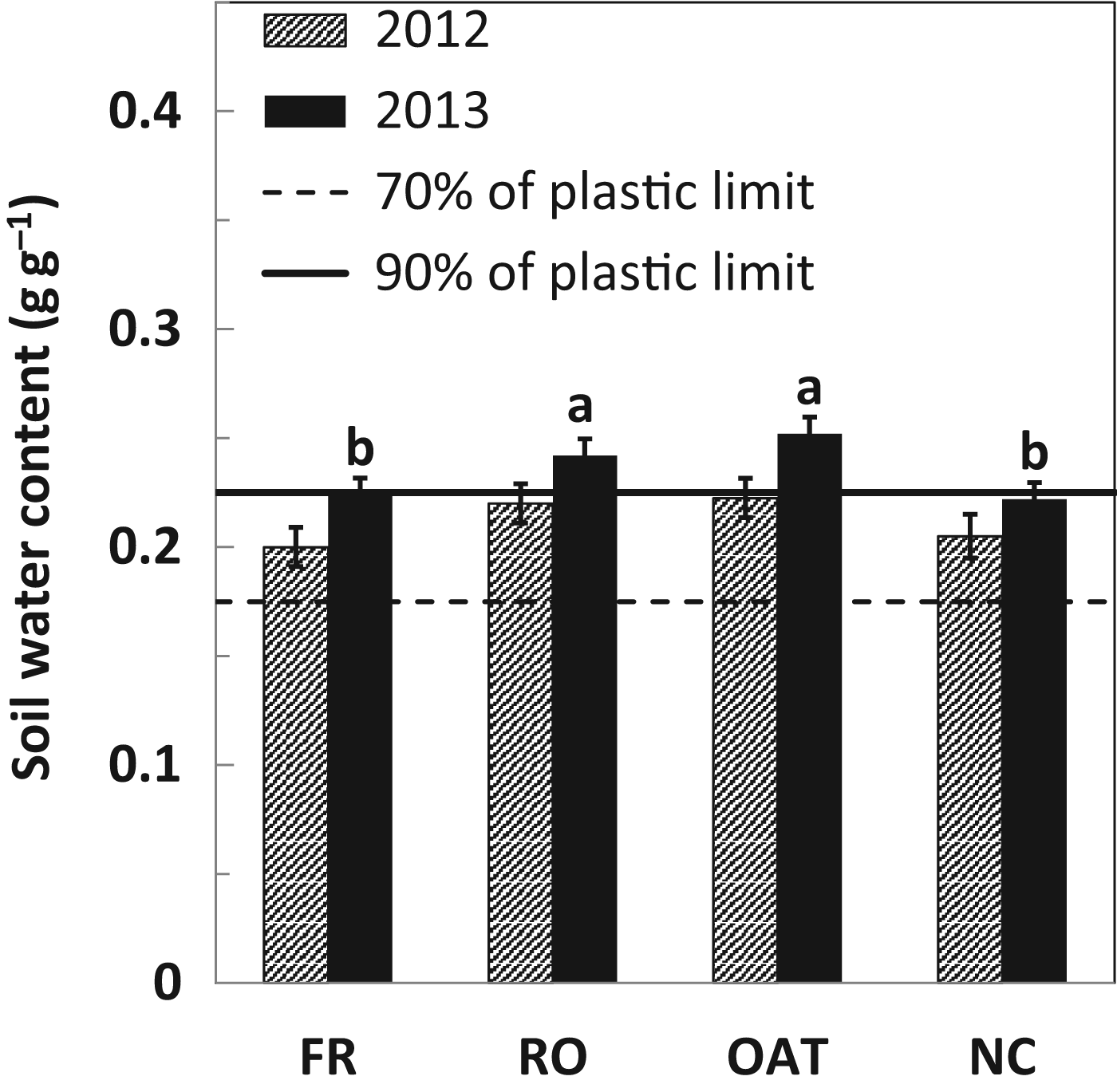
FR creates a drier seedbed in spring than OAT, allowing earlier field work operations. In addition to measurements of gravimetric water content of the 0–20 cm soil surface at seeding time, data from continuous monitoring of volumetric water content at 5 cm support the conclusion that FR allowed for more rapid soil drying after rainfall than OAT at both sites (Fig. 8). The high volumetric water content of NC at WREC as measured by the sensors is in apparent disagreement with the soil samples that show NC and FR had equivalent gravimetric water content (Fig. 8). The plots had comparable bulk densities so the discrepancy cannot be attributed to the difference between gravimetric and volumetric water content. The sensors were measuring volumetric water content at 5 cm depth, whereas the soil samples were 0–20 cm, which may account for the discrepancy; this would indicate that water was infiltrating the surface of the FR plots more quickly than the NC plots.
Volumetric water content (5 cm) at CMREC and WREC in early spring 2013 after winterkilled cover crops as measured by capacitance sensors. Average of three blocks at WREC and four blocks at CMREC. 1The bulk density in the no cover plots at CMREC was lower than the other treatments because of late fall tillage.

Both seasons at CMREC received below average precipitation for the month of March (Fig. 2) and field work was not hindered in any of the cover crop treatments either year, though dryer conditions and more rapid soil drying after FR compared to OAT was also evident (Fig. 8). The lower volumetric water content in the NC plots at CMREC is partly a function of lower bulk density in these plots because of fall tillage. In a spring with average or greater than average precipitation, the more rapid soil drying after FR compared to OAT might have a greater impact on the ability to perform field work in spring. The mixed impacts of RO on soil moisture between CMREC, where RO was more similar to FR, and WREC, where RO was more similar to OAT, indicate that there is high variability in residue quality of the RO mix depending on fall cover crop performance, even when the same seeding rate is used.
Soil temperature
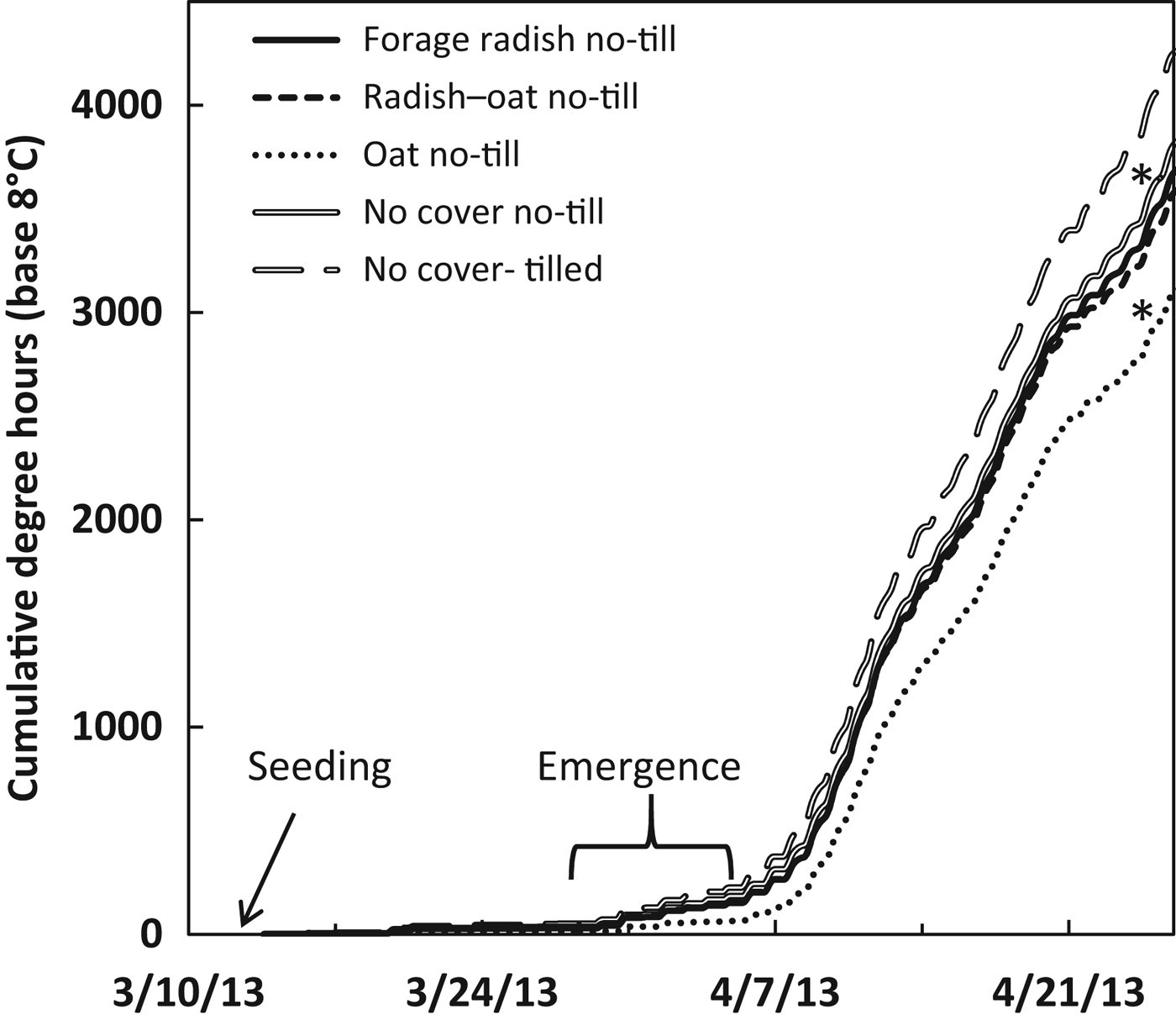
As has been discussed by other authors, mulch moderates the amplitude of daily soil temperature changes in addition to maintaining higher soil moistureReference Teasdale and Mohler 25 , Reference Moody, Jones and Lillard 55 , Reference Wierenga, Nielsen, Horton, Kies, Unger and Doren 56 . This phenomenon was evident in daily temperature fluctuations at both WREC and CMREC during early spring (Fig. 9). Generally, the concept of growing degree days is applied to air temperature and not soil temperature, but soil temperature can be dramatically different from air temperature and may exert a stronger influence on plant growth, especially for germination, emergence and early growth stagesReference Wierenga, Nielsen, Horton, Kies, Unger and Doren 56 , Reference Ritchie, Nesmith, Hanks and Ritchie 57 . The higher daily soil temperatures amounted to 20% fewer cumulative soil growing degree hours (base 8 °C) in OAT NT than FR, RO and NC NT treatments by April 22. The NC RT plots accumulated 16% more soil growing degree hours than FR, RO and NC NT, showing that tillage does create a warmer seedbed (Fig. 10), which could reduce the time needed for a crop to reach maturity. Soil temperatures generally exhibit wider fluctuation closer to the surfaceReference Wierenga, Nielsen, Horton, Kies, Unger and Doren 56 , and the temperature at seed depth (1.5–2.5 cm) may have had greater fluctuations than at 5 cm where the sensors were located, but likely followed the same pattern of higher maximum daily temperatures in treatments with less residues. In addition to direct effects on crop growth, soil temperature affects microbial activity, which influences nutrient availability. These data highlight the importance of management practices, including cover crops and tillage, on soil temperature and show that FR does not act in the way high-residue cover crops do to keep soil cool, but an untilled seedbed after FR is still not as warm as a tilled seedbed.
Daily soil temperature fluctuation (5 cm) after winterkilled cover crops at CMREC in early spring 2012 and at WREC and in early spring 2013, both prior to seeding spinach. Average of three blocks at WREC and four blocks at CMREC.

Cumulative soil temperature (base 8 °C at 5 cm) after seeding spinach at CMREC. All treatments NT except no cover-tilled (n=4). * represents differences between cumulative degree hours on April 22, 2013 (P<0.05).
Weed management
FR NT plots had near complete weed suppression at planting time and into mid-April at CMREC 1 and 2. RO and OAT plots also provided substantial weed suppression, but the presence of oat residue necessitated hand-weeding. For organic growers, weed competition is a primary limitation to production. Most mechanical weeding equipment has been designed for a tilled and residue-free surface. Investigating cultivation methods was beyond the scope of this research, but it should be noted that the difference in soil surface characteristics between both cover crop and tillage treatments was substantial as were residue quantity and quality. It is anticipated that some cultivation equipment designed for a tilled seedbed would be ineffective in an untilled seedbed, even if the seedbed were relatively residue-free.
At CMREC 2, the use of rototilling did not reduce the time required for weeding; i.e., the NC RT plots were not significantly different from the FR, RO and OAT NT plots with respect to the time required for weeding (Fig. 11). Cover crops provided some weed suppression compared to NC plots at WREC but there were weeds present in the NT plots at the time of planting both years. The partial, instead of complete, weed suppression in FR at WREC can be attributed to inadequate cover crop performance in fall at this site, which was likely a result of saturated conditions following hurricanes and unusual rain events both years (Fig. 2). Because the mechanism of weed suppression by radish is via light exclusion in fall, incomplete ground cover is expected to provide incomplete weed suppressionReference Lawley, Teasdale and Weil 28 . Farmers can therefore anticipate the likelihood of complete weed suppression in spring by assessing fall ground cover and make spring plans accordingly. By mid to late April, the weed ground cover at WREC 2 was substantial (Fig. 11). Tillage reduced the weed ground cover in FR, RO and NC plots, but the weeds quickly grew back in the NC plots, such that within 3 weeks after planting, the ground cover in the NC RT plots was equal to that in the FR, RO and OAT NT plots.
Weed groundcover by visual estimation on April 21, 2013 at WREC (a) and weeding time at CMREC on April 22, 2013 (b). Treatments with the same letter did not have statistically different means (F-protected LSD P<0.05). FR, forage radish; RO, radish–oat; OAT, oat; NC, no cover crop.

Conclusions
This research shows that radish, which can provide weed suppression in spring without leaving large amounts of residue, can fill a cover-cropping niche for early spring vegetables, such as spinach, that traditional high-residue cover crops do not adequately fill. In addition to providing N capture and other environmental benefits of a winter cover crop, radish can eliminate the need for spring tillage and reduce fertilizer requirements for spinach. NT seeding without herbicides after a low-residue winterkilled cover crop is a new concept and several questions still remain regarding on-farm implementation of such a system, including the effectiveness of common vegetable seeding and weeding equipment. Further research is needed to identify other low-residue winterkilled cover crops that can fill the same niche and other spring vegetables that respond well to NT seeding after low-residue winterkilled cover crops.
The well-drained Piedmont soil with high organic matter and fertility at CMREC produced cover crops with high biomass, and nearly complete weed suppression in spring after FR. The early and rapid availability of N after FR in both NT and RT treatments, contributed to high-yielding spinach crops. The moderately well-drained Coastal Plain soil formed on loess deposits at WREC did not produce cover crops that provided adequate weed suppression for NT seeding, and the physical conditions of the NT plots at WREC appear to have limited spinach growth. The fall cover crop performance and soil conditions at WREC may have been largely due to unusually high rainfall during the fall growing period. Despite the poor performance of NT seeding at WREC, FR provided some weed suppression, and allowed for more rapid soil drying in spring than OAT.
For adequate weed suppression by radish to seed without herbicides or tillage in spring, complete canopy closure 4–6 weeks after cover crop planting in late August in Maryland is necessary, which requires adequate fertility and growing conditions. To avoid the problem of insufficient fertility in fall, we suggest that an effort should be made to develop a predictive test for cover crops similar to the pre-sidedress nitrate test, which has been shown to be effective for fall planted vegetable crops such as cabbageReference Heckman, Krogmann, Nitzsche, Ashley, Morris, Sims and Sieczka 58 . If there is visible bare soil in fall or weeds are present at seeding time in spring, the usual practice of spring tillage can be performed and will not be hindered by heavy residue as it might be with high-residue cover crops. In the case that radish does not winterkill, as was the case at WREC, a single pass with a mower will effectively terminate a radish cover crop; mowing does not kill non-winterkilled oat as effectively.
Acknowledgements
The authors would like to thank Daniel Wallis for assistance. This research was supported by Northeast SARE Grant number LNE11-312 and the Decagon GA Harris Fellowship.