In December 2001, Pakistan was on the brink of both external and internal war. For over a decade, Pakistani-sponsored militants successfully tied down an estimated 200,000 Indian troops in the disputed province of Kashmir. However, on 13 December, one of the groups escalated the violence with an attack on the Indian Parliament building in New Delhi. Numerous Indian politicians held Pakistani leader Pervez Musharraf responsible for the terrorist attack, and demanded ‘a pro-active and hot-pursuit’ policy to destroy militant camps within Pakistan. To defuse the situation, Musharraf condemned the attacks and promised co-operation with India. Unfortunately for Musharraf, the militants appeared to have no intention of disarming quietly. After branding Musharraf a traitor, the groups turned their violence against his government. Throughout the following year, Musharraf narrowly escaped many terrorist attacks on his life. Once its foreign policy tool of choice, Pakistan appeared to be losing control over the very militants it had long cultivated. According to one of the former group members: ‘The boys aren't listening to anyone. They're desperate. They don't accept that the days of jihad are over.’Footnote 1
The case of Pakistan illustrates a key problem related to state sponsorship of violent militant groups. A growing body of literature in international relations argues that states seeking to engage in coercive diplomacy may sponsor various types of militants, including rebels, terrorists or gangs, as a substitute for conventional military conflict.Footnote 2 In theory, using militant groups to coerce rival governments can be both cheaper, in that the group assumes the cost and risks of fighting, and more efficient, in that the groups are local to the conflict and may be more resolute to fight. However, while the empirical literature demonstrates that states have become increasingly willing to sponsor, a significant part of the academic and policy literature concludes that sponsorship is often more harmful than beneficial.Footnote 3 These studies identify a pattern in which militants may initially claim they will remain loyal to the sponsor, but subsequently pursue their own agenda upon receiving state sponsorship. In some cases, the behaviour of state-sponsored militants may become so violent and damaging that the target government will punish the sponsor itself, using tactics such as economic sanctions or military force. These consequences are observable in several high profile cases, such as Jordan's support for the Palestinian Liberation Organization (PLO), Laurent Kabila's support for the Forces Armées Rwandais and the Taliban's support for al-Qaeda. In each case, sponsorship ultimately resulted in an internal conflict with the militants, an external conflict with the target government, or both. This raises the question: when are states willing to risk sponsorship, given the known potential for these adverse consequences?
This study addresses this question by presenting a game theoretic model of state sponsorship. I argue that state sponsorship represents a form of costly signalling that is useful in coercive bargaining, similar to the various strategies described by Schelling.Footnote 4 In this specific case, sponsorship increases the difficulty a target government will have in repressing the militants. This added difficulty can create a situation in which the government prefers making some policy concessions if the sponsor agrees to cease the militants’ attacks. However, with their new-found power, state-sponsored militants may be less willing to negotiate, and may punish the sponsor for making deals they view as unacceptable. This threat of punishment and internal violence may prevent the sponsor from ever reaching a settlement, and appears to render the sponsor non-credible in negotiation. Although this intuitively suggests that sponsorship is detrimental to bargaining, the model demonstrates that the increased risk of militant punishment can provide sponsors with substantial bargaining power. If a sponsor faces significant punishment for making peace, but the government is unable to defeat the militants using repression, the government will have no choice but to make a substantial offer that will both offset the sponsor's risk and increase the probability that the militants will not undermine the settlement.Footnote 5 We would therefore expect that sponsorship both increases the likelihood of a settlement favourable to the sponsor, but simultaneously increases the likelihood of greater violence, given that this behaviour undermines the sponsor's credibility. The model demonstrates that the strategy is only likely to produce positive results for two types of states. First, sponsorship may be beneficial to major powers, given that the support of these states can dramatically alter a conflict in favour of the militants, and given that major powers will suffer relatively less if violence escalates. Secondly, the model demonstrates that sponsorship can be beneficial to moderately weak states. Unlike failing states, moderately weak states can signal some ability to control their militants. However, since their control is sufficiently tenuous, these states are weak enough such that target governments will have to pay significant concessions to obtain this co-operation. While we can point to several anecdotal examples of this (Pakistan, Syria, Iran), I then test this hypothesis systematically using original data on state sponsorship of militant groups.
I proceed in four steps. First, I present an overview of the previous theoretical and empirical work on foreign intervention in conflicts involving militant groups, and also discuss the literature on costly signalling. I then use the insights from both literatures to formalize the strategic interaction between a potential state sponsor, a militant group and the group's target government into the stylized model. I then solve the game and use the equilibria to develop empirical predictions. Following the development and presentation of the model's equilibria, I next test this hypothesis using original data on state sponsorship of militant groups. I then conclude by discussing the results and the implications for the study of militant violence in international relations.
Understanding state sponsorship
A key starting point is to examine what exactly states gain by sponsorship. Byman argues that states sponsor militants to gain bargaining power over their rivals in order to accomplish their foreign policy objectives.Footnote 6 Since some states may lack the resources to project military and economic power internationally, they must find alternative means to pursue change in the international system.Footnote 7 One such strategy is to outsource the job of military coercion to militant groups that are already fighting the target government.Footnote 8 While these groups tend to be weaker and resource poor, gaining foreign assistance in the form of weapons, resources and political recognition can significantly improve the group's capability to survive a government's repressive efforts.Footnote 9 This exchange between a sponsor and a group represents an informal, asymmetric alliance that produces a joint production economy.Footnote 10 The sponsor outsources the job of fighting to a group that is in theatre, and is often more resolute, while the group gains the resources it needs to survive and prosecute conflict.Footnote 11 This exchange appears to produce efficiency for both sides, and should result in greater coercive power.
Although this relationship should in theory improve the bargaining power of both the sponsor and the group, it has a key drawback in that it creates moral hazard.Footnote 12 Since the sponsor is subsidizing the cost of conflict, the group may lose its incentive ever to terminate its violent campaign. Instead, the group can continue fighting at a reduced cost while the sponsor pays the costs of the violence, which are considerable in many cases.Footnote 13 Even if the group remains willing to terminate the violence, a second potential adverse consequence is that sponsorship may empower the group to the extent that the threat of the group's punishment serves as an effective veto over the state's foreign policy decisions. A classic example of this behaviour occurred after Jordan's support of the Palestine Liberation Organization (PLO), which later plotted to overthrow King Hussein's monarchy. In this case, support for the PLO was ultimately counter-productive in that it saddled Jordan with the cost of Israeli airstrikes, and created an internal threat to the regime. Schultz formally illustrates this problem by arguing that support for militant groups creates an enforcement problem where the state cannot credibly commit to disarming the group as part of a settlement.Footnote 14 In this way, sponsorship produces an interesting dilemma. Sponsorship can only have a coercive effect if it empowers the group such that the target government cannot subdue it through force. However, if the sponsor empowers the group to this extent, the sponsor creates a commitment problem in which it cannot credibly enforce the group's compliance with the bargaining agreement.
Presumably, since rational states should anticipate that sponsorship will undermine their bargaining power, they should be less willing to engage in this behaviour. However, a key problem might be that both policy makers and scholars appear to focus primarily on high profile cases where state sponsorship produces negative consequences, without focusing on other, more successful cases. To present a case where sponsorship may have been more effective, consider the case of the Pakistani support for various Kashmiri militants during the 1990s.Footnote 15 For several years, India resisted negotiating with Pakistan over the status of Kashmir, given its conventional military superiority over Pakistan's forces. In response, Pakistan began sponsorship of several anti-Indian militant groups operating within the disputed province following the start of a Kashmiri insurrection in 1989. This strategy was considerably costly to Pakistan, resulting in the Kargil conflict in 1999 and a near nuclear confrontation in December 2001 following the bombing of India's Parliament building. It is easy to conclude that these international crises, coupled with the growing internal instability in Pakistan resulting from its support of extremist groups, indicate that Pakistan's sponsorship of Kashmiri militants was a colossal policy failure. However, in examining the policy, we must also consider what Pakistan gained from its support of the Kashmiris. Following the de-escalation of the Parliament crisis in October 2002, India agreed to open trade and transit routes to Pakistan, declared a ceasefire in Kashmir, began withdrawing some of its troops from the province and began a peace process with Musharraf over the final status of Kashmir. Considering that India had initially refused any talks over Kashmir prior to the start of the insurgency, it is difficult to argue that Pakistan gained nothing as a result of sponsorship.
This case demonstrates that while sponsorship can produce adverse consequences, it can also potentially result in significant benefits. Following this logic, we can think of sponsorship as a form of costly signalling.Footnote 16 The literature on international relations argues that states can use costly signals by either significantly increasing the price of ‘backing down’ to the point where the sender will not do so or increasing the pay-off of executing a threat to the point where the sender will prefer force to the most beneficial of bargaining outcomes.Footnote 17 As a bargaining strategy, sponsorship effectively accomplishes both of these objectives. Sponsorship decreases the likelihood that a government will successfully repress the group. On the one hand, if the sponsor shares the objectives of the group, and the group is more likely to accomplish its objectives, the sponsor's utility for continuing conflict increases once it empowers the militants. On the other hand, since the group's pay-off for conflict improves with sponsorship, the group is likely to demand greater concessions in order for it to cease its violence. Moreover, since the group has become stronger, it can effectively punish its sponsor for defying its wishes. Therefore, by empowering the group, the sponsor creates a veto player that may be less willing to compromise. In such a situation, if the government is unable to eliminate the group due to the support the group receives, and the sponsor is constrained by the militants, the government may have little choice but to offer sufficient concessions such that the sponsor is willing to take the risk of peace. Thus, we see that sponsors can gain bargaining leverage by strengthening the militants to such an extent that the group becomes a veto player that ties the sponsor's hands, which effectively creates a two-level game.Footnote 18
To illustrate this dynamic, consider the behaviour of Pakistani President Musharraf during the crisis following the bombing of India's Parliament building in December 2001. Musharraf repeatedly made the case that disarming the militants would be quite difficult, and would create a substantial risk to his government. India's demand that Musharraf crack down on the militants responsible for the attack was essentially asking him to turn against both his allies in the Pakistani Army and in the Inter-Intelligence Service (ISI), both of which represented his key power base. In addition, the militants that Pakistan had long cultivated signalled their fanatical willingness to continue their campaign of violence at any cost, and threatened to destabilize Musharraf if he dared to agree to India's demands. Given the risks associated with alienating his power base and triggering an internal conflict, Musharraf indicated that he would require substantial co-operation on the part of India to comply with their demands. Recognizing the risk to Musharraf, and the dire consequences associated with his destabilization, India agreed to hold talks over the status of Kashmir in exchange for Musharraf's co-operation. This shows us something interesting: Pakistan improved its bargaining power by emphasizing the difficulty it would have in bringing its militants under control, given their extreme and risk-acceptant nature. If it is true that states that sponsor militants gain bargaining power by emphasizing that their groups are extremist and unwilling to compromise, there is an incentive to misrepresent the group's resolve to continue conflict. State sponsors would appear to gain bargaining power by signalling that their groups are too extreme to be contained, which would in turn compel their target governments to make significant concessions to avoid conflict. From previous literature, we know that the true preferences of such groups are often unobservable.Footnote 19 Therefore, it stands to reason that sponsored militants would have an incentive to overstate their intransigent nature in order both to compel governments into greater concessions and deter sponsors from making unacceptable deals.
The logic of costly signalling suggests that a state can use sponsorship as an effective bargaining tool if it can signal that the group is an extremist, intransigent organization, and that it will be very difficult for the sponsor to bring the group under control. However, this strategy can only be effective if the government is actually willing to negotiate in order to avoid further conflict. Unfortunately for potential sponsors, numerous governments publicly adopt a policy of ‘no negotiation’.Footnote 20 This policy represents an attempt at deterrence: if governments never negotiate, there is no incentive to sponsor militant violence. However, we know that despite these signals, governments frequently violate this policy.Footnote 21 This suggests that, like the sponsors, governments have incentives to misrepresent their willingness to negotiate. Therefore, we see two incentives to misrepresent in examining sponsorship: (1) sponsors have incentives to misrepresent their militants’ willingness to reject deals; (2) governments have incentives to misrepresent their willingness to negotiate. We must identify when, given these incentives, states are willing to take a gamble on sponsoring militant groups. To develop these empirical predictions, I now turn to the formal model.
The model
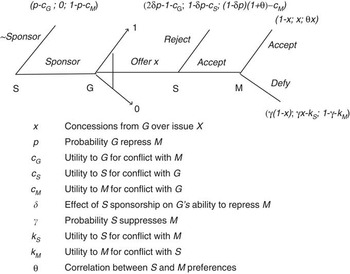
The model presented in Figure 1 has three players: a single government G, a potential state sponsor S and a militant group M. Each player is assumed to have ordered and transitive preferences that can be represented by Von Neumann–Morgenstern utility functions,Footnote 22 and each player is assumed to be risk neutral.Footnote 23 The game represents a stylized internal conflict between G and M. Let us assume that one component of G's utility function is her ability to successfully repress M, whereas one component of M's utility function is its ability to remain a functional political organization. Substantively, this represents a situation where the government seeks to eliminate its militant challenger, and reassert its control over its territory. However, the militants gain some value from sustaining collective action and keeping their organization operational. For example, if M is a rebel organization, the group may gain some value for maintaining its challenge to the state and for collecting rents from whatever segment of the population it controls. Similarly, if M is an armed gang, the gang gains some value from the illicit activity it controls, and therefore is better off sustaining its operations as opposed to ceasing them. For simplicity, let us normalize G's utility for successfully repressing M to 1, and G's utility if M survives to 0. Similarly, let us normalize M's utility if it is repressed to 0, and normalize M's utility for survival to 1. Let us further specify that G successfully represses M with probability p ∈ (0,1) and fails to do so with probability (1−p).
State sponsorship game Note: Payoffs represented: G, S and M.

At the start of the game, S makes a choice of whether or not to sponsor M by providing it with military support such that it can better resist G's repression. While it is assumed that S gains no intrinsic utility for keeping M operational, S's goal in sponsoring M is to gain bargaining power over some issue in dispute X ∈ (0,1).Footnote 24 Let us assume that each of the three players have preferences over the issue in dispute. Assume that G favours resolutions closer to x = 0, whereas S prefers resolutions closer to x = 1. G's utility for the bargaining outcome can therefore be represented by the function uG(x) = −x, whereas S's utility is represented by the function uS(x) = x. This issue substantively represents a policy dispute between the two states. In some cases, this dispute may be directly related to G's conflict with M, and may be over M's local autonomy over a region, protection for M's ethnic group or the distribution of economic benefits to M's population. In other cases, the dispute may have little or nothing to do with M's conflict, and may focus on some other separate issue, such as S's desire to seize G's natural resources. To capture this variation, I assume that M's utility is represented by the function uM(x) = θx, where θ ∈ (0,1). The variable θ represents the degree to which M shares S's preferences related to the issue in dispute between S and G. For example, if the issue in dispute centres solely on S's ability to seize G's natural resources, we might expect that θ→0, signifying that M gains very little from a potential bargain between G and S over these resources. However, if S were interested in securing an enclave to allow M's population local autonomy, we would expect θ→0. Let us specify that the preferences of (M,S) converge as θ→0 and diverge as θ→1.
Moves
S begins the game by deciding whether or not to sponsor M in the conflict against G. If S does not sponsor, the game ends in conflict between G and M. This conflict is represented as a costly lottery in which G represses M with probability p and M survives with probability (1−p). Following the traditional assumption, I assume that each side that participates in the conflict must pay a cost, c. G's pay-off for the cost of conflict is represented by cG ∈ (0,1), whereas M's pay-off for the cost of conflict is represented by cM ∈ (0,1). The winner of the conflict derives their respective utilities for M's repression or survival. Since it is assumed that S gains no intrinsic value for M's survival, S's utility for both outcomes is equal to 0.
S's alternative is to sponsor M, in which case S provides direct military assistance to M in its conflict with G. Let us assume that S's sponsorship affects M in two ways. First, S's sponsorship improves M's welfare by undermining G's efforts at repression. This effect is represented by a discount parameter δ∈(0,1) that is attached to G's probability of repressing M. G's probability of disarming a sponsored M, therefore, falls to δp ∈ (0, p). S's ability to influence the conflict in M's favour increases as δ→0 and decreases as δ→1. In exchange for this military assistance, M is co-opted into assisting S in achieving its policy goal in its dispute over X. For an illustratration with a concrete example, consider the case of Iran and the coalition of militant groups that formed Hezbollah following Israel's 1982 invasion of Lebanon. The goal of Hezbollah was mainly to resist the Israeli occupation of Lebanon. Iran, however, agreed to sponsor Hezbollah if it pledged loyalty to the Ayatollah and followed Iran's policy objectives. Working together, the group was able to resist Israeli attempts to suppress it in the south, while simultaneously providing Iran with a foreign policy tool that it could leverage against Israel. In this case, sponsorship proved mutually beneficial.
If S decides to sponsor, G is given the opportunity to offer a bribe to S over X if S terminates M's operations. G's strategy is continuous, ranging from a refusal to offer a bribe (x = 0) to total capitulation to S's demands (x = 1). S next decides whether or not to accept or reject G's offer. On the one hand, if S rejects the offer, the conflict continues between G and M. Both S and M attempt to ensure that M both survives and accomplishes S's policy objective, while G attempts to repress M and prevent change over the issue in dispute. However, by sponsoring M, S must pay a cost cS ∈ (0,1) if bargaining fails, which represents S's utility for the cost of entering the conflict between G and S. Substantively, cS may represent the cost to S for enduring economic sanctions imposed by G, the cost of border skirmishes with G's forces, or the cost to S associated with a direct military attack by G. On the other hand, if S accepts G's offer, M next decides between complying with S's decision and ceasing its operations, or refusing to disarm. M's decision to cease its operations and disarm terminates the game with a peaceful resolution. Alternatively, if M refuses to accept the deal negotiated by G and S, M continues to engage in violence against G and punishes S by engaging in attacks within his territory.Footnote 25 Since the negotiated settlement is conditional on M's disarming, S responds by attempting to disarm the group forcibly, which it succeeds in doing with probability γ ∈ (0,1) and fails to do with probability (1−γ). We can substantively think of γ as the ability of S to police its own territory, control its population and enforce the rule of law there. States for which γ→1, such as Cuba or South Africa, are thought of as having relatively greater internal stability. By contrast, states for which γ→0, such as Lebanon or Somalia, resemble failing states. In the event that S attempts to disarm M, S pays a cost kS ∈ (0,1), which represents the utility to S for the cost of conflict with M. Likewise, M pays a cost kM ∈ (0,1), which represents the utility to M for the cost of conflict with S. If S successfully disarms M, G grants S the concessions over the issue X.Footnote 26 However, if S fails to disarm M, G refuses to grant S the concessions, but M remains operational.
Payoffs
There are four possible outcomes to the game: S does not sponsor; S sponsors and does not accept a bribe; S sponsors, accepts a bribe and M disarms; and S sponsors, accepts a bribe but M defies S, and an internal conflict ensues. In the first case, the payoff to G is p−cG, the payoff to M is 1−p−cM and the payoff to S is 0. In the second outcome, where S sponsors but does not accept a bribe, M is able to both survive and accomplish S's policy objective with probability 1−δp. S gains a payoff of 1 if M accomplishes the objective and 0 otherwise, which produces a payoff of (1−δp) 1−cS to S for rejecting the bribe. If M survives with sponsorship, M gains its value for survival, 1, plus its value for S's policy objective (θ), which produces a pay-off of (1−p)(1 + θ)−cM. If M is instead repressed by G, M receives a pay-off of −cM. G's pay-off is represented by her probability of disarming M (p) minus the cost of conflict (−cG) and the cost of losing the policy good (−1). G's pay-off for fighting a state-sponsored M is therefore equal to δp(1) + (1−δp)(−1)−cG = 2 δp−1−cG.
The pay-off structure captures the key elements of the dilemma faced by state sponsors. If S refuses G's bribe, S enters into a costly conflict with G. Although M serves as S's agent, S must still pay some cost for sponsoring M's operations, which indicates that there should be some settlement along issue X that is preferable to this outcome. However, if S were to accept an offer from G, S risks facing a punishment from M if the group views the deal as unacceptable. Should M refuse, S will only obtain his bribe if he is able to disarm M himself, which produces a costly internal conflict with the group.
Information and Beliefs
There are two sources of private information in the bargaining setting. Let us assume that while M is aware of its preferences, and how much it values the policy goal sought by S, neither G nor S is aware of the true value of θ. G and S are only aware that θ∼U(0,1). This captures the essential problem in any principal–agent relationship. While S would prefer to use M to accomplish his policy goal, S cannot be certain how much M values this goal, and cannot be certain if M prefers maintaining its own survival to accomplishing S's objectives. On the basis of historical accounts of sponsorship, and the theoretical literature on the principal–agent relationship, we would expect militants to distort and misrepresent their preferences to sponsors in order to obtain sponsorship. However, after receiving sponsorship, the group may become less willing to co-operate with the sponsoring state. To illustrate with an example, consider the case of American support for Northern Alliance fighters following 11 September 2001 (9/11). To gain a ground force against the Taliban, US Special Forces began supporting Afghan elements of the Northern Alliance that claimed they wished to defeat both the Taliban and al-Qaeda. However, once the United States gave these fighters support, a significant portion of the Northern Alliance simply used American weapons and air strikes to settle scores against their enemies, or loot areas formerly under the Taliban's control. These fighters seemed less interested in the American objective in toppling the Taliban, and more interested in hoarding wealth for themselves. This case indicates that prior to sponsorship, S must base its decision to sponsor on whether it believes the group is truly interested in helping him accomplish his policy objective, or whether the group is solely using him to further its own survival. Allowing θ to be unknown to all players except M effectively captures this problem for S.
The second source of private information is G's utility for the cost of conflict (cG). The literature indicates that governments frequently claim that they will under no circumstances negotiate with militant groups, often to establish a ‘tough’ reputation.Footnote 27 However, empirically, we see that these ‘no concessions’ claims are often non-credible, and even the most fervent target governments sometimes do negotiate with militant groups. For example, while the United States, Britain and Israel all maintain ‘no concessions’ policies, each of these states has at some point negotiated with transnational terrorists, either for the release of hostages or over larger issues, such as territory. This suggests that ex ante, potential sponsors cannot be certain whether government claims that they will never negotiate are credible. This captures the second part of the strategic situation, in which S cannot be certain if G prefers to negotiate or is resolute enough to fight the state-sponsored M, despite the decreased probability that repression will succeed. S's decision to sponsor M is therefore a gamble that could produce policy gains if successful, but could result in conflict if bargaining were to fail. To capture this uncertainty, let us assume that while G is aware of the true value of cG, S and M are only aware that cG∼U(0,1), but are uncertain as to whether or not G will refuse to negotiate.
The solution
I solve the game using the Perfect Bayesian Solution Concept (PBE).Footnote 28 Let us begin the discussion of the solution at the final choice node. Here, M observes the offer x made by G to S. M is aware that this concession will only be given to S if it disarms. However, if M disarms, M loses the benefit it gains from sustaining its own operations. For example, in a case where the issue in dispute is the level of autonomy for a separatist region, the group faces the question of whether to give up its protection racket in exchange for the autonomy promised by G. Alternatively, M could punish S for making this deal and dare S to forcibly disarm it. Formally, M chooses to defy S if 1−γ−κM > θx. Rearranging terms, we can say that M defies S if (1−γ−κM)/x > θ. We can therefore define the probability that M defies S as equal to:Footnote 29

We see that as x→0, the probability that M defies S increases, signifying that M will almost certainly punish if S gains nothing from G. We further see that as γ→1, indicating that S is more likely to disarm M should he be challenged, M is less likely to defy S. Again, this makes intuitive sense. If S is better able to suppress M in an internal conflict, M is less likely to defy S's order to disarm. Let us now consider S's bargaining behaviour. At the second to last move, S decides whether or not to accept G's offer. S's decision is a function of both the probability that M will defy him and the level of concessions x that G makes. Since S is uncertain if M will defy him, and only knows that M will defy with probability θ*, S only accepts an offer if:

Using the quadratic equation, we can establish S's reservation price as:Footnote 30

From Conditions 2 and 3, we see that S's decision to accept a bribe risks that M will punish him with probability θ*. S will therefore require G to make a sufficiently significant offer that taking this risk is preferable to continuing conflict. Let us next consider whether or not G will make such an offer. G's utility for offering the bribe is equal to θ*(γ(1−x) + (1−γ)0) + (1−θ*)(1−x). Substantively, this indicates that if M defies, there is some probability γ that S will forcibly disarm M, after which G will yield the concessions. There is also some probability (1−θ*) that M will not defy S, and will disarm voluntarily. If this occurs, G receives the pay-off for disarming M minus the cost of the concession. We can identify G's optimal offer by taking ∂θ*(γ(1−x) + (1−γ)0) + (1−θ*)(1−x/∂ x and solving for x:Footnote 31

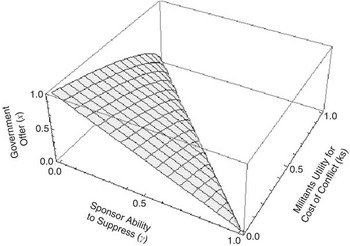
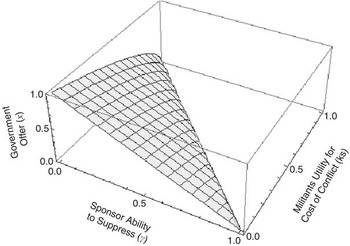
The above expression defines G's optimal offer. Figure 2 plots the value of G's offer as a function of the two variables γ and κM. We can see that the offer made by G maximizes when both γ→0 and κM→0. This indicates that G is likely to offer the largest bribe to S if M's willingness to punish S is high,Footnote 32 and S is unlikely to forcibly disarm M should he accept a bribe. In other words, governments make larger offers to sponsors that are both incapable of suppressing their militants and supporting militants who are willing to defy their orders. This seems slightly counter-intuitive, but consider the model's explanation. If a militant group appears very willing to defy their sponsor, and the sponsor appears incapable of suppressing them, the sponsor will require significant concessions for him to turn on his militants. Therefore, given the sponsor's vulnerability, G must make an offer that is large enough to both induce S to take the risk and large enough possibly to induce M to disarm peacefully. Therefore, we see that the more vulnerable S is, the larger the offer he will require in bargaining.
Government's optimal offer x* as a function of sponsor's ability to suppress militants (γ) and militants’ utility for the cost of internal conflict (kM)
However, given that weaker S require relatively larger concessions, G may become unwilling to meet them. The model identifies two cases: one in which x* < x′ and one in which x* ≥ x′. In the former, G's optimal offer falls short of S's reservation price, and will be rejected by S. This leaves G with one of two choices: G can either make an insufficient offer and fight the sponsored M or G can meet S's reservation price. In the second case, G's optimal offer x* exceeds S's reservation price, and will be accepted. Let us specify the condition under which x* ≥ x′ as a function of δ. We see that x* = x′ if:

We can demonstrate that x* > x′ if δ ≥ δ* and x* < x′ otherwise.Footnote 33 Let us first consider the latter case, in which δ < δ*. In this case, G's optimal offer x* is insufficient to meet S's demands, and will therefore be rejected. G's choice is therefore between making an insufficient offer and fighting a sponsored M, or offering S sufficient concessions to meet his reservation price. G prefers meeting S's reservation price if cG > 2δp−θ*(γ−x′)+(1−θ*)(1−x)′−1. Let us therefore define the probability that G is unwilling to meet S's reservation price as:

We see that if δ < δ*, G makes an offer x > x′ with probability c′G and meets S's reservation price with probability (1−c′G). Let us now consider the second scenario, in which δ ≥ δ*, which implies that x* > x′. In this case, G's optimal offer exceeds S's reservation price. Although x′ > x*, G maximizes her utility for the deal by setting x = x*. This occurs because as x increases, M is less likely to defy S, thereby improving G's pay-off. However, as in the previous case, S is uncertain as to the value of cG. This means that even though S knows that G will exceed his reservation price, S does not know if G prefers to fight the sponsored M over making this offer. S knows that G prefers to bribe if:

Rearranging the terms, G will refuse to negotiate if:

We can therefore establish that the probability that G will refuse to offer a bribe if δ < δ* is equal to:Footnote 34

We can therefore define G's strategy as: If δ < δ*, offer x < x′, if cG < c′G and offer x′ otherwise. If δ ⩾ δ*, offer x < x* with probability if cG < c*G and offer x* otherwise.
Given G's strategy, we can now predict whether or not S will sponsor, given his beliefs θ and cG. Let us first consider the case in which δ < δ*. S's utility for sponsorship in this case is:

Since we know that the offer at S's reservation price x’ is such that S is indifferent between accepting and rejecting, this expression simplifies to:

Therefore, we see that if x* < x′, S sponsors M if 1−δp−cS > 0 and does not sponsor otherwise. Therefore, if 1−δp−cS > 0, S has a dominant strategy to sponsor. This indicates that if δ→0, meaning that S's sponsorship can significantly alter the dynamic of the conflict in favour of, S is likely to have a dominant strategy to sponsor. We further see that as p→1, indicating that G is near certain to repress M, S is more likely to have a dominant strategy to sponsor. Finally, we see that as cS→1, S is unlikely to sponsor. Thus, we can characterize these S as those sponsors that do not find providing aid to the militants costly, and that have the capability to significantly reduce the probability of M's collapse as a result of their sponsorship. Empirically, this appears to correspond to cases in which major powers have acted as state sponsors. These states, given their power advantages, have a relatively greater ability to influence conflicts worldwide, at relatively low cost. What is interesting about the analysis here is that these states may sponsor militants against their adversaries, regardless of the risk of moral hazard. To illustrate with a case example, consider the behaviour of the Soviet Union and China during the Vietnam War. In this case, it seems reasonable to assume that American military power made it unlikely that the Vietcong would survive on their own against the Americans, and that p→1. Owing to this imbalance of power, both the Soviets and the Chinese may have been compelled to intervene on behalf of the Vietnamese in order to prevent American domination of Southeast Asia. It is clear, however, that the preferences of the Soviets and the Chinese, which focused on minimizing American influence, were not completely consistent with those of the Vietnamese, whose preferences focused on gaining an independent Vietnam.Footnote 35 Even though all sides were aware of this, both the Soviets and the Chinese chose to sponsor the guerrilla group. We therefore see that powerful sponsors that can influence conflict dynamics are not necessarily concerned with their militants’ propensity for moral hazard. A similar story could be told in examining American sponsorship of the mujihedeen during the Soviet occupation of Afghanistan.Footnote 36 It appeared fairly clear in this case that the militants’ preferences were not entirely consistent with the American preferences for the future of Afghanistan. Nonetheless, the American ability to influence the conflict was sufficiently high, as was the probability of the militants’ collapse, which produced a dominant strategy for the United States to intervene.
However, unlike the major powers, most states in the system do not have the capability to affect the militants’ probability of survival to this extent. The majority of states do not have the resource base of major powers, and are limited in their ability to influence conflicts in other states. This suggests that empirically, most conflicts involving minor powers would fall into the set of cases for which δ ≥ δ*. In these cases, sponsorship can improve a group's probability of survival, but cannot necessarily shift the balance of power entirely to the militants. This appears to correspond to most cases in which minor powers engage in sponsorship.Footnote 37 In terms of the model, S that are minor powers sponsor M if:

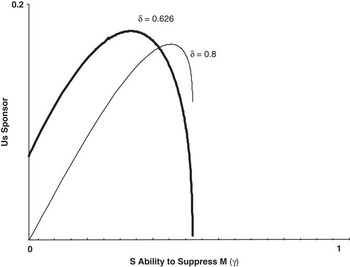
Figure 3 maps the utility to S for sponsorship as a function of γ, or S's ability to repress M. We see that γ has a curvilinear effect on S's utility for sponsorship. Given this hypothetical distribution of parameter values, the utility for sponsorship increases until γ ≈ 0.4 but subsequently falls sharply towards 0. Let us consider the substantive meaning of this result. We know that G's offer maximizes if the sponsor is unable to control his militants and the militants appear willing to risk internal conflict. Empirically, this might suggest that weaker states gain considerable bargaining power when sponsoring militants, particularly if their militants appear resolute enough to defy the sponsor. However, if G is required to make such a large offer, G might instead refuse to bribe altogether and attempt to repress the militants instead. Therefore, if S is completely unable to control his militants, G may be unwilling to negotiate. However, if γ→1, and S is able to suppress his militants with ease, G will make a relatively smaller offer, which will in turn undermine the rationale for initially sponsoring the militants. This suggests that sponsors can only gain bargaining power if they face some risk that their militants will defy them, but they will not gain any bargaining power if they are either too weak to disarm their militants or strong enough to disarm their militants with ease. Thus, we see that states not strong enough to alter the conflict outcome dynamically should only sponsor militants if they are moderately weak:
Effect of potential sponsor's ability to suppress its militants on the utility of sponsorship if 0 > 1−δp−cSNote: kS = 0.2; kM = 0.5; cS = 0.5; p = 0.8.

HYPOTHESIS 1: For non-major powers, the likelihood of sponsorship increases if the sponsor's ability to suppress its militants is moderately weak.
This hypothesis is novel in that many studies have argued in favour of the ‘weak state hypothesis’, which predicts that the probability that sponsorship increases as a potential supporting state's internal weakness increases. However, according to the model, the effect of weakness is non-monotonic. While weak states cannot credibly disarm their militants, moderately weak states meet a minimum threshold of internal capacity, but will have difficulty in suppressing their militants if a deal is reached with the government. According to Figure 3, this should increase the value of the concessions G will make. However, these states are not so weak that the probability of a successfully implemented deal is minimized. This suggests that the ideal state sponsor is not in complete control of the state's territory, which signifies that it will need considerable concessions to disarm their group, but is also not a failing state, which would signal that bargaining is hopeless and deals are non-credible. This analysis indicates that it is because these states appear to be ‘on the brink’ that they can use sponsorship of militants to gain bargaining power.
Therefore, a possible answer to the original question of why states sponsor militants, despite the risk that they may lose control of the groups, emerges. We see that states that can substantially alter the conflict in favour of their militant groups are more likely to use sponsorship to accomplish their foreign-policy objectives. This prediction matches numerous studies in the literature on foreign support for non-state actors.Footnote 38 While this suggests some external validity, the model offers a second, novel prediction. We see that for non-major powers, sponsorship appears only to provide bargaining power to states if their groups appear willing to risk internal conflict should they not be sufficiently appeased. Since the groups appear so willing to risk this form of conflict, sponsors can credibly claim that they can only accept a bribe that is both large enough to offset the cost of the risk of internal conflict. Governments that cannot credibly continue fighting against a sponsored militant group may have little choice but to appease the sponsor, given that sponsorship effectively decreases their ability to repress the group without opening negotiations with the sponsor. At first glance, this insight appears to support much of the current literature that identifies very weak states as likely to support militants. However, since weaker sponsors are less credible, and are likely to make significant demands, these sponsors risk that governments will simply reject negotiation in favour of conflict. Thus, we see that sponsors appearing to be states that face a credible risk of failure, but having something that resembles a functioning government, appear to have the greatest incentive to sponsor militant violence. Anecdotally, we can point to several states that fit this description that are indeed sponsors of militant violence, including Syria, Iran, Pakistan and Venezuela. While these states appear to suffer from internal turmoil, and appear to face considerable difficulty in repressing internal challengers, none of them are characterized as failing or collapsed states. Although this suggests that the model does have some external validity, the following section presents a research design to test this hypothesis more systematically.
Research design
The empirical prediction from Hypothesis 1 is that the potential sponsor's ability to suppress its militants has a curvilinear effect on the probability of sponsorship. To test this hypothesis, we require a dataset that includes a set of cases where a government is in conflict with a militant group, the rivals of the government have both the motivation and the ability to intervene on behalf of the militants and the rivals of the government have the opportunity to intervene on behalf of the militants. These data are collected from the UCDP Armed Conflict Dyadic Dataset,Footnote 39 which contains information on conflicts from 1989 to 2001. From these data, I identify the set of conflicts involving militant groups by excluding the interstate conflicts and focusing only on the cases of internal conflict and/or internationalized internal conflict. The data identify dyads consisting of two opposing actors in a violent conflict where at least one party is a government and another is a militant group. This allows me to identify the set of militant groups operating against governments during this period that were potentially seeking sponsorship. The next step is to identify the set of states that could potentially serve as sponsors to these militant groups.
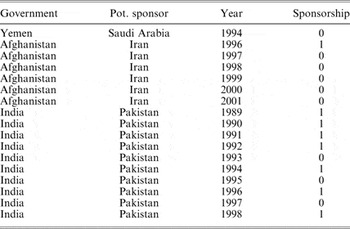
The policy and systematic literature argues that sponsors are likely to be the government's rival states.Footnote 40 Therefore, I identify the pool of potential sponsors using Thompson's rivalry data.Footnote 41 I consider each state that is a rival of the government that is fighting the militants to be a potential sponsor. These data are ideal for two reasons. First, each state that is listed as a rival of the government is hostile to it and therefore would have some motivation to sponsor the militants. Secondly, the Thompson rivalries do not include those cases where one side is militarily preponderant over another. This allows us to avoid the theoretical cases where a sponsor's aid dramatically alters the conflict landscape in favour of the militants, thereby giving the sponsor a dominant strategy to intervene.Footnote 42 This means that the pool of potential sponsors from the Thompson data will fall into the S 2 category, which allows us to test Hypothesis 1 appropriately. The dataset therefore consists of annual dyads from 1989 to 2001 between each government involved in a conflict against a militant group and each of the government's Thompson rivals. The unit of analysis is a rivalry year consisting of a government fighting a militant group and one of the government's rivals, which is considered to be a potential sponsor. Table 1 presents a snapshot of the dataset.
Sample Data

Variables
The dependent variable is whether or not one of the government's rivals sponsors the militant group. I define sponsorship using Byman's definition,Footnote 43 which requires that the assistance a state provides to militants be ‘the intentional assistance … to help it use violence, bolster its political activities, or sustain the organization’.Footnote 44 This definition is important because it separates active sponsorship of militants from the passive support provided by host states.Footnote 45 Since the coding rule specifies that the support must be ‘intentional’, the new dataset removes cases of passive support and focuses on active sponsorship. To identify precisely when sponsorship occurs, a coder searched through historical archives for each of the conflicts identified by Byman et al. to determine the cases where a state chose to support the group. The coder examined historical accounts from Keesing's Record of World Events, Lexis-Nexis, Facts on File and the SIPRI Yearbook. This variable is coded as 1 if the coder identified active and intentional support from the rival to the militant group, and 0 otherwise. In some cases, the new search identified sponsors that were not originally listed in Byman et al. In other cases, the criteria of deliberate assistance eliminated other cases identified by Byman et al. For example, the Byman data identify the African National Congress (ANC) as receiving support from ‘various Frontline states’, but do not specify which states. In our investigation, none of the Frontline states were intentionally providing active sponsorship during the 1990s, though several were serving as host states.Footnote 46 If a state met our coding criteria, we believe it made a deliberate choice to sponsor as indicated by the theoretical model. In other cases, we see cases where a government's rival had the opportunity and the ability to sponsor, but chose not to do so. The dataset identifies sponsorship in eighty-seven of the 337 years under observation (26 per cent). This consists of twenty-seven cases in which sponsorship begins (10 per cent), and sixty cases in which sponsorship continues from a previous year. The two regions with the greatest level of sponsorship are the North Africa/Middle East region (38 per cent) and sub-Saharan Africa (33 per cent). The fewest cases of sponsorship, perhaps surprisingly, are in the Latin American region, which did not detect any cases of sponsorship during this period.Footnote 47
The main independent variable is the potential sponsor's ability to suppress the militants. Theoretically, the ability to suppress militants is derived from not only its military power but also the penetration of its intelligence network into its society and the state's overall level of societal support.Footnote 48 To measure these characteristics, I use Arbetman and Kugler's measure of relative political capacity (RPC). The RPC indicator is represented as the ratio of Actual Tax Revenue to Predicted Tax revenue.Footnote 49 The argument is that increases in the RPC score suggest that the state is better able to enforce compliance with its laws among its population. Increasing the state's capacity is therefore an indicator of the state's power to control the behaviour of its non-state actors, which would include militant groups. The RPC score serves as a proxy measure of the state's ability to suppress its militants. If the state's score is high, the state is more likely to suppress the group, whereas lower scores indicate that the state is less likely to do so. Since Hypothesis 1 suggests that the potential sponsor's ability to suppress the group has a curvilinear effect on the probability we observe sponsorship, I include both the potential sponsor's RPC score and the square of this term (Potential Sponsor RPC and Potential Sponsor RPC 2). The model predicts that the probability of sponsorship will increase when moving from low to moderate values, but will subsequently decrease when moving from moderate to high values. This prediction critically differs from other empirical studies of state support for transnational militants, which predict that sponsorship is most likely if a state is weak or strong enough to disarm its militant groups.Footnote 50 According to the model's explanation, states that are on the dividing line between internally ‘strong’ or ‘weak’ classifications are the most likely sponsors of militant groups. Using the squared term allows me to critically test the model's explanation against these alternative predictions.
While the potential sponsor's RPC score is the key theoretical indicator, I also include several control variables based on previous studies of insurgency and civil war by Fearon and Laitin and by Hegre and Sambanis.Footnote 51 First, I control for the target government's ability to defeat the militants by also including the government's RPC score. Secondly, I include a measure of the government's military power relative to the potential sponsor. This is measured using a ratio of the military expenditures of the government and potential sponsor, which comes from the Composite Indicator of National Capabilities (CINC) data.Footnote 52 The measure of the government's relative power is captured as follows:

This measure captures the government's share of dyadic military power and is a reasonable measure of its military strength relative to that of the potential sponsor. Thirdly, I include measures of both the government's and potential sponsor's Per capita GDP scores from Fearon and Laitin,Footnote 53 which serve as a proxy for the development of both the government and the potential sponsor. Fourthly, I include the government and the sponsor's logged population scores and logged durability scores. Data from Fearon and Laitin and from Hegre and Sambanis identify that armed insurrections are more likely to occur in states with large populations,Footnote 54 while Jackman argues that states with younger institutions are more susceptible to rebellions.Footnote 55 I also include Fearon and Laitin's Elevation Difference indicator for the potential sponsor (which captures the ability of this state to provide bases) and a measure of the potential sponsor's Ethnic Fractionalization.Footnote 56
Method
Since the sponsorship dependent variable is dichotomous, I test the hypotheses using three probit models with robust standard errors clustered on each government. While the first model includes all of the observations, the second model eliminates observations with consecutive sponsorship years. This sharpens the analysis to include only those cases in which a rival state makes the initial decision to sponsor a militant group, and removes those cases where sponsorship was merely a continuation of policy from the previous year.Footnote 57 The third test operates in a similar way, except that, in this test, I increase the threshold needed to qualify as sponsorship. The Byman data provide three ordinal categories of sponsorship: 1. Minor, 2. Moderate, and 3. Critical. Minor sponsorship is classified as providing very limited support, and possibly only political inspiration. The third model, therefore, uses a stricter definition of sponsorship by specifying that the rival must provide at least intelligence or fighters to qualify as a sponsor. This requires the level of support identified as Byman to be coded as either a 2 or a 3. This is intended to show whether the results are robust if the threshold is increased. In addition, I control for duration dependence using the duration, duration 2 and duration 3 indicators as defined by Carter and Signorino.Footnote 58 The duration measure captures the number of years in which the potential sponsor does not provide sponsorship.
Results
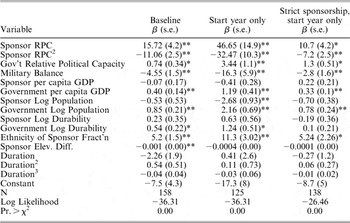
The results in Table 2 provide support for Hypothesis 1. We see that in each test, both the potential sponsor's RPC and the RPC 2 indicators are significant at p < 0.01. We see that while the sponsor's RPC variable is positive, the squared term is negative. This suggests a curvilinear effect where initially increasing the potential sponsor's RPC score initially increases the probability of sponsorship, but subsequent increases decrease the probability of sponsorship. This result is consistent across each of the models, which suggests robustness.
Results

*p < 0.05; **p < 0.01.
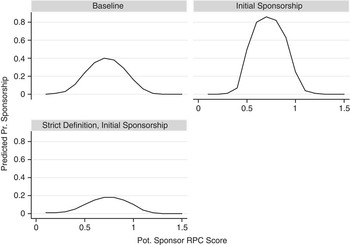
Figure 4 examines the substantive effect of increasing or decreasing the potential supporter's ability to disarm its militants on the probability of sponsorship. The predicted probabilities are generated using each of the three models by holding each variable at its mean value and manipulating the potential sponsor's RPC score. The vertical line represents the mean RPC score for all states between 1960 and 2006, which is equal to 0.999. Consistent with the theoretical model, we see that the probability of sponsorship initially increases as the potential sponsor's RPC score increases, but falls if the potential sponsor's RPC is increased again. We further see that the probability of sponsorship maximizes at an RPC score that is less than the mean. This substantively indicates that the probability of sponsorship appears to maximize if the potential sponsor is moderately weak, and is consistent with Hypothesis 1.
Effect of potential sponsor's ability to suppress its militants (RPC) on the probability of sponsorship

Table 3 examines the substantive effect of increasing or decreasing the potential sponsor's ability to disarm its militants on the probability of sponsorship using comparative statics. To do so, I estimate the predicted probabilities of sponsorship when the potential sponsor's RPC = 0.46 (one standard deviation below the mean), 0.86 (the mean) and 1.46 (one standard deviation above the mean). Categorically, these values represent a weak potential sponsor, a moderately weak potential sponsor and a relatively stronger potential sponsor. I consider the mean value of RPC = 0.86 to be moderately weak because it is less than the mean RPC score of 0.999 for the entire pool of states between 1960 and 2006. Let us first examine the baseline model, which uses all of the observations. In this model, the probability of sponsorship increases from 0.18 in the weak category to 0.31 in the moderately weak category, which is a 72 per cent increase. Similarly, in the model that uses only years in which sponsorship begins as well as the model using the stricter definition of sponsorship, an increase from the weak category to the moderately weak category produces respective increases of 148 per cent and 89 per cent. Therefore, we see that moderately weak states appear more likely to sponsor than the weakest states.Footnote 59 Further, as Hypothesis 1 predicts, we see a dramatic decrease in the probability of sponsorship if the potential sponsor's RPC score is increased to higher levels. Increases in the potential sponsor's RPC score decrease the probability of sponsorship by nearly 99 per cent in the first two models, and by 97 per cent in the model using the strict definition of sponsorship. The results, therefore, demonstrate that potential sponsors with the greatest ability to suppress their militants are very unlikely to sponsor. These results are consistent with the predictions of Hypothesis 1. States are most likely to sponsor militants if their capability to suppress their militants is neither too great, which would produce marginal concessions, or too weak, which would render them non-credible. The results show that the states that are most likely to sponsor are those that are somewhere in between – and may appear somewhat weak but not yet failing.
Effect of Potential Sponsor's Ability to Suppress Its Militants (RPC) on the Predicted Probabilities of Sponsorship

While we see support for Hypothesis 1, let us now add more depth to the substantive interpretation by using the statistical model to predict sponsorship in two real cases. The two cases we will examine are Israel's conflict with Hamas during the period from 1990 to 2000 and South Africa's conflict with the African National Congress (ANC) from 1980 to 1989. On the one hand, the states considered to be rivals with Israel include Egypt, Jordan, Syria and Saudi Arabia. On the other hand, South Africa's rivals include Botswana, Lesotho, Mozambique, Swaziland and Zimbabwe. While some of the Israeli dyads are included in the large N test, the South African case is excluded since the ANC insurgency began earlier than 1989. This allows us to see whether the results hold in a case that is out of sample. The data for the South African case were collected using Arnold's Wars in the Third World.Footnote 60 While each of the Frontline states served as passive supporters to the ANC, the information from this source allows us to identify which states also served as active sponsors.
Israel in the 1990s and South Africa from 1980 to 1989 have many similarities. Both governments had strong militaries and outweighed their militant challengers. Secondly, both Israel and South Africa had rivalries with nearly all of their neighbours. Israel had long rivalries with its Arab neighbours, while South Africa's apartheid regime made it a target of the newly independent African states bordering it. The conflict of interest in the Israel/Hamas case could be thought of as a clash over Palestinian autonomy, whereas the South Africa/ANC conflict involved the exclusion of indigenous Africans from the political process. In both cases, it appeared as if the militant groups could assist the potential sponsors in accomplishing their foreign policy objectives. However, perhaps the most important feature of the states surrounding both Israel and South Africa is that they exhibit substantial variation, which allows us to test Hypothesis 1's prediction that weaker states will be more likely to provide sponsorship.
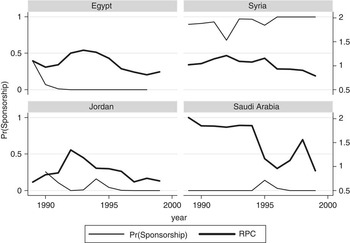
Let us first examine the Israeli case. Hamas is assumed to have four potential supporters: Egypt, Jordan, Saudi Arabia and Syria. Let us first assume we have no background knowledge of this conflict except for the theory and the available data. Figure 5 presents the predicted likelihood of sponsorship for each state from 1990 to 2000, along with the potential sponsors’ RPC score on the right axis. Assuming that we are completely uninformed about the real world and only have the theory and data, we would predict Syria to be the most likely of the four states to support Hamas. Syria consistently has the lowest RPC scores of the group of states, which never fall below 0.76. This indicates that Syria should not be considered a very weak state, but it is certainly not a strong one, especially when compared with Saudi Arabia, for example. On the basis of these data, this prediction is correct. The only state to provide active sponsorship to Hamas is Syria between 1990 and 1999, after which point sponsorship ends. We see that Syria's predicted probability of sponsorship is consistently high. It is also interesting to point out that the strongest state is Saudi Arabia, which did share some affinity for Hamas, and has the lowest predicted probability of sponsorship. The theory expects this result since Saudi Arabia's high RPC scores would prevent it from using Hamas effectively to gain bargaining power. Likewise, the model predicts that both Egypt and Jordan are unlikely to sponsor Hamas due to their relatively higher RPC scores. Therefore, we see that even though the theory greatly simplifies this conflict, it does a reasonable job of predicting which states provided sponsorship to Hamas during this period.
Israel/Hamas, 1990–2000

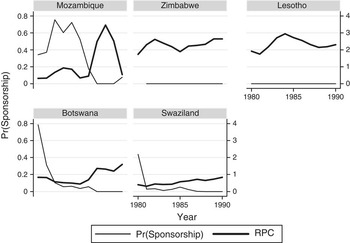
Let us next examine the case of South Africa.Footnote 61 From Figure 6, we see that Botswana and Mozambique have the highest predicted probabilities of sponsorship. We can make two interesting observations from observing these two cases. If we examine Botswana, we see that the statistical model initially predicts a very high probability of sponsorship when Botswana's RPC score is equal to 0.83 in 1980. This classifies Botswana as moderately weak. However, notice that as Botswana's RPC score declines until 1985, the probability of sponsorship also decreases. This indicates that although Botswana was becoming weaker, the probability that Botswana would sponsor the ANC was declining. This is consistent with the prediction that if potential sponsors are so weak that they will be unable to control their militants, they will have no incentive to sponsor.
South Africa/African National Congress, 1980–90

However, the pattern of predicted probabilities for Mozambique is also consistent with Hypothesis 1. We see an increase in the predicted probabilities that Mozambique sponsors the ANC as its ability to suppress the group increases until about 1986, after which the predicted probabilities decrease in connection with Mozambique's dramatic increase in RPC scores. In this period, Mozambique escalated its sponsorship of the ANC until about 1984, after which time it cut a deal in which it abandoned the ANC in exchange for South Africa's abandonment of RENAMO (Resistência Nacional Moçambicana). Consistent with the model, this deal was not made in the early stages of sponsorship for the ANC in 1980–82, largely because Mozambique's RPC score was very low, which signified that it could not credibly disarm the ANC. However, in 1984, Mozambique's RPC score reached a value of 0.85, which fits with the moderately weak classification needed to gain bargaining power. This year marked the last year in which Mozambique actively sponsored the ANC, which suggested that it waited until it could maximize its bargaining leverage to trade the ANC for an end to RENAMO attacks. Again, this is consistent with Hypothesis 1.
We further see that the test does not predict very high probabilities of sponsorship from the other Frontline states. For Lesotho and Swaziland, the fact that these states were landlocked within South African territory probably explains their unwillingness to take the gamble of sponsorship. However, it is interesting that Zimbabwe's predicted probability of sponsorship is very low. Zimbabwe in 1980 had only recently taken control from the apartheid government of Rhodesia. Given the similarity of the strategic situations faced by the Zimbabwe African National Union (ZANU) and the ANC, one might expect that Zimbabwe would be a willing sponsor. However, based on solely the RPC scores, the model predicts that Zimbabwe would not sponsor the ANC. We see that with the exception of Botswana in one year and Mozambique, none of the Frontline states have high predicted probabilities of sponsoring the ANC, which is consistent with the empirical record. Despite the conventional wisdom that each of the states were sponsors of the ANC, we see that the ‘support’ provided by these states tended to be indirect in the form of hosting. None of the Frontline states adopted the core of the ANC's demands against the South African state in their famous Lusaka protocol, and many of them privately sought to co-operate with South Africa so as to avoid directly entering into the conflict.Footnote 62
In these two cases, we see that holding all other factors constant, the moderately weaker Syria and Mozambique chose to sponsor their respective militants. The stronger governments, such as Saudi Arabia in the Israel case and Zimbabwe in the South African case, chose not to do so. Since these states were relatively stronger and capable of controlling their militants, neither state would have an incentive to sponsor them since they would provide little bargaining power. The model instead predicts that because Syria and Mozambique were moderately weak, whereas the others were relatively strong, these states could hope to push their respective target government into negotiation with the militants, which in turn would lead to higher pay-offs. This prediction is supported by the case studies. In total, both the large N and two case studies support Hypothesis 1 and suggest that moderately weaker states are better able to use militant groups for coercive bargaining.
Conclusion
This study began with asking why states would sponsor militant groups if such support often creates moral hazard, and ultimately produces a commitment problem. The theoretical model argues that state sponsorship serves to signal the tying of hands in bargaining with rival governments. Sponsorship ties hands in two ways. First, sponsorship decreases the probability of a militant group being repressed, thereby improving the probability that the group will be effective in accomplishing the sponsor's policy objective. This enables the sponsor to demand more in negotiation by improving the sponsor's value for the outside option associated with bargaining failure. Secondly, sponsorship gives the militants the power to punish the sponsor if it negotiates an unfavourable deal. Since the sponsor's outside option of conflict improves, and the sponsor's risk associated with peace increases due to the threat of punishment from the militants, the sponsor forces itself to demand considerable concessions from the target government in exchange for abandoning the militants. If the government's pay-off for conflict is sufficiently decreased due to the improved capability of the militants, the government may have no choice but to concede to the sponsor's demands. Like all costly signals, the sponsor increases the risk that the concessions it needs to make peace will become so excessive that the government will prefer to fight instead. However, since the mechanism of tying hands provided by sponsorship both increases the concessions the sponsor needs for a deal, and improves the value of its outside option, we can see that sponsorship can indeed be a valuable foreign policy tool.
Despite several cases of spectacular failure, the model developed in this study suggests that sponsorship can be an effective foreign policy tool. The model predicts that the bargaining power of sponsorship maximizes if the sponsor is either a major power or if the sponsor is moderately weak. This description seems to fit the empirical record. O'Brien's study, as well as numerous other studies, indicates that major powers often engage in state sponsorship of militant groups, particularly when opposing major power rivals.Footnote 63 While the previous literature supports the major power prediction, the empirical test in this study provides evidence that sponsorship is more likely to occur if the potential sponsor is moderately weak. These states are not failing states, but appear to face a significant risk of substantial internal conflict. This study offers an explanation why several states – such as Syria with the Sunni insurgency in Iraq, and Pakistan with the Kashmiris – that appear to be relatively unstable put themselves at greater risk by engaging in sponsorship. This risk appears to be a necessary ingredient in using sponsorship to gain bargaining power in international politics.
Appendix: Formal solution
Proposition 1. The following strategies and beliefs constitute a unique pure strategy PBE:
1. M : Defy if θ <(1−γ−kM)/x and Accept otherwise.
2. G : If δ<[−2+cS−kM (1−γ)2 + 4γ−γcS−3γ 2 + γ 3 + (1 + γ + kM)√((1−γ)(1−γ−kM))]/[p [p(−1 + γ)], offer x < x′; offer x < x′, if cG < [cs−c 2S + kM−cSkM−2kS + 2kMkS + 2γ−2γcS−γkM + γcSkM + 2γkS−γ 2 + γ 2cS−3δp + δpkM + 2γδp−γδpkM−γ 2δp + δ 2p 2 + √(4kS(1−γ−kM) + (−2+ cS + kM + 2γ−γkM−γ 2 + δp)2) + cS√(4kS(1−γ−kM) + (−2 + cS + kM + 2γ−γkM−γ 2 + δp)2)−δp√(4kS(1−γ−kM) + (−2 + cS + kM + 2γ−γkM−γ 2 + δp) 2)]/[−2 + cS + kM + 2γ−γkM−γ 2 + δp−√(4kS(1−γ−kM) + (−2−2γ + cS + kM−γkM−γ 2 + δp)2]; and offer x = x′ otherwise for all beliefs θ. If δ ≥ [−2 + cS−kM(1−γ) 2 + 4γ−γcS−3γ 2 + γ 3 + (1 + γ + kM)√((1−γ)(1−γ−kM))]/[p(−1 + γ)], offer x* if cG > −3 + kM + 2γ−γkM−γ 2 + 2√((1−γ)(1−γ−kM)) + 2δp, and offer x < x* otherwise for all beliefs θ.
3. S : If δ < [−2 + cS−kM(1−γ)2 + 4γ−γcS−3γ 2 + γ 3+(1+γ+kM)√((1−γ)(1−γ−kM))]/[p(−1 + γ)], Sponsor if 1−δp−cS > 0 and ∼Sponsor otherwise, for all beliefs θ and cG. If δ ≥ [−2 + cS−kM(1−γ)2 + 4γ−γcS−3γ 2 + γ 3 + (1 + γ + kM)√((1−γ)(1−γ−kM))]/[p(−1 + γ)], Sponsor if 1−δp−cS > 0 for all beliefs θ and cG. If 1−δp−cS < 0, Sponsor iff cG < [x*(1−θ*(1−γ))−θ*ks]/[x*(1−θ*(1−γ))−θ*kS−(1−δp−cS)], and ∼Sponsor otherwise for all beliefs θ.
Proof. The game is solved using the Perfect Bayesian Equilibrium Solution Concept (PBE). As is standard, I begin the analysis at the final node. Let us first consider M's final move. M defies if θx < 1−γ−kM. Rearranging in terms of θ, which is unknown to both S and G, M plays Defy if the following condition is met and Accept otherwise:

We can now turn to the discussion of S's second move, which follows from individual maximization. Define θ* = (1−γ−kM)/x, which represents the probability that M plays Defy. Given this probability, S accepts if the following statement is true and rejects otherwise:

Using the quadratic equation and solving for x, we can establish S's reservation price x = {[2−cS−kM−2γ + γkM + γ 2−δp ± √(4kS(1−γ−kM + (−2 + cS + kM + 2γ−γkM−γ 2 + δp)2)]/2}. Since the negative solution produces negative values, whereas the positive solution produces positive values, and we theoretically assume that x ≥ 0, we can define S's reservation price as:

S therefore plays Accept if x ≥ x′ and plays Reject otherwise.
Let us now consider G's behaviour. The expected pay-off to G for negotiation is θ*(γ−x) + (1−θ*)(1−x), which is a lottery conditional on whether or not M plays Accept or Defy. Since G is uncertain as to what value of x will induce M to play Accept, G maximizes her utility for negotiation with respect to x: ∂[θ*(γ−x) + (1−θ*)(1−x)]/∂ x = [(−x 2−kM(1−γ)−(1−γ 2)]/x 2. We then set [−x 2−kM(1−γ)−(1−γ 2)]/x 2 = 0 and solve for x to establish the maximum, which is x = {±√((1−γ)(1−γ−kM))}. Again, since x ≥ 0 by assumption, the negative solution is ruled out. We can therefore define G's optimal offer x* = √((1−γ)(1−γ−kM)).
This creates two possible cases: one in which x* ≥ x′ and a second in which x′ > x*. We can define which of these states is true as a function of δ by setting x* = x′ and solving for δ. We see that x* = x′ if:

If δ < δ*, it is true that x′ > x* whereas if δ ≥ δ*, x* > x′. Let us consider G's behaviour in the former case. Here, G either offers x′ or x < x′. If G offers the latter, S will reject the offer, which produces a pay-off to G of 2δp−1−cG. Therefore, we can see that if δ < δ*, G offers x′ if cG ≥ 2δp−1−θ*(γ−x′) + (1−θ*)(1−x′). By simplification, we see that G makes this offer if: cG ≥ [cs−c 2S + kM−cSkM−2kS + 2kMkS + 2γ−2γcS−γkM + γcSkM + 2γkS−γ 2 + γ 2cS−3δp + δpkM + 2γδp−γδpkM−γ 2δp + δ 2p 2 + √(4kS(1−γ−kM) + (−2 + cS + kM + 2γ−γkM−γ 2 + δp)2) + cS√(4kS(1−γ−kM) + (−2 + cS + kM + 2γ−γkM−γ 2 + δp)2)−δp√(4kS(1−γ−kM) + (−2 + cS + kM + 2γ−γkM−γ 2 + δp)2)]/[−2 + cS + kM + 2γ−γkM−γ 2 + δp−√(4kS(1−γ−kM) + (−2−2γ + cS + kM−γkM−γ 2 + δp)2]. Therefore, we can see that if δ < δ*, G offers x′ if cG > c′G and offers x < x′ otherwise. Define S's belief that G will offer x′ as: c′G = [cs−c 2S + kM−cSkM−2kS + 2kMkS + 2γ−2γcS−γkM + γcSkM + 2γkS−γ 2 + γ 2cS−3δp + δpkM + 2γδp−γδpkM−γ 2δp + δ 2p 2 + √(4kS(1−γ−kM) + (−2 + cS + kM + 2γ−γkM−γ 2 + δp)2) + cS√(4kS(1−γ−kM) + (−2 + cS + kM + 2γ−γkM−γ 2 + δp)2)−δp√(4kS(1−γ−kM) + (−2 + cS + kM + 2γ−γkM−γ 2 + δp)2)]/[−2 + cS + kM + 2γ−γkM−γ 2 + δp−√(4kS(1−γ−kM) + (−2–2γ + cS + kM−γkM−γ 2 + δp)2].
Let us consider the second case where δ ≥ δ*. Here, G's expected value for offering x* is greater than her expected value for repressing M if: θ*(γ−x*) + (1−θ*)(1−x*) ≥ 2δp−1−cG. Rearranging the terms and solving, we see that G offers x* if cG ≥ −3 + kM + 2γ−γkM−γ 2 + 2√((1−γ)(1−γ−kM)) + 2δp and offers x < x* otherwise. Define S's belief that G will offer x < x* as c*G = −3 + kM + 2γ−γkM−γ 2 + 2√((1−γ)(1−γ−kM)) + 2δp.
Let us now consider S's first move. First, let us examine the set of cases for which δ < δ*. In these cases, S's belief that G will offer x′ is equal to (1−c′G), whereas his belief that G will offer x < x′ is equal to c′G. However, since an offer of x′ by definition produces indifference between S's pay-off for accepting and rejecting, S knows that his pay-off for playing Sponsor will be equal to 1−δp−cS, regardless of G's strategy. Therefore, if δ < δ*, S sponsors if 1−δp−cS > 0 and plays ∼Sponsor otherwise.
Let us consider the alternative case where δ ≥ δ*. In this case, if 1−δp−cS > 0, S strictly prefers bargaining failure to ∼Sponsor. Therefore, since the pay-off for ∼Sponsor is equal to 0, and S can guarantee himself a pay-off of 1−δp−cS > 0 should he sponsor, S will always sponsor if 1−δp−cS > 0. This is true even if θ*(γx*−kS) + (1−θ*)(x*) < 0. If 1−δp−cS > 0 and 0 > θ*(γx*−kS) + (1−θ*)(x*), it must also be true that 1−δp−cS > θ*(γx*−kS) + (1−θ*)(x*), which means S will sponsor and reject any bribe. We can therefore establish that if 1−δp−cS > 0, S has a dominant strategy to sponsor in cases where δ ≥ δ*.
We see a different strategy if 0 > 1−δp−cS. Here, S prefers not to sponsor if he anticipates that bargaining will fail. If it is also true that 0 > θ*(γx*−kS)+(1−θ*)(x*), S strictly prefers to play ∼Sponsor. However, if θ*(γx*−kS) + (1−θ*)(x*) > 0, S prefers to sponsor if he anticipates that negotiation will succeed and prefers to play ∼Sponsor if he anticipates that bargaining will fail. Define c*G as S's belief that G will offer x*. Given this belief c*G, S sponsors M if:

Simplifying in terms of S's belief and solving for c*G, S sponsors if:

Since these cases only apply if 1−δp−cS < 0, the right-hand side of the expression is non-negative, and can take on a range between 0 and 1. We can therefore state that S sponsors if c*G < (x*(1−θ*(1−γ))−θ*kS)/(x*(1−θ*(1−γ))−θ*kS−(1−δp−cS)) or if
−3 + kM + 2γ−γkM−γ 2 + 2√((1−γ)(1−γ−kM)) + 2δp < [x*(1−θ*(1−γ))−θ*kS]/[x**(1−θ*(1−γ))−θ*kS−(1−δp−cS)], which by rearranging the terms can be expressed as:

Therefore, we see that if 1−δp−cS < 0, S plays Sponsor if the above expression is true and plays ∼Sponsor otherwise. □