Introduction
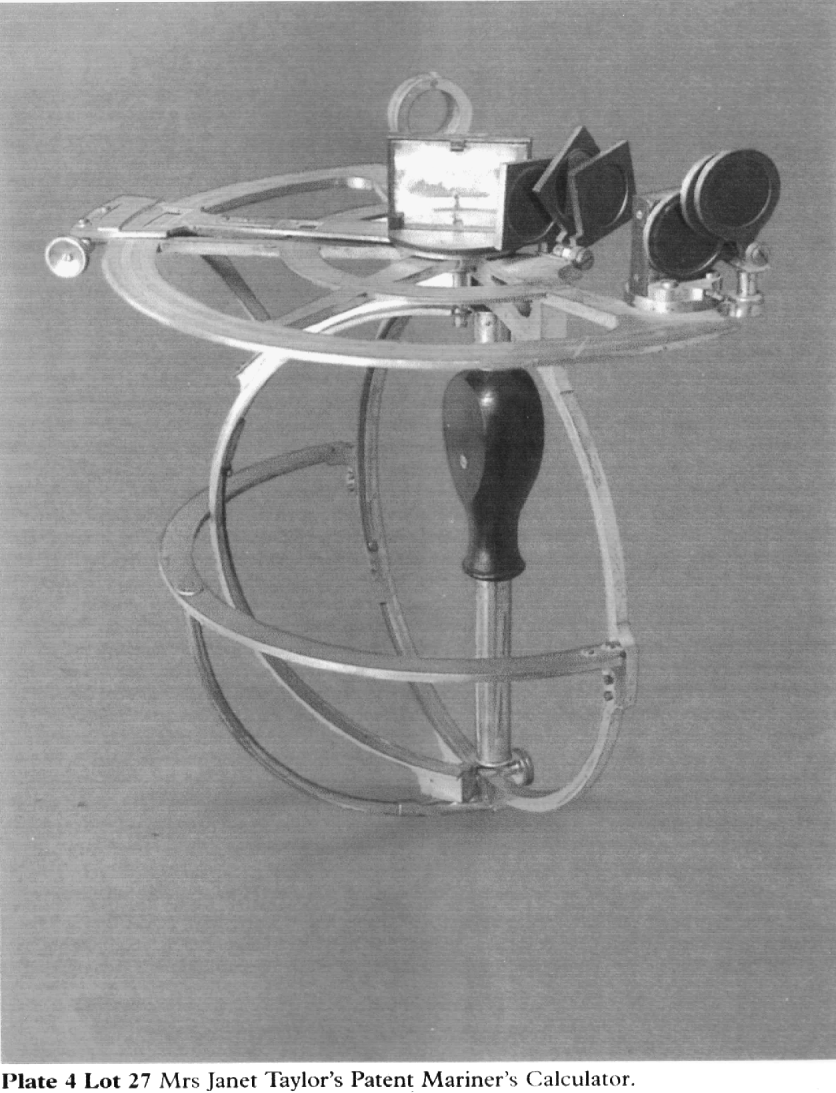
In March 1834, Mrs Janet Taylor, of East Street, Red Lion Square, Middlesex, lodged an application for a British patent for ‘A Mariner's Calculator’, claiming ‘improvements in instruments for measuring angles and distances, applicable to nautical and other purposes’. The application, No. 658, was granted in September 1834. Between 1617 and 1852 only seventy-nine patents were awarded in the category ‘Compasses and Nautical Instruments’;Footnote 1 the patents were awarded to renowned leaders in the field such as John Hadley in 1734,Footnote 2 Edward Troughton in 1788Footnote 3 and Edward Dent in 1844.Footnote 4 But quite intriguing is that, during this 235-year period, only one of these was to a woman: Mrs Janet Taylor, aged thirty.Footnote 5 There is only one of Mrs Taylor's instruments known to be in existence. It is not in the possession of the National Maritime Museum but in private hands, having been purchased at auction in 1999.Footnote 6 The image provided in the auction catalogue is shown in Figure 1.
Auction catalogue image of Mrs Janet Taylor's Mariner's Calculator, 1999.

The story of this intriguing instrument and its virtual disappearance is an unwritten but important chapter in maritime history. It is striking both because of its novelty, and because of its inventor. This article seeks to fill in some of the missing narrative. It begins with a brief consideration of the historical context and the demand for improved nautical instruments, followed by a description of the Mariner's Calculator and a glimpse of the story of its inventor. The article then discusses the assessment of the instrument by the Admiralty, concluding with an account of the reassessment of the instrument based on a construction of a replica in 2004.
The demand for nautical instruments
The nineteenth century was the high point of the British Empire and sea navigation drove it, as British merchant and naval fleets criss-crossed the oceans. In consequence, ‘A large demand for navigational instruments was created by the increasing overseas trade connected with imperial expansion, and with the growth of a merchant navy to carry goods and the Royal Navy to defend them.’Footnote 7 The need to ensure precise location at sea spurred the invention and improvement of instruments as well as the quest to find an accurate way of determining longitude. The loss of a fleet of five ships with at least eight hundred men under the command of Rear Admiral Sir Cloudesley Shovell in 1707 prompted the British parliament to create the Board of Longitude in the Longitude Act 1714. There were three levels of prizes, ranging from £10,000 to £20,000, for the discovery of a ‘practicable and useful’ method for the determination of a ship's longitude at sea. The story of John Harrison's long and arduous development of an accurate marine chronometer to answer this challenge has been well documented, both in formal and in popular writing.Footnote 8 The huge rewards proved a significant fillip to invention and to a rapid increase in the number of navigational instruments developed to assist in the accurate determination of longitude – such as the improved version of the quadrant called a ‘reflecting octant’ for the accurate measurement of lunar distances, the first account of which was given by John Hadley to the Royal Society in 1731.Footnote 9 With an improved degree of accuracy over the octant, the sextant, with an arc of 120 degrees, was used to measure the distance of the moon from the sun or star in order to find the longitude by lunar observation.
Improvements in these instruments were accompanied by accurate data on the positions of the moon, sun and various planets that were published as tables in annual Nautical Almanacs from 1767. These provided an essential companion for the mariners of the day, but eventually Harrison's clocks, in particular his H-4 model,Footnote 10 provided the solution to the longitude problem. While Harrison's chronometers would be the way of the future, it would be well into the nineteenth century before they became the usual tool for the mariner. The chief reason they remained out of reach of the ordinary seaman was their prohibitive cost and the complexity of calculations required to use them effectively. And so, for the time being, many mariners still relied on their sextants together with tables to estimate their position, and it was here that Mrs Taylor focused her attention.
The ‘Mariner's Calculator’
The ‘Mariner's Calculator’ was an ingeniously clever concept. The specifications written by the young Mrs Taylor included a lengthy three-page technical description of precisely how the device operated, along with two large diagrams:Footnote 11
The upper part of this instrument may be used as a reflecting sextant, there being the requisite glasses and a sight, combined with the angular instrument herein after set forth. The handle, by which the instrument is held when taking observations is fixed to the poles of a partially graduated circular ring.
A semi-circular graduated scale ‘moves’ on joints or hinges at the pole of the circular ring and is consequently capable of assuming any angle thereto. A semi-circular stay is fixed equatorially to the circular ring and the semi-circular scale moves within it. Another semi-circular graduated scale is affixed at the top of the instrument in such manner that the centre of the circle of which it is the half is in a right line with the poles of the circular ring and the upper semi-circular graduated scale is affixed at right angles to the circular ring by means of a correcting piece.
The index of this upper scale determines the angle formed by any movement of the lower scale with the circular ring. The circular ring and the lower scale have each a nonius sliding in a groove. These arrangements in connection with a pair of compasses enable a true representation of any proposed spherical triangle to be attained accurately marking the angles or sides given when those required will be obtained without calculation.Footnote 12
While her patent was pending, Mrs Taylor promoted her invention by describing herself in the second edition of her book, The Principles of Navigation Simplified: with Luni-Solar and Horary Tables, as ‘Janet Taylor, Inventor of the Mariner's Calculator’,Footnote 13 and by including a lengthy description of its attributes. It said in part:
DESCRIPTION OF THE MARINER'S CALCULATOR
This instrument combines the means of making observations, with the power of giving solutions to all problems in Nautical Astronomy, without the use of a single calculation, or log. One of its greatest advantages in instruction will be that it brings before the eye the exact position of the heavenly bodies at the time of observation, and the situation of places when applied to the sailings. The simplicity of its construction will render a perfect knowledge of it easily attainable, and if it be only used in ascertaining the correctness of calculation, I am convinced the mariner will find it of essential service.Footnote 14
Then followed a series of rules and notes for a range of applications, including for finding ‘the true Time’, ‘the true Altitude’, ‘the true Azimuth’, ‘Latitude by double Latitudes and elapsed Time’, ‘a Lunar Distance, as in the Nautical Almanac’, ‘the Distance between any two Places’, ‘the Bearing of One from the Other’ and ‘the differences of Longitude’, and for how to ‘clear a Lunar Distance’. These were ‘but a few of the uses of the Mariner's Calculator’.
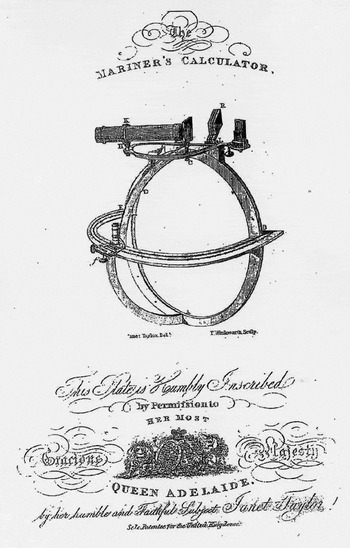
Mrs Taylor had also sought and gained permission to dedicate her Principles of Navigation Simplified to the king, William IV, and the Mariner's Calculator to his wife, Queen Adelaide, as illustrated in the diagram shown in Figure 2, which was included in the inside cover of the second edition of Mrs Taylor's Lunar Tables, published in 1834. The publication, and her invention, initially met with an enthusiastic positive response in their first public review in the Atlas Magazine:Footnote 15
The Principles of Navigation Simplified: with Luni-Solar and Horary
Tables and their Application in Nautical Astronomy etc etc. By Janet
Taylor, Inventor of the Mariner's Calculator etc. London 1834.
This is the second edition of Mrs Taylor's celebrated work in Nautical Astronomy which we noticed so lately as to lead us to rejoice at the sudden apparition of a second edition and in a form much improved. Mrs Taylor says some regret was expressed that her work in its first edition did not contain the elementary parts of navigation. Encouraged by the patronage of the King, to whom the work is now dedicated, and of the Queen who is the patroness of the MARINER'S CALCULATOR, the fair and learned authoress was soon enabled to reproduce her Luni-solar and Horary Tables with the prefix of the first book, in which she has ‘taken the science from its source, and elucidated it in the easiest manner, by those problems in geometry which are necessary for practice, and likewise by a careful selection of such theorems from EUCLID as are useful in demonstrating the different rules and methods introduced in the succeeding pages.
To the first part are added a journal of a voyage from London to Madeira, full of practical instruction; a description, and direction for use, of HADLEY'S sextant, and a description of Mrs Taylor's new invention the MARINER'S CALCULATOR. Of the second part of the work we have already spoken, and the whole is an invaluable present to the student of navigation and Nautical Astronomy.
Janet Taylor, Lunar Tables, 1834, inside cover.

It was appraisals such as these that made her very confident about the success of her invention. But, in reality, to have a favourable reception of her invention in maritime circles, Mrs Taylor needed to secure the approval of any one of the other ‘big three’ players – the Admiralty, the East India Company and Trinity House. The Admiralty oversaw the Navy, and, in 1795, established its own Hydrographic Office, overseen from 1829 by Captain Francis Beaufort.Footnote 16 The Corporation of Trinity House, first incorporated by Royal Charter in 1514, was the general lighthouse authority for Britain and responsible for the examination and licensing of pilots. The East India Company had been granted a charter of incorporation by Queen Elizabeth on 31 December 1600, giving it a monopoly of Indian and Far Eastern trade. It was the major provider of survey charts used on British merchant ships. It was absolutely critical for her to gain the endorsement of one or more of these bodies. Mrs Taylor understood this well enough, as she sought repeatedly, and eventually gained, their support for her books.Footnote 17 And she also soon delivered a prototype of her new device to the Admiralty for assessment, but continued to promote it in glowing terms in her books in the meantime. But just who was this Mrs Taylor, and what did the Admiralty think of her invention?
Mrs Taylor's early life
Not a great deal has yet been revealed about the life of Janet Taylor, with the only currently existing records being essentially short biographical notes.Footnote 18 She was born in Wolsingham, County Durham, on 13 May 1804,Footnote 19 the fifth child of the Reverend Peter Ionn and Jane Deighton, and died on 26 January 1870. After the death of her mother when she was just six years old, Janet's brilliance became apparent very early and at the age of nine she received a national scholarship, open to girls of at least age fourteen, to attend Queen Charlotte's school in Ampthill, Bedfordshire.Footnote 20 Her life thereafter took her into the heart of maritime London and the great docks on the Thames where she remained for over fifty years.
Inspired by her scholarly father in the wonders of navigation,Footnote 21 Mrs Taylor later became a prodigious author of nautical treatises and textbooks, born of a fascination in particular with measuring longitude by the lunar-distance method.Footnote 22 She conducted her own Nautical Academy in Minories in the east end of the City, not far from the Tower of London; she was a sub-agent for Admiralty charts;Footnote 23 she ran a manufacturing business for nautical instruments, many of which she designed herself;Footnote 24 and she embarked on the business of compass adjusting at the height of the controversies generated by magnetic deviation and distortions on iron ships.Footnote 25 In the absence of many personal records, such as a diary,Footnote 26 Mrs Taylor's story must be pieced together mostly from the public records – her publications and their reviews; discussion in relevant journals; and correspondence recorded, for example, in the Admiralty Hydrographic Office, in particular with the Hydrographer, Captain Francis Beaufort,Footnote 27 and with the Astronomer Royal, Sir George Airy.Footnote 28
Mrs Taylor's singular contribution to the maritime community and to the welfare of mariners was recognized in her being awarded gold medals (the highest award possible) by the king of Prussia,Footnote 29 by the king of HollandFootnote 30 and even by the Pope,Footnote 31 culminating in the eventual award of a Civil List pension in her country.Footnote 32 That her role was significant is also evident in that she was the only woman included among 2,200 entries in the encyclopedic work on The Mathematical Practitioners of Hanoverian England 1714–1840 by Professor Eva G.R. Taylor,Footnote 33 and notwithstanding that Janet's contribution continued well after the 1840s, beyond the period considered by Professor Taylor. Mrs Taylor was also the mother of eight children and stepmother to a further three, with both she and her husband changing their names on their marriage: he from George Taylor Jane to George Taylor; she from Jane Ann Ionn to Janet Taylor.Footnote 34 To provide an appropriate record of and tribute to her life, the authors of this article have just completed her lengthy biography and it is due to be published in 2011.Footnote 35
Assessment
As far as the Mariner's Calculator was concerned, the Admiralty finally settled upon giving it to their own Hydrographer, Captain Francis Beaufort, for assessment.Footnote 36 Beaufort had had a long naval career, beginning at the age of fourteen in 1787, rising to the rank of captain in 1810. He saw much active service, collecting an assortment of wounds, so much so that he ended up with a ‘wound pension’. As commander of the Frederickssteen in the eastern Mediterranean he not only managed to survey the coast of Karamania in Asia Minor but suppressed some of the fiercest Mainote pirates infesting the coast of Africa. His surveys and account of his explorations between 1810 and 1812 attracted great interest when published and for sixteen years after his return to England, Beaufort was engaged in the preparation of charts taken from his surveys. They were of such fine quality that they were engraved directly from his drawings as sent to the Hydrographic Office. In 1829 Beaufort was appointed the Admiralty's Hydrographer, a position he was to hold with great acclaim for the next twenty-six years.Footnote 37
Captain Beaufort was also a man of high reputation and esteem, and a worthy one, in ordinary circumstances, to undertake an assessment of the Mariner's Calculator. On this occasion, however, the timing could not have been worse, as he was in the throes of a great personal crisis with the imminent death of his wife of over twenty-one years, Alicia.Footnote 38 In the late summer of 1832 she had found a lump in her breast and it foretold of a slow, painful and certain death. The only analgesic available was laudanum, a mixture of opium and alcohol that induced a deep sleep, as well as hallucinations. A woman of great religious faith, Alicia bore her suffering with great dignity, even calmness, until she passed away on 27 August 1834. It was agonizing, and her husband was greatly affected.Footnote 39 In the midst of this great upheaval in his life Beaufort finally delivered his report to the Admiralty, as noted in the Admiralty Minute Book:
Three of the problems proposed by Mrs Janet Taylor have been worked with the Mariner's Calculator, and the results obtained have ill agreed with the truth. Perhaps this may have arisen from the imperfect construction of the instrument, to which she alludes, but if it were well made and the results accurate, the difficulty which the clumsy fingers of seamen would find in small measurements with compasses and the impracticability of measuring circular arcs would always render it objectionable. Even if the Instrument performed all that is stated it is not worthy of their Lordships' patronage from the mischievous tendency which it evidently has of inducing a slovenly and empirical mode of working observations and leaving the operator totally in the dark as to the reason of his proceeding. The union of the quadrant with the calculator only renders the Instrument more complex and the free use of the latter would prevent the former even remaining in adjustment.Footnote 40
By the time Patent No. 658 for ‘The Mariner's Calculator’ was formally granted on 27 September, however, its fate had effectively been sealed. Without the Admiralty's backing, there was little chance that the other two organizations would support it and it was clear to her that it now had no future. The fact that Janet Taylor's name still sat in the register of patents for ‘Compasses and Nautical Instruments’ alongside men like John Hadley would have been cold comfort, especially as it seemingly had come to nothing and had been a lengthy and most costly enterprise.Footnote 41 Indeed, it may have left her in dire financial straits since she had gambled much of her capital on its success. It is known that she had inherited money from her father, which in turn he had inherited largely from her mother,Footnote 42 and that eventually she left nothing at her death, having to ‘sacrifice’ everything to meet the demands of her creditors.Footnote 43
A particular question in the legacy of Mrs Taylor is whether her Mariner's Calculator, in which she had placed so much faith, was given a fair assessment. Among her many qualities, Mrs Taylor was undoubtedly a brilliant mathematician, and an extremely gifted author, astronomer, businesswoman and inventor. How could she have been so wrong with her invention – or was she?
Reassessment
Although Captain Beaufort was given the task of assessing the Mariner's Calculator, his personal circumstances at the time may have meant that he was hardly in a position to give it proper consideration. In the light of this context, was his judgement a fair and accurate one? Another that expressed reservations about her instrument was the author Charles H. Cotter, in his History of the Navigator's Sextant:
Mrs Taylor claimed that:
‘… this instrument has an advantage over the sextant; for the observer can rest it steadily against the shoulder, and take the most correct observations with the greatest of ease …’
How far this claim was justified is not known, for it is fairly certain that only a very few of these clumsy, yet ingenious, instruments were made.Footnote 44
In other words, Cotter viewed it as exceptionally clever, but totally impractical. It seemed appropriate to review Mrs Taylor's claim in modern times.
To undertake a reassessment of the Mariner's Calculator, one of the authors was awarded a research grant from Macquarie University in Sydney and enlisted the willing involvement of one of Britain's leading compass adjusters and nautical antique dealers, Ron Robinson of Hamble, in the south-east of England. Using the details set out in the original patent, and the ingenuity of Robinson's skilled instrument restorer, a replica of the Mariner's Calculator was produced. It was a challenging brief, as the patent gave only partial information. The assessment was to be undertaken knowing that Beaufort's report had been unfavourable but without Robinson's being provided the precise nature of it as set out in the Admiralty Minute Book. The authors knew that Robinson felt a real affinity for what Mrs Taylor had accomplished, and with his astonishing range of skills and contacts he was the obvious choice for this assignment. Within six months Robinson was ready to report his findings.Footnote 45 Following is a summary of his conclusions.
In the reconstruction of the Mariner's Calculator, Robinson noted that the patent was helpful, but only to a limited extent: ‘The drawings were technically inadequate to produce an exact instrument since in parts they were verging on the sketch and were barely sufficient’. Consistent with other patents of the period, not all details were revealed – to avoid replication by other craftsmen. However, what provided a very useful adjunct to the patent was the photograph Robinson obtained of the only surviving original Mariner's Calculator, included at the beginning of this article. The reconstruction was undertaken by an experienced craftsman, specializing in the restoration of period instruments, mainly nautical instruments. Tools and techniques of the era were familiar, and period elements from other instruments were able to be incorporated into the construction, such as a wooden handle from another sextant of those times:
It's an original handle, quite distinctive of the period, with a nice patina of age.
With respect to the mirrors: the frame, i.e. the mirror holder of the index mirror, together with the frame of the horizon mirror, are both originals from a sextant of the same period as the Mariner's Calculator. Indeed the mirrors where the silvering has somewhat aged are original – more commensurate with the spirit and period of the instrument. It's child's play to put in new mirrors. But using original components gives the reconstruction the age and patina it deserves.
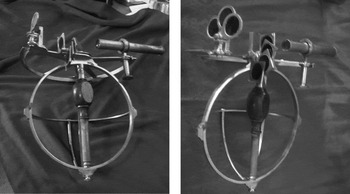
The completed reconstruction is seen in Figures 3 and 4.
Reconstruction of the Mariner's Calculator, 2004.

When asked if there there were any problems in the construction process, apart from some slight deviation in constructional details, Robinson reported,
The main difficulty from day one, having looked at the drawings, and trying to grasp tasks which the calculator set itself, involved scales which departed from the norm. It is straightforward to engrave in degrees, similarly in parts divided into minutes, as was the norm for most sextants. Indeed on what we call the top sextant arc the engraving is limited, simply to demonstrate angular division. It doesn't encompass the whole 180 degrees of division, but only a part thereof. As regards the additional scale originally placed on the top arc, this referred to distance. I do not consider it possible to engrave this distance scale where it would accurately or sensibly reflect the scale design by Janet Taylor.
There were limitations as to division of the scale in the patent. The distance scales were there, but not sufficient information on the drawing to project the scales and duplicate them. Early on we decided to run with what we could produce – the same construction and style as the original, but with the proviso that there would be shortcomings on the scale in order to produce precise measurements.
My goal was that the replica would look almost exactly as the original.
When it came to the central question prompting the reconstruction of the instrument – namely, does it work – Robinson prefaced his conclusions by saying,
I cannot give an unqualified answer to that. It has to be qualified, in the context of several things. If one follows Janet Taylor's instructions for use and her statements as to what it was capable of doing, there is a very sound factual and logical progression in her work. In theory it should have done exactly what she said it would do.
When pressed as to whether one could prove or disprove her claims, he responded,
There is no part of her written instructions that is fundamentally flawed. She followed the laws of geometry absolutely. It's clear to me that she had an absolute and clear grasp of her subject: total – sufficient to write competently about it. I am unaware of any serious holes that were poked in her theory. But she dug a small hole for herself in terms of this being the machine that was going to do all things for the navigator.
The fundamental problem that Robinson identified, in terms of the ‘small hole’, was the sheer intricacy of the instrument. It was, he concluded, ‘a very complex machine’, and while ‘what it was setting out to do was correct in principle’, it lacked ‘practicality’. He greatly respected, indeed admired, Mrs Taylor's ‘appetite and zest to produce the “do-all” machine’, and acknowledged that the Mariner's Calculator was built ‘with delicacy and charm’. But as to practicality, ‘that was another matter’:
It is one of those clever ideas. Any person of her talent – extraordinary talent – is likely to wish to produce something. It may be that she took her eye off what its likely practical use would be.
If I were to have the original Mariner's Calculator before me today, I would find it an instrument awkward, to say the least, in use. I would expect to find it requiring a degree of delicacy and dexterity which would be trying under normal seagoing conditions – especially at her time. With the arrival of steamships, apart from the ship rolling and pitching, you have a reasonable platform from which to make your observations. But with a sailing ship – when the sails are full – it's a different matter, and you don't have the advantage of electric light. Conditions were not snug. They were thoroughly uncomfortable – like an agricultural worker having to work on a bad day. You can never separate the instrument from the conditions prevailing and the operator's state of mind at the time. You have to consider field conditions.
Was Beaufort the right person to test the instrument? Robinson reflected upon this and responded,
The Hydrographer is not the right person to test most things. He would have got someone else to do it for him. He would have sought an opinion around him, in-house. But whether they were qualified or not is another question.
He would have wanted to give her good advice. I am convinced that had he given it the thumbs up, and the Admiralty bought, say, three, I still believe it wouldn't have succeeded. I don't think the world of mercantile navigation missed an opportunity. It was an awkward and complicated thing that would have required a dexterity of fingers and a dexterity of brains that the seamen of the day would not have had – even today.
Some one hundred years after the invention, Lieutenant Commander Ken Alger, a teacher of navigation and a keen amateur historian fascinated by the story of Mrs Taylor, hypothesized that Beaufort was being cruel to be kind.Footnote 46 Robinson had some sympathy for this suggestion:
Beaufort was blunt. What was called for was a blunt opinion from someone that was sympathetic to you. Such an opinion from a friend, someone you admired and respected, was more likely to be considered.
It was the age of invention, when you could invent a machine to do almost anything. But to get a true sense of it, imagine giving something like the Mariner's Calculator to someone like a coal miner, with fingers like sausages, in poor light and under seagoing conditions.
Conclusion
There is a striking similarity between the succinct report to the Admiralty by Beaufort and the reflective observations of Robinson. The ‘clumsy fingers of seamen’ noted by Beaufort were the ‘fingers like sausages’ for Robinson. The science was sound, but the instrument would be unworkable in practice by men with hands like these. Where Cotter suggested that the instrument was ‘clumsy, yet ingenious’, perhaps it would be fairer to say that the instrument was ingenious but impractical in the ‘clumsy’ hands of its potential users. And so it remains, it seems, an inspired, curious, white elephant of the history of nautical invention. But at least one other of Mrs Taylor's many nautical instruments has found a special niche – and this, too, based not on its practicality, but on its appearance and provenance.
In the National Maritime Museum at Greenwich is held for posterity a quintant (described as a sextant) entered by Mrs Taylor in the Great Exhibition of 1851.Footnote 47 It is a magnificent and flamboyantly ornate instrument, which appears to combine the principal aspirations of the exhibition in one – arts and manufacturing – reflected in the name of the Royal Society that had championed the Great Exhibition: the Royal Society for the encouragement of Arts, Manufactures and Science. Mrs Taylor's quintant can be seen as a metaphor for each of these elements and was designed and constructed especially for the Great Exhibition. At the centre of the instrument was the Prince of Wales's crest, in the German of the Hanovers, Ich Dien – ‘I serve’ – which was also on its box. Just as the prince's crest committed him to serve his country, the quintant was an instrument that served the mariner. It was an elegant, artistic combination of metaphor, allegory and practicality. The prince himself was only eleven years old, but in time the instrument came to be presented to the Royal Family, and, in turn, it came to the National Maritime Museum in May 1936 where it can be seen today.
As for the rest of Mrs Taylor's achievements, there is much to tell. The country finally gave her some acknowledgement – perhaps more for penury than for her contribution to the welfare of mariners – in the granting of a Civil List pension of £50 per year on 10 January 1860, ‘In consideration of her benevolent labours among the seafaring population of London, and of the circumstances of difficulty in which she is placed by the death of her husband’.Footnote 48
This article is written as a small step in redressing the absence in nautical history of the full story of Mrs Janet Taylor. She chose a profession in what was squarely a man's world at the time, and did so right in the heart of seafaring London. The story of the Mariner's Calculator is but one part of her story, although one that undoubtedly caused her much anguish as she tried to establish her credentials at such a young age. While the instrument itself may be said to have been unsuccessful, the way in which she would overcome this setback showed what a person of great strength and character she must have been.