Introduction
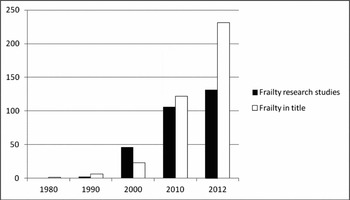
Frailty as a unique clinical concept is becoming more recognized, as evidenced by the growing numbers of publications and research studies being carried out every year (Figure 1). The definition of frailty has not changed significantly in the five years since the last review, but its importance in clinical practice has grown. The concept is still based on a subnormal physiological response in the face of various stressors. Operationally, several definitions have been used and some of the most recognized include the Frailty IndexReference Mitnitski, Mogilner and Rockwood1 and the Frailty phenotype.Reference Fried, Tangen and Walston2 The concept of the progression from non-frail to frail has developed and the significance of the pre-frail stage is now better described. The pre-frail state is increasingly recognized as the stage to target with different therapeutic modalities. The purpose of this review is to present the latest literature on frailty since the last review in 2007,Reference Jaafar, Heycock and George3 with a particular focus on interventions aimed at reversing the processes of frailty.
Number of publications per year with ‘frailty’ in the title versus original frailty research studies using MEDLINE

Search methods
The following review should be seen as complimentary rather than independent from the last one in this journal in 2007.Reference Jaafar, Heycock and George3 MEDLINE electronic databases were searched using the terms ‘frail’ and/or ‘frailty’ from January 2008 to January 2013. The titles and abstracts were screened by the authors to identify publications relevant to this review. 119 abstracts were of interest and full articles were obtained for relevant publications. Further searches were carried out as a result of reviewing the literature and the reference lists of such papers.
The review will discuss how the definition of frailty has expanded, new biomarkers and will review the intervention studies aimed at reversing the process of frailty.
Expansion of the frailty definitions and newer frailty assessment tools
Cognitive function and social influences on frailty
There is increasing acceptance of frailty as a syndrome that puts people at higher risk of morbidity and mortality, independent of their age or co-morbid diseases. However, a universal definition is difficult to agree on because of the complexities involved. Previously, the frailty indexes have focused on medical conditions, physical symptoms and anthropometric measurements. Recently, cognitive impairment and social factors have been incorporated into the newer frailty indexes.
A cohort study from Sao Paulo used the Cardiovascular Health Study (CHS) criteriaReference Fried, Tangen and Walston2 for frailty and presented data on cognitive performance according to whether people were non-frail, pre-frail or frail.Reference Yassuda, Lopes and Cachioni4 People with cognitive impairment, as measured using mini-mental state examination (MMSE), verbal fluency, delayed memory and the clock drawing test were more likely to have frailty. Of the frailty criteria, grip strength and gait speed were most associated with cognitive impairment.
A prospective cohort study in Canada demonstrated that adding cognitive assessment to the frailty index improves the predictive power of the frailty measure in the context of risk stratification of patients with coronary artery disease undergoing cardiac angiography.Reference Freiheit, Hogan and Eliasziw5 Executive function testing, rather than the standard MMSE, functioned better for identifying patients at risk of increased disability and quality of life. The final five variables in their tool included poor balance, abnormal body mass index (BMI), cognitive impairment (according to Trails B assessment), depressive symptoms (GDS > 4) and living alone.Reference Freiheit, Hogan and Eliasziw5 The tool demonstrated that both social factors and a psychological assessment were independently linked with poorer outcomes. Living alone was one of the strongest criteria in the model. However, probably due to small sample size, there were insufficient data to suggest that this frailty index could be used to identify increased mortality risk.
Single frailty measures
Usual gait speed
Gait speed is usually one of the parameters included when calculating frailty scores but is being recognized as a single test for frailty. Gait speed at usual pace has been used to predict negative outcomes in patients undergoing cardiovascular surgery.Reference Afilalo, Eisenberg and Morin6 Slow walkers (defined as needing more than 6 s to walk 5 m) had a 2- to 3-fold increase in mortality and morbidity after cardiac surgery. It had high sensitivity as a screening tool for frailty in this context.
In a review of gait speeds as a single-item test predictor of poor outcomes amongst community-dwelling older people, the single test was associated with decreased mobility, falls, developing dementia, admission to hospital, institutionalization and mortality.Reference Van Kan, Rolland and Andrieu7 Different cut-offs for abnormal walking speeds were reviewed but one of the measures most commonly used was usual pace over 4 m in less than 5 s.Reference Van Kan, Rolland and Andrieu7
Walking While Talking (WWT) test
The WWT test is a cognitive-motor stress test that requires individuals to walk while reciting alternate letters of the alphabet. WWT has been shown to be a predictor of frailty, disability and mortality in community-dwelling adults over 70 years of age without cognitive impairment.Reference Verghese, Holtzer, Lipton and Wang8 The cut-off speed was 0.7 m/s and each 0.1 m/s was associated with a 12% greater risk of developing frailty. It is worth noting that, in this study, a computerized walkway was used to measure the results. The WWT was better at predicting frailty, whereas the Short Physical Performance Battery (SPPB) was better at predicting disability. The WWT represents a simple test for detecting pre-frail patients and those at risk of disability, which could be utilized in the out-patient setting. Further research is needed to validate the tool.
Frailty measures in the context of surgery
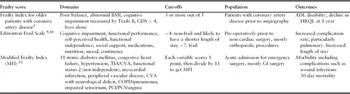
New frailty measures have been developed in the context of pre-operative assessments; examples are listed in Table 1. Greater frailty is associated with an increased complication rate, length of stay, disability, decreased quality of life and mortality following surgical procedures. However, such measures should be seen as aiding a proper assessment of the patient to optimize health, rather than as a tool to deny surgery.
Frailty measures validated in the pre-operative risk assessment of patients undergoing surgical procedures

TIA, transient ischaemic attack; CVA, cerebrovascular accident; COPD, chronic obstructive pulmonary disease; GI, gastrointestinal; PCI, percutaneous coronary intervention; PCS, prior cardiac surgery; BMI, body mass index; Trails B, trail-making test part B; GDS, geriatric depression scale, HRQL, health-related quality of life; ADL, activity of daily living.
Biomarkers of frailty
To date, whilst no laboratory test has been shown to be directly clinically applicable to diagnose frailty, multiple markers have been proposed as being of potential significance.
Inflammatory markers
A study of 110 patients over 75 years old demonstrated that raised inflammatory markers were associated with frailty.Reference Hubbard, O'Mahony, Savva, Calver and Woodhouse12 The patients did not have infections and were not taking antibiotics. C-reactive protein (CRP), interleukin-6 (IL-6) and tumour necrosis factor-α (TNF-α) were significantly raised in frail patients compared with pre-frail and non-frail, as defined by the CHS frailty criteria.Reference Fried, Tangen and Walston2
A study of 187 patients over the age of 70 undergoing colorectal surgery in Norway showed that frailty, as defined by CHS frailty criteria,Reference Fried, Tangen and Walston2 was associated with significantly elevated IL-6 levels.Reference Rønning, Wyller and Seljeflot13 The aim of this study was to assess the predictive power of individual biomarkers, including CRP, IL-6, D-dimer and TNF-α, for the development of post-operative complications. The blood tests were taken before the elective surgery when there was no evidence of infection, and the information on complications was collected from the hospital records. The rise in CRP and IL-6 between the pre-frail and frail groups was statistically significant. The association between TNF-α and frailty was less clear as the level was higher in the pre-frail group than the frail group. The conclusion was that IL-6 was the only biomarker that was an independent predictor of severe post-operative complications.Reference Rønning, Wyller and Seljeflot13 These tests may be useful in identifying frail patients as opposed to pre-frail, but should not be seen as independent of the clinical assessment.
Vitamin D
In a 4-year prospective cohort study of community-dwelling men over the age of 65, vitamin D deficiency (as defined by a 25(OH)D blood cut-off level of less than 20 ng/ml) was associated with greater odds of having frailty at baseline, but not as a predictor of emerging frailty.Reference Ensrud, Blackwell and Cauley14
Low vitamin D was shown to be a marker of frailty in older men but not in older women in a study from Chianti, Italy.Reference Shardell, Hicks and Miller15 It was shown that men with vitamin D levels less than 50 nmol/l (20 ng/ml) were at a significantly greater risk of being frail.
A recent research study suggests that vitamin D plays an important role in the recovery of muscle function, with vitamin D-deficient patients reporting worsening fatigue due to less efficient mitochondrial function.Reference Sinha, Hollingsworth, Ball and Cheetham16 As vitamin D replacement improved the mitochondrial maximal oxidative phosphorylation after exercise, this is recommended in severely depleted patients who are symptomatic. It is therefore possible to hypothesize that vitamin D-deficient patients will report less ability in performing physical activities, and that those who are frailer will have less sun exposure and hence lower levels of vitamin D. A cause–effect relationship remains to be proved but it is reasonable to consider vitamin D deficiency when treating patients with frailty.
Brain-derived neurotrophic factor
Brain-derived neurotrophic factor (BDNF) is a CNS neurotransmitter that has been shown to have neuroprotective effects;Reference Schabitz, Steigleder and Cooper-Kuhn17 low levels have been detected in neurodegenerative diseases such as Huntington's diseaseReference Ciammola, Sassone and Cannella18 and Alzheimer's disease.Reference Schindowski, Belarbi and Buee19 Low serum levels of BDNF have been associated with an increased mortality in older women.Reference Krabbe, Mortensen, Pedersen, Pedersen, Jorgensen and Bruunsgaard20
A small quasi-experimental study from Brazil looked at the effects of physical exercise in elderly non-frail and pre-frail community-dwelling women upon BDNF and showed that plasma BDNF did rise in both groups.Reference Coelho, Pereira and Lustosa21 Although the plasma levels were lower in the pre-frail group, there were no clear cut-off levels between non-frail and pre-frail individuals. The rise in BDNF after an exercise intervention suggests that pre-frailty is reversible; however, frail women were not included in the study and the BDNF levels were no better than other markers correlated with frailty such as the timed-up-and-go test. In future, it may be possible to use BDNF response to exercise as a marker for pre-frailty intervention because of its proposed neuroprotective effects.
Ready-to-use frailty calculators
Since the development of frailty measurement tools, ready-to-use calculators have appeared. Such tools will make it easier for the practising clinician to identify frailty; however, caution needs to be applied when considering in what context the tool is used.
Currently we are aware of two calculators that are free to use and have been validated in large population studies.
SHARE-FI
The Frailty Instrument for Primary Care of the Survey of Health, Ageing and Retirement in Europe (SHARE-FI)Reference Romero-Ortuno, Walsh, Lawlor and Kenny22 is one of the first frailty calculators available on the internet.
The tool was developed from a large cohort study of over 12 countries that recruited over 31,000 community-dwelling men and women over the age of 50.Reference Romero-Ortuno, Walsh, Lawlor and Kenny22 The definition of frailty was similar to the CHS criteriaReference Fried, Tangen and Walston2 but weight loss was changed to decreased appetite, and slowness to questions on functional limitation. Grip strength is used for weakness and is the only measurement required. There are English, French, German, Italian and Spanish versions where the five questions are answered with drop-down menus. Separate calculators for men and women exist. The frailty score out of 5 is given along with a category of: non-frail, pre-frail or frail. The frailty calculator is free to download via the web.23
The Edmonton Frail Scale
The Edmonton Frail ScaleReference Rolfson, Majumdar, Tsuyuki, Tahir and Rockwood9 is the first frailty score to be available for mobile phones and is free to download by adding the word ‘app’ to a web search. In the scale there are nine domains with a final score out of 17. Four categories or outcomes are possible: 0–3 classed as not fragile, 4–5 slightly fragile, 6–8 averagely fragile and 9–17 very fragile. It has been validated for use by non-geriatricians in a community-dwelling population. It takes less than five minutes to complete and can be used effectively pre-operatively.Reference Rolfson, Majumdar, Tsuyuki, Tahir and Rockwood9, Reference Dasgupta, Rolfson, Stolee, Borrie and Speechley10
Frailty as a predictor of cognitive decline
Whilst previous research has shown frailty to be linked to increasing morbidity and mortality, new evidence is emerging of the link between frailty and cognitive decline. An observational cohort study from Chicago showed that physical frailty was associated with developing mild cognitive impairment (MCI).Reference Boyle, Buchman, Wilson, Leurgans and Bennett24 In this study, the definition of frailty focused on four physical measures – grip strength, timed walk over 8 feet, body composition (BMI) and fatigue. Grip strength and timed walk at baseline were independently associated with development of MCI at 12 months. The applicability of such findings in clinical practice remains to be proven but, theoretically, screening for risks of developing MCI may help in developing preventative treatment strategies that would ultimately reduce cognitive and functional decline in older people.
In another prospective follow-up trial of 5480 community-dwelling people over 7 years, frailReference Fried, Tangen and Walston2 patients were found to have a significantly increased risk of developing vascular dementia.Reference Avila-Funes, Carcaillon and Helmer25 There is no proven cause-and-effect relationship between frailty and vascular dementia but it is possible that the risk factors for both overlap.
Frailty interventions
Pharmacological interventions
Angiotensin converting enzyme inhibitors
Use of an angiotensin converting enzyme (ACE) inhibitor has been suggested as a possible pharmacological intervention to improve body composition and function. In a large cross-sectional study of community-dwelling adults who were taking anti-hypertensives but did not have heart failure, ACE inhibitor use was associated with an increased lower extremity muscle mass.Reference Di Bari, van de Poll-Franse and Onder26
A small randomized trial of perindopril use in people older than 65 with mobility problems and functional impairment found that 20 weeks of treatment resulted in significant improvement of the 6-minute walk test.Reference Sumukadas, Witham, Struthers and McMurdo27 The participants did not have underlying heart failure or aortic stenosis but both treatment and control groups had a significant proportion of hypertension. ACE inhibitor use may have improved cardiac function even in the absence of diagnosed heart failure and hence improved the walking test.
A subsequent large prospective 3-year cohort study that examined the association between ACE inhibitors use and incidental frailty found no protective effects. The study involved 27,378 non-frail women without heart failure aged between 65 and 79 years.Reference Gray, LaCroix and Aragaki28 Until a sufficiently powered randomized controlled trial is carried out, a definite conclusion of the role of ACE inhibitors in frailty cannot be reached.
Raloxifene
Raloxifene is a non-steroidal selective oestrogen-receptor modulator and is licensed for osteoporosis treatment in post-menopausal women. A small randomized controlled trial using Raloxifene or Tibolone (a synthetic steroid) in older women has shown some promise, with Raloxifene significantly improving the body mass density.Reference Jacobsen, Melis, Verhaar and Olde Rikkert29 The results should be interpreted with caution, however, because there was no effect on grip strength and no standardized frailty measure was used. Overall, the data supports the use of Raloxifene over Tibolone in post-menopausal women, but further research is required to clarify any effect on frailty.
Dehydroepiandrosterone
A randomized controlled trial compared Dehydroepiandrosterone (DHEA) supplementation (50 mg/day) in addition to exercise, with placebo and exercise, in 87 community-dwelling elderly women who were either pre-frail or frail with a low DHEA level.Reference Kenny, Boxer, Kleppinger, Brindisi, Feinn and Burleson30 There was no effect on bone mass but there was a significant improvement in leg press strength and the Short Physical Performance Battery (SPPB) score after 6 months. It should be noted that the exercise programme chosen was non-weight-bearing but of progressive resistance training. This small study suggests that DHEA supplementation may improve pre-frail female patients’ response to gentle exercise and further studies are warranted.
Testosterone
A randomized controlled trial in 99 frail elderly men with low testosterone levels showed that transdermal testosterone was associated with a modest improvement in total lean body weight and axial BMD.Reference Kenny, Kleppinger and Annis31 All participants in the study received calcium (1500 mg/day) and vitamin D replacement (1000 IU of cholecalciferol per day). There was no significant improvement in physical function or markers of frailty. There were, however, problems with compliance that may have affected the overall results of the trial. In addition, hormonal therapy in men has been associated with increased cardiovascular events and mortality.Reference Basaria, Coviello and Travison32 Without further evidence to support it, testosterone replacement cannot be recommended as a treatment for frailty, even in men who are frail with low testosterone.
Growth hormone mimetic
The decline in growth hormone secretion with age had been seen as a target for reversing the process of sarcopenia and frailty until a systematic review of growth hormone use in healthy older people concluded that the adverse effects outweighed the modest benefits.Reference Liu, Bravata and Olkin33 The adverse effects included oedema, arthralgia, carpal tunnel syndrome, gynaecomastia and the onset of diabetes mellitus and impaired fasting glucose.
An oral growth hormone mimetic (MK-677) has been shown, in a small randomized trial of 65 healthy adults over the age of 60, to increase pulsatile growth hormone secretion and significantly improve the total fat-free body mass.Reference Nass, Pezzoli and Oliveri34 Unfortunately, the trial was too small to assess functional improvements and their effect on frailty or to assess safety. Therefore, further studies are required in this area.
Non-pharmacological interventions
Comprehensive geriatric assessment
A randomized controlled trial assessing the effectiveness of comprehensive geriatric assessment (CGA) in Taiwanese community-dwelling elderly patients showed a non-significant trend of improvements in the CHS frailty statusReference Fried, Tangen and Walston2 and Barthel index.Reference Li, Chen, Li, Wang and Wu35 The participants in the intervention arm received a holistic care plan involving a multi-disciplinary team for the 6-month duration of the study. The short duration and small numbers involved may have limited the power of the study but the fact that patients exhibited an improvement in their frailty measure is encouraging.
In another randomized controlled trial assessing the effectiveness of CGA in community-dwelling elderly patients, both morbidity and mortality were reduced in patients deemed to be at risk of frailty.Reference Monteserin, Brotons and Moral36 Conclusions are limited because the authors identified frailty and pre-frailty according to factors including co-morbidity, and social and psychological factors in addition to function scores rather than using a standardized frailty measure.
A study in Australia of 241 frail older people who had been recently discharged from hospital or rehabilitation services randomized to a 12-month multi-disciplinary intervention in the community or usual care from their general practitioner showed a small but statistically significant improvement in the gait speed from 0.48 to 0.55 m/s in the treatment group.Reference Fairhall, Sherrington, Kurrle, Lord, Lockwood and Cameron37 Walking speed is one of the main measures of frailty but the study did not show a change in the frailty status of the individuals. The study remains important because it demonstrated an improvement in those with established frailty.
Education
Education is usually part of the CGA intervention but the effect of education as an isolated intervention has been looked at in some studies.
A randomized controlled trial assessed an exercise and nutrition intervention and a problem-solving therapy intervention in 117 community-dwelling adults in Taiwan.Reference Chan, Tsou and Yang38 Group 1 received both the exercise and nutrition intervention and the problem-solving therapy intervention. Group 2 received only the exercise and nutrition intervention. Group 3 received only the problem-solving therapy intervention. Group 4 received neither intervention. All four groups received educational booklets on frailty, healthy diets, exercise protocols and self-coping strategies. All four groups showed significant improvements in their frailty status as measured by CHS Frailty criteriaReference Fried, Tangen and Walston2 and therefore even the educational booklets on their own resulted in a reversal of frailty. This is one of the first trials to demonstrate reversibility of the frailty status with a relatively short intervention. The most effective intervention strategy was the exercise and nutrition group. The maximum impact was only statistically significant at the end of the 3 months of the intervention and the effects were no longer significant at 12 months. However, in this group, bone mineral density and vitamin D levels continued to be significantly improved even at 12 months.
A trial in Sweden randomized 459 elderly community patients at risk of frailty to one of three groups.Reference Gustafsson, Wilhelmson and Eklund39 Group 1 received an educational preventative home visit lasting up to 2 hours from either an occupational therapist, physiotherapist, registered nurse or a social worker. The home visit intervention included information about local services and falls prevention strategies. Group 2 participants attended four 2-hour weekly multi-professional senior group meeting discussions where the healthcare professional led a discussion about health promotion. After the four meetings, there was a follow-up home visit. Group 3 was the control group who received usual community services as a control. Both interventions delayed dependency, which could be classed as social frailty. The weekly multi-professional meetings delayed deterioration in activities of daily living (ADLs) more effectively than the single preventative home visit. The study duration was short and, as there was no progression in frailty, the influence of the interventions upon the progression of frailty could not be established. There were no doctors involved so the intervention was distinct to CGA.
In the Netherlands, 193 patients with slight or moderate frailty according to the Groningen Frailty IndicatorReference Schuurmans, Steverink, Lindenberg, Frieswijk and Slaets40 were randomized to receive a psycho-social health education booklet or be told they would receive it in 6 months.Reference Frieswijk, Steverink, Buunk and Slaets41 The aim was to improve the self-management ability of the elderly population in order to maintain a positive sense of well-being. The educational booklet had three parts. Part 1 was about having a positive frame of mind; part 2 was about the importance of self-efficacy and initiative, and part 3 was aimed at comfort and stimulation. The subjective measures of well-being were significantly improved with the use of educational material but this effect did not last for the 6 months of follow-up.
Education on its own has been shown to delay the progression to frailty and even reverse frailty, but is best combined with other interventions such as CGA or exercise and nutrition. With increasing evidence in this arena, public health planners may start to consider implementing population screening programmes for frailty, especially when very low-cost interventions such as targeted education booklets show evidence of reversing or delaying frailty burden in the community.
Exercise and nutritional supplementation
Exercise and nutritional supplementation are usually implemented as part of the CGA but there have been very few studies investigating these as an isolated intervention.
Supplementing the diet with 30 g of protein per day improved physical performance in a randomized controlled trial in frail community-dwelling older people during 24 weeks of follow-up.Reference Tieland and van de42 However, there was no increase in skeletal muscle mass nor data showing reversal of frailty. The same team presented a randomized controlled trial combining protein supplementation and resistance-type exercise training in frail older people.Reference Tieland, Dirks and van der Zwaluw43 The data showed that the protein supplementation with the exercise intervention resulted in an increase in lean body mass in addition to the improvement in physical performance. The protein supplemented group gained 1.3 kg in lean muscle mass, whereas the exercise group without protein supplementation merely prevented any decline in lean muscle mass. Interestingly, in a non-frail population, the same intervention showed no significant improvement in either.Reference Leenders, Verdijk and Van der Hoeven44 Further research into the use of protein supplementation in combination with exercise programmes is warranted in the frail and pre-frail populations.
In a randomized controlled trial in Australia, 124 patients who had surgical repair of hip fractures were treated with 12 months of supervised high-intensity progressive resistance training, or usual of 6–12 weeks of standard physical therapy.Reference Singh, Quine and Clemson45 The intervention involved out-patient clinic appointments twice per week for 12 months, with weight lifting beginning between 6 and 8 weeks after the fracture. The intervention group averaged 80 supervised exercise training sessions, 10 home visits and 10 phone calls over 12 months. The numbers were smaller than planned due to funding limitations but there were impressive reductions in mortality (81%) and nursing home admissions (84%). The improvements in the treatment group were significant but the intensity of the programme may make it difficult to implement.
Another small randomized controlled trial showed that a 12-week functional circuit training programme reduced markers of physical frailty in frail older adults (over 80 years of age).Reference Gine-Garriga, Guerra, Pages, Manini, Jimenez and Unnithan46 There were significant improvements at week 12 in all frailty measures used. Although the training stopped at 12 weeks, the effect was still significant at 36 weeks upon the primary outcomes of Barthel Index, rapid-gait test and stand-up test.
Summary of interventions
Emerging frailty research shows promising trends towards improvements in frailty measures, especially amongst the pre-frail individuals. To date there are no large scale trials comparing different interventions. Whether additional benefit is derived from addressing hormonal imbalances remains to be established but such strategies may be useful under unique clinical circumstances. CGA, with particular emphasis on the role of education, exercise and nutrition appears to be an effective strategy in this area.
Conclusion
Frailty as a clinical syndrome is becoming more widely recognized and current evidence shows the importance of early detection of pre-frail states with a potential for reversibility of poor outcomes.
Multiple interventions along the lines of comprehensive geriatrics assessments can be valuable, but individual strategies remain to be proven in clinical practice. With the advent of easy to use calculators it is possible to screen large cohorts of populations for frailty, and such practices may inform future public health interventions.
Future research is needed to identify which interventions are most cost effective. In the meantime, there is increasing hope that frailty should not be seen as an irreversible condition but rather as a tool to identify how best to guide various management strategies.
Financial support
This research received no specific grant from any funding agency, commercial or not-for-profit sectors.
Conflicts of interest
None.