Introduction
Containment facilities (also known as quarantines) are a key component in many biological control (biocontrol) research programs. Within these specially designed and operated facilities, the study of foreign organisms (arthropods or pathogens) as candidates for biocontrol of invasive pest species can proceed securely with negligible chance of escape. Medium security facilities (levels 2 or 3 versus 4; Canadian Food Inspection Agency (CFIA) 2007) are typically used for the containment of these organisms. Although they could pose a risk to agriculture and/or nontarget indigenous species if they escape before deemed safe to release, they are not a threat to human or animal health. In Canada, the importation, containment, and permitting of release of biocontrol agents is regulated by the CFIA under the 1990 Plant Protection Act (De Clerck-Floate et al. Reference De Clerck-Floate, Mason, Parker, Gillespie, Broadbent and Boivin2006). Before an arthropod biocontrol candidate is allowed importation into a Canadian containment facility, the CFIA inspects and certifies the facility according to standards of the North American Plant Protection Organization (NAPPO 2004). This step ensures that appropriate architectural, mechanical, and operational features are in place to contain the organism.
Among the architectural and mechanical features implemented in the containment of arthropods, a few are considered key for facility security by regulators (see Plant Pest Containment levels 2 or 3; CFIA 2007). These “required” features include: (1) an entrance–exit anteroom (vestibule or foyer) on the facility's periphery that goes dark upon use to discourage arthropods from entering the room (i.e., a light lock), (2) insect traps within the anteroom to capture arthropods that may have entered the room from the containment side, and (3) inner containment rooms with lower air pressure relative to outside of the facility to produce an inward flow of air (i.e., negative air flow), thus drawing and keeping (especially small) arthropods inside containment (NAPPO 2004; CFIA 2007). The insect traps typically recommended are light traps (either “regular” or UV) (NAPPO 2004), but also may include sticky or pheromone traps (CFIA 2007). The traps are regarded both as a form of security and as a monitoring tool to identify containment failure (NAPPO 2004).
A large amount of attention is given to the design and operation of the entrance–exit anteroom of containment. As the main path in and out of the facility, it represents a potential conduit through the outer containment envelope where escapes may occur. In addition to the light lock feature, the two successive doors of the anteroom are self-closing with four-sided, tightly fitted gasketing around the frames (i.e., door frames with raised thresholds at floor), and are often alarmed or have a system to dissuade users from having both doors open at the same time (NAPPO 2004). According to required protocol, the user enters the anteroom and allows the outer door to close. The user then opens the inner door, enters containment and allows the second door to close. The anteroom is typically painted a light colour (walls, ceiling, and floor) and contains no furniture to aid detection and recapture of arthropods. Operationally, the flow of people and materials in and out of the facility through the anteroom is strictly controlled and minimised to reduce the likelihood of a containment breach.
During the design of the Agriculture and Agri-Food Canada, Insect Microbial Containment Facility (IMCF) at Lethbridge, Alberta, Canada, little information was available reporting on the efficacy of different containment features mandated by regulatory guidelines for containment construction and operation (NAPPO 2004; CFIA 2007). The current study was undertaken to address this deficiency by testing the containment efficacy of an entrance–exit anteroom equipped with different types of insect traps and negative air pressure. Results provide practical information to containment designers, operators, users, and regulators to assess the risk of containment loss for different species of arthropods, and on how to adapt existing physical or operational features to reduce this risk.
Materials and methods
Insect species
Adults of three insect species were selected for a diversity of size, flight behaviour, and taxonomy to test the efficacy of anteroom design features. The beetle, Chilothorax distinctus (Müller) (Coleoptera: Scarabaeidae) is about 4–6 mm in length. It is a strong diurnal flier with peak activity at dusk (Seamans Reference Seamans1934; Christensen and Dobson Reference Christensen and Dobson1976; K.D. Floate, personal observation). The house fly, Musca domestica Linnaeus (Diptera: Muscidae), is 6–8 mm in length and also is a strong diurnal flier. The wasp, Urolepis rufipes (Ashmead) (Hymenoptera: Pteromalidae), is about 1 mm in length and a weak flyer. Its period of peak activity is unknown.
Beetles were obtained from field populations at Lethbridge, Alberta, Canada, in September and October of 2006 and 2007. A further collection was made in May of 2007. Beetles were collected using pitfall traps baited with cattle dung, and then held at 10°C for 1–2 weeks until used. House flies and wasps were obtained from colonies maintained at the Lethbridge Research Centre.
Experimental area features
Insects were released in a small anteroom (2.4 m long × 2.4 m wide × 2.3 m high) possessing features to prevent the escape of insects from an inner Imported Species Laboratory (ISL) into a hallway; all areas couched deep within the IMCF. The ISL was designed as an additional secure area within the IMCF to receive shipments of imported arthropods for unpacking and examination.
The ISL anteroom has architectural and mechanical features similar to the main entrance–exit anteroom of the IMCF. A door from the IMCF hall opens into the anteroom, with an opposing door opening into the ISL. Both doors are tightly sealed on all four sides with rubber gaskets. A concrete threshold extends 5 cm above the floor to the bottom of each door, thus completing the seal and providing a further barrier to crawling insects. When both doors are closed, negative air flow and the air-tight door seals maintain an air pressure drop of 60 Pa moving from the hall into the ISL. Also, when both doors to the anteroom are closed and the room is vacated by personnel, a ceiling-mounted, ultraviolet (UV) light trap operates to capture incident insects. Upon first entering the anteroom through either door, the UV light trap automatically shuts off to place the room in darkness and create a “light lock”. After entering the room and closing the door, the UV light trap and an overhead fluorescent light automatically turn on until the second door is opened. Once the room is vacated, the UV light trap remains on continuously. The fluorescent light shuts off after 15 seconds if no motion is detected by an in-room motion sensor. To aid implementation of the proper entrance–exit protocol, an audible alarm sounds if both doors are opened simultaneously. Both doors are self-closing. To aid detection and recovery of arthropods, the anteroom has no furniture, the walls and ceiling are light beige, and the floor is light grey. A stainless-steel bracket shelf is mounted on one wall, but does not impede arthropod detection. Air temperature is a constant 20–22°C.
The ISL is 20 m2 × 2.3 m high, has the same light-hued colours as the anteroom, and is sparsely furnished with white and stainless-steel surfaces for easy detection of arthropods. The furniture is on coasters for easy movement. Ventilation openings to the room, plus floor and sink drains are covered with stainless steel, 100 mesh screening (0.076 mm wire), tightly sealed or fitted in place. An east-facing window directly opposite the anteroom door provides natural light to aid insect rearing, and attracts escaped insects to aid recapture.
The outer hall has the same light-hued colours, and contains no furniture or natural lighting.
Treatments
We ran four treatments to test the efficacy of different traps to recapture insects in the ISL anteroom. Treatment 1 tested use of a UV light trap. Treatment 2 tested use of an incandescent light trap. Treatment 3 tested use of a pan water trap with soapy water, which we thought might recover insects attracted to moisture. To our knowledge, use of a pan water trap has not been previously considered as an insect containment feature in anterooms. Treatment 4 tested use of the pan water trap and the most efficient light trap (UV or incandescent) for recapturing insects. This latter treatment examined whether the pan water trap augmented captures obtained with use of the light trap.
Treatments 1 and 2 were assessed under “typical” use of the anteroom as egress to and from the ISL. For this purpose, a person walked from the hall and through the anteroom to enter the ISL using mandatory protocol (i.e., one door opened and shut at a time). The person then exited the ISL, following the same protocol and route back into the hall. This process was repeated hourly, from 09:00 to 16:00, starting 1 hour after insects were released for 2–3 days post release. The anteroom, the ISL, and hall area immediately outside of the outer anteroom door (i.e., ∼10 m2) were then thoroughly searched for insects (live and dead), which were counted and removed.
For Treatments 3 and 4, insects were released into the anteroom but the doors remained continuously closed. After 2–3 days, the anteroom, ISL, and immediate hall area were thoroughly searched for insects (live and dead), which then were counted and removed.
We used a homemade UV light trap with the light source suspended 2 m from the floor. The light trap was built by one of the authors (P.S.) using a design posted on a website maintained by Ohio State University (http://ipm.osu.edu/lady/L.T.instr.htm). A 15-W spiral black-light bulb with a spectrum of ∼340–400 nm was used as the UV light source.
The incandescent light trap was identical to the UV light trap, but with a standard incandescent, 25-W light bulb with a spectrum of ∼480–800 nm. Wavelength readings for both traps were measured with an Ocean Optics SD2000 spectrometer (Ocean Optics, Winter Park, Florida, United States of America) placed 140 cm from the light bulb.
The pan water trap comprised a stainless-steel bowl (20 cm diameter, 4.5 cm deep) with sloped outer edges extending down to contact the floor. The bowl was filled with tap water with a drop of dish soap added to break the surface tension of the water. The pan water trap was placed against the wall between the inner and outer doors of the anteroom.
Insect release and recapture
For each treatment, insects were chilled to 10°C, counted, and placed in the lid of a petri dish (11.4 cm diameter) centred on the floor of the anteroom. Dead insects recovered from the petri dish at the end of the 2–3-day test period, were assumed to be dead at the time of release and excluded from statistical analyses.
Treatments were replicated three times, with replicates scattered among treatments over time. Number of individuals released for each replicate were: C. distinctus (50 or 100), M. domestica (50) and U. rufipes (50). Individual insects were not reused.
Statistical analyses
The percentage of insects recovered in traps was compared across treatments using ANOVA tests (critical P-value = 0.05) and Tukey's post-hoc comparisons. Data were transformed by arcsine of the square root prior to analyses.
Results and discussion
The efficacy of traps and negative air flow in restricting arthropods to the anteroom varied when used alone or in combination, and with insect species. These results underscore the importance of understanding the behaviour of the mobile stages of quarantined organisms to optimise their containment. This point has been made by others (e.g., Kahn Reference Kahn1999), but largely in the absence of experiments testing the efficacy of mandated design features in containment facilities.
Chilothorax distinctus
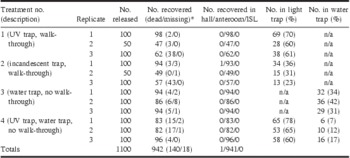
Combined across treatments and replicates, 1100 beetles were released (Table 1). Of these, 140 were considered dead at the time of release. For the remaining 960 beetles, 941 were recovered in the anteroom, 1 escaped into the hall, and 18 were unaccounted for. The 18 missing beetles may have escaped and/or were not found during searches (see section “Escapes from anteroom” below). Trap recovery of beetles within the anteroom varied with trap type (F 3,8 = 46.994; P < 0.001). In terms of significant differences (P < 0.05), trap efficacy was UV + water > UV > incandescent = water. The mean catch of beetles using UV light and pan water traps together (i.e., Treatment 4; Table 1) was 82.3% ± 2.7% of recovered beetles.
Numbers of Chilothorax distinctus released and recovered.

*Numbers recovered represent the sum of insects found in the anteroom, ISL, and hall post release, but excluding those that did not leave the petri dish and were assumed to be dead at the time of release and those that could not be accounted for (i.e., missing). The dead and missing were excluded from all analyses; e.g., for Treatment 2, Replicate 1, 36% of insects accounted for (34 of 94 beetles) were found in the light trap.
ISL, Imported Species Laboratory; UV, ultraviolet.
Based on these data, containment of C. distinctus in the anteroom is optimised with joint use of a UV light trap and pan water trap. The latter has no downside and collected on average 12% of recovered beetles in Treatment 4 (three replicates combined) in addition to the 60%–78% already trapped by the UV light in the anteroom (Table 1). The efficacy of the UV light trap in capturing C. distinctus is not surprising given the propensity for most insects to be attracted to short wavelength emissions, including scarab beetles (García-López et al. Reference García-López, Micó, Zumbado and Galante2011), and that crepuscular insects are particularly sensitive to even low intensity UV light (Johnsen et al. Reference Johnsen, Kelber, Warrant, Sweeney, Widder and Lee2006). Furthermore, C. distinctus is a strong flier and thus can easily reach the ceiling-mounted light. Thus, arthropod flight capabilities and variable response to light of different wavelength regions should be considered when choosing the type and mounting height of light traps.
Musca domestica
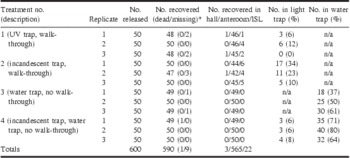
Combined across treatments and replicates, 600 flies were released (Table 2). Of these, one was considered dead at the time of release. For the remaining 599 flies, 565 were recovered in the anteroom, 3 escaped into the hall, 22 escaped into the ISL, and 9 were unaccounted for (see section “Escapes from anteroom” below). Trap recovery of flies within the anteroom varied with trap type (F 3,8 = 30.829; P < 0.001). In terms of significant differences (P < 0.05), trap efficacy was incandescent + water = water > UV = incandescent.
Numbers of Musca domestica released and recovered.

*Numbers recovered represent the sum of insects found in the anteroom, ISL, and hall post release, but excluding those that did not leave the petri dish and were assumed to be dead at time of release and those that could not be accounted for (i.e., missing). The dead and missing were excluded from all analyses.
ISL, Imported Species Laboratory; UV, ultraviolet.
Recovery of M. domestica using either the incandescent or UV light trap was low; i.e., 0%–12% for UV light trap catch (Treatment 1, Table 2), and 6%–34% for incandescent (Treatments 2 and 4). The UV light trap results are in contrast to what was found by Snell (Reference Snell2002) in a release-recapture study using M. domestica within a laboratory setting. In his study, a 15 W UV light (the same wattage as used in our study) was capable of capturing 19%–30% of released flies. Although he did not test the efficacy of an incandescent light trap, it was determined that a higher wattage of UV light bulb (30 W) was capable of catching an average of 76% of released flies, which suggests that wattage increase should be explored as a means to increase containment catch of arthropods.
In contrast to the light trap catch in our study, 50%–80% of released flies were recovered in the pan water trap (Treatments 3 and 4). Although not statistically different (P = 0.068), almost 2/3 more flies were recovered when the pan water trap was used with the incandescent light trap (mean trap catch for Treatment 4; 78.3% ± 4.1% of recovered flies). Thus, joint use of the latter two traps is recommended for M. domestica to optimise containment. Although not tested here, another possibility would be to add a sticky trap, typically in the form of a strip that is suspended from the ceiling.
Urolepis rufipes
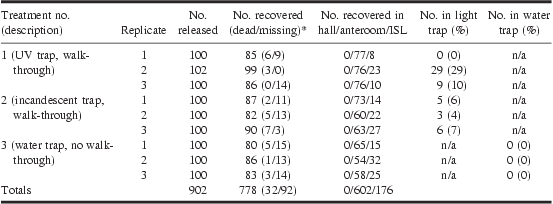
Combined across treatments and replicates, 902 wasps were released (Table 3). Of these, 32 were considered dead at the time of release. For the remaining 870 wasps, 602 were recovered in the anteroom, 176 escaped into the ISL, and 92 were unaccounted for (see section “Escapes from anteroom” below). None were detected in the hall. Overall recapture in traps was low. The greatest recovery within the anteroom was achieved with the UV light trap, but with no significant differences among trap types; i.e., UV = incandescent = water (F 2,6 = 2.701; P = 0.146). Because no wasps were recovered in the pan water trap, we did not examine whether recovery of wasps could be improved with use of a light trap in combination with a pan water trap.
Numbers of Urolepis rufipes released and recovered.
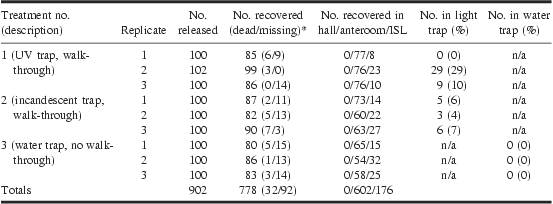
*Numbers recovered represent the sum of insects found in the anteroom, ISL, and hall post release, but excluding those that did not leave the petri dish and were assumed to be dead at time of release and those that could not be accounted for (i.e., missing). The dead and missing were excluded from all analyses.
ISL, Imported Species Laboratory; UV, ultraviolet.
The tested methods appear ill-suited to recover U. rufipes (Table 3) even though light traps are a recommended feature of containment facilities (NAPPO 2004). If it is attracted to light, it would seem to be a weak flier and unable to reach the ceiling-mounted light trap. Thus, the efficacy of a lowered light trap could be explored with this species. Alternatively, the wasp may be indifferent to, or repelled by light, as has been reported for some soil-dwelling invertebrates that exhibit negative phototaxis (e.g., isopods; Hassall et al. Reference Hassall, Zimmer and Loureiro2005). However, its absence from the floor-level pan water trap provides further reason to conclude that U. rufipes is a weak flier. The species is associated with shore flies (Diptera: Ephydridae), which breed in aquatic or semi-aquatic environments. Indeed, U. rufipes has been observed walking on the bottom of streams to attack fly larvae and pupae (Howarth and Polhemus Reference Howarth and Polhemus1991). Thus, its absence in the pan water trap is unlikely to reflect avoidance behaviour.
Despite the low recapture success, results support a recommendation to use a UV light trap. On average, the UV light trap (Treatment 1, Table 3) was still able to catch 13.0% ± 8.5% of recovered wasps, so there is no downside to using this trap type. However, the high number of escapees from the anteroom suggests a need for additional containment measures. These measures could include stricter protocols to minimise escapes from rearing cages deeper within the facility.
Escapes from anteroom
Overall results demonstrated the efficacy of the anteroom and its features in the containment of insects. We increased the risk of escapes by releasing insects into the anteroom at higher numbers than would normally be expected to occur. Despite this, only one C. distinctus was recovered outside of the anteroom; i.e., in the hall during a walk-through (Table 1). Even if we assume the worst-case scenario that the 18 missing beetles had all escaped into the hall and were not detected, overall containment would still be 98% (941/960 beetles). Containment efficiency was higher if any of these beetles escaped into the ISL and were not detected. Searcher error in finding or counting beetles is a possibility considering that there were missing beetles recorded during treatments without walk-throughs (Table 1). However, C. distinctus has a burrowing behaviour as a dung beetle, and may have been able to move between the door seals. We also assume that the probability of finding missing beetles (actually for all species tested) was higher in the ISL than in the hall. Although the hall has no hiding places for insects, it leads to other, diverse areas of the containment facility where escaped beetles would be lost to the searcher, whereas the ISL is small and defined in area, well-lit, and contains few places for insects to hide.
We anticipated and observed a higher rate of escape for M. domestica, which are faster and more agile insects than C. distinctus. Twenty-five of the recovered flies escaped from the anteroom, all during walk-throughs. If the nine flies that were not recovered all escaped into the hall, overall containment was 98%.
Urolepis rufipes had the highest escape success with 176 wasps (23%) recovered from the ISL (Table 3). Even if the 92 wasps that were not recovered all had escaped into the hall, our results would still show that most of the escapees had moved into the ISL and further into the containment facility, thus making overall containment at least 89%. The presence of wasps in the ISL during walk-throughs may have resulted from their passive movement from the anteroom with the inward rush of air associated with the opening of the door into the ISL – a predicted effect of negative air pressure within containment (Adair and Irwin Reference Adair and Irwin2008). However, the majority of wasps that escaped from the anteroom were still recovered in the ISL when the intervening door remained closed (Table 3, Treatment 3). We attribute this to both the ability of U. rufipes to penetrate small spaces around the door seals, but also to a preferential movement from an area of higher to lower air pressure. This latter and unexpected finding further supports the use of negative air pressure as a design feature to reduce escape of particularly small and active insects from containment facilities.
Conclusions
The success of containment methods varied with species and reflected behavioural differences. Standard methods are recommended for practicality and cost efficiencies. Towards this goal, results of the current study support use of a UV light trap or incandescent light trap (depending on insect species), a pan water trap, negative air pressure, and reduced walk-throughs to minimise risk of arthropod escape. Awareness of the specific behaviours for arthropod(s) of interest may suggest additional containment measures to further reduce the risk of escape.
Acknowledgements
The authors are grateful to Eva Pavlik and Paul Coghlin for their help with rearing and collecting insects and other study-associated tasks. This is Lethbridge Research Centre Publication Number 38711047.