Introduction
Age-related cataract is a serious eye disease and a global public health problem (Brian and Taylor, Reference Brian and Taylor2001). Vietnam has a population of approximately 86 million people, of which 17% are aged 50 years and older (General Statistics Office of Vietnam, 2010). Cataract accounts for 65% of blindness in Vietnam (ORBIS, 2008) (Vietnam Vision Project, 2013). The prevalence of cataract among the older population in Vietnam is approximately 2% (Vietnam Vision Project, 2013). The annual incidence of cataract and cataract surgery was conservatively estimated at 170,000 cases and over 120,000 surgeries, respectively (Vietnam Vision Project, 2013). The incidence of cataract surgery is also projected to increase as the population ages.
Depression is another major health issue for older adults in Vietnam, affecting 16%–47% of this age group (Tran et al., Reference Tran, Ngo and Conway2003; Wada et al., Reference Wada2005; Leggett et al., Reference Leggett, Zarit, Nguyen, Hoang and Nguyen2012). It has been found to be associated with lower quality of life and reduced activities of daily living (Vietnam Vision Project, 2013). Previous research indicated that vision impairment among older adults can impact on both physical functioning and psychological well-being (Horowitz, Reference Horowitz2004). Depression is also common among older populations with cataract with a Canadian study, reporting a prevalence of 26% in the sampled population (Wada et al., Reference Wada2005). However, the impact of cataract surgery on depression in both developed and developing countries remains unclear. A study by Harwood et al. (Reference Harwood, Foss, Osborn, Gregson, Zaman and Masud2005) in the United Kingdom reported a small improvement in depressive symptoms after first eye cataract surgery. In addition, a recent Australian population-based study found a significant decrease of 18% in the number of mental health contacts (mental healthcare received in ambulatory (community and outpatient), inpatient and residential mental health settings) for depression and/or anxiety in the first year after cataract surgery (Meuleners et al., Reference Meuleners, Lee, Ng, Morlet and Fraser2012). The corresponding reduction in healthcare costs for treatment of depression and/or anxiety was 28%. However, several other studies have found no significant change in depressive symptoms after first- and/or second-eye cataract surgery (McGwin et al., Reference McGwin, Li, McNeal and Owsley2003; Walker et al., Reference Walker, Anstey, Hennessy, Lord and Von Sanden2006; Ishii et al., Reference Ishii, Kabata and Oshika2008; Freeman et al., Reference Freeman2009).
The impact of cataract surgery on depression has not been investigated for an older Vietnamese population living in the community. It is also unknown which measures of vision may affect change in depression after cataract surgery for this group. To date, very few studies have examined the association between visual measures and change in depression after cataract surgery, and most only examined visual acuity. Therefore, the aim of this study is to determine the impact of cataract surgery on depressive symptoms and to examine the association between objective visual measures and change in depressive symptoms after surgery among a Vietnamese population.
Methods
Study design and sample
A prospective cohort study using a before and after design was undertaken and included participants aged 50 years and older who presented to the Eye Hospital in Ho Chi Minh City, Vietnam, and were scheduled to undergo first eye cataract surgery.
The inclusion criteria were: a diagnosis of bilateral cataract; people living independently in the community, and were aged 50 years or older. Exclusion criteria were: people who had cataract surgery previously, an injury or a diabetes-related cataract, a diagnosis of glaucoma or any other significant ocular conditions diagnosed before the date of the interview. In addition, patients with a diagnosis of dementia, Parkinson's disease, schizophrenia, and those who were wheelchair bound were also excluded.
Data collection
Eligible participants were recruited consecutively from the Eye Hospital between July 2011 and July 2012. Participants’ medical records were screened for eligibility by the researcher. Each eligible participant was provided with information about the study (including the purpose, involvement, and confidentiality of information) and their right to withdraw at any time without negative impact to their treatment. Once informed consent was obtained, a face-to-face questionnaire was administered by the researcher and three objective measures of visual function were assessed.
Information was collected at two time points for each participant; during the week before first eye cataract surgery and approximately one to three months after their most recent surgery (first eye surgery for those who had only one eye operated on and second eye surgery for those who had both eyes operated on). The one month after surgery period was chosen to allow the operated eye(s) to recuperate. Participants who had surgery on both eyes had the two surgeries within a very short time period. The mean length of time between the two surgeries was 18 days (SD = 14). The majority (95%) of patients had their worse eye operated on first, which was defined by visual acuity. All cataract procedures were undertaken by phaco-emulsification.
Questionnaire
The following self-reported information was collected from each participant: age, gender, place of birth, marital status, education, occupation, religion, ethnic background, current prescribed medications, spectacles worn, and comorbid conditions. The types of comorbid conditions included hypertension, heart disease, cancer, stroke, angina, rheumatoid arthritis, kidney disease, hearing loss, alcohol abuse, sleep apnea, hypertension, diabetes, and other chronic conditions.
Depressive symptoms were measured using the 20-item Center for Epidemiological Studies-Depression Scale (CES-D) (Radloff, Reference Radloff1977). It includes questions on appetite, hopefulness, happiness, mood, social relationships, and loneliness. The reliability and validity have been reported by Radloff (Reference Radloff1977). All questions are scored from 0 to 3 with 0 “rarely or none of the time,” 1 “some or a little of the time,” 2 “occasionally or a moderate amount of the time,” and 3 “most or all of the time.” A continuous overall score between 0 and 60 was produced, with higher scores representing more depressive symptoms. It is generally considered that a score of 16 or higher on the scale represents the presence of significant depressive symptoms (Radloff, Reference Radloff1977). The CES-D was translated into Vietnamese and back translated into English by two independent translators. The CES-D has been widely used for assessing depressive symptoms in Vietnam (Franks and Faux, Reference Franks and Faux1990; Tran et al., Reference Tran, Ngo and Conway2003; Leggett et al., Reference Leggett, Zarit, Nguyen, Hoang and Nguyen2012).
Objective visual measures
Three objective measures of vision (visual acuity, contrast sensitivity, and stereopsis) were assessed by the researcher under the guidance of the hospital's ophthalmologists. A standardized protocol for each of these assessments was followed.
Participants’ current lens correction was used for visual testing. Visual acuity (first eye, second or unoperated eye, and binocular) was measured using a Snellen chart (Ferris et al., Reference Ferris, Kassoff, Bresnick and Bailey1982; Holladay, Reference Holladay1997). Scores were converted to a logarithm of the minimum angle of resolution (logMAR) scale and those who could not read any letters were assessed by count fingers, hand motion, and light perception (Holladay, Reference Holladay1997). Contrast sensitivity (first eye, second or unoperated eye, and binocular) was measured using a Pelli–Robson chart in log units (Pelli et al., Reference Pelli, Robson and Wilkins1988). Binocular measures of visual acuity and contrast sensitivity only are presented in this paper. Stereopsis, a form of depth perception, was assessed by the Titmus Fly Stereotest (Stereo Optical Co., Inc., 2009), which measured disparity from 1.602 to 3.551 log seconds of arc. Participants who could not see any images were assigned a score of 3.551 log seconds of arc (Stereo Optical Co., Inc., 2009).
Statistical analysis
Descriptive analyses were undertaken to compare visual and descriptive characteristics as well as depressive symptom scores before and after cataract surgery. A generalized linear estimating equations model was undertaken for the 247 participants for whom complete data was available. The generalized estimating equations (GEE) model analyzed whether there was a significant change in depressive symptoms score after cataract surgery. The outcome of interest, depressive symptoms score, was entered as repeated variable and time (before or after surgery) was added to the model as an explanatory variable. All potential confounding factors were then entered into the model and the time (before or after surgery) variable was modeled while controlling for these.
In addition to the visual variables (binocular visual acuity, binocular contrast sensitivity, and stereopsis), potential confounders tested in the model were age, gender, education status, employment status, marital status, ethnicity, taking prescription medications (no/yes), comorbid medical conditions, which included other eye conditions (no/yes), new glasses after surgery, and living status (alone no/yes). These variables were selected based on findings of previous studies that identified them as potential confounding factors. A variable was also added to differentiate whether the person had only first-eye cataract surgery or both-eye cataract surgery since the first assessment. All statistical analyses were performed using STATA 12.
Ethical issues
The study was approved by the Curtin University Human Research Ethics Committee and the executive board of the Eye Hospital in Ho Chi Minh City, Vietnam.
Results
Four hundred and thirty-four bilateral cataract patients were initially identified as eligible to be part of the study. From those approached, 10 refused to participate and 11 were later excluded, resulting in a response rate of 95.1% and a sample of 413 patients. Nearly 40% of the initial participants were lost to follow up. There were no significant differences in those who were lost to follow up in terms of gender (p = 0.27) and age (p = 0.19). From the final sample of 247 participants, 107 (43.3%) underwent first eye cataract surgery and 140 (56.7%) patients had first- and second-eye cataract surgeries during the one to three month follow-up period.
The average age of the participants before cataract surgery was 66.5 years (SD = 7.8) with a minimum of 50 years and a maximum of 88 years. A large majority of participants were female (n = 268, 64.9%), aged between 60 and 69 years (n = 170, 41.2%), were married (n = 239, 57.9%), lived with family (n = 383, 92.7%), were not working (n = 326, 78.9%), were of Kinh ethnicity (n = 401, 97.1%), and 73.4% had attended junior high school. Sixty-four percent (n = 264) also reported at least one comorbidity and 60.5 % (n = 250) were not prescribed any medications. The average number of comorbidities was one (SD = 1.01) with a minimum of one and a maximum of five. Prescribed medications were most commonly taken for hypertension (n = 107, 65.6%). Thirteen participants (3.2%) had a secondary comorbid eye condition in addition to cataract including age-related macular degeneration or pterygium.
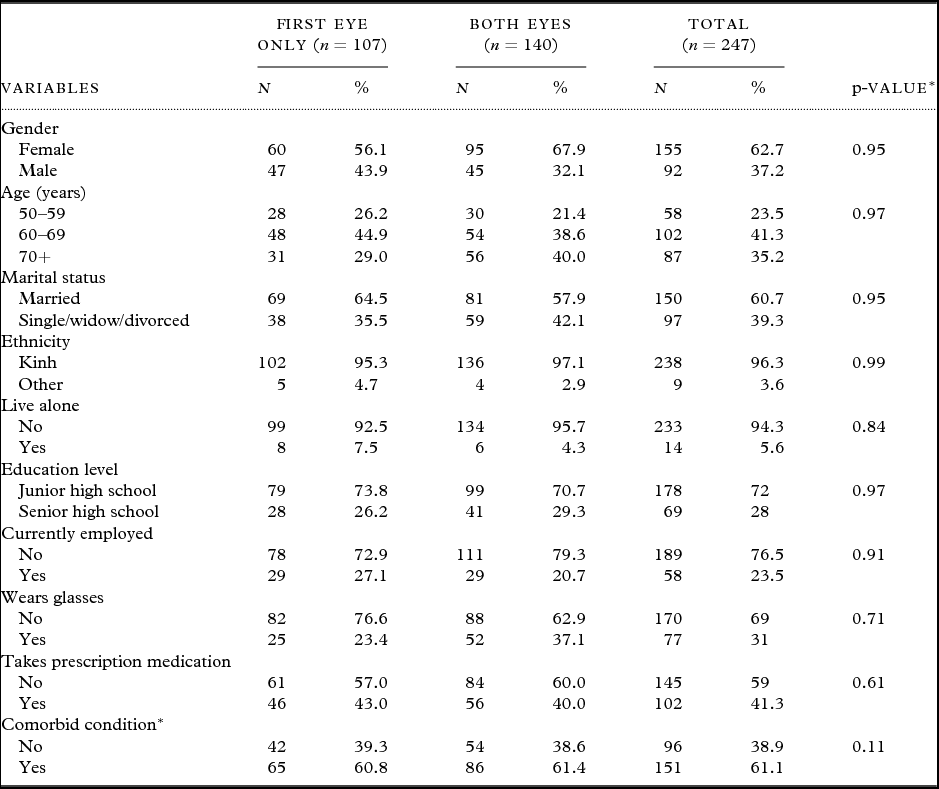
Similarly, among patients who completed the follow-up assessment (n = 247) those who had first eye surgery only (n = 107) and first- and second-eye cataract surgeries (n = 140) were mainly women (56.1% and 67.9%, respectively), were married (64.5% and 57.9%, respectively), were of Kinh ethnicity (95.3% and 97.1%, respectively), did not live alone (92.5% and 95.7%), had a comorbid condition (60.8% and 61.4%, respectively), but did not take any prescription medication (57.0% and 60.0%). However, the majority of those who had both first- and second-eye cataract surgeries were slightly older (40.0% were aged 70 years or older) than those who had first eye cataract surgery only (44.9% were aged between 60 and 69 years) (Table 1).
Demographic characteristics of bilateral cataract patients who underwent first eye cataract surgery only (n = 107) and both eye surgeries (n = 140), Ho Chi Minh City, Vietnam

*Comorbid conditions included hypertension, heart disease, cancer, stroke, angina, rheumatoid arthritis, kidney disease, hearing loss, alcohol abuse, sleep apnea, and diabetes.
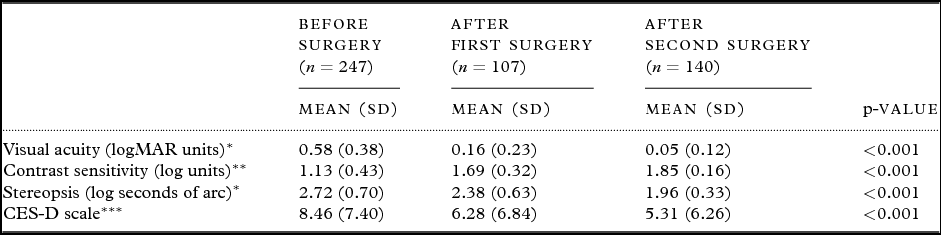
Table 2 presents the patient's visual test and depressive symptom scores before and after cataract surgery. Before cataract surgery, the mean binocular visual acuity was 0.58 logMAR (SD = 0.38). After surgery, visual acuity improved to 0.16 logMAR (SD = 0.23) for those who had first eye surgery only (n = 107) and to 0.05 logMAR (SD = 0.12) for those who had both first- and second-eye cataract surgeries (n = 140).
Mean binocular visual characteristics scores and mean scores for CES-D before and after first- and second-eye cataract surgeries (n = 247)
*logMAR: logarithm of the minimum angle of resolution.
**Lower scores represent better vision.
***Higher CES-D scales represent more depressive symptoms.
NOTE: SD = standard deviation; CES-D = Center for Epidemiological Studies-Depression.
Before surgery, mean binocular contrast sensitivity was 1.13 log units (SD = 0.43). After surgery, contrast sensitivity improved to 1.69 log units (SD = 0.32) for those who had first eye surgery only and to 1.85 log units (SD = 0.16) for those who had both first- and second-eye cataract surgeries.
Before surgery, mean stereopsis was 2.72 log seconds of arc (SD = 0.70). For participants who underwent first eye cataract surgery only, stereopsis significantly improved to 2.38 log seconds of arc (SD = 0.63). For participants who underwent first- and second-eye cataract surgery, stereopsis improved to 1.96 log second of arc (SD = 0.33).
Overall depressive symptom scores before and after first- and both-eye cataract surgeries are also presented in Table 2. Before cataract surgery, the mean depressive symptom score was 8.46 points (SD = 7.40) with 16.2% (n = 40/247) of the cohort scoring 16 or over on the CES-D scale. After first eye surgery, mean depressive symptom scores significantly improved to 6.28 (SD = 6.84) and to 5.31 (SD = 6.26) for those who had both eyes operated on. However, after surgery 8% of those who had first eye surgery only (n = 9/107) and those who had both eyes operated on (n = 11/140) still reported significant depressive symptoms (score of 16 or over).
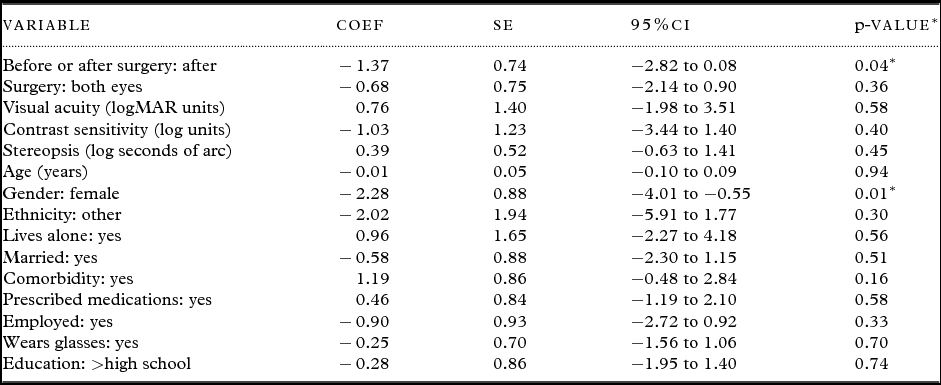
The results of the multivariate GEE linear regression model examining the change in depressive symptom scores after cataract surgery are presented in Table 3. After adjusting for age, gender, ethnicity, marital status, education, employment status, comorbidities, medication usage, refractive management, and living status, there was a significant decrease (improvement) of one point in the depressive symptoms score (p = 0.04) after cataract surgery. In addition, females reported a significantly greater decrease (improvement) of two points in depressive symptom scores (p = 0.01), compared to males. However, binocular contrast sensitivity, binocular visual acuity, and stereopsis were not significantly associated with change in depressive symptom scores. There was also no significant difference in change in depressive symptom scores between patients who had first eye surgery only and those who had both eyes operated on.
Generalized Linear Estimating Equation Model of depression score after cataract surgery, Ho Chi Minh City, Vietnam (n = 247)
*significant at p < 0.05.
NOTE: 95%CI = 95% confidence interval; SE = standard error.
Discussion
This is one of the first studies to examine the impact of cataract surgery on depressive symptoms for an ageing population in Vietnam. The results found a small but significant improvement in depressive symptom scores after cataract surgery. However, there was no difference in change in depressive symptoms score between those who had first eye cataract surgery and those who had both eyes operated on. Similarly, a UK-based randomized controlled trial (RCT) of older women who underwent first eye cataract surgery reported a small improvement in depressive symptoms, compared to a no surgery group (Harwood et al., Reference Harwood, Foss, Osborn, Gregson, Zaman and Masud2005). However, a second UK-based RCT of older women who underwent second eye surgery found no difference in depressive symptoms (Foss et al., Reference Foss, Harwood, Osborn, Gregson, Zaman and Masud2006). The results of our study may provide support to these previous findings that first but not second eye cataract surgery has a small benefit for depressive symptoms. It should be noted that it is possible that a change in depressive symptoms may not have yet occurred for some of the patients if the timing of the follow-up assessment was done shortly after cataract surgery. Surprisingly, while our study found a clinically significant improvement in visual acuity, contrast sensitivity, and stereopsis after first- and both-eyes cataract surgeries, these were not significantly associated with an improvement in depressive symptom scores.
Previous research has reported conflicting results. A RCT by Datta et al. (Reference Datta2008) found that only visual acuity was negatively associated with depression. However, these studies were conducted in developed countries. It is also possible that the low prevalence of depressive symptoms before surgery in the current study may provide an explanation for the study results. The study also found that being female was associated with a significantly greater reduction (improvement) in depressive symptom scores after cataract surgery and is consistent with previous studies (Franks and Faux, Reference Franks and Faux1990; Owsley et al., Reference Owsley, McGwin, Scilley, Meek, Seker and Dyer2007; Freeman et al., Reference Freeman2009). It is well known that depression is more prevalent in women than men, including in Vietnam (Leggett et al., Reference Leggett, Zarit, Nguyen, Hoang and Nguyen2012) and this may have contributed to the gender differences observed in this study.
The prevalence of depressive symptoms among this Vietnamese cohort of bilateral cataract patients was found to be 16%. These results are consistent with a multicenter study conducted on an ageing population (60 years and older) in Indonesia, Vietnam, and Japan, which found the prevalence of depression to be approximately 17% (Wada et al., Reference Wada2005). A separate Vietnamese study on adults aged 55 years or older found the prevalence of depression to be approximately 47% (Leggett et al., Reference Leggett, Zarit, Nguyen, Hoang and Nguyen2012), whereas another Vietnamese study found the prevalence of depression to be 24% (Tran et al., Reference Tran, Ngo and Conway2003).
The lack of a suitable comparison group that had cataract, but did not have surgery was a limitation of the study, although the “before and after” design using the same person as their own control would have accounted for interindividual differences that can confound studies using separate control groups. The self-reported nature of depressive symptoms in this study may also contribute to the validity of the data as well as the variable follow-up period of one to three months after cataract surgery. Unfortunately, information on daily activities and physical activity levels was not collected in this study and should be in future studies, examining the impact of visual impairment on depression. Another limitation was that cognitive ability was not captured in the study and is a well-known confounder in research with an older population (Pelli et al., Reference Pelli, Robson and Wilkins1988; Holladay, Reference Holladay1997; McGwin et al., Reference McGwin, Li, McNeal and Owsley2003; Reference McGwin, Gewant, Modjarrad, Hall and Owsley2006; Walker et al., Reference Walker, Anstey, Hennessy, Lord and Von Sanden2006; Ishii et al., Reference Ishii, Kabata and Oshika2008).
In conclusion, there was a small but significant improvement in depressive symptom scores after cataract surgery for an older population in Vietnam. However, there was no difference in change in depressive symptom score between those who had first eye cataract surgery and those who had both eyes operated on. Changes in contrast sensitivity, visual acuity, and stereopsis were not associated with depressive symptom scores. Further research is needed with a longer follow-up time to determine the impact of visual measures on depressive symptoms after cataract surgery.
Conflict of interest
None.
Description of author's roles
All listed authors have made a substantial contribution to conception and design, acquisition of data, analysis and interpretation of data, drafting the paper or revising it critically, and have approved the final version for publication. K. G. To, L. B. Meuleners, and D. V. Duong designed the study; K. G. To, V.-A. N. Huynh, T. D. Phi, D. V. Do, H. H. Tran, and N. D. Nguyen collected and managed the data; K. G. To, L. B. Meuleners, and M. L. Fraser analyzed and interpreted the data and wrote the paper.
Acknowledgments
This study was not supported by a funding organization.