In addition to the physical destruction and loss of life wrought by Hurricane Katrina when it struck Louisiana and Mississippi in August 2005, many graduate medical education (GME) residency/fellowship programs in the Gulf Coast region were severely disrupted. The hurricane and its immediate and long-term effects made it difficult, if not impossible, to continue to provide for the medical education of hundreds of resident/fellow physician trainees in this region. Because residents/fellows also provide a critical safety net of health care services, both in inner city and rural hospitals, this disruption was not only an academic concern but also a threat to access to health care for many people in New Orleans and throughout the Mississippi Delta region.
This article, which stems from a 2009 report of the American Medical Association (AMA) Council on Medical Education (CME),1 examines the effects of Hurricane Katrina on GME and resident/fellow trainees. In particular, it examines the response to Katrina by the Accreditation Council for Graduate Medical Education (ACGME), which accredits residency/fellowship programs in the United States, and how the ACGME changed its policies to allow for a more rapid, effective response to future disasters—policies, in fact, that were tested by Hurricane Ike, which struck Galveston, Texas, in September 2008.
ROLE OF THE ACGME
The ACGME is the private, nonprofit organization that accredits allopathic medical residency/fellowship programs in the United States. The ACGME's 28 review committees (1 for each of the 26 core specialties, 1 for the transitional year, and 1 for institutional review) oversee approximately 8700 ACGME-accredited residency and fellowship programs in 130 specialties and subspecialties, with approximately 111 000 residents/fellows active.
The ACGME comprises 5 member organizations: the American Board of Medical Specialties, the American Hospital Association, the AMA, the Association of American Medical Colleges (AAMC), and the Council of Medical Specialty Societies. Each of the ACGME's review committees include 6 to 15 volunteer physicians. Members of the review committees are nominated by the AMA Council on Medical Education and the appropriate medical specialty boards and organizations and subsequently confirmed by the ACGME Board of Directors.
KATRINA'S EFFECT ON GME PROGRAMS AND ACGME
In the immediate aftermath of Hurricane Katrina and the resulting levee breaks in New Orleans, it was extremely difficult to communicate regularly with the affected GME leaders in the area and similarly difficult for GME leaders to communicate with their residents/fellows. Given these circumstances, the ACGME, the AMA, and the AAMC used their respective Web sites as the chief means of communication to provide information directly to residents/fellows about the process for their placement and transfer as a result of the disruption to their training. In addition, the ACGME site in particular provided guidance to GME leaders and residency/fellowship program directors from across the United States who wished to accept displaced residents/fellows. Individual programs contacted ACGME staff responsible for the support of review committees (RCs), and those staff individually worked with program directors in affected programs to assist with placement and expedited approval of temporary increases. Furthermore, the ACGME used its authority under its “alleged egregious or catastrophic events” policy2 to initiate early site visits to disrupted programs. Through these mechanisms, ACGME staff and its RCs assisted in expediting the placement of 1300 displaced resident physicians from approximately 80 ACGME-accredited programs during the first 2 months after the hurricane. Existing ACGME-accredited programs in Louisiana and Texas received the majority of temporary transfers, but a number of residents were dispersed throughout the country in either temporary or permanent placements.
ACGME POLICY ADAPTATION FOR MANAGEMENT OF FUTURE EMERGENCY EVENTS
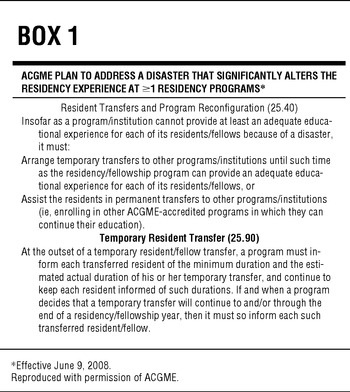
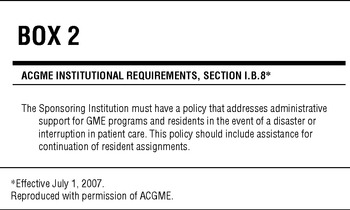
Although the ACGME and RCs acted rapidly in the aftermath of Katrina, this natural disaster revealed the need for more explicit ACGME policies that would provide the ACGME and its RCs with specific authority related to the emergency closure of sponsoring institutions, or residency/fellowship programs, or both and the transfer of residents/fellows. For this reason, the ACGME added explicit statements regarding elements of the accreditation process within disaster recovery to both the ACGME policies and procedures and its institutional requirements (Boxes 1 and 2). The policies and procedures include several points related to disaster, including the following:
ACGME Plan to Address a Disaster That Significantly Alters the Residency Experience at ≥1 Residency Programs*

ACGME Institutional Requirements, Section I.B.8*

• Definition of disaster
• ACGME declaration of a disaster
• Resident transfers and program reconfiguration (excerpted in Box 1)
• Communication with ACGME from disaster-affected institutions/programs
• Institutions offering to accept transfers
• Changes in participating sites and resident complement (excerpted in Box 1)
• Temporary resident transfer
• Site visits
The ACGME's Institutional Review Committee also added an accreditation standard that requires all institutions that sponsor ACGME-accredited residency/fellowship programs to have in place a disaster policy (Box 2).
Assistance in Updating and Strengthening ACGME's Emergency Preparedness Policy
As a member organization of the ACGME, the AMA plays an important role in helping to set ACGME policies and procedures. In the case of ACGME's plans to address disaster preparedness, members of the AMA Council on Medical Education's graduate medical education subcommittee commented in a March 28, 2006, memorandum to the ACGME, in part, that “the disaster policy needs further refinement and clarification, to address such issues as the flexibility/portability of [Centers for Medicare and Medicaid Services]-funded slots, and to ensure minimal loss of training time for affected residents/fellows. Also, more examples of what constitutes a disaster are needed.”
In addition to Council activity, AMA medical education group staff collaborated with ACGME staff to help mitigate the educational impact on residents/fellows affected by Katrina. Furthermore, AMA staff responsible for the National GME Census, an annual survey of GME programs from the AMA and the AAMC, collected data from programs that received residents displaced by Hurricane Katrina. Staff also made efforts to keep FREIDA Online (http://www.ama-assn.org/go/freida), the AMA's Internet-based database of GME programs, up to date with programs' changing contact information and closure status. AMA staff helped advocate for and obtain waivers from the Centers for Medicare and Medicaid Services (CMS) for transferring residents so that their CMS funding would follow them from a closing to the receiving residency program. CMS now permits the transfer of GME slots from a federally designated disaster area via the Emergency Medicare Transfer Affiliation Agreement, which allows the sending program to transfer the funding to follow the resident for the duration of time that the resident is at the receiving facility. Finally, AMA staff contacted the American Board of Medical Specialties to encourage its member certifying boards to develop a mechanism to accommodate discontinuities in training arising from residency closures, including waiving continuity care requirements and granting residents credit for partial years of training.
SEPTEMBER 2008: HURRICANE IKE TESTS THE NEW SYSTEM
Just as Katrina served to alert the GME community to the importance of developing emergency procedures for residency program closure and transfers of residents, Hurricane Ike, which made landfall at Galveston, Texas, on September 13, 2008, proved to be a stringent test of the ACGME's newly enacted policies.
The effectiveness of the ACGME's disaster plan was demonstrated in the ACGME's support to the GME leadership and residents at the University of Texas Medical Branch at Galveston (UTMB) after Hurricane Ike, which was a calamity of unprecedented proportions for UTMB. Subsequently, the hospital laid off 3000 employees as well as 130 faculty members, including tenured faculty.
Despite these difficult circumstances, Dr Thomas Blackwell, associate dean for GME at UTMB, worked to honor the institution's commitments to both current and future residents. As a member of UTMB's leadership, Dr Blackwell was able to consult with the institution's emergency management office and physically assess the damage to the institution within hours of the storm's passing. He realized immediately that temporary resident locations would need to be established quickly to preserve the training of all 597 existing residents/fellows. The first priority was to ensure training would continue without interruption.
As designated institutional official (DIO), Dr Blackwell's first telephone call was to the executive director of the ACGME Institutional Review Committee. The ACGME was immediately supportive in helping UTMB to identify other programs with the capacity for a temporary increase in resident positions. In addition to disseminating information to all GME constituents through its weekly electronic system and special electronic messages, the ACGME made available to Dr Blackwell and UTMB program directors and residents a separate component of the ACGME's Accreditation Data System. Under normal circumstances, all requests for resident transfers are entered into this electronic system. This separate Accreditation Data System component allowed the expedition of all requests for transfer and housed a database with all offers of temporary or permanent resident slots from institutions and programs across the United States. The resulting database was made accessible to Dr Blackwell and all of the program directors at UTMB so that they could assist residents in finding positions. This entire electronic support system, which automated the processes used during Katrina, can now be launched within 24 hours after a disaster. In addition to electronic support, all of the RC executive directors and ACGME staff were available to GME leadership and residents by telephone and e-mail to assist with questions and provide additional guidance. The GME leadership of UTMB had 24-hour immediate access to the executive director of the ACGME's Institutional Review Committee.
With the ACGME's support in place, Dr Blackwell and UTMB program directors then began communicating with the DIOs, program directors, and staff of the identified training sites through e-mail and by telephone to initiate the process of identifying alternative temporary training sites that were, first and foremost, best suited for each resident's continued education and training. Another priority was to relocate residents to training sites that would allow them to live with family or friends, thereby reducing housing costs, and to accommodate the needs of residents/fellows and their families, understanding that some had lost all of their possessions.
The expeditious establishment of both an emergency educational affiliation and program agreements, in addition to financial emergency Medicare affiliation agreements, allowed for the affected resident/fellow physicians to continue their training. The Medicare transfer agreements led to the resolution of financial issues that could have been complex, and the emergency educational affiliation and program agreements facilitated by the ACGME allowed UTMB to preserve educational standards. The residents/fellows remained employees of UTMB, including employee benefits, with the understanding that involved institutions would reimburse UTMB the Medicare direct medical education payments once they were received. These agreements were key components—along with close communication, detailed documentation, and visits to all alternative training sites by the DIO, GME staff, and program directors—to facilitate a smooth transition and continued educational excellence for the UTMB residents/fellows. The work of the many DIOs, program directors, and staff at the receiving institutions was also essential in helping the transferring residents/fellows to feel welcome and to quickly resume their educational and clinical duties. The relocation of 597 residents/fellows occurred within a 2-week period, thereby meeting the ACGME's deadline of September 29, 2008. About 92 residents from UTMB were permanently transferred to other programs. As of July 1, 2010, however, UTMB had restored its complement of residents to 530.
These continued efforts allowed for the submission of an institutional report and individual program summary reports to the institutional RC and RCs in November and December 2008 and again in January 2009. These detailed reports reflected the efforts made by the DIO and GME committee, confirming their close monitoring of programs and continued oversight. In addition, the RCs were able to receive updates to continue their monitoring and status updates of all of the programs, and UTMB was able to address frequently the status of recovery, plans for resident recruitment, and the success of relocating to alternative sites.
Less than 6 months later, on March 9, 2009, the ACGME conducted an institutional disaster-focused site visit at UTMB. Dr John Caughron, who was assigned as site visitor, came in with extensive knowledge from his experience with Hurricane Katrina. The disaster-focused site visit was especially beneficial for UTMB in that it allowed for concise responses to the ACGME's requests for information concerning the maintenance of an appropriate training environment for UTMB residents/fellows.
Looking back, 1 major suggestion for improvement is that it may have been reasonable to have delayed the RC site visits for a few more months because of the steep trajectory of change UTMB training programs were experiencing. New hospital functions and hospital capacity were improving on a weekly basis, and a delay in review would have provided a more accurate picture of the training programs.
CONCLUSIONS
When an impending residency/fellowship program closure is the result of a natural disaster, residents/fellows need to transfer to other programs efficiently, with the least disruption to their training. The work of the ACGME, with the assistance of its member organizations, to develop appropriate policies related especially to emergency closures has laid the groundwork for effective, timely response that better serves the needs of resident physicians and GME programs alike. Similarly, individual certification boards should be as flexible as possible in waiving continuity requirements in the event of a disaster that affects resident/fellow training.
Authors’ Disclosures: The authors report no conflicts of interest.