Introduction
Medicinal and aromatic plants (MAPs) as the name suggests have an eternal and significant position in the remedial arsenal of mankind. MAPs find a magnificent usage in the ancient Ayurveda, Siddha and Unani medical systems along with other schemes like homeopathic and allopathic systems, also making use of herbal drugs (Gurib-Fakim, Reference Gurib-Fakim2006). The prime importance of MAPs could be relied from the fact that the expected sale of herbal medicines is likely to increase up to US$3 trillion by 2020 (Schippmann et al., Reference Schippmann, Leaman and Cunningham2002). In the context of developing countries of Asian subcontinent, MAPs have an important role in generating income for the people whose livelihood is dependent on selling of the collected medicinal plant materials. The situation however is not as smooth as it appears to be, since MAPs production is hindered by various biotic and abiotic factors among which biotic constraints are more important. Till date however, a sizeable attention has been paid to the diseases affecting the crop plants providing food to mankind but what has been largely ignored are the diseases affecting our own savior – the MAPs. It is perceived that due to changing climatic conditions, the global production of crops, including MAPs, in the near future is under serious challenge threatened by increased disease severity consummated by higher survival rate of pests and pathogens (Elad and Pertot, Reference Elad and Pertot2014).
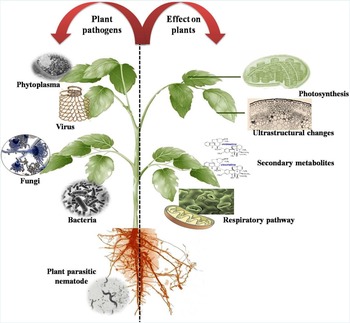
Apart from the changing climatic conditions, the indiscriminate and unplanned large scale cultivation of MAPs to meet the ever increasing demand by pharmaceutical industries, is leading to increased occurrence and severity of diseases. Furthermore, the cultivation of MAPs faces grave damage from diverse group of microbes (bacteria, fungi, viruses, phytoplasmas, phytonematodes), thereby posing serious threat to the yield, biomass, bioactive potential and prospects of MAPs (Fig. 1). The loss arising from plant diseases caused by phytopathogens not only reduces the yield of plant secondary metabolites but also the quality of raw material. The latter not only discourages consumers’ self-belief but also the prosperity of the producers. The present paper focuses on the major diseases of MAPs, their effect on various metabolic processes of the host plants, and offers suggestions for efficient management strategies for qualitative cultivation.
Schematic representation of the diverse group of plant pathogens and their effect on medicinal and aromatic plants.

Fungal and bacterial diseases
The cultivation of MAPs has increased manifold in the recent years owing to their great demand in the production of plant based drugs, aroma compounds and their worldwide trade. These plants are often affected by various diseases caused by fungi, bacteria, viruses and phytoplasmas of which fungal diseases are notably important (Table 1). A variety of fungi influence pathogenic invasions on MAPs and infect the aerial, foliage and underground plant parts. Among the various fungal diseases, powdery mildews primarily appear on the leaves and fresh stems thereby covering the entire surface of the growing parts of plants. Similarly, rust is another airborne disease known to attack leaves, twigs, branches and fruits. They produce pustules on the upper and lower surface of leaves. The other group belonging to fungal pathogens causes leaf spot and blight diseases where the symptoms appear on the leaves in the form of leaf spot followed by shrinking of the dead area and separation from the surrounding healthy tissues with varying lesion shapes (Thaung, Reference Thaung2008; Bhandari et al., Reference Bhandari, Harsh, Sharma, Mao and Thakur2014). In case of blight, burnt appearance leading to sudden death of the plant or its conspicuous parts viz. leaves, twigs or blossoms occurs (Sattar et al., Reference Sattar, Alam, Khaliq, Shukla and Khanuja2006; Ramappa and Shivanna, Reference Ramappa and Shivanna2013).
Major diseases occurring on Medicinal and Aromatic plants

MAPs are also affected by various other diseases such as root rot, wilt, damping off, anthracnose and die back, which are mainly caused by fungal and bacterial pathogens. They can generally be identified by decaying tissue, which may be hard, dry, spongy, watery, mushy, or slimy in appearance.
Control measures
The major control measures available for all these various diseases are the chemical control. Treatment of terminal cuttings with carbendazim solution (1 g/l) before plantation is an effective protection from fungal pathogens. Application of Streptocyclin @ 300 ppm around the roots of transplanted cuttings was found to protect the crop from bacterial infection (www.indg.in). Similarly, the chemical emisan (0.2%) was found to be effective for wilt disease treatment (Boby and Bagyaraj, Reference Boby and Bagyaraj2003). Paramasivan et al. (Reference Paramasivan, Mohan and Muthukrishnan2007) reported that the use of chemical fungicide (carbendazim) reduced incidence of disease by 18%. Although chemicals are effective for the control of all these diseases, yet there association with several harmful effects and residual contamination of raw drug per se has necessitated development alternative environment friendly measures.
Rhizospheric microorganisms are potential source of novel natural products for exploitation in agriculture and are recognized as a promising group in terms of diversity and pharmaceutical potential (Pliego et al., Reference Pliego, Kamilova, Lugtenberg and Maheshwari2011). The reduction of inoculum density or disease producing activities of a pathogen by one or more microorganisms, termed as biocontrol is achieved by competition, hyperparasitism, induced resistance etc. Several biocontrol agents have been successfully used and a large number of products are available in world market, which are not only highly economical but also ecofriendly with no adverse effect on human health.
The essential oils of several aromatic plants such as sage, sweet basil and cinnamon have antifeedant and repellent potentials, thereby acting as potent insect deterring agents. β-caryophyllene, a common sesquiterpene of many essential oils is effective against cabbage butterfly larvae. Terpinen-4-ol, main component of tea tree oil is the most effective as mosquito repellent (Vokou, Reference Vokou2002). Wintergreen oil (Gaultheria procumbens) is the essential oil mostly used for controlling mites in honey bees (Amrine et al., Reference Amrine, Noel, Mallow, Stasny and Skidmore1996). The essential oil and its sesquiterpenes obtained from Taiwania cryptomerioides have recently been shown to have antimite activity against two major allergenic household mites: Dermatophagoides pteronyssinus and Dermatophagoides farina (Chang et al., Reference Chang, Chen, Wang and Wu2001).
Plant parasitic nematodes
Plant parasitic nematodes (PPN) are the major pests of large number of MAPs, causing severe yield losses reducing considerable farm income (Table 1). The major plant parasitic nematodes which adversely affect the crop loss include root-knot nematodes (Meloidogyne spp.), cyst nematodes (Globodera spp., Heterodera spp.), reniform nematode (Rotylenchulus reniformis) and lesion nematode (Pratylenchus spp.). Several ectoparasitic nematodes also cause severe damage to MAPs and few are also involved as vector for plant viruses viz. Xiphinema spp., Longidorus spp. and Trichodorus spp.
Depending upon the specific life cycles, PPN are able to cause various types of wound on host plant roots while entering or feeding. The sedentary endoparasites Meloidogyne spp., Globodera spp. and Heterodera spp. have highly specialized feeding strategies together with elaborate life cycles. Vermiform juvenile nematodes (J2) perforate plants behind growing root tips (Doncaster and Seymour, Reference Doncaster and Seymour1973). They migrate either intracellularly, e.g. Globodera and Heterodera spp. or intercellularly e.g. Meloidogyne spp (Wu et al., Reference Wu, Jenkins, Blunden, Von Mende and Hankins1998) into the vascular cylinder, where specific ‘nurse cell systems’ are commenced (Jones and Northcote, Reference Jones and Northcote1972). Some of the important species of medicinal and aromatic plants which lodge most of these nematode species include Mentha spp., Pogostemon cablin, Ocimum spp., Withania somnifera, Bacopa monnieri, Rauvolfia serpentina, Hyoscyamus spp., Artemisia pallens, Chlorophytum borivilianum, Cymbopogon spp. and Eucalyptus citriodora. It is thus essential to identify the nematode infestation problems at initial stages and launch appropriate eco-friendly control measures.
Control measures
Biological control agents are gaining importance in the field of nematode management. Besides, these agents also play key role as plant growth promoting microorganisms (Sharon et al., Reference Sharon, Bar-Eyal, Chet, Herrera-Estrella, Kleifeld and Spiegel2001). It has been vastly reported that fungi parasitize egg shells of nematode by secreting chitinases (Gortari and Hours, Reference Gortari and Hours2008; Gupta et al., Reference Gupta, Saikia and Pandey2015a; Gupta and Pandey, Reference Gupta and Pandey2015). Trichoderma spp. is one such important member of the group imperfect fungi, which are found in close association with the host roots and contribute as plant growth stimulators (Ousley et al., Reference Ousley, Lynch and Whipps1994). Mycoparasitism and production of volatile and non-volatile antibiotics are important mechanisms operating in the case of Trichoderma spp. Earlier, our group has identified a strain of Trichoderma harzianum that has been found to produce a disease-free, healthy nursery with a reduction in root-knot nematode infection realising improved growth and productivity of MAPs (Saikia et al., Reference Saikia, Tiwari and Pandey2013).
Several fungal and bacterial agents have been reported for their biocontrol potentials. Also, mutualistic endophytic fungi such as non-pathogenic strains of Fusarium oxysporum and species of Trichoderma have been evaluated for their activity against phytonematodes (Sikora, Reference Sikora2008). In a study, a protein Cry5B's expression from Bacillus thuringiensis was evaluated by Li et al. (Reference Li, Tan, Voegtline, Bekele, Chen and Aroian2008). Soil application with bio-agents like T. harzianum and B. megaterium significantly reduced nematode population in soil and root, and increased the growth and yield of Bacopa monnieri crop (Gupta et al., Reference Gupta, Tiwari, Saikia, Shukla, Singh, Singh, Ajay Kumar and Pandey2015b). Integration of strategies such as dipping treatment of stem cutting with biocontrol agents along with dipping soil application of neem cake @ 400 kg/ha was found to be effective in nematode management in Tagetus erecta (Seenivasan and Devrajan, Reference Seenivasan and Devrajan2008).
Viruses and phytoplasma
Plant viruses and phytoplasma cause various diseases that affect the biomass yield and production of MAPs worldwide. Large numbers of MAPs viz. Mentha spp., Andrographis paniculata, Hyoscyamus muticus, Catharanthus roseus, Rauwolfia serpentina, Hyoscyamus albus and Papaver somniferum are reported to be infected by plant viruses (Postman et al., Reference Postman, Tzanetakis and Martin2004; Raj et al., Reference Raj, Kumar, Pratap, Vishnoi, Choudhari and Chandra2007; Samad et al., Reference Samad, Ajayakumar, Gupta, Shukla, Darokar, Somkuwar and Alam2008; Khan et al., Reference Khan, Saeed and Samad2015) (Table 1). Plant viruses are the major pathogen of MAPs, which produce a wide range of symptoms in plants, thereby causing huge losses in crop production across the world. The symptoms expressed by the plants due to virus infection might be topical or systemic in nature and depend upon the strain of virus, plant variety and geo-cultural environment. The various kinds of symptoms include chlorosis, mosaic, discoloration of leaves and malformations (Tzanetakis et al., Reference Tzanetakis, Postman, Samad and Martin2010; Khan and Samad, Reference Khan and Samad2014).
The major plant viruses influencing MAPs growth are nematode-transmitted viruses (Arabis mosaic virus, Strawberry latent ring spot virus and Tobacco ring spot virus), aphid-transmitted viruses (Alfalfa mosaic virus, Cucumber mosaic virus and Mint vein banding associated virus), vitiviruses (Mint virus-2 and Peppermint stunt virus), thrips-transmitted viruses (Tospoviruses: Impatiens necrotic spot virus and Tomato spotted wilt virus), whitefly-transmitted viruses (Tomato leaf curl Pakistan virus), viruses with unknown vectors (Tobacco mosaic virus and Lychnis ringspot virus-mint).
Like viruses, phytoplasmas are small (0.3–0.5 µM in size; 580–2200 kb circular DNA genome), cell-wall-deficient obligate parasites, closely linked to the gram positive bacteria (Hogenhout et al., Reference Hogenhout, Oshima, Ammar, Kakizawa, Kingdom and Namba2008). In the host plants, phytoplasma multiply and spread only in the phloem tissue of various organs. Modification in primary and secondary metabolic pathway genes is altered upon phytoplasma infestation. Infection of phytoplasma is known to cause disease on more than 100 MAPs of economic importance. The most peculiar symptoms observed on these medicinal plants includes yellowing of leaves, general stunting, early flowering, phyllody (leaf-like flower organs), witches’ broom (clustered branching), virescence (greening of flower petals), high levels of reproductive failure, proliferation of axillary shoots, leaves malformed, severe rosetting, stunting and death of entire plants (Christensen et al., Reference Christensen, Axelsen, Nicolaisen and Schulz2005; Hogenhout et al., Reference Hogenhout, Oshima, Ammar, Kakizawa, Kingdom and Namba2008; Bertaccini and Duduk, Reference Bertaccini and Duduk2010) – Table 1. Phytoplasma demonstrate some degree of host specificity and variation. The suspected symptomatic medicinal plants include Santalum album, W. somnifera, Cannabis sativa, T. erecta, Portulaca grandiflora, Rosa alba, Catharanthus roseus, Ziziphus jujuba, Datura inoxia, Calotropis gigantean, Foeniculum vulgare, Phyllanthus amarus, Matricaria chamomilla, Plantago ovata and Hibiscus rosa sinensis (Samad et al., Reference Samad, Shasany, Gupta, Ajayakuar, Darokar and Khanuja2006; Ajayakumar et al., Reference Ajayakumar, Samad, Shasany, Gupta, Alam and Rastogi2007; Khan and Musharaf, Reference Khan and Musharaf2014) (Table 1).
Control measures
Integrated management techniques are usually the best control measures for viral and phytoplasma pathogens. Soil drenching with carbendazim (0.1%) or propiconazole (0.1%) or dipping stem cuttings from disease free plants with carbendazim solution (0.1%) is an effective treatment (Reddy, Reference Reddy and Reddy2014). Similarly, stem cuttings dipped in 0.1% microbial culture of Pseudomonas fluorescens at the time of planting and growing is an effective treatment (Boby and Bagyaraj, Reference Boby and Bagyaraj2003). An intercrop of Tagetus erecta in between the rows of several MAPs has been found to be beneficial in controlling root-knot nematode problem by 67%. T. erecta decreases the incidence of Macrophomina phaseolina root rot disease up to 50% (D'Addabbo et al., Reference D'Addabbo, Laquale, Lovelli, Candido and Avato2014). Further, drip irrigation is useful for minimizing the spread of pathogens from infected plants to healthy plants.
Effect of diseases on plant secondary metabolites
Plants are the chief source of numerous phytochemicals including different secondary metabolites, which act as plant defence machinery by forming a network with the surroundings, a stress factor and development of resistance against the attack of pathogens. The biotic and abiotic factors are well known for enhancing the secondary metabolite production using a cascade of reactions and MAPs are no exception. In the present scenario special focus and interest is being laid on secondary metabolites as they have incredible array of biological activities (Stöckigt et al., Reference Stöckigt, Obitz, Falkenhagen, Lutterbach and Endress1995). Various studies have reflected the effect of biotic factors on the production of plant secondary metabolites. In a study by Favali et al. (Reference Favali, Musetti, Benvenuti, Bianchi and Pressacco2004), total alkaloid concentration was higher in C. roseus plants and explants infected with phytoplasmas than in the controls. Significant increment in the level of vinblastine in infected roots was observed with respect to healthy plants. Other researchers have also observed significant changes in polyamines such as putrescine, spermine and spermidine (Scaramagli et al., Reference Scaramagli, Vighi, Pressacco, Torrigiani and Favali1999), phenolics (Favali et al., Reference Favali, Musetti, Benvenuti, Bianchi and Pressacco2004) and secondary metabolites (Musetti et al., Reference Musetti, Scaramagli, Vighi, Pressacco, Torrigiani and Favali1999) when attacked by phytoplasmas.
Similarly, in a study by Eilert et al. (Reference Eilert, Kurz and Constabel1985) cells of a 7-year-old strain of Papaver somniferum when cultured with Botrytis spp. preparations enhanced the amount of sanguinarine in the cells compared with control set. Taking leads from the previous studies reporting positives of fungal elicitors, Zhao et al. (Reference Zhao, Zhu and Hu2001) used 12 fungi for increasing indole alkaloid accumulation in C. roseus suspension cell culture. Among the total fungi used, some fungal elicitors like Fusarium solani, Penicillium spimulorum, Penicillium citrium, Verticillium dahliae, Pythium irregular, Ustilaginodia verens and Armilluria melleu significantly stimulated ajmalicine production while serpentine accumulation was increased by F. solani, Absidia cristata and P. irregular.
Metabolites study by 1H-NMR spectra done by Choi et al. (Reference Choi, Tapias, Kim, Lefeber, Erkelens, Verhoeven, Brzin, Zel and Verpoorte2004) revealed higher amount of loganic acid, secologanin and vindoline involved in biosynthesis of terpenoid indole alkaloid along with polyphenols and chlorogenic acid of phenylpropanoids pathway in the infected leaves of C. roseus by phytoplasma. Similarly, in another study flower of C. roseus infected with phytoplasma showed higher accumulation of vindoline, catharanthine, vincristine and vinblastine as compared with control plant flowers (Srivastava et al., Reference Srivastava, Pandey, Kumar and Nautiyal2014). Gene level studies using semiquantitative real-time polymerase chain reaction (RT-PCR) further proved that phytoplasma-infected flowers were found to transcribe some of the early and intermediate stage genes of terpenoid pathway namely geraniol 10 hydroxylase (G10H), geragnyl geranyl pyrophosphate synthase (GGPS), Desacetoxyvindoline-4- hydroxylase (D4H), strictosidine synthase (StrS) and secaloganin synthase (SecS) at higher levels than flowers of normal plants. Thus, positive correlation between the expression of terpenoid pathway genes and accumulation of related alkaloids in the phytoplasma-infected flower highlighted the impact phytoplasma on the regulatory network of the host plant.
Ultrastructural changes associated in plants affected by disease
A growing body of evidence indicates that ultrastructural changes occur as soon as the pathogen attacks the host plant. Study conducted by Favali et al. (Reference Favali, Musetti, Benvenuti, Bianchi and Pressacco2004), showed ultrastructural alterations in infected roots of C. roseus upon phytoplasma infection with main modification in the cell wall and nuclei. The ultrastructural alterations were especially observed in the nuclei of root tissues, which showed modifications like chromatin condensation, a prominent attribute of initial cell death. Apart from the role of phytoplasma, high concentration of the alkaloid was thought to have played a major role in interrupting mitosis.
Further, during a research conducted by Pati et al. (Reference Pati, Sharma, Salar, Sharma, Gupta and Singh2008), scanning electron microscopy (SEM) showed various histological changes in the leaf tissues of Withania somnifera infected by leaf spot pathogen, Alternaria alternata. The SEM pictures of healthy and diseased leaves indicated a sequence of changes during the progression of infection from commencement stage of the infection. An evident bulge was observed on the surface of the infected leaf, whereas no such sign was observed in the healthy leaves. Further, a hyphal structure along with an increase in crystal-like substances near the aperture of stomata was also observed in diseased leaves. Similarly, post inflectional dynamics of leaf spot pathogen in W. somnifera was studied to higher level by Sharma et al. (Reference Sharma, Vats and Pati2014). Microscopic assessment using confocal microscopy of infected leaves showed the emergence of conidiophores through stomata while SEM pointed out stomata to be the site for fungal access into the host. Further, at the later stage of infection, outsized deposit of crystals were observed near the stomatal cavity. Observation taken by SEM, transmission electron microscopy revealed relatively large intercellular spaces in palisade tissue/middle lamella tissue loosening in infected leaves in comparison with healthy ones. Furthermore, the chloroplasts of the infected leaves exhibited signs of disintegration from their typical shape and appeared to be detached from the cell membrane suggestive of cell death.
An electron microscopic examination of mesophyll cells of C. roseus var. rosea, infected with Malaysian isolate of cucumber mosaic virus (CMV-MP) revealed significant alteration of the chloroplasts (Mazidah et al. Reference Mazidah, Lau, Yusoff, Habibuddin, Tan and Hua2012). The most significant alteration was the presence of large starch grains in necrotic zones and disorganized thylakoid system along with crystalline array of phytoferritin macromolecules within the chloroplasts of the infected tissues. Also, vacuoles of the CMV-MP-infected leaf cells were found to be occupied with membrane bound vesicles. Apart from the microscopic analysis, proteomics study on Mentha arvensis and A. alternata interaction showed up-regulation of WCOR719, an actin depolymerising factor (ADF) involved in cytoskeleton arrangement also known to play an important role in plant defence as well (Miklis et al., Reference Miklis, Consonni, Bhat, Lipka, Schulze-Lefert and Panstruga2007). Possible abundance of cytoskeleton proteins was related with the necrotrophic nature of pathogen i.e. permeation of host tissue using penetration pegs, which possibly involves rearrangement of cytoskeleton (Sinha and Chattopadhyay, Reference Sinha and Chattopadhyay2011).
Effect of disease on photosynthetic machinery
With evolution, plants and pathogens have developed dynamic connections as plants tend to survive through various means following pathogen assault while the other one looks for the host food for its own reproduction and dispersal (Korves and Bergelson, Reference Korves and Bergelson2003; Berger et al., Reference Berger, Sinha and Roitsch2007). In this context, Sharma et al. (Reference Sharma, Sharma and Pati2011) observed lowest level of total chlorophyll in W. somnifera infected with A. alternata when the pathogen infection reached at its highest peak. Similarly, Tan and Whitlow (Reference Tan and Whitlow2001) observed reduced photosynthesis in Catharanthus infected by phytoplasma due to reductions in both maximum carboxylation rate as well as non-cyclic electron transport. Photoprotective processes resulted in photoinhibition instead of photooxidative damage to PSII reaction centres. Stomatal conductance was also found to be decreased, but this did not boost the stomatal limitation to photosynthesis. In the above study, chlorosis was the first visual indicator of disease development in infected periwinkles which in turn is associated with net loss in chlorophyll. At the gene expression level, Tuffen (Reference Tuffen2010) reported symptoms of significantly reduced leaf size, chlorosis and increased branching along with the decrease in the expression of photosynthesis related genes in phytoplasma infected C. roseus. Sharma et al. (Reference Sharma, Vats and Pati2014) showed that leaf spot disease had significant effect on the photosynthetic efficiency of Withania, as continuous decline in carboxylation rate was observed with the progression of the disease. At the level of metabolite changes associated with pathogen infection, Choi et al. (Reference Choi, Tapias, Kim, Lefeber, Erkelens, Verhoeven, Brzin, Zel and Verpoorte2004) observed that Phytoplasma-infected C. roseus plants showed a noticeable lightening of older leaves, which was associated with the accumulation of carbohydrates in the source leaves (Lepka et al., Reference Lepka, Stitt, Moll and Seemüller1999). The loss of chlorophyll usually goes hand in hand by a general sugar-mediated suppression of genes concerned with phytosynthesis (Krapp et al., Reference Krapp, Hofmann, Schäfer and Stitt1993; Lerchl et al., Reference Lerchl, Geigenberger, Stitt and Sonnewald1996). Further, in a study by Haseeb et al. (Reference Haseeb, Butool and Shukla1998) infection of Meladogyne incognita in Ocimum kilimandscharicum severely disturbed the total chlorophyll content of the leaves.
Contrary to the above findings, proteomic study on the changes in the leaf proteome profile of the plant Mentha arvensis infected with a necrotrophic fungus, A. alternata showed alteration in a string of proteins related to photosynthesis with up-accumulation in maximum proteins, suggesting an enhancement of photosynthetic rate following the infection (Sinha and Chattopadhyay, Reference Sinha and Chattopadhyay2011).
Effect of disease on carbohydrate and starch metabolism
Attack of plants with the pathogen is known to profoundly affect host metabolism. Among the various metabolic alterations, partitioning of carbon between starch, soluble sugars, organic and amino acids are often disturbed in pathogen infected plants. Study by Lepka et al. (Reference Lepka, Stitt, Moll and Seemüller1999) observed significant alteration in starch level in C. roseus roots infected with phytoplasma while the level of soluble carbohydrates was found to remain unchanged. Also, higher amino acid content was found in the leaves of source and sink C. roseus infected by ash yellows phytoplasma. Working on the same line of changes in carbohydrate metabolism caused by phytoplasma infection, Choi et al. (Reference Choi, Tapias, Kim, Lefeber, Erkelens, Verhoeven, Brzin, Zel and Verpoorte2004) observed considerable increase in glucose and sucrose levels in infected C. roseus leaves. The result obtained was in accordance with that of Lepka et al. (Reference Lepka, Stitt, Moll and Seemüller1999) who also reported marked increase in the levels of glucose, fructose, sucrose and starch in the source leaves of C. roseus infected by phytoplasma. In case of the young leaves, carbohydrate content was largely decreased probably because of the impaired translocation of photosynthates from the mature phytoplasma infected leaves. Based on the above findings, it was proposed that increased levels of carbohydrates in source leaves of infected plants force plants to look for alternatives of consuming the glucose and sucrose like using them in secondary metabolic pathways, directing to terpenoid indole alkaloids or phenylpropanoids. Thus, sugars seem to play an important role in the pathogenicity of many plant pathogens as reported by a group of scientists where fructose utilization by Spiroplasma citri was the key factor for symptom development (Gaurivaud et al., Reference Gaurivaud, Danet, Laigret, Garnier and Bové2000). It was thus not unanticipated to find that in plants infected by certain mollicutes, repression of a gene Q (transketolase) is involved in sugar transport (Jagoueix-Eveillard et al., Reference Jagoueix-Eveillard, Tarendeau, Guolter, Danet, Bové and Garnier2001).
Effect of disease on host defence system
Pathogenic elicitation generates a rapid oxidative burst thereby inducing several defence-response proteins and pathogen-related proteins. In a study involving RT-qPCR, Spiroplasma citri interaction with perwinkle exhibited induction and expression of strictosidine b-d-glucosidase and extensin as defense response in the infected plants with respect to control (Nejat et al., Reference Nejat, Vadamalai and Dickinson2012). Similarly, in another study involving cDNA-AFLP analysis during wheat blue dwarf (WBD) phytoplasma infection on C. roseus showed induction of host defence responses.The upregulation of Glutathione S-transferase and alternative oxidase, related to the production and neutralization of reactive oxygen species in flowers with virescence was thought to play an important role in the periwinkle–phytoplasma interaction. Apart from the above mentioned genes, sodA gene, pathogenesis-related thaumatin-like protein (PR-5), callose synthase and serpin-like protein were also found to be up regulated in infected plants. In context with the host defence response, formation of lignin after pathogen infection is considered to be a major resistance mechanism. In the above study, two genes namely Myb transcription factor and phenylalanine ammonia-lyase associated with lignin biosynthesis, were also up regulated. Further, callose which is also well known for its crucial role in plant defence showed up regulation in callose synthase gene in periwinkle infected with phytoplasma thereby proving their role in stimulation of excess callose formation at molecular level.
Another study on M. arvensis and A. alternata interaction demonstrated over expression of various proteins like pathogenesis related protein Psem I, putative intracellular pathogenesis related protein and alcohol dehydrogenase 1 (Sinha and Chattopadhyay, Reference Sinha and Chattopadhyay2011). Based on the results obtained from the study, the authors proposed the transition of plants from normal physiological state to defensive mode. Interestingly, down regulation of peptidyl–prolyl cis–trans isomers was observed, which have been previously reported to be up regulated during plant defence response against fungal infection (Chi et al., Reference Chi, Yang, Han, Jing and Shen2010).
During Peanut witches’-broom (PnWB) and C. roseus communication, several defence genes were identified and analysed in the study by Liu et al. (Reference Liu, Tseng, Lin, Lin, Huang, Huang, Chang and Lin2014). Two pathogenesis-related gene 1 ortholog genes, CrPR1.1 (DDS58728) and CrPR1.2 (DDS58885), were found to be up-regulated in the infected leafy flowers. The microarray profile also confirmed the results as the expression levels of CrPR1.1 and CrPR1.2 were increased during PnWB infection.
Effect of disease on flower colour and morphology
Apart from the various parts affected by pathogens, abnormality in floral parts is also reported to be important observation as many plant pathogens alter host developmental processes for their advantage to enable flourishing colonization. In a report by Su et al. (Reference Su, Chen and Lin2011) PnWB phytoplasma causing leafy flower symptoms in C. roseus exhibited various floral abnormalities, including discoloration, virescence and phyllody in flowers. Similarly, in another study SEM images revealed presence of various flocculent structures on healthy flowers, which were absent when C. roseus was infected with PnWB (Liu et al., Reference Liu, Tseng, Lin, Lin, Huang, Huang, Chang and Lin2014). The results pointed the role of endogenous gene regulation in PnWB-infected C. roseus, which might have caused leafy flower formation where in due course of time the petals became leaves. In another study, cDNA-AFLP analysis uncovered two genes W_8-35 (encoding tetrahydroxychalcone 20–glucosyltransferase) and W_1-23 (encoding chalcone reductase) probably related to flower discoloration in WBD phytoplasma infected flowers (Li et al., Reference Li, Chen, Ma and Wu2013). Likewise in another report, reduction in carotenoids content in aster yellows phytoplasma infected leaves was observed 6 weeks after infection along with decrement in the anthocyanin content in flowers infected with aster yellows phytoplasma (Yu, Reference Yu1997).
Effect of disease on respiratory cycle
Among the disturbance in various metabolic pathways, genes of respiratory pathway are also mostly affected by pathogenic infections. In a report, C. roseus respiration rate increased after phytoplasma infection, which was confirmed by the up regulation of respiratory cycle enzymes (Li et al., Reference Li, Chen, Ma and Wu2013). Proteomic study of M. arvensis and A. alternata infection also revealed alteration in energy related proteins namely ATP synthase β subunit, triose phosphate isomerase and P450 upon pathogen attack (Sinha and Chattopadhyay, Reference Sinha and Chattopadhyay2011). Moreover, the gene set enrichment analysis results of C. roseus and phytoplasma interaction highlighted energy metabolic processing to be significantly altered suggesting requirement of host energy metabolic system by obligate phytoplasma for survival.
Future directions
Despite exceptional progress in the synthetic compounds during the last two decades, plants continue to be the main source of important drugs. It is anticipated that about 25–30% of all contemporary medicines are directly or indirectly obtained from plants. The biotic invasion of such ‘wonder plants’ in the form of several pathogens is a major hindrance in deriving high quality and quantity of products. Furthermore, with the changing climatic conditions resurgence of diseases is expected to shoot up. Although these diseases cannot be completely eradicated but development of new system for detection, identification and monitoring can play a vital role in effective disease management. Additionally these disease management strategies should also emphasize on the eco-friendly integrated disease management practices for protecting our ‘treasure trove’.
Acknowledgements
The authors are highly grateful to the Director, at the CSIR-Central Institute of Medicinal and Aromatic Plants, Lucknow, India for his valuable support.