Introduction
Under communism, law in East Central Europe (ECE) was reduced to the written system of legal rules. The theory of law was close to a conceptually simplified normativism (Szabó Reference Szabó, Jakab, Takács and Tatham2007; Kühn Reference Kühn and Hondius2006). The conception of law was state-centric and identified the law entirely with the letter of the statute. Communist judges thus exclusively focused on the ‘norm’, not the ‘living’ norm that actually operated in society, but rather a norm as identified within the text of a statute. Legal decisions were guided by the linguistic interpretation of legal texts and systemic arguments. The collapse of the communist regimes in the early 1990s led to a major transformation of the legal frameworks in ECE. A key element of that change was the increased importance of constitutional principles and, with time, of EU law, both of which acquired the same formal validity as other national legal rules (Galligan, Matczak Reference Galligan, Matczak, Coman and De Waele2007).
The new institutional conditions have provided strong incentives for judges to resort more frequently to non-formalistic argumentation in judicial reasoning. Both the new constitutions and EU law have required the judiciary to start applying general principles to cases at hand and to acknowledge that extra-legal factors may influence legal decision-making. Non-elected judges, due to their obligation of deferring to the legislature's axiological choices (Wolfe Reference Wolfe1994), have been expected to adhere to the new non-formalistic rules of adjudication.
How have judges in ECE responded to these new institutional incentives? This article examines whether adjudication strategies have adapted to the changes in the legal-institutional environment. This is done through an analysis of 1,187 administrative court decisions passed between 1999–2004 in Hungary, Poland and the Czech Republic. The article finds that, contrary to expectations, judges generally failed to react to the changes in the institutional environment and continued to apply the most-locally-applicable-rule approach (Schauer Reference Schauer1992), which is typical of formalism. Only in the Czech Republic, due to an active, coaching role of the constitutional court, can some evidence for de-formalising adjudication be detected. It seems that the main reason for the judiciary's lack of response to the changed institutional framework is the formalistic tradition of training judges during the communist era. This tradition, combined with a significant increase in courts' workload, has made the formalist strategy both an internalized approach to deciding cases and a comfortable and practical way of deciding cases without deeper and time-consuming analysis.
Section 2 describes the communist legacies and the institutional frameworks after 1989, with a special focus on administrative courts. It formulates hypotheses regarding the expected shift in adjudication strategies in ECE. Section 3 describes the data and methods used in analyzing judicial strategies across countries and over time. Section 4 presents and discusses the key findings from the analysis of court judgments. The final Section assesses the relevance of the present analysis for the study of institutions and judicial performance.
Communist Legacies and New Institutional Incentives
The way judges decided cases in communist times was formalistic for two main reasons. First, according to the then governing legal theory, higher-rank legal acts, like constitutions, could not be applied directly in the adjudication process, as it was the legislature's job to transform them into more detailed statutory rules and secondary legislation. This made the interpretation of general principles, like equality or equity principles, redundant. Second, another ingredient of a non-formalistic approach to judicial review, namely the use of extra-legal factors, such as Dworkinian policies, could have turned out to be highly detrimental to judicial independence. Any application of then contemporary public values in a legal case could have made a judge a supporter of totalitarian states and destroy public trust in courts. Both reasons encouraged the judiciary in ECE to deploy the formalistic strategy in adjudication as protection against undue political influence, which would have infringed on the autonomy of law. This strategy is reminiscent of the contemporary formalistic, textualist approach to legal interpretation, which is based on judges' reluctance to apply general standards and a ban on referring to extra-legal sources while deciding legal cases (Schauer Reference Schauer1988).
The courts' institutional environment changed radically after 1989, as democratic and liberal values were reintroduced into public life. The main vehicles of doing so were the new constitutions, which not only established a new axiological order, but also gave judges tools to deploy the new order in their day-to-day adjudication practice. In Poland, article 8 of the new Constitution enacted in 1997 enabled judges to apply the Constitution directly to the case at hand. The Hungarian Constitution contains no provision giving judges the right to apply the constitution (Bencze Reference Bencze2007). However, doctrine in this respect has been established under which judges cannot set aside a law they hold unconstitutional, but have to suspend proceedings and take the matter to the Hungarian Constitutional Court (HCC) if they hold that law to be applied is unconstitutionalFootnote 1. In the Czech Republic, the Czech Constitutional Court (CCC) has, since its very first decisions, pushed law courts to apply the Constitution directly. The CCC in its decision published in ÚS vol. 12, p. 97 (III. ÚS 139/98) states that:
One of functions of the Constitution, and especially of the constitutional system of basic rights and freedoms, is its ‘radiation’ throughout the legal order. The sense of the Constitution rests (…) also in a duty of state and public bodies to interpret and apply law considering the protection of basic rights and freedoms. In this case it means the duty of the law courts to interpret particular provisions of the civil procedure code from the viewpoint of sense and purpose of constitutionally guaranteed basic rights and freedoms.
Moreover, in all three countries, the view that judges must interpret certain provisions of any law in the light of the constitution has become unanimous (Gadó, Reference Gadó2008). All of these changes in the constitutional environment were made to encourage judges to apply general constitutional principles in their day-to-day work.
One of the most important elements of the new institutional framework was the introduction of general principles, especially those protecting business freedoms. The attitude judges have to those general principles is especially interesting in administrative court cases where one of the parties is always a public authority. Application of these principles by judges in their day-to-day practice can make them effective, even against the current policy of the state. Among these principles are freedom of business activity, freedom of commercial speech, protection of ongoing interest, and proportionality. This latter principle is of special interest as it limits public authorities' power to impose any measure of obligation on business entities even though the law authorises them to do so. A judge has the right to invoke this principle if he holds that an obligation imposed on a business entity is unreasonable and, in doing so, he can protect the entrepreneur from unreasonable burdens. Thus a judiciary that takes general principles seriously plays a key role in ensuring that those principles are effective. In the case of general principles protecting the freedom of enterprise, ensuring that the principles are effective means improving the flexibility, adaptability and economic effectiveness of the legal system. However, if judges do not apply general principles of law (such as the proportionality principle) in deciding cases, this could lead to a deterioration in the legal environment for business. Hence, the judiciary's attitude towards the new institutional framework is crucial to successful institutional change: if the judges put general principles into practice, they will work; if not, they will remain dead letter.
As a corollary of the political transition in ECE, EU law gradually became part of the legal system. It is now a legitimate source of legal reasons since it has the same ‘formal legal validity’ as other rules of law have in national law. Indeed, EU laws constitute stronger reasons than ‘ordinary’ rules of law due to certain fundamental legal principles (principle of supremacy in the context of EU law). Thus, in decision-making, judges are expected to take these ‘non-traditional’ arguments into consideration. Although the application of these elements of law requires different thinking from judges, as the elements are more abstract and more general than traditional elements, judges can be expected to rely on them, based on the fact that these types of legal standards are part of the law. Application of these more abstract arguments should lead to a growing sensitivity in terms of the social and political aims of the law; e.g. if a judge takes the principle of freedom of commercial speech seriously, he also has to be sensitive to the needs of a flourishing market economy. In sum, both constitutional and EU law principles open the way to the use of non-formal elements in judicial reasoning, including, e.g., references to values, lawmakers' intent or public interest.
The combined effect of these changes was to alter the institutional environment in which judges make decisions. Institutions, understood as humanly devised constraints that shape human interaction (North Reference North1990), are of key importance for law in general. These constraints are even more important for judicial behaviour, as judges, being non-elected public actors, should not follow freely their own axiological agendas, but rather defer to the people's value choices. Yet, the constraints cannot go too far. The judiciary should be independent and this independence should only be constrained by constitutions and statutes, which are the most democratically legitimised ways of expressing the people's will. The institutional changes whose effects we investigate in this paper occurred at this highest level of legal acts – constitutions and international agreements (such as those regarding EU accession), the latter having the force of statutory law.
There are then good reasons to assume that the institutional changes that took place at the beginning of the 1990s should have led judges to change the way in which they adjudicate. Judges' role is to apply the law that was enacted or accepted by the legislatures. When new standards of adjudication are introduced, judges are expected to follow those standards in their adjudication practice. If things are otherwise, fundamental values of contemporary democracy are put in question and what is sometimes called ‘a counter-majoritarian difficulty’ (Bickel Reference Bickel1962) becomes acute. Judges who do not respond to the institutional changes may be accused of refusing to accept the legislature's supremacy and of questioning the axiological choices made by the democratic majority.
The question also arises of what values judges put in practice while adjudicating cases, if not the values expressed in constitutions and statutes. The principle of the judiciary's accountability does not allow judges to follow their own axiological agendas, and there is no other possible and legally acceptable source from which they can derive values. Finally, if judges do not give effect to the rules and principles pre-defined by legislatures, it is possible that they make law by adjudicating. The judge–made law, however, can hardly be reconciled with the rule of law, especially in continental Europe, where judges, without being constrained by a precedential (stare decisis) model, may be tempted to retrospectively create rules and principles that are then applied ad hoc in the cases they decide. Thus, the causal chain that leads from the institutional change that occurred by enacting new constitutions and by accepting the EU law framework to the probable change in judicial behaviour is firmly based on fundamental assumptions of liberal democracies.
Even if the causal chain between the institutional change and its effects in the judiciary's day-to-day practice has been established, there is still a possibility for some mediating factors to come into play. As the shift we are looking for in this study occurs between a formalistic method of adjudication and a more principle-based model, natural candidates for facilitators of the process could be found among the highest courts, especially constitutional courts operating in the countries that are subject to this survey. These highest courts need to ensure that the constitutional principles are being applied properly in the legal systems and they may play a coaching role with regard to ordinary courts, not least because their judges usually enjoy the highest professional authority. Yet, there are several potential impeding factors in the transition from the formalistic to the non-formalistic model of adjudication. As the latter requires judges who are open to new approaches, the formalistic education that judges received under Communism may heavily influence their readiness to change. Moreover, other factors, notably heavy workloads or standards of professional assessment may encourage judges to prefer one strategy over the other. Such factors need to be taken into consideration when establishing whether the shift in adjudication mirrors the shift in the institutional environment in which judges operate.
Examining Judicial Strategies in ECE
Formalistic and Non-Formalistic Strategies
Formalistic judicial strategy implies that in their work judges are fully bound by a legal text and the rules embodied in it, which, in turn, fully control their adjudication. These rules should be followed more or less mechanically using arguments derived from their literal meaning. What matters, according to this view, is the right outcome, ‘right’ meaning logical consistency with rules pre-established within the system (Wróblewski, Reference Wróblewski1992). It is of no consequence whether the decision is made in accordance with certain ideals of justice or whether it is effective or sound.
The original idea behind formalism is to limit judicial discretion, thereby restricting judicial power. Under this doctrine, law is composed of nothing but binding sources of law. Anything that does not fit validity test criteria is ‘non-law’ and, therefore, of no relevance in legal argumentation. Most standards external to law, e.g. policies or efficiency of law, are excluded from the reasoning when law is applied (Wieacker Reference Wieacker and Weir1995), because they are not ‘the law proper’. In the Continental version of this doctrine, law is fully identified with the enacted law of the nation state (Zweigert, Kötz, Reference Zweigert, Kötz and Weir1998), i.e. national codes and statutes. The application of international legal norms within the sphere of national law is, at best, highly unlikely, if not conceptually excluded. In other versions of formalism, such as that proposed by Schauer (Reference Schauer1988, Reference Schauer1992), the willingness to apply general principles, including that for part of international and internal constitutional law, is criticised. According to this view, judges should refrain from applying the general principles, as they are embodied in hierarchically lower rules, and focus instead on applying most locally applicable rules when deciding cases (Schauer Reference Schauer1992).
On the opposite side of the spectrum, we find the concept of extreme anti-formalism. The basic tenet of this doctrine is the emphasis on outcomes consistent with values, be they derived from political ideology, religion, the idea of justice, effectiveness or another source, while adherence to the rules, i.e. standards internal to the legal system, is of secondary importance. What matters is the right outcome, ‘right’, in this context, meaning consistent with the applicable value system, not with general rules. A non-formalistic approach to adjudication implies, inter alia, applying general principles to the case at hand. As such, it is contrary to the most-locally-applicable-rule approach proposed by Schauer (Reference Schauer1992). The use of teleological arguments, which place emphasis on the rationale of a legal rule, its purpose, the policies underlying it, and its societal and economic functions, could also be seen as essentially anti-formalistic decision-making. The judge – a radical anti-formalist – would reject formalities as such, claiming that all cases must be decided considering the purpose of the rule.
To summarise, a high degree of formalism entails that judges employ in their reasoning arguments centred on the plain meaning of a statutory text and present their analysis as an inevitable logical deduction from the text. A formalist judge treats legal concepts as if their substance were complete and crystal clear. He denies that the link between a legal text and the resolution of a hard case is remote, that the solution is indeterminate and that it requires moral, political, and economic considerations. He does not acknowledge that rules are vague, uncertain, and conflicting, and that there is often a choice of several rules that might apply in a case (Schauer Reference Schauer1988). All judges are bound by rules, but the formalist judge overstates this bindingness while the anti-formalist judge downplays it.
The Data: Administrative Court Judgments
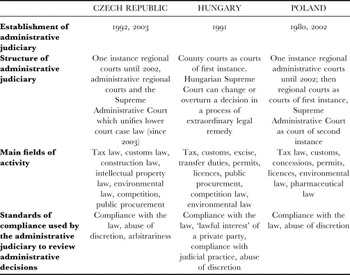
In our study we look at the performance of administrative courts. In ECE, the administrative judiciary was created in the 1980s and 1990s mainly as an antidote to the unrestricted powers of the administration. Table 1 gives an overview of the history and functions of administrative courts in the Czech Republic, Hungary and Poland. The administrative judiciary in all three countries fulfils the same role – it is responsible for checking that administrative decisions issued by administrative agencies and officials comply with general laws. The administrative judiciary thus helps individuals and businesses to protect their rights against interference from state authorities – if the parties to administrative proceedings are dissatisfied they can initiate judicial proceedings to double-check whether the decisions issued were correct, including whether they comply with EU law.
Administrative courts in Czech Republic, Hungary and Poland – basic information

Our research involved analysing 1,187 judgments issued by Czech (352), Hungarian (335) and Polish (500) administrative courts between 1999 and 2004 and published in official court journalsFootnote 2. These judgments concerned tax matters and other administrative decisions relevant to business activities (e.g. cases involving insurance and banking institutions, judgments in cases significant for investment, permit and licence cases, and environmental law). The analysis examined the type of standards that judges invoked in their judgments. We have classified the standards invoked by administrative courts into four categories. First, by standards internal to the law we mean the application of the relevant statute or regulations based on a linguistic interpretation or the way the regulation was earlier applied by the courts. We identified, inter alia, the following internal standards of law: linguistic interpretation of legal texts, systemic interpretation of the law, rational lawmaker assumption (argumentum ad absurdum), consistency of the legal system and previous administrative court decisionsFootnote 3.
Internal standards may be equated to ‘inner premises’ (Pałecki, Reference Pałecki2004):
‘(…) any kind of legal decision is governed by two basically different types of premises: those inferred from the “inside” of a given legal system which has autopoietic characteristics – “inner premises”; and some others, taken from the social and natural environment of the legal decision-maker, from “the outside” of a given legally directed decision-making process – “the outer premises”’.
Second, standards external to the law comprise substantive standards such as compliance with the lawmaker’s intentions, the social objectives and purposes of a law, the preventive function of the law, all of which may be treated as Dworkinian policies (Dworkin Reference Dworkin1977). Such standards are a type of ‘outer premises’ (Pałecki, Reference Pałecki2004), taken from the social environment of law practitioners. By referring to this group of standards, the judge steps outside the hermetic circle of the law to realise the social aims of the law intended by the legislature or as understood within the society. Third, constitutional standards derive from constitutions and include, inter alia, the proportionality principle, principles protecting freedom of business and protection of private property, freedom of commercial speech and antidiscrimination principles.
Finally, we have identified standards originating from European Union law. Long before EU accession, national courts were obliged to apply EU law to the extent relevant to the cases before them and were encouraged to follow the approach adopted in other member states to incorporate EU law principles into national jurisprudence. This was because the Association Agreements or ‘Europe Agreements’ in effect, from the mid-1990s, obliged these countries to apply their laws in compliance with the provisions of the Agreements.Footnote 4 Therefore, when analysing the standards applied by administrative judges, we also identified EU law standards. We noted each reference to Community law, both specific acts and Community law principles, or at least to the idea of European integration in general. This specifically included the following Community standards: interpretation consistent with Community law, non-discrimination in cross-border transactions, proportionality in Community terms, and other Community standards.
The four types of standards can be used to demonstrate the difference between the two adjudication strategies outlined above. Judges relying heavily on standards internal to the law are using a formalistic strategy, while the more references they make to the other three sets of standards, the more they are using or moving towards a non-formalistic adjudication model. A result showing (i) prevalence of references to internal standards in administrative court practice, and (ii) no change in prevalence over time indicates that the adjudication strategy adopted by administrative judges is formalistic. By analogy (i) prevalence of references to external standards or general principles and the resulting difference in administrative court practice (i.e. responsive to external standards, pro-constitutional and pro-Community) or (ii) current practice evolving towards such standards signals that judges are following a non-formalistic strategy.
Results and Discussion
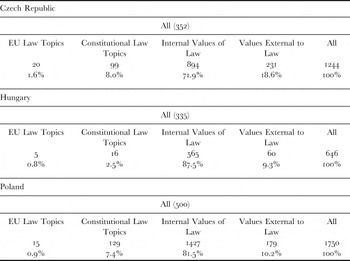
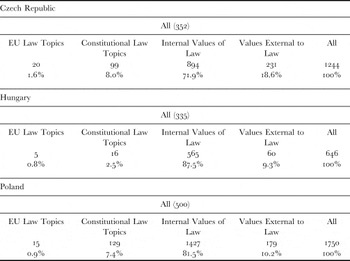
Table 2 shows the proportion of references made by judges to specific groups of standards in all of the judgments examined. The results show the predominance of references to internal law standards: between 70 to 87 per cent of all references in the judgments examined fell into this group. Within this group, judges mainly referred to a linguistic interpretation of legal texts. Frequent references were also made to compliance with earlier administrative court rulings, to the result of system interpretation, and to the legal literature. References to standards external to the law rank second and account for approximately 10 per cent of the total in Poland and Hungary, and for almost 19 per cent in the Czech Republic. Within this group, judges referred most frequently to the aim of the law or regulation, legislative intent, and the social function of the law. Given the ‘business’ nature of the judgments, we were surprised to see only occasional references to the in dubio pro libertate doctrine (in the event of doubt, judge on the side of the freedom or admissibility of activity) and its variant in dubio pro tributario (in a doubtful case, find for the taxpayer).
References to groups of standards in examined judgments
Source: Own study.
In particular cases several standards could be identified, the overall number of standards may be greater than the overall number of cases.
References to constitutional standards constituted between 2 and 8 per cent of all references. In this group, we find many references related to the constitution as a whole (e.g. unspecified constitutional rights and freedoms) or specific principles, e.g. admissible forms of imposing taxes or – very rarely – to the proportionality principle. For instance, in Poland, the proportionality principle was invoked in only 1 per cent of cases, a result that may seem surprising considering its importance as the key constitutional guarantee for free business activity. Approximately 1 to 1.5 per cent of all references concerned EU law standards. The most common references in this group were references to the principle of internal law interpretation in compliance with Community law, references to specific Community regulations and to the non-discrimination principle.
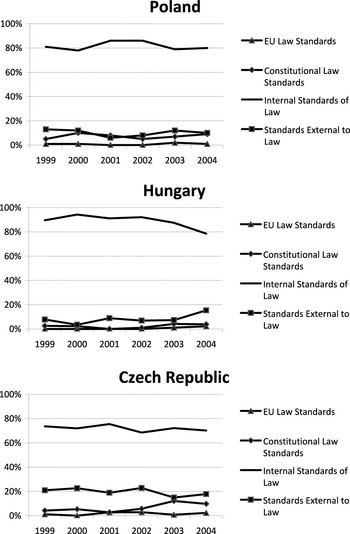
Figure 1 shows the frequency of references to the different groups of standards during the period of our research. The Table shows that generally over the five years covered by the research there were no significant changes in the frequency of references to specific groups of standards. Despite a minimal fluctuation and some deformalisation detected in Hungary with regard to the judgments issued in 2004, internal law standards occupy a constantly high position among the standards referred to. References to other groups of standards remain at a constantly low level. Thus, although the legal environment changed fundamentally due to the impact of a democratic constitution and EU membership, the pattern of references remained virtually unchanged.
Comparison of frequency of references to specific groups of standards over time

It could be suspected that the main changes in which ECE judges decide cases occurred earlier, before 1999. If so, the predominance of internal standards over other groups of standards might be interpreted as the effect of institutional change, not as evidence of the absence of change. A brief glance at administrative court verdicts before 1999 and after 2004 disproves such a suggestion. The results for Hungary show that the percentage of cases with references to internal standards in the period between 1990 and 1995 was 91 per cent (compared to 87.5 per cent in the period 1999–2004). However, verdicts issued by Polish administrative courts in 2006 contained more than twice the number of references to EU law standards as in 1999 to 2004, and there were even three times more in first instance administrative court verdicts. These results suggest that there had been no immediate reaction from the administrative judiciary to the changes in the institutional framework and that the outcome of the changes has been delayed.
Based on hypotheses formulated earlier we assess the adjudication strategy deployed by the administrative judiciary in the Czech Republic, Hungary and Poland as formalistic. First, this finding is due to the most-locally-applicable-rule approach used by the administrative judiciaries, which is manifested in their reluctance to apply general principles to cases, despite direct incentives to do so. These incentives are formulated in constitutions (as in the case of Poland), legal doctrine (in the Czech and Hungarian cases), and in EU law and international agreements concluded by all three countries. Second, adjudication strategies in Poland and Hungary avoided wider references to standards external to law, to Dworkinian ‘policies’ that, especially in hard cases, can help judges to find an answer to a legal question when faced with a shortage of legal text (Emmert Reference Emmert2003). The Czech Republic is different in this respect as the ratio of references to standards external to law was relatively high. The results of the survey must be interpreted in the light of possible selection bias resulting from the fact that the analysed judgments were all published judgments that had been chosen for publication by judges themselves. The formalistic approach visible in the analysed judgments could be due to the fact that only those judgments that promoted a judicial approach accepted by the selectors were chosen for publication. However, opinion polls carried out among judges also show that they have a strong preference for formalistic adjudication (Borucka-Arctowa, Pałecki Reference Borucka-Arctowa and Pałecki2003).
There are probably two reasons why the Czech results differ. First, unlike their counterparts in Poland and Hungary, whose constitutional courts mainly adjudicate abstract issues relating to the constitutionality of statutes, Czech judges come into daily contact with a resolutely anti-formalist constitutional tribunal. During the first ten years of its existence (1993–2003), the CCC repeatedly emphasised the anti-formalist nature of judicial interpretation of law and criticised the excessive textual positivism embedded deeply in the post-communist perception of judicial application of the law and judicial self-understanding. The CCC even developed a doctrine stating that excessive formalism in judicial reasoning under certain circumstances equals unconstitutionality. Facing a strong degree of post-communist methodological formalism – the excessive reliance of ordinary courts on a literal reading of the law as well as on rigid Czech legal theory – the CCC, inspired by foreign case law, tried to teach the ordinary courts that they are not
absolutely bound by the literal wording of a legal provision, as they can and must deviate therefrom if such a deviation is demanded by serious reasons of the law's purpose, the history of its adoption, systematic reasons or any principle deriving from the constitutionally conforming legal order … In doing so, it is necessary to avoid arbitrariness; the court decisions must be based on a rational argumentation.Footnote 5
In criticising the formalistic conception of law, the CCC openly remarked that the ‘[m]echanical application of the law, whether disregarding the rationale and meaning of the legal norm intentionally or by ignorance, makes from the law an instrument of alienation and absurdity’Footnote 6. It has been argued that the move towards purposive (teleological) argumentation is a necessary shift which must be completed in Central European legal doctrine (Holländer, Reference Holländer2003).
Part of the difference between Poland and Hungary, on the one hand, and the Czech Republic, on the other, lies in the fact that in the latter system the constitutional court has direct control over the ordinary judiciary's decisions (via constitutional complaint). The ever-present possibility that the CCC will interfere and oblige ordinary judges to take constitutional rights seriously means that the ordinary judiciary has a greater responsibility to apply basic rights on its own. Thus, as early as the late 1990s, we find several instances where the constitution is directly applied by administrative courts facing gaps in the code. Since 2003, when a new Supreme Administrative Court was created, this trend has become even more widespread. The CCC, equipped with the power to quash ordinary court decisions, time and time again stated that:
one of functions of the Constitution, and especially of the constitutional system of basic rights and freedoms, is its ‘radiation’ throughout the legal order. The sense of the Constitution rests not only in ordering basic rights and freedoms, as well as institutional mechanism and process of making legitimate state decisions, not only in a direct effect of the Constitution and its position as the source of law, but also in a duty of state and public bodies to interpret and apply law considering the protection of basic rights and freedoms. In this case it means the duty of the law courts to interpret particular provisions of the civil procedure code from the viewpoint of sense and purpose of constitutionally guaranteed basic rights and freedoms.Footnote 7
Contrary to the teachings of socialist jurisprudence, which is still adhered to by part of the post-communist legal academia, the purpose and meaning of the law is to be found not only in the letter of the law, the CCC has argued, because ‘legal enactments do, and must always, include within themselves the principles recognised as part of the democratic states governed by the rule of law.’Footnote 8 Textual (linguistic) interpretation represents only the first step in understanding the law. It is only ‘an exposure to understanding the rationale and meaning of the law.’Footnote 9
It seems that unlike the CCC, the Hungarian Constitutional Court, equipped only with purely abstract powers of constitutional review, did not succeed in educating the rank and file judiciary in the new constitutionalism. Even in 2002, it was ‘still the case that most ordinary court judges [saw] no relationship between the constitution and their everyday practices of deciding cases.’ (Halmai Reference Halmai and Sadurski2002) The Polish Constitutional Tribunal, albeit entitled to hear individual constitutional complaints regarding other court's decisions, failed to influence other judges with its anti-formalism approach, as recent studies indicate (Stawecki, Staśkiewicz, Winczorek Reference Stawecki, Staśkiewicz and Winczorek2008).
The second main reason for the greater anti-formalism in the Czech case lies in the fact that the Czech Supreme Administrative Court (SAC), unlike the regular judiciary, which comprises career judges only, represents an interesting mix of diverse legal professions. The SAC, created in 2003, includes former legal practitioners, attorneys and legal academics, while career judges form less than half the bench. This differentiates the Czech administrative judiciary from its Polish and Hungarian counterparts.
Having noted the coaching role of the Constitutional Court in the Czech Republic, one should not ignore that constitutional courts may have a contradictory role in the transition process. They may be assumed to give ordinary judges significant help by revealing the importance and place of fundamental rights within the legal system, as in the Czech example. But this assumption only holds under certain circumstances, as the Hungarian example illustrates. To start with, the jurisdiction of the HCC is uniquely wide, which may lead ordinary judges to conclude that they need not bother about constitutional principles and provisions, as they are problems for the constitutional court. In addition, there has been a power struggle between the HCC and the Hungarian Supreme Court over which of them should examine judgments passed by ordinary courts (see Szabó Reference Szabó, Jakab, Takács and Tatham2007; Solt Reference Solt2008); a similar struggle took place in Poland between the Constitutional Tribunal and the Supreme Court. Most ordinary court judges supported the Hungarian Supreme Court and Polish Supreme Court respectively, and, as a by-product, appear sceptical of constitutional reasoning.
To summarise, a formalistic approach to judicial decision-making seems to be a consistent strategy followed by the administrative judiciaries in ECE, with the Czech Republic judiciary being formalistic with regard to general principles application. This strategy is not in accordance with the approach taken by the legislative branches of government in these countries, which raises questions over judicial deference to legislative value choices. The socialist heritage of ECE, with its heavily formalistic approach to law application, is part of an explanation for this finding. This formalistic approach has been mirrored in the legal education in ECE. The ‘classical’ approach to legal education follows a ‘positivistic’ methodology, i.e. only a description is given of the subject taught; critical attitudes to existing legal systems are not encouraged. Therefore, future lawyers educated by this method learn little about the political and moral values underpinning the present legal system. This approach also bypasses serious training in legal reasoning, which could deepen the skills to use varying legal arguments. Most attempts to change the way judges are trained have been seen as attacks on judicial independence (Bobek Reference Bobek2008).
Moreover, resorting to formalist strategies has been encouraged by the number of cases, which rose rapidly in the years after the political transition (Horeczky, Ilonczai, 1996). This was a consequence of the rule of law system being established. As a consequence, the length of time judicial proceedings were taking also increased and considerable pressure was brought to bear on courts to shorten proceedings. Under these circumstances, it is not surprising that judges did not have enough time to examine every relevant aspect of the case and to mull over all the possible consequences of their decision, as the non-formalist strategy would require. They tended to seek the simplest, formal solutions to legal problems. A by-product of the judicial workload has been, e.g, the fall in the quality of reasonings by the Hungarian ordinary courts (see Hack Reference Hack2007; Bencze Reference Bencze2007).
Conclusion
Judicial formalism, being a legacy of the communist era, is still the main strategy ECE judges deploy when deciding cases in administrative courts. There are several reasons for the popularity of this approach (Schauer Reference Schauer1992). One is the individual preferences of judges, shaped by their education based on formalistic assumptions as to law application and rooted in their experience from the Communist period, when the judiciary was forced to stay within the limits of a legal text in order to keep a margin of independence. But there are also contemporary factors that influence the judiciary and incline it towards formalism, including the enormous caseloads the courts have to deal with and the necessity to justify their verdicts to the public. In both cases a formalist approach passes the test: it is quicker as it does not involve ‘unnecessary’ legal considerations, e.g. constitutional and EU law analyses of the case, and it is more convincing to lay people, as it is expressed in the more hermetic language of strictly legal argumentation.
The preference for judicial formalism seems to make judges impervious to changes in the institutional framework that point in the opposite direction. The constitutionalisation of modern legal systems and the primacy of EU law over national law require a non-formalistic approach to adjudication, if only because both rely on the application of general principles, such as proportionality or non-discrimination. The strategy followed by the judiciary of staying within the formalistic boundaries of a legal text, despite the environment having transformed, bears several risks. It may be detrimental to society, as it reduces the law's ability to regulate effectively people's businesses in a changing world. However, it may also be detrimental to the judges. The permanent discord between the axiological preferences of lawmakers, who champion general values, and the judiciary's reluctance to put these values into practice may further diminish the already quite limited authority the courts enjoy in ECE countries. As some public opinion polls show (Borucka-Arctowa, Pałecki Reference Borucka-Arctowa and Pałecki2003), people expect judges to rule in cases in an anti-formalistic way, as it helps the judges to dispense justice more effectively. Failure to meet these expectations will certainly not make the judiciary more popular.
The survey discussed in this article also shows that, for the time being, the preferences of social actors prevail over institutional incentives. Our findings thus support the hypothesis set out in the Introduction to this special issue (Zubek and Goetz Reference Zubek and Goetz2010), which stresses how the behaviour of the actors may shape institutional effects. In the case of the judiciary, judges' preferences in shaping institutional effects are so strong that they seem to have largely blocked change that could have been expected from the new institutional framework introduced by the new ECE constitutions and EU accession.
Does this mean that institutions do not play an important role in ECE? The answer is no. Rather, it seems that the effects of institutional changes are delayed. Accordingly, the obstacles to a successful transition from a formalistic model of adjudication to a non-formalistic, principle-based model are only gradually overcome, as indicated by recent surveys. It may, therefore, be only a matter of time before we see successful institutional change in the judiciaries of ECE.