I have long been fascinated and somewhat awed by the potential of homophonic translation, an approach that strives to render the sound qualities of a source text, more than and even at the expense of its sense. The preceding verses are my rendition of the opening lines of “Um Povo Comum Pensar” (“A Common People’s Thought”), a song written by Carlos José Gesteira de Lima and recorded by the Brazilian bloco afro group Olodum on their legendary 1987 album Egito Madagáscar (Egypt Madagascar). Hewing to the sound of the words as sung in Portuguese, starting with the opening lines (“Olha este som latino / É de lá de Cuba, de Cuba, de Cuba”), the translation seems to relinquish their lexical meaning entirely, veering in an entirely different direction.Footnote 1 The homophonic approach can be described as a renunciation of the potent mirage of what Lawrence Venuti has described as the instrumentalist model of translation: “the reproduction or transfer of an invariant that is contained in or caused by the source text, an invariant form, meaning, or effect” (Contra Instrumentalism 1). By contrast, translation by homophony takes variance for granted, proceeding through a disorienting warp of sound, with only glancing concern for semantic content.
For Venuti, because “a text is a complex artifact that sustains meanings, values, and functions specific to its originary language and culture, and when translated this complexity is displaced by the creation of another text that comes to sustain meanings, values, and functions specific to a different language and culture,” any translation inherently involves “radical transformation” (3). But the homophonic approach takes the transformative aspect of translation to the extreme because it threatens to abandon even the slightest pretense of equivalence between the source text and the translation, which seem to be related neither by “semantic correspondence” nor by “stylistic approximation” (2). If this sort of composition can be called a translation at all, it takes the source text as a starting point or a prompt for something that seems entirely new, a different statement in a different voice that retains only the faintest echo of its origin.
As exhilarating as it can be, homophonic translation can feel reckless—an abdication of the translator’s task. As Jeff Hilson puts it, “this mode of translation is for many an unacceptable practice, illegitimate and fundamentally suspect” (95). And it raises some questions: How far away can you get from a source while remaining responsible to it? Is there more than one way to be responsible? When you ditch or skirt meaning, what remains? What can be discerned at such a distance? What is a translation that “deliberately flouts translation’s, and by extension, language’s, fundamental utilitarian nature” (96)?
The wager of homophonic translation is that something still resonates, even as it flouts the instrumental transfer of meaning. To claim the status of translation is to cling to a conviction that (to return to my version of the Olodum lyrics) even when the explicit allusions to what Gerard Béhague calls “symbolic models of contemporary black consciousness”Footnote 2 in the Portuguese—for instance, to the “mente fortemente revolucionaria” (“strongly revolutionary mind”) of Che Guevara—are not retained, nonetheless the English-language version is imbued, on some faint lower frequency, with the diasporic thought of a common people.
In an exhaustive overview of the practice, the poet and critic Charles Bernstein explains that homophonic translation challenges a number of the basic assumptions of Saussurian linguistics: “At its core, homophonic translation refuses a Cartesian split between sound and sense, seeing sense as never more than an extension of sound. At every moment it refutes the idea that meaning can be displaced from sound or that reference has an arbitrary, rather than motivated, relation to acoustic rhythm, sound patterning, and aural iconicity” (“Doubletalking” 17). The principle of homophony lies at the core of what Jean-Jacques Lecercle calls the “remainder,” the aspect of language that “exceeds transparent uses of language geared to communication and reference and may in fact impede them, with varying degrees of violence” (Venuti, Translator’s Invisibility 187; see also Hilson 101). The operations of the remainder “deny not only the rules of grammar but also the arbitrariness of the sign, for they seem to motivate arbitrary signs by treating merely phonic similarities as linguistic relationships” (Lecercle 32).
Because it revels in sonic ambiguity—the ways that linguistic sounds can sometimes point to more than one meaning—homophony is a challenge to the Saussurian conception of a langue (“tongue”) as a “homogène” (“homogeneous”), self-contained system in which “il n’y a d’essentiel que l’union du sens et de l’image acoustique, et où les deux parties du signe sont également psychiques” (“the only essential thing is the union of meanings and sound-images, and in which both parts of the sign are psychological”; Saussure, Cours 32; Course 15). As Vincent Broqua and Dirk Weissmann note, “given that homophonic translation tends to straddle both source and target languages on the sonic level, the process questions the boundaries that separate different languages” (9), undermining what Yasemin Yildiz has termed the “monolingual paradigm” (2). In adhering to the sonic, Till Dembeck argues, homophonic translation “applies a constraint that de-naturalizes the commonplace relation between two langues, and thereby not only the notion of langue as such, but also prevailing notions of multilingualism… . It opens a semantic space between langues and makes them communicate in a way that seems to be systematically ruled out” (20).
It is crucial to note that as “a ‘method’ of transforming a text” (Dembeck 7), homophonic translation involves not an exact fidelity to sound at the expense of sense but a practice that destabilizes both sense and sound. Sound is altered rather than replicated: when the “sound qualities” of a source text are “transmuted into their sonorous equivalents within the target text” (Hilson 95), it is “the phonetic rather than the semantic properties of the original that have been transformed” (96). It is a method of “prolonging the sound” through imperfect echo, in which “repetition constitutes alteration” (Scott 291). As the translator Polly Barton describes her initial bewilderment at a menu with romanized transliterations of katakana (the syllabary used in Japanese to write words imported from English and other languages), “here was the sound of my own language, but passed through the filter of some utterly unimagined system” (47). Homophonic translation is a passage through distortion.
Bernstein stresses that “letting the sound lead is crucial, or often crucial, for the sound may lead to the sense” (“Breaking” 64). The point is not that homophonic translation relinquishes meaning altogether, but instead that new semantic possibilities and correspondences are discovered through sound. This is immediately apparent in many of the most celebrated examples of homophonic translations, such as David Melnick’s astonishing 1983 Men in Aida (a homoerotic sound-based rendition of the first book of the Iliad [see Bernstein, “Doubletalking” 41–42]), or the exuberant versions of the Latin poetry of Catullus composed by Louis Zukofsky and Celia Zukofsky between 1958 and 1966 and first published in 1969. As Josef Horáček points out, “the constraints of sound and syllable count compel the Zukofskys to radically expand their vocabulary as they search for words that approximate the Latin sound and resonate with Catullus’s Latin semantically at the same time” (108).Footnote 3 For Dembeck, the semantic “surplus” that homophonic translation adds to the source text
remains, at least to some degree, still determined by it: In listening something into the original text, one remains however loosely bound to the spectrum of sound the original allows itself to be associated with. This makes it possible to consider the translation as a reading of the original, which uncovers hitherto unnoticed semantic undercurrents within it. While listening in a certain way, one may “find” something in the original text that might “make sense” for a semantic reading as well. (11)
Letting the sound lead, it’s worth adding, is a technique or perhaps a susceptibility of thought—a receptivity to the “particular in-between space of the homophonic imagination” (Van Dyck 179)—that can be deployed anywhere. “Isn’t translation always the putting of words into someone’s mouth, that someone sometimes being you?” Sophie Seita wonders, citing a passage from one of her experimental theater performances in an essay on her practice (3). Reflecting on a line she used in the play, she declares, “When I translate, I keep everything in play. Or at bay? Sound play, in turn, like any good tutor, imparts knowledge by osmosis” (4). Letting her thinking unspool leisurely through the incitement of this slippage in sound, Seita espouses translation as a “playful pedagogy” that is inherently “unpredictable” (4): it “flourishes with a delayed futurity” (5).
I first began to experiment with homophonic strategies nearly two decades ago when I was trying to figure out a way to handle the stunning work of the Martinican poet and theorist Monchoachi, who might be said to forge a poetics at the border between French and Creole, most strikingly in book-length serial poems such as Mantèg (1980) and Nostrom (1982) that proceed in both tongues at once, in facing-page juxtapositions of Creole on the left and French on the right, without however framing one language as a translation of the other in any simple or straightforward sense.Footnote 4
As Kavita Singh has pointed out, Monchoachi’s bilingual poetry is “translative,” based in an open-ended and uneven “interaction between languages” that the reader is forced to negotiate (92), and also an adamant refusal of both equivalence (the implication that the content in the two versions is the same) and verticality (the privileging of either version above or before the other) (103).Footnote 5 Monchoachi himself has written that the dynamic between Creole and French in the Caribbean, “sinon inédite” (“if not unprecedented”), “n’en reste pas moins originale au regard d’un bilingualisme de plain-pied en ce qu’elle induit un décalage, comme une lune immutable, une véritable hétérotopie dont on peut parfois entendre l’imprononcé, l’inarticulé, le tremblement, les licences, les dissidences” (“is nonetheless distinct from a straightforward bilingualism in that it results in a gap: like an immutable moon, a true heterotopia in which you can sometimes hear the unpronounced, the unarticulated, trembling, licenses, dissidences”; “Entre Crié” 67; “Between Crié” 251). In my translation of the opaque doubling between Creole and French in Monchoachi’s Mantèg, I tried to find ways through sonic echoes and divergences between the two English versions to suggest something like what it means to listen across such a fraught décalage between the languages.
I turned to homophonic translation again years later when I was preparing remarks for a symposium at Columbia University to celebrate the centennial of the birth of Aimé Césaire (Edwards, “Enigma”). The impulse was partly a reaction to my circumstances: I was teaching in France that semester, without most of my books or research materials. I was trying to figure out how I could possibly come up with anything new to say about Césaire when it occurred to me that it was perhaps appropriate to come back to the great Martinican writer unencumbered by baggage, as it were, restricting myself to the one text I had with me because I was teaching it: his touchstone Cahier d’un retour au pays natal (Notebook of a Return to the Native Land). What could I say from there, from the finite and inexhaustible source of his best-known work? The poem famously pivots, descending into a confrontation with internalized racism and colonial degradation only to discover the momentum for a stirring resurgence of racial pride in its final third, unleashed through the concoction of the term négritude. So I started from the bottom, from the low point of the book, where the speaker finds himself prostrate, bereft, denuded—
—and begins from there, from a nothing that is not quite nothing, to reconstruct a sense of self not by ignoring or transcending his abjection but instead by confronting and accepting it. I took the next few lines:
Instead of concentrating on the meaning,Footnote 6 I tried to let the sound lead and to see where it would take me. I first rendered these lines in an intralingual homophonic translation (that is, a version in French that transformed their phonetic qualities while remaining within the language):
And then I ventured a homophonic translation into English:
Bernstein expands the scope of his inquiry beyond texts in translation to provide what he calls a “broader context for the homophonic imaginary” (“Doubletalking” 16), arguing that homophonic translation explores possibilities of linguistic invention that are similarly elaborated in Dada sound poetry; the zaum poems of the Russian futurists Velimir Khlebnikov and Aleksei Kruchenykh (20–21); the inchoate mass of YouTube videos featuring mondegreens or what in Japanese are termed soramini kashi, or “misheard lyrics” (49–51; see also Mena); and the “deliriously funny live verbal improvisations” of Sid Caesar’s “doubletalking” (20), in which the comedian performed virtuosic “verbal pantomimes” of languages including German, French, Italian, and Japanese (25–32). If translation by definition is a heightened species of reading that “takes up” a source text through a “special kind of strangeness-reinforcing writing,” as Damon Searls argues (50, 60), then Bernstein’s capacious purview allows us to see homophonic translation above all as a matter of poetics. Instead of assuming that poetics requires “something nobody ever thought of,” the writer can start with a “principle of substitution,” as Harryette Mullen puts it: “you can transform something that already exists” (66).
Over time I’ve come to make recourse to homophony as a key technique of poetic invention, rather than just a perilous cliff-edge of translation. When I composed a series of poems framed as imaginary liner notes to a reissue of the guitarist and singer Shuggie Otis’s 1974 album Inspiration Information, the realization that Otis himself had resorted to a sort of sound-based play in the title of one of the tunes (“Aht Uh Mi Hed,” which when you listen to the song sounds like the phrase “out of my head”), I composed the “notes” to that track as a series of homophonic derivations, progressively peeling away from the source phrase:
I think of Nathaniel Mackey as the writer who, across the remarkable breadth of his multifarious and interwoven work as a scholar and poet, has made the most definitive case that at the core of African diasporic poetry and music there is a sustained compulsion toward “the play of polysemous articulation,” especially through “multiply-aspected vocality” (Mackey, “Cante Moro” 197). Black aesthetics continually revisits ways of attending to “words wanting not to be / words…” (Mackey, Whatsaid Serif 16). One of the major thrusts in his own poetry and epistolary fiction is a persistent commitment to testing, distending, and extending the limits of articulation, especially through modes of linguistic substitution and recombination including etymology (for instance, when one of N.’s letters in Bedouin Hornbook notes “the base meaning of ‘conspiracy’ as a ‘breathing or blowing together’” [89]); near homophone—“What I’m proposing is that we hear into what has up to now only been overheard (if I can put it that way), that we can awaken resources whereby, for example, assent can be heard to carry undertones or echoes of ascent (accents of ascent)” (25); and anagram (“ythm, anagrammatic myth” [School 44]). All these strategies of “phonic license,” he suggests repeatedly, amount to an African diasporic protocol, a recognition of what Aunt Nancy, a character in Mackey’s epistolary fiction, calls “the phonic liberties transported Africans have been known to take” (Atet A.D. 124).
Mackey makes this case perhaps most powerfully in his scholarship on writers including Amiri Baraka, Edward Kamau Brathwaite, Zora Neale Hurston, and Wilson Harris. His 1994 article “Wringing the Word,” on Brathwaite—itself titled with a homophone, to signal what he argues is a constitutive relationship in the Bajan writer’s work between linguistic transformation (a certain violence deliberately done to language, “wringing” it the way one might wring out a wet piece of laundry) and the way it can be made to sound or “ring”—is an exhaustive examination of the ways that, across his first two trilogies of poetry, Brathwaite increasingly “assaults the apparent solidity and integrity of words, destabilizing them (showing them to be intrinsically unstable) by emphasizing the points at which they break, disassembling them and reassembling them in alternate spellings and neologistic coinages” (45). Looking at the angular equations Brathwaite’s poetry enacts through sonic transposition (equating chatter with scatter, or umpire with empire), Mackey argues that the “webs of sound” that “connect a word to other words” are ways of reminding us, “at the graphic level, of the divisibility and the alterability of words, their permeability to alternate arrangement, variability, change… . Words are reopened, broken open, their semantic integrity unsealed by ‘shadows of meaning’ that are played upon and thereby shown to permeate ‘the Word’” (48). These techniques, for Mackey, are not simply aimlessly ludic gestures but instead deliberate “verbal disruptions” that, in the context of the anglophone Caribbean, both “address” and “move to redress” the “cultural domination which accompanied and helped implement and sustain British imperialism” (42). To adopt the terminology of the political theorist Cedric J. Robinson with regard to the terms of political order, the way Brathwaite’s poetics implies that language is characterized not by integrity but by “incompleteness—the absence of discrete organistic integrity,” represents a “paradigm subversive to political authority as the arche-typical resolution, as the prescription for order” (196, 197).
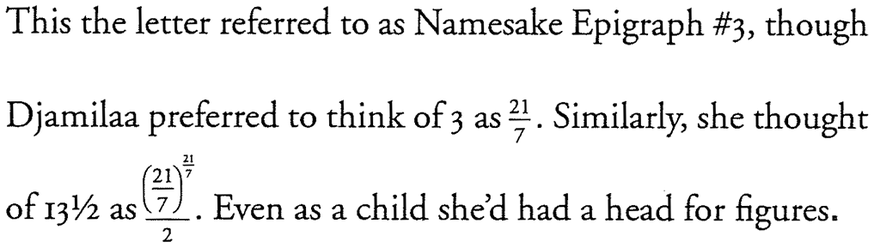
In Mackey’s own poetry and epistolary fiction, this insistence on the “generative divergence” (Atet A.D. 130) of language extends from the micro level of individual phonemes—when, for instance, the title of Arna Bontemps’s 1936 novel Black Thunder is suggestively foreshortened into blunder (Bass Cathedral 59), or the peculiar convergence of mapping and navigational mishap is signaled by the contracted term m’ap (90)—to the macro level of literary form, in the proliferation of subdivisions and appendices (“Compressed Accompaniments,” “Namesake Epigraphs,” “After-the-Fact Lecture/Libretti”) that come to be appended to many of N.’s missives over the course of the epistolary series.Footnote 8 There are also indications of internal division that go “unvoiced” (Atet A.D. 34), that are “nonsonant” (Whatsaid Serif 77)—that are signaled but that do not seem to make a material difference. Considering the names Obadiah and Djamilaa, a character reflects that “the ‘i’ in ‘-diah,’ like the ‘j’ in ‘Dja,’ he preferred to think of as silent, viewing it, as in mathematics, as the symbol of an imaginary operation” (Bedouin Hornbook 233). And there are other sorts of “imaginary operations” as well, as when a character, driven by a “penchant for roundabout fractions” (235), prefers to think of integers as fractions (fig. 1). There is a kinship, one might say, between the imaginary operation of mathematical subdivision—breaking the seeming coherence and finality of the integer into a potentially infinite internal differentiation of fractions—and the imaginary operations to which language itself is subjected as its letters and phonemes are transformed and recombined. All these effects might be thought of as ways that the work “annul[s] … any notion of ground as not annexed by an alternate ground” (Atet A.D. 58).
Mackey, Bedouin Hornbook, p. 218.

These strategies of serious play might be described as an “enharmonic poetics.” In music theory, the term enharmonic indicates a note that is equivalent to another in terms of the pitch it indicates, but which is written or “spelled” differently (see Rushton). To take just one example, in the equal temperament of the diatonic scale, the notes D♯ and E♭ are enharmonic (in other words, harmonically equivalent): that is, they indicate the same key on a piano keyboard and are identical in pitch. The reason a composer uses one or the other is that they imply different harmonies. In measure 133 of the first movement of Beethoven’s Pathétique, Sonata No. 8 in C Minor, Op. 13, a note initially written as E♭ in the prevailing harmony of G minor is “respelled” as D♯ because the harmony is about to resolve in a different direction, to E minor. It is the same note—but by writing it as D♯ the composer indicates to the pianist that the harmony is about to shift.Footnote 9 Like an integer rewritten as a set of fractions, the juxtaposition of alternative spellings in enharmonic modulation shows—through an “imaginary operation” indicated graphically—that any note is internally divided, containing multiple valences of harmonic potential. To extend Mackey’s analysis of Brathwaite’s poetics, then, we might say that like the adoption of “puns, malapropisms, odd spellings, neologisms, and strained meanings,” the recourse to an enharmonic poetics “speak[s] of disturbances outside as well as inside the language, social disruptions the word is thus made to register” (Mackey, “Other” 272).
In his late work, the Martinican theorist Édouard Glissant elaborates a singular theory of the art of translation. The translator, he argues,
is able to establish a relation between two languages—two systems of oneness [unicité]—only in the presence of all the other languages, their powerful presence in his imagination, even if he does not know any of them. What does this mean if not that, just as the poet invents a langage in his own language, the translator has to invent a langage going between one language and the other? A necessary langage going from one language to the other, a langage common to both of them, but in some sense unforeseeable with regard to each of them.Footnote 10
(Introduction [2020] 27)
Instead of viewing the translator as simply the conveyor of meaning or style between discrete domains (from one self-contained language to another), he suggests that translation is more a process of inventing a mediating practice of language that links them, an unpredictable “operation of creolization” (27).
Translation is not a reproduction of some unchanging quality in the source text, for Glissant, but instead the production of something new, something unexpected, that bridges tongue to tongue: “it is an art of the flight [art de la fugue] from one language to another, in which neither the first nor the second are effaced” (27). The French word fugue could be rendered in English as “flight” or “fugue”: it implies not so much taking off, much less transcendence, but a practice of evasion—a way of fleeing, an art of slipping away. Glissant continues:
Translation is a flight [fugue], which is a pretty way of saying a renouncement. What one must perhaps above all discern in the act of translation is the beauty of this renouncement. It is true that the poem, when translated into another language, loses some of its rhythm, its assonances, the chance that is both the accident and the permanence of writing. But one must perhaps consent to this, consent to this renouncement [Mais il faut peut-être y consentir, consentir à ce renoncement]. Because in fact, in the world-totality [la totalité-monde], this renouncement is the portion of oneself that in every poetics one abandons to the other. I will say that this renouncement, when it is supported by sufficient reasons and inventions, when it leads into this langage of sharing [de partage] that I have spoken about, is the thought of the light touch [la pensée même de l’effleurement], the archipelagic thought whereby we recompose the world’s landscapes, a thought which, against all kinds of systematic thought, teaches us the uncertain, the threatened, but also the poetic intuition in which we can now move ahead. Translation, the art of the light touch and the approach, is a practice of the trace.
(Glissant, Introduction [2020] 27–28; trans. modified; see Glissant, Introduction [1996] 46)
As Fred Moten and Elias Rodriques have pointed out, Glissant’s use of the verb consentir (“to consent”) is particularly complex. They and others have noted Glissant’s suggestive description of the departure of the Middle Passage as “le moment où l’on consent à n’être plus un seul” (“the moment when one consents not to be a single being”; Glissant, “One World” 5).Footnote 11 For Moten this arresting formulation “doesn’t merely defy but rather unravels a set of normative discourses on agency” and “individuation.” For Glissant “consent, which is not so much an act but a nonperformative condition or ecological disposition, is another way of approaching what he calls the ‘poetics of relation’” (Moten, Black xv).Footnote 12
It has gone unnoticed that Glissant uses a parallel formulation to describe the poetics of translation: “one must perhaps consent to this, consent to this renouncement.”Footnote 13 Reading these passages in tandem forces us to recognize that there is a structural homology between these two forms of putative singularity that must be renounced or surpassed, between the “unicité” (“oneness” or “uniqueness”) of the subject, on the one hand, and the oneness or uniqueness of language, on the other. Are they linked? Is consenting to the renouncement of translation an echo or an amplification of the constitutive consenting to multiplicity and entanglement in diaspora? Or is the point that consenting not to be a single being is always already a linguistic condition or disposition? If the trauma of the capture into new-world enslavement follows not only from the ways the transplanted population was dispossessed of what, “in the old order of things, was the permanent, the ritual, the truth of its being” (Glissant, Caribbean Discourse 15; trans. modified; see Discours antillais 41) but more specifically from a “stripping” of language—an uprooting from linguistic communities in Africa and a forced immersion in alien and “etymologically hostile” European tongues (Philip 81)—then it follows that the moment one consents to plurality (a strict rendering of the syntax of “à n’être plus un seul” would be “no longer to be only one”) is also the moment when one is divorced and scattered away from any one language.
Translation is an indispensable “art of the future,” then, “a vertiginous art, an art of salutary wandering,” because it takes up and deepens the passage into diversity at the core of the diasporic experience through an art of flight (art de la fugue) based in a beautiful renouncement of instrumentalism (Glissant, Introduction [2020] 27; trans. modified). And Glissant’s deliberate allusion to Bach’s The Art of the Fugue can be taken to imply that translation’s way of letting go, of relinquishing a portion of oneself to the other in the unpredictable passage from language to language, is also and not incidentally a matter of consenting to a certain musicality: a way of letting sound lead one away, or even astray.
When I was living in San Francisco for a few months in the late 1990s, I fell into a habit of haunting the extraordinary used bookstores in the Bay Area. Scraping by on my doctoral stipend, I didn’t have much money, but occasionally I got lucky. Over time I gradually added to my little hoard of pulp paperback editions of the science fiction of Samuel R. Delany. I tracked down translations of classics by the French anthropologist Marcel Griaule including The Pale Fox and Conversations with Ogotemmêli. And one day I was thrilled to stumble upon a couple of books by the great Guyanese novelist Wilson Harris, which were particularly hard to find because his work was published exclusively in small print runs by the English publisher Faber and Faber. I paid ten dollars for a copy of the 1977 edition pairing two short novels, Da Silva da Silva’s Cultivated Wilderness and Genesis of the Clowns. I was especially excited about the latter, which like much of Harris’s work is a resonant meditation on the complex legacies of colonialism and slavery in British Guyana.
Harris’s fiction often explores an unexpected crisis or cataclysm that leads to a collapse in a character’s “customary ways of perceiving the world,” an “undermining of any sense of a stable, self-sufficient order of things, especially where that order is of a social, political sort” (Mackey, “Unruly Pivot” 195). Genesis of the Clowns opens in 1974 when Frank Wellington, a white Creole former government surveyor living in London, receives an anonymous letter informing him of the suicide of the Afro-Guyanese foreman of the expeditions he had led along the coast and into the interior of Guyana nearly thirty years earlier. The news prompts Wellington to reflect on the crews he worked with, motley assemblages of men from various backgrounds (Afro-Guyanese, Indo-Guyanese, Amerindian) who held various roles (boatmen, sextant man, theodolite operator, gauge reader, meter man) on the team charting the topography.
In the 1940s Wellington had been single-mindedly focused on the practicalities of the task, gathering data and paying his employees according to their contracts, but in the 1970s he starts to realize the ways the men were galvanized and troubled by their diverse cultural and religious backgrounds. Whereas during the expeditions he tended to view his crew members patronizingly, out of what Harris calls in an essay “the ingrained habit of a material civilization” inclined to “extrapolate assumptions of character from a dominant model,” as he looks back he feels his “safe crust of bias” start to erode (“Phenomenal” 44). He starts to see the men less as types in a social and racial hierarchy than as a community entangled together in the “tragedy of polarized cultures on the brink of an awareness of themselves as satellite never sovereign” (Genesis 117).
As Sandra E. Drake points out in her insightful reading of Genesis of the Clowns, this transformation takes place through a “dissolution of codes” (“the meaning attributed to words or phrases in intellectual systems organizing our understanding of the world”), as Wellington remembers the weekly ritual of paying the men their wages and meticulously noting down the amounts (149). As he looks back, Wellington comes to see his paytable through multiple, incommensurate codes (economics, alchemy, geology, politics, mythology) in a way that makes him realize that no single code is dominant. The novel thus traces what it terms a “Copernican revolution of sentiment” in Wellington, the gradual process through which he comes to question his earlier assumption that his own perspective was the center of the universe (Harris, Genesis 92).
As he recalls his monomaniacal devotion to the surveying work in the 1940s, Wellington remembers that, even then, he had a habit of scribbling “dancing sketches” and abstract musings in the margins of his field book, allowing himself to become distracted from his task (86). “I cannot even now after all these years brush them aside as fantasies, evasions or statistical doodles,” Wellington says. “And the more thorough, the more specific and comprehensive my scientific work became, they—on the other hand—seemed all the more to stand in the light of a buried sun that possessed a spatial reason deeper than all apparent unreason” (86).
I was especially taken with Genesis of the Clowns not only because it can be read as a subtle reconsideration of race and economics in the postindependence period of the 1970s, when tensions between Afro-Guyanese and Indo-Guyanese interests roiled national politics, but also because the particular copy I found seemed to replicate the drama of Wellington’s self-questioning in its pages. Some reader had compulsively scribbled notes in the margins of many of the pages, highlighting and glossing terms, tracing key symbols, but also—in a peculiar echo of Wellington himself with his field book—jotting down occasional comments that seemed like a sort of daydreaming or reverie (see fig. 2). Sometimes the handwritten notes are sarcastic—at the bottom of one page, where the reader places a check mark next to a somewhat obvious pun, there is a snide annotation: “√ = ‘I get it!’ ha!” But sometimes the comments erupt into strange musings (“fulfill my mood / legit. feelings or dilute/cheapen. explore / work it out”) or maxims that seem only tangentially related to the narrative: “My name once meant something so different” (fig. 3).
Handwritten marginal notes in Harris’s Genesis of the Clowns. Collection of the author.

Handwritten marginal note in Harris’s Genesis of the Clowns. Collection of the author.

I was startled to come upon one marginal annotation in particular, about two-thirds of the way through the novel: “I am one of Nate Mackey’s dilated pupils” (fig. 4). I had met Mackey by the time I found this copy of Genesis of the Clowns. I first introduced myself to him after his engrossing dialogue with Brathwaite at Poets House in SoHo in November 1993 (later edited and published under the title ConVERSations with Nathaniel Mackey) and then dared to strike up an intermittent correspondence, eventually contributing a couple of pieces to his journal Hambone. While I was living in California, I even got a chance to spend an afternoon with Mackey at his home in Santa Cruz, hanging out and talking about poetry and music.
Handwritten marginal note in Harris’s Genesis of the Clowns. Collection of the author.

I was never Mackey’s student. But this made the inscription penciled in the Harris novel all the more powerful: I couldn’t help concluding that this must be a copy from one of Mackey’s former students at the University of California, Santa Cruz, and that the marginal notes were the traces of that pedagogical circumstance. I pored over the notes, straining to decipher the handwriting, wondering whether any of the observations were echoes of insights Mackey had shared in his classroom—whether, in other words, obtaining the book used by a former student from a secondhand bookstore could somehow transform me into a sort of second- or thirdhand student myself, giving me snatches of transcribed pedagogy. If Black studies as an insurgent formation represents “an alternative and a tradition of study that rests upon the translation and recovery of different ways of knowing” (Myers 8), then why couldn’t I be considered a student in another way, through the backdoor, using resources passed down, or discarded and recycled, or smuggled outside the walls of accredited learning? I took it as a reminder that study can be—indeed, perhaps must be—collaborative and relayed, marked by lag and belated insight, partial retention, delayed catalysis, echoed epiphanies, revisitations and reconsiderations long after the fact.
While it riffs on the prominent theme of transformed vision in Genesis of the Clowns, the play on words in the marginal note’s faux oracular declaration (“I am one of Nate Mackey’s dilated pupils”) is also a serious proposition about the pedagogical dynamic. It takes advantage of the homonym pupil—drawing on what Glissant calls the “internal multiplicity of languages” (Poetics 119)—to suggest a link between the student and the eye, between learning and sight. It implies that the student comes to see through the teacher’s eyes, as it were, but given that the function of the pupil in the iris is to regulate the amount of light that reaches the retina, it also implies that both teacher and student undergo a sort of expansion in receptivity (an opening or dilation) through the pedagogical encounter. Sometimes we see more, or otherwise, the pun hints, when we see double, when we dawdle, when we doodle in the margins, when we slip out of the classroom and dance in the corridor.