Introduction
There is considerable interest in the potential modification of the relative risk for developing dementia and its preclinical syndromes such as mild cognitive impairment (MCI). Dementia represents a substantial health, social, and economic burden in developed countries such as Australia, with estimates of over 245,000 Australians, or approximately 1.1% of the population, currently living with dementia. Despite difficulties in diagnosis, dementia is the leading cause of disability in adults older than 65 years (Access Economics, 2009). With the demographic passage of the “baby boomer” generation coupled with increased life expectancy, it has been predicted that by 2050 the incidence and frequency of dementia will increase dramatically with approximately 940,000 Australians, or 2.8% of the population, having dementia (Deloitte Access Economics, 2011). In 2002–2003, a total of AUS$3.85 billion or 4.5% of government health and aged care spending was expended on dementia (Access Economics, 2009). It is estimated that by 2060, health spending on dementia will be greater than that for any other health condition, with projected costs of AUS$83 billion or 11% of the expenditure in the entire health and residential aged care sector (Access Economics, 2009). Dementia has recently been identified by the Australian Government as a national health priority. It has furthermore been estimated that delaying the onset of dementia by just a few months will produce future health savings in the order of billions of dollars by mid-century (Access Economics, 2004). Hence, strategies that delay dementia onset, and/or increase resistance to aging-related cognitive decline, would have significant health and economic benefits.
Age-related decline in cognitive function, most notably information processing speed, attention, concentration, and memory performance, has been well described (Salthouse et al., Reference Salthouse, Fristoe and Rhee1996; Bisiacchi et al., Reference Bisiacchi, Borella, Bergamaschi, Carretti and Mondini2008; Johnson et al., Reference Johnson, Storandt, Morris and Galvin2009). Other studies indicate that pathological changes to the brain are also associated with aging, with progressive cortical shrinkage, reduction to gray matter volume in several regions, and white matter loss in the prefrontal cortex being documented (Beason-Held et al., Reference Beason-Held, Kraut and Resnick2008). Despite the evidence of these age-related changes to the function and structure of the brain, considerable variability is observed across individuals of approximately the same age and in the presence of brain structural changes that appear similar in location and extent.
It has been suggested that individual differences in cognitive aging may relate to underlying differences between individuals in their information processing capacity or “cognitive reserve.” The basis for cognitive reserve (CR) stems from numerous observations that the extent of brain pathology or brain damage does not directly relate to clinical manifestations of disease (Stern, Reference Stern2002; Reference Stern2009). The CR hypothesis predicts, for example, that older adults with a higher CR will be able to sustain greater insult to the brain before clinical symptoms appear compared with a person with less cognitive reserve. Stern (Reference Stern2002; Reference Stern2009) distinguished between passive and active components of reserve. The passive component is a product of brain size or number of neurons; thus, larger brains can sustain larger amounts of damage before clinical impairments emerge. The active component relates to the ways in which the brain utilizes pre-existing cognitive processes to compensate or cope with brain damage; thus, two patients can sustain identical patterns of brain damage but the one with greater CR retains a higher level of function than the patient with lower CR. Importantly, both genetic predisposition, factors associated with life experience, such as level of educational and occupational attainment and patterns of cognitive activity, and their epigenetic interaction are seen as contributing to CR (Richards and Sacker, Reference Richards and Sacker2003).
There is also increasing interest in the capacity of the aging central nervous system to adapt to, or help protect from, the brain lesions that are associated with neurodegenerative illnesses that cause dementia. In this regard, it is now appreciated that the mature nervous system can demonstrate substantial structural plasticity, such as in the generation of neural stem cells in some brain regions (Gu et al., Reference Gu, Janoschka, Ge, Geyer, Ellenbroek and Marsden2012) and the modification of dendritic spines and associated synapses (Kasai et al., Reference Kasai, Fukuda, Watanabe, Hayashi-Takagi and Noguchi2010). We have also recently demonstrated in an experimental animal model that cortical interneurons have the capacity to reorient their dendritic structures relative to a focal site of lesion (Blizzard et al., Reference Blizzard2011). Similarly, changes in neuronal activity involving functional input to the cerebral cortex can lead to dendritic arbor alterations (Tailby et al., Reference Tailby, Wright, Metha and Calford2005). In experimental models, stimulation via “environmental enrichment” also leads to better neurobehavioral outcomes following stroke (Janssen et al., Reference Janssen2010) and in transgenic models of Alzheimer's disease (AD; Jankowsky et al., Reference Jankowsky2005; Hu et al., Reference Hu, Xu, Pigino, Brady, Larson and Lazarov2010). These data indicate that complex mental stimulation may provide a protective effect for neurodegenerative conditions, potentially by promoting adaptive structural neuronal plasticity.
With respect to mental stimulation and neuroprotection, an inverse relationship exists between educational attainment and the risk for AD. A meta-analytic study identified a protective effect of education in incident dementia with an odds ratio of 0.46 (Valenzuela and Sachdev, Reference Valenzuela and Sachdev2006). Other studies have also shown a decreased risk of AD associated with more frequent involvement in cognitively stimulating activities independent of education in late life (Wilson et al., Reference Wilson2002; Reference Wilson, Scherr, Schneider, Tang and Bennett2007; Verghese et al., Reference Verghese2003). Longitudinal studies of catholic clergy indicate that education mediates the risk for AD, such that the higher the level of education the greater the level of neuropathology required before clinical symptoms of AD are evident (Bennett et al., Reference Bennett2003). Other studies confirm these findings in general population samples; those with a clinical diagnosis of AD have 2–3 years less formal education than those without a clinical diagnosis (Roe et al., Reference Roe, Xiong, Miller and Morris2007). Likewise, a study of catholic nuns indicated that the risk for AD increased fourfold in those with low levels of educational attainment and small head circumference, when other factors such as age and APOE-ε4 status were controlled for (Mortimer et al., Reference Mortimer, Snowdon and Markesbery2003). Both education and occupation have been found to reduce the likelihood that adults with MCI, a precursor to AD, will convert to AD, suggesting that enhanced cognitive reserve may exert a protective effect on adults with preclinical signs of AD (Garibotto et al., Reference Garibotto2008). The EClipSE study results indicated that increased years of education was associated with lower risks of dementia and that years of education had a dose-dependent protective effect that mitigated against the neuropathology of dementia (Brayne et al., Reference Brayne2010). Recently, Ritchie and colleagues suggested that at population level, an increased level of academic achievement (crystallized intelligence) could reduce AD by 18% whereas eliminating the APOE-ε4 allele would reduce AD incidence by 7% (Ritchie et al., Reference Ritchie, Carrière, Ritchie, Berr, Artero and Ancelin2010).
The effect of educational attainment may be mediated by other factors. Recently, it has been suggested that academic performance rather than years of education predicts risk for AD, with low levels of academic performance being associated with an increased risk for AD (Mehta et al., Reference Mehta2009). In a study of community-based elderly people, it was found that the level of social engagement, as measured by the size of social networks, mediated the relationship between neuropathology (neurofibrillary tangles and amyloid plaques) and level of cognitive function. That is, participants with higher levels of social engagement displayed higher levels of cognitive function despite increasing neuropathological burden (Bennett et al., Reference Bennett, Schneider, Tang, Arnold and Wilson2006). Likewise, frequent cognitive activity (playing chess and visiting a library) is also associated with reduced risk for AD, with cognitively inactive adults having a 2.6 times greater risk for developing AD (Wilson et al., Reference Wilson, Scherr, Schneider, Tang and Bennett2007).
In summary, existing research suggests that prior education and occupational history may mediate an individual's risk for clinically evident AD. The precise nature of this apparent protective relationship is unclear, with some studies suggesting that education and occupation may enhance CR, such that an individual can develop significant neuropathology but not display clinically significant cognitive decline. Other studies suggest that education and occupation may mask other factors that may be protective against AD, such as frequency of cognitive activity, socialization, depressive symptomatology, diet, history of vascular disorder, and academic performance. Possibly the key limitation of the research to date is that while longitudinal studies have been utilized, the potential beneficial effect of education, particularly at older ages, has not been examined prospectively. In this regard, while individuals with higher levels of education have higher levels of cognitive function, it is assumed that higher levels of education create increased cognitive function or CR. Such a causal relationship has yet to be established, as it remains possible that it is enhanced CR that enables an individual to undertake higher levels of education and not vice versa. Such a hypothesis would suggest that CR is genetically predetermined, with educational attainment reflecting an underlying genetic predisposition. Ultimately, the only possible method to resolve this issue is to investigate the effects of education prospectively, with the measurement of CR occurring before and after the period of engagement in varying amounts and types of purposeful mental activity associated with higher education.
There is substantial international interest in the potential for mental stimulation to provide a protective influence on the trajectory of aging-related cognitive decline and risk of dementia. While there is significant epidemiological evidence for a protective effect of early-life education against dementia, there is little direct evidence indicating that later-life effortful “brain exercise” can protect against dementia and age-related cognitive decline through enhancing cognitive reserve. The Tasmanian Healthy Brain Project (THBP) is a long-term, prospective cohort study designed to examine the trajectory of cognitive health in an older group of Australians engaging in university study. Prospective examination of a cohort exposed to an intervention designed to enhance cognitive performance will further advance an understanding of the causal relationship between educational attainment, later-life involvement in complex cognitive activity, and cognitive reserve. The aims of the THBP are the following:
1. To examine whether participation of older adults in university education modifies subsequent aging-related cognitive decline.
2. To determine whether later-life university education, increased socialization, lifetime mental activity, decreases in depressive symptomatology, or increased quality of life are the critical factors in reducing age-related cognitive decline.
3. To determine whether genetic risk factors for AD mediate or modulate any beneficial effect of later-life university educational enhancement on age-related cognitive decline.
4. To determine if genetic polymorphisms linked to cognitive performance and brain plasticity contribute to cognitive reserve and/or effects of late-life education.
5. To ascertain if increasing the cognitive reserve of older adults results in a significantly decreased risk, or delayed onset, of neurodegenerative diseases such as AD.
Structure and design of the study
The principal aim of the THBP is to determine the influence of cognitive reserve on rates of age-related cognitive decline. The THBP is a mixed-group longitudinal design comprised of two groups:
1. Control group. Healthy adults aged 50–79 years at the time of recruitment. These participants will not engage in any university-level education.
2. Experimental group. Healthy adults aged 50–79 years at the time of recruitment. All experimental participants will undertake a minimum of 12 months’ university study at either part-time or full-time load, with a minimum study load of two units of study at undergraduate or postgraduate level. An undergraduate Bachelor degree requires the completion of a total 24 units of study. Experimental participants will be subgrouped according to the study load completed: (a) 2–8 units of study; (b) 9–16 units of study; (c) 17–24 units of study; (d) >24 units of study.
Participants will be community-residing adults aged 50–79 years at the time of recruitment into the study. Participants will be screened to exclude conditions which are independently associated with impairments to cognitive function (dementia; multiple sclerosis; prior head injury requiring hospitalization; epilepsy; cerebrovascular complications including stroke, aneurysm, transient ischaemic attacks; poorly controlled diabetes; poorly controlled hypertension or hypotension; other neurological disorders, e.g. cerebral palsy or spina bifida; chronic obstructive pulmonary disease; heart disease; partial or total blindness; deafness; current psychiatric diagnosis). A total of 1,000 participants will be sought to participate in this study, with 100 participants in the control group and a total of 900 participants in the experimental group. Participants in the control and experimental groups will be matched to ensure equivalent mean age, gender distribution, and mean level of education prior to commencing the project.
On the basis of longitudinal studies conducted with a similar aged population in Tasmania (Saunders and Summers, Reference Saunders and Summers2010; Reference Saunders and Summers2011; Summers and Saunders, Reference Summers and Saunders2012), we would expect an attrition rate of less than 10% per year from the study due to factors such as death, significant illness, geographic relocation, or disinterest in continued participation. Tasmania is an ideal location for a longitudinal cohort study given the engagement of the local population in medical research projects, historically high retention rates and the advantage of a single university distributed across multiple sites over the Island. Furthermore, as there is limited migration out of the state or between regional areas within the state and the oldest population in Australia (28% of the Tasmanian population being 55 years or older), Tasmania is ideally situated for longitudinal studies into aging.
Methodology
Recruitment flow
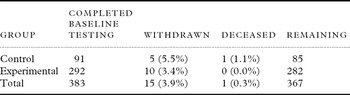
As of 31 December 2012, a total of 383 adults aged 50–79 years had commenced in the THBP (see Table 1). The dropout rate (withdrawn from study and deceased) is currently 4.2%, resulting in a participant pool of 367 adults who have completed screening and baseline assessment. The recruitment of participants is ongoing.
Recruitment flow for the Tasmanian Healthy Brain Project (as of 31 December 2012)

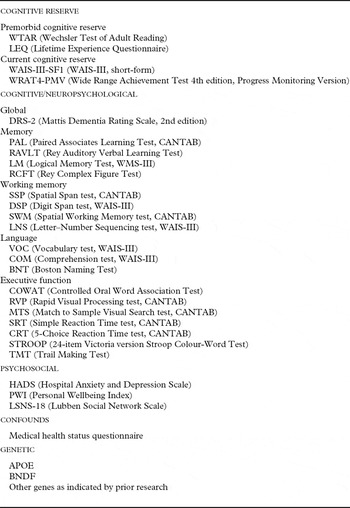
The THBP will involve a comprehensive assessment of neuropsychological/cognitive functions, cognitive reserve, psychosocial function, and genetic analysis. Participants will be assessed annually using a standardized assessment battery (Table 2).
Tasmanian Healthy Brain Project test battery

WAIS-III = Wechsler Adult Intelligence Scale, 3rd edition; CANTAB = Cambridge Automated Neuropsychological Test Assessment Battery.
Cognitive reserve stream
Cognitive reserve is an appealing construct in its conceptual simplicity; however, there are no established measures of cognitive reserve in the individual (Stern, Reference Stern2002). Educational history and occupational history are thought to impart cognitive reserve, as well as other factors such as innate intelligence and other life experiences (Stern, Reference Stern2002). However, it is evident that confounds exist between intelligence, education, and occupational history (Stern, Reference Stern2009), making it difficult to utilize a simple estimate of cognitive reserve based on one or more of these factors. Furthermore, cognitive reserve is not stable across an individual's lifespan, with additional life experiences either enhancing or reducing an individual's cognitive reserve (Stern, Reference Stern2009).
Two approaches to assessing cognitive reserve will be employed in the THBP (see Table 1). The first approach is designed to provide a measure of premorbid (or pre-intervention) cognitive reserve. An assessment of premorbid cognitive reserve will be undertaken using two measures: the Wechsler Test of Adult Reading (WTAR) and the Lifetime Experience Questionnaire (LEQ; Valenzuela and Sachdev, Reference Valenzuela and Sachdev2007). The WTAR consists of 50 words that have an atypical grapheme to phoneme translation. Capacity to read such words aloud is preserved until late stages of dementia; consequently, the WTAR provides a stable and reliable estimate of premorbid intellectual capacity (The Psychological Corporation, 2001). The LEQ is a multi-stage questionnaire designed to assess mental activity across an individual's lifetime. The LEQ assesses specific mental activity (e.g. educational and occupational activity) and non-specific mental activity (e.g. sport, hobbies, recreational activity, and musical activities) across three age bands: young adult (13–30 years of age), mid-life (30–65 years of age), and late life (65 years onward) (Valenzuela and Sachdev, Reference Valenzuela and Sachdev2007). Participants complete the LEQ on the basis of retrospective recall of information from each of the age bands. Additionally, detailed information regarding each participant's prior educational history (primary, secondary, and tertiary levels) will be recorded at baseline. The combination of performance on the WTAR, LEQ, and prior education will be used to determine each individual participant's premorbid cognitive reserve.
The second approach involves monitoring change to the level of cognitive reserve at each annual assessment. Two measures of current cognitive reserve will be utilized: the Wechsler Adult Intelligence Scale, 3rd edition Short Form 1 (WAIS-III-SF1; Donnell et al., Reference Donnell, Pliskin, Holdnack, Axelrod and Randolph2007) and the Wide Range Achievement Test, 4th edition, Progress Monitoring Version (WRAT4-PMV; Roid and Ledbetter, Reference Roid and Ledbetter2006). The WAIS-III-SF1 results in an estimated full-scale intelligence quotient score derived from the combined performance on four WAIS-III subtests (picture completion, digit symbol coding, similarities, and arithmetic; Donnell et al., Reference Donnell, Pliskin, Holdnack, Axelrod and Randolph2007). The WRAT4-PMV assesses word reading, sentence comprehension, spelling, and math computation in adults with higher secondary education (Roid and Ledbetter, Reference Roid and Ledbetter2006). The WRAT4-PMV and the WAIS-III-SF1 will provide a composite measure of change in cognitive function over time in individual participants in the THBP.
Cognitive/neuropsychological stream
A standardized battery of neuropsychological measures has been selected to assess core cognitive functions (global, memory and learning, working memory, language processing, and executive function). The tests selected have excellent reliability and validity and are suitable for use in repeat testing with 12-month retest intervals (Strauss et al., Reference Strauss, Sherman and Spreen2006; Lezak et al., Reference Lezak, Howieson, Bigler and Tranel2012).
Global cognitive function
The Mattis Dementia Rating Scale, 2nd edition, is a clinical test assessing cognitive symptoms of dementia and is used in the THBP to screen for clinically significant cognitive decline indicative of dementia onset (Saunders and Summers, Reference Saunders and Summers2010; Reference Saunders and Summers2011; Summers and Saunders, Reference Summers and Saunders2012).
Memory and learning
A combination of two tests of verbal memory and two tests of visual learning will be used in the THBP. The visual Paired Associates Learning (PAL) subtest of the CANTAB will be used to assess learning and recall of visual information over successive trials. PAL is sensitive to memory decline in early AD and MCI (Swainson et al., Reference Swainson2001). The second test of visual memory is the 3-minute recall trial of the Rey Complex Figure Test (RCFT), assessing a person's visuo-spatial orientation and organization as well as recall of visual information, both of which display impairments in mid-stages of AD (Lezak et al., Reference Lezak, Howieson and Loring2004).
The verbal memory tests include the Rey Auditory Verbal Learning Test (RAVLT), a 15-item word learning and recall test in which words are presented repeatedly across five successive trials. The RAVLT is sensitive to early memory decline in early AD and MCI (Saunders and Summers, Reference Saunders and Summers2010; Reference Saunders and Summers2011; Summers and Saunders, Reference Summers and Saunders2012). The second verbal memory test is the Logical Memory subtest of the WMS-III, in which participants are assessed on their capacity to recall two short prose passages at immediate and delayed recall trials. The Logical Memory test has been widely used in the detection of MCI (Petersen et al., Reference Petersen, Smith, Waring, Ivnik, Tangalos and Kokmen1999).
Working memory
Assessment of working memory capacity occurs in both visual and verbal modalities. Visual working memory capacity is assessed using two tests: the Visual Spatial Span (SSP) subtest and the Spatial Working Memory (SWM) subtest of the CANTAB. The SSP assesses short-term memory capacity for visual information, whereas the SWM assesses manipulation of information and strategy use for visual short-term memory information (Saunders and Summers, Reference Saunders and Summers2010; Reference Saunders and Summers2011; Summers and Saunders, Reference Summers and Saunders2012). Verbal working memory capacity is assessed using the Digit Span (DSP) subtest and Letter–Number Sequencing (LNS) subtests of the WAIS-III. The DSP assesses short-term memory capacity for auditory–verbal information, with the LNS assessing the capacity to manipulate verbally presented information in short-term memory (Lezak et al., Reference Lezak, Howieson and Loring2004).
Language
Assessment of language functions utilizes standardized measures that do not require reading literacy. The Vocabulary subtest of the WAIS-III assesses word recognition and capacity to provide definitions for common words in the English language. This test is resistant to age-related cognitive decline and performance does not decline until the late stages of dementia (Lezak et al., Reference Lezak, Howieson and Loring2004). The Comprehension subtest of the WAIS-III assesses the capacity to use language to express ideas and understand verbal communication (Lezak et al., Reference Lezak, Howieson and Loring2004). The Boston Naming Test (BNT) assesses the capacity of the individual to name common and uncommon objects presented visually, with dysnomia being an early symptom in the early stages of AD (Lezak et al., Reference Lezak, Howieson and Loring2004).
Executive function
Assessment of executive function involves measures of visual and verbal information processing speed, impulse control, mental flexibility, attention and concentration, and decision making. The Controlled Oral Word Association Test (COWAT) assesses the individual's capacity to name words starting with a specific letter within 60 seconds and is sensitive to early changes in cognitive function (Lezak et al., Reference Lezak, Howieson and Loring2004). The Rapid Visual Processing subtest of the CANTAB assesses visual sustained attention and has been shown to be sensitive to subtypes of MCI and AD (Saunders and Summers, Reference Saunders and Summers2010). The Match to Sample Visual Search subtest of the CANTAB assesses reaction time for matching visual stimuli and is sensitive to both MCI and AD (Saunders and Summers, Reference Saunders and Summers2010). The Simple Reaction Time subtest of the CANTAB assesses simple sustained attention for visual information, which is slow in AD but not in MCI (Saunders and Summers, Reference Saunders and Summers2010). The 5-Choice Reaction Time subtest of the CANTAB assesses the speed of decision making and response time, which are impaired in AD but not in MCI (Saunders and Summers, Reference Saunders and Summers2010). The 24-item version Stroop Colour–Word Test assesses the speed of information processing and impulse control for auditory–verbal information (Lezak et al., Reference Lezak, Howieson and Loring2004). The Trail Making Test assesses divided attention capacity on a visuo-motor task (Lezak et al., Reference Lezak, Howieson and Loring2004).
Psychosocial stream
The emerging evidence that social engagement and social activity throughout life may play a role in reducing age-related cognitive decline and potentially delay dementia onset (Bennett et al., Reference Bennett, Schneider, Tang, Arnold and Wilson2006; James et al., Reference James, Wilson, Barnes and Bennett2011) will be explored in the psychosocial stream of the THBP. While premorbid social engagement and activity will be assessed as a component of cognitive reserve using the LEQ, the potential impact of engagement in university education in facilitating social engagement and activity will be assessed on an annual basis with the psychosocial test battery. Current psychological health is assessed utilizing the Hospital Anxiety and Depression Scale (HADS) to monitor clinical symptoms of anxiety and depression that can impact on cognitive test performance. Assessment of quality of life is undertaken with the Personal Wellbeing Index (PWI), an Australian derived quality-of-life questionnaire with strong reliability and validity metrics (International Wellbeing Group, 2006). Social engagement is assessed using the 18-item Lubben Social Network Scale (LSNS-18), which measures frequency and type of social interactions with family, neighbors, and other friendships. The LSNS-18 will be used to quantify the impact of socialization on age-related cognitive decline (Roff et al., Reference Roff, Burgio, Gitlin, Nicols, Chaplin and Harin2004).
A structured questionnaire assessing health, medical conditions, prescription medication use, drug and alcohol use, sleep, and diet for the preceding 12 months (Saunders and Summers, Reference Saunders and Summers2010; Reference Saunders and Summers2011; Summers and Saunders, Reference Summers and Saunders2012) will be used to monitor for potential confounds to test performance across each assessment session.
Genetic stream
Genetic markers for increased risk for dementia are a critical variable to be explored in research examining interventions designed to reduce the incidence or onset of dementia. Salivary samples will be collected from participants to extract DNA for assaying of genetic markers associated with AD. Research indicates that specific genetic markers are associated with increased risk for late-onset dementia, most notably the APOE gene. There are three allele variants for the APOE gene, labeled ε2, ε3, and ε4. Adults who are ε4 homogeneous (ε4/ε4) have a 10–12 times higher risk of dementia than adults without the ε4 allele (ε3 and ε2 variants), with adults who are ε4 heterogeneous (ε4/ε3 or ε4/ε2) having a 3–4 times higher risk of dementia than adults without the ε4 allele (Corder et al., Reference Corder1993). Approximately, 14% of adults have the ε4 allele (Small et al., Reference Small, Rosnick, Fratiglioni and Bäckman2004), indicating that a significant proportion of the sample have a genetically elevated risk for AD.
While APOE has been found in multiple studies to be the genetic marker of highest significance in predicting risk for dementia, other genes have recently been implicated as increasing risk for dementia, albeit at smaller magnitudes than the APOE gene. Those genes identified in genome wide association studies (GWAS) to increase risk for dementia include CLU, PICALM, CR1, BIN1 (Harold et al., Reference Harold2009; Lambert et al., Reference Lambert2009), ABCA7, MS4A6A/MS4A4E, EPHA1, CD33, and CD2AP (Hollingworth et al., Reference Hollingworth2011; Naj et al., Reference Naj2011). Thus, there is increasing evidence of multiple genetic markers that are associated with increased risk for late-onset Alzheimer's dementia. We will also investigate in this population the distribution of gene variations linked to cognitive function and/or brain plasticity (e.g. catechol O methyl transferase, brain derived neurotrophic factor, and KIBRA).
Statistical analyses
Critical to the THBP is the development of a measure of cognitive reserve. CR is a theoretical construct that incorporates the influence of factors such as education, occupational history, innate intelligence, and life experience (Stern, Reference Stern2002). However, there is no operational measure of CR. Assessment tools such as the LEQ (Valenzuela and Sachdev, Reference Valenzuela and Sachdev2007) assess factors such as prior education, occupational history, and other cognitive activities. However, rather than a point measure of CR, tools such as the LEQ may best be described as assessing premorbid active cognitive lifestyle (Suo et al., Reference Suo2012). Two measures of CR will be developed in the THBP, premorbid CR, and current CR. As CR is conceptually a latent construct emerging from those factors identified as influencing CR (Stern, Reference Stern2002), exploratory factor analysis will be used to identify the construct of premorbid CR and the construct of current CR. A premorbid CR factor will be extracted from data collected at baseline assessment from the variables: LEQ performance, WTAR estimated FSIQ, and prior years of education. A current CR factor will be extracted from baseline assessment data from the variables: WAIS-III FSIQ and WRAT4-PMV subtest performance. The regression equation derived from the factor model for baseline current CR at baseline will be applied to the results at subsequent timepoints to enable change in current CR to be assessed longitudinally for each participant.
Each aim of the study will be examined with specific statistical approaches. The first aim to assess if participation in the THBP modifies age-related cognitive decline will be examined using a mixed-group repeated measures ANOVA, with participants grouped according to study load undertaken and performance on repeated neuropsychological measures being assessed over time. The second aim to identify the factors associated with decreased age-related cognitive decline will be examined using multiple regression analyses, regressing cognitive reserve factor scores, study load, socialization activity, and quality-of-life measures as predictors of change in neuropsychological test performance over time. The third aim to identify whether genetic markers act as a mediator of the relationship between educational enhancement and age-related cognitive decline will be examined using a mixed-group repeated measures MANOVA. The analysis will explore the relationship between genetic status group (e.g. APOE status), study level group, and change in current CR over time as a repeated measure. The fourth aim to determine if genetic polymorphisms contribute to cognitive reserve will be examined by correlational and regression techniques, examining potential associated between genotype subtypes, study load, CR (premorbid and current). The final aim of the THBP is to determine if increasing the CR in older adults reduces risk for, or delays the time of the onset of, clinical symptoms of AD. To assess this aim, a sufficient number of participants in each group will need to have transitioned to a negative outcome state (e.g. AD). Once a sufficient sample size is attained, a discriminant function analysis will be used to identify the multivariate predictor variables that best predict risk for AD as an outcome.
Conclusion
In 2009 in Australia, 245,000 Australians had dementia, with estimates predicting that number to soar to close to 1 million by 2050 (Access Economics, 2009; Deloitte Access Economics, 2011). The estimated economic cost of AD in Australia is projected to reach AUS$83 billion in 2060 (Access Economics, 2009). While a number of studies are currently examining the effect of various pharmacological and non-pharmacological treatments in adults with AD; ultimately, the application of treatment following the onset of AD is too late to maximize the potential healthcare benefits of such interventions. The ideal time point to apply an intervention is prior to the onset of clinical symptoms of AD when the potential for delaying AD onset is greatest. Consequently, investigations are needed to examine the efficacy of early intervention with non-pharmacological approaches in preventing or delaying the onset of neurodegenerative diseases such as AD.
The THBP explores the viability of using an existing activity that is cost-effective, complex, and purposeful (i.e. university education) to prevent or delay the onset of age-related cognitive decline. Utilizing existing university education as an intervention rather than devising a specific cognitive therapy approach has multiple benefits. These include using existing infrastructure and resources that are available across Australia, utilizing an approach which can be tailored to the individual's interests thereby enhancing compliance with the intervention, incorporating social interaction as a component of the intervention, and has a potential economic benefit of creating a highly educated older workforce in a period of declining workforce as the population ages.
To the best of our knowledge, the THBP will be the world-first large-scale prospective study examining whether university-level education delays age-related cognitive decline. The finding that further education in later adult life reduces age-related cognitive decline will indicate that positive cognitive growth is possible in older adults and can be achieved utilizing existing resources in the community. A finding that the rate of neurodegenerative disorders is significantly lower in adults who engage in late-life tertiary education will demonstrate the potential significant economic and social benefit of tertiary education in older adults. With a rapidly aging population and limited resources for care of older adults with neurodegenerative diseases, a readily available intervention that can reduce or delay the demand for support services will be of great benefit to health service provision in Australia. This is coupled with recent recognition of the value of life-long learning and increasing numbers on the vanguard of the baby boomer generation undertaking undergraduate and postgraduate university study.
The THBP is ideally suited for examination of the relative contribution of both genetic and environmental factors associated with age-related conditions such as dementia. Access to an extensive longitudinal data set of cognitive information for each participant presents an excellent opportunity to examine the interplay between genetic markers and age-related cognitive decline, as well as the effect of education (and cognitive reserve) as a mediator of genetic risk for dementia. As far as we are aware, there is currently no study that examines genetic risk factors for dementia that also examines the potential mediating effect of education and cognitive reserve. It is possible that “environmental” factors such as education or cognitive reserve may lessen the impact of genetic risk factors for Alzheimer's dementia (Scarmeas and Stern, Reference Scarmeas and Stern2003). However, it is also possible that such environmental factors have no direct impact on genetic risk factors for AD, and that these genetic risk factors inevitably result in the development of the neuropathological processes associated with the disease. A delay in the onset of AD arising from late-life education may instead reflect an enhancement of cognitive reserve, with this enhancement resulting in a delay to the onset of clinical symptoms of AD due to increased cognitive functions (Scarmeas and Stern, Reference Scarmeas and Stern2003). As such, there may be no effect on the underlying neuropathological processes of AD with the disease continuing unaffected. The benefit of education may be to enhance the cognitive resilience to neuropathology such that clinical AD symptoms only become manifest when the neuropathology reaches a level that overcomes the level of cognitive resilience of the individual (Scarmeas and Stern, Reference Scarmeas and Stern2003).
Furthermore, the results of the THBP may enable the identification of a subset of adults who will benefit maximally from late-life education. A premise of this research and related studies is that the application of specific techniques or therapies will enhance the cognitive reserve of participants and consequently reduce risk for dementia. If the level of cognitive reserve attained by an individual is determined by a combination of genetic and lifetime environmental factors, then it is possible that the capacity of cognitive reserve for an individual is biologically predetermined. Through exposure to environmental factors across the lifetime (e.g. education, occupation, and hobbies) the individual will develop their level of CR up to the maximum of their predetermined capacity. Participants in the THBP display a diverse range of educational and occupational backgrounds. It is possible that high-achieving adults may have already met their cognitive reserve capacity prior to commencing in the THBP. Other adults through limited prior educational opportunity may not have attained their biologically determined cognitive capacity. By examining the level of premorbid cognitive reserve in each participant, the results of the THBP will provide evidence as to whether the benefits of late-life education are restricted to those adults who have not fulfilled their cognitive reserve capacity and do not occur in those adults who have already attained their cognitive reserve capacity. This may enable the development of tailored intervention programmes whereby cognitive reserve enhancement approaches are utilized in those adults who have not attained cognitive reserve capacity.
Conflict of interest
None
Description of authors’ roles
M.J. Summers, co-project leader, designed the study, and was responsible for conducting the study and writing of the paper. N.L.J. Saunders assisted with writing of the paper, coordination of data collection, and conduct of the study. M.J. Valenzuela designed the measures of cognitive activity and provided expertise on cognitive reserve. J.J. Summers assisted with the design of study and writing of the paper. K. Ritchie provided expertise in the design of the longitudinal components of the study. A. Robinson assisted with the design of the study. J.C. Vickers, co-project leader, assisted with the design of the study and conducted the study.
Acknowledgments
This project is funded by a National Health and Medical Research Council (NHRMC) Project grant (1003645).