Introduction
Assaults on staff are unfortunately relatively common in psychiatric intensive care units (PICU) (Palmstierna et al. Reference Palmstierna, Huitfeldt and Wistedt1991; Vaaler et al. Reference Vaaler, Iversen, Morken, Fløvig, Palmstierna and Linaker2011). Aggressive behaviour is one of the most common reasons for transfer to a PICU (Bowers et al. Reference Bowers, Hammond, James, Quirk, Robson and Stewart2012) and one study found that one third of patients in a PICU committed an assault during their admission (Walker & Seifert, Reference Walker and Seifert1994).
Morale and job satisfaction are negatively affected when staff have been subjected to violent incidents (Ito et al. Reference Ito, Eisen, Sederer, Yamada and Tachimori2001; Walker and Seifert, Reference Walker and Seifert1994). One study described a link between the risk of staff having been assaulted and a desire to leave their job (Ito et al. Reference Ito, Eisen, Sederer, Yamada and Tachimori2001). Another paper showed that staff who have been assaulted have had problems with mental health and anger control (Whittington & Wykes, Reference Whittington and Wykes1992). Attitudes to assaults vary. Poster (Reference Poster1996) found significant differences amongst nurses in views on whether assaults should be expected as part of the job and whether the assaults should be reported to the police.
In examining the profile of the assaulted, one study found male staff under the age of 30 to be at high risk of assaults from patients (Hamadeh et al. Reference Hamadeh, Al Alaiwat and Al Ansari2003). Additional studies indicate that younger and less experienced staff members are at risk of violence (Chou et al. Reference Chou, Lu and Mao2002; Whittington & Wykes, Reference Whittington and Wykes1994; Owen et al. Reference Owen, Tarantello, Jones and Tennant1998).
Whether assaults should be reported to the police is an important question. There is ambivalence and controversy about this, and concerns have been expressed about the Memorandum of Understanding that exists between the Crown Prosecution Service (CPS) and the NHS Security Management Service (Wilson et al. Reference Wilson, Murray, Harris and Brown2012).
Incidents can often go unreported, even in more severe cases; one study found that the gravity of the assault had no bearing on whether it was reported to the police (Owen et al. Reference Owen, Tarantello, Jones and Tennant1998). Young et al. (Reference Young, Brady, Iqbal and Brown2009) described 245 incidents meeting the legal definition of assault where police were contacted in ten; only one resulted in a prosecution. Of the assaults, 46.5% were dealt with by staff using de-escalation alone (Young et al. Reference Young, Brady, Iqbal and Brown2009).
The current survey was designed to assess the reported number and impact of assaults on staff members in the psychiatric intensive care unit of Springfield University Hospital, South West London.
The survey had two main objectives:
-
1. To ascertain the number of reported assaults on staff on the PICU, details of the assaults, and to establish the impact on the staff members.
-
2. To explore attitudes of the staff towards assaults, including those towards reporting assaults to the police.
The PICU unit at Springfield Hospital is a 13-bed unit for male patients. All patients are detained under the provisions of the Mental Health Act 1983. The PICU provides a service for the London boroughs of Kingston, Richmond, Merton, Sutton and Wandsworth. The Trust serves a population of approximately one million people covering a diverse range of ethnic backgrounds.
Method
The survey was carried out between February 2010 and March 2010. The survey consisted of two questionnaires.
The first questionnaire (Appendix S1, online at http://journals.cambridge.org/jpi/10.1017/S1742646413000241) was mostly quantitative but with some free text qualitative sections. It gathered information about the demographics of the staff, reported frequency and types of reported assaults over the previous year and details about the outcome for both staff and patients after an assault. Further questions asked were whether staff felt safe working on the ward and if they felt there were appropriate procedures in place to provide a safe environment.
The second questionnaire sought attitudes of staff towards assaults. This was largely based on the ‘attitudes toward patient physical assault’ questionnaire of Poster & Ryan (Reference Poster and Ryan1989). Permission was given by the main author to use the survey with some minor changes made to suit the PICU and UK setting. The questionnaire comprises of a series of seventeen statements related to assaults with answer options of ‘agree’, ‘disagree’ and ‘neutral’ for each statement.
The questionnaires were distributed to all 32 permanent PICU staff members, with a covering letter and consent form. Completed questionnaires were returned anonymously. A t-test and chi-squared test were used as appropriate to explore the relationship between demographic variables and risk of assault.
Ethical approval was gained prior to the start of the survey from the St. George's Hospital Ethics Committee.
Results
Twenty-six of 32 staff (81%) filled out the questionnaire. There were 11 nurses, 11 nursing assistants and 4 doctors. Eighteen (69%) of the respondents were Black and 5 were Asian or described themselves as ‘other’. One staff member was white. Two declined to answer the question about their ethnicity. Sixteen staff members were male and 10 were female (62 and 38%).
Assaults over the year
Twenty-three (88%) of the staff described having been assaulted over the year when both reported verbal and physical assaults were asked about. Seventeen staff (65%) had been physically assaulted. Twenty-four staff (92%) had been subject to racist abuse.
Eleven staff members (42%) had been spat at and the same number had been punched. Two staff members had been bitten or scratched. For some of these incidents the forms of assault happened simultaneously, for example being spat at and kicked at the same time. Four of the staff who had been assaulted needed to go to hospital for treatment after the assault. Some of the staff members were assaulted at more than one time during the year; three staff reported being assaulted more than five times over the year; three staff had been assaulted three times and four staff members were assaulted twice.
Impact on staff
Of those staff members who had been assaulted, ten (39%) reported that this had negatively affected their work. Seven needed time off work (range 2–30 days). Comments made included that they felt ‘angry when at work’, ‘had low morale’, ‘were finding it difficult to focus on work’ and that they were ‘shaken up by the experience’.
Outcome for the patient
Sixteen of the patients at the time of assault were given ‘time-out’. Eight patients received rapid tranquillisation and eight required seclusion. Some patients carried out more than one assault and as a result had more than one of these interventions.
Police involvement
Six staff members reported an assault to the police. Free text statements about reasons for not reporting assaults were; ‘not very much support is given to staff by the police’; ‘I was not interested to take legal action’; ‘because the patient was unwell, the CPS won't do anything’; ‘it won't change anything from past experience’.
However eight members of staff gave opinions about the outcome of an investigation (suggesting some were referring to internal investigations); six were happy with the outcome and two were not.
Staff safety
Most of the staff (16; 62%) felt safe on the ward and 80% believed that there were appropriate safety measures in place. Most of the staff members who were not happy with safety on the ward suggested that more staff were required.
Relationship between assaults and demographics of staff
Older staff were more likely to report physical assault with the mean age of those reporting assault being 37.2 yr (sd 17.9), the mean age of those not reporting assault was 18.4 yr (sd 11.2); this was statistically significant (p = 0.009, t-value = 2.85). Men were more likely to be assaulted than women (p = 0.005, χ2 = 8.99); 14 of the 16 men (88%) had been physically assaulted compared to 3 of the 10 women (30%).
Staff attitudes towards assault
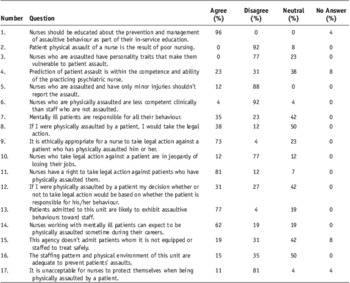
The modified attitudes to assaults questionnaire responses are listed in Table 1. The number of staff not giving an answer to a question was low. About half of the staff said they would take legal action if they were assaulted, and viewed the staffing pattern and physical environment as adequate to prevent assaults.
Responses to modified attitudes to assaults questionnaire

More than half (62%) of staff felt that they would be assaulted at some time during their career. The majority of staff (92%) believed that assault was not the result of poor nursing or related to clinical competence. Most (77%) felt that their personality did not influence the likelihood of assault. However, 35% felt that mentally ill patients were responsible for all their behaviour; 42% did not express an opinion on this issue. The majority of staff (77%) were confident that taking legal action would not result in them losing their job and 81% recognised they had a right to take action.
Strengths and Weaknesses of The Study
This was a small study based in one psychiatric intensive care unit in London. The response rate in the unit was good. We did not gain ethical approval to record demographic data of non-respondents.
Only permanent rather than agency staff members took part in the survey, as the ethics approval granted would not permit their inclusion due to lack of line management support and on-going supervision for support regarding any potential distress related to incidents involved in the study. This may have reduced the numbers of assaults reported. It may also have introduced a response bias as permanent staff members who elect to work in a PICU environment could have differing attitudes compared to bank staff, who work in a number of clinical areas. It would have been very difficult to get responses from all the bank staff working on the PICU. Selecting only permanent staff did mean that we could get a picture of what was happening in our PICU, allowing improvements to be made and further relevant discussions with staff.
The survey was retrospective in nature thus there may have been some errors of recall. Future research may employ a prospective method of researchers recording objective incidents on the ward rather than relying solely on staff reports. It would have been interesting to assess the number and nature of incidents and to compare the objective recording with staff reports. Numbers were too small for more than basic statistical analysis.
The survey results add to the literature demonstrating that assaults on staff on a psychiatric intensive care ward are unfortunately common. This is an important area which is developing a larger body of research.
Discussion
That staff described having their work affected after an assault is a result supported by the literature. One study demonstrated that 49% of nurses assaulted by psychiatric patients believe it takes ‘several months to recover emotionally from an assault’ (Needham et al. Reference Needham, Abderhalden, Halfens, Fischer and Dassen2005). In the same study it was shown that anxiety and fear are the most commonly reported after-effects, with some nurses feeling guilt after the assault. Despite the high level of assaults in this study more staff felt safe than not, and a large number felt there were appropriate procedures in place for staff safety. The main concern was perceived low staffing levels (they have been increased since the survey took place).
The issue of whether assaults should be reported to the police generates some controversy and that is reflected in the responses of the staff. However, most assaults were not reported to the police, as is reflected in the literature. The reasons given for this varied. Staff did not think on the whole that reporting incidents would impact negatively upon their career so this cannot explain the low rate. Results also suggested that the lack of reporting is not due to staff feeling it is wrong to do so. Although Ho et al. (Reference Ho, Ralston, McCullough and Coverdale2009) have argued that for many psychiatrists ethical considerations are very important when making this decision, it is interesting that believing that the patient is responsible for their own behaviour did not affect the decision to take legal action (Table 1, questions 7 and 11). This may explain the conflicting responses. There is currently a tendency for psychiatrists who are responsible for the patient's care to be asked to provide statements regarding a patient's capacity and understanding of right and wrong after an assault, although Wilson et al. (Reference Wilson, Murray, Harris and Brown2012) argued that all assaults should in fact be reported and processed. There appears to be some tension between the criminal justice system and the mental health system about the value of prosecution. Forensic psychiatrists may argue, as do Wilson et al. (Reference Wilson, Murray, Harris and Brown2012), that prosecution: is of value as it may have some therapeutic benefit in itself; treats those with mental disorder in the same way as the rest of the population; improves risk management; and may allow forensic disposal. The CPS approach this decision with more of an emphasis on ‘public interest’ (Crown Prosecution Service, 2013), arguing against prosecution if a defendant was suffering from significant mental ill health at the time of the offence, unless: the offence is serious; there is a real possibility that it may be repeated; or there is need to protect staff or the wider public. The joint working agreement between the NHS, Association of Chief Police Officers (ACPO) and the CPS, stated: ‘It must be stressed that, in the majority of cases reported to the police by NHS staff working in mental health/learning disability settings, there will have been an initial assessment that the offending behaviour is not directly caused by the person's condition and that any police and CPS response should take account of this internal assessment process’ (ACPO, the CPS and NHS Protect, 2011). This document also stated that if the assailant lacks capacity, intervention is appropriate only in cases of serious and repeated violence (ACPO, the CPS and NHS Protect, 2011). This guidance is especially relevant with regard to assaults on PICU staff, where the assailants are likely to lack capacity and for the assaults to be directly related to their mental disorder.
Some staff thought that there was ambivalence in the criminal justice system regarding reporting of assaults. Thakkar & Kini (Reference Thakkar and Kini2012) suggested that the reasons staff have for not reporting incidents to police are: the feeling that it will not achieve anything; the level of paperwork generated; a reluctance to prosecute a patient deemed to be unwell; the concerns that there may be negative impact on the therapeutic relationship; and fear of reprisals. They suggested that changes in attitude towards reporting violent incidents to the police are required. They proposed that discussing patient assaults in staff induction training, supervision sessions, appraisal and trust audits can achieve this change (Thakkar & Kini, Reference Thakkar and Kini2012).
Older staff members were more likely to report assaults. This may be because older staff have been working in PICU environments for a longer period of time than younger members of staff, and are therefore likely to have experienced a previous assault. We found that members of staff were pleased with the outcome of reporting assaults; this perception could have encouraged older members of staff to report incidents, when compared with younger staff members. Male staff members were also assaulted much more than female staff. This may be due to a perception amongst ward staff that male members of staff should be the named nurse for more aggressive patients. This finding warrants further investigation.
The perceived importance of education and training was shown in the results with 96% of staff thinking that education around assault should be part of in-service training. This is a view supported by the evidence: Owen et al. (Reference Owen, Tarantello, Jones and Tennant1998) found that staff without aggression training experienced more violent incidents. Sjöström et al. (Reference Sjöström, Eder, Malm and Beskow2001) found no statistically significant reduction in the number of aggressive patients after a training course; however they did describe a reduction in the perceived number of aggressive incidents. Other studies have found that nurses’ training reduces severe events of patient aggression (Abderhalden et al. Reference Abderhalden, Needham, Dassen, Halfens, Haug and Fischer2008; Bowers et al. Reference Bowers, Nijman, Allan, Simpson, Warren and Turner2006). More training sessions could potentially increase staff ability to understand and deal with aggressive patients leading to greater personal achievement and satisfaction.
Staff did not feel that in any way the nursing staff should be ‘blamed’ for being the victim of an assault. Indeed some seemed to expect it as part of the job, but not all felt competent in dealing with assault. Vaaler et al. (Reference Vaaler, Iversen, Morken, Fløvig, Palmstierna and Linaker2011) found that nursing staff are able to predict violence based on a global clinical prediction. The nursing staff may therefore be underestimating their own abilities to judge when violence is likely.
Conclusions
This small survey confirms the findings of other studies that assaults occur commonly on a psychiatric intensive care ward. Most staff members do not want to prosecute when they have been assaulted for a variety of reasons reflecting the ethical and practical difficulties in this area.
Staff members were keen to have training regarding management of violence and it would appear from this study that there is a need to provide training regarding prediction of imminent violence. The potential benefits of training about the ethics and practicalities of reporting assaults to the police requires further research. It would be useful to re-evaluate attitudes to assault once training of this nature has taken place. At a time when there is concern in the UK about some aspects of nursing practice it is important to recognise and respect the physical risks some members of the profession are placed at as part of their daily work.