An estimated 85 per cent of the world’s population claims membership in a religious group.Footnote 1 Yet the importance that people attach to their religious identity varies considerably. For some, religion is the defining characteristic of who they are; their politics and perspectives on the world are inextricably bound up in their faith. For others, religious group membership is merely one social attachment among many; their attitudes and behavior are little affected by their religious affiliation. These differences underscore the fact that membership in a religious community need not translate into subjectively felt attachment to one’s faith. They raise the question: under what conditions does membership in a religious group become socially salient? As events around the world – in Afghanistan, Iraq, Nigeria, Central African Republic, Syria, Israel, Yemen and elsewhere – are spearheaded by actors claiming religious piety as a motivation, it becomes increasingly important for social scientists to evaluate the sources of that motivation.
In this article, we demonstrate how political events – in particular political elites’ mobilization of religion for strategic purposes – can alter the importance that people attach to their religious identities. While many studies in the instrumentalist tradition emphasize elite mobilization of social identities, fewer document the impact of such mobilization on the way regular citizens identify themselves. Fewer still focus explicitly on attachments to religion. Our exploration of the mobilization of religious identity does both. Our emphasis on the political sources of religious identification also contrasts with traditional accounts of the sources of religious salience that emphasize social and economic factors such as economic development and secularization,Footnote 2 the supply of different religions and the competition between them,Footnote 3 or the content of specific religious practices and belief systems.Footnote 4
The methodology we employ is novel as well. The most straightforward approach to studying how political mobilization may alter the salience of religious identities would be to compare individuals exposed to different political environments. However, the conclusions one could draw from such a comparison would be weakened by the fact that many factors other than the political environment may also differ across the two settings. For example, if we observed a concerted effort by political leaders in Country A to mobilize supporters along religious lines and we found much stronger attachments to religion there than in Country B, we might be tempted to attribute the difference in religious salience to political mobilization. But we would be wrong to do so without first ruling out the role of a whole set of factors – patterns of religious practice and dress, levels of development, the numbers and sizes of religious groups and any number of other features – that might also vary across the two countries and offer competing explanations for the variation in religious salience that we observe.
The ideal research design would be an experiment in which we randomly assigned people to two distinct political environments and then compared the average level of religious identification in each environmental condition. Unfortunately, such an experiment is not feasible outside of a laboratory, and laboratory experiments have well-known limitations.Footnote 5 We can, however, approximate such an experiment by exploiting the exogenous changes in political environments provided by the nineteenth-century partition of Africa.Footnote 6 Given that the boundaries between present-day African countries were drawn by colonial officials who had little knowledge of the people they were bisecting, we can take the drawing of the borders as having randomly assigned the populations living in the border areas to different treatments. Since the characteristics of the communities living in close proximity to the border were presumably the same at the time the border was demarcated, we can attribute the differences we find in the salience of religion to the country environments to which people were as-if randomly assigned. Of course, those country environments are defined by a variety of factors. But since a key difference is the political currents and debates to which citizens are exposed by virtue of their membership in a particular national political community, we can make a plausible connection between the political currents and debates in each country and the outcomes we observe on either side of the border – provided that we can successfully control for the other factors that differ.
This is the strategy we adopt in this article. We exploit the border between the West African countries of Burkina Faso and Côte d’Ivoire to investigate whether people living on either side of (and in close proximity to) that border attach different degrees of importance to their religious identities. Focusing on populations living very close to the border allows us to hold constant many social, economic, cultural and historical factors in the study environment while varying our causal variable of interest: the national political environment to which individuals are exposed. Other salient features may still differ on either side of the border, and we control for them to the extent possible. But by locating our study in a border area we achieve a greater degree of control over these potentially confounding factors than would be possible in a more standard observational study.
Consistent with constructivist and instrumentalist accounts of identity salience, we find evidence that the context matters considerably: among people living just a few kilometers away from one another, those living on the Côte d’Ivoire side of the border are nearly three times as likely as those living on the Burkina Faso side to rank religion as their most important social identity. After discounting alternative explanations rooted in differences in the religious composition of the populations, the extent of secularization, the quality and quantity of religious infrastructure, and the level of competition among religious groups on either side of the border, we develop an explanation rooted in politics. Specifically, we argue that the differences we find in religious attachments among people living in each country stem from the politicization of religion in the course of the recent civil conflict in Côte d’Ivoire. We argue that membership in the Ivorian national community, and exposure to explicit political appeals to religious coalitions during the course of that country’s recent civil war, provides the most compelling explanation of the greater salience of religion among respondents living on the Ivorian side of the border.
The study contributes in both theoretical and methodological ways. From a theoretical standpoint, it reinforces the claim that the importance of social identities like religion is context dependent, and that a critical defining element of that context is exposure to the mobilization strategies used by political elites. Given current assumptions that religious identities are innately conflict inducing or that certain religions are intrinsically more deeply felt than others,Footnote 7 our research demonstrates that the salience of religious identity can hinge on purely environmental factors, and that patterns of political mobilization can define that environment. In this respect, religion – though sometimes thought to be sui generis – is no different from any other social identity, provided that political leaders can use the identity to organize and mobilize.
From a methodological standpoint, the study contributes to the growing body of research that employs ostensibly arbitrary African country borders as sources of explanatory leverage.Footnote 8 This study differs, however, in its effort to highlight and address some of the potential pitfalls of such an approach.Footnote 9 For example, rather than simply taking the border we study as exogenous, we consider the circumstances surrounding its demarcation to confirm that the process can in fact be viewed as having allocated people to each side of the border in ‘as-if random’ fashion. We also investigate whether individuals may have sorted themselves into (or out of) the study areas for reasons endogenous to the outcome of interest. This step is required by the porousness of the border we study, the ease of internal migration within each country, and the lengthy interval between the drawing of the border and our measurement of religious identification among the people living on either side of it. Finally, we conduct our empirical analyses in a manner appropriate to the clustered structure of our data. These are all steps that should be undertaken in African cross-border research, but are frequently neglected.Footnote 10
EXPLAINING VARIATION IN RELIGIOUS SALIENCE
It is now commonplace to observe that the strength of social attachments can change over time, either as part of a long-term historical process or due to short-term changes in the political environment. Laitin, for example, shows how attachments to ancestral city-states among the Yoruba of Nigeria were a product of British colonial practice.Footnote 11 Weber describes a process whereby peasants in rural France gradually adopted a national French identity as a function of the political modernization process that took place during the late nineteenth and early twentieth centuries.Footnote 12 Eifert, Miguel and Posner, by contrast, emphasize the impact of shorter-term changes in the political context. They demonstrate a spike in the salience of ethno-linguistic attachments in the lead-up to competitive elections in African countries.Footnote 13 Posner also documents the changing salience of linguistic and tribal identities across periods of multiparty and single-party electoral competition in Zambia.Footnote 14
The explanations for these latter outcomes highlight the instrumentality of political elites’ identity choices. Insight into why political elites might be especially attracted to religious identities as bases for political mobilization is provided by Toft, who argues that, owing to their transnational nature, religious identities may be especially useful for cultivating external ties.Footnote 15 By engaging in ‘religious outbidding’, elites can achieve the dual purpose of signaling religious commitment to a domestic audience while also generating support from abroad. Reynal-Queral shows how, once activated, religious identities may be difficult to demobilize because religious identity implies a set of non-negotiable behavioral guidelines that are derived from scriptural texts.Footnote 16 In the context of political bargaining, these non-negotiable elements frequently emerge as central sticking points, thus intensifying attachments to religion and reinforcing the social salience of religious identities.
The political mobilization logic that we propose to explain increased religious salience in Côte d’Ivoire is further supported by the fact that religious groups have institutional properties that are particularly well suited to mobilization. Eschewing the notion of religious behavior as irrational fervency, Wald, Silverman and Fridy use social movement theory to demonstrate that religious groups are instead institutionalized networks guided by the strategic choices of leaders.Footnote 17 They underscore how the moral exigency behind religious appeals makes mobilization along religious lines an especially effective means of generating support. Similarly, Djupe and Gilbert note that public speech with religious themes creates a tendency for the group to seek strategies to add its moral and communal interests to the public discourse, thereby reinforcing the importance of the religious identity.Footnote 18
Other scholars stress the organizational features of religion that link the salience of religious identity to political mobilization. Fox and Mickenberg separately argue that membership tracking, access to resources and other organizational advantages make religious appeals relatively more effective than other types of identity mobilization.Footnote 19 Studying the context of African-American churchgoers, Harris similarly stresses the ease with which political appeals to religion circulate through a religious community.Footnote 20 In the African context, Ranger describes mobilization along religious lines as capable of attracting wider constituencies due to the combination of moral appeals and organized networks.Footnote 21 And drawing on places as diverse as Israel, India, the United States and Iran, Jelen and Wilcox note that elites regularly exploit the organized nature of religious networks to mobilize supporters.Footnote 22 There are reasonable grounds, then, to suggest that couching appeals in religious terms can be politically useful and that such appeals can reinforce attachments to religious identities.
Those arguments, of course, address why political elites choose to exploit religion and why, once it is exploited, religion tends to remain salient. This study, by contrast, concerns change in the salience of religion. At least three literatures address this issue. The first is the classic theory of secularization, which argues that religion offers a ‘sacred canopy’ of consistent worldviews to practitioners that keeps religion at the center of their identity in times of difficulty and/or uncertainty.Footnote 23 The expansion of science, rational thought and development, however, has torn at the threads of that canopy and led to a decline in the salience of religious identity.Footnote 24 This approach therefore associates changes in the salience of religion to long-term changes in people’s socio-economic circumstances.
More recently, scholars have revised the theory of secularization to account for the stark difference in religiosity between the developed and developing parts of the world. According to Norris and Inglehart, religion indeed becomes less important as wealth and stability improve, but people in many parts of the world face ‘existential insecurities’ such as poverty, hunger and natural disaster that generate a persistent need for hope in a better afterlife.Footnote 25 Religion – through its emphasis on the afterlife, the support offered by clergy, and periodic gatherings for prayers and celebrations – provides this comfort, thus remaining more salient in poorer or insecure places even as it loses its significance for the wealthier.Footnote 26
A second line of reasoning attributes changes in the salience of religion to the interdenominational competition for adherents that arises in societies characterized by religious pluralism. Building on supply-side economic logic, Stark and Iannaccone suggest that, in such a context, more efficient religious organizations are better able to compete for new members, provide new places of worship and adopt their social teachings to a changing audience.Footnote 27 This helps explain why religiosity has dropped drastically in the traditionally Catholic countries of Europe, where one religion is hegemonic, but has remained strong in the United States, where religious options are plentiful and competition is robust.Footnote 28
A third approach focuses on the ways in which the ideological, historical and symbolic elements of particular faiths render religion a more salient social identity. Although such arguments in principle apply to any religion, they have in practice been invoked primarily to explain the particular salience of religious identity among Muslims. For example, Haynes emphasizes the fact that Islamic legal codes blend the religious and political, which in turn gives rise to conflicts between Muslims and state actors asserting the primacy of secular rules and policies.Footnote 29 Kalyvas emphasizes Islam’s absence of hierarchy, which allows radical groups to hijack political processes and thus reinforce the salience of religious identity.Footnote 30 Toft stresses the fact that, unlike other world religions, Islam has never witnessed an intra-religious event sufficiently costly to warrant separating religious from political identities.Footnote 31 As in Haynes’ account, this leads to conflicts between Islamic leaders and the state, and generates political mobilization that keeps religious identities at the center of political and social life. These economic and sociological approaches offer a sharp contrast to the expressly political logic we advance in this study.
RESEARCH DESIGN: EXPLOITING THE BURKINA FASO–CÔTE D’IVOIRE BORDER
Our study measures and compares the salience of religion among residents living on either side of the Burkina Faso-Côte d’Ivoire border. In order to interpret any differences we find as stemming from the contrasting political environments in the two countries, we must first demonstrate that the people who wound up on each side of the border got there by chance.Footnote 32 This involves ruling out the possibility that they sorted themselves through migration (which we turn to later) and documenting that the border was in fact arbitrarily drawn.Footnote 33 The evidence suggests that it was.
The present-day border between Burkina Faso and Côte d’Ivoire was originally established in the 1880s as the boundary between administrative districts (cercles) in what was then French Sudan.Footnote 34 It runs from west to east, from the intersection of the Bani and Léraba Rivers in the southwestern corner of Mali to the Black Volta River on the western edge of Ghana. The colonial officials who demarcated the boundary followed the common practice of tracing natural geographic features in deciding where it would be located: most of the 584-kilometer border was drawn along seasonal rivers and streams, and the remaining portions were simply an exercise in connecting the dots. The eastern portion of the border, which divided the Gaoua and Bondougou districts in the late nineteenth century, is described in the records of Maurice Delafosse, a French colonial administrator who spent sixteen years in the region. Delafosse notes that where rivers and streams could not serve as a guide, the border was drawn ‘[…] in a sensible fashion […] to the East and Southeast’,Footnote 35 in order to meet a point pre-determined with the British on the thalweg of the Black Volta River.Footnote 36
Whereas borders that follow straight lines can be plausibly taken as exogenous to the characteristics of local residents,Footnote 37 those that follow geographic features warrant closer scrutiny. Data collected by Huillery suggest that, across a range of indicators of socio-economic status and colonial investment in the first decades of the twentieth century, the cercles located on either side of the present-day Burkina Faso-Côte d’Ivoire border were very similar.Footnote 38 Huillery’s data are corroborated by Delafosse’s account. His diaries provide detailed descriptions of the habits of dress, scarification, circumcision and weaponry of the communities living in the border region but make no mention of any dissimilarities in those living on either side of the present-day boundary.Footnote 39 Taken together, these findings provide a plausible basis for proceeding under the assumption that the demarcation of the border, and hence the allocation of people to either side, was as-if random. This is a crucial step if we seek to interpret cross-border differences in the strength of religious identity as products of the different country environments to which people were exposed.Footnote 40
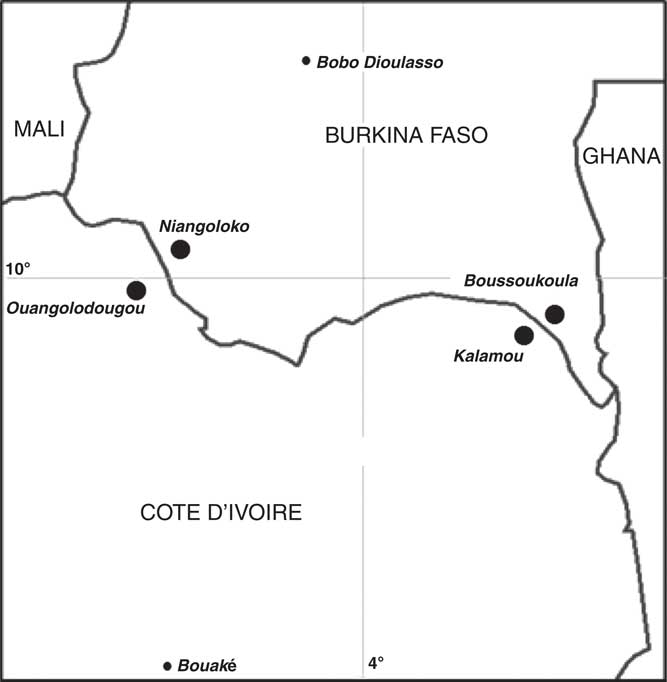
To document the differences in religious salience on either side of the border, we administered a survey to approximately 200 respondents distributed across two pairs of research sites – one rural and one urban – just astride the border (see Figure 1). The rural locations are the predominantly Lobi villages of Boussoukoula, Burkina Faso and Kalamou, Côte d’Ivoire. The villages are situated approximately 7 kilometers apart, directly across the border from each other in the eastern section of the border zone, near Ghana. The two urban locations, approximately 50 kilometers apart, are the market towns of Niangoloko, Burkina Faso and Ouangolodougou, Côte d’Ivoire (populations roughly 30,000 each). Both towns lie on the main road connecting Côte d’Ivoire and Burkina Faso, approximately 300 kilometers west of the two rural sites. We recruited fifty respondents in each site via a random sampling procedure with stratification by age and gender. Surveys were administered in Dioula and/or French in the two urban sites and in Lobiri (and occasionally French) in the two rural locations.Footnote 41
Research sites

Characteristics of the Sample
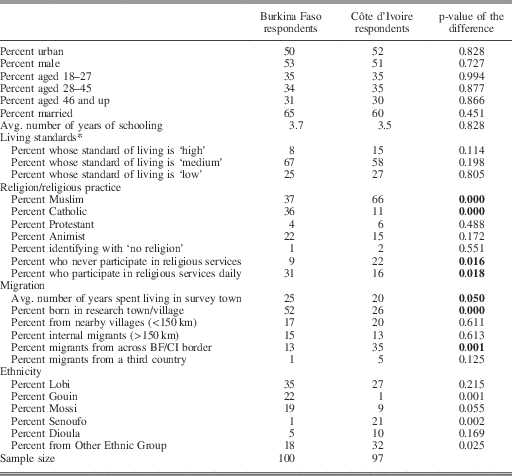
As one would expect given both our sampling protocol and the plausibly exogenous nature of the border, our respondents from Burkina Faso and Côte d’Ivoire were, on average, indistinguishable from one another with respect to most measurable characteristics (full descriptive statistics are provided in Appendix Table A1). Two important differences were, however, evident. First, Burkinabé respondents were significantly less likely than their Ivorian counterparts to be Muslim (37 per cent versus 66 per cent) and more likely to be Catholic (36 per cent versus 11 per cent). If, as turns out to be the case, Muslims are more likely (and Catholics less likely) than members of other religious communities to rank their religious identity as most important, then this creates a potential problem, since what might look to be greater religious attachment in Côte d’Ivoire (and/or lower religious attachment in Burkina Faso) may instead be an artifact of the higher (lower) share of Muslims among survey respondents from that country – an explanation rooted in the differing religious compositions of each local community rather than one hinging on political mobilization.
Secondly, migration rates differ on either side of the border.Footnote 42 Respondents in Burkina Faso had lived in their current village/town about 25 per cent longer, on average, than their Ivorian counterparts (25.2 years versus twenty years). They were twice as likely to have been born in the village/town in which we surveyed them (52 per cent versus 26 per cent). And they were about three times less likely to have migrated from across the border (13 per cent versus 35 per cent). Although we might have expected these differences to be smaller given the close proximity of each pair of survey sites, this pattern of greater mobility in Côte d’Ivoire is consistent with more general patterns countrywide. In Côte d’Ivoire, longstanding policies designed to encourage labor migration created a population that, by the late 1990s, was over one-quarter foreign born.Footnote 43 Burkina Faso, however, has historically been a migrant sending rather than receiving country, with less than 10 per cent of its population having migrated from other nations.Footnote 44 In Comoé and Noumbiel, the two provinces in which the Burkinabé research sites are located, just 7.7 per cent of residents were foreign born.Footnote 45
As noted, the problem raised by these different rates of population mobility is one of endogenous sorting: the possibility that people moved for reasons related to their attachment to religion. If, for example, those who attached greater importance to their religious identities were systematically more likely to move across the border to Côte d’Ivoire, or from elsewhere in Côte d’Ivoire into the border region, it would generate stronger average religious identifications among Ivorian survey respondents, even if the true impact of Côte d’Ivoire’s political environment were 0. In the analyses to follow, we employ several techniques to address these potentially confounding factors.Footnote 46
Measuring the Salience of Religious Identities
To probe the salience of religious identities, we asked four simple questions, common to public opinion surveys on social and political attitudes in the region:Footnote 47
∙ Each person has several ways of identifying him/herself: nationality, religion, ethnic group, occupation, gender, personality, point of view, etc. For you, what identity is most important?
∙ After that, what identity would you place in second position?
∙ Could you marry a person of a different religion?
∙ To whom do you feel closer: a person of your country who is not of your religion, or a person of your religion who is not of your country?
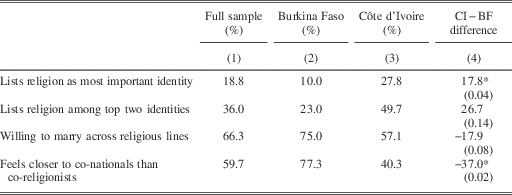
Differences in response patterns among respondents living on either side of the border are striking. As Table 1 illustrates, respondents living on the Côte d’Ivoire side of the border were almost three times more likely than those living on the Burkina Faso side to identify themselves primarily according to their religion (27.8 per cent versus 10 per cent) and far less likely to mention nationality (25 per cent versus 42 per cent).Footnote 48 Respondents living in Côte d’Ivoire also ranked religion among their top two identities at a much higher rate (49.7 per cent versus 23 per cent) than did individuals in Burkina Faso.
The Salience of Religious Identity

Note: differences reported in Column 4 are from two-sample t-tests with unequal variances; standard errors in parentheses, calculated by cluster mean as in Dunning (Reference Dunning2012, 181). N=4 combined cluster observations (two per country). * p<0.10 in two-tailed tests. We highlight this level of statistical significance given the relatively small sample size.
The two questions that probe social attitudes regarding religion tell a complementary story. Ivorian respondents were less likely than their Burkinabé counterparts to say that they could marry a person of a different religion (57.1 per cent versus 75 per cent) and less likely to favor co-nationals over co-religionists when asked to choose between them (40.3 per cent versus 77.3 per cent).
Since survey respondents were assigned as a cluster to each country rather than individually randomized to live on one side of the border or the other, calculating the significance of these differences using conventional methods can be misleading.Footnote 49 This is because those who live near each other may react similarly to the same conditions but differently from those who live elsewhere, hence generating a correlation of potential outcomes within each cluster and increasing the variance of the estimated treatment effect. The adjacency of our research sites goes some way toward mitigating this problem,Footnote 50 but the fact that the people living in the border area were assigned to treatment as clusters still has the effect of reducing the study’s effective sample size. We therefore calculate the statistical significance of the cross-country differences in the fourth column of Table 1 by comparing the cluster means of responses from each survey site. Even with this highly conservative approach, we find statistically significant differences across Burkinabé and Ivorian respondents in the likelihood that they list religion as their most important identity and in the likelihood that they feel closer to co-religionists than to co-nationals (p<0.10). The cross-border differences in willingness to marry a person of a different religion and in listing religion among one’s top two identities are also close to, but do not quite reach, conventional levels of statistical significance (p-values between 0.10 and 0.15).Footnote 51
These findings suggest that something about living on one side of the border or the other is associated with a respondent’s level of religious identification. But before investigating what that something might be, we first need to address the possibility that patterns of endogenous sorting that took place after the border was drawn might be responsible for these patterns.
Accounting for Endogenous Sorting
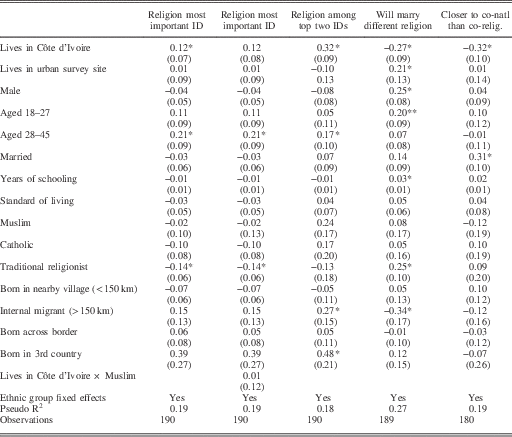
A significant challenge for attributing religious identification to the political context in Burkina Faso or Côte d’Ivoire is the fact that, as noted, respondents in Côte d’Ivoire were significantly more likely than those in Burkina Faso to have been born in (and migrated from) a place other than where they were surveyed. This is relevant because migrants are more likely to attach importance to their religious identities: whereas just 15.7 per cent of non-migrants ranked religion as their most important social identity, 28.8 per cent of migrants did so.Footnote 52 This raises the possibility that the differences we observe in religious identification in Côte d’Ivoire and Burkina Faso could be a product of endogenous sorting.
Migration poses a validity threat to any location-based study involving jurisdictional boundaries.Footnote 53 The degree of the threat varies, however, with what we hypothesize the precise treatment to be. If the outcome is associated with a longstanding difference in the Ivorian and Burkinabé contexts, then sorting at any point in time, even decades ago, could compromise our ability to detect a causal effect. However, if the outcome is due to a difference that arose more recently, then only migration since that time (but prior to our data collection) would threaten our inferences. We therefore tackle this problem in two different ways. The first, most conservative, approach is to use a respondent’s country of origin, rather than country of residence, as the independent variable of interest, as suggested by McCauley and Posner.Footnote 54 Analogous to an intention-to-treat analysis, this specification treats all cross-border migration as potentially endogenous to the outcome of interest.Footnote 55 A second approach attempts to distinguish between early migrants who were later affected by the precise political treatment that we are investigating and more recent ones, who migrated after the treatment on which we focus and who therefore should not have been affected by it. To foreshadow the explanation we provide in the following section, we locate that treatment as beginning in 2000, with the start of the Ivorian conflict. Hence, we also test for treatment effects based on the country of residence as of 2000. Since some scholars date the start of tensions to the period following the death of President Félix Houphouët-Boigny in 1993,Footnote 56 we test for differences among respondents living in Côte d’Ivoire after that year, as well.
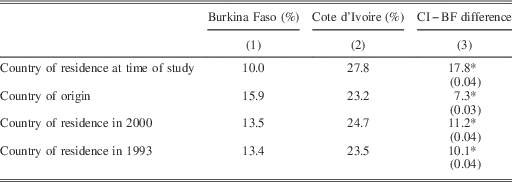
Row 1 of Table 2 reports the cross-border differences among respondents based on the side of the border on which they resided at the time of data collection (also reported in Row 1 of Table 1): 10.0 per cent of residents on the Burkina Faso side versus 27.8 per cent of their counterparts just across the border in Côte d’Ivoire identify religion as their most important identity. In Row 2, the Burkina Faso–Côte d’Ivoire difference is determined by the respondents’ country of origin rather than country of residence. Under this conservative specification, the cross-country difference is reduced but still notable: 15.9 per cent of those who were born in Burkina Faso prioritize religion, compared to 23.2 per cent of those born in Côte d’Ivoire. We would expect the difference to be tempered since some early migrants from Burkina Faso would have moved to Côte d’Ivoire and then been affected by the new political environment, and this is indeed what we see: the larger difference is between the first and second rows in Column 1 than Column 2, which is consistent with the fact that more subjects migrated from Burkina Faso to Côte d’Ivoire than vice versa.
Proportion of Respondents Listing Religion as Most Important Social Identity, by Country of Residence and Country of Origin

Note: differences reported in Column 3 are from two-sample t-tests with unequal variances; standard errors in parentheses, calculated by cluster mean, as in Dunning (Reference Dunning2012, 181). N=4 combined cluster observations (two per country). *p<0.10 in two-tailed tests.
Finally, in Rows 3 and 4 of Table 2, we report religious attachments based on residence in each country as of two alternative starting points for the Ivorian conflict – 2000 and 1993. The results are in keeping with our expectations: controlling for the endogenous sorting that may have occurred since those dates, approximately 24 per cent of respondents in Cote d’Ivoire, versus just over 13 per cent of those living in Burkina Faso, list religion first. All of these differences are significant at the p<0.10 level in a (conservative) cluster mean-level test. These patterns suggest that cross-border differences in religious salience are not likely due to individuals sorting themselves across the border based on religion. But if endogenous migration cannot account for the differences, then what might?
EXPLAINING THE DIFFERENTIAL SALIENCE OF RELIGION IN BURKINA FASO AND CÔTE D’IVOIRE
Documenting a cross-border difference in outcomes is an important first step in our analysis. But it only allows us to pose the question of why religion is more salient on the Côte d’Ivoire side of the border than on the Burkina Faso side. Developing an answer is a completely separate task, and it is complicated by what Dunning calls the ‘compound treatment problem’: the fact that all of the candidate explanations – religious demographics, political institutions, post-partition histories, levels of economic development, and differences in the quality and quantity of religious institutions – co-vary, at least at the level of the country as a whole.Footnote 57 This makes it difficult to figure out which of them may be driving the differences we observe. Adjudicating among the competing explanations also requires that we leave aside the neat, quasi-experimental approach we have been pursuing thus far and weigh their relative merits through more traditional historical, institutional and observational methods.Footnote 58
We first address the possibility that variation in religious salience among our Ivorian and Burkinabé respondents is rooted in the differing proportions of the major religious denominations on either side of the border. Recall that respondents from Côte d’Ivoire were more likely to be Muslim than those from Burkina Faso. Recall also that prominent arguments in the literature attribute the salience of religious identity among Muslims to the synergy between religious and political life in Islam.Footnote 59 If Muslim respondents differ in their tendency to prioritize religion, then the cross-border differences in the composition of religious group memberships could be driving the country effect that we have identified.
Muslims in our study do in fact rank their religious identities differently: 25.7 per cent report that religion is their most important social identity, compared to only 10.6 per cent of Catholics.Footnote 60 However, the fact that the cross-border difference in religious salience remains statistically significant if we limit our sample to Muslim respondents (p=0.088 calculated by cluster mean; p=0.01 calculated at the individual level) suggests that the effect of living on one side of the border or the other dominates the effect of religious group membership.
A second potential explanation is that different levels of wealth and secularization, either in each border area or between the two countries more generally, might be responsible for the differing salience of religion on either side of the border. The problem with this argument is that we find, if anything, the opposite of the predicted pattern: religious identities are stronger in Côte d’Ivoire, yet average per capita incomes in the country have historically been (and, despite a deteriorating economy in the late 1990s and early 2000s, at the time of our research continued to be) higher than in Burkina Faso. These patterns persist in our study area as well: living standards among our Ivorian respondents are slightly higher than among Burkinabé respondents (see Appendix Table A1). Our measure of living standards is admittedly blunt, but if the secularization thesis explained the outcome, we would expect to see higher living standards associated with lower levels of religious identification, not the reverse. Demographic and Health Surveys from the districts abutting the border area in each country also suggest that residents of the border region are nearly identical in socio-economic terms, which further undermines an explanation rooted in differences in levels of development.Footnote 61
A third possible explanation of the differences we see in religious attachment on either side of the border emphasizes variation in the quantity or quality of religious institutions and infrastructure. By this account, religion is more salient in Côte d’Ivoire because of the greater opportunities for people in that country to practice their faith. A parallel explanation, also rooted in the density of religious infrastructure, is that communities with more churches and mosques generate greater inter- and intra-religious competition and thus stronger attachments to religion.Footnote 62 Of course, a well-developed religious infrastructure could just as plausibly be a product of strong religiosity as a cause. But it is still useful to test whether there are cross-border differences in this potentially relevant factor.
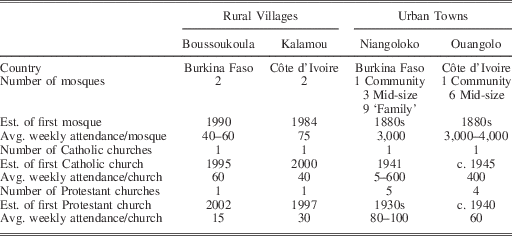
To find out, we interviewed religious leaders in each of the four survey sites to determine the local supply of religious institutions, and found that they were nearly identical in each pair. The rural villages of Boussoukoula and Kalamou each have two mosques, one Catholic Church and one Protestant center for worship. In the large, urban towns, the structure of mosque sizes differs, but the total amount of Muslim worship space is comparable, and the number of Christian churches is almost identical (see Table 3).
The Supply of Religion by Village/Town

Note: all estimates provided by religious leaders in respective villages. The majority of Muslims in the region attend only Friday prayer services. Muslim attendance estimates for the urban towns refer to the community mosques, which are large, non-denominational mosques. Represented among the mid-size mosques in both urban towns are the Sunni, Tijaniyya and Ahmadiyya denominations. Represented among the Protestant churches in both urban towns are the Assembly of God, Baptist, Alliance and Mission International churches. Leaders of all churches in all four villages reported adherents coming primarily from the village/town itself, with a small minority coming from neighboring villages.
But what about the quality of religious institutions? It may be that the number of churches/mosques is less important than how active they are. Again, such activity may be an indicator of religious salience rather than a cause, but it remains useful to test whether there are meaningful differences across our Ivorian and Burkinabé study communities. We attempt to get at this issue (imperfectly, we recognize) by comparing when each church or mosque was built, based on the logic that low-quality religious institutions would disappear over time. Again, we find strong similarities across the site pairs (see Table 3). In both urban sites, the first mosques appeared in the 1880s, under the guidance of Islamic militant Samory Touré.Footnote 63 Protestant churches appeared in the 1930s, and a large Catholic church quickly followed in each town in the early 1940s.Footnote 64 In the rural sites, mosques first appeared in 1990 and 1984, respectively; Christian churches appeared in both villages only within the decade prior to our research. Attendance rates are also comparable, given the relative sizes of the religious communities in each area. Given these similarities, the explanation for cross-border differences in religious salience likely lies elsewhere.
An alternative formulation of the supply-side argument emphasizes religious pluralism, and the resulting competition for members, at the national level.Footnote 65 By this logic, the outcome we observe in our study area could be a product of different levels of national-level religious pluralism in Côte d’Ivoire and Burkina Faso, which might inspire different degrees of intra-group competition for adherents and hence different levels of attachment to religion throughout each country – including in peripheral regions like the ones we study. The Alesina et al. Religious Fractionalization score for Côte d’Ivoire is indeed slightly higher than for Burkina Faso (0.755 versus 0.580), but both countries place in the top third of the worldwide distribution, suggesting that the difference is a matter of degree rather than kind.Footnote 66 Furthermore, if national-level religious pluralism and the competition to which it gives rise are responsible for reshaping the salience of religion in Côte d’Ivoire, those attachments should manifest themselves in the local practice of religion and in the building of religious places of worship. As noted, we do not find evidence that they do.Footnote 67
Having ruled out explanations that prioritize sociological and economic factors, we turn now to our preferred political explanation, which links the greater salience of religious identity in Côte d’Ivoire to respondents’ greater exposure in that country to the politicization of religion during the Ivorian civil war.
The Political Mobilization of Religion in Côte d’Ivoire
Under President Houphouët-Boigny, Côte d’Ivoire was a country in which religious and ethnic differences were largely mitigated through cooptation.Footnote 68 However, in the power struggles that erupted after Houphouët’s death, politicians seized upon ethnic and religious differences as a means of winning and holding onto power, most famously in the xenophobic policy of Ivoirité (Ivorianness). In so doing, they opened deep fissures between southern (largely Christian) and northern (largely Muslim) Ivorians, the latter of whom were identified with the country’s many foreign migrants from northern, and largely Muslim, countries.Footnote 69 A coup in late 1999 was followed by disputed elections in 2000 and a 2002 rebellion that divided the country. The civil war officially ended with a peace agreement in 2007, though hostilities continued into the next decade. Observers generally take the 2000 elections and ensuing violence as the start of the actual conflict, though the discriminatory policies put in place in the aftermath of Houphouët-Boigny’s death in 1993 constitute the beginning of identity divisions.
Although the rhetoric of Ivoirité was typically couched in the ethno-national distinction between ‘authentic’ Ivorians and foreigners, ‘at the street level “foreigner” translated rather loosely into […] Muslim’.Footnote 70 Hence the xenophobic appeals very easily led to divisions along religious lines. These divisions were only deepened by current President Alassane Ouattara’s claim in late 1999 that he was prevented from running for president in 2000 ‘[…] because I’m a Muslim […]’,Footnote 71 by former president Laurent Gbagbo’s labeling of opposition forces from the North as ‘the Ivorian Taliban’,Footnote 72 and by the burning of churches and mosques and the murder of religious leaders during the course of the conflict.Footnote 73 By the time of our fieldwork in 2005, Côte d’Ivoire had become a place where religious differences were a central lens through which national politics were viewed.
Both sides saw religion as a conduit to political legitimacy and support during a period of crisis. Gbagbo, a southern Christian, successfully lobbied fellow evangelical Christians and US Senator James Inhofe to call for US involvement from the Senate floor.Footnote 74 For his part, Ouattara, a northern Muslim, ‘found his battle horse in religion’, rallying the support of the Superior Council of Imams in addition to party loyalists and Muslim sympathizers.Footnote 75 These strategies are in keeping with the exploitation of the institutional and moral features of religion that Wald, Silverman and Fridy and others have described.Footnote 76
Against this backdrop, it is perhaps not surprising that survey respondents in Ouangolodougou and Kalamou were more likely than their counterparts across the border in Niangoloko and Boussoukoula to view religion as their most important social identity. Nor is it surprising that the Ivorian respondents were much more likely than their Burkinabé counterparts to say that they feel closer to someone from their religious group than to someone from their country, or that they were less willing to marry across religious lines. Although living only a short distance apart, the Ivorian respondents’ physical location in the country in which the religiously tinged civil conflict was taking place seems to have increased the emphasis they placed on religion as a social identity.Footnote 77
Suggestive evidence that these differences are, in fact, products of a relatively brief window of religious politicization in the post-Houphouët era comes from answers to a survey question asking respondents whether they prayed less, the same or more at the time of our field work (in 2005) compared to ten years prior. Religiosity (as measured here by how often people pray) appears to have risen among respondents in both countries. But whereas Burkinabé respondents were roughly 2.5 times more likely to say they pray ‘more’ than ‘less’ (42 per cent versus 17 per cent) compared with ten years earlier, Ivorian respondents were more than 4.5 times more likely to say this (55 per cent versus 12 per cent; p-value on the difference, calculated by cluster mean=0.10). If the respondents’ answers can be taken as a meaningful measure of increasing religiosity, then Ivorians became more religious faster than the Burkinabé – a finding that is consistent with the differential politicization of religion in each country during the first few years of the Ivorian conflict.
The explanation thus far has emphasized the impact of political events on the Ivorian side of the border. But we must also consider whether the finding of greater religious salience on the Ivorian side of the border might instead be driven by a reduction in the salience of religion in Burkina Faso. Since we measure the importance that respondents attach to their religious identity compositionally – that is, in a way that reduces the overall level of religious salience each time a respondent ranks a non-religious identity first – this could occur if something in Burkina Faso caused respondents on that side of the border to emphasize a different identity.
The most plausible alternative to religious identity there is nationality, which was chosen by 42 per cent of Burkinabé respondents as their top identity.Footnote 78 This figure is indeed high: Burkina Faso would have ranked third in attachment to national identity had it been included among the sixteen countries in the Round 2 Afrobarometer survey.Footnote 79 Yet aside from former President Blaise Compaoré’s occasional role as a regional mediator, there has been little to distinguish the Burkinabé national identity prior to the overthrow of Compaoré in 2014. Just as likely is that the prominence of other principal identity types, notably ethnicity and religion, has been tempered – the former through the dominant size of the Mossi,Footnote 80 and the latter due largely to cross-cutting cleavages and a gradual ascendancy of Islam and Christianity devoid of antagonism.Footnote 81 In fact, to the extent that the salience of national identity is higher in Burkina Faso than is typical of countries in the sub-region or of Burkina Faso at other points in time, some consider this a secondary effect of the civil strife in Côte d’Ivoire.Footnote 82 The recognition that they do not suffer civil strife may have accentuated respondents’ attachments to nationality in Burkina just as it accentuated attachments to religion in Côte d’Ivoire. If so, this would only reinforce the argument that the politicization of religion in Côte d’Ivoire best accounts for the cross-border differences we highlight.
CONCLUSION
In this article, we have shown that living on the Côte d’Ivoire side of the arbitrarily imposed border between Côte d’Ivoire and Burkina Faso is associated with a significantly higher likelihood of ranking religion as one’s most important social identity and favoring one’s co-religionists over one’s co-nationals, and with being less willing to marry someone of a different religion. We weigh several possible explanations for these differences and conclude that the most likely explanation is a political one rooted in the greater exposure of people living on the Ivorian side of the border to the politicization of religion during a period of political upheaval in Côte d’Ivoire. Our findings are consistent with an instrumentalist political account of the salience of religious identity, and illustrate how political elites’ mobilization efforts can affect the priority that people attach to social identities like religion.
These results are in keeping with growing evidence that several recent, ostensibly religious, conflicts have their origins in localized disputes and grievances that have little to do with religion per se. Christian–Muslim violence in the Central African Republic grew out of a personal power struggle between leaders.Footnote 83 The supposedly Islamic rebel group active on the Congo–Uganda border owes its origins more to unresolved political and socio-economic injustices than to religious orthodoxy.Footnote 84 And political identities in the longstanding Israeli–Palestinian conflict have oscillated between the religious, the racial and the national.Footnote 85 Surveys conducted in any of these settings would almost certainly suggest that membership in one’s religious community is highly salient. But, as along the Côte d’Ivoire–Burkina Faso border, it would be premature to conclude that this salience stemmed from the social, economic or religious context without first examining the political factors at work.
In addition to reaffirming the effects of political context on religious identities, the study makes three additional contributions. First, it gives an indication of the speed with which social identities can become salient. While others have documented the possibility of rapid changes in identity salience triggered by elections, our findings, which we attribute to changes that took place between the onset of the Ivorian conflict in 2000 and our data collection in 2005, provide a non-electoral example of how the salience of identities can swing in discernible ways in just a few years.
Secondly, our account demonstrates how conflicts with origins in one dimension of social identity can affect the importance that people attach to other dimensions of social identity. Although the Ivorian civil war began for reasons related to ethno-national discrimination and access to political opportunities rather than religious differences or doctrine, our findings suggest that they affected the salience of religious identities – all due to the happenstance correlation between religion and national origin in Côte d’Ivoire’s immigrant-based economy.
Finally, our study provides evidence of the surprising local-level importance of African boundaries. Due to the manner in which they were drawn, African borders have long been viewed as providing only juridical clarity to peripheral areas with low population densities and little connection to the politics that take place in far-off national capitals.Footnote 86 Our finding of significant discontinuities at a (particularly peripheral) border suggests the need to reassess this view.
Appendix
Descriptive Statistics

Determinants of Religion as the Primary Self-Identification Choice