Karl Marx said “Religion is the opiate of the masses.” He was wrong. It's sports.
—Bill ScharrerFootnote 1In recent decades, professional football in Europe has emerged as the “second religion” in Africa. In the words of Musa in Nigeria, “European football has become part of my life, it is more than just a source of entertainment but it's like my second religion.” Another Arsenal supporter, Jude, does not even deny the risk of escalating violence: “What often makes me angry in football centers [places to watch European football broadcasts] is the insult and unnecessary mockery. There are times people will tell you something that will annoy you just because their team beat yours … This kind of negative words sincerely stir anger in one, and I believe it can cause physical fights one day.”Footnote 2 Clearly, the outcomes of football games played over 5,000 kilometers away have a profound impact on the lives of Nigerians. Could this “second religion” cause conflicts—something more than just brawls—in Africa? If so, by what mechanisms?
We answer these questions by analyzing the effect of results in professional football in Europe on conflicts in Africa. In doing so, we challenge previous studies on conflict, which until recently have ignored the roles of politically irrelevant factors like sports events.Footnote 3 Most of the standard frameworks—including grievance theses,Footnote 4 contentious politics frameworks,Footnote 5 collective action theories,Footnote 6 and bargaining modelsFootnote 7—give the impression that politically irrelevant events should not matter, because they would not obviously affect the costs, benefits, information, or outcomes of conflict. We, however, argue that psychological cues do have an effect.
To this end, sports events provide unique analytical advantages. Other dramatic events, like natural disasters, are also influential. However, disasters provide citizens with objective information about the government's performance in mitigatory and response policies.Footnote 8 Thus, even without any effects from psychological cues, natural disasters can affect information, and thus citizens’ rational choices, and hence conflicts. By contrast, as Ashworth, Bueno de Mesquita, and Friedenberg acknowledge,Footnote 9 sports events provide no objective information about politicians’ competence.Footnote 10 The political irrelevance of sports events allows us to isolate the effects of psychological cues from those of rational updates.
Moreover, unlike Card and Dahl and related studies on the economic and social consequences of sports events,Footnote 11 we analyze a politically, geographically, and causally distant relationship between football in Europe and conflicts in Africa. While the literature focuses on domestic relationships, the effects of “local” sports events are rarely exclusively local; hundreds of millions of people in Africa, for instance, breathlessly watch football games played in Europe. Given the globalization of the sports industry, it is imperative to understand the intercontinental spillover of major sports events.
Last but not least, unlike recent studies on big international sports events such as the World Cup and the Africa Cup of Nations,Footnote 12 we focus on European professional football to ensure the political irrelevance of the events. Even though we do not find compelling evidence except for a few correlational studies,Footnote 13 one might still suspect that politicians in Africa could affect the results of international competitions via budgetary allocations and sports policies (for example, selection of managers and coaches).Footnote 14 By contrast, African politicians have no meaningful influence over the results of professional football in Europe. This means that if the professional football games in Europe affect conflicts in Africa, the reasons must be something other than rational updates—such as psychological factors.
One such factor is moods; losing a game can affect emotional status, causing anger, distress, shame, sadness, and anxiety.Footnote 15 People can join protests to vent their negative mood. Conversely, people may bask in the glory of their team's victory. Another factor is misattribution; people can directly or indirectly misattribute “bad luck” in a game to their politicians and thus stage protests.Footnote 16 By contrast, after a game victory, people may give undeserved credit to politicians. Finally, the collective experiences of victories and losses can unite football fans across ethnic cleavages, which may halt conflicts, especially those related to ethnic issues.Footnote 17
We examine these mechanisms in two sets of analyses. In the first, we identify the effect of game results in Europe on protests in Africa by exploiting as-if random variation in the results of close football games conditional on pre-game betting odds. Analysis of 15,087 close games and 40 African countries reveals that compared to draws, losses of African players’ teams increase peaceful demonstrations in their original countries while not changing the likelihood of riots or armed conflicts. The effect of close losses is particularly large for non-ethnic demonstrations targeted at a central government.
Once we establish the causal relationship, we dissect the mechanisms by using individual-level surveys. By exploiting as-if random coincidences of survey interviews and football games, we show that compared to draws, close losses temporarily decrease people's trust in their political leaders, while winning or losing games have almost no effect on people's moods. Overall, these findings, as well as extensive analysis of effect heterogeneity and robustness, indicate that football games in Europe have sizable effects on social conflicts in Africa.
Africa and European Professional Football
European professional football is an important entertainment in the daily lives of Africans. Partly due to the relative lack of alternatives, soccer is the most popular sport in Africa.Footnote 18 This feature distinguishes it from Asia, where other sports are also popular, and also from Latin America, which has vigorous domestic leagues. According to a 2011 survey, 71 percent of people in Africa have an interest in soccer.Footnote 19 And around 276 million people in Sub-Saharan Africa—about a quarter of the entire population—regularly watch the Premier League.Footnote 20 Moreover, as the anecdotes at the beginning of this paper reflect, many Africans are devoted fans of European professional football. As Ka, Od, and I describe, “The European football fellowship is a new ‘religion’, another kind of ‘ethnicity’, and other form of ‘ritual’.”Footnote 21 Due to the absence of cable networks and the high cost of good display devices, most Africans use so-called viewing centers, where they pay an entrance fee to view live football games on satellite television (or over the Internet from the 2010s). Because of the zealous fandom, ubiquitous coverage on satellite television, and low entrance fees, since the late 1990s viewing centers have spread across the continent, even to rural villages.Footnote 22
Fandom's rapid growth is the flip side of the increasing presence of African players in European football. In 1970 only one African player played in the top five leagues; in 2005, there were 217 who did (Figure 1). In the period of our analysis (the 2005 to 2018 seasons), 990 Africans play in the top five leagues, 79 percent of games have at least one African player, and two players per game originally come from Africa. Among those players, 63 percent are from Western Africa, followed by Eastern (24%), Northern (10%), and Southern Africa (3%).Footnote 23 Similarly, 47 percent of them play in Ligue 1, followed by Serie A (16%), Premier League (14%), Bundesliga (11%), and La Liga (11%). These patterns reflect soccer's overwhelming popularity in Western Africa,Footnote 24 where most countries are former French colonies.
The rapid increase of African players in European professional football

In this paper, we focus on the results for football teams to which an African player belongs. People can support teams without African players, but the presence of co-national players is a strong indicator of fandom. For example, the popularity of Chelsea in Côte d'Ivoire is often attributed to the presence of national players, such as Didier Drogba and Solomon Kalou.Footnote 25 Similarly, the presence of Nwankwo Kanu is said to make Arsenal popular in Nigeria.Footnote 26 Because this is an important assumption in the interpretation of our findings (though we did not come up with compelling alternatives), we test the relationship in Appendix A2. We find that the presence of co-national players is indeed a significant predictor of fandom. Later, we also check robustness by analyzing players’ appearance in games.
The Psychological Origins of Social Conflicts
We argue that the results of football games provide a psychological cue and thus affect the likelihood of conflict. To be clear, we do not argue that football games would cause full-fledged civil wars, which depend on organizational and strategic dynamics. However, social conflicts (like peaceful demonstrations and violent riots) depend on individuals’ participation and are hence subject to people's cognitive biases. In fact, many protests are small and thus do not require collective action.Footnote 27 Among the protests occurring in Africa in 1990 to 2017, 37 percent had less than a hundred participants, and only a third had more than a thousand.Footnote 28
Importantly, psychological explanations are complementary to standard theories of protests. For instance, deviant behavior by even just a few individuals can change the strategic calculus of other rational people or organizations, and thus spark large-scale protests. As Kuran states, the participation of a few deviant people can marginally improve the prospect of a protest and thus induce other rational people to join in, which in turn may lead to the participation of even more.Footnote 29 This can quickly snowball into unexpectedly large protests.Footnote 30 Similarly, the results of football games can provide opposition parties or movements with psychological cues, which can be used to mobilize people for protests.Footnote 31 Thus, even though psychological cues may or may not affect armed conflicts specifically, they can cause both small- and large-scale protests.Footnote 32
Null Expectation: Rational Update
From the perspective of a standard rational update model,Footnote 33 the results of professional football games in Europe should not affect protests in Africa because they do not change material payoffs or provide any new information about the competence of domestic politicians. Any effect sports and education policies might have on the performance of African players in Europe would only become meaningful over decades. This means that those policies do not immediately reveal the politicians’ competence. Thus, any immediate effect of European professional football should be explained by reasons other than rational update.
Mechanism 1: Mood
A straightforward explanation is that the results of the football games influence moods—that is, transitory feeling statesFootnote 34—which in turn affect the likelihood of protests. On the defeat of a favored team, people can lose excitement and confidence, and feel sad or even angry. Although people can vent their negative moods through various means (for example drinking, gambling, crime, and violence),Footnote 35 joining protests can also alleviate them.Footnote 36 Conversely, a victory for their team can relieve people's negative moods and provide positive feelings of enthusiasm and elation, and hence halt protests. Thus, the mood mechanism predicts that the loss (win) of an African player's team will increase (decrease) protests in his original country.
The literature on social psychology, however, implies asymmetric effects. The basking-in-reflected-glory and cutting-off-reflected-failure theses state that people tend to associate themselves with a glorious outcome of their favored team and thus obtain positive moods, while they tend to discount such an association to maintain their mental status when their favored team experiences a failure.Footnote 37 The asymmetric mood mechanism therefore predicts that winning games foster positive moods and hence reduce protests, while losing games have no effect.
Mechanism 2: Attribution
Other (not mutually exclusive) mechanisms are based on misattribution—that is, unjustified credit and blame. While the mood mechanism primarily pertains to emotion, attribution relates to (distorted) information processing. In its simplest form (direct attribution), people can attribute bad luck in football games not only to the players, coaches, and managers in Europe but also, unreasonably, to domestic politicians.Footnote 38 Although direct misattribution may or may not be realistic, attribution can also be indirect.Footnote 39 Because contemporary political processes are complicated, people often use their subjective welfare heuristically to evaluate politicians’ performance. From this perspective, losing matches can hurt the subjective welfare of people, which in turn can be blamed on politicians and thus lead to protests. Or, on the victory of favored teams, people might give politicians undeserved credit, forgiving their objective incompetence.Footnote 40 The misattribution mechanism predicts that losing games will trigger protests while winning games will curb them.
The social psychology literature implies asymmetric effects. Success/failure bias refers to the human tendency to blame others for failures (even when they are not responsible) while crediting successes to oneself (even when one is not responsible).Footnote 41 People can then perceive their favored team's victory as a personal success and thus may not credit politicians (or refrain from protesting), while they directly or indirectly attribute their favored team's losses to domestic politicians (and join protests). This egoistic attribution, which we call the asymmetric misattribution mechanism, suggests that losing games will cause blaming and protests, but winning games will not improve people's attitudes toward politicians or reduce protests.Footnote 42
Mechanisms 3: Identity
Finally, the glory or misery shared with co-national players may unite fans under the national identity, which in turn may make existing ethnic cleavages less salient and halt protests, especially those related to ethnic issues.Footnote 43 As the rally-around-the-flag effect suggests,Footnote 44 both collective glory and suffering unite people. The rally mechanism predicts that both winning and losing games will reduce (ethnic) protests. Table 1 summarizes the causal mechanisms and predictions.
Causal mechanisms and predictions

Note: 0, +, and − indicate no, positive (higher likelihood of protests), and negative (lower likelihood) effects, respectively.
Event Data Analysis: Research Design
We test the hypotheses by conducting two sets of empirical analyses: an event data analysis at a macro level, and a survey analysis at the individual level. One empirical challenge is that the results of European football games are not randomly assigned. For instance, better sports and education policies may be associated with both a larger number of star players from a country and greater social stability. This endogeneity might create a spurious correlation. We address this problem by using a natural experiment in both analyses: we compare a close win, draw, and loss of an African player's team. Because the fates of close games are easily swayed by random chance, such as shots that hit the post and own goals, the treatment assignment should be closer to as-if random.Footnote 45
Another problem is that points are scored less frequently in soccer than in other sports. As a result, one goal means a big difference, and thus even winners and losers of close games can be systematically different. In fact, even though we compare the narrowest margin of wins and losses,Footnote 46 the later balance check indicates that the natural experiment improves the covariate balances but does not do so perfectly.
In the event data analysis, we therefore follow Card and Dahl's well-established approach by conditioning on pre-game bookmaker betting odds (decimal odds).Footnote 47 Betting odds are the inverse of expected probabilities of game results (a 50% probability of winning gives 2.00 odds). Thus, to the extent that betting odds provide accurate predictions of game results, we can directly observe the treatment assignment probability and hence identify the causal effect. Our identification assumption is therefore that conditional on the pre-game betting odds, the results of close games are randomly assigned. Substantively speaking, if two games have similar betting odds but their results are different, the difference can plausibly be considered “unexpected” and thus as-if random. Moreover, because inaccurate betting odds can cause large financial losses, bookmakers have strong incentives to measure them accurately.Footnote 48 Even though it is sometimes difficult to predict the results of football games, our design is valid to the extent that the bookmakers make an accurate prediction or the result of a close game is random. As a robustness check, we limit the comparison to close games of similar betting odds and similar numbers of shots on target to focus on even closer games.
We also use the difference-in-differences (DiD) by taking the first difference of the outcome variable between a few days before and after a football game. This eliminates confounders that do not change over that period (for example, reporting biases in conflict data). Because DiD can overstate effect sizes,Footnote 49 we also report the results without first differencing and those with lagged dependent variables (LDV) models in a robustness check.Footnote 50
Finally, we account for potential reverse causality (anticipation of protests might affect player performance and violent plays, which in turn could affect game results)Footnote 51 as well as alternative interpretation (policies in African countries might affect the performance of African players and thus game results) by controlling for player performance in a robustness check.Footnote 52 The remaining variation in the game results comes from the performance of the African players’ teammates. It is unlikely that the performance of non-African players would be affected by conflicts or policies in an African country.
Sample and Unit
The unit of analysis is a pair of a player i and a football game j. Figure 2 illustrates the configuration of our data. Because each player has a single birth country and each game has a single date, we can uniquely define the outcome variable: the incidence of protests in player i's birth country a few days before and after game j.Footnote 53 Similarly, because a player belongs to a single team on the day of a given football game, the treatment variable—the result of player i's team in game j—is also uniquely defined. We use a player, instead of his birth country, as a unit to control for individual performance in a robustness check.Footnote 54 Although the event data analysis largely rests on country-level variation and might therefore be subject to aggregation biases, we later supplement it with an analysis of individual-level surveys.
Unit of analysis and variables

Our sample includes all players whose birthplaces are African countries, and the football games in the top five European leagues (La Liga in Spain, Premier League in England, Serie A in Italy, Bundesliga in Germany, and Ligue 1 in France) and the Champions League (group and knockout stages; only teams from the top five leagues) between the 2005–06 and 2018–19 seasons.Footnote 55 In the following analysis, we drop 272 games in which both sides had players from the same African country,Footnote 56 and limit the sample to close games.Footnote 57 The resulting data contain 61,527 observations, including 951 players from 40 African countries in 184 teams playing 15,087 close games. For simplicity, we split the sample into the games in which African players’ teams drew or closely lost (N = 43,984), and the games in which they drew or closely won (N = 43,084).Footnote 58 The summary statistics are given in Appendix A4.
Treatment Variable
The treatment variable D ij is a dichotomous variable that is 1 if African player i's team loses or wins in game j and 0 if the result is a draw. We code the treatment status based on African players’ team affiliations instead of their appearance in games.Footnote 59 To be sure, we later conduct a robustness check by splitting the sample into those with and without African players’ appearance. The data were scraped from Transfermarkt.com on 7 April 2021.
Outcome Variables
The outcome variable ΔY ij is the difference in the daily probability (%) of conflict incidence in player i's birth country before and after football game j:  $\Delta Y_{ij} = 100\left({{{\mathop \sum \nolimits_{t\in { {1, \ldots , T} } } y_{ijt}} \over T}-{{\mathop \sum \nolimits_{t\in { {-T, .., -1} } } y_{ijt}} \over T}} \right)$, where y ijt is a dummy of conflict incidence in player i's birth country t days after game j, and T is a time window.Footnote 60 We omit observations on the day of the game (t = 0) because the treatment status is indeterminate (hours before a game are controlled, while hours after a game are treated). We use a three-day window (T = 3) because the games should have only temporary effects and because a three-day window effectively contains an entire week (3 + 1 + 3 = 7).Footnote 61 In robustness checks, we use different time windows.
Incidences of protest are derived from Armed Conflict Location and Event Data (ACLED) and the Social Conflict Analysis Database (SCAD), which are standard data sets of conflict events.Footnote 62 For ACLED, we include all demonstrations and riots if the exact date information is available.Footnote 63 We also create a separate variable of battles between armed groups for comparison. For SCAD, we collect demonstrations and their types (e.g., sizes, targets, and issues).Footnote 64 Although SCAD contains richer information about each event, it substantially underreports the number of events. For instance, while according to ACLED, about 10 percent of the observations experienced demonstrations within three days after the football game, the number is less than 3 percent in SCAD. Moreover, SCAD does not contain information about the precision of event dates,Footnote 65 which is crucial for our daily-level analysis, and the data set has not been updated since 2018. Thus, we use ACLED in the main analysis and supplement it with SCAD to disaggregate the demonstration events by target, issue, and size.
Although both data sets depend on media reports and are thus subject to reporting biases, “as long as the measurement error is uncorrelated with the independent variables, measurement error in the dependent variable is not particularly problematic in a standard regression framework other than increasing the uncertainty around the estimates we obtain.”Footnote 66 Moreover, because we use the first differences of the outcome variables, the reporting biases do not matter unless there are systematic differences a few days before and after a football game.
Control Variable
The data on pre-game betting odds in the top five leagues are BetBrain's average bookmaker betting odds from Football-Data.co.uk (scraped 1 January 2022). These are averages of twenty bookmaker websites, providing the most consistent data on betting odds for every football game played in the 2005–2019 period. Because the data set does not cover the Champions League, we supplement it with Odds Portal's average betting odds (<https://www.oddsportal.com>, scraped 5 April 2021). The treatment assignment probability (%) is calculated as  $P_{ij} = 100{{{\rm odd}{\rm s}_{{\rm draw}, ij}} \over {{\rm odd}{\rm s}_{v, \;ij} + {\rm odd}{\rm s}_{{\rm draw}, ij}}}$ for v ∈ {loss, win} and game j of player i's team.
Specification
With the directly measured assignment probabilities, we conduct nearest-neighbor matching without replacement.Footnote 67 We use the unstandardized caliper size of five percentage points (we later conduct robustness checks with different calipers). The matching yields 12,168 losing and draw games (91% of the sample) and 11,943 winning and draw games (90% of the sample). The resultant samples include 35,481 and 34,033 player-game observations, respectively.
With the matched samples, we estimate the average treatment effect that is local to a few days before and after a losing or winning game (local average treatment effect on the treated, LATT) by taking a difference:
 $${\rm LATT} = {\rm E}[ {\Delta Y_{ij}\vert D_{ij} = 1, \;\;P_{ij}\approx p_{ij}} ] -{\rm E}[ {\Delta Y_{ij}\vert D_{ij} = 0, \;P_{ij}\approx p_{ij}} ] $$
Here, i and j are a player from an African country and a football game, respectively. We condition on the inverse of betting odds P ij so that treated and control units have assignment probabilities centered on a value of p ij.
Because our design accounts for confounders, we do not use fixed effects in the main analysis and leave it to robustness checks. The unit fixed effects are redundant because DiD accounts for static factors. Time fixed effects (year, month, week, day of the week) are also unnecessary as far as the treatment is as-if randomly assigned. For instance, even though the football games are usually played on weekends, we compare losing, winning, and draw games. As a result, the weekend effects are canceled out in the comparison.Footnote 68 This means that day-of-the-week fixed effects are redundant and only reduce the power of analysis. In fact, as we show in robustness checks, the estimates are nearly identical across various specifications with fixed effects. The fixed effects also make the estimates less interpretable and more dependent on modeling assumptions,Footnote 69 exacerbate the attenuation biases of measurement errors,Footnote 70 and limit external validity.Footnote 71
The standard errors are two-way clustered by country and game. Clustering by country accounts for the cases where players from the same country belong to different teams, thereby yielding repeated values of the outcome variable. Clustering by game accounts for situations in which multiple players from Africa belong to teams in the same game, which also yields repeated values of the treatment variable.
Event Data Analysis: Results
The analyses with the main specification indicate that both barely losing and barely winning games increase the likelihood of demonstrations (Table 2). Substantively, a close loss (win) increases the probability of demonstrations by 0.67 (0.62) percentage points. Because the average value of the outcome is 0.60 percentage points, the close loss and win double the rate of demonstrations. By contrast, the effects on riots and battles are statistically and substantively minimal; the effect sizes are less than half of that of close losses on demonstrations, and all of the signs are negative.Footnote 72 The null effect on battles is consistent with our argument that armed conflicts are driven by organizational and strategic dynamics. The null or even slightly negative effect on riots implies that emotional cues can drive people to start protests, but they may avoid risky options and use relatively safe means, which is consistent with some of the previous findings about rationality in irrational behaviors.Footnote 73
Effect of close losses and wins on conflict incidence

Notes: Coefficient estimates, with corresponding standard errors in parentheses. The standard errors are two-way clustered by player's birth country and game. The sample includes 12,168 (11,943) games, 931 (929) players, 184 (184) teams, and 40 (40) countries for the comparison of losing (winning) and draw games. *p < .05; †p < .10.
Figure 3 shows the results without first differencing. The outcomes are the incidence of demonstrations on each day from the game. The effects of close losses are pronounced one to three days after the game, and there is no significant effect on demonstrations before the game. By contrast, the effect of close wins is not statistically significant, and there are subtle (perhaps random) decreases in event probability one to two days before a game. DiD magnifies the subtle differences and makes the estimate positive in Table 2.Footnote 74 In fact, the effect of winning disappears in a later robustness check with an LDV model, which provides a conservative bound.Footnote 75 Overall, we find that barely losing games increase demonstrations, while the effect of winning games is uncertain. These results are not consistent with the rational update, asymmetric mood, or rally mechanism, leaving the mood, misattribution, and asymmetric misattribution mechanisms as possibilities.
Effect by days from a football game (event data analysis)

We also disaggregate the targets, issues, and sizes of demonstrations by using SCAD, which provides more detailed information about each event.Footnote 76 The findings hold with this alternative data set (first column of Figure 4). Moreover, the effects of close losses are particularly large for non-ethnic demonstrations targeted at a central government.Footnote 77 We do not see differences due to the size of the demonstration. These results are inconsistent with the rally mechanism (null effect on ethnic demonstrations) and provide suggestive evidence for the attribution mechanisms (the existence of targeting). Because central governments are more visible, they can be an easy target of misattribution.
Effect by target, issue, and size of demonstration (SCAD data)

Assumption Checks
To check the validity of the assumptions, we first regress the treatment variable on the assigned probabilities based on the betting odds (simple linear regression; Table 3). If the betting odds are accurate measures of assignment probability, the coefficient should be close to 1, while non-systematic measurement errors can cause biases toward 0. If the coefficient is larger than 1 or negative, it indicates the existence of systematic measurement errors and thus invalidates the design. In samples of all games, the coefficients are indeed close to 1, indicating the accuracy of the measurement. Predicting close games is slightly more difficult, reflecting the randomness of their results.
Prediction of game results by observed assignment probability

Notes: Coefficient estimates, with corresponding standard errors in parentheses. The samples are those before matching. The standard errors are two-way clustered by player's birth country and game. *p < .05; †p < .10.
Second, we check whether African players’ teams in the matched pairs have similar characteristics in a covariate that is not used in the matching.Footnote 78 To this end, we compare their differences in rank within football leagues. The team ranks are standardized to a 0–100 percentile scale (the smaller the number, the higher the rank), and from the rank of a losing or winning team we subtract the rank of a matched team in a draw game. Teams with high ranks are more likely to win and less likely to lose (Figure 5). Subsetting to close games shrinks the differences (second column of each pane), but there remain differences of over seven percentile points. Matching on betting odds, however, greatly reduces the differences. Even with non-close games (third column of each pane), the imbalances become small, though the team ranks are still different by one percentile point and the p-value is only marginally above the conventional threshold (p = .12). Combining the natural experiment and matching (last column of each pane) eliminates the remaining imbalances.
Differences in pre-game team ranks

Finally, we conduct placebo tests. In Appendix A5, we confirm that close losses or wins have null effects on past demonstrations (in-time placebos). In Appendix A6, we also find that an African player's game has null effects on demonstrations in countries other than his original country (African countries except for his original country, and countries in another continent; in-place placebos). These results lend further credence to the main findings.
Effect Heterogeneity
We also check face validity by subsetting the samples to substantively relevant cases—that is, games of players who are regularly on the pitch (regular players gain more attention), and games in the Champions League (high-stakes games). Figure 6 reports the estimated effects of close losses and wins when we subset the samples by the terciles of players’ season appearances (left) and by league (right). In the left pane, the results are maintained only when players are regularly on the pitch. In the right pane, the point estimates are over three times larger for the Champions League, though the effects are not statistically significant due to the small sample size (only about 3% of the observations are games in the Champions League). In Appendix A8, we further assess effect heterogeneity by splitting the Champions League games into group and knockout stages, looking at the teams’ participation in the Champions League, and incorporating the popularity of football teams in African countries.Footnote 79
Effect heterogeneity (event data analysis)

Robustness Checks
Finally, we conduct a series of robustness checks, which are summarized in Table 4 and detailed in Appendix A11. The results of losing games are robust to those changes, while the results of barely winning games are less stable. Importantly, when we use the LDV model, which provides a conservative bound on the causal effect,Footnote 80 the effect of winning becomes null, and the point estimate shrinks to one-third. These results imply that our findings about winning could be an artifact of DiD.
Robustness checks (event data analysis)

Notes: *p < .05; †p < .10.
1. Significant at a 10% level with player-specific week fixed effects, and null with all of the player-specific time fixed effects.
2. Significant at a 10% level with player-specific year fixed effects.
3. Statistically significant at a 10% level for T = 1.
4. Null for T = 1.
5. Significant at a 10% level for 4 out of 40 cases.
Overall, the event data analysis indicates that barely losing games increase peaceful demonstrations, while the effect of barely winning games is uncertain. These results are consistent with the mood, misattribution, and asymmetric misattribution mechanisms (Table 1). The additional analyses—especially those about targets—provide some support for the asymmetric misattribution mechanism. The caveats are that we have not yet directly quantified attribution, moods, or identity, and that the country-level analyses can suffer from aggregation biases. In the following sections, we therefore analyze individual-level surveys.
Survey Analysis: Research Design
We examine the effect of the football games on mood, attitude toward politicians, and nationalistic sentiment by analyzing individual-level surveys from Afrobarometer.Footnote 81 However, as we mentioned, the natural experiment with close games is useful but insufficient for causal identification. Moreover, conditioning on pre-game betting odds is not reliable because there are so few football games during the periods of the Afrobarometer surveys.
We address these problems by exploiting as-if random coincidences of survey interviews and football games. That is, we compare people who are interviewed just a few days before or after a close football game.Footnote 82 Thus, the critical assumption is that the dates of survey interviews are not affected by the results of close football games in Europe. As Depetris-Chauvin, Durante, and Campante argue, this is plausible as “the logistics involved in the implementation of the Afrobarometer survey (selection of the enumeration sites, setting up of the field teams, etc.) requires many months if not years of preparation, and are hardly related to the occurrence of sports events let alone to their unpredictable result.”Footnote 83 The dates of the games are also set at the start of each season and are unlikely to be affected by the Afrobarometer surveys. But because the games might affect non-responses in the surveys, we conduct balance checks, placebo tests, and density tests.
Sample and Unit
The unit of analysis is a triplet of a survey respondent, a player from a country in Africa, and a football game. The pairs of players and football games are organized like those in the event data analysis.Footnote 84 We then link a survey respondent to the football game if the interview was held within three days before or after the game (we also use different time windows in robustness checks), and if players from the respondent's country belong to either team in the game.Footnote 85 The resultant sample of barely losing (winning) and draw games contains 7,659 (7,011) respondents in 15 (12) African countries who are interviewed around the dates of 27 (26) football games of 23 (23) players in 20 (21) teams between the 2005–06 and 2018–19 seasons.Footnote 86 Due to the lack of survey interviews held within the time window, the samples do not cover the Champions League. There are 10,398 observations for the sample of close losses and draws and 9,410 observations for the sample of close wins and draws. The summary statistics are available in Appendix 12.
Treatment Variables
The first treatment variable is the same as that in the event data analysis: a dichotomous variable D ij that takes 1 if African player i's team barely loses or wins game j and 0 if the result is a draw.Footnote 87 The second treatment variable, R jk, takes a value of 1 if respondent k was interviewed after game j and 0 otherwise.
Outcome Variables
The outcome variable W k is respondent k's answer to a given survey question. Following and expanding on Depetris-Chauvin, Durante, and Campante,Footnote 88 we select eighteen Afrobarometer indicators that are relevant to the causal mechanisms and available in a majority of the survey rounds in the period of analysis (2005–2019; third to seventh rounds).Footnote 89 For the attribution mechanisms, we select eight indicators about trust in a leader (president or premier), members of parliament (MPs), local councils, ruling parties, opposition parties, police, army, and courts, as well as three indicators of the performance of leaders, MPs, and local councils.
For the mood mechanisms, we use the interviewer's evaluation of the respondent's attitude during the interview, including friendliness, interest in the survey questions, cooperativeness, patience, ease, and honesty. Although ideally we would like to directly measure the positive and negative moods (e.g., excitement, elation, sadness, and anger) as in experimental studies,Footnote 90 the direct measures are not available. We therefore use the indirect attitudinal measures.Footnote 91 Even though each item does not directly relate to mood and only captures respondents’ positive attitudes, respondents’ moods can be reflected in their attitude, and thus the attitudinal measures can collectively capture respondents’ mood. For this reason, we aggregate the attitudinal measures by calculating the average (“overall mood”). Although this measurement may not be perfect, we believe it is the best available in our observational setup. Finally, following Depetris-Chauvin, Durante, and Campante, we use an item about national identity—a one-dimensional scale of ethnic-national identity. All of the survey answers are rescaled to a 0 to 10 range.Footnote 92
Specification
With these variables, we estimate the average treatment effect local to respondents who answered questions a few days before and after close losses or victories, by taking double differences:
 $$\eqalign{& {\rm LATT} = ( {{\rm E}[ {W_k\vert D_{ij} = 1, \;\;R_{\,jk} = 1} ] -{\rm E}[ {W_k\vert D_{ij} = 1, \;\;R_{\,jk} = 0} ] } ) \cr & \quad\,\,\,\,\,\,\,\,\,\,\,\,\,\,\,\,\,\,-\;( {{\rm E}[ {W_k\vert D_{ij} = 0, \;\;R_{\,jk} = 1} ] -{\rm E}[ {W_k\vert D_{ij} = 0, \;\;R_{\,jk} = 0} ] } ) .} $$
The main unit of analysis is respondent k. Player i ≡ i (k) refers to a player born in respondent k's country. Football game j ≡ j (i,k,h) refers to a game player i's team played within h days before or after respondent k's interview. For the reasons we mentioned in the event data analysis, the time window is set to three days (h = 3; see the Specification subsection of the event data analysis and note 61), and we conduct robustness checks with smaller windows. The observations are triangularly weighted by the days from a football game (respondents closer to games have larger weights). Even though this can also be considered a regression discontinuity design (RDD) with a discrete running variable (that is, survey date), we do not include the running variable because the time window is small and thus the regression can cause overfitting problems (see later robustness checks).Footnote 93 Finally, for the reasons we mentioned in the event data analysis (see the Specification subsection of the event data analysis), we do not use fixed effects or control variables and leave it for robustness checks.
We address the problems of multiple hypothesis testing by controlling the false discovery rate.Footnote 94 The standard errors are two-way clustered by country and game. As in the event data analysis, this accounts for repeated observations of games and players. Because each respondent belongs to a single country, clustering by country also accounts for repeated observations of survey respondents (see note 85).
Survey Analysis: Results
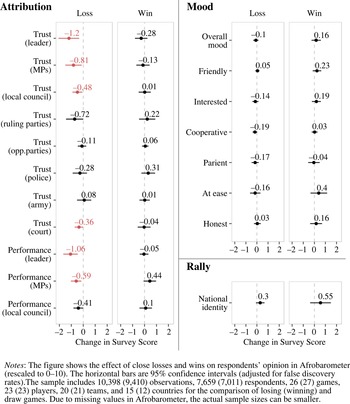
Figure 7 reports the results of the survey analysis.Footnote 95 People who answered the questions immediately after barely losing games tend to place less trust in a leader and under-evaluate the leader's performance (Figure 7, left). Because the average value of trust in a leader is 5.33, a close loss decreases it by 23 percent. Barely losing games also sours people's attitudes toward MPs and ruling parties, and, to a lesser extent, local councils and courts. The effect of close losses is nearly zero for trust in opposition parties, police, and the army. These results suggest that people tend to blame visible politicians (leaders, MPs, ruling parties) who are supposed to be responsible for their welfare.
Effect of close losses and wins on public opinion

By contrast, a close victory has little effect on trust or performance evaluation. Although close victories are estimated to decrease trust in a leader by 0.28 points, the effect is not statistically significant, and the effects on some of the other outcomes (for example, trust in ruling parties and performance of MPs) are even positive. Thus, at least statistically, there is no evidence that people blame or credit politicians for close victories. These asymmetric effects of losses and wins are consistent with the asymmetric misattribution mechanism.
Turning to the mood mechanisms (Figure 7, top right), we do not see any large effect on respondents’ observed attitudes. In fact, most of the point estimates and confidence intervals are tightly centered around 0, indicating precise nulls. Although we cannot exclude the mood mechanisms given the limitations of the measurement, we do not find strong evidence. Moreover, the mood mechanisms cannot explain why losing matches lowers trust in a leader while not changing trust in opposition parties, police, or the army. Without any attribution, bad moods should lower trust in any actors.
Similarly, we find only an inconclusive result for the rally mechanism (Figure 7, bottom right). Although the point estimates are positive and relatively large, they are not statistically significant. Thus, even though we cannot deny the possibility that both losing and winning games would unite people through nationalism, the statistical evidence is weak. Overall, the results are the most consistent with the asymmetric misattribution mechanism. The differential effects on political trust indicate that people directly or indirectly attribute bad luck in football games to incumbent politicians.
In Figure 8, we decompose the effect on trust in a leader by days from the game.Footnote 96 The effect of close losses is pronounced one day after the game. This result is consistent with the event data analysis, in which the effect of close losses is large one to three days after the game (Figure 3). This means that a close loss in a football game (which is usually played in the evening) affects people's perceptions the next day (t + 1) and then triggers demonstrations on days t + 1 to t + 3. The lag of up to two days may indicate the time during which tiny unreported events grow into those reported in the media.
Effect by days from a football game (survey analysis)

Mechanisms
The main results are consistent with the asymmetric misattribution mechanism. However, this may or may not mean that people directly attribute bad luck in football games to domestic politicians. A more realistic interpretation is that losing matches reduce respondents’ subjective welfare, which in turn is blamed on politicians (indirect attribution). We therefore analyze the effect of football games on respondents’ evaluation of the future, present, and past economy.Footnote 97 Losing games significantly lowers this evaluation (Figure 9). The fact that football games affect evaluations of the past economy implies that the results do not capture effects on the actual economy but that the games changed respondents’ subjective evaluation of their economic welfare.
Effect of close losses and wins on welfare evaluation

An alternative explanation is that the games attract people to viewing centers, allow them to talk with other people or politicians, and thus create opportunities for mass mobilization. We probe this channel by analyzing the effect on social interactions: the frequency of discussing politics, raising issues, and contacting government officials, MPs, or political parties. Neither losing nor winning games significantly affects the frequency of social interactions (Figure 10). Overall, even though the mobilization mechanism might be consistent with the results of the event data analysis, it is not supported by the survey data, or it cannot fully explain the asymmetric effects on leader approval.
Effect of close losses and wins on social interactions

Assumption Checks
To check the plausibility of the identification assumption, we conduct balance checks, placebo tests, and density tests, all of which are summarized in Table 5. As covariates, we use the eleven objective indicators: age, female, Muslim, Christian, primary education, employment, and access to food, water, medical care, cooking fuel, and cash (all dummies except for age). The third to sixth columns of Table 5 show the number of observations and average values of the covariates for the treated (those interviewed immediately after barely losing or winning games) and control (other respondents in a sample) groups. The seventh and eighth columns show the standardized mean differences and variance ratios of the treated and control groups. As a rule of thumb, a covariate is said to be balanced if the standardized mean difference is between −0.2 and 0.2 and the variance ratio is between 0.5 and 2.Footnote 98 The last column shows the p-values of placebo tests, in which the outcome variable in (2) is replaced by each of the covariates. Finally, the p-values of the density tests are reported at the bottom of each pane.Footnote 99 Although there are a few minor imbalances in four of the sixty-six balance metrics (6%), there is no consistent evidence of imbalance, and the density tests indicate no evidence of sorting. To be sure, we later check robustness by controlling for the covariates.
Balance checks, placebo tests, and density tests

Note: If the standardized mean difference is larger than 0.2 or smaller than –0.2, if the variance ratio is larger than 2 or smaller than 0.5 (Rubin 2001), or if p is less than 0.1, the number is bolded.
Effect Heterogeneity 1: Substantive Relevance
As in the event data analysis, we check face validity by subsetting to substantively relevant cases. Because the samples do not contain games in the Champions League (no game was played within three days before or after survey interviews), we only report the results by players’ season appearances.Footnote 100 Consistent with the event data analysis, the effects of losses are large for the games of regular players, while the effects of victories are null (Figure 11).Footnote 101
Effect heterogeneity 1 (survey analysis)

Effect Heterogeneity 2: Demographic Covariates
For explorative purposes, we subset the data by demographic indicators (Figure 12).Footnote 102 First, we use educational attainment to see whether education can reduce cognitive biases. The results provide some evidence—secondary education reduces misattribution—but we do not find equivalent results for higher education. This may be because people with higher education tend to learn liberal ideas and hence are more motivated to blame leaders.
Effect heterogeneity 2 (survey analysis)

Second, we split the data by gender to see whether the results are driven by male respondents. Although the point estimate is slightly larger for men, the difference is small, and close losses affect both men and women (Figure 12, second pane). One possibility is that after losing games, husbands might use violence to vent frustration,Footnote 103 and their wives could attribute their sufferings to political leaders. Because Afrobarometer does not contain information about marital status, we leave it to future studies to further explore this channel.
Third, we subset the samples by Islamic religiosity to indirectly quantify the role of drinking; that is, the results of football games might affect alcohol consumption,Footnote 104 which in turn might induce cognitive biases. Because the Quran prohibits drinking, if there is an effect on Muslim people, the explanation should come from other reasons. The effect of close losses is indeed even more pronounced for Muslim people (Figure 12).
Fourth, we explore whether media usage induces any difference in the causal effects. To this end, we conduct subsample analyses for television and Internet use—primarily as a means to watch live football games. Although only items about media access to news are available in Afrobarometer,Footnote 105 they may still be used as proxies. There are no large differences due to media usage (Figure 12, right). However, this could be due to the coarseness of the proxies. Note also that none of these covariates are exogenous, so the effect heterogeneity is not rigorously identified.
Robustness Checks
Finally, we conduct an array of robustness checks, which are summarized in Table 6 and detailed in Appendix A18. As seen in the table, while the results for close wins are unstable and mostly null, the effects of close losses are robust to most of the changes. The only exception is the inclusion of player-specific fixed effects but this is due to overfitting. In the survey analysis, we examine twenty-seven football games, of which only four are played by the same players. This means that the within-player variation in the treatment variable (the results of the football games) is tiny, and thus that the player-specific fixed effects are overly restrictive. Because the fixed effects are not essential in our identification strategy (see the Specification subsection of the event data analysis), we do not think this would pose particular problems.
Robustness checks (survey analysis)

Notes: *p < .05; †p < .10.
1. Due to the numerical instability with the fixed effects, the standard errors are two-way clustered by player (instead of country) and game.
2. Statistically significant at a 5% level with week fixed effects, and with all of the time fixed effects.
3. Statistically significant at a 5% level with player-specific week fixed effects; statistically significant at a 10% level with player-specific month fixed effects.
4. Null with player-specific week fixed effects.
5. Null for h = 3.
6. Significant at a 5% level for 1 of 16 cases, and at a 10% level for 1 of 16 cases.
Discussion
In this paper, we have analyzed the effects of psychological cues on conflicts and built hypotheses about the effects of far-away sports events on local protests. We find that compared to draw games, close losses of African players’ teams increase peaceful demonstrations in their original countries, while they do not change the likelihood of riots or armed conflicts. Such losses are also followed by a temporary decline in people's trust in their political leaders. By contrast, close victories have no equivalent or compensating effects on conflict or public opinion.
These findings provide both evidence and counterevidence for the various hypotheses we have mentioned. First, the rational update mechanism is unlikely to be sufficient; it cannot fully explain why politically irrelevant events affect protests or people's opinion in Africa. Second, the mood and asymmetric mood mechanisms are not strongly supported by our analyses. Data are limited, but we see no discernible effect of football results on the observed attitudes of the respondents. Also, these moods cannot explain the differential effects on political trust. Third, the misattribution mechanism cannot explain the weakly positive and mostly null effect of close wins on demonstrations, or the asymmetric effects on political trust. Fourth, the rally mechanism is also not supported by solid evidence; European football may or may not help people in Africa overcome ethno-religious divisions, but our analysis shows that it does not decrease protests, including those related to ethnic issues. This implies that we cannot simply extend the findings on international sports events to European professional football.
That leaves asymmetric misattribution. The near-null effect of close victories is consistent with the proposition that people tend to perceive victories as their own success and thus do not credit politicians. By contrast, since people tend to unreasonably blame others—including not only coaches and managers but also local politicians—for the failures of their favored teams, close losses should lower their trust in politicians and thus increase protests. The additional analysis of subjective welfare implies that the asymmetric misattribution can be indirect: losing games lower people's subjective welfare, which in turn is blamed on politicians. Finally, the weak finding that close victories increase demonstrations might be explained by self-confidence. That is, if people perceive a victory as their own success, they may become more confident of their own capabilities, which in turn may motivate them to challenge authorities. This, however, is conjecture; the effect of close wins is not robust and may be a false positive.
Substantively, our findings imply that European professional football has an unintended externality across the continents: football in Europe makes people in Africa blame their governments and leads to protests. Fortunately, the effect is limited to peaceful demonstrations; we do not observe equivalent effects on violent riots or armed conflicts. Moreover, we cannot deny the possibility that European football provides a psychological cue for peaceful demonstration and hence incentivizes governments to address social problems. Given these possibilities, we refrain from making hasty judgments. It is a task of future studies to analyze the welfare consequences of the spillover.
Moreover, to the best of our knowledge, this is the first study that extends the insights in the behavioral literature of votingFootnote 106—that is, the effects of seemingly irrelevant events—to conflict studies and international relations. Although previous studies have analyzed the psychological causes of conflicts by conceptual discussion, correlational analyses, and survey experiments,Footnote 107 they lack causal evidence with real-world data. We have filled this gap by analyzing events that are not directly relevant to rational updates. Future studies will likely apply the research design to other topics and provide further evidence on the psychological origins of conflict.
Finally, to be clear, we do not intend to imply that people in Africa are particularly irrational. Previous studies have shown that people in the United States and elsewhere also use irrational attribution.Footnote 108 We extend the analysis to Africa. What this paper implies is therefore that human beings are similarly irrational, whether they live in Africa or elsewhere, so conflict studies and theories of international relations need to account for it.
Data Availability Statement
Replication files for this article may be found at <https://doi.org/10.7910/DVN/HWVUER>.
Supplementary Material
Supplementary material for this article is available at <https://doi.org/10.1017/S0020818322000261>.
Acknowledgments
We are grateful to Ross Buchanan, Charles Crabtree, Michael Denly, Michael G. Findley, John Gerring, Takuma Kamada, Jay C. Kao, Tetsuya Matsubayashi, Takeshi Murooka, Xin Nong, the two anonymous reviewers, and the editors of IO for thoughtful comments. This paper was presented at the 2021 Summer Meeting Program of the Japanese Society for Quantitative Political Science.