Introduction
Better and more accessible healthcare over the past century resulted in people living longer and healthier lives. However, this has also led to an increase in numbers of people who live with non-transmissible, chronic diseases, including dementia (World Health Organisation (WHO), 2012). Trends in dementia prevalence and the resulting impact on economies leave no doubt of the magnitude of challenges faced by public health and social care commissioners and providers across the world. In response to these challenges in 2012 WHO declared dementia a global public health and a social care priority (WHO, 2012).
Many countries have already put in place plans and strategies aiming to address challenges related to dementia (e.g. Department of Health and Ageing, 2006 (Australia); Department of Health, 2009 (GB); Ministry of Health, Labour, and Welfare, 2012 (Japan)). Moreover, it has been acknowledged that, in order to manage future costs of dementia care and to adequately support those living with dementia and their families, health and social care systems across the world must develop and embrace new, cost-effective care packages that would meet the needs of people with dementia and their caregivers across the course of the illness (Wimo and Prince, Reference Wimo and Prince2010). Furthermore, the WHO (2012) asserts that strategies and services relating to dementia care should involve people with dementia and their caregivers.
The FGC is an approach to partnership working which brings together service users, their key support network (family members and significant others) and health and social care professionals, in a family-led decision making forum (Connolly, Reference Connolly2006). Since its first introduction in New Zealand, in the late 1980s, the FGC has been applied in children and families services and in youth care systems of various countries (Burford and Hudson, Reference Burford and Hudson2000). In an adult context the FGC was found to be an inclusive process that enables people to maintain maximum possible independence and autonomous control over basic life decisions, while still addressing the person's need for assistance (Hobbs and Alonzi, Reference Hobbs and Alonzi2013). However, there is little systematic evidence in relation to the use or effectiveness of FGC in general (Hobbs and Alonzi, Reference Hobbs and Alonzi2013; Frost et al., Reference Frost, Abram and Burgess2014), let alone specifically in relation to dementia care. Indeed, a small scale systematic search of electronic sources (CINAHL, Medline, PsychINFO and Cochrane Library) using combination of the following key terms: Dementia, Alzheimer's Disease, FGC, family group decision making, yielded no results. This was despite utilization of MeSH headings and free text searching, as well as Boolean operators and truncations to expand the search.
Therefore is seems timely to present findings of a qualitative study which sought to evaluate the impact of the pilot FGC service delivered to people with dementia and their families. Specifically, the study addresses the following questions:
-
1. What is service users’ and professionals’ perception of the FGC as an approach to supporting people with dementia?
-
2. What are the benefits of the FGC for service users, their families, and service providers in the context of dementia care?
-
3. What are the main challenges to the FGC application in the context of dementia care?
Methods
Ethical approval
The study has been reviewed by the South East Scotland Research Ethics Service (SESRES) and was classified as an opinion survey seeking the views of NHS patients and their carers on service delivery (ref: NR/1203AB23).
Intervention
The FGC as an innovative way of partnership working with vulnerable adults and their families was piloted by one of the public sector social care providers in South East Scotland over 12 months. One of the main principles of the FGC is that the service is delivered by co-ordinators independent of any professional involvement with the family (FGC Forum (NI), 2012). To ensure that this standard was met the public sector social care service provider leading the project formed a partnership with an autonomous organization specializing in the provision of social care services, including the FGC, who supported the implementation of the pilot.
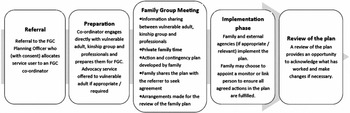
The FGC is described as a process involving five well-defined stages. Central to this process is a family group meeting which offers service users and their informal support network the opportunity to speak about their needs, to identify resources, and to share views and wishes regarding best possible solutions. The pilot intervention which is the subject of evaluation in this study reflected the structure presented in Figure 1.
Family Group Conferencing – the process.

Recruitment
Recruitment to the pilot
The recruitment of participants was co-ordinated by the FGC Planning Officer within the service leading the pilot. Approximately 80 post dementia diagnosis referrals were screened for their suitability for the FGC. These included referrals to the Social Work Department and to HealthCare Services. Due to the pilot nature of the project the decision was made to include participants across the dementia spectrum. This was to identify when this model of intervention is likely to be of most value. Other inclusion criteria applied during the recruitment process are presented in Table 1. As a result ten families were invited to participate in the FGC. All families were provided with detailed information about the pilot and the nature of their involvement, both verbally and in writing, and all gave written consent.
FGS Pilot – inclusion criteria

Recruitment to the evaluation
Due to the choice of a focus group as a data gathering method, in some participants, there was up to ten months delay between service users’ participation in the FGC and the evaluation. We wanted to provide all families involved in the pilot the opportunity to participate in the evaluation. This meant that, at the time of the evaluation, different families were at different stages of their FGC process. Some families who started the FGC at the onset of the pilot completed the process a few months prior to the evaluation, while others completed it within weeks before attending the focus group. For this reason, and for ethical considerations, the decision was made that the evaluation would focus on the information collected from family members who participated in the pilot and professionals involved in service provision. This was because, in consultation with families, health and social care practitioners and FGC co-ordinators involved in the pilot, it was considered that participating in a group discussion could result in unnecessary confusion and distress by people with dementia some of whom, at the time of the focus group, may have had limited or no memory of the process they participated in a few months or weeks ago.
All families and professionals involved in the pilot were invited to take part in the evaluation. The professionals were provided with information about the evaluation and invited to participate by the FGC Planning Officer. The representatives of the families were approached by independent FGC co-ordinators who provided them with information about the evaluation and requested their involvement in the project. If agreeable, the participant's contact details were forwarded to the researcher within Queen Margaret University (first author) who then contacted the person by telephone or e-mail in order to make appropriate arrangements. Based on detailed information provided to participants by the researcher, both verbally and in writing, written consent was obtained from all.
Sampling strategy
The purposeful sampling approach (Patton, Reference Patton2002) was adopted to include all professionals and representatives of families with the experience of involvement if the FGC. The sampling strategy was aimed at collecting data from a focussed sample of “information rich participants”, who could offer in-depth insights into issues of central importance to the purpose of our inquiry (Patton, Reference Patton2002). This is a standard practice in qualitative research aiming to develop understanding and give meaning to a social process, rather than to quantify and generalize to the wider population (Fox et al., Reference Fox, Hunn and Mathers1998).
Data gathering process
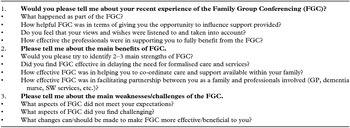
This study made use of data gathered through focus group interviews. Two homogenous groups were formed according to participants’ role within the pilot and the related experience of the FGC (Lysack et al., Reference Lysack, Luborsky, Dillaway and Kielhofner2006). As a result, one focus group was conducted with professionals involved in the provision of the FGC pilot. Representatives of families who participated in the project took part in a separate focus group. The aim of data collection in this study was to elicit participants’ views on the FGC as an innovative practice in dementia care, and to identify its strengths, weakness and needed improvements. The interview focussed on three main areas, which included general feedback relating to the FGC experience and exploration of its strengths and challenges. The main interview questions are presented in Table 2.
Example interview questions (informal support network)

The first author facilitated both focus groups. She was supported by trained research assistant who took detailed notes. The focus group for professionals took place in a meeting room at Queen Margaret University. In order to facilitate easy access to the venue, the focus group for representatives of families was arranged at the conference center local to the participants. Each focus group was approximately one hour long. Both group interviews were digitally recorded and transcribed in preparation to data analysis.
Data analysis
The data analysis involved thematic content analysis using the constant comparative method (Glaser and Strauss, Reference Glaser and Strauss1967). The transcripts were read in detail word by word to derive initial coding. An open coding procedure was used to identify words and passages of text that appeared to capture key thoughts or concepts (Glaser and Strauss, Reference Glaser and Strauss1967). Notes were made of initial impressions, thoughts and suppositions and a more detailed coding scheme was developed. Coding was carried out by a qualitative researcher and then analyst triangulation (Whittemore et al., Reference Whittemore, Chase and Mandle2001) was performed by peers with experience in qualitative research and practical experience of the FGC. Comprehensive coding covering areas of interest was then carried out and the data were further sorted into themes. Themes were derived to express directly the content of interviews (Patton, Reference Patton2002). Relationships between themes were identified through diagrams and peer debriefing (Creswell and Miller, Reference Creswell and Miller2000).
Results
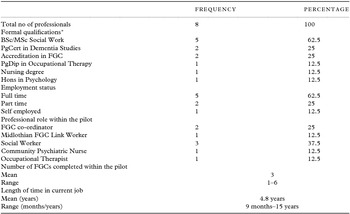
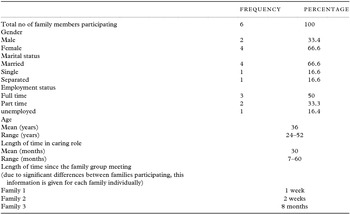
In total the study involved 14 participants. All professionals involved in pilot's delivery were invited to take part in the evaluation and all participated in the focus group. This represents a 100% of the target population. Out of ten families who were asked to consider participation ten family members gave their initial consent. However, four subsequently opted to withdraw from the study. One participant withdrew at the stage of being contacted by the researcher without stating the reason. One participant agreed to participate in the focus group but did not appear on the day. Reasons for this are not known to the researchers. Two further participants agreed to participate in the focus group but due to family circumstances were not able to attend the event. Consequently, the final sample comprised eight professionals (57%) and six family members (43%). Family members who took part in the evaluation represented three families who participated in the pilot (30%). Detailed information about demographic characteristics of the professionals who took part in the study is presented in Table 3. Table 4 outlines demographic features of family members involved.
Demographic information: professionals

*numbers exceed total number of professionals involved in the study due to multiple qualifications achieved by some of them.
Demographic information: families

Themes
Data analysis allowed formulation of two main themes: benefits of the FGC and implementation challenges, which will be presented in this section.
THEME 1 (BENEFITS OF THE FGC)—FGC AS A FORUM FOR FAMILIES TO MEET: It was acknowledged across the sample that the FGC offers families the opportunity to gather at the same time, at the same place and with the common purpose of considering the needs of the person with dementia, identifying resources available within the family and formulating an action plan aiming to address the needs of the vulnerable family member. This was of particular importance as the participants acknowledged that normally family gatherings do not offer similar opportunities. This is because they usually neither include all key people nor have a focussed agenda.
. . .bringing the family together is the biggest strength of the FGC. It's bringing the family together because without that you wouldn't have the voices of the family and you wouldn't have the person with dementia's input and how then can you figure out what their needs are and how to move things forward? (Joyce*, family member)
In addition, FGC was seen as a process focused on practical aspects of care which facilitates recognition and appreciation of skills brought to the family group by individual family members. It was perceived as helpful in coordinating resources available within the family, identification of areas in which individual family members can offer support, and re/activation of roles within families.
[FGC] encourages [family members] to understand that they all have their own skills and areas of expertise. So for one person it may be helping with personal care, for another person it may be keeping the garden trimmed. They can all have their own role. (Claire*, professional)
Both family members and professionals agreed that the FGC leads to the activation of family resources which means that, wherever possible, care is provided by family members as opposed to a paid carer. Being cared for by a family member was identified as preferential to people with dementia over care delivered by formal carers.
If its one of us that's trying to help [my grandfather] then, I think that he would be glad it's us. [. . .] And it makes him more willing. . . (Erin*, family member)
Moreover, because the FGC helps the families to consider what support can be offered by different family members, it provides the opportunity to share the burden of care which is usually carried out by the main carer. By doing so it offers respite to the main carer, thus protecting him/her from the effects of continuous caring.
[the FGC] gives the family the opportunity to meet together and share the responsibility in terms of providing the support that is needed.[. . .] It spreads the burden on one particular carer to other members of the family. Eases one main carer attending at all times. Every member of the family who decides to take part in it relieves the main carer of carer's stress. (Ewan*, professional)
FGC as a tool for the professionals
The FGC was perceived as a platform for sharing the family story with professionals and presenting them with a comprehensive view of the service user's personal circumstances, therefore facilitating development of a better understanding of the individual and his/her needs. However, as the FGC puts the families at the center of the decision making process it ensures that the care plan is focused on the issues that are of relevance and importance to both the person with dementia and their family members. It was identified by the participants that the care plan generated as an outcome of the FGC supports the professionals in their endeavor to engage in truly person-centered and family-oriented practice.
As professionals we’ve got ideas largely based around risk about what's important and how important what element is. We are always in danger of putting it on to the service user and their family. Instead of which if they have FGC they are much more likely to be able to say actually, we don't really give a toss about that, that's not an important issue to us, it's far more important XYZ. And this is something that we haven't even thought of or something that does not enter our thinking just because it seems very minor but it's very important to that family or that person. So I think it allows us to be better guided for what counts and what doesn't count. (Lea*, professional)
As a result the FGC was perceived as facilitating development of more trusting and open relationships between families and professionals. The voluntary nature of participation in FGC, and the fact that the process is managed by co-ordinators who are independent of any statutory organization were seen as contributory factors. Additionally, the family group meeting, which involves the initial contact with service representatives in its information sharing phase, was perceived as an opportunity for the families and the professionals to come together, to listen to each other, and to get to know each other on equal ground.
It actually helps people to relax and to know each other, to know that the professionals actually know what is going on there. That it's not about blaming. So it definitely helped to create this atmosphere of building relationship. (Teresa*, professional)
FGC as a means to culture change
It has been recognized by the participants in our study that current services are predisposed to deliver interventions based on an expert opinion by a professional or a group of professionals, often guided by their professional standards, policy requirements, and their assessment of risk. It was indicated that, at times, such practice may lead to authoritarian decision making which takes control away from the service users in favor of the professional involved. It was acknowledged that this often results in fragile relationships between services and service users and low satisfaction with services received. In contrast, it was anticipated that FGC, by empowering families to make their own decisions with regard to the care of a person with dementia, has the potential to move the power balance back from professionals to families. FGC was also perceived as providing the opportunity to facilitate different way of thinking by professionals about their role in service delivery.
I think it's one of the challenges for us as professionals not to go there with superman pants on to fix things and to allow families the opportunity to fix things for themselves. And that is a challenge because that is a change in the way we operate. It's getting away from us being the problem solver. (Lea*, professional)
Moreover, the participants expressed a belief that the FGC may contribute to a change in service users’ expectations towards services. The professionals noted that often, faced with deteriorating health or changing care needs, service users and their families assume the services will step in with solutions to their problems. The FGC was seen as a means of changing this attitude by encouraging the natural support networks to consider and activate the resources available within them and a return to a more community based model of caring.
There is a culture that's been borne of people thinking they deserve social work to come and do things for them. So I think the FGC is [. . .] also trying to change families’ way of thinking and putting it back to them. We will still fill the gaps when it's needed but we are not going to go with solutions first. (Aimee*, professional)
THEME 2 (IMPLEMENTATION CHALLENGES)— INCLUSION OF THE PERSON WITH DEMENTIA: Although it was emphasized that inclusion of a person with dementia in the FGC process and in the family group meeting should be seen as a priority, it was also recognized that in some cases this may be challenging or even impossible. It was indicated that, due to the nature of dementia an individual may lack the capacity to undertake an informed decision regarding participation in the FGC. Moreover, it was suggested that a situation where a group of people discuss the needs of a person, sometimes without an active contribution from that individual, may cause distress due to a perceived loss of control for that individual.
[My father's in law] ability to really say whether he wanted to be involved in that is debatable because he more or less went along with that rather than really being happy to participate. I don't think he really knew what he was asked to do. [. . .] He saw everybody around the table as making decisions about him and that actually frightened him. (Joyce*, family member)
In some circumstances including a person with dementia in the family group meeting was also reported as distressing for other family members. It was seen as particularly challenging when a person with dementia had limited insight into his/her difficulties and when more sensitive issues regarding the person's needs were discussed. In such situations the presence of a person with dementia was perceived as affecting the openness of other family members who wanted to protect the feelings of their loved one.
I think it is very important [to be] aware that sometimes people in the pathway of their dementia merely lack insight and it's difficult for the families to be as open and as honest as they would like to be. [. . .] families will often not say their true thoughts [. . .] So if the person is lacking insight into how things actually are, sometimes the meeting continues without the person being present and is very valuable as well. (Claire*, professional)
Ethical implications of the inclusion of a person with dementia were considered by the participants and it was concluded that because FGC is a decision process regarding the needs of the particular person, the inclusion of this individual should always be aimed for. However, because the FGC was perceived as a family centered approach, it was recognized that the severity of dementia and the person's ability to give informed consent, the needs of other family members and the wishes of both the individual with dementia and his/her family members, should be considered when making a decision about the presence of the person with dementia at the family group meeting.
Family dynamics
Pre-existing pattern of family relationships and different expectations and agendas represented by various family members were perceived as an important determinant of the success of the FGC and participants’ commitment to the outcomes of the process.
Family dynamics can be very complex [. . .] I think it depends very much on the complexity of the family and how committed they are to stick to the plan. (Teresa*, professional)
Taking into account the fact that families are invited to participate in the FGC process at a time when they face additional practical and emotional challenges related to supporting their loved one who experiences dementia, it was suggested that consideration needs to be given to the way these family dynamics and mutual perceptions of the level of commitment by various family members are managed within the FGC process. As a way of managing these dynamics it was indicated that in the preparation stage extra care should be taken to ensure that all key people within a person's support network are identified and actively involved. It was suggested that the success of the FGC in terms of active involvement of all relevant parties rests on the skills of the independent co-ordinators who were perceived as responsible for getting the relevant people on board and ensuring that they are prepared to contribute to the support plan generated by the family group.
Professional input
The FGC affords the family the opportunity to identify gaps in care provision which may require professional input and thus allows them to benefit from contributions of the social and healthcare professionals invited to the FGC. There were several aspects to this involvement which were seen as beneficial, including the opportunity for the person with dementia to benefit from proactive services focused on promoting independence and participation rather than on the reactive management of dementia symptoms.
Had the meeting not taken place with [. . .] the Social Services, I’m pretty sure for the foreseeable future we would just have carried on as we are. [As the result of the FGC] we are going to get someone to help [our father]. That means less pressure for my sister. Somebody to come in the morning and help with the medication. He [the father] may go to a few more groups. (Tom*, family member)
However, the family members who participated in the study discussed issues related to the timing of involving representatives of various professional groups to ensure that a person with dementia and his/her family can fully benefit from their input. It was suggested that the families should be provided with information about the role of various allied health professionals and the scope of their practice, prior to the family group meeting. The participants expressed the view that the need for professional input should be considered in the context of the needs of the individual with dementia in the preparation stage, and the relevant professionals should be, with service user's consent, invited to attend information sharing part of the family group meeting. This would allow families to make an informed request for professional input, where required, at the family group meeting.
[Following the FGC the key worker] has made a referral to [a health professional]. And [the health professional] visited my Dad and my Dad said ‘oh, I get on fine’. At that point she terminated the visit and said ‘well, there is no point in me coming along if there is nothing I can offer’. She was just taking this directly from my Dad. And anybody could ask my Dad anything and he would say ‘I don't need any help, I manage just fine’. I’m pretty sure that if the [health professional] had attended that meeting she would have got a much fuller picture and maybe actually would be able to contribute something. (Adam*, family member)
Discussion
The current study aimed to explore benefits and challenges related to the use of FGC in the context of dementia care. Therefore the discussion will focus on these two areas in the light of our findings and current evidence base supporting FGC as an approach to care delivery.
As indicated in the introduction, research evidence in relation to the use or effectiveness of FGC in general (Hobbs and Alonzi, Reference Hobbs and Alonzi2013; Frost et al., Reference Frost, Abram and Burgess2014), let alone specifically in relation to dementia care, is limited. A small scale systematic search of electronic sources, completed by the authors, yielded no results. Consequently, the search of grey literature was performed and resulted in identification of three documents reporting outcomes of pilot FGC services for vulnerable adults, including older people with dementia (Marsh, Reference Marsh2007; Day Break, 2010; Day Break FGCs, 2012). Therefore, the results of the presented study will be discussed in the context of these documents, and international research evidence related to the use of FGC in other contexts i.e., child welfare, public mental healthcare, and adult social support.
FGC in dementia care: opportunities
The overall feedback in relation to the FGC process as experienced by service users and professionals involved in our study was positive. All participants evaluated the service as a constructive way of partnership working between families and professionals which has the potential to improve the experience of the person with dementia, the families and the services involved, in terms of care provision. Our study indicates that FGC is seen as the opportunity for families to consider needs of a person with dementia, to identify resources available within the family and utilize these resources in order to support their loved ones in various aspects of daily living. FGC was also reported to allow people with dementia the benefit of being cared for by family members rather than by formal carers, which was found to be of preference by people with dementia in previous studies (Friss Feinberg and Whithatch, Reference Friss Feinberg and Whitlatch2002). This general feedback is in line with the existing evidence examining the application of FGC in various contexts. Morris and Connolly (Reference Morris and Connolly2012) reviewed research relating to family engagement strategies in child welfare, particularly in the context of services in the UK and New Zealand. They concluded that families demonstrate positive attitudes towards opportunities to become involved in the process that determines arrangements for care provided to their vulnerable family member and show enhanced commitment to and engagement with care and protection plans (Morris and Connolly, Reference Morris and Connolly2012). Malmberg-Heimonen (Reference Malmberg-Heimonen2011) who analyzed the effects of FGCs in Norwegian adult social services found that this approach to practice had positive effects on life satisfaction, mental health and social resources for long term social assistance recipients. It the context of services for vulnerable adults, including people with dementia, the Daybreak (2010) services reported FGC to be a successful means of working in partnership with families and promoting their active engagement in care delivery.
The professionals involved in the current study perceived FGC as affording them the chance to gain more comprehensive understanding of the needs of people with dementia and to develop more trusting and open relationships with families. This was seen as means of facilitating partnership-based and more person-centered and family-oriented practice. Previous research also indicated that FGC may result in increased partnership working between professionals and families (Schmid and Pollack, Reference Schmid and Pollack2009). However, research also highlights that public sector workers are influenced by strong organizational pressures which may hinder their commitment to family-led decision making (Schmid and Pollack, Reference Schmid and Pollack2009). Sumsion and Lencucha (Reference Sumsion and Lencucha2007) who investigated factors impacting client-centered collaboration in mental health settings in Canada found that the historical context of professional control seemed to counter professionals’ efforts to form trusting partnerships with the clients. Wallcraft (Reference Wallcraft2012) recently reviewed literature related to service users’ involvement in adult safeguarding which suggests that service users’ participation in care-related decision making is often hampered by tension between the principle of involvement and duty of care and/or risk-management priorities experienced by care professionals. These findings appear to be relevant to studies examining attempts to implement FGC in various care contexts. Marsh (Reference Marsh2007) found that, in a pilot FGC service implemented by service for children, older adults, and people with learning disabilities in Kent, England, FGC principles of partnership working were reported to apply to partnership based decision making only and were not transferred by the professionals into the care plan implementation period that follows. In 2001 Sundel et al. completed a study examining social worker's attitudes towards FGC applied in child welfare in Sweden and in the UK. They found that although, in both countries, professional attitudes towards FGC were overwhelmingly positive the utilization of the approach in practice was surprisingly low. The authors implied that social workers’ professional accountability may have played part in overriding their declared aspiration to utilize the potential benefits offered by FGC (Sundell et al., Reference Sundell, Vinnerljung and Ryburn2001). Another potential explanation offered by the authors highlighted the fact that in both countries the implementation of FGC was experienced by professionals as process driven by national or local policy-makers. They acknowledged that sanctioning FGC in legislation and policy as a model of working with service users and their families may encourage professionals to utilize this approach in practice. However, the results of their study also suggested that implementation of the FGC model is more likely when care workers are directly involved in the policy decisions to include the FGC as part of local practice (Sundell et al., Reference Sundell, Vinnerljung and Ryburn2001).
Participants in our study recognize that current services are predisposed to be guided by professional standards, policy requirements and risk-avoidance culture. This is reflected in the literature which acknowledges that public services appear to be driven by historical assumption of professional control over decision making and resources (Morris and Connolly, Reference Morris and Connolly2012; Wallcraft Reference Wallcraft2012; Hobbs and Alonzi, Reference Hobbs and Alonzi2013). This contrasts sharply with the personalization agenda promoting service user involvement which is integral to health and social care policy in many countries (Wallcraft, Reference Wallcraft2012; Hobbs and Alonzi, Reference Hobbs and Alonzi2013). However, our findings also indicate that FGC is perceived as having the potential to move power balance back from professionals to families by empowering families to make their own decisions with regard to the care of a person with dementia and changing professionals’ perception of their role in service delivery. Moreover, participants in our study anticipated that FGC may contribute to a change in service users’ expectations towards services. This added value of FGC as means to culture change is acknowledged in the literature. Macgovan and Pennel (Reference Macgovan and Pennel2001) who explored the utilization of FGC in Canada and the USA noted that the service offers means to stimulate social consciousness and to promote social action, resulting in the increase of social responsibility. Gallagher and Jasper (Reference Gallagher and Jasper2003) who examined FGC in the context of services for children and young people in England indicated that the model challenges the notion of professional expertise and therefore fosters more participative practices. In their review of evidence in relation to the application of participatory decision making models in adult safeguarding in the UK Hobbs and Alonzi (Reference Hobbs and Alonzi2013) stress that FGC emphasizes the need for cultural change towards working in the way that risk is understood, managed, and negotiated with people using services. They also suggest that, if family group decision making services are to transition into mainstream services, organizational changes are required to accommodate such new person-centered and family-led ways of working (Hobbs and Alonzi, Reference Hobbs and Alonzi2013). Other authors also indicate that development of strengths-based, shared decision-making work with families requires a paradigm shift within the existing services (Connolly, Reference Connolly2006). As discussed previously (Sundell et al., Reference Sundell, Vinnerljung and Ryburn2001) changes in standards of practice can and should be policy driven. However, Connolly (Reference Connolly2006) argues that such a fundamental transformation in the approach to practice require shift in values which may not be shared by all workers. She suggests that where professionals are unable to embrace principles of working with families promoted within FGC there is a risk that outcomes will be professionally driven (Connolly, Reference Connolly2006). Connolly (Reference Connolly2006) indicates that skilful co-ordination of FGC process is required to ensure that it remains focussed on the needs of a service user and that decisions undertaken as an outcome are family-led.
FGC in dementia care: challenges
Respect for dignity, individual autonomy, including the freedom to make one's own choices, and the right to full and effective participation are emphasized within United Nations Convention of the Rights of Persons with Disabilities (UN 2008, Art. 3). FGC enacts this principles through its premise that vulnerable person should be enabled to have their voice heard (Day Break, 2010). Although all participants in our study agreed that inclusion of the person with dementia in the FGC process and specifically in the family group meeting, should always be aimed for, it was recognized that this may, in some cases, prove challenging. The participants highlighted issues related to cognitive capacity which, may affect the ability of people with dementia to give informed consent to participate in the process, or/and to engage in decision making. These issues were previously recognized within other services offering the FGC as part of their support to vulnerable adults (Marsh, Reference Marsh2007; Day Break, 2010; Day Break FGCs, 2012). However, previous research suggests that older adults with mild to moderate cognitive impairment can effectively participate in decision making process, make choices and provide reasonable explanations for these choices (Horton-Deutsch et al., Reference Horton-Deutsch, Twigg and Evans2007). Moreover, study by Fetherstonhaugh et al. (Reference Fetherstonhaugh, Tarzia and Nay2013) indicates that, although people with dementia recognize that as their condition progresses they will require more support with decision-making, they want to be involved and retain sense of control over decisions that affect them for as long as possible. There is also evidence that family carers want to preserve the autonomy of their loved-ones with dementia but sometimes struggle to determine what is in their relatives’ best interest and how to ascertain their capacity (Samsi and Manthrope, Reference Samsi and Manthorpe2013). It has been acknowledged in the literature that, when FGC is applied in the context of care delivered to vulnerable adults, the assessment of mental capacity is one of the major considerations (Day Break, 2010; Hobbs and Alonzi, Reference Hobbs and Alonzi2013). The role of an independent FGC co-ordinator in the process of assessing capacity and ensuring that the rights of a vulnerable adult are protected, his/her voice is heard and opinions and wishes considered and reflected in the family support plan, is recognized in the literature. It has been indicated that, in order to meet these requirements, training and skills of co-ordinators working with vulnerable adults should accommodate additional competences (Day Break, 2010; Hobbs and Alonzi, Reference Hobbs and Alonzi2013). Specifically, it was identified that FGC co-ordinators working with vulnerable adults should have a thorough understanding of the legal and policy framework for safeguarding vulnerable adults and ensure that their practice is in line with the requirements of such frameworks (Hobbs and Alonzi, Reference Hobbs and Alonzi2013). Additionally, the literature points to advocacy as crucial in working with vulnerable adults (Day Break, 2010; Hobbs and Alonzi, Reference Hobbs and Alonzi2013). Depending on personal preferences a person can be represented by a family member, a professional or an independent advocate. Regardless the form of advocacy, it has been stressed that, where an adult is assessed as lacking capacity to make a specific decision under a relevant legal adult safeguarding policy, FGC can still be used as long as mechanisms are in place to ensure accountability for making decisions in a person's best interest (Hobbs and Alonzi, Reference Hobbs and Alonzi2013). A successful use of such approach was reported by de Jong et al. (Reference De Jong, Schout and Abma2014) who examined the applicability of FGC in Dutch mental health services. The authors concluded that FGC can result in positive outcomes even without the client being present at the family meeting, with the person's interest represented by a third party.
Another issue highlighted by the participants in our study relates to pre-existing family dynamics and multiple agendas represented at the family group meeting. It is recognized that, in the context of adult services, the complexity and long-standing nature of relationships within kinship network impacts on the FGC outcomes (Connolly, Reference Connolly2006). It is also acknowledged that current understanding of the impact family dynamics have on the outcomes of interventions is limited (Podgorski and King, Reference Podgorski and King2009). Rosland et al. (Reference Rosland, Heisler and Piette2012) reviewed literature in relation to the impact of family behaviors and communication styles on the outcomes of chronic illness other than dementia. They found that positive family interactions characterized by encouragement of self-reliance and autonomy were associated with improved illness outcomes whereas control and overprotection were related to negative outcomes. In their review of literature considering family dynamics in provision of care for people with dementia Podgorski and King (Reference Podgorski and King2009) concluded that the quality of family relationships prior to the onset of dementia and the family members motivation for providing care are two most reliable predictors of outcomes for both person with dementia and the caregiver. These findings, combined with experiences reported by the participants in our study, justify anticipation that family dynamics may have a significant impact on the outcomes of FGC for all parties. However, how these dynamics influence outcomes of FGC; the extend to which family dynamics serve as moderating or mediating factors; and how to best manage these dynamics within FGC remains unclear and should be considered in future research. The participants in our study highlighted skills of the independent FGC co-ordinators in managing family interactions as crucial. Therefore, in order to maximize benefit of FGC to all parties, the training of FGC co-ordinators should equip them with skills to successfully identify key people within the support network of a person with dementia; ensure their active engagement in FGC process; and skillfully manage the dynamics during FGC to safeguard best possible outcomes for a person with dementia and other FGC participants.
One of the premises of FGC is to enable service users to make decisions with regard to support available within the kinship network and, where required, formal services (Connolly, Reference Connolly2006). Our results suggest that, in order to make informed requests in terms of professional input, service users would benefit from access to information about the role of various allied health professionals and the scope of their practice, prior to the family group meeting. The requirement for timely and accurate information about dementia and services available was identified as pivotal by people with dementia and family caregivers within previous studies (Alwin et al., Reference Alwin, O¨Berg and Kreves2010). It is acknowledged that without information about available services service users cannot make informed decisions regarding support required (Egdell, Reference Egdell2012). Participants in our study indicated that early access to services would facilitate independence and participation. This is in line with previous study by Górska et al. (Reference Górska2013) which indicate that people with dementia would benefit from enhanced access to non-pharmacological interventions and other services promoting activity and facilitating social involvement. Wolfs et al. (Reference Wolfs2012) suggest that early access to the required services leads to enhanced outcomes for caregivers and delayed institutionalization for people with dementia. It appears that providing people with dementia and their family caregivers with timely and comprehensive information about the available services has the potential to improve their outcomes and empower them to make informed decisions in relation to the support required. Indeed, it has been recognized that early awareness of support options may help to avoid situations where service provision becomes necessity not an option, hence increase service users’ choice and prevent crisis (Wolfs et al., Reference Wolfs2012).
Recommendations for further research
Evidence base in relation to FGC in the context of adult services, and in particular in relation to dementia care, is scarce. There is a need for further research into the applicability of this approach for this client group. Moreover, as the existing research is mainly based on small-scale pilot projects, conducting bigger scale evaluation of FGC in the context of mainstream dementia services would be desirable. Further research should involve methods which would allow a comparison with other ways of supporting people with dementia and their families and capture long-term effects of FGC. As highlighted previously future studies should also consider the impact of family dynamics on outcomes for FGC participants and how these dynamics could be managed within FGC. Additionally, evidence base would be strengthened by a comprehensive evaluation of cost effectiveness of this new approach to practice.
Recommendations for practice
The results of the current study as well as previous, unpublished evaluations of FGC provisions in dementia care, suggest that this new approach to practice can enhance outcomes for service users, their families and services involved. As such, it should be considered for inclusion as part of mainstream services offered to this client group. However, the results of the presented research indicate that, to maximize benefits to all parties careful consideration needs to be given to issues related to the capacity of a person with dementia to participate in the FGC process; family dynamics which impact on FGC outcomes; and the requirement for timely and accurate information about the service available to enhance choice and to empower service users to make informed decisions with regard to the required services. The role of independent FGC facilitators was highlighted as pivotal in managing these issues.
Limitations
We acknowledge that the results of this study, although informative in terms of opportunities and challenges related to utilization of FGC in the context of dementia care, should be cautiously considered in relation to other care settings. The results are based on a small, pilot intervention. Moreover, although we succeeded in securing feedback from all professionals involved, we do acknowledge that families who chose not to participate may have different experiences and views of this service.
Additionally, it is recognized that the quality of data collected through focus group interviews depend on the skills of the interviewer (Hines, Reference Hines2000). Two interviewers were involved in this study. One of them was a researcher experienced in qualitative interviewing and having a special interest in dementia and the other was a trained research assistant. Both have background in health sciences.
Another disadvantage of focus group interview rests in the fact that the approach may encourage a group response. In other words key individuals may choose not to share their views and beliefs with others. Furthermore, one dominant person may influence the views of other group members (Hines, Reference Hines2000). However, to minimize this effect the interviewers took necessary care to ensure that all participants were actively involved in the discussion and it is demonstrated in the current paper through presenting quotations from different participants to indicate the various opinions within the group.
Conclusions
The presented study sought to evaluate the impact of the pilot FGC service delivered to people with dementia and their families. Both families and professionals involved in the implementation of the pilot contributed their feedback. FGC was perceived as having the potential to positively impact service users, their families, service providers and the wider culture of care. However, despite an overall positive evaluation the participants identified a number of challenges related to service implementation. These related to the capacity of a person with dementia to participate in the FGC process; family dynamics which impact on FGC outcomes; and the requirement for timely and accurate information about services available. These issues ought to be considered and carefully managed in order to secure maximum benefit to all parties.
*Participants’ names were changed to ensure anonymity.
Conflict of interest
None
Description of authors’ roles
S. Górska assisted with development of the research proposal, collected and analyzed the data, and wrote the paper. Prof. K. Forsyth designed the study, supervised data collection, and assisted with writing the paper. S. Prior assisted with data analysis and with writing the paper. L. Irvine assisted with study design and offered feedback on the paper. P. Haughey facilitated recruitment of the participants.
Acknowledgments
The authors would like to thank all the participants of this study for their contributions.