Introduction
The concept of duration of untreated illness (DUI) was initially put forward in the literature of schizophrenia and first-episode psychosis, which has linked DUI to worst treatment response, symptom control, and overall functional outcome.Reference Murru and Carpiniello1 Accordingly, DUI has been defined as the “interval between the onset of a specific psychiatric disorder and the subsequent administration of the first pharmacological treatment given at standard dosages and for an adequate period of time in compliant subjects.”Reference Altamura, Camuri and Dell’Osso2 It is only recently that concern has been raised regarding the importance of DUI in nonpsychotic conditions such as anxiety disorders and obsessive-compulsive disorder (OCD).Reference Altamura, Camuri and Dell’Osso2 However, the factors that facilitate or delay treatment seeking by these patients remain relatively unexplored.Reference Dell’Osso, Benatti and Oldani3–Reference Poyraz, Turan and Saglam6 Theoretically, as turned out to be true in psychosis, early intervention in anxiety and obsessive-compulsive disorders (AOCD) can also lead to improved outcomes.
In a series of studies performed on Italian patients with OCD, Dell’Osso and colleagues found mean DUI ranging from 7.2 to 7.8 years.Reference Dell’Osso, Benatti and Oldani3–Reference Dell’Osso, Camuri and Benatti5 They also reported DUI to be related to the presence of aggressive-checking symptomsReference Dell’Osso, Benatti and Oldani3 and to a worse response to serotonin reuptake inhibitors.Reference Dell’Osso, Buoli, Hollander and Altamura4 Similar DUI values were reported in a Turkish sample of OCD patients described by Poyraz et al.,Reference Poyraz, Turan and Saglam6 who also found DUI greater than 4 years to be associated with lower rates of precipitating events and greater endorsement of the belief that OCD symptoms were not associated with an illness. In the latter study, symptom fluctuation and the prospect of using medication chased away some poor insight OCD patients, who also had longer DUI.Reference Poyraz, Turan and Saglam6 DUI in panic disorder (PD) patients was associated with greater rates of depression but had no impact on treatment response.Reference Altamura, Santini, Salvadori and Mundo7 Finally, depression,Reference Dalrymple and Zimmerman8 OCD,Reference Ertekin, Celebi and Koyuncu9 and number of feared situationsReference Dalrymple and Zimmerman8 have accelerated treatment seeking, while increased age,Reference Ertekin, Celebi and Koyuncu9 earlier SAD onset,Reference Ertekin, Celebi and Koyuncu9 and a lower level of educationReference Ertekin, Celebi and Koyuncu9 were associated with delayed treatment seeking in SAD.
There are even fewer studies contrasting DUI between different AOCD samples. An Australian study found that the first contact with a family physician since the first anxiety disorder symptom took longer for SAD patients (3.8 years) than for either PD (1.2 years) or generalized anxiety disorder (GAD) patients (0.8 years).Reference Wagner, Silove, Marnane and Rouen10 Dell’Osso et al.Reference Dell’Osso, Camuri and Benatti5 compared DUI of 138 PD, 127 GAD, and 85 OCD patients and found DUI to be significantly different between the groups, with PD showing the shortest DUI (3.2 years), GAD showing an intermediate DUI (6.8 years), and OCD showing the longest DUI (7.8 years). A subsequent study from the same group was unable to replicate these findings, although the lack of differences was ascribed to a substantially lower number of subjects (49 PD, 68 GAD, and 40 OCD).Reference Benatti, Camuri and Dell’Osso11 Nevertheless, in the latter study, GAD and PD subjects sought treatment by themselves more frequently, while OCD subjects were more often encouraged by others to seek help.Reference Benatti, Camuri and Dell’Osso11
Clearly, DUI may be influenced by factors unrelated to the psychiatric diagnosis itself, including individual or family attitudes toward mental illness (such as fear of stigma), cultural beliefs (e.g., in religious or traditional healing), and the availability of mental health-care systems (which, once engaged, should be able to provide assessment in a timely fashion).Reference Altamura, Camuri and Dell’Osso2 However, we believe that a few relevant cross-diagnostic features that have not been explored yet in relation to DUI may also reduce (e.g., anxiety sensitivityReference Deacon and Abramowitz12) or retard (e.g., illness perceptionReference Witteman, Bolks and Hutschemaekers13) time to treatment seeking. For instance, we hypothesize that not only does the fear caused by anxiety-related symptoms (e.g., rapid heartbeat) actually shorten time to treatment seeking regardless of diagnosis, but also the perception of the certain causes of the AOCD (e.g., the lack of supportive communities) may determine whether patients will anticipate or delay treatment seeking.
The use of DUI in the context of AOCD should take into consideration some particularities of the latter conditions, including the meaning of “onset” and “adequate treatment.” For instance, onset of illness is more often insidious in AOCD than in acute psychosis, and adequate treatment in AOCD often includes nonpharmacologic approaches, such as exposure and response prevention in OCDReference McKay, Sookman and Neziroglu14 and cognitive therapy in SAD.Reference Mayo-Wilson, Dias and Mavranezouli15 Therefore, in this study, we compared DUI using the first contact with a mental health professional in OCD, PD, and SAD patients and investigated its correlates, both within specific diagnoses and across the whole sample.
Methods
Eighty-eight patients who sought treatment at the AOCD Clinic of the Institute of Psychiatry of the Federal University of Rio de Janeiro (IPUB/UFRJ) and who (1) had a main diagnosis of OCD (n=33), SAD (n=24) and PD (n=31) confirmed by the Mini International Neuropsychiatric Interview, (2) were aged between 18 and 70 years, and (3) were able to read and fill out forms were selected for this study. Subjects were excluded if they had severe mental disorders that interfered with the procedures or interpretation of the assessments (such as mental retardation, manic episodes, psychotic episodes, or dementia) or severe personality disorders (according to the attending physician). All subjects signed the informed consent before being informed about the objectives and procedures of the study, which was approved by the local institutional review board (CAAE: 50308015.1.0000.5263).
Besides having their sociodemographic data collected, AOCD patients were also assessed for their illnesses features with an instrument that included, among relevant clinical information, age at onset of subthreshold symptoms and age at which psychiatric and/or psychological treatments were first sought. We defined DUI as the latency between onset of symptoms of the patient’s main diagnosis and the age at which the patient first sought help for mental health issues (regardless of whether this was with a psychiatrist or a psychotherapist). This strategy differed from previous studies in the field, which defined DUI as the latency between onset of illness and first adequate pharmacologic treatment.Reference Altamura, Camuri and Dell’Osso2 Severity of symptoms was assessed with the Beck Depression and Anxiety Inventories, the Dimensional Obsessive-Compulsive Scale, the Panic and Agoraphobia Scale, and the Social Phobia Inventory.
Transdiagnostic features
The Anxiety Sensitivity Index–Revised (ASI-R; Brazilian Portuguese version validated by Escocard et al.Reference Escocard, Fioravanti-Bastos and Landeira-Fernandez16) was originally developed by Cox and TaylorReference Taylor and Cox17 with the purpose of measuring anxiety sensitivity, or the fear of anxiety-related sensations. The ASI-R is a 36-item self-report instrument in which patients rate a series of statements on a 5-point Likert scale ranging from 0 (very little) to 4 (very much). Therefore, the total score can range from 0 to 144. Items are grouped into six categories, including fear of (1) cardiovascular symptoms, (2) respiratory symptoms, (3) gastrointestinal symptoms, (4) publicly observable anxiety reactions, (5) dissociative and neurologic symptoms, and (6) cognitive dyscontrol symptoms.
The Illness Perception Questionnaire–Mental Health (IPQ-MH; Brazilian Portuguese version translated by Fontenelle et al.) was originally developed by Witteman et al.Reference Witteman, Bolks and Hutschemaekers13 For the purposes of our study, we selected its Cause subscale, which was originally based on the Causal Belief Questionnaire.Reference Whittle18 In the Cause subscale of the IPQ-MH, patients answer the question “What do you see as the causes of your problem?” by selecting statements on each of the following categories: psychosocial (e.g., “Unresolved feelings resulting from the past”), biological (e.g., “A chemical imbalance in my body”), structural (e.g., “Unhelpful attitudes held by others because of my class”), and stress (e.g., “Conflict with my ex-partner following separation”). Each statement is scored on a 5-point Likert scale raging from 1 (strongly disagree) to 5 (strongly agree).
Statistical analysis
We employed a chi-square test or Fisher exact test for comparisons of categorical variables between two (short vs. long DUI) or three groups (OCD, PD, and SAD); Student’s t test for comparisons of continuous variables between two independent groups; and ANOVA or the Kruskal-Wallis H test between three independent groups, depending on normality of distribution. Post hoc tests included the Tukey HSD test or an additional Kruskal-Wallis test, respectively.Reference Keselman, Games and Rogan19 Correlation between two continuous variables was performed using Spearman rank correlation. The adopted level of significance was 0.05.
Results
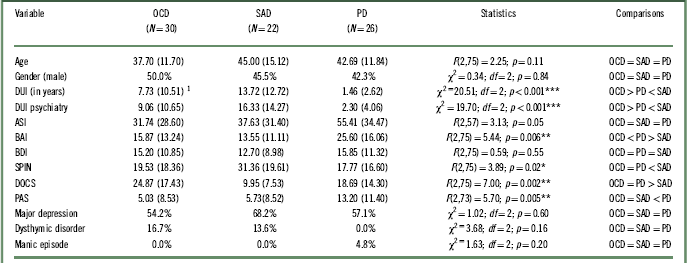
The mean DUI of the whole sample was 7.33 years (10.55 years). A comparison among the three diagnostic groups in terms of sociodemographic and clinical features is depicted in Table 1. The DUI was significantly different between groups that sought treatment after the onset of illness (χ2=20.5; df=2; p <0.001), with OCD patients having longer DUI (7.73 [10.51] years) than PD patients (1.46 [2.62] years; χ2=8.99; df=1; p=0.003) and shorter DUI than SAD patients (13.72 [12.72] years; χ2=4.12; df=1; p=0.04). After the onset of illness, it took a mean of 8.44 (11.16) years for patients to be seen by a psychiatrist. Ten patients sought treatment before the self-reported onset of illness, but these rates did not differ between diagnostic groups (χ2 =1.30; df=2; p=0.52).
Comparison of sociodemographic and clinical features, including duration of untreated illness, among OCD, SAD, and PD patients

ASI=Anxiety Sensitivity Index; BAI=Beck Anxiety Inventory; BDI=Beck Depression Inventory; DOCS=Dimensional Obsessive-Compulsive Scale; DUI=duration of untreated illness; OCD=obsessive-compulsive disorder; PAS=Panic and Agoraphobia Scale; PD=panic disorder; SAD, social anxiety disorder; SPIN=Social Phobia Inventory.
*p<.05**p<.01***p<.001
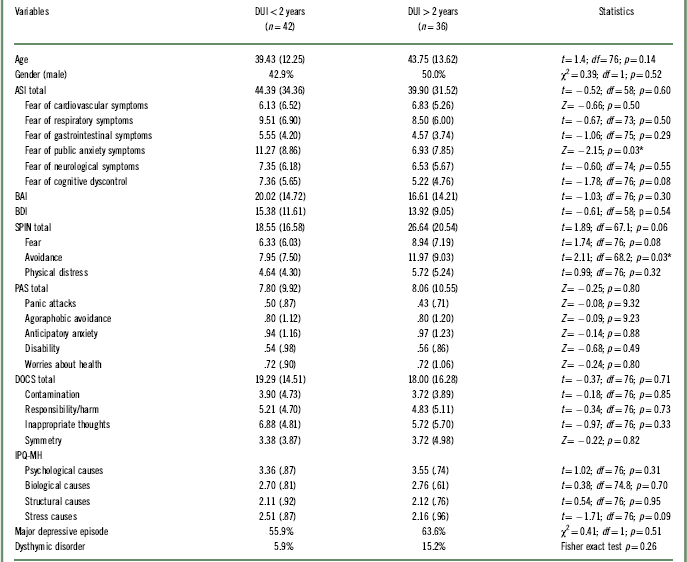
The whole sample was divided into short (<2 years) versus long (>2 years) DUI based on the median DUI for the total number of subjects enrolled (see Table 2). The only differences between groups were greater fear of public display of anxiety in short DUI (Z=−2.15; p=0.03) and greater social avoidance in long DUI (t=2.11; df=68.2; p=0.03). Further analyses showed that greater DUIs in OCD (>2 years), SAD (>10 years), and PD (>0 years), defined as DUI greater than the median values within a specific group, were also unrelated to gender, severity of symptoms, and most comorbid mood or anxiety disorders. However, greater DUI was associated on a trend level with greater lifetime rates of major depressive disorder in SAD patients (Fisher exact test=0.07).
Comparison of sociodemographic and clinical features of patients with short (<2years) vs. long (>2 years) duration of untreated illness

ASI=Anxiety Sensitivity Index; BAI=Beck Anxiety Inventory; BDI=Beck Depression Inventory; DOCS=Dimensional Obsessive-Compulsive Scale; DUI=duration of untreated illness; IPQ-MH=Illness Perception Questionnaire–Mental Health; OCD=obsessive-compulsive disorder; PAS=Panic and Agoraphobia Scale; PD=panic disorder; SAD, social anxiety disorder; SPIN=Social Phobia Inventory. *p<.05.
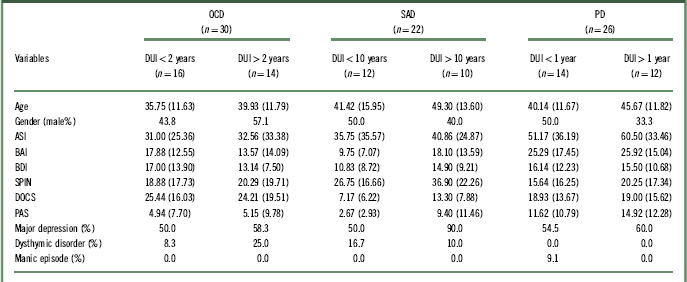
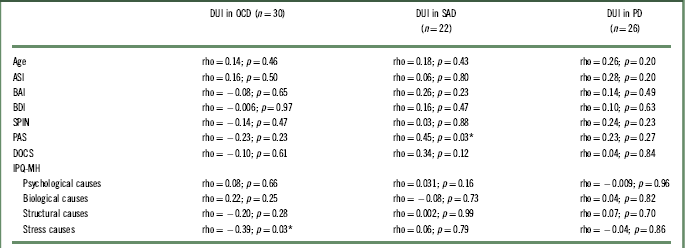
We did not find any relationship between anxiety sensitivity and DUI within each diagnostic group, both when groups were divided into short and long DUI based on the median scores (Table 3) and when correlational analyses were performed between DUI and different variables (Table 4). However, DUI correlated negatively with the perception of OCD being caused by stress (rho=−0.39; p=0.03) and positively with severity of panic-related disability (rho=0.51; p=0.01) in SAD patients, but not in OCD or PD patients. A trend toward seeking first help from a psychologist was reported in the OCD group (linear-by-linear association=3.47; df=1; p=0.06).
Comparison of sociodemographic and clinical features of OCD, SAD, and PD patients with DUI below and above median values for each sample

ASI=Anxiety Sensitivity Index; BAI=Beck Anxiety Inventory; BDI=Beck Depression Inventory; DOCS=Dimensional Obsessive-Compulsive Scale; DUI=duration of untreated illness; IPQ-MH=Illness Perception Questionnaire–Mental Health; OCD=obsessive-compulsive disorder; PAS=Panic and Agoraphobia Scale; PD=panic disorder; SAD, social anxiety disorder; SPIN=Social Phobia Inventory.
Correlation between DUI and sociodemographic and clinical features in each diagnostic group

ASI=Anxiety Sensitivity Index; BAI=Beck Anxiety Inventory; BDI=Beck Depression Inventory; DOCS=Dimensional Obsessive-Compulsive Scale; DUI=duration of untreated illness; IPQ-MH=Illness Perception Questionnaire–Mental Health; OCD=obsessive-compulsive disorder; PAS=Panic and Agoraphobia Scale; PD=panic disorder; SAD, social anxiety disorder; SPIN=Social Phobia Inventory. *p<.05.
Discussion
The aim of this study was to contribute to the literature of DUI in AOCD by (1) replicating previous findings of DUI in AOCD from different cultures; (2) performing original comparisons between different AOCD; (3) refining the concept of DUI in AOCD according to therapeutic particularities of PD, SAD, and OCD; and (4) assessing other relevant variables thought to be important for treatment seeking, including anxiety sensitivity and illness perception. We found greater fear of public display of anxiety symptoms in the short-DUI group and greater social avoidance in the long-DUI group. Further, perception of stress being the cause of OCD was correlated to shortened DUI in OCD patients, and disability related to panic symptoms was associated with increased DUI in SAD patients. No significant correlate of DUI emerged in the PD sample.
Our first analysis contrasted patients with short versus long DUI regardless of diagnosis. While the finding of greater avoidance among patients with longer DUI dovetails with our initial predictions, our results linking greater fear of public display of anxiety symptoms to shorter DUI are difficult to explain, particularly because they seemed to contradict the former finding (after all, both social avoidance and fear of displaying public symptoms are part of the same overarching social anxiety constructReference Stein20). However, because it is also difficult to disentangle duration of illness from DUI (definitions of both are dependent upon age at illness onsetReference Altamura, Camuri and Dell’Osso2), increased sensitivity to publicly observable symptoms (a predisposing factor for social anxietyReference McWilliams, Stewart and MacPherson21) could reflect shorter duration of illness rather than DUI itself.
Ten patients sought treatment before the self-reported onset of illness, but these rates did not differ significantly among OCD (3 patients), SAD (2 patients), and PD groups (5 patients). Despite not being characteristic of any specific diagnostic category, these findings suggest that there may be unique possibilities for early interventions before full-blown illnesses emerge. It also indicates that further efforts should be implemented to identify at-risk phenotypes for these conditions, including behavioral inhibition,Reference Perez-Edgar and Guyer22 separation anxiety,Reference Battaglia, Ogliari, D’Amato and Kinkead23 or positive family history of OCD.Reference do Rosario-Campos, Leckman and Curi24 Interestingly, 6 of the 10 patients who sought treatment before full-blown diagnoses had a family history of psychiatric illness, although only 1 patient had a family history of a disorder (PD) addressed by the present research protocol.
On average, after the onset of illness, it took a mean of 7.33 (10.55) and 8.44 (11.16) years for patients of the studied sample to be seen by any mental health specialist or a psychiatrist, respectively. The DUI was significantly different between groups who sought treatment after the onset of illness, with OCD having a longer mean DUI (7.73 [10.51] years) than PD (1.46 [2.62] years) and a shorter mean DUI than SAD (13.72 [12.72] years). While these findings almost exactly replicate previous findings showing that OCD patients display an average of 7–8 years of symptoms before treatment initiation,Reference Dell’Osso, Benatti and Oldani3–Reference Poyraz, Turan and Saglam6 they also add to the literature by showing SAD to display greater DUI than OCD, a finding consistent with other studies demonstrating significant delays in terms of primary-care and specialized treatment seeking by SAD patients.Reference Wagner, Silove, Marnane and Rouen10
Greater DUIs in OCD (>2 years), SAD (>10 years), and PD (>0 years), defined as DUI greater than the median values within a specific group, were unrelated to gender and most comorbid mood or anxiety disorders. However, greater DUI was associated on a trend level with greater lifetime rates of major depressive disorder in SAD patients. This finding is consistent with studies showing patients with SAD to be at an increased risk for depressionReference Beesdo, Bittner and Pine25 and may be partially dependent on greater duration of (not necessarily untreated) illness. However, due to our cross-sectional design, we were unable to determine if untreated SAD contributed to increased rates of depression or depression decreased treatment seeking, thus increasing DUI. A previous study found DUI in PD to be associated with a higher frequency of depression.Reference Altamura, Santini, Salvadori and Mundo7
Further, DUI correlated negatively with the perception of OCD being caused by stress. In other words, the more patients with OCD believed that their illness was caused by the threat of or an actual recent very unpleasant event, family or marital conflict or difficulty, grief or separation, or even physical illness, the sooner OCD patients sought treatment for their condition. We can only speculate about why the perceived etiological role of stress was restricted to the OCD sample. For instance, while OCD patients may perceive distress (including actual marital or family dysfunctionReference Lebowitz, Panza, Su and Bloch26) as a proxy for greater severity of OCD symptoms, they may also believe that stress-related problems are more readily treatable by a mental health specialist.
We also found a positive correlation between DUI and severity of panic-related disability in SAD, but not in OCD or PD patients, thus suggesting that panic attacks due to SAD actually hinder treatment seeking in this later population. It may be, for instance, that the anticipation of potential scrutiny by mental health specialists, often qualified as “authority figures,” actually leads SAD patients who are already housebound and disabled by “situational” panic attacks to delay or avoid appropriate treatment.Reference Potter, Wong and Heimberg27 Although we have hypothesized the opposite phenomenon to hold true in the context of PD,Reference Brown, LeBeau and Liao28 severities of panic attacks in PD did not correlate negatively with DUI. In addition, we did not find any relationship between anxiety sensitivity and DUI within each diagnosis or across the whole sample.
A trend toward seeking first help from a psychologist was reported in the OCD group as compared with PD or SAD groups. This finding is consistent with the increasing popularity of psychological treatments, particularly exposure and response prevention (ERP), for OCD patients. In contrast, the hint toward decreased psychological treatment for other conditions may also reflect a predominant fear of somatic (medical) illnesses among PD patients and of having intimate issues “fleshed out” and scrutinized during psychological assessments among SAD patients; theoretically, in these cases, patients could be inclined to “bypass” initial assessments by psychologists. However, this phenomenon may also be ascribed to a proclivity of psychotherapists not to refer PD and SAD patients to psychiatric assessment.
Our paper has a number of limitations that limit its comparability with previous studies. Most strikingly, we employed a definition of DUI that emphasized “any mental health treatment” instead of “appropriate pharmacologic treatment,” which probably has a “psychiatric” bias.Reference Altamura, Camuri and Dell’Osso2 However, we feel our proposed strategy proved relevant for our analysis, as OCD patients sought first help from a psychologist earlier than SAD and PD patients (albeit on a trend level). Indeed, there is plenty of evidence showing that ERP is as effective or even more effective than selective serotonin reuptake inhibitors (SSRI) in the treatment of OCD,Reference Romanelli, Wu and Gamba29 SAD,Reference Mayo-Wilson, Dias and Mavranezouli15 and PDReference Imai, Tajika and Chen30 (although we cannot confirm which type of psychotherapy was provided for these patients). In sum, there was usually a substantial delay in treatment seeking among most patients with OCD and SA, and perception of stress as a cause of OCD prompted treatment seeking, while severity of panic symptoms in SAD patients delayed treatment seeking.
Disclosures
Paula Vigne, Pedro Fortes, Rafaela V. Dias, Luana D. Laurito, Carla P. Loureiro, Gabriela B. de Menezes, and Ulrich Stangier have nothing to disclose.
Leonardo F. Fontenelle has the following disclosures: Conselho Nacional de Desenvolvimento Científico e Tecnológico, grant number 308237/2014-5; Fundação Carlos Chagas Filho de Amparo à Pesquisa do Estado do Rio de Janeiro, grant number 201.305/2014 and 211.191/2015; D’Or Institute for Research and Education David Winston Turner Endowment Fund.