Significant outcomes
• A positive relationship between heart rate variability (HRV) is supported by the study results and there is a gender difference in the depression score of this study, where female is higher than male.
Limitations
• There was no antidepressant trail to evaluate their effectiveness on the HRV.
• The participant's depression scales were evaluated by using Tung's questionnaire, which is used only in Taiwan and some Asian countries.
• History of emotional problem of the participants was not clarified.
Introduction
The sympathetic nervous system innervates the cardioaccelerating centre of the heart, the lungs and the non‐striated muscles. In opposite, the parasympathetic nervous system innervates the cardiomoderator centre of the heart, lungs and the non‐striated muscles. Sympathetic and parasympathetic divisions function antagonistically to preserve a dynamic modulation of vital functions Reference Servant, Logier and Mouster1. Reduced HRV seems to indicate decreased cardiac vagal tone and elevated sympathetic activity in anxious and depressive patients and would reflect deficit in flexibility of emotional physiological mechanisms Reference Servant, Logier and Mouster1, Reference Licht, de Geus and Zitman2. Depression and anxiety disorders (ADs) are associated with significantly lowered HRV and it appears to be mainly driven by the effect of antidepressants Reference Licht, de Geus and van Dyck3. There is growing evidence showing that psychiatric disorders are associated with autonomic dys‐regulations and it is responsible for the increased mortality in patients with psychiatric disorders Reference Birkhofer, Schmidt and Forstl4. Findings from several epidemiological studies have revealed that major depression is associated with an increased risk of developing cardiovascular diseases (CVD) and presenting complications and new events in subjects with already established CVD Reference Garcia‐Gomez, Lopez‐Jaramillo and Tomaz5, Reference Monk, Kovelenko and Ellman6, Reference Kim, McGorray and Bartholomew7, Reference van der Kooy, van Hout and van Marwijk8. Also, changes in measures of HRV have been associated with an increased risk for sudden cardiac death Reference Baumert, Lambert and Dawood9. A study showed that depressed mood is related to the magnitude of decrease in parasympathetic cardiac control during stressors in health man and women and similar phenomenon was observed among patients with cardiac disease Reference Hughes and Stoney10. Therefore, HRV analysis in psychiatric patients before and during therapy elucidates the role of autonomic disturbances in such diseases and may help to optimise the treatment. In conclusion, we hypothesised that HRV investigation in adolescents may early prevent the mental diseases occurrence, even suicidal behaviour.
Materials and methods
This study project included 333 seventh grade students (mean age, 13.32 years; male 172 and female 161, respectively). The participant's depression scales were evaluated by using Tung's questionnaire (<5 = no depression, 6–10 = emotional lately, >12 = depression) and the HRV instrumental analysis [mean heart rate turbulence, standard deviation of all RR intervals, root mean square of successive differences, pressure stress index, total power, very low frequency, low frequency (LF), high frequency (HF) and LF/HF ratio] was performed in each participant. Consent for this study was obtained from all the participants who have been signed by the guardians. This project had been approved by the IRB of Bei‐Tou Armed Forces Hospital.
The Statistical Package for the Social Sciences (SPSS™ version 12 for Windows™; SPSS, Inc., Chicago, IL, USA) computer software was used for statistical analysis. A p‐value < 0.05 was considered statistically significant.
Results
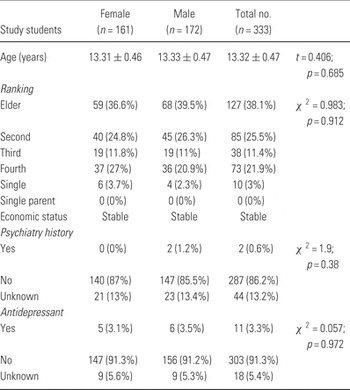
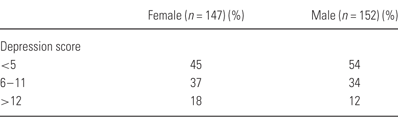
The socioeconomic status of the participants showed that the age, ranking in the family, parents, economic condition, drug history and the history of psychiatric disorders have no significant differences (Table 1). The evaluation results revealed that the depression score of female was higher than male (Table 2). Moreover, the participants with lower depression scale usually associated with lower HF and higher LF/HF ratio but there were not statistically significant. The participants with higher depression scale would present with higher average heart rate and associated with lower standard deviation of heart rate, but it was also not statistically significant.
The background data of the participated students

The analysing results of Tung's questionnaire
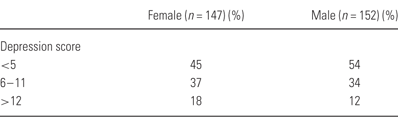
Female depression score is higher than male, especially in the score over 12, the emotion stable students are male predominance, and there are no statistic differences in the group of 6–11 score students between female and male (p < 0.05).
Discussion
Changes in the HRV are well‐known among patients with depression, which alternates the cardiac autonomic tone towards decreased parasympathetic activity and increase sympathetic activity. It is possible that a common neurobiological dysfunction contributes to both depression and cardiac autonomic changes in the illness Reference Udupa, Sathyaprabha and Thirthalli11. It is hypothesised that there are anomalies in the functioning of the central autonomic neural network in subjects with major depression, and more specifically in the hippocampus, prefrontal cortex and the brain stem nuclei. Such abnormalities, in association with lower central levels of serotonin give rise to a predominance of the sympathetic flow and a loss of cardiac vagal tone Reference Garcia‐Gomez, Lopez‐Jaramillo and Tomaz5. A study showed that the heart rate increases were attenuated in the depressed subjects compared with non‐depressed controls and the effect was independent of sleep stage or baseline heart rate. All effects were independent of subject age. These findings point to a change in autonomic regulation of heart rate in depression Reference Lahmeyer and Bellur12. Moreover, there is evidence that these autonomic dys‐regulations are partly responsible for the increased mortality in patients with psychiatric disorder Reference Birkhofer, Schmidt and Forstl13. A more recent important study in Sweden showed that adolescent female psychiatric patients with AD and/or major depressive disorder reveal reduced HRV compared with healthy controls and medication with selective serotonin‐reuptake inhibitors explained a part of this difference Reference Henje Blom, Olsson and Serlachius14.
Loss of normal autonomic nervous system control of heart rate and rhythm is an important risk factor for adverse cardiovascular events. Several studies have shown a link between reduced HRV in post‐myocardial infarction patients and increased risk for adverse cardiovascular events, including ventricular arrhythmias and sudden death. Recently, studies indicate that patients with depression and ADs exhibit abnormally low HRV compared with non‐psychiatric controls. Reduced HRV seems to indicate decreased cardiac vagal tone and elevated sympathetic activity in anxious and depressive patients and would reflect deficit in flexibility of emotional physiological mechanisms Reference Henje Blom, Olsson and Serlachius14.
HRV has become a popular method for the studies of physiologic mechanisms responsible for the control of heart rate fluctuations, in which the autonomic nervous system appears to play a primary role Reference Stys and Stys15. HRV analysis and integration in the assessment and monitoring of psychiatric patients before and during therapy elucidate the role of autonomic disturbances in such diseases and may help to optimise treatment Reference Birkhofer, Schmidt and Forstl13. Anxiety and antisocial behaviour showed distinct relationships to heart rate, and to autonomically mediated components of HRV from postural and respiratory sources. Spectral analytic techniques helped to elucidate these unique regulatory patterns, suggesting utility for future research in this area Reference Mezzacaoppa, Tremblay and Kindlon16.
Treating depression with cognitive behaviour therapy (CBT) may reduce heart rate and increase short‐term HRV. Thus, CBT may have a beneficial effect on a risk factor for mortality in depressed patients with coronary heart disease Reference Carney, Fredland and Stein17. However, a study showed that depressive disorder is associated with low systolic blood pressure and less hypertension, whereas the use of certain antidepressants is associated with both high diastolic and systolic blood pressures and hypertension Reference Licht, de Geus and Seldenrijk18. Moreover, a recent study showed that depression without CVD is associated with reduced HRV, which decreases with increasing depression severity, most apparent with nonlinear measures decreases despite resolution of symptoms, highlighting that antidepressant medications might not have HRV‐mediated cardioprotective effects and the need to identify individuals at risk among patients in remission Reference Kemp, Quintana and Gray19.
This study showed that the depression score of females was higher than males in the junior high school students with depression and anxiety. Lower depression scale persons usually associated with lower HF and higher LF/HF ratio and higher depression scale persons would present with higher average heart rate and associated with lower standard deviation of heart rate, respectively. However, the above results are not statistically significant. In conclusion, there is positive relationship between HRV and depression or anxiety, especially in the female gender. Theoretically, HRV in depression or anxiety patients is an important risk factor for detecting and prevention of mental disorder development, even suicidal behaviour in teenagers but large group, randomised and controlled studies of the treatment with antidepression is needed.