I. INTRODUCTION
Titanium (Ti) is an attractive material because of its high strength to weight ratio compared to aluminum and steel. Reference Lütjering and Williams1,2 It also possesses high corrosion resistance and good chemical inertness, a desirable feature for structural materials. Reference Froes and Eylon3,Reference Froes, Mashl, Hebeisen, Moxson and Duz4 To increase the fuel efficiency, a number of Ti alloys and composites have been developed over the decades for manufacturing specific components in aerospace and other industries. Reference Ward-Close, Winstone and Partridge5–Reference Montgomery, Wells, Roopchand and Ogilvy10 The adoption of TiB reinforced Ti metal matrix composites (TMMCs) by Toyota Motors for the intake and exhaust valves Reference Saito11,Reference Saito, Takamiya and Furuta12 was a milestone development in TMMCs. The reduced weight and improved performance of TMMCs at both room and high temperatures can mitigate the concern over the cost issue and make Ti materials more acceptable to the automotive industry. Therefore, a number of reinforcements, such as WC, Al2O3, SiC, TiB, TiC, and CNT, in the form of particles, whiskers, rods, wafers or thin plates (<150 nm thick), and nanotubes have been explored previously for the fabrication of TMMCs. Reference Bakshi, Lahiri and Agarwal13–Reference Vreeling, Ocelík and De Hosson17 In particular, ultrahigh compressive strengths (>2.5 GPa) and ductility (>40%) have been obtained for Ti–TiC MMCs fabricated by the simple press-and-sinter approach. Reference Luo, Li, Tian, Wang, Yan, Schaffer and Qian18
Boron nitride nanotubes (BNNTs) have excellent physical, mechanical, and chemical properties that are comparable to carbon nanotubes. Reference Ishigami, Aloni, Zettl and Kemerink19 They possess very high elastic modulus (750–1200 GPa) Reference Chopra and Zettl20,Reference Suryavanshi, Yu, Wen, Tang and Bando21 and tensile strength (∼24 GPa), Reference Shen22 in addition to their high melting point (∼3000 °C), high oxidation resistance over the temperature range of 700–950 °C, and good thermal and chemical stability. Reference Chen, Zou, Campbell and Caer23,Reference Golberg, Bando, Tang and Zni24 These attributes make them an attractive reinforcement filler in composite materials and therefore numerous researches on BNNT-reinforced polymer Reference Zhi, Bando, Tang, Honda, Sato, Kuwahara and Golberg25–Reference Li, Chen and Stachurski31 and glass-based Reference Bansal, Hurst and Choi32,Reference Choi, Bansal and Garg33 composites are carried out. However, the development of BNNTs reinforced MMCs is still in its infancy. Only a few studies have recently looked at Al-BNNTs MMCs, Reference Lahiri, Hadjikhani, Zhang, Xing, Li, Chen and Agarwal34–Reference Patel, Liu, Eng and Iqbal39 while no research has been reported on Ti–BNNTs MMCs as yet. Incorporation of BNNTs into an aluminum matrix greatly improved mechanical properties. The interfacial reaction zone is also thinner and more stable than those observed at other types of matrix–reinforcement interfaces. Reference Lahiri, Singh, Li, Xing, Seal, Chen and Agarwal40 A recent study has demonstrated that BNNT and Ti can react and form a continuous interface at temperatures above 700 °C. Reference Bhuiyan, Li, Wang, Hodgson and Chen41 Therefore, it can be assumed that BNNT has the potential to be an effective reinforcement for titanium matrix.
In this research, BNNT reinforced Ti MMCs were prepared by the conventional press-and-sinter process. The effect of processing conditions and volume faction of BNNTs on the microstructure and mechanical properties of the resulting Ti MMCs was studied.
II. EXPERIMENTAL
The BNNTs were synthesized using a ball milling and an annealing method in a specially designed rotating furnace using ball-milled boron powders under a nitrogen atmosphere (refer to Ref. Reference Chen, Fitz Gerald, Williams and Bulcock42 for details). The required amount of Ti sponge powders (<149 μm, 99.4% purity containing, Johnson Matthey Catalog Company, Haverhill, Massachusetts.) and synthesized BNNTs were mixed in a proportion of 0–5 vol% reinforcements by considering the density of titanium as 4.5 g/cm3 and that of the BNNTs as 2.2 g/cm3. Reference Lahiri, Rouzand, Richard, Keshri, Bakshi, Kos and Agarwal43 The powder mixture was ultrasonicated for a short duration and ball milled (Pulverisette-7, Fritsch GmbH, Idar-Oberstein, Germany) at a speed of 100 rpm for 20 min in an Ar atmosphere using stainless steel balls of 1 mm in diameter and a ball to powder weight ratio of 2:1. This allowed effective dispersion of BNNTs in the Ti powders without damaging the structure of the BNNTs. A charge of 1.2 g of the powder mixture was then loaded into a die and pressed uniaxially at room temperature to fabricate cylindrical green compacts with dimensions of 6 mm in diameter and 9 mm in height. Sintering was carried out over the temperature range 800–1100 °C for 1–3 h in an Ar atmosphere with a heating rate of 5 °C/min.
All density values presented in this research were obtained by the Archimedes method and the relative density was calculated using the theoretical density of the respective composite based on the rule of mixtures. The morphology of BNNTs and the fracture surface of the composite samples were examined using scanning electron microscopy (SEM) with a Zeiss Supra 55 VP FEG SEM instrument (Carl Zeiss AG, Oberkochen, Germany). Transmission electron microscopy (TEM) was conducted with a JEOL 2100 LaB6 machine. A JEOL 2100F FEG TEM microscope (JEOL Ltd., Tokyo, Japan) was used to obtain high-resolution TEM (HRTEM) images, diffraction patterns, and energy dispersive X-ray spectroscopy (EDX). For compression tests, the sintered composites were machined into 4.67 mm (diameter) × 7 mm (length) cylinders with a 1.5 aspect ratio. Compression test was performed on an Instron 8801 machine (100 kN) at room temperature (Instron, Norwood, Massachusetts) and at 500 °C at a cross head speed of 0.005 mm/s (equivalent to a strain rate of 7 × 10⁻⁴ s−1). For each condition, a minimum of four samples were tested, and the average values are reported.
III. RESULTS AND DISCUSSION
A. Morphology and phases
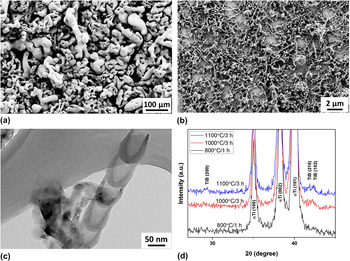
The morphology of the Ti sponge powder used is shown in Fig. 1(a). The powder particles show a variety of morphologies, and a large portion of them are elongated. In addition, a large number of particles are perforated. Figure 1(b) shows the typical morphology of the BNNTs. The nanotubes have lengths up to a few micrometers and diameters ranging from 30 to 100 nm. A closer inspection of the BNNTs by TEM, shown in Fig. 1(c), revealed a distinct bamboo-like structure. The majority of the BNNTs used in this research were found to exhibit a bamboo-like structure, although some cylindrical nanotubes were also observed. The rough surfaces of these bamboo-like BNNTs offer increased contact with the Ti matrix for interfacial bonding during sintering and are therefore desired.
(a) SEM image of sponge type Ti powders, (b) SEM image of BNNTs, (c) TEM image showing bamboo structure of BNNTs, and (d) XRD patterns of Ti–5 vol% BNNT composites sintered at different conditions.

The XRD spectra obtained from the as-sintered Ti–5 vol% BNNTs composites are displayed in Fig. 1(d). When sintered at 1100 °C for 3 h, weak diffraction peaks appeared at 29.22°, 41.76°, and 42.19° corresponding to the (200), (210), and (102) planes of the TiB phase, respectively. The TiB phase resulted from the reaction between Ti and BNNTs since the bamboo BNNTs are chemically more reactive.
B. Microstructure of the composites
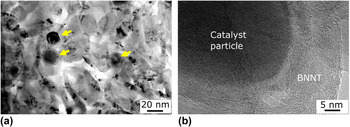
To identify and analyze the BNNTs and the resulting reaction phases in the Ti matrix, TEM study was carried out on Ti–5 vol% BNNTs composite samples after compression testing. In the sample sintered at 800 °C for 1 h, the bamboo-like structures of the BNNTs with an internal conical hollow section were still retained (Fig. 2). Hence BNNTs are stable at 800 °C up to 1 h in the Ti matrix.
(a) TEM image of the Ti–5 vol% BNNT composite sintered at 800 °C for 1 h. The arrows indicate Fe catalyst particles inside BNNTs. (b) HRTEM image of a BNNT in the composite sintered at 800 °C for 1 h showing the bamboo-type structure around an Fe particle.

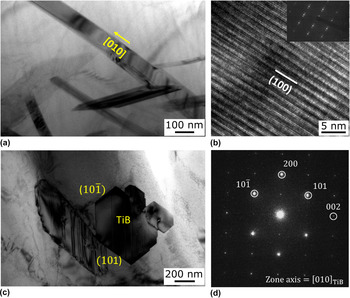
In the composite sintered at 1000 °C for 3 h, the effect of sintering temperature on the stability of the BNNTS is clear by the formation of TiB whiskers in the matrix along with BNNTs. Their longitudinal axis grew along the [010] direction as shown in Fig. 3(a). The HRTEM image shown in Fig. 3(b), obtained from TiB in the Ti matrix, shows Moiré fringes contributed from both the α-Ti matrix and the TiB phase in the composite.
Reference Li, Wang, Qin, Chen, Lu and Zhang16,Reference Feng, Jia, Zhou and Huo44
The cross-section of a TiB whisker is shown in Fig. 3(c), along with the corresponding SAED pattern in Fig. 3(d). The cross section is featured by the slowest growing facets (101) and
 $\left( {10\bar 1} \right)$
planes.
Reference Feng, Zhou, Jia and Meng45,Reference Tjong and Mai46
The formation of TiB in the composite corroborates a recent study on the interfacial reactions between Ti and BNNTs.
Reference Bhuiyan, Li, Wang, Hodgson and Chen41
It was noticed that heat treatment of Ti-coated BNNTs resulted in the initial formation of TiB2 nanocrystals on the surfaces of the BNNTs at 800 °C, which gradually grew and transformed into TiB whiskers by consuming the inner portion of each nanotube with increasing the heat treatment temperature.
(a) TiB needles in the composite sintered at 1000 °C for 3 h, (b) HRTEM image from this needle with inset showing the diffraction pattern from TiB in Ti matrix, (c) TEM image from the cross section of TiB needles, and (d) Diffraction pattern obtained from the TiB phase.

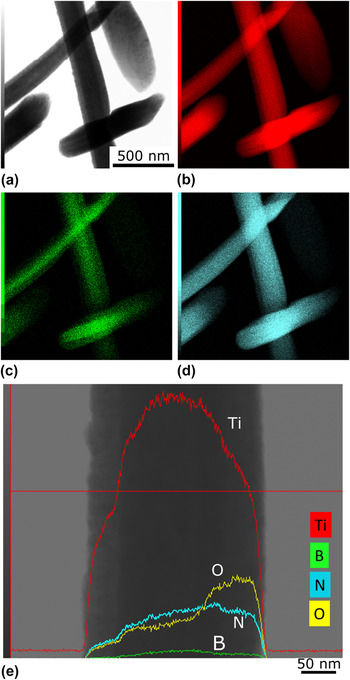
In addition to the retained BNNTs and in situ-formed TiB whiskers in this composite, some BNNTs have exhibited partial reactions in their internal void areas (Fig. 4). Elemental maps from this area, as shown in Figs. 4(b)–4(d), indicate high concentrations of Ti, B, and N. An EDX line profile from one such partially reacted nanotube is shown in Fig. 4(e), which reveals that the concentrations of Ti, B, and N were much higher at the center than in the surrounding areas. These results suggest that it was a BN nanotube prior to the reaction and that the reaction proceeded from the Ti–BNNT interface.
(a) Bright-field STEM image of partially reacted nanotubes and EDX elemental mapping for (b) Ti, (c) B, and (d) N elements. (e) EDX line profiles on a partially reacted nanotube.

C. Mechanical properties at room temperature
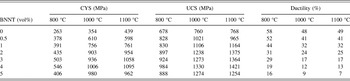
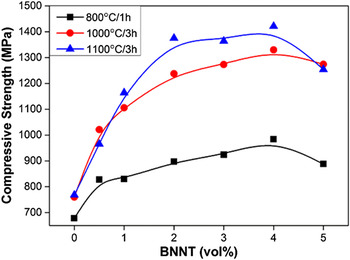
Mechanical properties of the Ti–BNNTs composites were evaluated by conducting compression tests both at room temperature and at 500 °C. The compressive yield strength (CYS), ultimate compressive strength (UCS), and ductility at room temperature are listed in Table I. The strength of the composite increased with increasing BNNTs content and sintering temperature, while the ductility declined, as shown in Fig. 5. The Ti–4 vol% BNNTs composites achieved the highest UCS for all sintering conditions investigated (see Fig. 5). For example, the Ti–4 vol% BNNT composite attained a compressive strength of 984 MPa after 1 h of sintering at 800 °C, compared to 678 MPa for the same Ti matrix powder sintered at 800 °C for 1 h. This increase (45%) in strength can be mainly contributed to the composite strengthening of BNNTs, which, as shown earlier, were stable at 800 °C up to 1 h. The BNNTs can act as an effective barrier for dislocation movement in the composite during plastic deformation.
Compressive properties at room temperature for Ti–BNNT composites.

UCS at room temperature for composites with various BNNT contents and sintering conditions.

With the use of a higher sintering temperatures and a longer sintering time, the strength of the Ti–BNNT composite can be improved further. For example, the compressive strength of Ti–4 vol% BNNT increased from 1330 to 1421 MPa with increasing the sintering temperature from 1000 to 1100 °C (3 h at each). However, it should be noted that the resulting composites are no longer Ti–BNNTs because no BNNTs were observed in the microstructure when sintered at 1100 °C for 3 h. The increased strengthening effect arose from in situ-formed TiB whiskers as well as higher sintered densities. Therefore, it remains challenging to fabricate high-strength Ti–BNNTs by pressureless sintering as compared to hot pressing or spark plasma sintering.
D. Mechanical properties at 500 °C
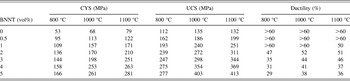
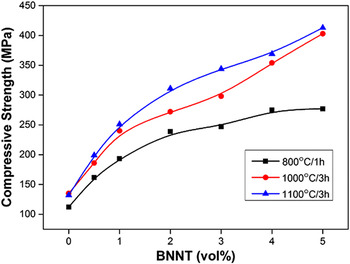
To assess the potential of Ti–BNNTs composites for applications at elevated temperatures, compression tests of these composites were also performed at 500 °C, as listed in Table II. As expected, the strength decreased while the ductility increased. Unlike the room temperature compression tests, the highest UCS was obtained from the Ti–5 vol% BNNTs composite irrespective of sintering conditions, as shown in Fig. 6. The Ti matrix powder sintered at 800 °C for 1 h exhibited a compressive strength of 112 MPa at 500 °C, while that of the Ti–5 vol% BNNTs composite retained 277 MPa. It is clear that the introduction of BNNTs was very effective in improving the compressive strength of Ti. The Ti–5 vol% BNNTs composite sintered at 1000 °C for 3 h and at 1100 °C for 3 h showed a compressive strength of 403 MPa and 413 MPa, respectively. However, the composites sintered at 1100 °C for 3 h are no longer Ti–BNNTs composites in which all BNNTs transformed into TiB whiskers.
Compressive properties at 500 °C for Ti–BNNT composites.

UCS at 500 °C for composites with various BNNT contents and sintering conditions.

E. Fracture behavior
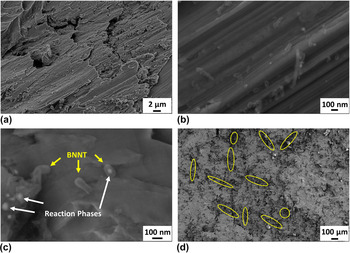
The distribution of BNNTs and in situ-formed TiB whiskers in the matrix and their effect on strengthening the composite were analyzed by observing the fracture surfaces of the composite samples after the compression tests. The fracture surfaces of the Ti–5 vol% BNNT composite sintered at 800 °C for 1 h, shown in Fig. 7(a), present elongated grains and the formation of shear bands in the matrix, which indicate a ductile failure. A high-magnification image in Fig. 7(b) revealed fragments of BNNTs in the matrix after compression tests. A number of protruding BNNTs were also observed at various locations on the fracture surface, as shown in Fig. 7(c), implying that the load was effectively transferred from the soft Ti matrix to the BNNTs reinforcements. During sintering at 1000 °C, reactions between Ti and BNNTs produced nanoscale titanium boride whiskers at their interfaces. Figures 7(b) and 7(c) show the fracture of BNNTs under deformation, which implies that the thin interfacial reaction phase provides good bonding between Ti and BNNTs, thus no pull-out of nanotubes was observed. However, clusters of BNNTs were observed in many areas on the fracture surface, highlighted by circles in Fig. 7(d). The irregular shapes of the Ti powder particles and the large difference in size between the Ti powder (<150 μm) and the BNNTs (∼2 μm) entailed BNNTs to segregate in the interstitial spaces between the Ti powder particles.
(a) Fracture surface of Ti–5 vol% BNNT composite sintered at 800 °C for 1 h, (b) Fragments of BNNTs on the fractured surface, (c) Protruded BNNTs from the matrix after fracturing of composite, and (d) Low magnification image showing segregation of BNNTs.

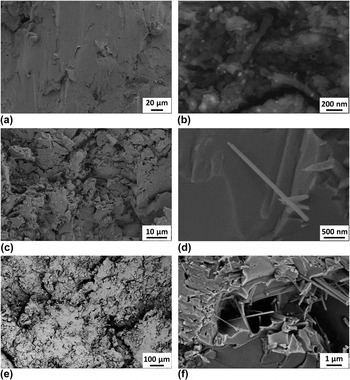
The Ti–5 vol% BNNT composite that was sintered at 1000 °C for 3 h exhibited a mixed mode of ductile and brittle fracture. Ductile fracture, shown in Fig. 8(a), took place in the region where BNNTs are retained, which is visible in the high-magnification image in Fig. 8(b). In contrast, brittle fracture occurred in the matrix where in situ-formed TiB whiskers are prevalent, as shown in Figs. 8(c) and 8(d). TiB is much stronger than Ti, and most TiB whiskers were pulled out from the Ti matrix resulting in cleavage failure. Similar mixed modes of fracture were also reported in the case of the in situ-formed TiC particle reinforced Ti–6Al4V alloy composite Reference Tjong and Mai46 and TiNi–5 vol% CNT composite prepared by hot pressing. Reference Feng, Sui and Cai47 However, unlike the TiB whiskers, cracks initiated due to the fracture of TiC reinforcements in those composites. For the composites that were sintered at 1100 °C for 3 h, their fracture exhibited an entirely brittle mode, shown in Fig. 8(e). The high volume fraction of TiB whiskers and their brittleness in the composites rendered clear cleavage fracture, see Fig. 8(f).
(a–d) Fracture surface of the Ti–5 vol% BNNT composite sintered at 1000 °C for 3 h showing (a) ductile type fracture, (b) retained BNNTs in the matrix, (c) cleavage type fracture and (d) in situ formed TiB needle. (e) Fracture surface of Ti–5 vol% BNNT composite sintered at 1100 °C for 3 h and (f) randomly oriented TiB whiskers.

IV. CONCLUSIONS
BNNT reinforced Ti matrix composites were manufactured by the press-and-sinter approach. Density values in the range of 95–97% were obtained in the sintered composites. BNNTs started to react with Ti to form TiB whiskers at 1000 °C. The microstructure of the composites sintered at 1000 °C for 3 h consisted of the in situ-formed TiB phase and retained BNNTs in the Ti matrix. Compression tests both at room temperature and at 500 °C showed a significant increase in the mechanical properties of the composites, compared to pure Ti. The highest compressive strength at room temperature was obtained for the Ti–4 vol% BNNT composites, irrespective of sintering temperature and periods. The highest compressive strength of the composites at 500 °C was obtained from the Ti–5 vol% BNNT composite, regardless of sintering conditions. Fracture surface of the composite sintered at 800 °C showed intergranular ductile fracture with fragments of BNNTs. Composites sintered at 1000 °C showed a mixed mode of ductile and brittle fracture in the composites depending on the location of BNNTs and TiB in the matrix. Brittle fracture mainly occurred in the places where TiB whiskers are present. When sintered at 1100 °C for 3 h, no BNNTs were retained, which were all transformed into TiB whiskers.
ACKNOWLEDGMENTS
Financial support from the Australian Research Council under Discovery, Linkage project and Deakin Ph.D. scholarship is gratefully acknowledged. Authors thank John Vella for assisting the property testing. The present work was carried out with the support of the Deakin Advanced Characterisation Facility.