Introduction
Malaria is a major cause of child death and disability in Mali. In a study following community health centres in two towns in the central Mopti region, presumptive malaria accounted for 33.8% (N=10,123) of all recorded consultation diagnoses between 1998 and 2006 (Rose-Wood et al., Reference Rose-Wood, Doumbia, Traore and Castro2010). In 2009, 68% of reported deaths of Malian children under five were attributed to malaria (PMI, 2011). The effects are particularly severe in Sahelian zones like Koulikoro, where the annual rainy season is accompanied by 6 months of high malaria transmission from June to November (Findley et al., Reference Findley, Medina, Sogoba, Guindo and Doumbia2010). A study mapping West Africa's geographic risk profile for anaemia, to which malaria is a major contributor, identified a large spatial cluster of low mean haemoglobin concentration (<80 g/l) and maximal risk of anaemia (>95%) over an area abutting Koulikoro Region, where the risk was nearly as high (Soares Magalhães & Clements, Reference Soares Magalhães and Clements2011).
In areas of high malaria transmission with weak health systems, malaria control programmes often promote proper management of illness in the home (WHO, 2004; UNICEF, 2007; WHO/UNICEF, 2012). However, problems can arise when severe illness develops, particularly since malaria can quickly develop into a complicated episode during which multiple organs may be affected, potentially causing mortality as high as 10–50% (Dondorp & Day, Reference Dondorp and Day2007). In cases of severe illness, recourse to formal health services is by no means universal: a study of paediatric malaria cases in the Sikasso Region of Mali found that traditional medicine was the only treatment used in half of severe cases, for which the overall mortality rate was 17% (Diallo et al., Reference Diallo, Graz, Falquet, Traore, Giani and Mounkoro2006).
Promoting effective home treatment requires an understanding of the social, cultural, political and economic context of malaria recognition and treatment-seeking (Williams & Jones, Reference Williams and Jones2004). Applied social science research in public health has made considerable progress toward examining factors that influence malaria treatment-seeking behaviour, and particularly normative cultural beliefs and practices (Breman et al., Reference Breman, Alilio and Mills2004; Mwenesi, Reference Mwenesi2005; Chibwana et al., Reference Chibwana, Mathanga, Chinkhumba and Campbell2009; Maslove et al., Reference Maslove, Mnyusiwalla, Mills, Mcgowan, Attaran and Wilson2009; Iwelunmor et al., Reference Iwelunmor, Idris, Adelakun and Airhihenbuwa2010). However, this research has not fully considered how relationships, age, gender roles and organizing structures within the household affect the management of illness and treatment-seeking behaviours, which in turn have critical consequences on child health.
This study examines how household members interact during episodes of severe febrile illness in children, and how actual behaviour contrasts with stated social norms about the roles of different household members. These social norms assign responsibility for identifying a child's illness, making decisions about care-seeking, and paying for care to different household members according to gender, age and status. This study aims both to describe these roles, as well as situations in which expectations are violated, leading to a re-evaluation of assumptions about how households respond to severe childhood illness and who in the household should be the ‘target’ of public health messages promoting timely care-seeking from health facilities.
Background
Studies looking at the relationship between household dynamics and the home management of malaria are few in number but already suggest the limits of targeting only mothers in messaging about home management of malaria and care-seeking behaviours. In The Gambia, while mothers were identified as the primary caregiver in 80% of cases of cerebral malaria in children, in 85.2% of cases the household elder or father made the decision to take the child to the health centre. The child's mother made the decision in only 7.4% of cases (Okoko & Yamuah, Reference Okoko and Yamuah2006). In Tanzania, mothers managed uncomplicated malaria, but in cases of severe malaria, senior women were the key decision-makers (Comoro et al., Reference Comoro, Nsimba, Warsame and Tomson2003). A study of care-seeking in rural Senegal found that decision-making was collaborative in 71% of cases requiring treatment outside the home, with household roles divided according to gender norms, inter-generational relations and family characteristics (Frankel & Lalou, Reference Frankel and Lalou2009). Less commonly, authors have reported that mothers have the autonomy to diagnose and treat malaria themselves, such as in a study in Zambia (Kaona & Tuba, Reference Kaona and Tuba2005).
A few studies have investigated how dynamics within the household affect decisions on management of childhood malaria. Along the Kenyan coast, mothers discussed illnesses with numerous other females but were expected to defer to husbands and household elders for direction and financial support for treatment. In cases of severe malaria with convulsions, conflict and serious disputes often arose among household members (Molyneux et al., Reference Molyneux, Murira, Masha and Snow2002). In Ghana, both fathers and senior women strongly influenced treatment-seeking decisions, due in part to their control over household resources. Mothers were also able to determine treatment steps if personal resources were available to them (Tolhurst & Nyonator, Reference Tolhurst and Nyonator2006). However, other research in Africa has found that when a woman's contribution to the household income increased, it did not typically correspond to an increase her household decision-making power (Pfeiffer et al., Reference Pfeiffer, Gloyd and Ramirez Li2001; Pfeiffer, Reference Pfeiffer2003). Lastly, the study in Senegal mentioned above suggested that collective management of illness episodes tended to favour home-based rather than facility-based care, so as to optimize human and financial resources (Frankel & Lalou, Reference Frankel and Lalou2009).
This research expands upon previous studies examining household-level management of malaria by incorporating the perspectives of mothers as well as other influential household members involved in the management of childhood illness. This study examines the roles of various household members during different steps of an illness episode, and the ability of members to take actions to identify and treat a sick child. In households where members were not in consensus about how treatment should be pursued, investigators examined why conflict arose and how differing viewpoints affected management of the child's illness.
Methods
This study used a qualitative approach to explore intra-household dynamics in the response to severe childhood illness, using 25 case studies of rural Malian households.
Study site and population
Research took place in the Kati District in Koulikoro Region from October 2006 to January 2007, coinciding with the end of the rainy season and peak number of severe malaria cases. This period is also the leanest, most difficult time of the year for most rural household as food stores and resources run low but the annual harvest is not yet available. Twenty-five households in four villages participated in the study. The villages were selected with the assistance of the Chief District Medical Officer based on their distance to a health centre (within 5 km) and population size (range: 870–4500 inhabitants).
Villages in Koulikoro Region are inhabited by subsistence farmers of the Bambara ethnic group, whose households often contain multiple generations; one study found an average of 22 members per household among the Bambara (Madhavan & Adams, Reference Madhavan and Adams2003). The most senior male member of the household controls compound resources, land use and household production and labour (Adams & Castle, Reference Adams, Castle, Sen, Germain and Chen1994). Upon the payment of the bridewealth, a husband and his family traditionally gain the rights to the woman's labour and any children born of the marriage (Adams & Castle, Reference Adams, Castle, Sen, Germain and Chen1994; Castle, Reference Castle1995). However, many Bambara women enjoy some degree of financial independence by cultivating crops or by participating in other income-generating activities.
Ethical approval for this study was granted by the Johns Hopkins University Bloomberg School of Public Health Committee on Human Research and the University of Bamako Faculty of Medicine, Pharmacy, and Dentistry internal review board.
Data collection
In the four study villages, 25 households were identified in which a child suffered from a severe febrile illness within the past 2 weeks. Cases of severe illness were identified through several sources, including health workers at the local community health centre, traditional healers, village leaders and community members. Study interviewers resided in the village while performing data collection, returning regularly to Bamako to transcribe interviews and focus group discussions and participate in team meetings. These regular updates informed ongoing data collection in an iterative process and allowed for research questions to be refined over the course of the study.
Interviews were conducted with the child's mother and father, as well as with all household members who were identified as having been involved in some way during the illness episode (106 interviews with 81 informants). Each mother provided a detailed illness narrative, which was followed by a thematic discussion of household roles and responsibilities, power dynamics and conflict in regard to child health and illness, over the course of two interviews. Interviews with other household members examined their involvement during the illness episode and their perceptions of household roles and organization. As household members were typically engaged in some aspects of an illness episode more than others, narratives frequently provided different perspectives and details that contributed to a more complete and comprehensive account of the illness episode. In the few instances where household members described accounts with conflicting information, interviewers attempted to re-examine and clarify discrepancies and as much as possible. Participants also completed a brief knowledge and practices questionnaire on malaria treatment and child health (n=79). Lastly, key-informant interviews were conducted with traditional healers, health agents and village leaders (n=9), as well as eight focus group discussions, including two each with male heads of household, grandmothers, fathers and mothers (n=8 focus group discussions, each with 9–15 participants).
Data analysis
Data were analysed using a thematic analysis approach. All data collection activities were conducted and recorded in the local language, Bambara, and then translated and transcribed verbatim into French. Interview and focus group discussion transcripts were reviewed for emergent themes and analysed for content. Members of the research team developed and refined codes related to the key issues explored. Interviews were managed and coded with the use of Atlas.ti (Scientific Software Development GmbH) and major trends and cross-cutting themes were identified and refined. Survey responses were analysed using SPSS Version 14.0 for Windows.
Results
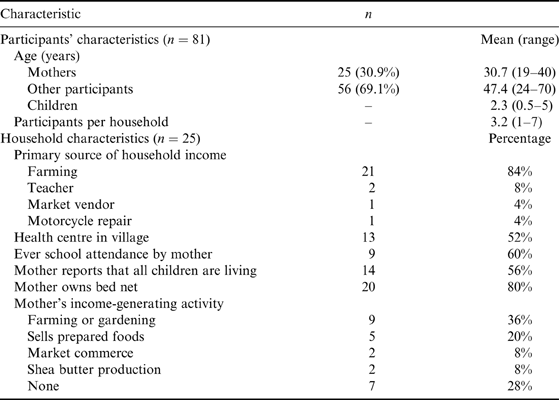
Characteristics of households and participants are displayed in Tables 1 and 2. Twenty-five household case studies were included, encompassing interviews with 25 mothers and 56 other household members (n=81), with an average of 3.2 participants per household (range: 1–7). Mothers tended to be younger than other participants, with an average age of 30.7 years compared with 47.4 years for other participants. Most households' primary source of income was from farming (84%); household organization was split between monogamous (56%) and polygamous (44%) marriages, although most were ‘extended households’ (68%) encompassing one or more paternal family members. Just over half of households (52%) were located in a village with a health centre. Only half of mothers (56%) reported that all their children were living.
Demographic characteristics of household informants (n=81), Mali, 2006–07

Characterization of households by marital status of mother and household structure (n=25), Mali, 2006–07
a Nuclear households are comprised of the father of the child and his wife (wives), and the father is the only member of the paternal family present in the household. Extended households are those in which one or more paternal family members are present.
b Four mothers were not the first wife of the child's father.
Norms about household roles in managing childhood illness
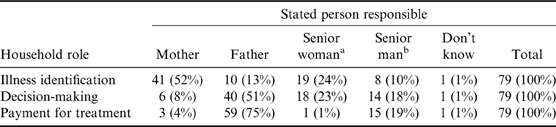
Table 3 displays results from the survey in which participants identified who in their household was typically responsible or best able to perform three tasks pertaining to the management of childhood illness: identifying the illness, making decisions pertaining to care-seeking and paying for treatment. Illness identification was deemed primarily the responsibility of mothers (52%) and senior women (24%), whereas most respondents (75%) said fathers took on financial responsibility for health care. There was less agreement on the role of decision-making about care-seeking, a role attributed first to fathers (51%), then senior women (23%) and thirdly senior men (18%).
Survey data: household roles in the management of childhood illness (n=79), Mali, 2006–07
a Senior woman includes any female household member older than the child's mother, including the child's grandmother, or a more senior wife of either the head of household or the child's father.
b Senior man includes the father, uncle or older brother of the child's father.
Illness identification and diagnosis
Most informants (52%) identified the child's mother as being most capable of recognizing symptoms of illness due to her constant and close proximity to the child and her familiarity with the child's sleeping and eating habits. After noticing that a child is ill, the mother is expected to notify other adult members of the household before taking any steps to address the illness:
The mother should be the first to identify a childhood illness because she is always with the child; she sleeps with him, she wakes with him, she carries him on her back. Therefore, if there is a change in the state of the child, it is the mother who will first perceive it and she should alert the father or other members of the household that the child is suffering.
(Father, 18M1)However, informants often distinguished between observing signs of illness and diagnosing illness, believing the former to be the role of the mother, and the latter best done by older, more experienced members of the household:
It is the mother who is the first to notice an illness. But often, even if the mother can notice the symptoms of the child's illness, she does not know what the illness is. She can ask the other members of her household. The old people can examine the child and they can tell her what illness it is. Or if there is no one in the household who knows the illness, the mother will go and show the child to a traditional healer.
(Mother, 06A2)Several grandparents claimed that they were the household members most capable of diagnosing childhood illnesses because of their many years of experience with such matters:
Ha, the knowledgeable ones are the old women and the old men! They are the ones who have seen many illnesses. If you have not seen things, then you cannot know. Some women can identify illnesses, but generally it is the old people who understand illnesses. We old people, we are the ones who have seen plenty of things. Who could know more than us?
(Grandfather, 23M1)Indeed, in the survey on household roles, 24% of participants identified senior women and 13% identified senior men as responsible for identifying illness, suggesting a strong expectation that older member of the household are best suited to perform this key task.
Decision-making about seeking treatment
When asked who among the members of their household were generally most capable of making decisions about health care outside the home, less than 8% of informants identified the child's mother. More than half of informants (51%) identified the child's father as being the most capable of making this decision. Another quarter of participants (23%) believed the child's paternal grandmother or other senior woman is most capable, while another 18% identified the child's grandfather or patriarch.
Although women are often able to participate in the decision-making process about the health of their children in informal ways, the customary right of fathers to make ultimate decisions regarding the behaviour and welfare of family members was repeatedly stressed, often in terms of financial responsibility and ‘ownership’ of the child. Because children belong to the patriline, mothers are not usually entitled to take action without first receiving authorization. In some households, women acted relatively independently, but still informed their husbands of treatment actions. Other mothers were completely uninvolved in the decision-making process and merely enacted caregiving behaviours decided upon by other household members:
Me, I can decide nothing about how to treat my child … The father of the child, the [paternal] grandmother and grandfather are the owners of the child. If they tell you to bring the child to a place, you bring him there, and if the treatments don't improve the child, you tell them. If they tell you to go to the health centre, it is then that you bring the child. If they don't tell you this, the treatments that you have at your disposal, you use these, until they tell you otherwise.
(Mother, 21A2)Less commonly, fathers expressed a collaborative relationship with their wives with regards to decision-making in the face of illness in their children (see case studies in the Appendix).
While a mother is expected to receive authorization from her husband before pursuing treatment for a severely sick child, the highest authority often rests with the most senior male of the household, if that is someone other than the child's father:
In our household, when the mother informs the father that the child is sick, he will also go and inform the head of the household and if he or the grandmother has traditional medicine, they will give it. Or, the head of household will tell the father to take the child to this or that traditional healer, or to the health centre.
(Father, 07M1)If an illness befalls a child during the absence of the father, other men in the family will assume the responsibility of making decisions, directing care or paying for treatment:
This is not the first time this child has fallen ill – she has had many illnesses. It is not just me who is involved in the decisions about care because sometimes I am absent. Therefore, it is all of my brothers who make decisions when I am not here. For the things that happen in your presence, you can make the decision, but when you are absent, the decision becomes the duty of your brothers who are present. We help each other in this manner.
(Father, 15M1)Paying for treatment
The household survey showed a strong consensus that men are viewed as being responsible for financing children's health care, with 75% of participants stating that fathers should pay for health care and 19% of participants identifying another senior man (Table 2). Twenty-two of the 25 households included in the case studies sought treatment at a health centre, occasionally multiple times, during the illness episode. The father and/or another male member of the paternal family financed treatment in 86% of these cases.
Participants related fathers' decision-making power to both hierarchical respect and financial responsibility. One father explained why he believed this responsibility fell to him:
The father should always pay for treatment. If, after having brought the child for treatment [at the health centre], an ordinance or charge is imposed, the father is held accountable to pay it because in our traditional society it is the father who is responsible and pays for everything. It is up to him to go and work and to find the money necessary to provide for the needs of his family. Among us, the wife does not have a big role to play in paying for costs.
(Father, 19M1)During interviews, several participants (particularly fathers) noted that if the father was short of money, other members of the family, such as brothers or the child's mother, should contribute to financing health care.
Since traditional therapy is often free or relatively inexpensive, mothers may be able to prepare medicinal teas or visit traditional healers without requesting money or authorization from their husbands. One woman, whose husband was away travelling when her child fell seriously ill, explained why she used traditional therapies, but did not take her child to the health centre until after her husband returned:
Bring the child to the health centre? No, I cannot do this without the authorization of my husband. When it is a traditional healer, I can manage the situation alone; there is no difficulty in this. But if I must go to the health centre and I do not have any money, what am I going to do? The husband is the provider of money and if he is not at the house or does not give you the means, what can you do at the hospital?
(Mother, 05A1)Intra-household dynamics and treatment-seeking behaviours
Three examples illustrate the range of household dynamics that were witnessed in the study and place some of the findings in context (Appendix). As expected, household dynamics depended on a complex interplay of household structure, size and the personal qualities of the individual members, ranging from collaboration and joint decision-making between parents, to hierarchical decision structures based on age and gender, to conflictive schemas where members acted independently or in opposition to one another.
Households in which the father was proactively involved in the decision-making process were the most likely to promptly seek care at a health centre following the onset of signs of severity. In these households, mothers were not delayed by waiting for permission or financial support since fathers took the initiative to rapidly pursue and pay for treatment. Conversely, children from households in which the father was uninvolved or negligent in his decision-making and financial responsibilities received treatment that was delayed and inadequate, ultimately resulting in more negative health outcomes.
While a father's prerogative and responsibility to enact treatment decisions is uncontested, a mother's ability to do the same depends in large part on the household structure (monogamous or polygamous, number of senior male and female household members) as well as on individual and family characteristics. However, despite the strong influence of household structure, mothers are still able to find both subtle and overt ways to participate in decision-making:
Your husband is responsible [for making the decision], but if you exchange ideas with other mothers about treatment you can tell him ‘this person said that their child had the same illness and was cured by this treatment’. When you say this, then your husband will tell you to go to that source of care.
(Mother, 05A2)Here in my home, everyone is involved in decisions because if the child of one of my wives falls sick, all of the other women are generally involved. Each person gives their opinion about which treatment should be tried, whether it is modern or traditional treatment.
(Father, 18M1)Older women often exert more influence in the decision-making process than younger mothers: a junior woman cannot usually supersede her mother-in-law or co-wife if either of the latter assumes responsibility for managing the illness. When asked whether she would seek treatment for her severely sick child, even if her mother-in-law told her to wait, one mother replied:
In my opinion, a mother should wait. If those responsible for the child [the paternal family] want to treat a child in this or in that manner, you must do it. Even if the illness of the child worsens, this is not the problem of the mother. It is the problem of the ‘owners’ of the child.
(Mother, 21A2)Several mothers expressed similar feelings of resignation and disempowerment, while others were pleased to be able to rely upon senior household members and viewed them as a valuable resource in addressing severe childhood illness. Yet many mothers demonstrated in either word or action that, although they respected cultural norms and usually deferred to husbands and elders, they would take action in defiance of family or cultural expectations if they believed their child's health was at serious risk:
Normally it is the father who should make decisions about seeking care because he is responsible for the child. But if he does not have money, or if he does nothing, then the mother is obligated to do the impossible to save her child. You know that a child is too precious … just to stand by and watch die.
(Mother, 07A2)Conflicts arising from perceived neglect of household role
Conflicts sometimes arose when a household member was considered to be negligent of his or her established role in the family: mothers and, most often, fathers neglecting their obligation to pay for health care. The perceived or actual neglect of household roles often had a detrimental impact on the management of the illness episode and the family as a whole. Though a mother's child care responsibilities can be taken over by another family member without significantly affecting the treatment-seeking process, when a father neglects his role of providing sufficient financial support, prompt and proper care-seeking is critically obstructed and the child's health seriously endangered.
When confronted with a direct request for money to go to a health centre, fathers had various reactions:
Ha, in the bush, certain fathers do not give even 5 francs (1¢) for the treatment of their child. If you want the truth, there are certain fathers who take charge of all treatment – even if they don't have money, they will find credit. But people are not the same. It depends on their good will and on their understanding.
(Father, 06M1)Men who did not comply with requests or suggestions to seek care at a health centre usually did not directly forbid mothers or others from going. Rather, they deflected the request either by requiring the continued use of traditional medicines, or they simply failed to acknowledge the request at all. By doing so, fathers withheld giving authorization to their wives but avoided being held directly accountable for denying their children critical health care. Additionally, the financial onus of treatment is passed on to mothers or other household members.
In the face of her husband's refusal, a woman's first recourse is usually to appeal to senior members of her household (if they are present) to intervene in the disagreement. Although circumventing the hierarchy is not done lightly, this option allows the mother to resolve the issue from within the household before assistance is sought from outside:
It is the father who decides everything because it is he who is responsible for the mother and the child. If you don't agree with him, there is nothing you can do except to go see the elders of your family and speak with them. When I realized that my husband was going to refuse me, I went and explained the problem to his older brother. His elder brother called him and spoke seriously with him and my husband cannot say no to the orders of his older brother.
(Mother, 07A2)If the sick child's parents reside in a nuclear household without any extended family members, a mother may appeal to a trusted friend to act as an intermediary between her and her husband:
My husband refused to give any money for the child; he said that he did not have any money for the health centre treatment … That night, my husband's friend intervened … Oh, his friend really scolded him that night! … After this dispute, my husband went and borrowed money and I took the child to the health centre.
(Mother, 12A2)If, after petitioning senior household members or friends to intervene, financial assistance is still not forthcoming, it is then up to the mother to acquire financial means to pursue care at a health centre on her own. As most women in this rural, subsistence agricultural community do not have much, if any, access to cash, this can pose a significant challenge. If she does not have any money, mothers may search for credit among neighbours or sell personal belongings. This time-consuming delay can put significant strain upon the mother as well as postpone critical health care for the sick child.
Discussion
As has been documented in many settings in Africa and elsewhere, initial treatment of childhood illnesses often begins in the home with traditional therapies and medicines purchased from vendors or left over from previous illness episodes (McCombie, Reference McCombie2002; Williams et al., Reference Williams, Jones, Alilio, Zimicki, Azevedo, Nyamongo and Sommerfeld2002; Williams & Jones, Reference Williams and Jones2004). When symptoms are perceived as signifying a routine childhood illness, management and treatment often remain under the purview of mothers. Recourse to a health centre does not usually occur until it is clear that these more accessible and inexpensive therapies have failed to completely alleviate symptoms.
Once an illness episode is perceived as being severe and scarce household resources are called upon for treatment, decisions about care-seeking take on increasing consequence. Correspondingly, the management of the illness may shift away from the mother to the father and senior members of the household. As this study shows, the ability to make crucial decisions about treatment for severely ill children is viewed as the prerogative of men and representatives of the patriline, not only because children are regarded as ultimately belonging to the father's family but also because the finances necessary to pursue modern care are typically within their control. This notion of paternal ‘ownership’ pertaining to children's health has also been observed in Ghana (Tolhurst et al., Reference Tolhurst, Amekudzi, Nyonator, Bertel Squire and Theobald2008). When mothers disagree with the treatment decisions (or lack thereof) made by the father or other household members, this research indicates that they may pursue other options – an upending of normative household roles that can encumber mothers with significant social and financial stress, as well as delay effective treatment of childhood illness. Studies in Burkina Faso and Kenya have also documented ways in which women take action despite seeming powerlessness according to gender norms – particularly if they have access to their own source of cash (Whyte & Kariuki, Reference Whyte and Kariuki1991; Sauerborn et al., Reference Sauerborn, Berman and Nougtara1996).
Research exploring intra-household responses to illness shows that gender roles and social norms of seniority and power strongly influence how decisions are made (Castle, Reference Castle1993, Reference Castle1994, Reference Castle1995; Adams & Castle, Reference Adams, Castle, Sen, Germain and Chen1994; Adams et al., Reference Adams, Madhavan and Simon2002; Molyneux et al., Reference Molyneux, Murira, Masha and Snow2002; Aubel et al., Reference Aubel, Toure and Diagne2004; Okoko & Yamuah, Reference Okoko and Yamuah2006; Tolhurst & Nyonator, Reference Tolhurst and Nyonator2006). Because of fathers' access to the resources necessary to cover direct and indirect costs of care, their involvement strongly influences the management of the illness episodes. In this study, proactive, involved fathers went to great lengths to overcome obstacles and provide prompt, appropriate treatment for their children, whereas delays caused by negligent, uninvolved fathers served to exacerbate the severity of their children's conditions and put undue pressure upon mothers to manage the illnesses alone. With limited resources and access to treatment, mothers were compelled to use ineffective therapies, endure the stress of household conflict, or take on solitary responsibility for pursuing care. These consequences may ultimately contribute to significantly detrimental outcomes for sick children by derailing and delaying proper treatment.
Public health programmes that exclusively target mothers of young children risk failure when they do not take into account the complexity of intra-household dynamics (Aubel et al., Reference Aubel, Toure, Kone, Malakova, Waltensperger and Balde2005). Health interventions frequently focus exclusively on individuals within households – such as children, mothers, adolescents – whose interests, needs and abilities are related, but not necessarily identical, to that of the larger household (Zeitlin et al., Reference Zeitlin, Megawangi, Kramer, Colletta, Babatunde and Garman1995). Differentiation exists within households in terms of members' needs, priorities, access to, and control over resources, and the extent to which some individuals determine a response to a health crisis while others bear the costs of those decisions (Adams et al., Reference Adams, Cekan and Sauerborn1998). Insufficient attention has been placed on understanding the roles, authority and decision-making patterns that influence practices contributing to health and child development, even though behaviour is shaped by the socio-cultural dimensions of family systems, including hierarchies based on gender, age and experience (Aubel et al., Reference Aubel, Toure, Kone, Malakova, Waltensperger and Balde2005). This study contributes to the understanding of intra-household roles and dynamics and emphasizes that health programmes must widen their focus beyond targeting only mothers if they hope to significantly impact the management of severe childhood illness. The role that mothers play is undoubtedly central, but their behaviour and ability to pursue care-seeking for their children may be dramatically influenced by other members of their household.
A systematic review of qualitative studies on barriers to malaria prevention and treatment has suggested that traditional medicine and concerns about the safety and efficacy of conventional medicines are major impediments to care-seeking behaviours, especially in cases of severe malaria (Maslove et al., Reference Maslove, Mnyusiwalla, Mills, Mcgowan, Attaran and Wilson2009). Programmes addressing these issues must consider that fathers, as well as grandparents and family elders, exercise considerable influence in matters related to health and child care, although they are seldom incorporated into maternal and child health programming. Health behaviour change frameworks usually regard these crucial household members as ‘influencing’ forces, who are only acknowledged insofar as how they affect mothers. Instead, health messaging and interventions must be enlarged to consider these actors as primary targets. Recognizing the vital role that fathers and senior household members play in child health and engaging them more directly in health programming is essential to improving household management and treatment of severe childhood illnesses.
Conclusion
Currently and in the past, behaviour change communication related to child health and malaria has been aimed primarily at mothers, who are expected to recognize signs of severe illness and take steps to bring their children to the health centre. Indeed, some research has shown that educating mothers about malaria signs, symptoms and severity can increase the use of formal health facilities in cases of severe illness (Okeke, Reference Okeke2010). However, this study contributes to a growing literature demonstrating that mothers are often not fully empowered to independently access resources and make important health-seeking decisions necessary to respond promptly to signs of severe childhood illness. Although a few fathers expressed a collaborative relationship with their wives in regard to managing illness in their children, many others stressed more conservative and authoritarian views. Senior men and women may also play an important role in diagnosing illnesses and financing and directing care. It is crucial for programmes related to child health and malaria to take into account broader household roles and intra-household dynamics and adjust their interventions accordingly. It may be especially important to include fathers as targets of messaging, as it is often they who have greater control of family resources and can facilitate faster, better care-seeking.
Acknowledgment
The authors wish to acknowledge the career of co-author Sidy Traoré who, before his untimely death, engaged in countless endeavours to improve the health and nutrition of children in Mali. He is sorely missed.
Appendix
Kadiatou's household: a case of parental collaboration
Seydou, a schoolteacher, and his wife Aminata live with their two children and a nephew. In interviews, both parents spoke of their ‘good understanding’ and said they support each other's decisions about their children's health or make them in unison.
One evening, Seydou noticed his daughter Kadiatou, aged two and a half, was running a fever. Aminata treated her with an initial correct dose of chloroquine at home. The next evening, Kadiatou began to cry and convulse, and ran a high fever. A traditional healer told the parents to treat her only with traditional medicine, but at sunrise Seydou insisted she be brought to the community health centre, where she was diagnosed with severe malaria and received injections of quinine and diazepam, costing over US$20, one of the largest amounts expended in this study.
Kadiatou failed to fully recover, even when Seydou purchased more medications at the pharmacy. After two days with no improvement, Aminata suggested bringing Kadiatou to the referral hospital in the district capital, which Seydou supported, giving his wife all that remained of the family's savings, US$17. Kadiatou was again diagnosed with malaria and prescribed three medications – two of which Aminata was able to purchase. The child recovered completely and mother and daughter returned to their village.
Boubacar's household: a case of gendered hierarchy
Boubacar's household contains four generations and 21 family members. Although Boubacar's uncle is the official head of the household, his father, Modibo, is the family's primary source of income.
Boubacar, age four, fell ill with fever and stomach pains while his father, Modibo, was away. His mother Aicha informed her mother-in-law, who administered traditional therapies, but these failed to alleviate his symptoms. The mother-in-law then instructed Aicha to take the child to a traditional healer, but Boubacar's condition improved only slightly. When Modibo returned, he instructed his eldest son to take Boubacar to the community health centre, where he was treated for malaria, but not cured. Modibo asked his sister-in-law to take Boubacar to another traditional healer; he concurrently purchased more medicine for his son at the community health centre. Neither treatment fully cured Boubacar of his illness, which persisted after the end of this study.
In this household, roles and responsibilities are clearly defined according to age and gender hierarchy. Female members, including the child's mother, aunt and grandmother, said they were limited to identifying illness symptoms and providing direct care. Male members took the lead in making decisions and discussed amongst themselves how the illness should be treated.
Moussa's household: discord in the household
Two-year old Moussa lived in a large monogamous household. One evening, he became feverish and cried incessantly, and did not respond to paracetamol (acetaminophen) or traditional therapies.
Moussa's grandmother said she believed the illness was related to sorcery. But Moussa's uncle, the household head, instructed her to bring the child to the health centre, and Moussa's father gave her money. Instead, she took Moussa to a traditional healer. Moussa's uncle reacted angrily to this and he instructed his teenage daughter to take Moussa to the health centre the following day. Moussa's mother remained uninvolved, claiming she was too tired to look after him.
Several days later, as Moussa remained ill, his father took him to traditional healers, then, as a last resort, to a health facility in Bamako. When Moussa returned to the village, still ill, his grandmother and father each brought him to more traditional healers but he continued to slowly lose weight and strength at the end of this study.
Although household roles were informed by differences in age and gender, members acted independently – sometimes in opposition and at other times duplicating efforts. Household members were not fully aware of the treatment actions taken by others during the illness episode.