INTRODUCTION
Studies on the diversity and distribution of local fauna and flora are of great importance and provide suitable background information as the basis for best conservation policies. Gujarat being at the western proximity of India is an important geographical location with the longest coastline in the country. A total of 486 species of marine fish have been identified so far from Gujarat (Barman et al., Reference Barman, Mukherjee and Kar2000). In the fish fauna of the State, order Torpediniformes is represented by only one family Narcinidae and two species namely Narcine timlei (Bloch & Schneider, 1801) and Narcine brunnea (Annandale, 1909) (GEC, 1996; Subba Rao & Sastry, Reference Subba Rao and Sastry2005). The marbled electric ray Torpedo sinuspersici Olfers, 1831 belonging to the family Torpedinidae has been recorded for the first time from Gujarat waters.
MATERIALS AND METHODS
During the survey of the Saurashtra coast for benthic faunal studies, one specimen of Torpedo sinuspersici was collected from the trawl catch near Dhamlej Village (20046′29″N 70036′19″E) of the Junagadh district. The specimen was first preserved in 10% formalin and then it was transferred to 70% alcohol. The specimen was identified using different identification keys and monographs (Reeve et al., Reference Reeve, Reeve, Al- Mamari, Al-Shuaily and Henderson2011; www.biosearch.in) and deposited in the Zoology Museum, Department of Zoology, The M.S. University of Baroda (ZL-PS-CH-11).
RESULTS
SYSTEMATICS
Order TORPEDINIFORMES
Family TORPEDINIDAE Bonaparte, 1838
Genus Torpedo Houttuyn, 1764
Torpedo sinuspersici Olfers, 1831
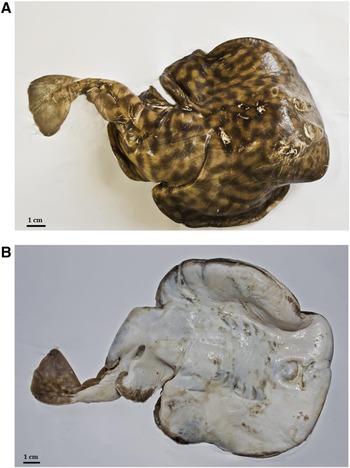
(Figure 1)
Torpedo sinuspersici, adult female off Gujarat, India: (A) dorsal view; (B) ventral view.

TYPE MATERIAL
Body measurement of one female specimen of Torpedo sinuspersici measuring 21.5 cm total length collected from Gujarat coast. Measurements of different body parts are given in percentage with reference to total body length.
Total length: 21.5 cm; width of the disc, 12 cm (55.81%); snout to vent length, 11.8 cm (54.88%); length of 1st dorsal fin, 1.5 cm (6.97%); height of the 1st dorsal fin, 1.8 cm (8.37); length of 2nd dorsal fin, 1.0 cm (4.65%); height of the 2nd dorsal fin, 1.5 cm (6.97%); length of the caudal fin, 3.7 cm (17.20%); width of the caudal fin, 3.5 cm (16.27%); diameter of eyes, 0.3 cm (1.39%); diameter of spiracles, 0.9 cm (4.18%).
DIAGNOSIS
Body is soft and flabby and brown in colour with light coloured vermiculated reticulations or blotches; ventral side is white in colour, head and pectoral fins form disc-like shape which comprises 50 to 60% of total body length; skin is smooth and devoid of scales; paired kidney shape electric organs are visible beneath the skin; eyes small, spiracles are situated just behind the eyes, small tentacles are present around spiracles; mouth is ventrally located and broadly arched with small, sharp and cusp teeth; five pairs of small gills are located under the disc; tail is short and strong; two dorsal fins are located on the proximal part of tail with rounded apex; first dorsal fin is larger than second; the caudal fin is triangular in shape with blunt corners.
REMARKS
Torpedo sinuspersici has widespread distribution in the western Indian Ocean. Except for the western region the species has been reported from the Red Sea and Arabian Sea (de Carvalho et al., Reference De Carvalho, Stehmann and Manilo2002), and Persian Gulf (Carpenter et al., Reference Carpenter, Krupp, Jones, Zajonz, De Angelis, Carpenter and Niem1997). In India the species has a very patchy distribution. Previously the species has been reported from Malabar (Anonymous, 2008) on the western coast of India, while from the east coast the species was reported from Visakhapatnam (Sujatha, Reference Sujatha2002) and Tamil Nadu (Biswas et al., Reference Biswas, Mishra, Das, Nayak, Selvanayagam and Satpathy2012). The present report forms the first record of Torpedo sinuspersici from the coast of Gujarat State.
The species has low commercial value and fishermen usually discard the species from their catch. The species is amongst the rare and data deficient fish of the world. The present report provides information on its first record from the Gujarat coast and extends its distributional range.
ACKNOWLEDGEMENTS
The authors thank Dr P.C. Mankodi for confirming the species identification and Mr Ravi Vasava and Mr Vishal Pankhania for their assistance in field surveys.