Introduction
In Europe, one in five elderly people with functional limitations receive long-term care in an institution (Onder et al., Reference Onder2012). More than half of these elderly are diagnosed with dementia (Lithgow et al., Reference Lithgow, Jackson and Browne2012; Hoffmann et al., Reference Hoffmann, Kaduszkiewicz, Glaeske, van den Bussche and Koller2014) and frequently suffer from some type of neuropsychiatric symptoms over the course of the disease (Steinberg et al., Reference Steinberg2008). Resulting challenging behaviors include verbal and physical aggression, agitation, psychotic symptoms, sleep disturbances, depression, oppositional behavior, and wandering (Brodaty and Arasaratnam, Reference Brodaty and Arasaratnam2012). Currently, only few pharmacologic options are available for the management of neuropsychiatric symptoms. However, patients with dementia are regularly prescribed psychotropic drugs. The prescription numbers are striking (Wetzels et al., Reference Wetzels, Zuidema, de Jonghe, Verhey and Koopmans2011), taking into account the limited effectiveness of psychotropic drugs for the treatment of neuropsychiatric symptoms and the severe side effects experienced by this patient group (Zuidema et al., Reference Zuidema, van Iersel, Koopmans, Verhey and Olde Rikkert2006). These side effects include sedation, negative impact on (psycho) motor function – walking and swallowing, accelerated cognitive decline, and risk of falling. Most controversial is the treatment of neuropsychiatric symptoms with antipsychotics (Ballard et al., Reference Ballard, Corbett, Chitramohan and Aarsland2009; Harding and Peel, Reference Harding and Peel2013). Antipsychotics are associated with an increased risk of extrapyramidal effects, stroke, pneumonia, and death. Other psychotropic drugs such as antidepressants, anxiolytics, hypnotics, or anti-dementia drugs also have side effects and are therefore hardly a better alternative (Trinh et al., Reference Trinh, Hoblyn, Mohanty and Yaffe2003; Sink et al., Reference Sink, Holden and Yaffe2005). The prescription of psychotropic drugs in nursing homes is frequent (Wetzels et al., Reference Wetzels, Zuidema, de Jonghe, Verhey and Koopmans2011), even though the US Food and Drug Administration (FDA) published warnings and required changes to the prescribing information for risperidone already in 2003 (Banerjee, Reference Banerjee2009). In 2004, the European Medicines Agency (EMA) also issued a public advice about an increased risk of cerebrovascular adverse events and mortality in elderly patients with dementia receiving olanzapine (Banerjee, Reference Banerjee2009). These warnings by the EMA continued during the following years (European Medicines Agency, 2008; Ballard et al., Reference Ballard, Creese, Corbett and Aarsland2010). Also national drug agencies in the United Kingdom (UK), Italy, Spain, France, and other countries issued warnings about the increased risk of mortality associated with antipsychotics between 2004 and 2005 (Gallini et al., Reference Gallini, Andrieu, Donohue, Oumouhou, Lapeyre-Mestre and Gardette2014). Additionally, drug safety warnings have been published in some countries (Janssen-Cilag GmbH, 2004; Lilly Pharma, 2004). Furthermore, clinical practice guidelines in European countries recommend that psychological and social approaches should be the first treatment option of neuropsychiatric symptoms, followed by pharmacological recommendations as second-line treatment (Gauthier et al., Reference Gauthier2010; Azermai et al., Reference Azermai, Petrovic, Elseviers, Bourgeois, Van Bortel and Vander Stichele2012). Since the warnings, there are several studies describing psychotropic drug use in parts of Europe but comparative studies across Europe are scarce(Foebel et al., Reference Foebel2014). Studies have mainly been conducted on a national level to estimate the prescription rates of psychotropic drugs as for example in the Netherlands (Wetzels et al., Reference Wetzels, Zuidema, de Jonghe, Verhey and Koopmans2010). These data present a highly prevalent and persistent antipsychotic drug use (Wetzels et al., Reference Wetzels, Zuidema, de Jonghe, Verhey and Koopmans2010; van der Spek et al., Reference Van der Spek2015). However, to our knowledge there is no systematic review comparing the use of psychotropic drugs in nursing homes from different Western European countries. A comparison of Western European data can highlight the countries in which a low prevalence of antipsychotic drugs already exists and therefore might serve as example for other countries on how to achieve lower prescription rates. We choose to limit our search for Western European countries (including Scandinavian countries), since it is expected that these countries are more comparable to each other. An earlier study already demonstrated substantial differences in prevalences of inappropriate medication use in nursing homes between Western and Eastern European countries (Fialová et al., Reference Fialová2005). Therefore, including only Western European countries will lead to a more straightforward comparison. The aim of this study was to examine prescription rates of psychotropic drug use in patients living in nursing homes between different Western European countries since the first warnings were published.
Methods
A literature search was performed in Scopus, Pubmed, and Web of Science in October 2015. The search string included the following keywords: psychotropic, antipsychotics, antidepressants, anxiolytics, hypnotics, anti-dementia drugs, dementia/Alzheimer's, nursing home, country. A total of 19 Western European countries were used in the search string. Several database features such as truncation, proximity operators, and phrase searching were used (if available in the search engine) to increase the relevancy of retrieval of the free text search. The search was limited to abstracts published between January 2004 and October 2015. Abstracts, titles, and where necessary the whole paper was screened by the author (SJ) for the following inclusion criterion: living in a nursing home, data collection took place after 2003. Studies in which patients were selected on certain disease characteristics, such as specific target groups (e.g. patients with a depression), were excluded.
Data extraction
Information from the studies was extracted on country, study methods, year, inclusion criteria, and number of participants. The data about psychotropic drug use from cross-sectional and longitudinal studies was extracted. The “pro re nata” use was not included. From the longitudinal (cohort and interventional studies), the first measurement (baseline assessment) was used for the analysis. Psychotropic drugs were divided into the groups of known antipsychotics, antidepressants, anxiolytics, hypnotics, anti-dementia agents according to the Anatomical Therapeutic Classification (ATC) (World Health Organization, 2015). Besides the psychotropic drug, patient characteristics, as described in the papers, were acquired. This was done in order to see whether the samples from the various studies were similar.
Data analysis
The authors tabulated the study design, place, outcomes, and results. Drug prescription rates were pooled by country. Therefore, a meta-analyses of prevalence was undertaken for binary outcomes. Proportions were subjected to a double arcsine transformation to stabilize the variance, following the recommendations of Barendregt et al. (Barendregt et al., Reference Barendregt, Doi, Lee, Norman and Vos2013). Pooled percentages and 95% confidence intervals from the selected studies are graphed by drug. The relationship between antipsychotic and antidepressant drug use was examined by computing the correlation coefficient. The study period is extracted from the papers and is averaged for the period over which the (baseline) data were collected. All analyses were carried out using the IBM SPSS Statistics 22 and Excel 2013.
Results
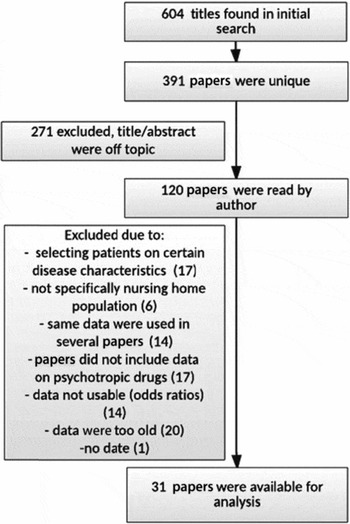
The process of selecting papers for the review is illustrated in Figure 1. The literature search yielded 604 hits of which 390 papers were unique. These abstracts were read by the author (SJ). Of these 390 unique studies, 276 were excluded because the title/abstract indicated it to be off-topic. Of the remaining 114 papers, 17 papers selected patients on certain disease characteristics and were therefore excluded. In six papers, the authors did not differentiate between people living in the community or nursing homes. Fourteen papers were excluded because the data were previously reported and subsequently used in several papers. Another 17 papers were excluded because they did not have data on psychotropic drug prevalence. Furthermore, 20 papers needed to be excluded because data collection took place before 2003. One paper was excluded because the authors did not mention the year of data collection. Finally, a total of 31 papers were available for analysis. Three papers contained data on more than one country and there are considered as individual studies.
Search results.

Initially, we searched for all psychotropic drugs. However, more than half of the relevant papers did not provide any data regarding anxiolytics, hypnotics, or anti-dementia drugs. Due to the amount of missing data, these drug groups were not further analyzed. However, 38 studies had data on antipsychotic drug use and 28 studies on antidepressant drug use. These data were analyzed further.
Description of the studies
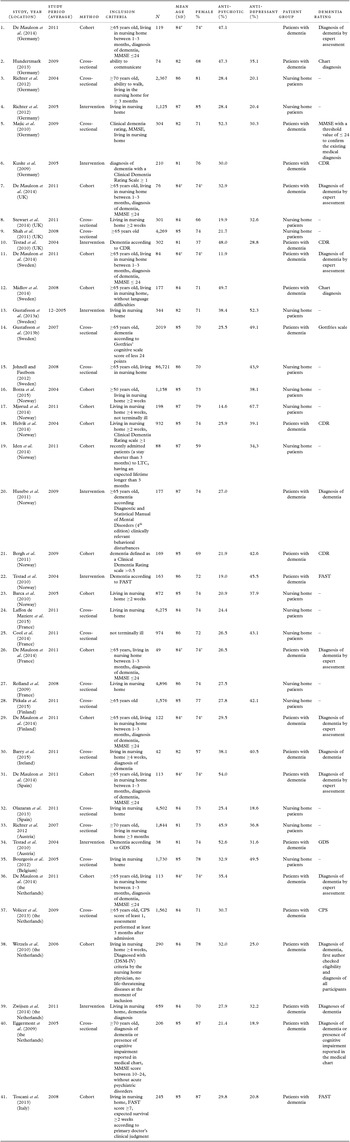
The selected studies were conducted in Norway (eight studies) (Barca et al., Reference Barca, Engedal, Laks and Selbaek2010; Testad et al., Reference Testad2010; Bergh et al., Reference Bergh, Engedal, Røen and Selbæk2011; Husebo et al., Reference Husebo, Ballard, Sandvik, Nilsen and Aarsland2011; Helvik et al., Reference Helvik, Engedal, Benth and Selbæk2014; Iden et al., Reference Iden, Engedal, Hjorleifsson and Ruths2014; Mjørud et al., Reference Mjørud, Røsvik, Rokstad, Kirkevold and Engedal2014; Borza et al., Reference Borza, Engedal, Bergh, Barca, Benth and Selbæk2015), Germany (six studies) (Kuske et al., Reference Kuske2009; Majic et al., Reference Majic2010; Richter et al., Reference Richter, Mann, Meyer, Haastert and Köpke2012; Hundertmark, Reference Hundertmark2013; de Mauleon et al., Reference de Mauleon2014), Sweden (five studies) (Johnell and Fastbom, Reference Johnell and Fastbom2012; Gustafsson et al., Reference Gustafsson, Karlsson and Lovheim2013a; Gustafsson et al., Reference Gustafsson, Sandman, Karlsson, Gustafson and Lövheim2013b; de Mauleon et al., Reference de Mauleon2014; Midlov et al., Reference Midlov, Andersson, Ostgren and Molstad2014), the Netherlands (five studies) (Eggermont et al., Reference Eggermont, de Vries and Scherder2009; Wetzels et al., Reference Wetzels, Zuidema, de Jonghe, Verhey and Koopmans2010; Volicer et al., Reference Volicer, van der Steen and Frijters2013; de Mauleon et al., Reference de Mauleon2014; Zwijsen et al., Reference Zwijsen2014), France (four studies) (Rolland et al., Reference Rolland, Abellan van Kan, Hermabessiere, Gerard, Guyonnet Gillette and Vellas2009; Cool et al., Reference Cool2014; de Mauleon et al., Reference de Mauleon2014; Laffon de Mazieres et al., Reference Laffon de Mazieres, Lapeyre-Mestre, Vellas, de Souto Barreto and Rolland2015), UK (four studies) (Testad et al., Reference Testad2010; Shah et al., Reference Shah, Carey, Harris, Dewilde and Cook2011; de Mauleon et al., Reference de Mauleon2014; Stewart et al., Reference Stewart2014), Finland (two studies) (de Mauleon et al., Reference de Mauleon2014; Pitkala et al., Reference Pitkala2015), Austria (two studies) (Testad et al., Reference Testad2010; Richter et al., Reference Richter, Mann, Meyer, Haastert and Köpke2012), Spain (two studies) (Olazaran et al., Reference Olazaran, Valle, Serra, Cano and Muniz2013; de Mauleon et al., Reference de Mauleon2014), Ireland (one study) (Barry et al., Reference Barry, Parsons, Passmore and Hughes2015), Belgium (one study) (Bourgeois et al., Reference Bourgeois, Elseviers, Azermai, Van Bortel, Petrovic and Vander Stichele2012), and Italy (one study) (Toscani et al., Reference Toscani2013). Of these studies, 17 were cross-sectional. These studies collected their data from national databases or via surveys. Furthermore, the data of eight studies were extracted from the baseline measurement of intervention studies or randomized controlled trials. The remaining 16 studies were cohort studies. The study population in the 41 studies consisted of nursing home residents with a mean age of 84 years (SD 2), of which 73% are female (SD 5.7). The sample sizes varied considerably between studies from N = 38 to N = 86,721 participants. The mean number of participants in these studies was 3,109 (SD 13,466).
The studies differed regarding to the selection of patients. In 17 studies, there was no selection of cognitively impaired nursing home residents. The remaining 24 studies, however, included only patients with the diagnosis of dementia. In those studies, dementia was diagnosed by a physician/expert assessment (Husebo et al., Reference Husebo, Ballard, Sandvik, Nilsen and Aarsland2011; Wetzels et al., Reference Wetzels, Zuidema, de Jonghe, Verhey and Koopmans2011; de Mauleon et al., Reference de Mauleon2014; Zwijsen et al., Reference Zwijsen2014; Barry et al., Reference Barry, Parsons, Passmore and Hughes2015), notes in patient files (Eggermont et al., Reference Eggermont, de Vries and Scherder2009; Hundertmark, Reference Hundertmark2013), or various scales. The Clinical Dementia Rating scale was used by four studies to determine the prevalence of dementia in the patients (Kuske et al., Reference Kuske2009; Testad et al., Reference Testad2010; Bergh et al., Reference Bergh, Engedal, Røen and Selbæk2011; Helvik et al., Reference Helvik, Engedal, Benth and Selbæk2014) and the Gottfries’ Scale in two Swedish studies (Gustafsson et al., Reference Gustafsson, Karlsson and Lovheim2013a; Gustafsson et al., Reference Gustafsson, Sandman, Karlsson, Gustafson and Lövheim2013b). Other studies used the German version of the Mini-Mental State Examination (MMSE) to confirm the existing medical diagnosis (Majic et al., Reference Majic2010), the Cognitive Performance Scale (CPS) (Volicer et al., Reference Volicer, van der Steen and Frijters2013), the Functional assessment staging (FAST) (Testad et al., Reference Testad2010; Toscani et al., Reference Toscani2013), and the Global Deterioration Scale (GDS) (Testad et al., Reference Testad2010; Wetzels et al., Reference Wetzels, Zuidema, de Jonghe, Verhey and Koopmans2010) to select patients with dementia.
Comparison between European countries
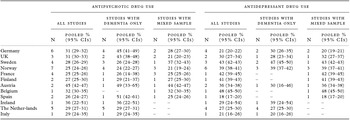
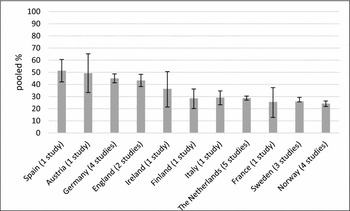
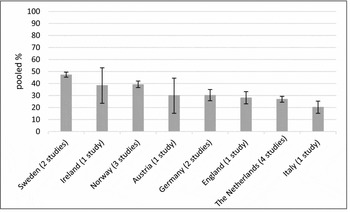
The pooled percentage of antipsychotic use was 27% (95% CI 27–28) and the pooled percentage of antidepressant use was 40% (95% CI 40–41) of the study population. The antipsychotic use in nursing homes ranged from 12% to 59% and antidepressants from 19% to 68% (see Table 1). The highest use of antipsychotics was found in Austria, Ireland, and Belgium while Belgium, Sweden, and France showed highest use of antidepressants (see Table 2). In the selected group of studies with dementia patients only, the highest antipsychotic drug use was prescribed in Spain, Austria, and Germany (see Figure 2). In the mixed group, the highest ranking countries are Belgium, Sweden, and France. In the selected group of studies with dementia patients only, the highest antidepressant drug use was prescribed in Sweden, Ireland, and Norway (see Figure 3). In the mixed group, the highest ranking countries are Belgium, Sweden, and France.
Description of the studies included

*Mean age and Gender only published for the total study population and not per country.
Antipsychotic and antidepressant drug use per country (number of studies, pooled percentage, 95% confidence intervals)

Comparison of the pooled percentages of patients prescribed antipsychotics between European countries of studies selecting patients with dementia.

Comparison of the pooled percentages of patients prescribed antidepressants between European countries of studies selecting patients with dementia.

A Pearson correlation coefficient was computed to assess the relationship between antipsychotic and antidepressant drug use in studies selecting patients with dementia. Although there was a slight negative correlation between the two drugs for studies selecting patients with dementia visible of r = −0.2 (N = 13), no statistically significant correlation between the two drugs was observed. In studies selecting nursing home patients, no significant correlation between the two drugs was seen either (r = −0.1, N = 11, p = ns).
Discussion
In this systematic review, we compared the differences in prescribing rates of antipsychotic and antidepressant drugs between Western European countries. The highest rates of antipsychotic drug prescription were found in Austria, Ireland, and Belgium while the highest rates for antidepressants were seen in Belgium, Sweden, and France.
This study gives interesting insights in the antipsychotic and antidepressant drug use between European countries. Especially since we differentiate between studies including nursing home patients in general and studies including patients with dementia. Unlike other countries, Norway has a relatively low antipsychotic drug use for studies selecting dementia patients and studies with a mixed population. Whereas Sweden has a high antipsychotic and antidepressant drug use when one looks at the studies including nursing home patients. This is surprising, since its overall antipsychotic drugs use is one of the lowest in Europe for patients suffering from dementia. Altogether, Norway and Sweden had a relatively low antipsychotic drug use for studies selecting dementia patients.
Overall, large differences between countries and between studies were found. Differences between countries with regards to the care organization could explain the differences in drug use. For example, the Dutch situation in nursing homes differs from similar institutions in other European countries. Dutch nursing homes have more expertise since only specialists in elderly care medicine are responsible for the medical treatment (Schols et al., Reference Schols, Crebolder and van Weel2004). Due to this expertise, patients are more likely to receive extended medical treatment in the nursing homes instead of being transferred to hospitals (Houttekier et al., Reference Houttekier2010). Therefore, the Dutch nursing home population might differ from other European countries. Additionally, European variation of physicians prescribing habits can be related to the presence of accessibility, financial incentives, and the effect of culture (Sturm et al., Reference Sturm, van Gilst, Veeger and Haaijer-Ruskamp2007). In our search, we did not use age as a criterion; therefore, the population of patients might not be elderly in all cases, but it might increase the chance that the results mirror the actual nursing home population better. Differences between studies could also be explained by differences between nursing homes. The existence of considerable variation in the antipsychotic drug use between various nursing homes in the Netherlands was already found by Kleijer (Kleijer et al., Reference Kleijer2014). In his study, Kleijer found an even larger variability of antipsychotic drug prescription (5%–52%) compared to our results. He demonstrated that variability was related to nursing home characteristics rather than differences in prevalence of neuropsychiatric symptoms among these facilities. This indicates differences in institutional prescribing cultures.
In parallel to the strengths of the study, such as the fairly large sample size of most studies and the representation of nursing home populations of 12 countries, there are several limitations which need to be considered when interpreting the findings. First, the studies have different inclusion criteria and do not always provide a comprehensive overview of important patient characteristics of behavior, stage dementia, and cognition. Therefore, the groups might differ. Differences in patient characteristics might explain the differences in antipsychotic and antidepressant drug use. In addition, there could be a selection at the ward level, since wards participating in research are not randomly chosen. Chances are that wards with low use are more eager to join cohort or cross-sectional studies, since they do not expect a lot of intervention to lower psychotropic drug prescription. Therefore, in intervention studies, wards participate who expect a lot of the intervention and have a somewhat higher psychotropic drug use at baseline. It is unclear whether this plays a big role. Second, due to the differences in study designs the sample sizes in the studies reviewed vary widely. Our results may include rates of individual nursing homes or rates across several facilities. Therefore, our results might be exaggerate individual organizational practices rather than representing an individual country. Third, most of the studies did not differentiate between subgroups of antipsychotics and antidepressants. For instance, no data are provided about the frequency of typical and atypical antipsychotics. A cross-European comparison would have been interesting because recommendations in national guidelines to use (a)typical antipsychotics are different.
Psychotropic drugs are commonly used drugs in nursing homes, even though the use of these drugs is continuously discussed. The EMA as well as several clinical guidelines warn about adverse events for several psychotropic drugs for years. From these reports, one can expect that physicians working in nursing homes consciously try to reduce psychotropic drugs. However, this study showed that at least antipsychotics and antidepressants are widely used. Others have already shown that warnings of international drug authorities on antipsychotic drug use in dementia patients do not impact overall prescription behavior (Schulze et al., Reference Schulze, van den Bussche, Glaeske, Kaduszkiewicz, Wiese and Hoffmann2013). It has been suggested that evidence-based guidelines are not considered as adequate for daily practice by physicians (McCleery and Fox, Reference McCleery and Fox2012). Therefore, more practice-based recommendations for appropriate drug prescription are needed to lower the high antipsychotic drug use, such as the one recently developed practice guidelines for antipsychotic drug use (Zuidema et al., Reference Zuidema2015). Further studies are also required to identify the best strategies to implement these recommendations in order to reduce psychotropic drugs in nursing homes. Additionally, due to the limited information about the patient characteristics in the studies found, we could not thoroughly explain the differences seen between European countries. The studies from Sweden and Norway had a lower antipsychotic drug use; however, no significant association was found. Therefore, more studies are needed to explain the differences between this Nordic countries and other Western European countries.
Conflict of interest
None.
Description of the authors’ roles
SJ designed the study and developed the search protocol with input from JvM and SZ. SJ conducted the review. SJ extracted and analyzed the data under supervision of JvM and SZ. SJ drafted the paper. JvM, SZ, and MIJ commented on the drafts and advised in various stages of the research. All authors have been involved in drafting the paper critically for important intellectual content, and have given final approval of the version to be published.