1. Introduction
Model building is a central activity in chemistry. Chemists interested in the progress of chemical reactions try to build mathematical models of the mechanisms by which chemical species are transformed from reactants to products. A key question in this enterprise is just what counts as a good model.
Recently, as complex dynamical systems such as chemical oscillators have become a focus of study, chemists have grappled with the inherent challenges to understanding such systems, some of which come from experimental limitations. Typically, chemical oscillators contain many chemical species, a number of which are difficult or impossible to measure under experimental conditions. Despite these challenges, chemists have made serious attempts to subject their models to more stringent tests. This desire for more stringent tests of mechanistic models, coupled with the limits to what can be observed experimentally, has led chemists to theoretical considerations that suggest ways to impose stringent tests using what can be monitored. These theoretical considerations focus squarely on the connections between species in a system.
2. Background: Chemical Reactions and Model Mechanisms
Before we consider the problem of chemical oscillators, it's worth reviewing the general desiderata for a good proposed mechanism for a chemical reaction. A reaction mechanism consists of a sequence of elementary chemical steps, in which particular species collide and are transformed to other species, and the rate constants that describe the rate at which each of these elementary steps proceeds. A good proposed mechanism for a chemical reaction is one that fits the overall stoichiometry (i.e., the overall balance of products and reactants), fits the empirical rate law (the dependence of the rate of the reaction on the concentrations of various chemical species in the system), and posits reasonable elementary steps.
It is important to note that even in their introductory textbooks, chemists are very conscious of the underdetermination of theory by data. This passage is typical of the caveats issued to chemistry students: “We can never prove that a proposed mechanism is right; we can only prove that it has not yet been shown to be wrong. … When two theories are presented, the temptation and usually the wiser choice is to opt for the simpler one, at least until the data compel you to do otherwise” (Dickerson, Gray, and Haight Reference Dickerson, Gray and Haight1979, 893). Introductory chemistry texts work through numerous examples of proposed mechanisms, describing how to derive theoretical rate equations from the elementary steps and rate constants in a model, so that most students are competent to evaluate a model's fit with stoichiometry and empirical rate law. However, the “reasonableness” of the elementary steps is less clear-cut. For a proposed elementary step, the chemist will consider whether it involves chemical species known to exist (or species considered unlikely to exist) or whether it would require unlikely events (such as the simultaneous collision of four molecules). Judgments of reasonableness depend both on the amount of specific information chemists have about particular chemical species and their interactions and on the broader theoretical understanding of how chemical phenomena can, and can't, work. In an article attempting to systematize some of this information, Edwards, Greene, and Ross (Reference Edwards, Greene and Ross1968, 381) write:
The working rules which are presented herein, and other ones in the literature, allow a chemist to judge the reasonableness of his mechanism. Often they tell what mechanisms are not reasonable in relation to the available data, they do not tell us what the mechanism really may be. Thus a chemist must use his knowledge of chemical systems and his imagination when he postulates a mechanism. And he will want to test his mechanism by independent techniques.
This statement nicely illustrates the careful balance chemists try to maintain between recognizing that there are many possible mechanisms consistent with the experimental data and yet seeking a mechanism that gives good insight into what is really going on in the experimental system.
3. Good Models of Chemical Oscillators
In identifying good model mechanisms, we have seen that chemists narrow the field of mechanisms consistent with the empirical data to those that are also “reasonable” in the detailed chemical interactions they posit. Given the great variety of reactions chemists encounter, it is perhaps not surprising that certain exotic phenomena, such as reactions whose species concentrations oscillate over time, have posed special challenges to the chemist's ability to explain and build good models.
At least until the middle of the twentieth century, chemists took it as perfectly reasonable that “a chemical system, in the absence of external inputs of matter or energy, must continuously approach an ultimate equilibrium state” (Epstein et al. Reference Epstein, Kustin, Kepper and Orbán1983, 112). Given this assumption, chemical systems displaying periodic oscillations in species concentration seemed to be clear violations of the laws of nature (in particular, of the second law of thermodynamics), despite the fact that these systems had been observed and reported in the literature from the 1920s onward. Thus, the first condition a good model of an oscillating chemical system needed to meet was that it showed how such behavior is possible without violating any of the laws of chemistry.
Given this explanatory challenge, early model mechanisms of chemical oscillators looked rather more abstract than the mechanistic model discussed in Section 1. Rather than identifying actual chemical species in a system and positing their interactions by way of elementary mechanistic steps, these proposed mechanisms looked more like the “Oregonator” model of Field and Noyes (cited in Luo and Epstein Reference Luo and Epstein1990, 276):
1.
 $A+Y\rightarrow X+P$
2.
$X+Y\rightarrow 2P$
3.
$A+X\rightarrow 2X+Z$
4.
$2X\rightarrow A+P$
5.
$Z\rightarrow fY$





In this mechanism, [A] and [P] are fixed at constant values and f represents a stoichiometric coefficient.
A mechanistic model such as the Oregonator shows how oscillations in the concentration of species X could arise from ordinary chemical reactions. Step 3 of the mechanism provides a positive feedback, since increasing the concentration of X will increase the rate of this step, resulting in more rapid production of X. Negative feedback comes from steps 2 and 4. Each of these two elementary steps proceeds at a higher rate when the concentration of X is increased, and this increases the rates of X consumption by these steps. The oscillations in [X] arise as the positive feedback from step 3 increases [X], which in turn increases X depletion due to steps 2 and 4, which is followed by the rebuilding of [X] due to step 3, and so on.
The goodness of the early abstract mechanistic models of chemical oscillators lay in their ability to answer “how possibly” questions about chemical systems displaying exotic behavior. The next step was to find ways to build realistic model mechanisms that embodied the features (positive and negative feedback) brought to light by the abstract models. In other words, the goal was to propose a model mechanism for a particular chemical oscillator that would show how the oscillatory behavior was possible given the known reactants and products, the available kinetic data, and a “reasonable” set of elementary mechanistic steps. Even at this stage of refinement, however, proposed mechanisms were more focused on the “how possibly” question than on precise quantitative fit with the real system being modeled:
In the early days a mechanism might have been considered satisfactory (or even unique!) if it yielded oscillations in some region of parameter space near, but not necessarily overlapping with, the experimentally observed region of oscillations. Agreement, even of a qualitative nature, with such “details” as the measured amplitude, waveform, or period of oscillation was rarely approached. (Luo and Epstein Reference Luo and Epstein1990, 270)
The next step, then, would be to devise a model mechanism that achieved better agreement with the qualitative and quantitative details of the experimental system being modeled.
4. Choosing between Models
The chlorite-iodide reaction affords a nice view of the way chemists have refined their mechanistic models. The reaction has overall stoichiometry:

An early study of the kinetics of this reaction determined that it “is catalyzed by the iodine product, and the autocatalysis is inhibited by iodide ion” (Kern and Kim Reference Kern and Kim1965, 5309). And, when the reaction is run in a continuous flow stirred tank reactor, where reactions are flowed in and products are removed, it can exhibit oscillatory behavior. In this system, the oscillations in [I2] and [I−] can be tracked experimentally, the former by measuring ultraviolet absorbance at 460 nanometers, the latter by measuring the potential of an ion-specific electrode.
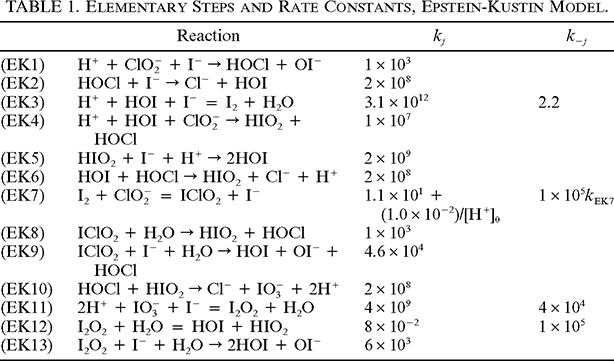
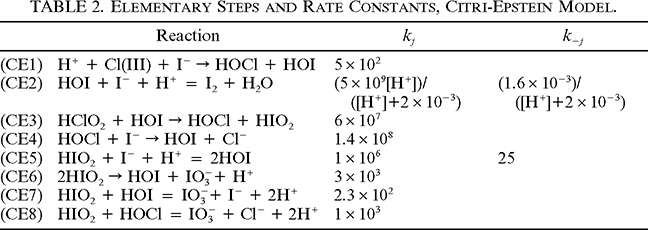
In Reference Epstein and Kustin1985, Epstein and Kustin proposed the first mechanism for this reaction to account for the oscillatory behavior (Table 1). This mechanism includes 13 elementary steps and 12 chemical species. Two years later, Citri and Epstein proposed an improved model mechanism (Table 2) with eight elementary mechanistic steps and 10 chemical species.

| Reaction |
 $k_{j}$ |
 $k_{-j}$ |
|
|---|---|---|---|
| (EK1) | H+ +
 $\mathrm{ClO}\,^{-}_{2}$
+ I− → HOCl + OI− |
1×10³ | |
| (EK2) | HOCl + I− → Cl− + HOI | 2×10⁸ | |
| (EK3) | H+ + HOI + I− = I2 + H2O | 3.1×10¹² | 2.2 |
| (EK4) | H+ + HOI +
 $\mathrm{ClO}\,^{-}_{2}$
→ HIO2 + HOCl |
1×10⁷ | |
| (EK5) | HIO2 + I− + H+ → 2HOI | 2×10⁹ | |
| (EK6) | HOI + HOCl → HIO2 + Cl− + H+ | 2×10⁸ | |
| (EK7) | I2 +
 $\mathrm{ClO}\,^{-}_{2}$
= IClO2 + I− |
1.1×101 + (1.0×10⁻²)/[H+]0 | 1×10⁵k EK7 |
| (EK8) | IClO2 + H2O → HIO2 + HOCl | 1×10³ | |
| (EK9) | IClO2 + I− + H2O → HOI + OI− + HOCl | 4.6×10⁴ | |
| (EK10) | HOCl + HIO2 → Cl− +
 $\mathrm{IO}\,^{-}_{3}$
+ 2H+ |
2×10⁸ | |
| (EK11) | 2H+ +
 $\mathrm{IO}\,^{-}_{3}$
+ I− = I2O2 + H2O |
4×10⁹ | 4×10⁴ |
| (EK12) | I2O2 + H2O = HOI + HIO2 | 8×10⁻² | 1×10⁵ |
| (EK13) | I2O2 + I− + H2O → 2HOI + OI− | 6×10³ |

| Reaction |
 $k_{j}$ |
 $k_{-j}$ |
|
|---|---|---|---|
| (CE1) | H+ + Cl(III) + I− → HOCl + HOI | 5×10² | |
| (CE2) | HOI + I− + H+ = I2 + H2O | (5×10⁹[H+])/ ([H+]+2×10⁻³) | (1.6×10⁻³)/([H+]+2×10−3) |
| (CE3) | HClO2 + HOI → HOCl + HIO2 | 6×10⁷ | |
| (CE4) | HOCl + I− → HOI + Cl− | 1.4×10⁸ | |
| (CE5) | HIO2 + I− + H+ = 2HOI | 1×10⁶ | 25 |
| (CE6) | 2HIO2 → HOI +
 $\mathrm{IO}\,^{-}_{3}$
+ H+ |
3×10³ | |
| (CE7) | HIO2 + HOI =
 $\mathrm{IO}\,^{-}_{3}$
+ I− + 2H+ |
2.3×10² | |
| (CE8) | HIO2 + HOCl =
 $\mathrm{IO}\,^{-}_{3}$
+ Cl− + 2H+ |
1×10³ |
The Citri-Epstein model proposes a different set of elementary steps to describe the oxidation of iodide by chlorite. In addition, it eliminates the intermediate
 $\mathrm{IClO}\,^{-}_{2}$
, “whose existence has been called into question elsewhere” (Citri and Epstein Reference Citri and Epstein1987, 6035). Both these changes fall under the umbrella of “reasonableness” chemists invoke in evaluating proposed mechanisms. And, the resulting model mechanism seemed to produce better agreement between predicted and measured concentrations of iodide and iodine than that given by the earlier model.
Experimental measurements of [I−] in the system display a sharp rise in the measured potential, followed by a more gradual decrease after the maximum. Once the potential has reached the minimum, it remains flat until the next sharp rise in potential. The Epstein-Kustin model predicts periodic oscillation in the potential due to I−, but the predicted potential decrease is not so gradual, and rather than flattening out between peaks the predicted potential shows a steady increase before each sharp rise. In contrast, the predictions of the Citri-Epstein model show the same pattern of sudden rise, gradual decrease, and flattening of I− potential as is seen in the experimental system (although the experimental decrease in I− potential is more gradual than the predicted decrease in I− potential).
The most noticeable improvement, however, is in the prediction of the [I2] oscillations. Experimentally, absorbance measurements indicate that [I2] rises gradually before displaying a sharp increase. The sharp increase is followed by a sharp decrease, but then the [I2] increases more gradually, almost back to the maximum, before gradually decreasing to the minimum and repeating the pattern. In other words, the traces of [I2] show double-peak oscillations, the first peak angular and the second rounded, with the double-peaks separated by rounded troughs. The Epstein-Kustin model predicts oscillation in [I2], but these are traces with broad, flattened maxima and angular troughs. In contrast, the [I2] oscillations predicted by the Citri-Epstein model display the double-peak (although the rounded peak is neither as high nor as round as what is measured experimentally, and the predicted troughs are not as rounded as the measured ones).
These competing models have moved beyond merely showing how oscillations are possible in this reaction. They propose actual mechanistic steps between chemical species in the system to show why oscillations happen under the particular experimental conditions required for oscillatory behavior. And given this goal, it would seem that the 1987 mechanism, which predicts oscillations in [I2] that bear a much closer resemblance to the experimentally observed oscillations, is a real improvement over the 1985 model. But here we get into tricky territory. Chemists could continue tinkering away at the model mechanisms, using only the relative “reasonableness” of elementary steps as a constraint, and see whether new adjustments yield better or worse agreement with the experimentally observed oscillations. They could also comb through the various sets of rate constants reported for each elementary step in the literature and try to work out whether the conditions under which they were determined are close enough to the prevailing conditions in this chemical system. But at a certain point judging improvements in the shapes of the predicted oscillatory traces could get rather subjective. Should amplitude or period be the most important criterion in assessing goodness of fit? Would “fatter” predicted [I2] oscillations be a better or worse fit than the “skinnier” [I2] oscillations predicted by the 1987 model? The uncertainties in these judgments led to calls for more stringent tests of the models (e.g., in Stemwedel Reference Stemwedel, Schreiber and Ross1995).
We have moved from model mechanisms that needed only to show how oscillatory behavior is possible to mechanisms chemists seek to subject to stringent tests of their fit with the experimental system being modeled. In the case of the chlorite-iodide system and the two proposed model mechanisms, notice that the goodness of the model is assessed in terms of how well the predicted I− and I2 concentrations fit those determined experimentally. But each of these model mechanisms identifies many more chemical species as present in the reaction system, so a reasonable approach might be to measure all the chemical species in the system and compare these dynamical concentration measurements to the concentrations predicted for these species by the model. Making good predictions for the behaviors of two species is nice, but making good predictions for all 10 or 12 (or however many there really are) would be a real achievement.
For a system such as the chlorite-iodide reaction, however, this approach is not experimentally feasible. The desired measurements would require dynamic concentration data obtained using techniques that would not interfere with the reaction (e.g., by removing the chemical species being measured). Both [I2] and [I−] can be probed without changing their concentrations in the reaction system: [I2] by means of absorbance at 460 nanometers and [I−] by means of potential measured with an iodide-selective electrode. Some of the other species present are susceptible to dynamical measurement, but not in these conditions (e.g., [Cl−] could be measured using a chloride-selective electrode, except for the fact that iodide also reacts with the membrane of the electrode, thus interfering with accurate [Cl−] measurement). Other intermediate species might be measured by various chemical assays if the progress of the reaction could be halted in the samples being assayed. (A further challenge: To determine the dynamical behavior of the concentrations in these species, numerous assays would have to be done and their times synchronized with the time-evolution of [I−] and [I2].) In short, the exhortation to “measure everything” quickly collides with experimental limitations.
5. Using Theoretical Considerations to Get More within the Experimental Constraints
The problems encountered with the chlorite-iodide reaction are typical in studies of chemical oscillators in aqueous media: it is seldom easy, or even possible, to make dynamical measurements of more than a handful of the species present in the system. Yet the standards for a good model mechanism have shifted: rather than being satisfied with a model that gives “good” predictions of iodide and iodine behavior in the system, chemists want more proof of the model's value. Since this proof cannot easily come from a display of its fit with experimental measurement of all the other species, the fit between model and reality must be demonstrated in some other way.
Here, theoretical considerations provide a way to make more stringent experimental tests of a model even given the experimental limits on which species can be measured. In particular, theoretical studies of systems with complex dynamical behavior have identified certain features that must be present in systems displaying this behavior. The particular ways such features are realized will give rise to specific kinds of responses to various perturbations of the system. Thus, the theory of chemical oscillators suggests additional useful experiments that may be performed, allowing additional tests of a model mechanism without requiring the measurement of additional chemical species. More important, these experiments will yield information about the connections between species in the system. Thus, if a model mechanism were to make a bad prediction for such an experiment, the experimental result would do more than just indicate that the model is incorrect: it would actually suggest ways to improve the model by adjusting the relations between species.
Eiswirth, Freund, and Ross (Reference Eiswirth, Freund and Ross1991) examined nearly 30 models of oscillating dynamical systems and noted some features common to all these models. In particular, all these systems contain a supercritical Hopf bifurcation; for values of the control parameter on one side of this bifurcation point the system rests on a stable steady state, while for values of the control parameter on the other side of the bifurcation the system displays oscillatory behavior. In addition, they distinguished a small number of ways the necessary instability in the dynamics of an oscillatory system can arise (i.e., a small number of ways to arrange positive and negative feedbacks). They used these to identify categories of oscillator.
Although the specific chemical details vary for different oscillators within the same category, these oscillators share common features as to how the crucial species interact with each other. In particular, the classification identifies particular roles the essential species take on to produce the necessary dynamics. An essential species of type X is involved in autocatalytic reactions (i.e., X participates in reactions in which a higher [X] leads to more rapid production of X). An essential species of type Y is an exit species (i.e., Y is involved in steps that remove X from the reaction mixture). An essential species of type Z is a negative feedback species (i.e., Z participates in reactions introducing a negative feedback on X production). In different categories of oscillators, the species occupying these roles are connected to each other in distinctive ways.
In this categorization, Eiswirth et al. began with a collection of models (rather than experimental systems) and used a common mathematical feature (the Hopf bifurcation) as the starting point from which to work out required features and reasonable connections. But this categorization system can help solve the problem of fitting models to reality because a model's Hopf bifurcation corresponds to a real feature of the chemical oscillator—the set of conditions on one side of which the system is in a steady state and on the other side of which it oscillates. The chemist wants to know how the oscillations arise in the real system; the theory indicates that the bifurcation arises as a result of the interplay of species playing various essential roles in setting up a particular balance of positive and negative feedback. One way to construct a better model of a chemical oscillator, or to test an existing mechanistic model of that oscillator, is to determine which species in the real system play which of the essential roles.
Eiswirth et al. examined the mathematical structures of models near the Hopf bifurcation, where a linear approximation is a good one. Thus, many of the defining marks of different essential species are connected to the Jacobian matrix for a given model. In a mechanistic model, a Jacobian matrix gives dynamics of the system to first order in terms of rate of change of concentration of each species with respect to a change in concentration of each species. From this feature of the model, one can derive information about how a particular species will react to a perturbation in another species, a prediction that carries over in a straightforward way to the experimental system. By adjusting experimental conditions to keep the real system close to the bifurcation point, chemists are in a position to monitor the species they can while perturbing other species not susceptible to dynamical measurement, getting more information about the connections between these species in the system. The categorization scheme provides a theoretical framework for interpreting this information and imposes higher standards of reasonableness on models proposed to account for the behavior of the real systems.
Certain kinds of experiments (including those described by Eiswirth et al. [Reference Eiswirth, Freund and Ross1991] and Stemwedel, Schreiber, and Ross [Reference Stemwedel, Schreiber and Ross1995]) flow naturally from this categorization of models with oscillations. With the categories of oscillators and the roles of the essential species within an oscillator defined, new experimental questions arise. (To what category does this oscillating system belong? Is this species type X or Y in the reaction?) A new set of experiments can be conducted to help answer such questions. Since the categorization focuses on the mathematical structure of the Jacobian matrix, these new experimental approaches tend to focus on the interactions between species in the real chemical system—in other words, the ways in which changes in a particular species concentration produce changes in the behavior of other species in the system.
The beauty of this theoretical approach is that it works well for the experimentalist who may be able to perturb more species than can be measured dynamically as the reaction proceeds. Even if a particular species’ concentration cannot be tracked, it may be possible to add a pulsed perturbation or a constant inflow of that species and determine the effect this has on the species that can be measured. By monitoring whether particular perturbations increase or decrease steady-state concentrations, shift the reaction from the steady state to the oscillatory side of the bifurcation (or vice versa), or have no observable effect on any of the species being monitored, chemists can piece together information about how to classify species in a real system as nonessential to the oscillatory behavior or as essential species playing particular roles.
For the chemist going to the lab with a proposed model in hand, the Eiswirth framework provides very clear tests of the model. The categorization presents the model in terms of species connected in particular ways to produce particular kinds of feedback. Perturbations of the species in the real system, and the measured responses to these perturbations, will either support the connections posited in the model or point to a different arrangement of species to produce the positive and negative feedbacks. This last point is extremely useful to the chemist, since it means that the experimental tests do not merely yield agreement or disagreement with the model, but contain information about ways the model could be improved. And, it is possible to get good data on the assignments of all the species within this framework even in cases in which some species in the experimental system cannot be monitored.
A notable feature of this approach is its focus on how the components of a system are connected. Rather than comparing two competing models on the basis of apparent similarity of predicted oscillatory traces to experimentally measured oscillation, it allows for deeper probing. Do the competing models differ in which species plays which essential role? If so, which of these arrangements of species fits best with the data obtained by perturbing various species in the real system?
It may be harder to apply this theoretical framework to the problem of building an adequate model of a chemical oscillator “from scratch.” In the case in which chemists have identified a chemical oscillator but have not yet proposed a mechanism, they can certainly perform experiments of the sort used to distinguish essential and nonessential species, to assign the roles of essential species, and to determine the category of the oscillator. However, the chains of inference involved in trying to “derive” a model from such experiments could get rather complicated. (For example, essential species of a particular type may display different kinds of experimental behavior depending on the category of oscillator they are in.) Especially in the event that not all the species in the system can be monitored, the chemist may not be able to derive a unique model of the oscillator. (An example of how such a derivation might proceed is described in Stemwedel et al. [Reference Stemwedel, Schreiber and Ross1995].) However, these experimental findings could still yield valuable information about how the chemical species in the real system are connected to each other, and these are data a good model of the oscillator will have to account for.
6. From Experimental Hardships, Better Models
The agenda of chemists building models of chemical reaction systems has undergone a significant shift. The task has changed from providing a model that oscillatory behavior is possible at all without violation of chemical laws to providing realistic models positing actual mechanistic steps through which a particular chemical system can display oscillatory behavior. Despite experimental difficulties making dynamical measurements of chemical species, chemists press to subject their realistic models to more rigorous tests. Here, experimental limitations are circumvented by theoretical progress.
The project of categorizing models of oscillators answers the question of how a few basic types of connection between species can set up the feedbacks necessary to produce oscillations, as well as the related question of how various complicated interaction between species can be understood as instantiations of the basic connection types. This theoretical project brings with it experimental implications: the ways these connections between species manifest themselves, and manifest themselves as distinct from each other, in what can be measured in the real chemical system being modeled.
Thus, a more general question about what is required in a good model of a chemical oscillator contributes to solving the problem of how to test experimentally particular models of particular oscillating chemical reactions. The categorization's focus on the connections between species that produce the oscillatory behavior illuminates experimental strategies to get circumstantial evidence for the roles of species that cannot be monitored directly. Not only does this theoretical approach impose new standards of reasonableness on mechanistic models, but the focus on connections rather than individual components in isolation also gives better feedback as to how to improve a model.
Interestingly, the theoretical question about the basic kinds of interactions required for oscillatory dynamics is prompted, at least in part, by the fact that chemists can't, as a rule, observe all the interactions within a chemical oscillator and see which of them are driving the dynamics. This experimental opacity makes pressing the question of what can be inferred about a reactive system from the very existence of oscillatory behavior. In turn, inferring some necessary features of the reaction mechanism from theoretical considerations also brings to light existing experimental techniques that can provide more stringent and instructive tests of proposed reaction mechanism. Gaps in what can be observed feed the theoretical work that lets chemists get more information from what they can observe.