Introduction
Childhood maltreatment is associated with increased mental health issues in adolescence and adulthood, including disorders with high disease burden, such as depression, anxiety, and substance use disorders (Green et al., Reference Green, McLaughlin, Berglund, Gruber, Sampson, Zaslavsky and Kessler2010; Kessler et al., Reference Kessler, McLaughlin, Green, Gruber, Sampson, Zaslavsky and Williams2010). Due to the strong relationship between childhood maltreatment and poor mental health outcomes, a significant body of research has attempted to examine the underlying neurobiological mechanisms of this association – although a precise characterization of these has so far proven to be elusive (McLaughlin, Weissman, & Bitrán, Reference McLaughlin, Weissman and Bitrán2019; Teicher, Samson, Anderson, & Ohashi, Reference Teicher, Samson, Anderson and Ohashi2016). It has been hypothesized that childhood maltreatment has the capacity to impact neurodevelopmental processes during critical periods such as adolescence, and consequently contribute to negative developmental outcomes (Teicher et al., Reference Teicher, Samson, Anderson and Ohashi2016). However, current research approaches, which either examine different types of maltreatment cumulatively, or examine single types of maltreatment in isolation, may have limitations that impede the ability to elucidate mechanisms (Lambert, King, Monahan, & McLaughlin, Reference Lambert, King, Monahan and McLaughlin2017; McLaughlin, Sheridan, & Lambert, Reference McLaughlin, Sheridan and Lambert2014; Sheridan & McLaughlin, Reference Sheridan and McLaughlin2014). Investigating key dimensions of maltreatment that may differentially impact neurodevelopment, and consequently psychopathology, is therefore vital.
The Dimensional Model of Adversity and Psychopathology (DMAP) suggests that different types of maltreatment can impact neurodevelopmental processes, as well as the development of cognitive and emotion function, differently (McLaughlin & Sheridan, Reference McLaughlin and Sheridan2016; McLaughlin et al., Reference McLaughlin, Sheridan and Lambert2014, Reference McLaughlin, Weissman and Bitrán2019; Sheridan & McLaughlin, Reference Sheridan and McLaughlin2014). The model conceptualizes two main dimensions of adversity: threat and deprivation. The dimension of threat encompasses threatening or harmful experiences, such as physical, sexual, or emotional abuse. In contrast, deprivation refers to the lack of expected nurturing environmental inputs, such as physical and emotional support, as well as cognitive and social stimulation (i.e. core features of neglect) (McLaughlin & Sheridan, Reference McLaughlin and Sheridan2016; McLaughlin et al., Reference McLaughlin, Sheridan and Lambert2014, Reference McLaughlin, Weissman and Bitrán2019; Sheridan & McLaughlin, Reference Sheridan and McLaughlin2014). The model purports that a history of abuse (i.e. experiences of threat) may lead to adaptive mechanisms that facilitate rapid threat detection. As such, it has been suggested that abuse may be associated with alterations in neural systems associated with threat detection, and salience processing (McLaughlin et al., Reference McLaughlin, Sheridan and Lambert2014; Sheridan & McLaughlin, Reference Sheridan and McLaughlin2014). In contrast, neglect (i.e. the experience of deprivation), which is associated with reduced exposure to a diverse range of experiences that are essential for early learning and development, and deviation from species-expectant cognitive and social stimulation, is posited to have a profound influence on higher-order cognitive development. As such, neglect may uniquely be associated with neural systems involved in executive function and higher-order cognition (McLaughlin et al., Reference McLaughlin, Weissman and Bitrán2019).
Indeed, a recent systematic review of the literature supports these hypotheses (McLaughlin et al., Reference McLaughlin, Weissman and Bitrán2019). Specifically, the review found evidence that threat/abuse-related exposures are more consistently associated with alterations in regions of the salience network [SN; comprised of the insula and dorsal anterior cingulate cortex (dACC)]. The review also suggested that deprivation/neglect is more consistently associated with alterations in regions of the executive control network [ECN; comprised of frontoparietal regions such as the dorsolateral prefrontal cortex (PFC) and parietal cortex]. However, while aberrant neural interactions between different regions may be relevant to the pathophysiology of psychiatric disorders (DiMartino et al., Reference DiMartino, Fair, Kelly, Satterthwaite, Castellanos, Thomason and Milham2014), most work supporting DMAP has been conducted on brain structure and function rather than connectivity (Dennison et al., Reference Dennison, Rosen, Sambrook, Jenness, Sheridan and McLaughlin2019; Edmiston et al., Reference Edmiston, Wang, Mazure, Guiney, Sinha, Mayes and Blumberg2011; Hanson et al., Reference Hanson, Chung, Avants, Shirtcliff, Gee, Davidson and Pollak2010, Reference Hanson, Nacewicz, Sutterer, Cayo, Schaefer, Rudolph and Davidson2015b; Martin, Reference Martin2015; McLaughlin et al., Reference McLaughlin, Sheridan, Gold, Duys, Lambert, Peverill and Pine2016, Reference McLaughlin, Weissman and Bitrán2019; Tottenham et al., Reference Tottenham, Hare, Millner, Gilhooly, Zevin and Casey2011).
Further, adolescence is associated with considerable functional brain maturation. Therefore, research on brain development during this period may provide insight into the effects of abuse and/or neglect on neurodevelopmental processes that are suggested to be particularly relevant for the development of psychopathology (McLaughlin et al., Reference McLaughlin, Weissman and Bitrán2019). As such, there has been a call to investigate the impact of adversity on brain development during developmentally sensitive periods (Ho, Dennis, Thompson, & Gotlib, Reference Ho, Dennis, Thompson and Gotlib2018; McLaughlin et al., Reference McLaughlin, Weissman and Bitrán2019). Therefore, a fruitful next step in our understanding of the impact of childhood maltreatment on functional brain development is to examine resting-state functional connectivity (rsFC). Resting-state fMRI has proven to be a valuable tool for examining multiple functional domains at rest, while circumventing task-associated confounds (such as ceiling and floor effects), thus making it particularly suitable for developing populations and longitudinal designs (Fox & Greicius, Reference Fox and Greicius2010; Kelly, Biswal, Craddock, Castellanos, & Milham, Reference Kelly, Biswal, Craddock, Castellanos and Milham2012). Further, evidence shows superior reliability of rsFC as compared to task-based methods (Choe et al., Reference Choe, Jones, Joel, Muschelli, Belegu, Caffo and Pekar2015; Herting, Gautam, Chen, Mezher, & Vetter, Reference Herting, Gautam, Chen, Mezher and Vetter2018; Plichta et al., Reference Plichta, Schwarz, Grimm, Morgen, Mier, Haddad and Meyer-Lindenberg2012), which is especially critical for longitudinal designs.
Using rsFC-based approaches, normative increases in ‘within-network’ integration through adolescence and young adulthood have been reported consistently (Dumontheil, Reference Dumontheil2016; Stevens, Reference Stevens2016; Truelove-hill et al., Reference Truelove-hill, Erus, Bashyam, Varol, Sako, Gur and Davatzikos2020). This increase in within-network connectivity has been posited to be one of the neural substrates for progressive increases in cognitive control, self-regulation, and social function (Dumontheil, Reference Dumontheil2016; Ernst, Torrisi, Balderston, Grillon, & Hale, Reference Ernst, Torrisi, Balderston, Grillon and Hale2015; Stevens, Reference Stevens2016; Stevens, Pearlson, & Calhoun, Reference Stevens, Pearlson and Calhoun2009). As such, the disruption of normative patterns of functional development (i.e. alterations to the pattern of increase in within-network connectivity) of core neural systems involved in emotion and cognitive function (such as the SN and ECN) by the experience of abuse and/or neglect may pave the way for adaptive or maladaptive mental health outcomes (Teicher et al., Reference Teicher, Samson, Anderson and Ohashi2016).
It has been suggested that the experience of maltreatment during childhood accelerates neural development as an ontogenetic response to adversity (Callaghan & Tottenham, Reference Callaghan and Tottenham2016). However, most work in this area has been cross-sectional, and longitudinal work – which has been sparse in the literature – is required to test this hypothesis (McLaughlin et al., Reference McLaughlin, Weissman and Bitrán2019). Longitudinal work provides the opportunity to examine trajectories and therefore developmental deviations (DiMartino et al., Reference DiMartino, Fair, Kelly, Satterthwaite, Castellanos, Thomason and Milham2014) associated with childhood maltreatment. Our recent work (with a sub-sample of participants in this study) found widespread maltreatment-associated rsFC changes from mid to late adolescence (Rakesh et al., Reference Rakesh, Kelly, Vijayakumar, Zalesky, Allen and Whittle2021); however, we did not explore these effects on a priori networks of interest. To our knowledge, no longitudinal studies have looked at the differential impact of abuse and neglect on the development of connectivity of neural systems hypothesized to be associated with maltreatment history (i.e. SN and ECN), and their association with mental health symptoms.
The goal of the present study was to examine the relationship between the history of abuse and neglect and change in within-network connectivity of key functional systems purported to be impacted by a history of abuse or neglect (i.e. the SN and ECN) during adolescence. Given that studies have observed sex-specific effects of childhood maltreatment on functional connectivity (Burghy et al., Reference Burghy, Stodola, Ruttle, Molloy, Armstrong, Oler and Birn2012; Herringa et al., Reference Herringa, Birn, Ruttle, Burghy, Stodola, Davidson and Essex2013), and the importance of examining sex differences in the neurobiological consequences of adversity has also recently been highlighted in the literature (Bath, Reference Bath2020), we examined the moderating effect of sex on these associations in exploratory analyses. Next, in exploratory analyses, we investigated whether change in connectivity of these systems was associated with mental health symptoms. We examined symptoms of depression, anxiety, and substance use as they are all strongly associated with childhood maltreatment (Kessler et al., Reference Kessler, McLaughlin, Green, Gruber, Sampson, Zaslavsky and Williams2010), and also have high incidence rates during adolescence (Kessler et al., Reference Kessler, Berglund, Demler, Jin, Merikangas and Walters2005). Finally, other work in youth has shown that both deprivation (Edmiston et al., Reference Edmiston, Wang, Mazure, Guiney, Sinha, Mayes and Blumberg2011; Silvers et al., Reference Silvers, Lumian, Gabard-Durnam, Gee, Goff, Fareri and Tottenham2016; Sripada, Swain, Evans, Welsh, & Liberzon, Reference Sripada, Swain, Evans, Welsh and Liberzon2014; Weissman, Conger, Robins, Hastings, & Guyer, Reference Weissman, Conger, Robins, Hastings and Guyer2018) and threat (Edmiston et al., Reference Edmiston, Wang, Mazure, Guiney, Sinha, Mayes and Blumberg2011; Hanson et al., Reference Hanson, Chung, Avants, Shirtcliff, Gee, Davidson and Pollak2010; Hart et al., Reference Hart, Lim, Mehta, Simmons, Mirza and Rubia2018; Saxbe et al., Reference Saxbe, Khoddam, Del Piero, Stoycos, Gimbel, Margolin and Kaplan2018) are associated with alterations in the structure, function, and connectivity of regions of the default mode network [DMN, comprised of the medial PFC (mPFC), posterior cingulate cortex (PCC), hippocampus, and precuneus (amongst other regions)]. However, current theories on adversity and brain development do not describe how exposure to threat or deprivation may differentially sculpt DMN circuitry (McLaughlin et al., Reference McLaughlin, Weissman and Bitrán2019). As such, we conducted exploratory analyses to examine the differential effects of abuse and neglect on within-DMN connectivity.
Given that adversity is posited to accelerate neural development (Callaghan & Tottenham, Reference Callaghan and Tottenham2016), and within-network integration increases throughout adolescence (Dumontheil, Reference Dumontheil2016; Stevens, Reference Stevens2016; Truelove-hill et al., Reference Truelove-hill, Erus, Bashyam, Varol, Sako, Gur and Davatzikos2020), we hypothesized that abuse would be associated with greater increases in within-network connectivity of the SN, while neglect would be associated with greater within-network connectivity of the ECN. Due to the paucity of studies in this space, we did not have specific hypotheses about sex differences in abuse and neglect-associated rsFC development. Finally, while we expected abuse- and neglect-associated changes to be relevant for mental health, due to a dearth of literature on this topic, we did not have specific hypotheses about these associations.
Methods
Participants
Participants were from a large longitudinal study; the Orygen Adolescent Development Study (OADS). Please refer to Whittle et al. (Reference Whittle, Yap, Yucel, Fornito, Simmons, Barrett and Allen2008) for a detailed description. Briefly, the OADS is a longitudinal study that aims to investigate risk and resilience factors for adolescent mental health. Informed consent was obtained for all participants and their parent or guardian at each study wave in accordance with the human research ethics committee of The University of Melbourne, Australia. Participants (N = 142) underwent resting-state functional MRI at mid- (T1; n = 130, mean age = 16.46 years, s.d. = 0.52, 66F) and late-adolescence [T2; n = 102 (including 12 participants that did not have scans at T1), mean age = 18.83 years, s.d. = 0.45, 54F, mean follow-up period = 2.35 years). Attrition from T1 to T2 was not associated with change in key demographic, childhood trauma questionnaire (CTQ), and psychopathology variables (p > 0.05). For further details, see online Supplementary Material. The 2006 Socio-Economic Indexes for Areas Index of Relative Socioeconomic Disadvantage was used to assess socioeconomic status (SES). Full-scale IQ was estimated using a short form of WISC-IV, based on three subtests (Vocabulary, Matric Reasoning, Symbol Search) (Wechler, Reference Wechler2003).
Measures of abuse and neglect
Childhood maltreatment history was assessed in early adolescence (at age 14) through the CTQ, a well-established 28-item self-report questionnaire that assesses maltreatment history and has been shown to have acceptable psychometric properties in community samples (Cronbach α = 0.90) (Scher, Stein, Asmundson, Mccreary, & Forde, Reference Scher, Stein, Asmundson, Mccreary and Forde2001). Participants responded about maltreatment that occurred prior to T1. Items can be summed to obtain a total maltreatment score as well scores on five subscales: physical abuse, physical neglect, emotional abuse, emotional neglect, and sexual abuse (Bernstein et al., Reference Bernstein, Fink, Handelsman, Foote, Lovejoy, Wenzel and Ruggiero1994). In order to examine the differential effects of abuse and neglect, we summed the scores for physical, emotional, and sexual abuse – hereafter referred to as abuse, and of emotional and physical neglect – hereafter referred to as neglect. Continuous abuse and neglect scores (used in analyses) were significantly correlated (r = 0.63, p < 0.001). See online Supplementary Fig. S1 for distributions and online Supplementary Fig. S2 for the prevalence of abuse and neglect in our sample. Of note, 36 (25%) and 31 participants (22%) met cut-offs for abuse and neglect, respectively (based on Walker et al., Reference Walker, Gelfand, Katon, Koss, Von Korff, Bernstein and Russo1999).
Depression, anxiety, and substance use
At both T1 and T2, adolescents completed the Center for Epidemiologic Studies Depression Scale (CES-D) (Radloff, Reference Radloff1977), Beck Anxiety Inventory (BAI) (Beck, Epstein, Brown, & Steer, Reference Beck, Epstein, Brown and Steer1988), and the Centers for Disease Control and Prevention's Youth Risk Behavior Survey (YRBS). Participants were administered the CES-D and the BAI at the time of each scan to assess the presence of depressive and anxiety symptoms, respectively. Problematic substance use at the time of each scan was assessed using the YRBS and defined based on a method used previously (Rakesh et al., Reference Rakesh, Lv, Zalesky, Allen, Lubman, Yücel and Whittle2020b) (see online Supplementary Material for details).
MRI pre-processing
For MRI acquisition protocol, see online Supplementary Material. Images were preprocessed using fMRIPrep (version 1.3.2) (Esteban et al., Reference Esteban, Markiewicz, Blair, Moodie, Isik, Erramuzpe and Gorgolewski2019). Details of the pipeline can be found in online Supplementary Material. To minimize motion-associated confounds, we employed a rigorous approach; we included ICA aroma in our fMRIPrep pipeline, did not include participants with a mean framewise displacement (FD) > 0.5 mm (Power, Barnes, Snyder, Schlaggar, & Petersen, Reference Power, Barnes, Snyder, Schlaggar and Petersen2012), and included mean FD values as covariates of no interest in our models. Residual noise was removed by means of white matter and CSF signal regression (based on ICA aroma output) and bandpass filtering (0.01–0.1 Hz) (Pruim et al., Reference Pruim, Mennes, van Rooij, Llera, Buitelaar and Beckmann2015) using FSL. Previous work has shown that the inclusion of individual motion estimates as nuisance regressors in group-level analyses effectively accounts for motion-associated inter-individual variation in resting-state fMRI measures (Fair et al., Reference Fair, Nigg, Iyer, Bathula, Mills, Dosenbach and Milham2013; Satterthwaite et al., Reference Satterthwaite, Wolf, Loughead, Ruparel, Elliott, Hakonarson and Gur2012). However, given that functional connectivity is susceptible to motion (Satterthwaite et al., Reference Satterthwaite, Ciric, Roalf, Davatzikos, Bassett and Wolf2019), we have also provided results excluding participants with a mean FD > 0.2 mm. Using this more stringent thresholding, we lost a total of 26 (out of 232) scans across two time points (n = 130 participants).
Resting-state within-network functional connectivity
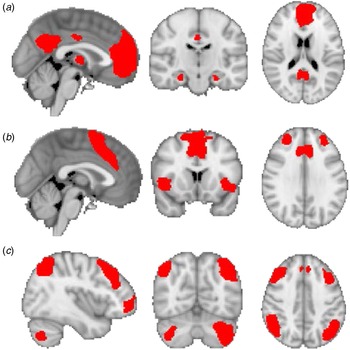
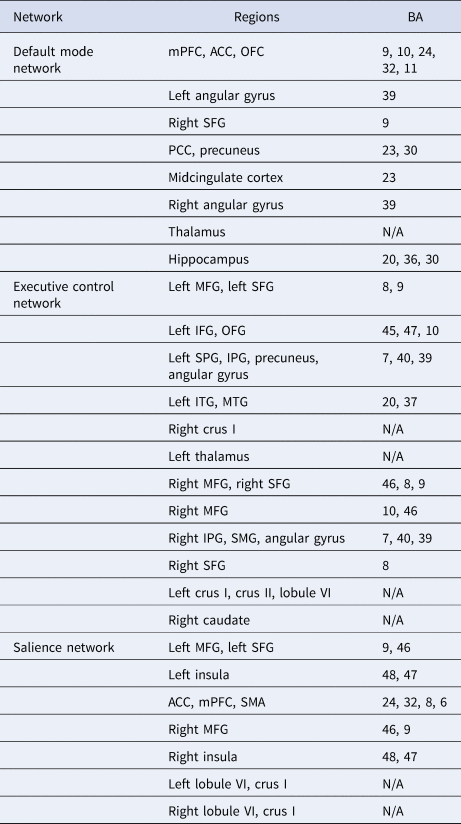
To perform focused analyses on the impact of abuse and neglect on network cohesion, data were extracted from the dorsal DMN (which contains the mPFC, PCC, and several other regions), anterior SN (which contains the dACC, insula, and several other regions), and bilateral ECN in the present study (Fig. 1; Table 1). Within-network connectivity was computed for the SN, DMN, and ECN using a commonly used parcellation scheme (Shirer, Ryali, Rykhlevskaia, Menon, & Greicius, Reference Shirer, Ryali, Rykhlevskaia, Menon and Greicius2012; https://findlab.stanford.edu/functional_ROIs.html). For details, see online Supplementary Material.
Networks of interest: (a) dorsal default mode network (DMN); (b) anterior salience network (SN); (c) bilateral executive control network (ECN).

Regions in the DMN, ECN, and SN

mPFC, medial prefrontal cortex; ACC, anterior cingulate cortex; OFC, orbitofrontal cortex; SFG, superior frontal gyrus; PCC, posterior cingulate cortex; MFG, middle frontal gyrus; IFG, inferior frontal gyrus; OFG, orbitofrontal gyrus; SPG, superior parietal gyrus; IPG, inferior parietal gyrus; ITG, inferior temporal gyrus; MTG, middle temporal gyrus; SMG, supramarginal gyrus.
Statistical methods
Linear mixed-effects models (LMMs) were used to examine the relationship between abuse/neglect and change in connectivity of the SN, DMN, and ECN with age. LMMs are particularly suited to longitudinal analyses as they permit the use of all available data (including participants with data at only one time point) (Gibbons, Hedeker, & DuToit, Reference Gibbons, Hedeker and DuToit2010). Subsequent cross-sectional analyses (for significant longitudinal findings) were conducted using ordinary least squares regression. We verified if unstandardized residuals were normally distributed in all analyses, and analyses were conducted using robust regression if residuals were found to not be normally distributed. We covaried for sex (where relevant), SES, IQ, and FD (as time-varying covariates) in all our models and controlled for multiple comparisons using the false discovery rate (p < 0.05) (Benjamini & Hochberg, Reference Benjamini and Hochberg1995). In order to determine whether findings were specific to abuse/neglect, we also covaried for abuse in neglect models, and vice versa. Model equations and collinearity checks can be found in online Supplementary Material.
Next, we examined the relationship between abuse/neglect, within-network FC for those networks where a significant relationship was found longitudinally, and mental health at T2 using mediation models, with CTQ abuse/neglect scores as the predictor, change in within-network connectivity as the mediator (obtained using random slopes from LMM), and CES-D, BAI, and problematic substance use scores at T2 as the outcome variable. Moderated mediation models were then run to test the role of sex as a moderator. IQ, SES, sex (models where sex was not a moderator), and the respective T1 psychopathology score (CES-D, BAI, and problematic substance use) were included as covariates. Mediation analyses were conducted using the PROCESS Macro in SPSS (Hayes, Reference Hayes2018). Scatter plots and correlations between abuse, neglect, and outcome variables as well as covariates (SES and IQ) can be found in online Supplementary Material.
Results
Demographic information
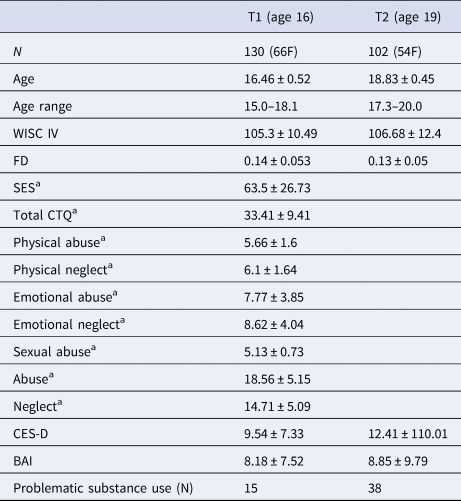
Demographic information can be found in Table 2.
Demographic information for time 1 and time 2

BAI, Beck Anxiety Inventory; CTQ, childhood trauma questionnaire; CES-D, Center for Epidemiological Studies Depression Scale; FD, framewise displacement; SES, socioeconomic status; WIS-C, Wechsler Intelligence Scale for Children IV (used to assess IQ).
Values correspond to mean ± standard deviation.
a Time-invariant variables were reported for all 142 participants in the study. Collected prior to T1.
Relationships between abuse/neglect and change in within-network connectivity
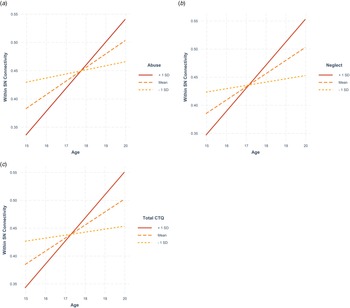
We found a significant positive association between both abuse and neglect, and change in within-SN connectivity (B = 0.01, s.e. = 0.004, p = 0.005; Fig. 2a; B = 0.01, s.e. = 0.003, p = .003; Fig. 2b, respectively). Results were also significant when excluding participants with mean FD > 0.2 mm (abuse: B = 0.01, t = 2.63, p = 0.01; neglect: B = 0.012, t = 3.03, p = 0.003). These associations were not significant when controlling for abuse-associated change in the neglect model and vice versa. See online Supplementary Material for model output. We did not find significant associations between abuse or neglect and changes in within-DMN connectivity or within-ECN connectivity (online Supplementary Fig. S6). In addition, in order to aid with our interpretation of abuse- and neglect-associated changes in within-SN connectivity, we also investigated whether the same relationship existed for cumulative maltreatment. We found a significant association between total CTQ scores and change in within-SN connectivity from mid to late adolescence (B = 0.006, s.e. = 0.002, p = 0.002; Fig. 2c).
Developmental trajectories are represented for within-SN connectivity, for adolescents with relatively high and low abuse (a), neglect (b), and total CTQ (c) scores. The slopes represent the average trajectories for groups based on + 1s.d., mean, and −1s.d. of abuse, neglect, and total CTQ scores. CTQ, childhood trauma questionnaire.

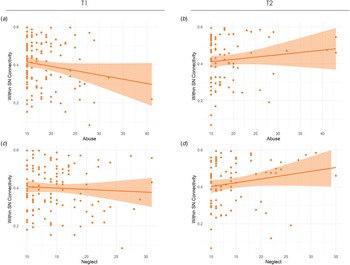
In order to elucidate at which ages the developmental trajectories diverged as a function of maltreatment, we examined cross-sectional relationships for within-SN connectivity at each time point. At T1 we found a significant negative relationship between abuse (Fig. 3a) but not neglect (Fig. 3c), and within-SN connectivity. At T2, we found a significant positive association between neglect (Fig. 3d), but not abuse (Fig. 3b), scores and within-SN connectivity.
Cross-sectional relationships are represented for within-SN connectivity with abuse and neglect at time 1 (a, b) and time 2 (c, d). The slopes represent the average trajectories for the whole sample. T1: abuse and within SN connectivity: R 2 = 0.096, F (5,124) = 2.622, B = −0.005, p = 0.048; neglect and within-SN connectivity R 2 = 0.084, F (5,124) = 2.261, B = −0.004, p = 0.132. T2: neglect and within-SN connectivity: R 2 = 0.113, F (5,96) = 2.445, B = 0.006, p = 0.033; abuse and within-SN connectivity: R 2 = 0.089, F (5,96) = 1.867, B = 0.005, p = 0.163. Findings with participants excluded based on FD > 0.2 mm: T1: abuse and within-SN: R 2 = 0.079, F (5,107) = 2.93, B = −0.004, t = −1.507, p = 0.135; neglect and within-SN: R 2 = 0.078, F (5,107) = 2.89, B = −0.004, t = −1.446, p = 0.151. T2: abuse and within-SN: R 2 = 0.029, F (5,87) = 1.56, B = 0.005, t = 1.459, p = 0.148; neglect and within-SN: R 2 = 0.061, F (5,87) = 2.2, B = 0.007, t = 2.276, p = 0.025.

Sex as a moderator of relationships between abuse/neglect and change in within-network connectivity
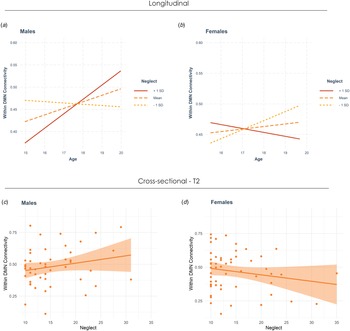
Given that sex has been shown to moderate the relationship between early adversity and brain development (Bath, Reference Bath2020), we tested the role of sex as a moderator. We found that sex significantly moderated the relationship between neglect history and change in within-DMN connectivity (B = −0.015, s.e. = 0.006, p = 0.014; see online Supplementary Material for model output). Results were also significant when excluding participants with mean FD > 0.2 mm (B = −0.015, t = −2.29, p = 0.02). While males exhibited neglect-associated increases in within-DMN connectivity (Fig. 4a), no effect was found in females (Fig. 4b). This effect was found to be significant when controlling for abuse-associated change (p = 0.004). Cross-sectionally, sex was found to moderate the relationship between neglect and within-DMN connectivity at T2 but not T1 (Fig. 4c, d depicts the relationship in males and females at T2). For non-significant findings, see online Supplementary Material.
Sex differences in neglect-associated changes in within-DMN connectivity in males (a) and females (b). The slopes represent the average trajectories for groups based on + 1s.d., mean, and −1s.d. of abuse and neglect scores. Of note, sex was binary variable with females coded as 1 and males as 0. Males and change in within-DMN connectivity: B = 0.004, s.e. = 0.002, p = 0.04; females and change in within-DMN connectivity: B = −0.002, s.e. = 0.002, 0 = 0.163. Cross-sectional relationships are represented for neglect and within-DMN connectivity for males and females at time 2 (c, d). Sex was found to moderate the relationship between neglect and within-DMN connectivity at T2 [R 2 = 0.072, F (5,96) = 1.233, B = −0.01, p = 0.042]. Findings with participants excluded based on FD > 0.2 mm: neglect and within DMN: R 2 = 0.0001, F (5,86) = 1.01, B = −0.008, t = −1.493, p = 0.139.

Relationships between change in connectivity and mental health
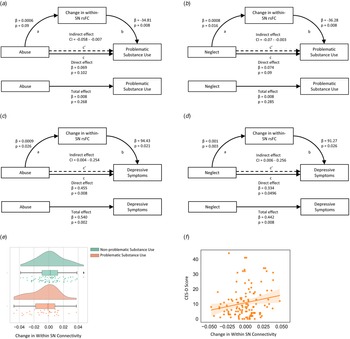
Although there were no total or direct effects of abuse/neglect on problematic substance use (i.e. no effects with or without controlling for FC), we found a significant role of change in within-SN connectivity (obtained using random slopes from LMM) as a mediator between abuse and problematic substance use at T2 (CI −0.0581 to −0.007; Fig. 5a) and neglect and problematic substance use at T2 (CI −0.0758 to −0.0032; Fig. 5b). These mediation effects were also significant when excluding participants with mean FD > 0.2 mm (abuse: CI −0.0711 to −0.0016; neglect: CI −0.0855 to −0.005). However, in analyses with the subsample excluding participants with mean FD < 0.2 mm, within-SN connectivity was also found to mediate the association between abuse/neglect and higher depressive symptoms at T2 (abuse: CI 0.004–0.254; neglect: CI 0.006–0.256; Fig. 5c, d). See online Supplementary Material for non-significant mediation findings.
Mediation model for (a) abuse (reported during early adolescence) predicting problematic substance use at late adolescence, (b) neglect (reported during early adolescence) predicting problematic substance use at late adolescence, through change in within-SN connectivity from mid- to late-adolescence. Mediation model for (c) abuse (reported during early adolescence) predicting depressive symptoms at late adolescence, (d) neglect (reported during early adolescence) predicting depressive symptoms at late adolescence, through change in within-SN connectivity from mid- to late-adolescence. Statistical values reported in (c) and (d) are from the sample excluding participants with FD > 0.2 mm. (e) Raincloud plot for the slope of change in within-SN connectivity for problematic substance use and non-problematic substance use groups (path b). (f) Association between the slope of change in within-SN connectivity and CES-D scores (path b).

Discussion
The aim of the present study was to examine the differential impact of abuse and neglect on the functional development of the SN, DMN, and ECN. We found a significant relationship between both abuse and neglect scores and the development of within-SN connectivity, such that higher abuse and neglect scores were associated with greater increases in within-network connectivity of the SN with age. We also found that only in males, neglect history was uniquely associated with the development of within-DMN connectivity (i.e. findings remained when accounting for abuse). Further, we found that increases in within-SN connectivity mediated the association between abuse and neglect, and reduced incidence of problematic use, and higher depressive symptoms in late adolescence.
We hypothesized that we would see abuse-, but not neglect-associated increases in within-SN connectivity. Our findings only partially supported this hypothesis, as we observed alterations in the development of SN connectivity as a function of both abuse and neglect. Increased abuse/neglect scores were found to be associated with greater increases in within-SN connectivity. The SN, which contains the bilateral anterior insula and dACC, has been suggested to be critically involved in the evaluation of internal and external states in order to guide behavior (Seeley et al., Reference Seeley, Menon, Schatzberg, Keller, Glover, Kenna and Greicius2007; Uddin, Reference Uddin2015). Indeed, altered SN function and connectivity have previously been reported in individuals with a history of childhood maltreatment (McLaughlin et al., Reference McLaughlin, Weissman and Bitrán2019; Van der Werff et al., Reference Van der Werff, Pannekoek, Veer, van Tol, Aleman, Veltman and van der Wee2013).
The pattern of greater functional segregation and therefore specialization during adolescence seen in the resting-state fMRI neurodevelopment literature (Dumontheil, Reference Dumontheil2016; Truelove-hill et al., Reference Truelove-hill, Erus, Bashyam, Varol, Sako, Gur and Davatzikos2020) has been posited to be one of the neural substrates for increased functioning observed during the same period (Stevens, Reference Stevens2016; Stevens et al., Reference Stevens, Pearlson and Calhoun2009). Our finding of abuse- and neglect-associated increase within-SN connectivity could therefore reflect more advanced salience processing and consequently greater sensitivity to threat. Further, accelerated neurodevelopment has been suggested to be an ontogenetic response to early adversity (Callaghan & Tottenham, Reference Callaghan and Tottenham2016), and it has been suggested that the experience of adversity leads to reprioritization of developmental strategy in favor of quicker maturation of stress-associated systems. As such, given that development has shown to be associated with increased functional integration within individual systems (Truelove-hill et al., Reference Truelove-hill, Erus, Bashyam, Varol, Sako, Gur and Davatzikos2020), our finding of increased within-network connectivity of the SN from mid to late adolescence (as a function of both abuse and neglect) could be consistent with the stress-acceleration hypothesis, particularly because within SN connectivity (which was negatively associated with abuse at time 1) it was found to ‘speed up’ between time 1 and time 2, leading to a positive relationship at time 2 (with neglect).
That both abuse and neglect were associated with the development of within-SN connectivity may not be surprising because of the high correlation between them, thereby making it more difficult to observe differential associations; however, the variance explained by the model that included both abuse and neglect as predictors was higher than that of the standalone models, giving us confidence that both types of maltreatment are contributing to the relationship. Our finding of abuse and neglect both being associated with changes in the same network does not contradict the DMAP model, as it is possible that abuse and neglect impact SN connectivity through different underlying mechanisms. For example, given that the SN is considered important for evaluative responses to threat and safety (Marstaller, Fynes-Clinton, Burianová, & Reutens, Reference Marstaller, Fynes-Clinton, Burianová and Reutens2021; Menon & Uddin, Reference Menon and Uddin2010; Seeley et al., Reference Seeley, Menon, Schatzberg, Keller, Glover, Kenna and Greicius2007; Uddin, Reference Uddin2015), and that threat/abuse is purported to impact emotional and fear learning, abuse could be acting on SN connectivity through activation of the HPA axis and downstream hormonal and metabolic changes (McLaughlin et al., Reference McLaughlin, Sheridan and Lambert2014). On the other hand, neglect (or deprivation) may be acting on SN connectivity through a distinct mechanism via aberrant synaptic proliferation and pruning processes due to a deviation from the species-expectant experience of cognitive, social, and other forms of stimulation (McLaughlin, Sheridan, & Nelson, Reference McLaughlin, Sheridan and Nelson2017). Indeed, the anterior insula (a core region of the SN) plays a crucial role in integrating sensory information from multiple modalities in order to support cognitive awareness and identify salient information. Accordingly, from a theoretical standpoint, an alteration in said inputs (e.g. less parental warmth/contact) could potentially reshape SN circuitry (Liu et al., Reference Liu, Yuan, Ding, Xu, Long, Li and Yu2017). For example, several studies have reported functional and structural re-organization of the SN in response to different types of sensory deprivation (e.g. Bavelier et al., Reference Bavelier, Newman, Mukherjee, Hauser, Kemeny, Braun and Boutla2008; Ding et al., Reference Ding, Ming, Wan, Li, Qin and Yu2016).
Nevertheless, there might be other reasons for our findings. For instance, an even clearer distinction between the neurobiological consequences of abuse and neglect may only be seen in cohorts where individuals have one experienced only or the other form of maltreatment. Further, we also found a similar relationship between change in within-SN rsFC and total maltreatment scores. This may suggest that a ‘cumulative risk’ framework may be beneficial, particularly in community samples where only very few individuals have experienced only abuse or neglect. In addition, cross-sectional analyses showing results being driven by T1 connectivity for abuse and T2 connectivity for neglect further suggest differential effects of abuse and neglect. These findings may indicate that neglect could have more long-lasting effects on within-SN connectivity (i.e. effects were present for a longer duration). In any case, larger longitudinal samples with exposure to multiple forms, and severity, of threat and deprivation are required to investigate this further (McLaughlin et al., Reference McLaughlin, Weissman and Bitrán2019).
In the present study, we found sex to moderate the relationship between neglect and the development of within-DMN connectivity. Specifically, higher neglect scores were associated with increased within-DMN integration with age in males. This finding was consistent with the DMAP model's prediction of differential effects of abuse and neglect, as we found that the effect was specific to neglect and remained after covarying for abuse. Further, this finding is partially consistent with hypotheses regarding temporal patterns of development. Given that normative development has shown to be associated with increased age-associated within-DMN functional integration (Truelove-hill et al., Reference Truelove-hill, Erus, Bashyam, Varol, Sako, Gur and Davatzikos2020), our findings could be interpreted to reflect neglect-associated acceleration of development in males. This finding is somewhat inconsistent with other work that found deprivation (i.e. childhood poverty and neighborhood disadvantage) to be associated with reduced connectivity within the DMN (Rakesh, Seguin, Zalesky, Cropley, & Whittle, Reference Rakesh, Seguin, Zalesky, Cropley and Whittle2021; Sripada et al., Reference Sripada, Swain, Evans, Welsh and Liberzon2014), which could be due to the difference in age of the sample (~24 v. ~16–18), the study design (cross-sectional v. longitudinal), and/or the utilization of different measures of deprivation (poverty v. neglect). Moreover, studies have also shown reduced DMN structural connectivity as a function of neglect/deprivation (Kumar et al., Reference Kumar, Behen, Singsoonsud, Veenstra, Wolfe-Christensen, Helder and Chugani2014). We speculate that it is possible that reduced structural connectivity as a function of neglect could lead to regions ‘working harder’ to communicate, thereby causing an increase in functional connectivity. While these previous findings are not consistent with our finding being only in males, sex differences were not investigated in these prior studies, and so a positive association between neglect and within DMN connectivity in males could be masked if sex differences are not investigated. Although it is unknown why findings were specific to males, it is of note that sex differences in the neurobiological consequences of maltreatment have been highlighted in the literature (Bath, Reference Bath2020; Helpman et al., Reference Helpman, Zhu, Suarez-Jimenez, Lazarov, Monk and Neria2017). Previous work has also reported early life stress-associated differences in rsFC to be moderated by sex (Burghy et al., Reference Burghy, Stodola, Ruttle, Molloy, Armstrong, Oler and Birn2012; Herringa et al., Reference Herringa, Birn, Ruttle, Burghy, Stodola, Davidson and Essex2013). Several studies have also reported male-specific alterations in brain structure as a function of maltreatment (De Bellis & Keshavan, Reference De Bellis and Keshavan2003; De Bellis et al., Reference De Bellis, Hooper, Chen, Provenzale, Boyd, Glessner and Woolley2015; Frodl, Reinhold, Koutsouleris, Reiser, & Meisenzahl, Reference Frodl, Reinhold, Koutsouleris, Reiser and Meisenzahl2010; Karl et al., Reference Karl, Schaefer, Malta, Dörfel, Rohleder and Werner2006; Samplin, Ikuta, Malhotra, Szeszko, & DeRosse, Reference Samplin, Ikuta, Malhotra, Szeszko and DeRosse2013; Whittle et al., Reference Whittle, Vijayakumar, Dennison, Schwartz, Simmons, Sheeber and Allen2016); however, work on sex differences in FC has been less common (McLaughlin et al., Reference McLaughlin, Weissman and Bitrán2019). Of note, however, in a recent analysis of the sample reported here, we reported male-specific maltreatment-associated alterations in limbic circuitry (Rakesh et al., Reference Rakesh, Kelly, Vijayakumar, Zalesky, Allen and Whittle2021). These results provide evidence to support the differential impact of early life adversity on males and females, and highlight the importance of examining sex differences in future work (Bath, Reference Bath2020).
Importantly, we found that change in within-SN connectivity mediated the relationship between childhood maltreatment (both abuse and neglect) and lower problematic substance use at T2. The direction of this effect was unexpected and inconsistent with our hypotheses; however, the SN, and in particular the insula, has been heavily implicated in substance use and addiction (Droutman, Read, & Bechara, Reference Droutman, Read and Bechara2015). Indeed, studies have consistently shown substance-use/dependence-associated reductions in insula volume and reduced activation during affective and decision-making tasks (Gilman & Hommer, Reference Gilman and Hommer2008; Kim et al., Reference Kim, Song, Seo, Lee, Lee, Kwon and Chang2011; Rakesh, Allen, & Whittle, Reference Rakesh, Allen and Whittle2020a; Stewart et al., Reference Stewart, May, Poppa, Davenport, Tapert and Paulus2014) in adults and adolescents. Recent work from our group has also shown insula hypoconnectivity to be associated with substance use disorder in adolescents (Rakesh et al., Reference Rakesh, Lv, Zalesky, Allen, Lubman, Yücel and Whittle2020b). Although the direction of our findings may seem somewhat counter-intuitive, they could be interpreted to reflect a resilience or protective mechanism. Specifically, the SN is also considered to be a hub for the integration of affective information (such as reward). Previous work has reported trauma-associated increased connectivity within the SN, and higher within-SN connectivity to be associated with reduced reward sensitivity in youth (Marusak, Etkin, & Thomason, Reference Marusak, Etkin and Thomason2015) – these results could potentially explain our finding of abuse and neglect-associated increases in within-SN connectivity contributing to lower problematic substance use [associated with higher reward sensitivity (Kim-Spoon et al., Reference Kim-Spoon, Deater-Deckard, Holmes, Lee, Chiu and King-Casas2016)] during late adolescence. Thus, increased integration within the salience system as a function of abuse and neglect could reflect an adaptive or compensatory mechanism in maltreated individuals, and may act as a neuroprotective factor against the development of problematic substance use during adolescence.
Furthermore, in the subsample with stricter thresholding for motion, we also found increases in within-SN rsFC to mediate the association between abuse/neglect and higher depressive symptoms. Regions of the SN have been consistently implicated in both substance use and depression in youth (Droutman et al., Reference Droutman, Read and Bechara2015; Lee et al., Reference Lee, Pavuluri, Kim, Suh, Kim and Lee2019; Rakesh et al., Reference Rakesh, Allen and Whittle2020a). We speculate that maltreatment-associated increases in within-SN connectivity may dampen reward sensitivity, and decrease the likelihood of adolescents engaging in risky but rewarding behaviors such as substance use, and at the same time increase the risk for depression, which is associated with low reward function (Forbes & Dahl, Reference Forbes and Dahl2012). We did not find such a relationship with anxiety, which may highlight that this relationship is specific to reward-associated behavioral/psychopathological outcomes (i.e. depression and substance use). However, given that this finding was not found in the whole sample, we make these interpretations very cautiously. Given no differences between the full sample and subsample (with stricter motion thresholding) in key demographic and maltreatment variables, the reason for the difference in findings is challenging to comment on; however, we speculate that it could be because of the differences in average head motion.
While this study has strengths, including the longitudinal design, some limitations must be considered. First, as noted above, our sample was from the community and did not have a large number of people who have experienced significant abuse or neglect, which may have made it difficult to tease apart their distinct neurobiological consequences. Second, childhood maltreatment was self-reported retrospectively, and thus could have been impacted by recall bias; however, subjective self-reported maltreatment has recently been shown to be reliable in predicting psychopathology (Danese & Widom, Reference Danese and Widom2020). Third, sex differences could be a result of differences in pubertal trajectories, which have previously been linked to neurodevelopment (Chahal et al., Reference Chahal, Vilgis, Grimm, Hipwell, Forbes, Keenan and Guyer2018). Future longitudinal work should account for pubertal stage and development in analyses. Fourth, reconciling findings with past work was challenging, as our review of the literature and our Discussion was limited by the fact that researchers have only recently begun to make consistent efforts to investigate the effects of abuse and neglect on brain development separately, particularly for rsFC. Fifth, our study only examined specific resting-state networks of interest (i.e. the SN, ECN, and DMN); however, several other regions and individual connections not examined here could potentially be impacted differentially by abuse and neglect. For example, abuse has been suggested to specifically impact the development of affective circuits (e.g. amygdala-mPFC) (Cisler, Reference Cisler2017; Cisler et al., Reference Cisler, James, Tripathi, Mletzko, Heim, Hu and Kilts2013; Thomason et al., Reference Thomason, Marusak, Tocco, Vila, McGarragle and Rosenberg2014), and deprivation likely preferentially sculpts reward circuitry (e.g. fronto-striatal circuitry) (Goff et al., Reference Goff, Gee, Telzer, Humphreys, Gabard-Durnam, Flannery and Tottenham2013; Hanson, Hariri, & Williamson, Reference Hanson, Hariri and Williamson2015a; Mehta et al., Reference Mehta, Gore-Langton, Golembo, Colvert, Williams and Sonuga-Barke2010), which is considered significant for both depression and substance use (Baskin-Sommers & Foti, Reference Baskin-Sommers and Foti2015). The differential impact of abuse and neglect on the development of these connections remains an open question for future work. Sixth, mediation without entirely temporally separated variables has limitations (Maxwell & Cole, Reference Maxwell and Cole2007; Maxwell, Cole, & Mitchell, Reference Maxwell, Cole and Mitchell2011) and there was overlap between when outcome variables were well collected and when the second imaging scan was conducted. Future work should explore mechanistic links between abuse, neglect, and psychopathology using extended longitudinal designs and completely temporally separated variables. , (Maxwell & Cole, Reference Maxwell and Cole2007; Maxwell et al., Reference Maxwell, Cole and Mitchell2011) Seventh, it is also plausible that there could have been ongoing maltreatment between when maltreatment was measured (age 14) and when the scans were taken (age 16 and age 19). This could have confounded some of the relationships that were measured. Future work should also examine relationships between maltreatment experienced at different points in development and change in connectivity. Finally, the present study did not have enough power to examine the impact of the age at which maltreatment was experienced. Future longitudinal work should investigate this in more detail.
In sum, the present study extends the current literature by demonstrating links between childhood maltreatment, and connectivity of the salience and DMNs. It also sheds light on potential neurobiological mechanisms for problematic substance use and risk for depression. Our findings show that childhood maltreatment has long-term effects on neurodevelopment, particularly on systems underlying salience processing and emotion regulation. Notably, our findings are largely consistent with DMAP, but suggest that abuse and neglect impact similar as well as distinct neural circuitry. These findings have implications for our understanding of the underlying neurobiological mechanisms of how childhood maltreatment may affect the risk for mental health problems. The present study highlights the importance of understanding early markers of risk and resilience in order to guide prevention efforts.
Supplementary material
The supplementary material for this article can be found at https://doi.org/10.1017/S0033291721003135
Financial support
This study was funded by the Colonial Foundation, the National Health and Medical Research Council (NHMRC; Australia; Program Grant 350241), and the Australian Research Council (ARC; Discovery Grants DP0878136 and DP109 2637). DR was supported by a Melbourne Research Scholarship (MRS; University of Melbourne). SW was supported by an NHMRC Career Development Fellowship (ID: 1125504).
Conflict of interest
The authors report no biomedical financial interests or potential conflicts of interest.
Ethical standards
The authors assert that all procedures contributing to this work comply with the ethical standards of the relevant national and institutional committees on human experimentation and with the Helsinki Declaration of 1975, as revised in 2008.