For many women with early stage breast cancer, breast conserving surgery followed by radiotherapy is an alternative to total mastectomy and has comparable survival rates (Reference Dixon and Mak12). Given a choice between the two, some women may choose a total mastectomy because it makes them feel safer, because it decreases the risk of further surgery, or because they may want to avoid radiotherapy (Reference Kirby, Basit and Manimaran22), but patients treated by BCS have on average better psychosocial outcomes (Reference Temple, Russell and Parsons37).
The UK's National Institute for Health and Clinical Excellence (NICE) recommended in 2002 (28) that breast cancer patients should be fully informed of all available treatment options. This recommendation was made partially in response to previously observed variation in BCS rates between English hospitals, ranging very substantially between 20 percent and 80 percent. More recently, the first annual report of the National Mastectomy and Breast Reconstruction Audit in 2008 (29) noted that there was still considerable variation between hospitals in the United Kingdom, reiterating concerns raised by other recent commentators (7;Reference Dixon and Mak12). Guidelines by the Association of Breast Surgery at BASO (British Association of Surgical Oncology) (5) also emphasize informed choice for the patient and choosing surgery of sufficient magnitude to prevent local recurrence.
For many interventions appraised by healthcare technology assessment organizations (such as NICE) a “diffusion” process of the intervention into clinical practice and among networks or communities of practitioners may have been initiated before the time that technology assessment was undertaken. For example, the use of implantable cardioverter defibrillators was already increasing when NICE recommended them (Reference Sheldon, Cullum and Dawson35), as was the use of pimecrolimus and tacrolimus for atopic eczema (Reference Lacey23). Local variation in diffusion processes could in part explain the variation in BCS use between hospital teams, over and above the range of clinical or organizational factors already known to cause variation in BCS use (such as patient and tumor factors, and variation in aspects of local health service provision, such as ease of access to radiotherapy for example) (Reference Adelson, Lim, Churches and Nguyen1,Reference Hiotis, Ye, Sposro and Skinner18). A surgeon's own attitude toward BCS treatment protocols might be influenced by training or through personal and professional contact with peers, through socialization and networking, and this hypothesis merits further scrutiny. Previous studies suggest that clinicians often prefer personal recommendations from colleagues or clinic networks over other sources of information about new medical technologies and practices (Reference McGettigan, Golden, Fryer, Chan and Feely27), and that clinician networks are a powerful means of spreading best practice and innovation (Reference Riskin, Longaker, Gertner and Krummel33).
We, therefore, aimed to examine the influence of personal and professional contacts between surgeons on the use of BCS. Detailed data on personal and professional contacts between clinicians are almost impossible to gather on a national level, and, therefore, a proxy measure for professional socialization and networking was developed by looking at teams working at the same hospital site or sites.
METHODS
Data
Hospital Episode Statistics (HES) records relating to National Health Service (NHS) hospital admissions in the whole of England (39) were analyzed to identify inpatient episodes in women with a main diagnosis of malignant neoplasm of breast (ICD-10 code C50) or carcinoma in situ (D05) during a 12-month period between 1 March 2006 and 30 April 2007, which included mastectomy (OPCS 4 code: B27) or breast conserving surgery (OPCS 4 code: B28) anywhere in the HES procedure fields. Male patients with breast cancer were not included in the analysis because their expected treatment pathway would be different. The HES anonymized consultant team code was used to identify activity related to individual surgical (“consultant”) teams. In this report the term “surgical team” is used to describe the team of an NHS hospital consultant (in this instance, a specialist breast surgeon) including his/her trainees, along with associated staff.
For each surgical team, a ratio expressing the proportion of BCS in relation to all breast cancer surgery that the team performed during the study period was calculated. Teams performing less than ten breast cancer operations during the study period were excluded from the analysis, to avoid extreme BCS use ratios caused by small patient numbers. A small number of patient episodes that included both breast conserving surgery and full mastectomy were also excluded from the calculation of the consultant team BCS ratios.
Colleague Influence Variable
A surrogate measure of colleague influence was constructed, focusing on current (during the study year) connections with surgical teams they worked alongside in one or more hospitals during the study period. This variable was constructed using a three-stage process. First, the hospital site codes listed in HES records were used to create an inventory listing every hospital site that each individual consultant team had worked in during 2006/07 (some teams had worked in more than one hospital sites). If the hospital site code in HES was missing or miscoded, we used the code of the relevant NHS Hospital Trust (a UK term generally referring to the administrative entity of either a single main hospital or a main hospital with subsidiary site) listed on the HES system, and carried out Internet research to determine at which specific hospital site surgeons employed by these hospital trusts performed breast cancer surgery. Some hospital premises referred to in the inventory had an affiliation with, or were located in close proximity to another hospital. It was not always clear what constituted a separate hospital “site.” Hospital site plans and road maps were examined, and two sites were recorded as a single site only if one was completely contained within the grounds of another, or if their sites were contiguous or separated by a single public road. From the initial inventory, a list was created of teams that had worked alongside each other at one or more hospital sites during 2006/07. Finally, to measure the overall level of BCS use that each team was “exposed” to by their colleague teams, the mean BCS rate of their colleague teams was calculated, and became the main variable of interest in this study.
Other Analysis Variables
There are several factors already known to cause variation in BCS use (Reference Adelson, Lim, Churches and Nguyen1;Reference Collins, Kerrigan and Anglade9;Reference Cutuli, Lemanski and Fourquet10;Reference Hall, Holman, Hendrie and Spilsbury17;Reference Hiotis, Ye, Sposro and Skinner18;Reference Johantgen, Coffey, Harris, Levy and Clinton20;Reference Kimmick, Camacho, Balkrishnan and Anderson21;Reference Mandelblatt, Berg and Meropol26;Reference Velikova, Booth and Johnston40;Reference Zorzi, Puliti and Vettorazzi41), and these needed to be taken into account in the analysis. Many of the factors listed in previous literature relate to local patient demographic characteristics and particular aspects of local health service provision. A surgical team would be subject to the same local patient demographic and local health service characteristics as the teams working alongside them in the same hospital or hospitals. The effect of these other factors could, therefore, provide an alternative explanation as to why the BCS usage rates in a given locality were similar, confounding the potential effect of colleague teams. Only by including these factors in the regression as independent variables can such potential confounding be controlled for. The full list of variables for the present study, how they were operationalized, and references substantiating the choice are described in Supplementary Table 1, which appears online (www.journals.cambridge.org/thc2010012).
Almost all of the variables included in the analysis were suggested as independent predictors of BCS rates by previous literature, but there were three exceptions, these being (i) the proportion of a consultant team's breast cancer surgery patients with a previous hospital admission with a diagnosis of breast cancer (C50) or breast carcinoma in situ (D05) during a period starting more than 60 days before the index admission; (ii) the proportion of a consultant team's breast cancer surgery patients with prior BCS surgery; and (iii) the proportion of a consultant team's breast cancer surgery patients with prior total mastectomy.
In all cases, these three variables were calculated using the fullest extent of usable HES historic data, which extends back to April 1997. These variables were used, because in preliminary testing they were all found to be independent predictors of BCS usage by consultant teams.
It would have been ideal if we could adjust our analysis for cancer stage at diagnosis, but unfortunately stage information is not recorded in the HES system. Nevertheless, as a separate measure of differences in disease severity case-mix, we calculated, for each surgical team, the proportion of their breast cancer surgery patients with just a diagnosis of carcinoma in situ (D05), as opposed to those with a diagnosis of breast cancer (C50).
Hierarchical (blockwise entry) linear regression was used to specifically isolate the impact of the colleague team influence variable, with all other independent variables being entered into the regression first. Regression diagnostics were performed to confirm the reliability of the analysis, checking for multicollinearity and heteroscedasticity.
RESULTS
Dataset
The extracted HES data included 37,510 relevant patient episodes relating to 610 different consultant teams. Of these, 178 teams (who managed a total of 479 breast cancer-related episodes) were excluded because they performed ten or fewer breast surgery operations during the study year. Twelve other teams were also excluded because they did not work at any site with at least one other consultant team doing more than ten breast operations a year. The BCS rate for the remaining 420 consultant teams varied between 0.0 percent and 93.8 percent of all breast surgery operations, and the average of their colleague teams’ BCS rates varied from 0.0 percent to 82.0 percent.
Each consultant team worked at an average of 1.27 different hospital sites, and had an average of 2.42 colleague teams with more than ten breast cancer operations a year that worked alongside them at their hospital(s). Each hospital site had on average 2.1 consultant teams that carried out breast surgery operations at some time during the 2006/07 year.
Regression
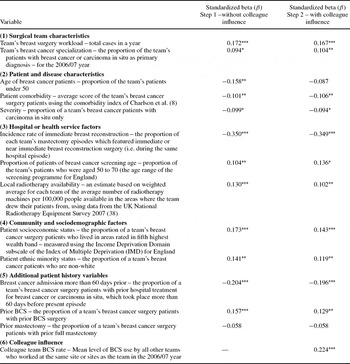
Table 1 presents the results of the regression analysis. After adjusting for the effect of other factors in step 2 of the regression, the mean BCS rate of colleague teams significantly predicted BCS use by a consultant team, with a standardized beta of 0.224 (p < .001). This result suggests that, if a team's consultant teams increased (or decreased) their BCS rate by 10 percent on average, the index team's own rate, all other things being equal, would be expected to increase (or decrease) by approximately 3 percent.
Association Between Patient, Tumor and Organisational Variables (Including Practice of Colleague Surgical Teams) and Breast Conserving Surgery Ratea

aR2 = .504 for Step 1; ΔR2 = .045 for Step 2 (p < .001). *p <.05; **p < .01; ***p < .001.
Without the colleague influence variable (step 1), the adjusted R-squared value of the regression model was 0.504, and with it, the adjusted R-squared value was raised to 0.549. The change in the R-squared is significant (F Change = 41.915; p < .001), suggesting that colleague influence appears to be a meaningful independent explanatory factor for a team's BCS rate.
As for the other independent variables, Table 1 indicates that after taking into account colleague influence (step 2 of the regression) many other variables included in the regression were significantly associated with BCS usage. More specifically, teams who specialized in breast cancer, or who had higher volume of breast surgery were more likely to have a high BCS rate. Higher BCS usage was also associated with lower patient comorbidity [calculated as the average of their patients’ Charlson Comorbidity Index (Reference Charlson, Pompei, Ales and MacKenzie8;Reference Nuttall, Van Der Meulen and Emberton31) scores]. Teams having higher proportions of patients with prior hospital admission (i.e., at least 60 days before) for breast cancer or carcinoma in situ were statistically less likely to have a high BCS rate. Having a high portion of patients with previous BCS was statistically associated with the team having a high BCS rate.
Local hospital or health service factors also predicted BCS usage: a higher rate was significantly associated with higher local availability of radiotherapy, and a higher proportion of patients in the age groups covered by the English breast cancer screening program. Conversely, higher incidence of immediate breast reconstruction (measured as reconstruction happening during the same hospital episode) was a very strong negative predictor of BCS surgery. Finally, the sociodemographic profile of the local population appeared to have an association with type of breast surgery. A more affluent patient population was associated with higher BCS rate. Higher BCS rate was also associated with a higher proportion of non-white patients.
Finally, BCS use was inversely correlated with the proportion of carcinoma in situ–only patients, suggesting that patients with tumor of uncertain behavior (i.e., not necessarily malignant) were more likely to be treated with total mastectomy. This result is both counterintuitive, and discordant with previous research (Reference Hiotis, Ye, Sposro and Skinner18). In further analysis, we identified a systematic coding difference in the proportion of patients diagnosed with carcinoma in situ between urban and rural hospitals (data not shown), which we believe reflects differential coding practices. Therefore, the observed association is likely to be confounded by other variables, and to be spurious.
DISCUSSION
These findings appear to confirm that the clinical practice of consultant teams is influenced by the practices of teams who work alongside them at the same hospital site(s), and that this effect can be detected using routinely collected data.
As well as studies that examine diffusion of medical innovation at the level of whole hospitals (Reference Laliberte, Fennell and Papandonatos24;Reference Riley, Taylor and Elliott32), there has been both quantitative (Reference Anderson and Jay2;Reference Ankem3;Reference Becker6;Reference Strang and Tuma36) and qualitative research (Reference Gabbay and le May14;Reference Greer15) into the role of clinician-to-clinician contacts. However, social influence issues have never been examined before with respect to BCS use among clinicians, with the exception of research by Fedeli et al. into the role of clinicians in larger hospitals acting as “early adopters” of the technique (Reference Fedeli, Alba and Schievano13), and the work of Lazovich et al. (Reference Lazovich, Solomon, Thomas, Moe and White25) who tracked the national growth of the popularity of BCS in the United States after a consensus development conference on the issue. Different HTA organizations have initiated clinical “ambassador” or “fellow” schemes that aim to increase awareness of healthcare technology appraisal recommendations among practitioners, such as the Swedish Council on Technology Assessment in Health Care (SBU) “Ambassador“ program (Reference Rentzhog and Jonsson34), or NICE's own Fellowship scheme, announced in October 2009 (http://www.nice.org.uk/getinvolved/nicefellowsandscholars.jsp).
Two limitations of our study deserve particular comment. First, measurement of the effects of professional socialization and networking through a common location is limited and our analysis has focused only on colleagues who worked alongside other consultant teams during a single year. It was not possible to measure any previous (longitudinal or historical) colleague influence, or the influence originating outside these sites, for example the effects of formal regional clinical (cancer) networks. The methodology assumes that teams who work in the same hospital have some professional socialization, even if there might be little contact between teams. In addition, the mean BCS rate of a team's “colleague teams” is intended as a crude overall measure of professional peer-influence, but measuring it using a simple mean across all of a team's colleague teams assumes that all these separate colleague teams exert equal influence on the index team.
The second limitation is that, although we examined the potential influence of many different patient, disease, sociodemographic, and healthcare factors on BCS rate, it remains possible that the observed association with colleague team BCS rate may in fact be confounded by another, not accounted for variable or variables. This could include some unidentified aspect or aspects of local patient sociodemographics, or it could be an artifact of local health service provision, for example regional clustering of BCS expertise in relatively high volume “centers of excellence”. Repeating the analysis by excluding those consultant teams in “high volume” hospital centers (defined, for example, as those in the top quartile of activity), or adjusting for hospital-level BCS volume, could serve as sensitivity analysis to examine the potential effect of hospital type or BCS volume on the observed “networking” effect. We plan to conduct this analysis in the future.
We found that a high rate of immediate reconstruction following mastectomy by a surgical team has a strong negative correlation with BCS use by the same team. How should this relationship be understood? One interpretation is that the reconstruction rate calculated for this analysis can be viewed as a measure of reconstruction availability. Possibly this is justified, given that rates of immediate reconstruction vary greatly between different parts of England, and that rates overall are much lower than they could be (29). Low rates in a given area could, for example, reflect shortage of skills or resources for reconstruction procedures. The relationship could, therefore, be interpreted as suggesting that wider availability of immediate reconstruction from a patient's surgical team may lower the threshold of acceptability by women for more extensive breast surgery—a tendency suggested by the qualitative study of Collins et al. (Reference Collins, Kerrigan and Anglade9). An alternative interpretation is that the immediate reconstruction rate is not a measure of availability, and that surgeons skilled in breast reconstruction surgery may have a bias toward recommending relatively more extensive surgery. This finding should perhaps motivate qualitative research to examine these two hypotheses in more depth. A third possibility is that the case load of teams with expertise in breast reconstruction is “skewed” toward more advanced cancers typically requiring total mastectomy. In any case, the low overall rate in absolute terms of immediate reconstruction means that the incidence rate of immediate reconstruction alone is not responsible for most of the observed variation in BCS rates.
There is also substantial variation in local availability of radiotherapy in England (7;30). Variation was also found in the present study which calculated, for each consultant team, an appropriately weighted average number of radiotherapy machines available locally per 100,000 people. Unsurprisingly, given the necessity of radiotherapy following BCS, a low average number of local radiotherapy machines was associated with lower use of BCS. Shortages or longer waiting times for radiotherapy may dissuade both clinicians and patients from BCS use and toward more extensive breast surgery—trading this off against the inconvenience of repeated travel to sometimes distant hospitals, as supported by previous non–UK-based research (Reference Adelson, Lim, Churches and Nguyen1;Reference Hiotis, Ye, Sposro and Skinner18).
The present study found that having a high proportion of non-white patients was significantly associated with higher BCS usage. Conflicting findings have been found in non-UK research about the relationship between BCS use and ethnic minority status. Our finding may be because ethnic minority populations tend to reside in urban areas in the UK (Reference Denham and White11), and, therefore, have a higher likelihood of being treated by larger, more specialized teaching hospitals that may act as centers of excellence for innovation diffusion (Reference Haddock and Begun16;Reference Jerome-D'Emilia and Begun19), and which also may have easy access to radiotherapy. This can be further examined empirically in future studies.
The findings concord with previous research, supporting a positive association between surgical team BCS rate and the following: volume of activity, team specialization, proportion of screening-detected cancers, lower patient comorbidity, and higher average patient wealth.
In the longer-term, training of new breast surgeons in the United Kingdom has changed significantly over recent years, and this may probably impact on BCS use and on the clinical outcomes. Recent guidance on oncoplastic breast surgery by the Association of Breast Surgery at BASO (4) could also influence BCS rate practice in the future.
Two possible future avenues for investigation include: first, searching for colleague influence effects in the use of other medical techniques; and second, in developing this methodology to try and detect the effects of individual team-to-team knowledge and practice transfer over a period of time.
CONCLUSIONS
At a surgical team level, much apparent variation can be explained by examination of patient demographic and disease characteristics, but also, contextual factors including working alongside other teams in the same hospital site(s).
Consideration of colleague influence is important for HTA organizations who seek to influence clinical practice. More than factual reasoning is needed to change practice, if local colleague judgment seems to be trusted as a source of information, independently of the existence guidance issued by a national body. The other side of the coin, however, is that network influences could potentially be useful for fostering diffusion of practice. National HTA organizations, as well as local health service managers might consider exploring in more detail the use of both formal and informal practitioner networks as a method of disseminating guidance.
CONTACT INFORMATION
Andrew R. Hoy, MA (Hons) (andrew.hoy@nice.org.uk), Analyst, Centre for Public Health Excellence, MidCity Place, 71 High Holborn, London WC1V 6NA, United Kingdom
Hannah Patrick, MRCP, MFPHM (hannah.patrick@nice.org.uk), Consultant Clinical Adviser, Interventional Procedures Advisory Committee, National Institute for Health and Clinical Excellence, MidCity Place, 71 High Holborn, London WC1V 6NA, United Kingdom
Bruce Campbell, MS, FRCP, FRCS (bruce.campbell@nice.org.uk), Chair, Interventional Procedures Advisory Committee, National Institute for Health and Clinical Excellence, MidCity Place, 71 High Holborn, London WC1V 6NA, United Kingdom; Professor, Peninsula College of Medicine & Dentistry, Universities of Exeter and Plymouth, United Kingdom
Georgios Lyratzopoulos, MD, FFPH, FRCP, MPH, DTM&H, Ptychio latrikes (georgios.lyratzopoulos@nice.org.uk), Consultant Clinical Adviser, National Institute for Health and Clinical Excellence, MidCity Place, 71 High Holborn, London WC1V 6NA, United Kingdom; Clinical Senior Research Associate, Department of Public Health & Primary Care, School of Clinical Medicine, University of Cambridge, Institute of Public Health, Forvie Site, Robinson Way, Cambridge CB2 0SR, United Kingdom