Democratic theory posits that citizens hold well-informed beliefs about political matters that determine the electoral fate of governments. In principle, this should lead policymakers to closely respond to citizens’ political preferences, and therefore, public policy will broadly reflect public opinion. However, empirical work shows that citizens often have very poor knowledge about political matters (Nadeau, Niemi and Levine Reference Nadeau, Niemi and Levine1993; Chiricos, Hogan and Gertz Reference Chiricos, Hogan and Gertz1997; Alba, Rumbaut and Marotz Reference Alba, Rumbaut and Marotz2005; Wong Reference Wong2007; Citrin and Sides Reference Citrin and Sides2008) and an extensive literature in political science has carefully demonstrated that voters are vulnerable to various types of framing and cue effects and that this offers opportunities for special interests and elites to manipulate public opinion. Several recent studies have extended previous findings to more nuanced tests. This work demonstrates that frame and cue effects vary over time (Druckman et al. Reference Druckman, Hennessy, Charles and Webber2010), depend on the party sponsor (Slothuus and de Vreese Reference Slothuus and de Vreese2010; Nicholson Reference Nicholson2011b), the strength of the messages and the competitiveness of the environment (Druckman et al. Reference Druckman, Hennessy, Charles and Webber2010), issue importance (Lecheler, de Vreese and Slothuus Reference Lecheler, de Vreese and Slothuus2009), the sequencing of messages (Chong and Druckman Reference Chong and Druckman2010), and the credibility of the sender (Druckman Reference Druckman2001b).
Thanks to this research, we now have a more detailed understanding of the roles that frames and cues play in opinion formation. However, these findings provoke at least two important questions. First, most previous work has demonstrated that issue-specific messages and partisan cues affect citizens’ preferences, generating the impression that elites can easily persuade citizens. Yet, we know very little about when elite communication fails to induce opinion change (Nicholson Reference Nicholson2011b; Aaroe Reference Aaroe2012). Second, and at least as important, it remains an unresolved question whether these previous findings, which very often stem from lab and survey experiments that deal with low-salience issues in non-politicized environments, generalize to real-world voting settings in which voters decide over salient policy issues under informationally noisy conditions (Selb et al. Reference Selb, Kriesi, Hänggli and Marr2009; Barabas and Jerit Reference Barabas and Jerit2010). Lab settings offer researchers the valuable opportunity to exert tight control over the environment in which individuals make decisions. At the same time, however, participants operating in such a political vacuum may constitute relatively “easy” targets for opinion manipulation through frames and cues.
In real-world competitive democracies, however, parties and the media tend to focus their messages on highly salient and contentious political issues to mobilize and inform voters. This often includes heated and polarized political debates featuring a variety of competing frames and cues that may conform or clash with voters’ pre-existing opinions on the matter. Given such a noisy and contested environment, do framing and cue effects still operate in the way that previous, lab-experimental research has suggested? If, for example, voters have been pre-exposed to political campaigns or already formed a strong view on a salient policy issue, do frames and cues still work to manipulate voter opinion in the intended direction, or do they backfire and simply reinforce voters’ pre-existing opinions? Answering these questions helps to identify the limits of framing in real policy contexts. Gaining a better understanding of the conditions under which elite communication fails to affect opinion formation is particularly interesting because the vulnerability of citizens’ preferences to framing effects may entail the risk of extremists or governments manipulating public opinion in ways that potentially threaten fundamental civil or political rights vital to a functioning democracy (Riker Reference Riker1986; Chong Reference Chong1996; Lupia and Menning Reference Lupia and Menning2009).
Our study makes two contributions. First, we take a step toward probing the generalizability of established arguments about the effects of frames and cues on opinion formation to more realistic policy settings. Second, while previous work has focused on examining the impact of either cues or frames on preference formation (Druckman and Lupia Reference Druckman and Lupia2000; Nicholson Reference Nicholson2011b; Aaroe Reference Aaroe2012) our research design allows us to parcel out and directly compare the effects of frames, cues, and their combination. We draw upon an original survey experiment that examines how voters respond to issue frames, party cues, and their interaction in the context of a highly salient and politicized referendum on immigration policy in Switzerland (Hug Reference Hug2011). The referendum involved a controversial proposal called the “deportation initiative” that stipulated that foreigners that commit certain crimes in Switzerland are deported back to their home countries.
Given the generally high salience of the immigration issue in Switzerland, the deportation initiative triggered a heated debate that pitted the major parties against each other and polarized the electorate. In particular, the major party on the right, the Swiss People’s Party (SVP), sponsored the initiative and tried to frame the proposal as a public safety issue, while the major party on the left, the Social Democratic Party (SP), strongly opposed the initiative and framed it as a human rights issue. We designed an experiment using a 3×2 design that closely followed both this campaign dynamic and previous designs that have been used in the framing literature. In the week before the referendum we exposed a representative sample of Swiss voters to a party cue, an issue frame, or a combination of cue and frame for both the pro and contra direction (i.e., in favor or against the deportation initiative). Our experiment also included a control group that was exposed to neither frame nor cue.
If we consider all respondents, we find that neither frames, nor cues, or a combination of both had robust effects on policy preferences. At the same time, however, our results suggest noteworthy differences across partisans: regardless of whether we expose voters to frames and cues in a pro or contra direction, they tend to react by increasing support for the position that is in line with their pre-existing partisan attachments (contrast effect). That is, irrespective of whether voters are confronted with arguments and endorsements made by the SVP or the SP, voters that identified with the SVP had a higher propensity to increase their support for the deportation initiative, while voters that identified with the SP, if anything, decreased their support for the initiative. This effect also depends on party identifiers’ levels of knowledge. The contrast effect operates most strongly among SVP identifiers with low political knowledge. For SP identifiers we find that the reinforcement effects occur mostly among more knowledgeable individuals. In addition, both cues and frames appear to contribute to the reinforcement effect, although among SVP identifiers the effect of party cues (pro and con) slightly exceeds the effect of the issue frames.
Taken together, our results support some of the findings from previous framing studies that have highlighted the moderating role of partisan orientation and political knowledge, in particular, in policy decisions that involve a conflict along partisan lines (McLaren Reference McLaren2001; Hartman and Weber Reference Hartman and Weber2009; Jerit and Barabas Reference Jerit and Barabas2012). Our findings confirm that partisan predispositions can play an important role for whether and in which direction individuals change their policy preferences when exposed to partisan cues. Political information can activate more temporally stable predispositions such as partisan alignments that determine how individuals’ policy preferences change in response to frames, largely independent of their direction.
At the same time, our results point toward possible limits of voter manipulation by frames and suggest that issue ownership and partisan identification may play a particularly noteworthy role in moderating the effects of frames and partisan endorsements on voter opinion, at least in the context of this very salient public policy decision. This result adds to recent work that explores the limits of framing effects (Nicholson Reference Nicholson2011a; Aaroe Reference Aaroe2012) and the generalizability of lab-experimental findings reported in studies of opinion formation (Barabas and Jerit Reference Barabas and Jerit2010). Our results point toward the possibility that the effects of political information in a highly salient and hotly contested policy decision differ from those that have been documented in lab-experimental settings. The results are consistent with the idea that in contentious policy issues where partisan supporters hold strong beliefs and have been previously exposed to various competing campaign messages, additional frames and party cues, regardless of their direction, remind voters of their pre-existing beliefs and can thus act to reinforce existing partisan orientations among party identifiers.
Issue Frames, Partisan Endorsements, and Preference Formation
Elections are central to democratic systems, where citizens can become informed about political matters and subsequently make decisions based on an evaluation of the available arguments and knowledge about the likely consequences of their electoral choices. Thus, one fundamental issue in electoral research concerns the role of political information for electoral outcomes and the power of elites to frame public opinion. A key question in this literature is whether and how campaign dynamics and political communication, such as, group endorsements, cues, and political arguments affect voters’ preferences (Lupia Reference Lupia1994; Druckman Reference Druckman2001a) or whether electoral choice mostly depends on structural factors, such as, socio-demographic characteristics or party identification (Weisberg Reference Weisberg1980; Bartels Reference Bartels2000). We explore the effects of frames and cues on citizens’ preferences in the context of a salient referendum and draw on previous theoretical accounts of opinion formation in competitive information environments (Chong and Druckman Reference Chong and Druckman2007a; Druckman et al. Reference Druckman, Hennessy, Charles and Webber2010; Slothuus and de Vreese Reference Slothuus and de Vreese2010; Nicholson Reference Nicholson2011b). In theorizing about the effect of political information we distinguish two types of information that may matter for opinion formation: frames and cues.
Knowledge about the motivations for and consequences of policy enables citizens to make informed decisions about political matters. Emphasizing a specific dimension of a policy decision or making a likely consequence more salient can induce individuals to change their opinion about which policy they prefer. The literature has carefully elaborated on and documented how variation in the way in which political information is framed affects individual preferences (Druckman Reference Druckman2001b).Footnote 1 We expect that frames will move a citizen’s opinion in the desired direction by bringing available and applicable beliefs to an individual’s mind (Chong and Druckman Reference Chong and Druckman2007b). For example, making the potential costs of increased immigration more salient should lead individuals to hold more negative opinions about immigration. Likewise, a political message that highlights the costs of higher immigration inflows should increase support for this policy. We expect to find the same pattern in our experiment, with pro frames increasing support for a policy and contra frames reducing support.
HYPOTHESIS 1: (Direction of Issue Frames) Pro (contra) frames increase (decrease) individual support for a policy.
While frames vary the salience of specific aspects of a political issue, cues provide informational shortcuts that may enable voters that tend to be poorly informed about political issues to make decisions as if they were well informed (Lupia Reference Lupia1994; Druckman and Lupia Reference Druckman and Lupia2000). These results suggest that individuals use information about group endorsements to guide their voting decision. These cues enable them to make decisions as if they were better informed.
In competitive information environments, parties typically hold opposing views on policy issues and most research on electoral behavior and political communication highlights the role of party identification as a filter that determines individuals’ perceptions of parties’ messages (Campbell et al. Reference Campbell, Converse, Miller and Stokes1960). Recent work has theorized about the effects of information that conflict with an individual’s long-term partisan alignment. Political information can either match or conflict with partisan orientations and this determines how it affects citizens’ policy preferences (McLaren Reference McLaren2001; Schuck and de Vreese Reference Schuck and de Vreese2006).
In several experiments that examine attitudes toward a proposed Klu Klux Klan rally, Hartman and Weber (Reference Hartman and Weber2009) find that frames affect preferences only if there is a match between the ideology of the sender and the receiver. Slothuus and de Vreese (Reference Slothuus and de Vreese2010) argue that issue frames have a stronger effect if they are sponsored by a respondent’s own party as opposed to the opposing party. Jerit and Barabas (Reference Jerit and Barabas2012) show that individuals’ processing of information suffers from a partisan bias in that they tend to better learn about facts that are consistent with their partisan orientation. This finding is consistent with the theory of motivated reasoning which suggests that individuals aim to uphold their long-term values and beliefs. Partisan predispositions then also determine whether and in which direction individuals revise their policy preferences in response to partisan cues. If a voter is confronted with a message sponsored by a party she feels attached to, this increases the probability of revising her opinion toward the direction of that party (Taber and Lodge Reference Taber and Lodge2006; Lebo and Cassino Reference Lebo and Cassino2007; Slothuus Reference Slothuus2010; Schläpfer Reference Schläpfer2011).
HYPOTHESIS 2: (Partisan Cue—Match of Party Sponsor and Party Identification) If individuals are exposed to a message sponsored by the party they feel attached to, they are more likely to change their attitudes toward the direction of that party.
In contrast, if an individual receives a cue from an opposing party, the theory of motivated reasoning suggests that such a message may backfire by strengthening prior beliefs (Slothuus and de Vreese Reference Slothuus and de Vreese2010; Nicholson Reference Nicholson2011b). This contrast effect should be most pronounced among less politically knowledgeable individuals. Arceneaux and Kolodny (Reference Arceneaux and Kolodny2009) study two Pennsylvania statehouse elections and find that endorsements by a liberal issue advocacy group to vote for the Democratic candidates reduces support for these candidates among Republicans and that this negative endorsement effect vanishes as political awareness increases. Recently, Aaroe (Reference Aaroe2012) shows that political messages may backfire if they involve an elite cue by a party leader that the receiver does not like.
We expect such contrast effects to be most pronounced among individuals that oppose the party that “owns” the issue. In our context, the right-wing SVP had issue ownership over the deportation initiative: it had proposed the initiative, collected the necessary signatures, and invested in a costly political campaign (see below for more details). Moreover, the deportation initiative constitutes an “easy” issue, because it can be understood at the gut level, requiring neither specific reasoning abilities nor deep, encyclopedic knowledge (Carmines and Stimson Reference Carmines and Stimson1980). Any information about this issue should therefore activate opposition against the initiative among SP identifiers who generally oppose the SVP.
HYPOTHESIS 3: (Partisan Cue—Conflict Between Party Sponsor and Identification) If individuals are exposed to a message sponsored by a party that owns the issue and that conflicts with their own partisan identification, they are more likely to change their attitudes toward the direction of their own party.
Previous work has demonstrated that political knowledge moderates the effect of information on opinion formation (Zaller Reference Zaller1992). Political messages have a higher probability of providing less knowledgeable individuals with new information than individuals that are already well informed. First, as less knowledgeable individuals have a smaller information set, they also have less stable political attitudes, in particular, on very specific policy issues. Therefore, new information has a higher probability of triggering a reevaluation of prior opinions that may eventually result in opinion change. Second, more politically knowledgeable individuals have a higher probability of having already been exposed to frames and cues. Such prior exposure to political messages would reduce the value of additional information and its potential to affect preferences (Druckman and Leeper Reference Druckman and Leeper2012). Third, when exposed to political information, less knowledgeable individuals have more limited informational resources to counter arguments. This adds to the effectiveness of political messages in inducing opinion change among the less knowledgeable.
Citizens with more political knowledge, however, can often counter political arguments made in the public debate, and therefore, have more stable political preferences that are less vulnerable to political messages. For example, Kriesi (Reference Kriesi2002) examines opinion change on the “tax on trucks” initiative in Switzerland using observational data. He finds that politically less knowledgeable citizens more frequently change their opinion over the course of the campaign. This suggests that issue frames are more effective among low-information individuals than among well-informed citizens. Therefore, we expect that an individual’s political knowledge conditions the effect of issue frames and partisan endorsements. In particular, issue frames and partisan cues should be more effective among less knowledgeable individuals.
HYPOTHESIS 4: (Low Information) The effects of issue frames and partisan cues are stronger among less politically knowledgeable individuals.
Research Design
The Swiss Deportation Initiative
We test these hypotheses in the context of an original survey experiment that we embedded around the referendum vote on the deportation initiative that took place in Switzerland in November 2010. The deportation initiative was a highly controversial policy proposal which stipulated that foreign residents who commit certain crimes should automatically be deported back to their countries of origin. Immigration has long been a major policy issue in Switzerland and since the 1990s the SVP owns immigration issues and has kept them on the political agenda by launching several referendums to tighten immigration policies and to reduce the number of foreigners living in Switzerland.
The deportation initiative was one of the first anti-immigration policy proposals that received a majority of votes (53 percent “yes” votes). In the run-up to the vote the SVP ran a costly and highly professional campaign to drum up support for the initiative. The SVP framed the initiative as a public safety issue, claiming that immigrants to Switzerland are disproportionately responsible for crime. It argued that expelling foreign criminals would significantly reduce crime rates and thereby add to public security. Other parties openly opposed the deportation initiative. In particular, the main opposition party on the left, the SP, tried to mobilize against the initiative by framing it as a fairness and human rights issue. It argued that the deportation initiative involved double standards, as it would imply that immigrants and Swiss citizens are sentenced differently for committing the exact same crime. Moreover, in some cases individuals would have to be deported back to countries that practice torture or the death penalty, which would violate basic rights guaranteed in the Swiss constitution and also international law.
The referendum on the deportation initiative provides a suitable setting to test how the effects of cues and frames operate in the context of a realistic, highly salient policy decision. Given that Swiss parties ran an intense political campaign before the referendum, most voters had likely received information about the upcoming referendum and had been confronted with the key arguments that dominated the public debate well before election day.Footnote 2 In contrast to previous research, which has often focussed on low-salience issues where voters are largely uninformed and do not hold strong beliefs, in the case of the deportation initiative we expect that respondents have already been exposed to a variety of arguments before our treatments. In addition, Swiss citizens likely already held well-defined beliefs about the immigration issue given the long-term dominance of the topic in Switzerland’s political discourse.
The available post-referendum surveys show that voters considered the vote on the deportation referendum as a very important decision for themselves as well as the country. Above-average turnout in almost all regions further underscores the impression that the policy proposal strongly mobilized citizens (turnout was 53 percent, while average turnout in the last two decades was 44 percent, Milic and Vatter Reference Milic and Vatter2010, 2). The outcome of the referendum also triggered strong political reactions. Dissatisfied with the outcome of the referendum and allegedly ever more xenophobic Swiss immigration policies, opponents of the initiative engaged in partly violent demonstrations in several towns in Switzerland, a rarity in a country known for its peaceableness.Footnote 3
Experimental Design
We devised a telephone survey experiment to explore the effects of issue frames and party endorsements on support for the deportation initiative. The survey used a representative sample of currently registered Swiss voters and took place in the week before the referendum on the deportation initiative (N=914).Footnote 4 The survey first measured voters’ partisan orientations and political knowledge.Footnote 5 It then randomly exposed voters to one of six treatment groups or a control group. The experimental groups followed a 3×2 design where we used three information treatments (an issue frame, a party cue, and a combination of both) and crossed them with two directions (pro and contra).
In the first and second treatment group, respondents were exposed to one of the two key arguments that dominated the highly polarized referendum campaign (pro frame and contra frame). These frames were designed as pure issue frames and provided no information about a party endorsement. The pro frame followed the arguments made by the SVP campaign and framed the issue by saying that the deportation initiative would significantly reduce crime rates and thereby increase public safety. The contra frame followed SP’s line of reasoning that framed the issue as a human rights issue. Specifically, the SP argued that the deportation initiative violates basic rights guaranteed in the Swiss constitution and international law. In the third and fourth treatment group, respondents were exposed to a simple party cue that just provided respondents with information about which party endorsed support (SVP) or opposition (SP) to the deportation initiative (pro party cue and contra party cue). Respondents in the fifth and sixth treatment group received both treatments, that is, the pro frame and the pro cue or the contra frame and the contra cue. The group of respondents assigned to the control group received neither a frame nor a cue.Footnote 6
Our goal is to test how the different treatments affect support for the deportation initiative. Accordingly, after respondents were exposed to the treatments, the survey included questions that asked voters how they intended to vote in the upcoming referendum about the deportation initiative as well as another question about their degree of support for the initiative. For the analysis we measure these outcomes using the variables support, which measures an individual’s level of support for the initiative (ranging from 0 “strongly oppose” to 10 “strongly in favor”, rescaled to vary from 0 to 1) and pro vote (1 if the respondent intends to vote or voted for the initiative, and 0 if she/he intends to vote or voted against), respectively.
Results
Effects of Frames and Cues
To test if frames and cues affect support for the deportation initiative and vote choice, we regress both support and pro vote on a full set of indicator variables for the six treatment groups using heteroskedasticity-robust standard errors; the reference group is the control group of respondents that received neither a frame nor a cue. As can be expected, given the randomization and sample size, all our results are substantively identical if we include respondent characteristics (such as age, education, gender, etc.) as additional control variables.Footnote 7
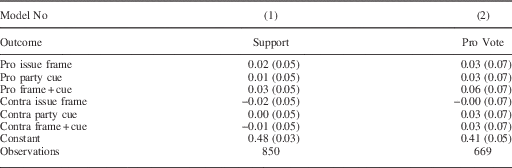
Table 1 reports the results. We find that for both the pro and the contra direction, neither the issue frame, nor the party cue, or a combination of both had meaningful average effects on individual support for the initiative or respondents’ vote intentions. The point estimates for the average treatment effect among the sample of all voters are close to 0 and fairly precisely estimated. In contrast to earlier research which concluded that voters are easily manipulable, these results suggest some limits on the ability of issue frames and partisan endorsements to move voter support in one or the other direction, at least in a highly salient and hotly contested policy decision like the deportation initiative. Presumably, in contrast to much of the previous framing research that examined low-salience issues or policy contexts that were unfamiliar to voters, in our context many voters already held rather strong pre-existing beliefs about the immigration issue that made them less susceptible to react to frames and cues.
Effects of Frames and Cues on Support for Deportation Initiative

Note: regression coefficients shown with robust standard errors in parentheses. Support: Support for deportation initiative (0/1). Pro Vote: 1 if will vote or voted for deportation initiative, 0 if will vote or voted against. The independent variables include one dummy variable for each treatment group (frame, cue, or both for pro and contra direction, respectively). The reference category are respondents assigned to the control group with no frame or cue.
Effects of Frames and Cues by Party Identification
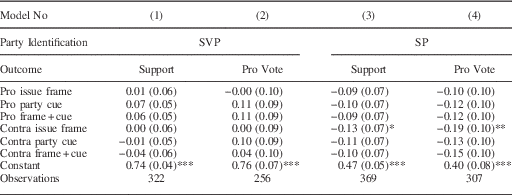
Several of our hypotheses suggest that the average treatment effects for the full sample might mask important heterogeneity in the effects of political information across different groups of voters. In this section, we examine how frames and cues interact with respondents’ party identification. In particular, following the hypotheses stated above, we expect that voters react more strongly to frames that are sponsored by their own party and also that voters may counteract frames that are sponsored by the opposing party. Table 2 presents the regression results where we replicate the baseline models for the subsamples of respondents that identify with the SVP (models 1 and 2) or the SP (models 3 and 4), respectively.Footnote 8 The results suggest that among SVP identifiers the frames and cue had no effect on support or vote intention. If anything, most of the point estimates are positive indicating that regardless of the pro or contra direction of the frame or the cue, SVP identifiers show increased support for the initiative compared with the control group of SVP identifiers that are not exposed to a frame or cue. The point estimates for the pro direction suggest that issue frames have no effect, while the party cues raise support somewhat (albeit not significant). This contrasts with the findings in Druckman et al. (Reference Druckman, Hennessy, Charles and Webber2010) who document a strong direct effect of issue frames, but no effects for a non-partisan cue on voter opinion.
Effects of Frames and Cues on Support for Deportation Initiative by Party Identification

Note: regression coefficients shown with robust standard errors in parentheses (***p<0.01, **p<0.05, *p<0.1). Support: Support for deportation initiative (0/1). Pro Vote: 1 if will vote or voted for deportation initiative, 0 if will vote or voted against. The independent variables include one dummy variable for each treatment group (frame, cue, or both for pro and contra direction, respectively). The reference category are respondents assigned to the control group with no frame or cue. Models 1 and 2 refer to the sub-sample of respondents that identify with the Swiss People’s Party (SVP). Models 3 and 4 refer to the sub-sample of respondents that identify with the Social Democratic Party (SP).
How do frames and cues affect the opinions of SP identifiers, that is, respondents located on the other side of the political spectrum? Models 3 and 4 in Table 2 report the results. For SP identifiers all point estimates for the treatment indicators are negative (albeit mostly insignificant) for both outcomes. This indicates that, if anything, both pro and contra frames and cues (and their combination) cause SP identifiers to more strongly oppose the deportation initiative compared with SP identifiers in the control group. This effect is statistically significant for the contra issue frame that described the initiative as discriminatory. Exposing SP voters to this frame makes them about 13 (19) percentage points less likely to support (vote for) the initiative. In the following section we explore to what extent this effect is driven by differences in citizens’ level of knowledge.
Effects of Frames and Cues by Political Knowledge
Previous research suggests that voters’ political knowledge moderates the effects of frames and cues (Zaller Reference Zaller1992). Less knowledgeable individuals have to rely more strongly on frames and cues to form their opinions than those who are better informed (Lupia Reference Lupia1994). Specifically, political messages may provide less knowledgeable individuals with new information while more knowledgeable individuals are more likely to have been previously exposed to this information. Therefore, we expect that political messages should have stronger effects on less knowledgeable citizens. To test if the effects of frames and cues depend on political knowledge, we replicate our benchmark model but add a full set of interactions of the treatment dummies and a binary measure of political knowledge, which takes the value of one if respondents answered two political knowledge questions correctly and 0 otherwise. The first question asked respondents to name the Swiss president, the second question asked respondents to name the number of signatures required to launch a federal initiative. This binary classification is useful because it almost exactly divides the sample in half.
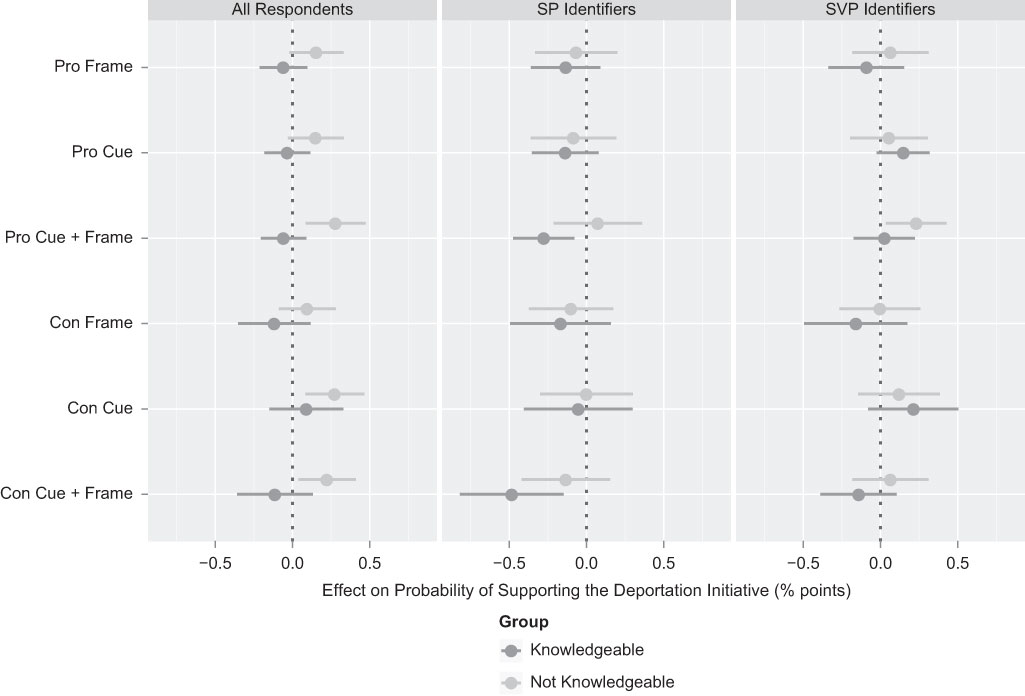
To facilitate interpretation, Figure 1 displays the estimates of the effects of the treatments on the probability of voting for the deportation initiative graphically for both not knowledgeable and knowledgeable voters in each of the three sub-samples.Footnote 9 Looking at the sample of all respondents, the results suggest that regardless of their direction, the combination of frames and cues made less knowledgeable respondents more likely to vote for the deportation initiative than more knowledgeable individuals. The results are most pronounced for the contra cue, which was a pure partisan endorsement by the SVP and the combination of the pro cue and frame, which consisted of an anti-discrimination argument and an SP endorsement. In contrast, none of the frames or cues had an effect on knowledgeable respondents. This contrasts with previous research that has argued that politically more sophisticated voters react more strongly to frames and cues (Druckman et al. Reference Druckman, Hennessy, Charles and Webber2010; Slothuus and de Vreese Reference Slothuus and de Vreese2010). When looking at the sub-samples of partisan identifiers, however, we find that the effects differ somewhat by party.
Effects of frames and cues on support for deportation initiative by level of knowledge Note: plots show effects of treatments (with 90 percent robust confidence intervals) on the probability of voting for the deportation initiative for both not knowledgeable and knowledgeable voters in each of the the three sub-samples. Estimates are based on the respective models reported in the Appendix.

Among SP identifiers, the combination of a frame and a cue, regardless of their direction, made more knowledgeable voters less likely to vote for the deportation initiative. This confirms previous work that has argued that frames and cues lead voters to reinforce their existing partisan orientations. Less knowledgeable SP identifiers are less affected by the frames and cues in general. This unexpected result may reflect that the strength of contrast effects increases the more individuals know about parties’ policy platforms and their differences, which raises the probability of citizens perceiving specific policy questions as a defining issue. In our context, this appears particularly relevant as more politically knowledgeable SP identifiers might have the informational resources to identify immigration policies as the defining issue toward right-wing parties like the SVP. This might heighten their sensitivity toward relevant political messages like the ones used in the political campaign in the run-up to the referendum on the deportation initiative. Among SVP identifiers, the combination of a pro frame and a pro cue made less knowledgeable voters more likely to vote for the deportation initiative, which is consistent with our theoretical expectation. We reestimated all models using an additive index of political knowledge (the full results are reported in the Appendix). The results remain unchanged.
Conclusion
The welfare-enhancing effect of democracy depends on whether and how citizens’ electoral choice reflects their knowledge about the likely consequences of public policy decisions. Many observers worry, however, that individuals’ opinions are easily manipulable by political elites applying framing strategies to shape public policy to their own advantage. While scholarship on electoral choice and opinion formation has generated important knowledge about the effects of issue frames and cues in lab-experimental settings, we have little systematic evidence on the impact of information on public opinion in the context of real-world and highly salient policy issues. Moreover, in democracies, public debate tends to cluster along partisan cleavages with some parties advocating a policy proposal while others oppose it. Yet, we still lack knowledge about the separate and combined effects of partisan endorsements and issue frames that either support or oppose a policy.
We experimentally examine the role of issue frames, partisan endorsements, and their interaction on opinion formation in the context of a contentious referendum on immigration policy in Switzerland. Our results support some of the previous findings on how framing effects depend on partisan orientation and political sophistication. For example, we find that political messages have effects that depend on partisan identification and political knowledge. Among party identifiers, our findings are consistent with the idea that political information activates more temporally stable partisan alignments that then shape individuals’ reactions to frames, largely independent of their direction. We also find that the impact of political messages may depend on political knowledge.
At the same time, when analyzing all respondents, we find that neither issue frames nor party cues, or a combination of both, had notable effects on support for the deportation initiative or individuals’ vote intentions. We can think of two potential explanations for this finding. First, citizens may already have been exposed to frames and these affected their preferences in the course of the campaign. As a consequence, the cues and frames used in our experiment failed to induce opinion change (Druckman and Leeper Reference Druckman and Leeper2012). Alternatively, citizens may simply hold very stable pre-existing beliefs that remain robust even if exposed to different types and combinations of homogeneous political messages. This would suggest that the possibility to manipulate public opinion through framing may be more limited when it comes to contentious policy issues than previous evidence based on laboratory experiments and policy issues of relatively low salience suggest.
Recent work seems to lend support to the latter explanation. In fact, our results are consistent with an emerging literature identifying the limits to framing effects in competitive information environments (Slothuus Reference Slothuus2010; Nicholson Reference Nicholson2011a; Aaroe Reference Aaroe2012; Jerit and Barabas Reference Jerit and Barabas2012). Our study contributes to this emerging literature by further probing the generalizability of lab-experimental results and assessing the limits of framing in real-world voting decisions. In particular, while the overall effects of elite communication in a very salient direct-democratic decision appear limited, framing seems to work mostly when targeted at partisans depending on their level of knowledge and the importance of the issue to partisan identifiers. If the policy concerns a defining issue toward other parties, political messages will be more effective among identifiers with higher levels of political knowledge. We hope that future work continues to explore to what extent the findings from laboratory experiments generalize to real-world policy decisions on salient public policy issues.
Supplementary Material
To view supplementary material for this article, please visit http://dx.doi.org/10.1017/psrm.2014.39