Introduction
The impact of stress on mental health varies tremendously from one person to the next. The prevailing view is that persons who are at high risk for psychopathology are more sensitive to stress, which is attributed to genetic (Kendler et al. Reference Kendler, Kuhn, Vittum, Prescott and Riley2005; Gotlib et al. Reference Gotlib, Joormann, Minor and Hallmayer2008), cognitive (Hankin, Reference Hankin2008) and family environmental risk factors (Ellenbogen & Hodgins, Reference Ellenbogen and Hodgins2009), or the interplay among them. Although stress reactivity to laboratory challenges has been studied in populations at risk for affective disorders (Ellenbogen et al. Reference Ellenbogen, Hodgins, Walker, Couture and Adam2006; Gotlib et al. Reference Gotlib, Joormann, Minor and Hallmayer2008; Hankin et al. Reference Hankin, Badanes, Abela and Watamura2010), researchers have rarely examined the functioning of stress-sensitive biological systems in response to stress in the natural environment. The present study addresses this issue by examining the relationship between objective measures of stress in the natural environment and diurnal functioning of the hypothalamic–pituitary–adrenal (HPA) axis among the offspring of parents with bipolar disorder (OBD) and the offspring of parents with no family history of affective disorders (OFH−).
The relationship between stress and affective disorders is well documented (Kessler, Reference Kessler1997; Hammen, Reference Hammen2005). Stress is typically considered to be an environmental risk factor that triggers the onset of affective episodes. However, genetic factors are known to influence a person's exposure to stressful circumstances, and the genetic liability to depression overlaps with the liability to experience stressful life events (Kendler & Karkowski-Shuman, Reference Kendler and Karkowski-Shuman1997; Kendler et al. Reference Kendler, Karkowski and Prescott1999; Farmer et al. Reference Farmer, Redman, Harris, Mahmood, Sadler, Pickering and McGuffin2002). These findings suggest that persons at high risk for an affective disorder may create or engage in risky psychosocial environments, or that they may be more sensitive to negative environmental challenges. The literature to date has focused mainly on acute or episodic stress (i.e. negative life events) and its association with the onset, maintenance and recurrence of depression (e.g. Hammen, Reference Hammen1991; Mazure, Reference Mazure1998). Studies examining how chronic stress, defined as ongoing difficulties in multiple domains of daily roles, relates to the affective disorders are less common, and rarely have both chronic and episodic stress been assessed concurrently (McGonagle & Kessler, Reference McGonagle and Kessler1990; Hammen et al. Reference Hammen, Kim, Eberhart and Brennan2009). Recently, in a sample of 816 women, the onset of a depressive episode was associated with both chronic and episodic stress, with evidence that the relationship between episodic stress and depression was more robust in participants reporting high levels of chronic stress than among those reporting low levels of chronic stress (Hammen et al. Reference Hammen, Kim, Eberhart and Brennan2009). A comprehensive investigation of stress should therefore include a simultaneous examination of both episodic and chronic stress.
Changes in the HPA axis represent one possible avenue by which stress may increase the risk of developing an affective disorder (McEwen, Reference McEwen2008). The HPA axis orchestrates the response to prolonged challenge and facilitates recovery and adaptation to environmental change through the actions of glucocorticoids (cortisol in humans) in the peripheral and central nervous system. In addition to its catabolic functions, which replenish energy reserves during sustained challenge, glucocorticoids serve to suppress primary stress reactions (i.e. inflammatory and immune responses) and elicit changes in gene expression that prepare the organism for future challenges (Sapolsky et al. Reference Sapolsky, Romero and Munck2000; de Kloet et al. Reference de Kloet, Karst and Joels2008). In persons with major depression and bipolar disorder, the functioning of the HPA axis is compromised, as indicated, for example, by the overproduction and release of corticotropin-releasing hormone (CRH) from the hypothalamus, hypercortisolemia in approximately half of all patients, and disrupted negative feedback control of the axis (Schmider et al. Reference Schmider, Lammers, Gotthardt, Dettling, Holsboer and Heuser1995; Meyer et al. Reference Meyer, Chrousos and Gold2001; Gallagher et al. Reference Gallagher, Watson, Smith, Young and Ferrier2007). With some exceptions (Ashman et al. Reference Ashman, Dawson, Panagiotides, Yamada and Wilkinson2002; Ising et al. Reference Ising, Lauer, Holsboer and Modell2005), there is increasing evidence that subtle HPA abnormalities exist prior to the onset of an affective disorder, and may represent a marker of vulnerability for these disorders (Modell et al. Reference Modell, Lauer, Schreiber, Huber, Krieg and Holsboer1998; Lundy et al. Reference Lundy, Jones, Field, Nearing, Davalos, Pietro, Schanberg and Kuhn1999; Goodyer et al. Reference Goodyer, Herbert, Tamplin and Altham2000; Ellenbogen et al. Reference Ellenbogen, Hodgins, Walker, Couture and Adam2006, Reference Ellenbogen, Hodgins, Linnen and Ostiguy2011; Mannie et al. Reference Mannie, Harmer and Cowen2007).
The OBD are at high risk for affective disorders and other mental disorders (Birmaher et al. Reference Birmaher, Axelson, Monk, Kalas, Goldstein, Hickey, Obreja, Ehmann, Iyengar, Shamseddeen, Kupfer and Brent2009); a review of the literature showed that the OBD are two and a half times more likely to be diagnosed with any mental disorder and four times more likely to be diagnosed with an affective disorder than offspring of parents with no mental disorder (Lapalme et al. Reference Lapalme, Hodgins and LaRoche1997). We recently reported that the OBD experienced more chronic stress and more severe interpersonal episodic stress than the OFH−, even after controlling for affective disorders among the offspring (Ostiguy et al. Reference Ostiguy, Ellenbogen, Linnen, Walker, Hammen and Hodgins2009). We have also reported that the OBD displayed higher daytime cortisol levels in the natural environment when they were, on average, 16.7 years (Ellenbogen et al. Reference Ellenbogen, Hodgins, Walker, Couture and Adam2006) and 18 years old (Ellenbogen et al. Reference Ellenbogen, Santo, Linnen, Walker and Hodgins2010). The latter study sampled cortisol in the afternoon over 14 days. The higher cortisol levels among the OBD as compared to the OFH− were not related to the small number of participants with diagnoses of mental disorders, nor were they associated with self-reports or parent reports of clinical symptoms, age, self-reported compliance with the saliva sampling protocol, time of awakening, smoking, food consumption, exercise, or oral contraceptives. In summary, the OBD have shown higher levels of chronic and episodic stress in addition to increased daytime cortisol levels as compared to the OFH−.
Based on the stress literature and our previous findings, we hypothesized that the high daytime cortisol levels exhibited by the OBD result from an increased sensitivity to interpersonal stress. Interpersonal stress represents an important proximal risk factor for affective disorders (Hammen, Reference Hammen2003; Hammen et al. Reference Hammen, Shih, Altman and Brennan2003; Eberhart & Hammen, Reference Eberhart and Hammen2006) and has also been shown to influence HPA activity (Seeman & McEwen, Reference Seeman and McEwen1996; Stetler & Miller, Reference Stetler and Miller2008). For instance, in a study of young women at high risk for depression, the combination of interpersonal chronic and episodic stress, but neither type of stress alone, was associated with elevated cortisol levels in the natural environment (Marin et al. Reference Marin, Martin, Blackwell, Stetler and Miller2007). To test our hypothesis, we examined whether interpersonal chronic and episodic stress moderated the relationship between elevated cortisol levels and vulnerability for an affective disorder, indexed by having a parent with bipolar disorder. In all analyses, we controlled for lifetime affective disorders and also current non-affective disorders in the offspring, controlling for disorders that have been shown to be associated with HPA dysregulation (e.g. Pajer et al. Reference Pajer, Gardner, Rubin, Perel and Neal2001; Bhagwagar et al. Reference Bhagwagar, Hafizi and Cowen2005). Secondary analyses were conducted with non-interpersonal chronic and episodic stress, to test whether the results are specific to interpersonal stress.
Method
Sample
In the first phase of our longitudinal study, parents with a diagnosis of bipolar disorder, their spouses and children were recruited from psychiatric departments and support groups in Québec, Canada. Comparison group parents were recruited from the same neighborhoods as the parents with bipolar disorder. All parents underwent SCID-I (Spitzer et al. Reference Spitzer, Williams, Gibbon and First1992) for DSM-III-R administered by an experienced clinician. The comparison group parents had no current or lifetime Axis I disorder except for two parents diagnosed with a past episode of substance abuse, one with a past anxiety disorder, and one with both a past anxiety disorder and past substance abuse (for more information on the sample, see Ellenbogen & Hodgins, Reference Ellenbogen and Hodgins2004).
Approximately 10 years later, 123 offspring participated in a clinical reassessment, cortisol sampling, and an information processing protocol. Of the initial sample, 18% of the OBD and 17% of the OFH− refused to participate or were not located as of January 2010. The participants and non-participants did not differ on a number of parent-rated measures, completed when the offspring were between 4 and 12 years old. The data from one participant were considered to be statistical outliers because of extreme elevations of cortisol (>3 s.d. from the mean), and were dropped from the analyses.
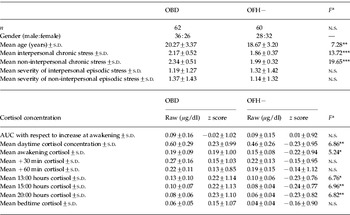
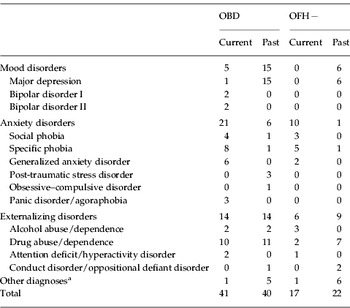
The final sample included 62 OBD and 60 OFH− (64 males and 58 females), aged between 14 and 28 years (mean=19.48, s.d.=3.38; see Table 1). The OBD were significantly older than the OFH− participants [F(1, 120)=7.28, p<0.01], and therefore age was included as a covariate in all analyses. Forty-two (67.7%) OBD and 26 (43.3%) OFH− were diagnosed with at least one lifetime mental disorder (see Table 2 for a list of diagnoses), and eight OBD and four OFH− participants were taking medication: venlafaxine (one OBD; one control), clonazepam (one OBD), risperidone (one OBD), divalproex (one OBD), lithium (one OBD), valproate semisodium (one OBD), levothyroxine (one OBD), dextroamphetamine (one OFH−), omeprazole (one OFH−), isotretinoin (one OFH−), an unspecified decongestant (one OBD), and an unspecified antibiotic (one OBD).
Descriptive and demographic information for the OBD and the OFH−

OBD, Offspring of a parent with bipolar disorder; OFH−, offspring with no family history of affective disorders; s.d., standard deviation; n.s., not significant; AUC, area under the curve.
a F statistics based on two-tailed one-way ANOVAs of the standardized data (z scores).
* p<0.05, ** p<0.01, *** p<0.001.
Number of psychiatric diagnoses for the OBD and the OFH−

OBD, Offspring of a parent with bipolar disorder; OFH−, offspring with no family history of affective disorders.
a Other diagnoses include past adjustment disorder with depressive symptoms (n=3), past separation anxiety (n=1), past enuresis (n=4), past motor/vocal tic (n=2), hypochondriasis (n=1), current anorexia nervosa (n=1), and past phencyclidine (PCP)-induced psychotic disorder (n=1).
Measures
UCLA Life Stress Interview
The UCLA Life Stress Interview (Hammen, Reference Hammen1991) consists of two sections: a chronic and an episodic stress assessment. The chronic stress interview assesses stress in nine domains during the past 6 months. Stress in each domain is coded by the interviewer on a five-point scale using specific behavioral anchor points, where 1 represents exceptionally good circumstances and 5 indicates extremely stressful and maladaptive circumstances. Interpersonal chronic stress was defined as the sum of scores in the domains of close friends, social life, romantic, and family relationships. Non-interpersonal chronic stress was defined as the sum of scores in the domains of work, education, finances, health, and health of family members. Independent interviewers' ratings of videotaped sessions from 20 participants revealed high reliability for all domains, with a mean intraclass correlation coefficient of 0.85.
The episodic stress interview assesses stressful life events that have occurred within the past 12 months. Life events and contextual information were subsequently presented to a panel of raters blind to the risk status and mental health of the participant. The panel coded the severity of each event using a five-point scale, and categorized them as interpersonal or non-interpersonal. Events were considered interpersonal if they resulted in a significant change in a relationship. Separate scores were computed for interpersonal and non-interpersonal events by summing the severity ratings. The interview has excellent reliability and has been used extensively in different adult and adolescent populations (Adrian & Hammen, Reference Adrian and Hammen1993; Kim et al. Reference Kim, Miklowitz, Biuckians and Mullen2007). Interviews were conducted by clinical psychologists who underwent extensive training and were blind to group status.
Mental disorders
Offspring aged ⩾19 years (n=69) were interviewed with the SCID-I (First et al. Reference First, Gibbon, Spitzer and Williams2001), and those aged ⩽18 years (n=53) with the Kiddie-Schedule for Affective Disorders and Schizophrenia – Present and Lifetime version (K-SADS-PL; Kaufman et al. Reference Kaufman, Birmaher, Brent and Rao1997). The SCID-I and K-SADS-PL were administered by an experienced licensed clinical psychologist.
Cortisol sampling
Participants collected saliva at awakening, 30 and 60 min later, at 13:00, 15:00, 20:00 hours, and at bedtime on three consecutive days while following their usual routine. Participants were instructed to remove lipstick, to refrain from drinking water at least 5 min before sampling, and to refrain from eating, drinking (except water), smoking, and brushing teeth at least 60 min before sampling. Participants also recorded their activities prior to sampling. Saliva was expressed directly into polypropylene 6 ml vials. The vials for saliva collection were kept in larger bottles with time-stamping micro-circuitry in the cap (MEMS 6 TrackCap, Aardex Ltd, Switzerland), which automatically registered the exact time when the container was opened and closed.
Saliva samples were frozen at −20°C until assayed for cortisol by a sensitive radioimmunoassay using commercial kits from Diagnostic Systems Laboratory [DSL-2000; Sanofi Diagnostics, Canada; n=37 (30%); 20 OBD/17 OFH−] and MP Biomedicals [USA; n=85 (70%); 42 OBD/43 OFH−]. DSL stopped producing radioimmunoassay kits for cortisol during the course of the study, forcing us to switch to the use of cortisol kits from MP. We compared absolute cortisol values obtained with both kits and found that the main effect of the assay kit on daytime cortisol approached significance (DSL mean cortisol=0.602 μg/dl and MP mean cortisol=0.499 μg/dl; p=0.064). We controlled for assay kit by standardizing cortisol data for each kit, so that cortisol levels for both kits had a mean of 0 and a standard deviation (s.d.) of 1 (z scores). Characteristics of the assays were similar between the two kits with a sensitivity set at 0.01 μg/dl (or 0.276 nmol/l). The inter- and intra-assay coefficients of variation for all assays were respectively 3.4% and 4.6% for the DSL kit and 4.0% and 4.6% for the MP kit, both on a range of 0.01–10 μg/dl dose.
Procedure
Written informed consent was obtained from offspring aged ⩾18 years, or from parents of offspring aged ⩽17 years. At the laboratory, offspring completed the diagnostic assessment and the UCLA Life Stress Interview, and were trained to collect saliva at home as described above. Upon completion of the saliva sampling, the participants returned to the laboratory to complete questionnaires and a series of information processing tasks (not reported here). Participants were compensated $150 (CAN) for their time and related expenses.
Statistical analyses
Cortisol levels were computed as the mean of samples collected at the same time on three different days. The cortisol response following awakening was examined using the area under the curve ‘with respect to increase’ (AUCi), a reactivity measure sensitive to changes over time (Pruessner et al. Reference Pruessner, Kirschbaum, Meinlschmid and Hellhammer2003) and described as the most appropriate construct to examine in relation to psychosocial factors (Chida & Steptoe, Reference Chida and Steptoe2009). Data were also aggregated to create a measure of mean daytime cortisol level (+60 min after awakening, 13:00, 15:00, 20:00 hours, and bedtime samples). Aggregated and AUCi cortisol values were standardized (see section on cortisol sampling). No transformation of standardized cortisol values was necessary because the scores were normally distributed. Scores for chronic stress were positively skewed and therefore were log10-transformed.
Hierarchical multiple regressions were performed on the AUCi cortisol awakening response and mean daytime levels of cortisol. As medications were not associated with cortisol in preliminary analyses, they were not included as a covariate in the main analyses. In all regressions, independent variables were entered in the following steps: (1) offspring age, gender, presence of a lifetime affective disorder, and presence of a current non-affective disorder; (2) interpersonal chronic stress, severity of interpersonal episodic stress, and group (risk status); and (3) interaction terms (group×interpersonal chronic stress and group×interpersonal episodic stress). Significant interactions were followed up by simple slope analyses, according to guidelines by Aiken & West (Reference Aiken and West1991) .
Results
Compliance
Objective examination of compliance with the saliva sampling protocol (n=94–105) using MEMS caps indicated that, on average, the OBD and OFH− sampled, respectively, 0.8±5.9 and 0.9±5.4 min following the awakening+30 min, 1.7±6.1 and 2.5±9.1 min following the awakening+60 min, 11.9±25.1 and 11.8±22.4 min following 13:00 hours, 25.4±27.4 and 24.0±30.3 min following 15:00 hours, and 16.0±35.0 and 20.1±38.4 following 20:00 hours. No group differences in sampling times were detected, indicating satisfactory compliance with the saliva sampling protocol in both groups.
Interpersonal stress and the cortisol response following awakening
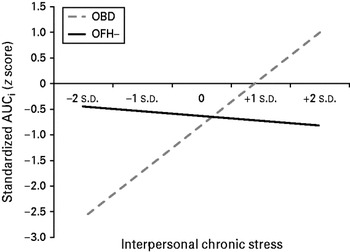
The regression model examining predictors of cortisol AUCi following awakening as the dependent variable was significant [R=0.46, F(7, 112)=3.41, p<0.001], accounting for 21.5% (R 2, adjusted R 2=0.15) of the variance. Four variables predicted cortisol AUCi following awakening: offspring lifetime affective disorder (β=0.20, t=2.22, p<0.05), female gender (β=0.23, t=2.66, p<0.01), interpersonal chronic stress (β=0.42, t=3.46, p<0.001), and the interaction between interpersonal chronic stress and group (β=−0.32, t=−2.77, p<0.01). The interaction term, illustrated in Fig. 1, was further examined using simple slope analyses. The results revealed that OBD who reported high levels of interpersonal chronic stress (+1 s.d. above the mean) exhibited higher cortisol AUCi following awakening compared to OBD who reported low levels of chronic stress (−1 s.d. below the mean; simple slope b=4.45, t=3.48, p<0.001). Among OFH− participants, the slope of the AUCi across levels of interpersonal chronic stress did not differ from zero. Thus, the OBD who experienced interpersonal chronic stress had a larger cortisol response following awakening than the OBD reporting low interpersonal chronic stress; this relationship was absent in the OFH− participants.
Depiction of the significant interaction between group and interpersonal chronic stress predicting area under the curve with respect to increase (AUCi) for the cortisol response following awakening. The offspring of parents with bipolar disorder (OBD) who reported high levels of interpersonal chronic stress (⩾1 s.d. above the mean) had greater hypothalamic–pituitary–adrenal (HPA) axis reactivity following awakening than the OBD who reported low levels of interpersonal chronic stress. No relationship between stress and HPA axis reactivity was observed among the offspring of parents with no history of affective disorders (OFH−).

Interpersonal stress and daytime cortisol levels
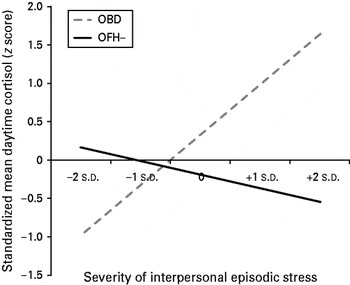
The regression equation examining predictors of daytime cortisol levels was significant [R=0.42, F(9, 111)=2.65, p<0.01], accounting for 18% (R 2; adjusted R 2=0.11) of the variance. Significant predictors of daytime cortisol levels were group (β=−0.26, t=−2.65, p<0.01), female gender (β=0.22, t=2.42, p<0.05), and the interaction between group and severity of interpersonal episodic stress (β=−0.31, t=−2.66, p<0.05). The significant effect of group indicated that daytime cortisol levels were higher in OBD than OFH−. The interaction term, illustrated in Fig. 2, was further examined using simple slope analyses. The results revealed that OBD who reported severe interpersonal episodic stress (+1 s.d. above the mean) exhibited higher levels of daytime cortisol compared to OBD reporting lower levels of interpersonal episodic stress (simple slope, b=0.17, t=1,74, p=0.08), although the finding fell short of conventional statistical significance. Among OFH−, the slope of daytime cortisol across levels of interpersonal episodic stress did not differ from zero. Thus, the OBD who reported severe interpersonal episodic stress exhibited higher levels of daytime cortisol than the OBD reporting mild interpersonal episodic stress; this relationship was absent in the OFH− participants.
Depiction of the significant interaction between group and the severity of interpersonal episodic stress predicting mean daytime cortisol. The offspring of parents with bipolar disorder (OBD) who reported more severe negative life events (⩾1 s.d. above the mean) had higher mean daytime cortisol levels than the OBD who reported less severe negative life events. No relationship between stress and daytime cortisol levels was observed among the offspring of parents with no history of affective disorders (OFH−).

Secondary analyses: non-interpersonal stress and cortisol levels
Two additional hierarchical multiple regressions were conducted to examine whether indices of non-interpersonal stress also predicted cortisol AUCi following awakening and daytime cortisol levels. The interaction between non-interpersonal chronic stress and group (β=−0.26, t=−2.31, p<0.05) predicted AUCi following awakening. Consistent with interpersonal stress findings, simple slope analyses of the interaction term revealed that the OBD who reported high levels of non-interpersonal chronic stress exhibited high cortisol AUCi following awakening compared to the OBD reporting low levels of non-interpersonal chronic stress, although the finding did not reach conventional statistical significance (simple slope, b=2.15, t=1.55, p=0.12). In the OFH−, the slope did not differ from zero. Daytime cortisol levels were not associated with either chronic or episodic non-interpersonal stress.
Discussion
The present study sought to determine whether interpersonal chronic and episodic stress moderated the relationship between risk status, defined as having a parent with bipolar disorder, and cortisol levels measured seven times over three consecutive days in the natural environment. Four key findings emerged. First, the OBD exhibited higher levels of daytime cortisol than the OFH−, replicating our previous findings in this sample when the OBD were, on average, aged 16.7 and 18 years (Ellenbogen et al. Reference Ellenbogen, Hodgins, Walker, Couture and Adam2006, Reference Ellenbogen, Santo, Linnen, Walker and Hodgins2010). Second, ratings of chronic stress, collapsed across group, predicted the cortisol response following awakening. Third, the OBD experiencing high levels of interpersonal chronic stress exhibited higher HPA axis reactivity following awakening than the OBD who reported low levels of interpersonal chronic stress. By contrast, among the OFH−, no associations were detected between chronic stress and cortisol levels following awakening. Unexpectedly, the interaction between non-interpersonal chronic stress and group also predicted the cortisol awakening response. Finally, the OBD experiencing severe interpersonal episodic stress had higher cortisol levels during the day than the OBD experiencing mild interpersonal episodic stress. Again, among the OFH−, no associations were detected between daytime cortisol levels and episodic stress, and no significant findings in either group were observed for non-interpersonal episodic stress. Importantly, each of the observed interactions between group, defined by family history, and stress that predicted cortisol levels were significant after controlling for offspring age, gender, lifetime affective disorders, and current non-affective disorders.
The observed interactions between stress and group suggest that the OBD are physiologically more sensitive to stress in the natural environment than OFH− participants. An increased sensitivity to stress, particularly in interpersonal domains, may partly explain our consistent findings of higher daytime cortisol levels among the OBD than OFH− during adolescence and young adulthood (Ellenbogen et al. Reference Ellenbogen, Hodgins, Walker, Couture and Adam2006, Reference Ellenbogen, Santo, Linnen, Walker and Hodgins2010), and also a similar finding in the offspring of parents with major depression (Mannie et al. Reference Mannie, Harmer and Cowen2007). Of note, two studies of the OBD have failed to find evidence of an increased sensitivity to stressful life events when examining the relationship between family history of affective disorders and the onset of an affective disorder (Hillegers et al. Reference Hillegers, Burger, Wals, Reichart, Verhulst, Nolen and Ormel2004; Wals et al. Reference Wals, Hillegers, Reichart, Verhulst, Nolen and Ormel2005). However, because these studies did not include a control sample, they are not comparable to the present study. Moreover, the difference between studies may indicate that increased stress sensitivity in the OBD is specific to the functioning of the HPA axis. The results of the present study, however, are consistent with those from other longitudinal investigations that have highlighted the role of stress and stress sensitivity in the development of mood disorders (Caspi et al. Reference Caspi, Sugden, Moffitt, Taylor, Craig, Harrington, McClay, Mill, Martin, Braithwaite and Poulton2003; Kendler et al. Reference Kendler, Kuhn, Vittum, Prescott and Riley2005; Espejo et al. Reference Espejo, Hammen, Connolly, Brennan, Najman and Bor2006; Wichers et al. Reference Wichers, Geschwind, Jacobs, Kenis, Peeters, Derom, Thiery, Delespaul and van Os2009). A recent study of 502 female twins showed that stress sensitivity (conceptualized as negative affect following daily stress) was predictive of future depressive symptoms and also major depressive disorder (Wichers et al. Reference Wichers, Geschwind, Jacobs, Kenis, Peeters, Derom, Thiery, Delespaul and van Os2009). A study of the offspring of parents with major depression demonstrated that girls who were homozygous for the short allele in the promoter region of the serotonin transporter (5-HTTLPR) gene exhibited increased HPA axis reactivity to a laboratory stressor compared to girls with at least one long allele (Gotlib et al. Reference Gotlib, Joormann, Minor and Hallmayer2008). Similarly, among a sample of 393 adolescents at risk for psychopathology, high morning cortisol levels sampled in the natural environment were associated with the carrier status of the short allele of the 5-HTTLPR gene (Goodyer et al. Reference Goodyer, Bacon, Ban, Croudace and Herbert2009). Of note, the relationship between elevated cortisol levels and the subsequent development of depression was moderated by the 5-HTTLPR gene polymorphism. Thus, an increased sensitivity to stress may represent an important risk factor for the development of an affective disorder and the sensitivity to stress may be genetically determined.
The sensitivity to stress displayed by the OBD may also result, at least in part, from a long history of stressful experiences. The OBD were raised in chaotic family environments in which parents provided low levels of structure and modeled ineffective skills for coping with stress (Chang et al. Reference Chang, Blasey, Ketter and Steiner2001; Ellenbogen & Hodgins, Reference Ellenbogen and Hodgins2009; Ostiguy et al.,Reference Ostiguy, Ellenbogen and Hodginsin press). It is well established that exposure to a stressful environment in early life, as indexed by maternal anxiety and depression (Halligan et al. Reference Halligan, Herbert, Goodyer and Murray2004; O'Connor et al. Reference O'Connor, Ben-Shlomo, Heron, Adams, Glover and Golding2005), poverty (Lupien et al. Reference Lupien, King, Meaney and McEwen2000) or non-optimal parenting practices (Ellenbogen & Hodgins, Reference Ellenbogen and Hodgins2009; Ostiguy et al.,Reference Ostiguy, Ellenbogen and Hodginsin press), affects the development and sensitivity of the HPA axis and the methylation of genes that regulate HPA functioning (Heim et al. Reference Heim, Owens, Plotsky and Nemeroff1997; Weaver et al. Reference Weaver, Cervoni, Champagne, D'Alessio, Sharma, Seckl, Dymov, Szyf and Meaney2004). Environmental factors may also alter other putative risk factors, such as cognitive vulnerability and changes in appraisal (Alloy et al. Reference Alloy, Abramson, Walshaw, Keyser and Gerstein2006), which could subsequently increase the HPA response in the natural environment. Thus, an early stressful family environment, genes, or a combination of both may sensitize the HPA axis to stress through different mechanisms. Genetically informed longitudinal investigations are needed to further elucidate the determinants of increased sensitivity to stress.
The present study observed that chronic stress predicted the cortisol response following awakening but not daytime cortisol levels, and that episodic stress predicted cortisol levels in the daytime but not the awakening response. These findings are consistent with evidence that cortisol levels following awakening and in the daytime are regulated by different psychobiological factors (Clow et al. Reference Clow, Thorn, Evans and Hucklebridge2004). The cortisol rise following awakening is partly determined by genetic factors (Wüst et al. Reference Wüst, Federenko, Van Rossum, Kumsta, Hellhammer, Entringer, Koper, Yehuda and McEwen2004), by distal factors such as stressful experiences in childhood (Meinlschmidt & Heim, Reference Meinlschmidt and Heim2005), long-standing medical conditions, and chronic stress (Pruessner et al. Reference Pruessner, Hellhammer and Kirschbaum1999; Therrien et al. Reference Therrien, Drapeau, Lupien, Beaulieu, Dore, Tremblay and Richard2008). By contrast, evidence suggests that cortisol levels during the rest of the day are determined primarily by shared (Schreiber et al. Reference Schreiber, Shirtcliff, Van Hulle, Lemery-Chalfant, Klein, Kalin, Essex and Goldsmith2006) and non-shared environmental factors (Kupper et al. Reference Kupper, de Geus, van den Berg, Kirschbaum, Boomsma and Willemsen2005), consistent with the association between interpersonal episodic stress and elevated afternoon cortisol levels. Furthermore, the increase in cortisol levels following awakening and cortisol levels measured at other times are not correlated (Edwards et al. Reference Edwards, Clow, Evans and Hucklebridge2001), supporting the premise that the rise in cortisol following awakening is regulated by a different mechanism than that controlling cortisol levels during the rest of the diurnal cycle (Clow et al. Reference Clow, Thorn, Evans and Hucklebridge2004).
The limitations of the study warrant consideration. The participants varied in age from 14 to 28 years, but the younger (age 14–18 years) and older (age 19–28 years) participants did not differ significantly on any of the stress scores. Although many confounding influences on salivary cortisol levels were assessed in this study, menstrual cycle phase was not measured. Despite having objective measures of sampling compliance (i.e. vial lids with time-stamping micro-circuitry), the exact time of awakening was not verified objectively, leaving open the possibility that some samples were collected some time after awakening. There were no group differences in sampling compliance, suggesting that delays in taking the saliva sample after awakening had no influence on the findings. As a precaution, however, future studies should adopt ambulatory monitors of physical activity to measure the time of awakening objectively. The present results derive from the study of an ethnically homogeneous sample of OBD and OFH− from the province of Québec (Canada). It is not known whether the findings will generalize to other populations of high-risk offspring. Moreover, this study is cross-sectional, and thus the direction of the associations between stress and cortisol levels cannot be determined. Finally, the interpersonal episodic stressors were not overlapping in time with the measurement of cortisol. Therefore, we cannot conclude that the episodic stress led directly to the elevation in cortisol. Future studies in high-risk populations could benefit from the use of time-linked ambulatory protocols assessing episodic stress and cortisol levels concurrently.
In conclusion, the OBD exposed to high levels of stress in their natural environment exhibited higher cortisol levels than the OBD exposed to lower levels of stress. The observed associations were absent among offspring with no family history of affective disorders, suggesting that the OBD have a biological sensitivity to stress, particularly with respect to interpersonal difficulties. This finding has direct implications for the development of affective disorders, as high cortisol levels in vulnerable populations are associated with an increased risk of developing an affective disorder (Goodyer et al. Reference Goodyer, Bacon, Ban, Croudace and Herbert2009; Ellenbogen et al. Reference Ellenbogen, Hodgins, Linnen and Ostiguy2011). Importantly, the high cortisol levels exhibited by the OBD (Ellenbogen et al. Reference Ellenbogen, Hodgins, Walker, Couture and Adam2006, Reference Ellenbogen, Santo, Linnen, Walker and Hodgins2010) were attenuated in those reporting low levels of stress, suggesting that the vulnerability associated with a family history of affective disorders may be mitigated by environmental interventions.
Acknowledgments
This research was supported by a grant from the Canadian Institutes of Health Research (awarded to M. A. Ellenbogen). M. A. Ellenbogen is also currently supported by a Canada Research Chair appointment from the Social Sciences and Humanities Research Council of Canada. C. Ostiguy was supported by a scholarship from the Fonds du Québec en Recherche sur la Société et la Culture. We thank Dr S. Coté and L. Hallis for their invaluable assistance on this project, and all the families for so graciously taking the time to participate in our research.
Declaration of Interest
None.