Introduction
Duchenne muscular dystrophy is an X-linked genetic disorder caused by a mutation in the dystrophin gene. The loss of dystrophin results in progressive and severe skeletal myopathy and cardiomyopathy with 100% penetrance. Duchenne muscular dystrophy affects 1 in every 3500–5000 live male births per year. 1,Reference Mendell and Lloyd-Puryear2 Clinically, patients with Duchenne muscular dystrophy suffer progressive peripheral, respiratory, and cardiac muscle dysfunction. Advances in non-invasive respiratory home support and the use of steroids have allowed Duchenne muscular dystrophy patients to live longer, and gene therapies hold promise for disease modification. Nonetheless, older patients have increased cardiac morbidity and mortality. The 2018 Duchenne Muscular Dystrophy Care Considerations sponsored by the Centers for Disease Control and Prevention Reference Birnkrant, Bushby and Bann3 and 2017 American Heart Association scientific statement on the management of cardiovascular manifestations in neuromuscular disease Reference Feingold, Mahle and Auerbach4 enumerate cardiac medications that can be used with Duchenne muscular dystrophy patients. However, these documents fail to provide guidance on initial doses and optimized medication titration. In practice, there are multiple subspecialties prescribing medications for cardiac care in Duchenne muscular dystrophy, including neurologists, cardiologists, and primary care physicians. Despite ongoing cardiac disease, the optimization of cardiac medications is the best option to extend the lifespan and improve the quality of life in this population. Reference Jurikova, Masarova and Pamovsky5,Reference Porcher, Desguerre and Amthor6
Methods
This document represents an expert opinion statement developed by cardiologists from the Advance Cardiac Therapies Improving Outcomes Network (ACTION), a multidisciplinary collaborative focused on enhancing care of children with heart failure. It aims to offer a concise set of recommendations tailored for clinicians managing patients with Duchenne muscular dystrophy. The recommendations integrate major guidelines from the Duchenne Muscular Dystrophy Care Considerations, the American Heart Association, and the American College of Cardiology, along with the clinical expertise of the ACTION centres. These guidelines are intended to serve as potential best practices, including dosage recommendations, but should not replace the clinical judgement of the treating team. It is anticipated that these recommendations will evolve as more information becomes available regarding cardiac outcomes in Duchenne muscular dystrophy and the effect of prophylactic cardiac medication use.
Results
Progression of medical therapies
The following is an expert-opinion-based recommended progression of cardiac medical therapies dependent on the degree of systolic dysfunction (Figure 1). Of note, achieving therapeutic heart failure medication targets in patients with Duchenne muscular dystrophy may be significantly limited by blood pressure. Preference may be given to multi-drug therapy at lower doses in those patients, in the appropriate clinical context. Additionally, the use of prophylactic cardiac therapies (i.e. before systolic dysfunction is detected) continues to expand given that the development of cardiomyopathy is universal in the Duchenne muscular dystrophy population.
Recommended treatment for cardiomyopathy in Duchenne muscular dystrophy: prophylactic initiation of angiotensin-converting enzyme inhibitors by 10 years. Mineralocorticoid receptor antagonists added by 12 years old or with myocardial fibrosis. Beta-blockers added with persistent tachycardia in the absence of dysfunction. All medications recommended for patients with decreased ejection fraction. ACE = angiotensin-converting enzyme; ARB = angiotensin receptor blocker; ARNI = angiotensin receptor/neprilysin inhibitor; MRA = mineralocorticoid receptor antagonist; SGLT2i = sodium-glucose cotransporter-2 inhibitor.

Angiotensin-converting enzyme inhibitors and angiotensin receptor blockers
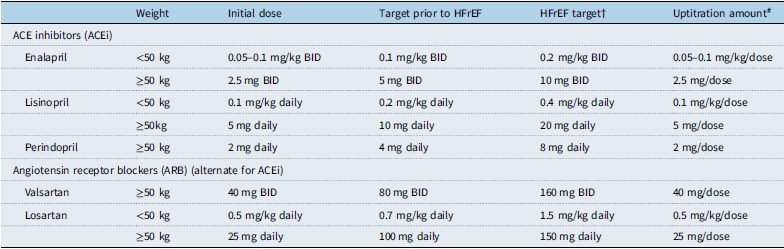
Angiotensin-converting enzyme inhibitors are considered first-line therapy for patients with Duchenne muscular dystrophy. Since the publication of Care Considerations and Management of Cardiac Involvement Associated with Neuromuscular Diseases, a prospective randomized trial of patients with Duchenne and Becker muscular dystrophy with late gadolinium enhancement on cardiac MRI demonstrated a decrease in the rate of progression of late gadolinium enhancement with the use of angiotensin-converting enzyme inhibitor. Reference Silva, Magalhaes and Meira7,Reference Russo, Papa and Williams8 Prophylactic initiation of this therapy was also associated with higher survival and decreased hospitalization for heart failure in Duchenne muscular dystrophy. Reference Porcher, Desguerre and Amthor6 Angiotensin receptor blockers are considered second-line therapy if angiotensin-converting enzyme inhibitors are not tolerated due to adverse effects of angioedema or cough. Angiotensin-converting enzyme inhibitors and angiotensin receptor blockers should not be used concurrently. Based on these data and the existing recommendations, we propose the following indications for initiating therapy (Table 1):
Weight-based medication doses for ACEi and ARB

# Doses are generally titrated every 2–3 weeks prior to HFrEF and may be uptitrated in 1–2 week increments in patients with HFrEF with appropriate monitoring or every few days if monitored inpatient. † Routine use of combined high-dose MRA and ACEI/ARB may be harmful. Close monitoring of potassium with uptitration or initiation/titration of other medications that may cause hyperkalemia is warranted. Side effects to monitor: cough, angioedema, and hypotension symptoms such as fatigue, dizziness, and sleepiness.
ACEi = angiotensin-converting enzyme inhibitor; ARB = angiotensin receptor blocker; MRA = mineralocorticoid receptor antagonist; HFrEF = heart failure with reduced ejection fraction.
A. Initiation of therapy is recommended by 10 years of age in the absence of systolic dysfunction. Reference Birnkrant, Bushby and Bann3,Reference Feingold, Mahle and Auerbach4 The committee noted that the age cut-off of 10 years is arbitrary in nature and as such continues to discuss the optimal timing of initiation of cardiac medications.
B. Given there is evidence suggesting 15–20% of Duchenne muscular dystrophy patients have late gadolinium enhancement prior to 10 years of age, Reference Hor, Taylor and Al-Khalidi9 it is reasonable to consider therapy with angiotensin-converting enzyme inhibitor prior to the age of 10 without dysfunction.
C. The major care guidelines are consistent with the recommendation for initiation of therapy at the onset of systolic dysfunction. The most common definition of systolic dysfunction is ejection fraction (EF) less than 55% or shortening fraction less than 28%.
Beta-blockers and ivabradine
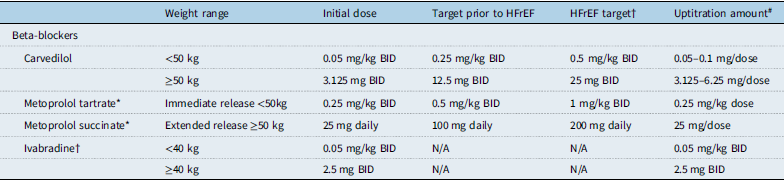
Beta-blocker therapy is recommended for patients with systolic dysfunction in the Care Considerations and American Heart Association guidelines. Reference Birnkrant, Bushby and Bann3,Reference Feingold, Mahle and Auerbach4 While the data is not definitive, this would also be consistent with evolving data in adults with heart failure with midrange ejection fraction (HFmrEF, EF 40–49%), especially those with a downward trajectory in systolic function. Reference Brann, Janvanishstaporn and Greenberg10 The 2022 American Heart Association, American College of Cardiology, and Heart Failure Society of America guideline also gives a 2b recommendation for beta-blockers for patients with heart failure with midrange ejection fraction. Based on these data and the existing recommendations, we propose the following indications for initiating therapy (Table 2):
Weight-based medication doses for beta-blockers and ivabradine

# Doses are generally titrated every 2–3 weeks prior to HFrEF and may be uptitrated in 1–2 week increments in patients with HFrEF with appropriate monitoring or every few days when monitored inpatient.* Metoprolol formulation may be used independent of weight ranges. When converting, total daily dose is equivalent between short and long acting (i.e. 25 mg twice daily (BID) = 50 mg Extended Release daily).† As tolerated to achieve a 20% reduction in heart rate without inducing bradycardia. For bradycardia decrease to previous dose or by 0.02 mg/kg BID. Max dosing for <40 kg: 0.2 mg/kg/dose BID; ≥ 40 kg: 7.5 mg/dose BID. Side effects to monitor: bradycardia and hypotension symptoms such as dizziness, fatigue, and increased sleepiness.
HFrEF = heart failure with reduced ejection fraction.
A. Beta-blocker therapy is recommended for patients with Duchenne muscular dystrophy with any evidence of systolic dysfunction.
B. It is reasonable to initiate beta-blocker therapy in patients with persistent sinus tachycardia or patients with symptomatic sinus tachycardia as defined by published, age-specific values. Reference Thomas, Jefferies and Lorts11,Reference Thomas, Morgan and Burnette12,Reference Saarel, Granger and Kaltman13,Reference Rijnbeek, Witsenburg and Schrama14
C. Beta-blockers should be considered for the management of arrhythmia or increasing ectopy, in consultation with a cardiologist.
D. It is reasonable to initiate ivabradine Reference Wakisaka, Kimura and Morita15,Reference Adorisio, Calvieri and Cantarutti16 in patients with persistent sinus tachycardia that is not responsive to beta-blocker therapy or in those intolerant of beta-blocker medications.
Mineralocorticoid receptor antagonist
The American Heart Association guidelines have suggested that it is reasonable to consider the use of mineralocorticoid receptor antagonist therapy in the presence of systolic dysfunction and that it may be considered in the setting of late gadolinium enhancement on cardiac MRI. Preliminary evidence suggests mineralocorticoid receptor antagonist therapy is associated with a decrease in the decline of strain in patients with Duchenne muscular dystrophy. Reference Raman, Hor and Mazur17 Based on these data, the Care Considerations has noted mineralocorticoid receptor antagonist therapy may be a useful adjunct therapy. As a result, we propose the following indications for initiating therapy (Table 3):
Weight-based medication doses for MRA

* Weight-based adjustments are reasonable based on patient size for patients <50 kg. # Doses are generally titrated every 2 weeks with associated monitoring of potassium with uptitration or initiation/titration of other medications that may cause hyperkalemia. † Routine use of combined high-dose MRA and ACEi/ARB may be harmful. Close monitoring of potassium is warranted. Side effects to monitor: hyperkalemia, dizziness, headache, and diarrhoea. Spironolactone may cause gynecomastia.
MRA = mineralocorticoid receptor antagonist; ACEi = angiotensin-converting enzyme inhibitor; ARB = angiotensin receptor blocker; HFrEF = heart failure with reduced ejection fraction.
A. It is reasonable to initiate mineralocorticoid receptor antagonist in patients with cardiac fibrofatty changes at any age or by 12 years of age, given this is the average age of first late gadolinium enhancement detection. Reference Raman, Hor and Mazur17,Reference Tandon, Villa and Hor18,Reference Raman, Hor and Mazur19
B. Mineralocorticoid receptor antagonist therapy is recommended in Duchenne muscular dystrophy in the presence of systolic dysfunction.
Angiotensin receptor/neprilysin inhibitor
There is no significant data on the use of the angiotensin receptor/neprilysin inhibitor (sacubitril/valsartan) in patients with Duchenne muscular systrophy, and its use is not specifically addressed in the Care Considerations or the American Heart Association Neuromuscular Diseases guidelines. Given this, the recommendations described are based on existing results from non-Duchenne adult heart failure trials and the American Heart Association and European Society of Cardiology’s chronic heart failure treatment guidelines. Reference Maddox and Januzzi20,Reference McDonagh, Metra and Adamo21 The 2021 Update to the 2017 American College of Cardiology Expert Consensus Decision Pathway for Optimization of Heart Failure Treatment notes that angiotensin receptor/neprilysin inhibitor is preferred to angiotensin-converting enzyme inhibitor or angiotensin receptor blocker, while the European Society of Cardiology 2021 Guidelines for the Diagnosis and the Treatment of Acute and Chronic Heart Failure suggests that an angiotensin receptor/neprilysin inhibitor may be considered as first-line therapy instead of an angiotensin-converting enzyme inhibitor or with persistent symptoms despite angiotensin-converting enzyme inhibitor, beta-blocker and mineralocorticoid receptor antagonist therapy. It remains unclear if any statement of preference should apply to patients with Duchenne muscular dystrophy in particular. Thus, while acknowledging the lack of
data for the use of angiotensin receptor/neprilysin inhibitors in Duchenne muscular dystrophy specifically, we propose the following indications for initiating therapy (Table 4):
Weight-based medication doses for ARNI

# Doses are generally uptitrated in 1–2 week increments in patients with HFrEF with appropriate monitoring or every few days in closely monitored (inpatient). † Routine use of combined high dose MRA and ARNI may be harmful. Close monitoring of potassium with uptitration or initiation/titration of other medications that may cause hyperkalemia is warranted. Side effects to monitor: hypotension, hyperkalemia, and angioedema.
ARNI = angiotensin receptor/neprilysin inhibitor; MRA = mineralocorticoid receptor antagonist; HFrEF = heart failure with reduced ejection fraction.
A. The use of an angiotensin receptor/neprilysin inhibitor can be considered in place of angiotensin-converting enzyme inhibitor/angiotensin receptor blocker therapy for Duchenne muscular dystrophy patients with a left ventricular ejection fraction ≤ 40% in the setting of appropriate background heart failure medical therapy.
Sodium-glucose cotransporter-2 inhibitors
There is no specific data on the use of sodium-glucose cotransporter-2 inhibitor in patients with Duchenne muscular dystrophy, and its use is not specifically addressed in the Care Considerations or the Management of Cardiac Involvement Associated with Neuromuscular Diseases guidelines. Given this, the recommendations described are based on existing results from the non-Duchenne adult heart failure trials and the American Heart Association and European Society of Cardiology’s chronic heart failure treatment guidelines as well as expert consensus. Reference Maddox and Januzzi20,Reference McDonagh, Metra and Adamo21 Thus, while acknowledging the lack of data for sodium-glucose cotransporter-2 inhibitors in Duchenne muscular dystrophy specifically, we propose the following indications for initiating therapy (Table 5):
Weight-based medication doses for SGLT2i

† May consider starting at 5 mg daily if blood pressure marginal and increase as tolerated. * Weight-based adjustments are reasonable based on patient size for patients <50 kg. # Doses are generally uptitrated in 1–2 week increments in patients with HFrEF with appropriate monitoring or every few days in closely monitored (inpatient). Avoid in patients with history of diabetic ketoacidosis and severe kidney disease. Side effects to monitor: urinary tract and genital infections, nausea, constipation, and renal dysfunction.
SGLT2i = sodium-glucose cotransporter-2 inhibitor; HFrEF = heart failure with reduced ejection fraction.
A. The use of a sodium-glucose cotransporter-2 inhibitor should be considered in Duchenne muscular dystrophy patients with a left ventricular ejection fraction of less than 40%.
B. Sodium-glucose cotransporter-2 inhibitor therapy can be considered for patients with Duchenne muscular dystrophy in the presence of mild systolic dysfunction (left ventricular ejection fraction less than 55% and/or shortening fraction less than 28%) and elevated natriuretic peptides.
Sodium-glucose cotransporter-2 inhibitors work, in part, through the promotion of glucosuria, and as such, they have a mild diuretic effect. It is notable that the frequency of urinary tract infections and genital infections, including fungal and serious bacterial infections, is increased in patients on sodium-glucose cotransporter-2 inhibitor therapy. Patients with Duchenne muscular dystrophy are at risk for each of these infections independent of sodium-glucose cotransporter-2 inhibitor therapy. An individualized discussion of the risks and benefits based on a patient’s dermatologic and urologic history is encouraged. Additionally, discussion with endocrinology should be considered for patients with a history of diabetes. Care should be taken during prolonged periods of fasting given the risk for euglycemic ketoacidosis. Additionally, sodium-glucose cotransporter-2 inhibitors should be held for 3 days prior to surgery.
Therapeutic monitoring
We recommend obtaining baseline cystatin C and basic metabolic panel in all patients. Cystatin C is a more reliable biomarker for glomerular function compared to creatinine since creatinine levels can be influenced by muscle mass, which is significantly decreased in Duchenne muscular dystrophy patients due to progressive muscle wasting. In contrast, cystatin C, a protein produced at a constant rate by nucleated cells and less affected by variations in muscle mass, provides a more consistent and accurate measure of glomerular filtration rate. Reference Screever, Kootstra-Ros, Doorn, Nieuwenhuis, Meulenbelt, Meijers and de Boer22,Reference Aldenbratt, Lindberg and Johannesson23 Labs should be repeated every 6–12 months if dosing is stable or more frequently if undergoing significant dose titrations or clinical deterioration is noted.
Medications should continue to be uptitrated if blood pressure remains at least 90/50 mmHg or above the 5th percentile for age and weight in younger children unless patients are symptomatic. Older patients with Duchenne muscular dystrophy may tolerate blood pressures <90/50 mmHg, and goals may be titrated on an individual basis at the discretion of the treating clinician with appropriate monitoring. A home blood pressure cuff can be a useful adjunct for uptitration, though it is not required.
Additional recommendations
In addition to the above medication management, care recommendations for patients with Duchenne muscular dystrophy should include referral to paediatric cardiology for management of cardiomyopathy at the time of Duchenne muscular dystrophy diagnosis.
An initial cardiology visit, with baseline imaging (echocardiogram and/or cardiac MRI) and electrocardiogram, is necessary at diagnosis. Follow-up visits should occur yearly from the time of diagnosis. More frequent visits may be appropriate for symptomatic patients or those with identifiable cardiac involvement at the discretion of the clinician.
For patients with Duchenne muscular dystrophy, the evaluation of cardiac function should be closely integrated with routine clinical visits. Diagnostic cardiac imaging, including echocardiography and cardiac MRI, should align with annual visits to monitor cardiac health effectively. When echocardiographic images are of sufficient quality, incorporating strain imaging is highly recommended as it provides valuable insights into myocardial deformation and function. Additionally, for comprehensive assessment, intermittent cardiac MRI with late gadolinium enhancement is advised to evaluate fibrofatty infiltration of the myocardium, starting at age 8–10 years old for patients who do not require anaesthesia, when such imaging is available.
Ambulatory rhythm monitoring is not recommended in asymptomatic young patients, 18 years old or younger, without evidence of cardiomyopathy (late gadolinium enhancement, systolic dysfunction, or left ventricular dilation), and who do not require nighttime respiratory support. Yearly ambulatory rhythm monitoring is recommended in patients with systolic dysfunction.
Yearly laboratory testing is recommended for patients on cardiac medications or with evidence of cardiovascular abnormalities. These include assessment of renal function (preferably cystatin C), serum potassium, and NT pro-brain natriuretic peptide or brain natriuretic peptide. Patients with Duchenne muscular dystrophy presenting with acute chest pain should be evaluated for changes in electrocardiogram and troponin given the risk of dystrophinitis. Reference Hor, Johnston, Kinnett, Mah, Stiver, Markham and Cripe24 Given this risk, obtaining a baseline troponin and trending this at some frequency may be considered.
Lastly, as dysfunction progresses, a review of care with a cardiomyopathy or heart failure team is generally warranted to help (a) assess further optimization holistically and (b) consideration of advanced therapies, including assessments of candidacy for mechanical circulatory support or heart transplantation.
Discussion
The timely initiation and precise dosing of cardiac medications play a pivotal role in mitigating the progression of cardiomyopathy in Duchenne muscular dystrophy patients. This discussion underscores the significance of initiating cardiac medications at the appropriate time and with the correct doses to optimize therapeutic efficacy and improve patient outcomes, based on a synthesis of established guidelines and the collective clinical experience of cardiac centres as part of ACTION.
Initiating cardiac medications at the right time is critical for effectively managing Duchenne muscular dystrophy-associated cardiomyopathy. Delayed initiation may result in missed opportunities to intervene during key stages of disease progression, leading to irreversible cardiac damage and poorer outcomes. By delineating clear indications for medication initiation, this paper empowers healthcare providers to proactively address cardiac dysfunction in Duchenne muscular dystrophy patients, thereby potentially delaying disease progression and improving long-term cardiac outcomes.
Furthermore, the importance of administering medications at the appropriate doses cannot be overstated. Suboptimal dosing may compromise therapeutic efficacy, while excessive dosing may increase the risk of adverse effects, underscoring the need for individualized dosing strategies tailored to each patient’s unique clinical profile. By providing comprehensive dosing guidelines based on both established protocols and real-world clinical experience, this paper equips clinicians with the tools necessary to optimize medication dosing and enhance treatment outcomes while minimizing the risk of adverse events.
Conclusions
In conclusion, as the management of Duchenne muscular dystrophy advances, particularly with the evolution of skeletal and respiratory muscle therapies, a systematic approach to addressing Duchenne muscular dystrophy cardiomyopathy becomes increasingly imperative. This encompasses both prophylactic and symptomatic utilization of heart failure therapies, as well as the proactive evaluation of pre-symptomatic disease progression. Amidst the landscape of emerging novel therapies, such as gene therapies, which may introduce potential cardiovascular toxicities post-administration, the importance of current cardiac care for individuals with Duchenne muscular dystrophy cannot be overstated.
This expert opinion document offers comprehensive guidance on dosing, timing, and optimization strategies for cardiac medications tailored to Duchenne muscular dystrophy cardiomyopathy. It brings together evidence-based guidelines and insights from the ACTION and the Dystrophinopathy Committee, providing a holistic approach to improving patient care.
Through initiatives like the ACTION Muscular Dystrophy Committee and the Dystrophinopathy Registry, alongside the insights provided in this medication harmonization document, we endeavour to cultivate a more equitable, prospective, and efficacious care environment for Duchenne muscular dystrophy cardiomyopathy. Our ultimate aim is to drive improvements in cardiac outcomes, thereby enhancing the overall quality of life for our patients and their families.