I. INTRODUCTION
Owing to their superior properties such as ultrahigh strength over crystals, bulk metallic glasses (BMGs) have attracted tremendous interests for their fundamental scientific importance and engineering application potential.Reference Inoue1–Reference Chen3 For practical applications as functional materials, metallic glasses are required to simultaneously possess exceptional glass-forming ability (GFA), high strength, and large plasticity. It is known that BMGs with both high GFA over 20 mm and high strength can only be obtained for Zr-, Pd-, and Pt-based systems.Reference Johnson4–Reference Inoue, Nishiyama and Kimura7 Recently, much attention has been paid to Cu-rich BMGs which exhibit lower cost, wider supercooled liquid region, and higher strength. However, the low GFA and plasticity greatly hindered the potential of Cu-rich BMGs in engineering applications.
It is known that Cu–Zr–Al ternary system establishes a favorable basic system for the development of (Cu, Zr)-based multicomponent compositions associated with large GFA and good mechanical properties. Recently, Cu47Zr45Al8 alloy has been demonstrated to be optimal Cu-rich BMG composition in the ternary Cu–Zr–Al system. At this composition, fully glassy rods of 15 mm in diameter can be made by means of tilt-mould casting.Reference Zhou, Zhang, Zhang, Kimura, Zhang, Makino and Inoue8 It has recently been revealed that, for developing metallic glasses with larger GFA and higher plasticity, it is desirable to add a minor element with larger atomic size and higher mixing enthalpy for atomic-scale compositional separation in the existing constituent compositions.Reference Wang, Bian, Wen, Pan and Zhao9–Reference Zhang, Cheng, Cao, Xu and Ma12 In this case, Xu et al. have found that small amounts addition of light rare-earth elements can greatly enhance the thermal stability and GFA of Zr-rich Cu–Zr–Al alloys. The largest BMG sample of 10 mm in diameter can be obtained for Cu45Zr46Al7Gd2 alloy.Reference Xu, Chen, Zhang, Wang and Jiang13 Park et al. pointed out that the addition of yttrium in Cu46Zr47Al7 alloys can promote high plasticity as well as GFA.Reference Park, Kyeong and Kim14 However, the roles of other rare-earth elements microalloying in amending the GFA and properties of Cu-rich BMGs are not clear.
In the present work, the effect of addition of a small amount of dysprosium (Dy) on the thermal stability, formation, and properties in Cu-rich Cu–Zr–Al alloys has been studied. The minor alloying strategy, namely, (Cu0.47Zr0.45Al0.08)100–xDyx (x = 0, 1, 2, 3, 4 at.%) is found to be remarkably effective in enhancing the GFA and plasticity of the Cu-rich BMGs. The aim of this work is to present new Cu-rich BMGs with large size and good mechanical properties for further applications of BMGs in the future.
II. EXPERIMENTS
Alloy ingots with nominal compositions of (Cu0.47Zr0.45Al0.08)100–xDyx (x = 0, 1, 2, 3, 4; at.%) were prepared by arc melting mixtures of Cu, Zr, Al, and Dy with a purity of 99.99, 99.9, 99.99, and 99.9%, respectively, in a Zr-gettered high purity argon atmosphere. Ribbon samples with a cross-section of 0.02 × 1.2 mm2 were prepared by melt spinning. Cylindrical rod samples were prepared by tilt casting method in an argon atmosphere. The structure of the as-cast samples was examined by x-ray diffraction (XRD) with Cu-Kα source. The thermal stability associated with glass transition, supercooled liquid region, and crystallization was examined by differential scanning calorimetry (DSC) at a heating rate of 0.67 K/s. The liquidus temperature and melting behavior was measured with a differential thermal analyzer (DTA) at a heating rate of 0.33 K/s. Mechanical properties were measured under uniaxial compression using an Instron testing machine. In accord with American Society for Testing and Materials (ASTM) standards, cylindrical specimens with gage dimensions of 2.0 ± 0.03 mm in diameter and 4.0 ± 0.05 mm in length were made by injection casting method for room temperature uniaxial compression test at a strain rate of 5 × 10⁻⁴ s−1. The fracture morphology was examined by scanning electron microscopy (SEM). The elastic properties were characterized using a longitudinal and transverse wave PZT resonator at a frequency of 2.0 MHz.
III. RESULTS
A. Thermal stability
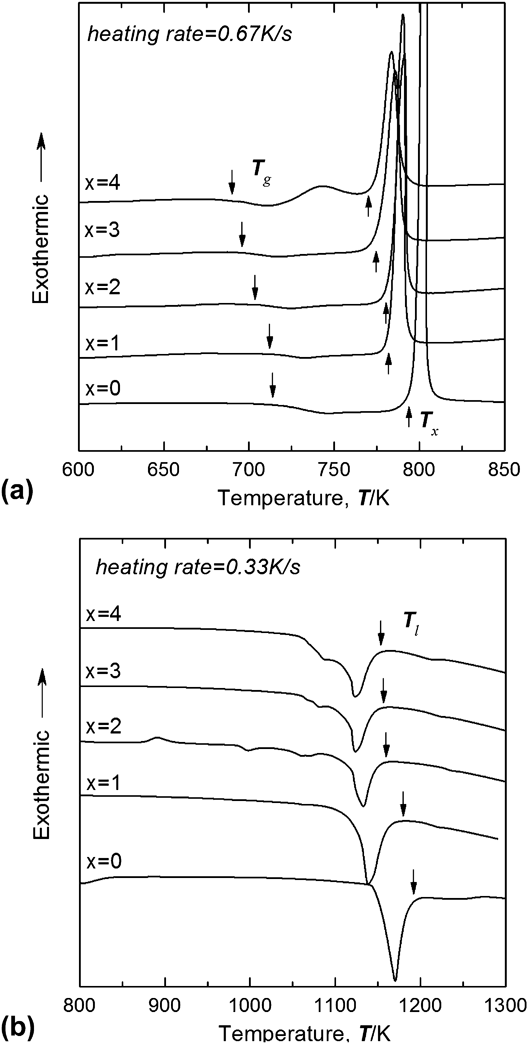
The ribbon samples of (Cu0.47Zr0.45Al0.08)100–xDyx (x = 0, 1, 2, 3, 4; at.%) alloys were identified to be amorphous by XRD. The DSC traces of these melt-spun alloys are shown in Fig. 1(a). The glass transition temperature (T g) and crystallization temperature (T x) are marked with arrows. All the samples exhibit a distinct endothermic heat event characteristic of the glass transition, followed by exothermic transformations from the supercooled liquid due to crystallization. With increasing Dy content from x = 0 to 3, the T g and T x decrease monotonously from 714 to 697 K and 794 to 774 K, respectively. The largest ΔT x (ΔT x = T x − T g) of 79 K is obtained for the Dy-bearing alloy with x = 2. With further increasing Dy content to 4 at.%, a tiny and diffused exothermic peak appears followed by the sharp principal crystallization peak. The small exothermic reaction may be attributed to nanocrystallization in the supercooled liquid region, implying a compositional heterogeneity in the as-cast glassy matrix. This behavior indicates that the competing phase changes to metastable phase due to the increase in atomic mismatches and the interaction between small and large atoms.Reference Park and Kim15 The alloying effect of Dy on the thermal stability of Cu47Zr45Al8 alloy is shown by the altered stability of supercooled liquid and the delicate changes of crystallization behavior.
DSC (a) and DTA (b) curves of (Cu0.47Zr0.45Al0.08)100–xDyx (x = 0–4, at.%) glassy alloys.

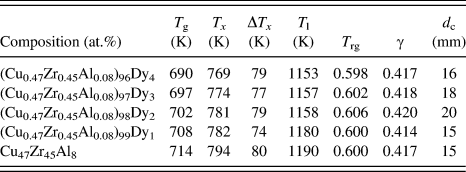
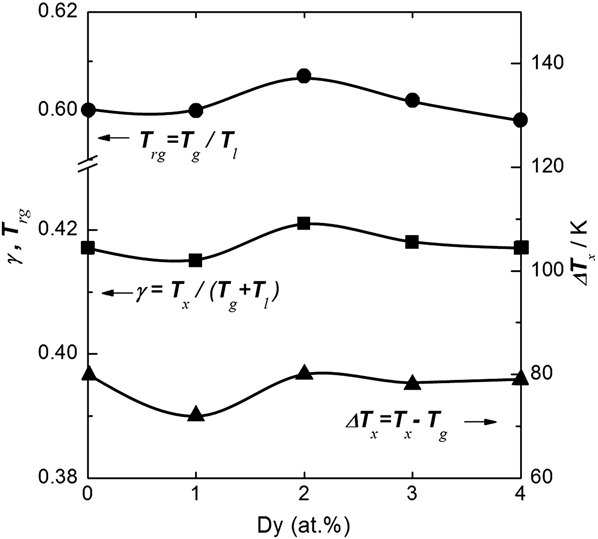
The crystallization products of the Cu47Zr45Al8 glass manifest nearly eutectic melting behavior by showing a single endothermic peak [Fig. 1(b)]. The minor addition of Dy to this alloy has led to appreciable decrease of the liquidus temperature (T l) with the significant profile change of the endothermic peak, or overlapped multiple endothermic peaks. From DTA curves [see Fig. 1(b)], the T l decreases obviously from 1190 to 1158 K with Dy content increasing from x = 0 to 2, while the T l slightly changes with further Dy addition. The essentially different melting behaviors are ascribed to the altered crystallization products formed upon continuous heating within the Dy content range. The measured temperature data are tabulated in Table I. Based on the thermal data obtained by DSC and DTA, GFAs at the serial compositions were assessed using the well-recognized GFA indicators, ΔT x, T rg (T rg = T g/T l), and γ (γ = T x/(T g + T l)) values.Reference Turnbull16,Reference Lu and Liu17 Fig. 2 shows the ΔT x, T rg, and γ values as a function of Dy concentration. With the largest ΔT x of 79 K, T rg of 0.606, and γ value of 0.420, the (Cu0.47Zr0.45Al0.08)98Dy2 alloy is found to be the best glass former in the alloy series. Casting experiments were carried out to examine the validity of the GFA indicator, and the detailed results are shown as follows.
Summary of the thermal parameters and the critical sample diameters of the (Cu0.47Zr0.45Al0.08)100–xDyx (x = 0–4, at.%) glassy alloys.
ΔT x, T rg, and γ values of (Cu0.47Zr0.45Al0.08)100–xDyx (x = 0–4, at.%) glassy alloys as a function of Dy concentration.
B. Glass-forming ability
We further investigated the minor Dy addition on GFA of the alloys produced by tilting copper mold casting. The outer shape and the XRD patterns of the as-cast (Cu0.47Zr0.45Al0.08)98Dy2 and (Cu0.47Zr0.45Al0.08)97Dy3 rods with diameters of 20 and 18 mm are shown in Figs. 3(a) and 3(b), respectively. These glassy rods exhibit very smooth surface and shiny luster. Neither roughness nor concavity could be observed over the entire outer surface. The XRD patterns taken from near the center of the cross-section of the rods consisted of only broad peaks, and no diffraction peak corresponding to a crystalline phase is seen, indicating that a single glassy phase is formed. Significant minor Dy alloying effect on GFA occurs at compositions containing 2 at.% Dy, where d c reaches two centimeter scale. These casting experiment data are also included in Table I.
Outer shapes (a) and cross-sectional XRD patterns (b) of as-cast (Cu0.47Zr0.45Al0.08)98Dy2 and (Cu0.47Zr0.45Al0.08)97Dy3 glassy rods with diameters of 20 mm and 18 mm.
C. Mechanical properties
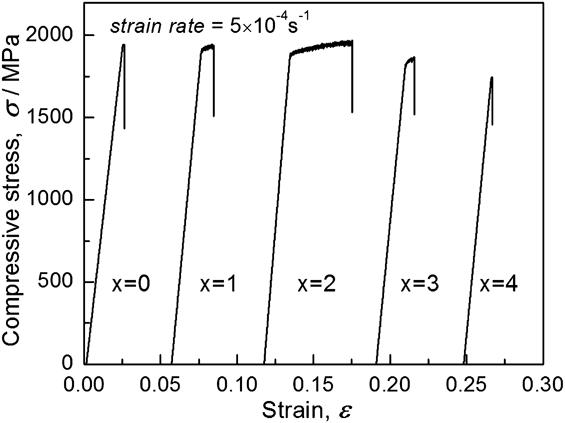
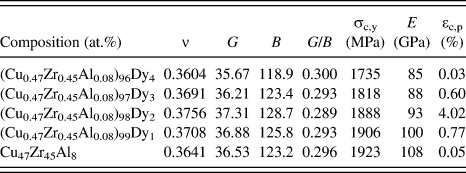
Figure 4 shows compressive stress–strain curves of the as-cast (Cu0.47Zr0.45Al0.08)100–xDyx (x = 0–4; at.%) glassy alloy rods with the diameters of 2 mm. The Cu–Zr–Al–Dy bulk glassy alloys possess good mechanical properties, i.e., yield strength (σc,y) of 1735–1906 MPa, Young's modulus (E) of 85–100 GPa, plastic strain (εc,p) of 0.03–4.02% (see Table II). It is noticed that we did not find any evident plasticity for the basal ternary Cu47Zr45Al8 alloy.Reference Zhou, Zhang, Zhang, Kimura, Zhang, Makino and Inoue8 However, the plasticity of the basal alloy was significantly enhanced by adding minor Dy quantity of 2 at.%. The largest plastic strain around 4.02% was attained with a typical elastic-perfectly plastic behavior in the 2 at.% Dy alloy. However, with further increase of Dy to 3 and 4 at.%, the plastic strain decreases and finally disappears, which is being accompanied by decrease of strength.
Compressive stress–strain curves of as-cast (Cu0.47Zr0.45Al0.08)100–xDyx (x = 0–4, at.%) glassy rods with a diameter of 2 mm.
Summary of the mechanical properties of the (Cu0.47Zr0.45Al0.08)100–xDyx (x = 0–4, at.%) glassy alloys.
Following the suggestion of Lewandoski et al., the alloy with high Poisson's ratio can be expected to show high plasticity.Reference Lewandowski, Wang and Greer18 Ultrasonic measurements were carried out to determine the sound velocity in Cu–Zr–Al–Dy glassy alloys. Based on the sound velocity and density of the BMGs, the shear modulus (G), bulk modulus (B), and Poisson's ratio (ν) can be described as:
 $$G = \rho v_{\rm{s}}^2\quad {\rm{,}}$$
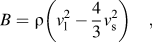 $$B = \rho \left( {v_{\rm{l}}^2 - {4 \over 3}v_{\rm{s}}^2} \right)\quad {\rm{,}}$$
 $$\nu = {{v_{\rm{l}}^2 - 2v_{\rm{s}}^2} \over {2(v_{\rm{l}}^2 - v_{\rm{s}}^2)}}\quad {\rm{,}}$$
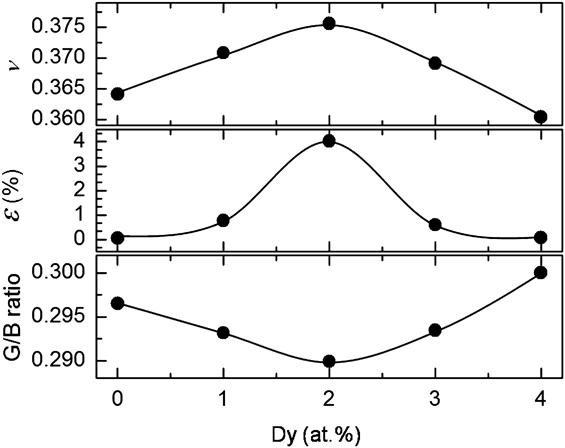
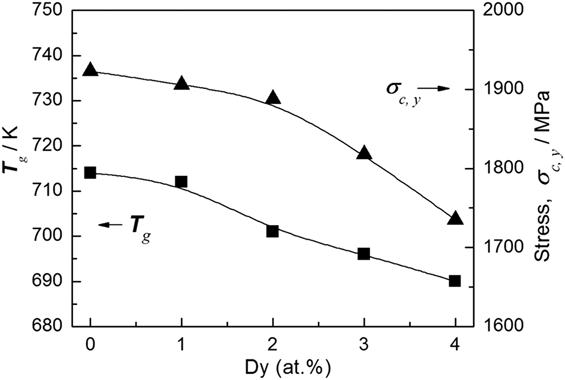
where v s is transverse wave velocity, v l is longitudinal wave velocity.Reference Papadakis19,Reference Scheriber20 The shear modulus (G), bulk modulus (B), and Poisson's ratio (ν) were calculated from the acoustic data are shown in Table II. Figure 5 shows the change of Poisson's ratio and the plastic strain (ε) as a function of Dy content. To reveal the correlation between the elastic constants and plasticity of these BMGs, the G/B ratios are calculated (see Table II) and their variation tendencies against Dy content are also shown in Fig. 5. The highest Poisson's ratio and lowest G/B ratio appear in the vicinity of the 2 at.% Dy content, followed by a rapid decrease with increasing Dy content. Moreover, it is noticed that the strength values show distinct dependence with T g, as shown in Fig. 6. This may originate from the change in the bonding nature among the constituent elements of the glassy alloys because the T g of the glassy alloys reflects the bonding force among the constituent elements.
Change of ν, ε, and G/B ratios of (Cu0.47Zr0.45Al0.08)100–xDyx (x = 0–4, at.%) glassy alloys as a function of Dy concentration.
Change of σc,y and T g of (Cu0.47Zr0.45Al0.08)100–xDyx (x = 0–4, at.%) glassy alloys as a function of Dy concentration.
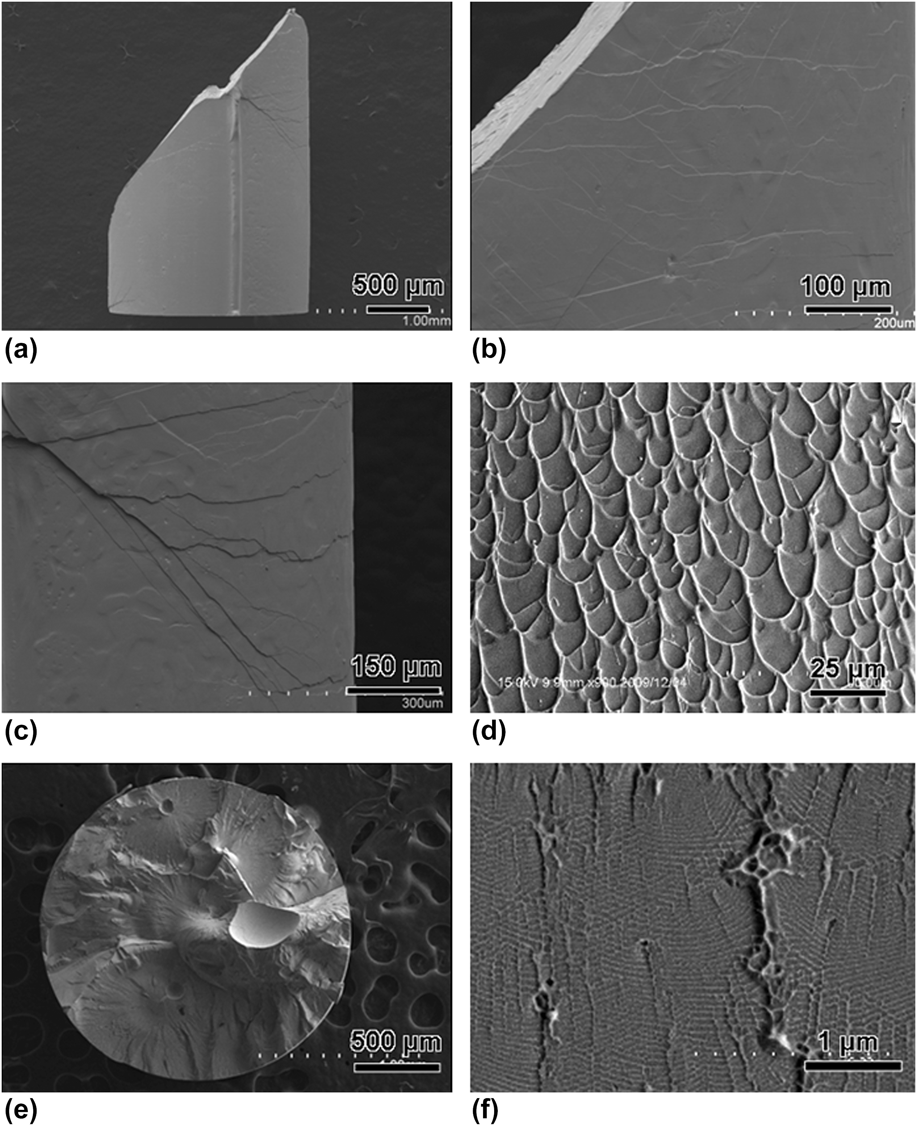
The macroscopic SEM profiles of fractured (Cu0.47Zr0.45Al0.08)98Dy2 and (Cu0.47Zr0.45Al0.08)96Dy4 glassy samples are shown in Fig. 7. The deformation and final fracture of the (Cu0.47Zr0.45Al0.08)98Dy2 sample occurred along the maximum shear stress plane which was declined by about 45° to the direction of applied load as shown in Fig. 7(a). It can be seen that a large number of shear bands with branches can be observed on the outer surface of the 2% Dy alloy sample [see Figs. 7(b) and 7(c)]. In addition, the fracture surfaces consist mainly of a well-developed vein pattern [see Fig. 7(d)], which is typical of other BMGs with good toughness.Reference Inoue, Zhang, Zhang and Kurosaka21,Reference Zhang and Inoue22 However, for the alloy with 4 at.% Dy addition, the contour of the fracture surface is fairly rough and changed to be nanowaves [Figs. 7(e) and 7(f)]. The complex fracture surface morphologies indicate large shear instability of this alloy before fracture. The higher Dy content alloy follows a purely brittle facture mode as evidenced by the smooth fracture surfaces without any vein-like characteristic.
SEM images of surface and fracture feature of as-cast (Cu0.47Zr0.45Al0.08)98Dy2 (a–d) and (Cu0.47Zr0.45Al0.08)96Dy4 (e and f) glassy rods after compressive deformation.
IV. DISCUSSION
For developing alloys with high GFA, a simple and effective way is to add some element which satisfies the ‘three empirical component rules’ into the alloys.Reference Inoue1 In this work, although Zr–Dy pair shows positive heats of mixing of +8 kJ/mol, the addition of Dy into the Zr–Cu–Al alloy system causes generation of stronger chemical affinities between Cu–Dy (−22 kJ/mol), Al–Dy (−39 kJ/mol), which can improve the local packing efficiency and restrain long range diffusion of atoms. These factors lead to the high stability of the supercooled liquid and the high GFA. Moreover, the atomic size of Dy (Goldschmidt radius ∼0.177 nm) is much larger than that of Cu (0.128 nm), Zr (0.160 nm), or Al (0.143 nm). From the three empirical component rules, the addition of Dy into the Cu47Zr45Al8 alloy is believed to introduce significant distortions of its local atomic environments due to the large atomic size mismatches between Dy and other elements.Reference Inoue1
Disordering associated with the minor alloying favors stabilization of a metallic liquid, which may account for the decrease of T g and the increased ΔT x observed in the DSC experiments. The significant depressing of the onset melting temperatures and the liquids points observed in the Dy-bearing alloys might also be attributable to the disordering effect. Considering this aspect, a more comprehensive parameter γ (γ = T x/(T g + T l)), introduced by Lu and Liu, was used to evaluate the GFA in this alloy series.Reference Lu and Liu17 The parameter indicates that the best glass former in a system is not necessarily to be at the eutectic point because the T x effect should be taken into account. In other words, glass formation also depends on the stability of the competing crystalline phases, although the eutectic composition usually has the highest liquid phase stability. Therefore, from Table I, we can conclude that the alloy with a larger critical diameter possesses a higher value of γ in the present system.
It has been well established that the formation of (Zr,Cu)-based BMGs are oxygen content-sensitive. Cu–O and Zr–O particles existing in the supercooled alloy liquids can trigger heterogeneous nucleation of crystalline phases thus significantly degrade the GFA. The minor alloying element Dy, which has a large enthalpy of mixing with oxygen (∼1900 kJ/mol), is believed to preferentially react with oxygen or other harmful impurities present in the alloy liquid and do not promote crystal nucleation but scavenge the alloy liquid.Reference Wang23 In this way, the supercooled liquid can be stabilized and as a consequence, GFA of the alloy is enhanced.
A high Poisson's ratio and low G/B ratio allows for shear collapse before the extensional instability of crack formation can occur. The alloy with 2 at.% of Dy which simultaneously has the highest Poisson's ratio and lowest G/B ratio does show the largest plastic deformation ability under room temperature compression. As discussed above, the alloy is believed to have a more disordered atomic structure than the basic Cu47Zr45Al8 alloy due to Dy alloying. This causes the tip of a shear band to extend rather than to initiate a crack. Deformation is therefore accomplished by the formation of multiple shear bands, which results in the observed large plasticity.Reference Zhang, Chen, Chen and Liu24,Reference Schroers and Johnson25 From the outer surface of the tested samples, it can be seen that the alloy with 2 at.% Dy does show much more fine extended multiple shear bands.
Glass transition temperature, T g, may also be used as an indicator of bonding forces among the constituent elements.Reference Lewandowski, Wang and Greer18 In our work, T g decreased with Dy contents increasing, when the yield strength decreased remarkably, indicating the gap between element atoms might be enlarged. We can further assume in these alloys the existence of certain structurally weak regions, which is known as glue parts of the BMG structure.Reference Chen, Krause and Coleman26 As these regions can sustain negligible stress, the glue structures upon continued loading are forced to move along the directions to thermodynamically stable positions. Their redistribution generates additional retarded elastic deformations, and therefore results in the decrease of the elastic modulus. After yielding, the considerable amount of glue structure would enable the atoms to rearrange themselves easily to accommodate applied shear strain without a drastic disturbance in bonding configurations, which can also account for the improved plasticity. It should also be noted that the sensitivity of elastic properties to small compositional variation renders the determination of a plastic–brittle transition possible as the G/B ratio does in this work.
V. CONCLUSIONS
Cu-rich Cu–Zr–Al–Dy bulk glassy alloys with high GFA and good mechanical properties were developed using microalloying technique. The addition of a small quantity of Dy to Cu–Zr–Al alloy greatly increases the stability of supercooled liquid, T rg and γ values, leading to a considerable increase in the GFA. The two-centimeter order rods with full glassy structure were obtained for the (Cu0.47Zr0.45Al0.08)98Dy2 alloy. The Cu–Zr–Al–Dy BMGs exhibit good mechanical properties under a compressive deformation mode, i.e., high yield strength of 1735–1906 MPa, Young's modulus of 85–100 GPa, and distinct plastic strain of 0.08–4.02%. The strength values and plastic strain show distinct dependence with the change of T g and Poisson's ratio. The (Cu0.47Zr0.45Al0.08)98Dy2 alloy with largest plasticity shows highest Poisson's ratio of 0.375 but lowest G/B of 0.289. Cu-rich BMGs have been successfully proven to simultaneously possess high GFA, high strength, and good plasticity, which is useful for further extension of application fields of BMGs.
ACKNOWLEDGMENTS
This research is financially supported by the National Natural Science Foundation of China (Grant No. 51301029 and 51375071).