1. Introduction
Systematic differences across languages and language varieties, not only in terms of lexical and syntactic aspects, but also structurally and semantically, offer promising avenues of research in bilingualism. On the one hand, investigating the acquisition and use of language varieties differing on several linguistic levels leads to insights in terms of cross-linguistic influence. On the other hand, more general questions concerning the cognitive challenges of switching between the two different systems can be put forward. Along these lines, the ways in which individual bilingual speakers vary can be explored. Given the robust evidence on cross-linguistic differences in the encoding of motion events across the languages we focus on, analyzing variation in motion descriptions constitutes a suitable domain to explore these questions.
In a number of studies in the motion domain, language mode is explicitly controlled for, in that participants had some small talk with the instructors in the target language (e.g., Brown & Gullberg, Reference Brown and Gullberg2008; Lai, Rodriguez & Narasimhan, Reference Lai, Rodriguez and Narasimhan2014), or were asked to do some additional activity in the target language such as counting prior to the experiment (e.g., Treffers-Daller & Tidball, Reference Treffers-Daller, Tidball, Guijarro-Fuentes, Schmitz and Müller2015). The potential influence of language mode was addressed in some studies in that participants whose performances were examined in two different sessions were asked to show up for the second session after a break (e.g., Nicoladis, Rose & Foursha-Stevenson, Reference Nicoladis, Rose and Foursha-Stevenson2010; Brown & Gullberg, Reference Brown and Gullberg2011). Kersten, Meissner, Lechuga, Schwartz, Albrechtsen and Iglesias (Reference Kersten, Meissner, Lechuga, Schwartz, Albrechtsen and Iglesias2010) report a language mode effect in English–Spanish bilingual participants, who differed in their attention to manner in a categorization task in an English monolingual condition and a Spanish monolingual condition. A study by Athanasopoulos, Bylund, Montero-Melis, Damjanovic, Schartner, Kibbe, Riches and Thierry (Reference Athanasopoulos, Bylund, Montero-Melis, Damjanovic, Schartner, Kibbe, Riches and Thierry2015) reveals a similar context-bound pattern: German–English bilingual speakers categorized motion events differently depending on the language context. In contrast, Filipović’s (Reference Filipović2011) study on recognition memory of motion events in Spanish–English bilinguals did not yield any effect of the language of instruction (or prior verbalization) on memory performance. While these studies all address the importance of taking into account the language context while testing, the influence of language mode as an experimental condition is not systematically manipulated and investigated. This paper investigates how French–German bilingual speakers describe motion events in both languages. First, it addresses the question of how language dominance configurations of within the linguistic repertoire influence the production patterns. Second, we investigate these patterns in light of theoretical propositions on language activation – the language mode at the moment of production (Grosjean, Reference Grosjean1998, Reference Grosjean2008). While concepts of language dominance and language mode have been widely discussed in bilingualism research, the effect of both these factors on language production in the motion domain has not been investigated empirically.
The present study is an extended follow-up to previous investigations (Berthele, Reference Berthele2017; Berthele & Stocker, Reference Berthele and Stocker2016). In these studies, we found effects of language dominance and language mode on French and German descriptions of motion events. The current study adopts a similar research design, but offers several improvements (better stimuli, larger sample, better control of language mode, to name just a few).
2. Background
2.1. Language dominance and language mode in bilingual lexicalization
Studies rooted in a bilingualism framework adopt different definitions of ‘bilingualism’ (see Cook & Bassetti, Reference Cook and Bassetti2011, pp.143–146 for a discussion on different definitions). In the current paper, the term is used broadly and refers to individuals regularly using two languages regardless of proficiency level, length of residence, age of acquisition or simultaneous vs. successive acquisition (Grosjean, Reference Grosjean1982). In line with Grosjean (Reference Grosjean1989), “using two languages regularly” neither implies that the bilingual person can be seen as two monolinguals in one person nor that she or he is a balanced bilingual, i.e., masters the languages at the same level of proficiency. One of the aspects of bilingualism is therefore the question of language dominance.
Gertken, Amengual and Birdsong (Reference Gertken, Amengual, Birdsong, Leclercq, Edmonds and Hilton2014) define dominance as “a multi-faceted, gradient and dynamic construct that includes but is not equivalent to language proficiency”. On the one hand, this definition highlights the continuous nature of the construct. Modelling language dominance as a cline acknowledges the fact that bilinguals are not simply dominant in one language, but dominant in that language to measurable degrees – information that would be lost if dominance is understood as a categorical construct (Flege, MacKay & Piske, Reference Flege, MacKay and Piske2002; Dunn & Fox Tree, Reference Dunn and Fox Tree2009; Birdsong, Reference Birdsong2014; Goral, Campanelli & Spiro, Reference Goral, Campanelli and Spiro2015). On the other hand, language proficiency is regarded as a component of dominance, but neither defines the concept fully, nor necessarily has to correlate with dominance on all levels (Birdsong, Reference Birdsong2006; Dunn & Fox Tree, Reference Dunn and Fox Tree2009; Gertken et al., Reference Gertken, Amengual, Birdsong, Leclercq, Edmonds and Hilton2014). Further essential components defining dominance are language use (Lim, Liow, Lincoln, Chan & Onslow, Reference Lim, Liow, Lincoln, Chan and Onslow2008; Daller, Reference Daller2011; Birdsong, Reference Birdsong2014), language history (Flege et al., Reference Flege, MacKay and Piske2002; Li, Sepanski & Zhao, Reference Li, Sepanski and Zhao2006) and language attitudes (Grosjean, Reference Grosjean1982; Pavlenko, Reference Pavlenko2004).
A second notion, language mode, relates to the relative weight of the bilinguals’ languages when processing input and output: in Grosjean's (Reference Grosjean1998, Reference Grosjean and Nicol2001, Reference Grosjean2008) terms, language mode refers to “the state of activation of the bilingual's languages and language processing mechanisms at a given point in time”. However, even today researchers are faced with the question what activation or inhibition of languages to different degrees implies (e.g., Yu & Schwieter, Reference Yu and Schwieter2018). Based on different understandings of language activation or inhibition, a series of psycholinguistic models on lexical access and control in bilinguals have been developed (Grosjean, Reference Grosjean, de Groot and Kroll1997; Green, Reference Green1998; Dijkstra & Van Heuven, Reference Dijkstra, Van Heuven, Grainger and Jacobs1998, Reference Dijkstra and Van Heuven2002). While these models differ in their propositions on language activation mechanisms, whether language-as-a-whole or only certain aspects are activated and whether there are inhibition mechanisms, they all assume that different states of language activation exist. More importantly for the present purposes, these states of activation lead to different phenomena of cross-linguistic influence (Grosjean, Reference Grosjean2008).
Furthermore, Grosjean puts forward that “bilinguals who are highly dominant in one language may simply not be able to control language mode in the same way as less dominant or balanced bilinguals” (Reference Grosjean2008, p. 63). The effect of language mode is thus assumed to depend on the dominance configuration of the individual speaker. Accordingly, language dominance and language mode interact.
The number and types of cross-linguistic influence phenomena in bilingual lexicalization are assumed to be affected by dominance configurations, language mode and the interaction of these variables. Particularly interesting are thus domains that offer a variety of linguistic and cognitive challenges on different levels such as the cross-linguistically variable motion events descriptions.
2.2. Motion event descriptions in French and German
Differences in the encoding of motion events across languages and language varieties have been in the focus of comparative and cognitive linguistics for quite some time (see Matsumoto & Slobin, Reference Matsumoto and Slobin2012). Differences in the way languages and speakers package semantic components pertaining to motion events led to the development of typological frameworks such as Talmy's influential work (2000). However, other authors from different linguistic traditions had already made similar proposals (e.g., Malblanc, Reference Malblanc1966; Tesnière, Reference Tesnière1969 for French and German). The growing body of findings suggest that in terms of voluntary motion events, where a figure (we use Talmy's terms in the remainder of this contribution) covers a certain path moving in a certain manner, there can be two different types of encoding these events. While speakers of the verb-framed type (V-language) follow the tendency to encode the path in the verb, speakers of the Satellite-framed type (S-language) usually describe the path in verb-external elements. In this regard, French and German belong to different types: the former favors the expression of path in verbs (e.g., sortir ‘to exit’, entrer ‘to enter’, traverser ‘to cross’), while manner of motion is typically expressed in adverbial elements (e.g., en sautant ‘jumping’, sur les quatre pattes ‘on all fours’). The latter maps the manner of motion on the verb (e.g., rennen ‘to run’, springen ‘to jump’, kriechen ‘to crawl’) while path or deictic components are encoded in verb-external elements (e.g., auf ‘up’ and ab ‘down'or hin ‘hither’ and her ‘thither’).
This contribution focuses on motion verbs, which show the most striking cross-linguistic difference and therefore allow for a thorough quantitative approach. Encoding of semantic information in further grammatical elements or construction-based accounts (cf. Goschler, Woerfel, Stefanowitsch, Wiese & Schroeder, Reference Goschler, Woerfel, Stefanowitsch, Wiese and Schroeder2013) is beyond the scope of this contribution.
2.3. CLI in motion verb constructions
Motion event descriptions of French–German bilingual speakers can show phenomena of cross-linguistic influence going beyond the lexical or syntactic level. The general questions addressed in studies investigating the occurrence of CLI of speakers acquiring and using two typologically different languages are whether speakers retain dominant language patterns or whether there is restructuring and convergence of the two systems. Convergence can manifest itself in, for instance, an increasing number of manner verbs in French constructions or an increasing use of path verbs in German.
Drawing on work of Müller (Reference Müller1998), Hohenstein, Eisenberg and Naigles (Reference Hohenstein, Eisenberg and Naigles2006) and Iakovleva (Reference Iakovleva2012), the degree of CLI phenomena in the motion event domain depends not only on typological differences but also on structural ambiguity. In other words, patterns are transferred not simply because one language exerts an influence on the other language, but because for certain structures, one language may be more transparent and systematic. Along these lines, bilingual speakers use transfer as a “relief strategy” (Müller, Reference Müller1998) and use the pattern of the more systematic system to cope with ambiguity.
Other explanations of CLI in the motion event domain are motivated by the Thinking-For-Speaking-hypothesis (Slobin, Reference Slobin and Hi2006). Cadierno (Reference Cadierno, Han and Cadierno2010) argues that CLI phenomena are not simply transfer of structures, but rather depend on the different degrees of salience of particular concepts in the respective languages. Manner of motion, for instance, is less salient in S-languages, and it is backgrounded when expressed in the main verb root and is thus less notable for V-language learners.
Questions of the components on which CLI phenomena are observed go hand in hand with questions about the directionality of CLI phenomena. While many studies report evidence for unidirectional influences, the rare instances of bidirectional CLI in the literature suggest that the typologically different framing patterns of motion events can lead to processes of restructuring in the first, or dominant, language.
Several studies note a higher use of manner verbs in V-languages due to the influence of an S-language either as L1/less dominant language (e.g., Larrañaga, Treffers-Daller, Tidball & Ortega, Reference Larrañaga, Treffers-Daller, Tidball and Ortega2011; Navarro & Nicoladis, Reference Navarro, Nicoladis and Eddington2005; Treffers-Daller & Tidball, Reference Treffers-Daller, Tidball, Guijarro-Fuentes, Schmitz and Müller2015) or, in the reverse direction, as L2/dominant language (e.g., Aveledo & Athanasopoulos, Reference Aveledo and Athanasopoulos2015; Brown & Gullberg, Reference Brown and Gullberg2008; Hohenstein et al., Reference Hohenstein, Eisenberg and Naigles2006). A particular challenge for L1 S-language speakers are descriptions of items involving the crossing of a spatial boundary in V-languages. There is usually no restriction on manner verbs in a satellite-framed pattern, but the use of manner verbs in boundary-crossing clauses is generally avoided in V-languages (Aske, Reference Aske1989; Slobin & Hoiting, Reference Slobin and Hoiting1994) as it leads to ungrammatical or ambiguous constructions (e.g., il saute dans la maison either reads as ‘he jumps into the house’ or ‘he jumps inside the house). While findings show that proficient V-language speakers usually do not use manner verbs in these contexts (Cadierno & Lund, Reference Cadierno, Lund, VanPatten, Williams, Rott and Overstreet2004), other scholars note that even at advanced levels, learners frequently use verbs encoding manner of motion (Larrañaga et al., Reference Larrañaga, Treffers-Daller, Tidball and Ortega2011; Treffers-Daller & Tidball, Reference Treffers-Daller, Tidball, Guijarro-Fuentes, Schmitz and Müller2015). However, difficulties in terms of manner verb use by learners of an S-language have been reported in several studies (Alcaraz Mármol, Reference Alcaraz Mármol2013; Alonso, Reference Alonso2011, Reference Alonso2013, Reference Alonso2016; Antonijević & Berthaud, Reference Antonijević and Berthaud2009; Bauer, Reference Bauer2010; Brown & Gullberg, Reference Brown and Gullberg2008; Cadierno, Reference Cadierno, Han and Cadierno2010; Carroll, Weimar, Flecken, Lambert & von Stutterheim, Reference Carroll, Weimar, Flecken, Lambert and von Stutterheim2012; Hohenstein et al., Reference Hohenstein, Eisenberg and Naigles2006; Reshöft, Reference Reshöft and Schönefeld2011).
Concerning the path verb lexicon, S-language speakers learning a V-language do not have to learn a wide range of path verbs, since this category is more limited than the manner verb inventory is. Several studies report that path verbs are acquired quickly and effortlessly (Iakovleva, Reference Iakovleva2012; Navarro & Nicoladis, Reference Navarro, Nicoladis and Eddington2005; Treffers-Daller & Tidball, Reference Treffers-Daller, Tidball, Guijarro-Fuentes, Schmitz and Müller2015; Song et al., Reference Song, Pulverman, Pepe, Golinkoff and Hirsh-Pasek2016). Bidirectional transfer patterns modulated by an age factor are reported in Hohenstein et al.’s (Reference Hohenstein, Eisenberg and Naigles2006) study where bilingual L1 Spanish - L2 English speakers used fewer path verbs than monolingual Spanish speakers, but the L2-effect was stronger for early bilinguals. On the one hand, the influence of the verb-framed pattern in terms of an increasing use of path verbs in the S-language has been found in several studies (Alcaraz Mármol, Reference Alcaraz Mármol2013; Brown & Gullberg, Reference Brown and Gullberg2013; Hohenstein et al., Reference Hohenstein, Eisenberg and Naigles2006). On the other hand, Goschler et al. (Reference Goschler, Woerfel, Stefanowitsch, Wiese and Schroeder2013) do not find any difference in path verbs between bilingual Turkish–German speakers and monolingual German speakers. However, the influence of a V-language can manifest itself in deictic or generic verbs in terms of fewer manner verbs and more path verbs. Goschler et al. (Reference Goschler, Woerfel, Stefanowitsch, Wiese and Schroeder2013) note a preference for semantically light verbs in German by bilingual Turkish–German speakers compared to monolingual German speakers, particularly for the verbs kommen and gehen. Similarly, Suner Munoz and Jessen's (Reference Munoz Suner, Jessen, Schmidt and Torres2016) data shows that L1 Turkish - L2 Danish speakers used the deictic verb gå ‘to go’ in Danish more frequently than Danish speakers, who preferred to employ manner verbs. On the one hand, these examples may reflect a Turkish lexicalization type in that speakers used these verbs analogously to Turkish path verbs when German (Goschler et al., Reference Goschler, Woerfel, Stefanowitsch, Wiese and Schroeder2013, p. 244) or Danish (Suner Munoz & Jessen, Reference Munoz Suner, Jessen, Schmidt and Torres2016) lacked corresponding path verbs. On the other hand, the use of “semantically light”, generic or deictic motion verbs does not have to be the result of typologically determined influences, but may point to general learner strategies (Goschler, Reference Goschler2009, Reference Goschler2013) or to conceptually oral linguistic varieties (Berthele, Reference Berthele2004).
At the same time, teasing apart these typologically or structurally induced phenomena from general learner preferences for semantically less dense and less complex forms is not straightforward. A typical finding in SLA studies is that motion event descriptions from language learners are in general less elaborate than those from L1-speakers (Hickmann & Robert, Reference Hickmann, Robert, Hickmann and Robert2006). The possible misinterpretation of the use of generic or neutral verbs instead of more diverse manner verbs as a V-language influence rather than as an effect of smaller vocabulary size calls for controlling participants’ proficiency and language dominance configurations.
2.4. Preceding studies
In Berthele (Reference Berthele2017), motion event descriptions in French and German were elicited by means of video clips showing voluntary motion events. The video clips were comprised of critical items showing self-propelled motion events (e.g., “A figure balances down the rooftop”) and filler items showing transitive motion events (e.g., “A figure puts a teddy bear on the shelf”) in order to distract them and prevent participants from using the same verb types. 172 speakers participated, 20 of whom described the clips twice: once in French and once in German. The resulting data comprised 96 response sets in each language. The participants’ dominance configurations were assessed via the Bilingual Dominance Scale (Dunn & Fox Tree, Reference Dunn and Fox Tree2009). The results showed an effect of language dominance on several dependent variables, but not on all variables and not for both languages. For instance, in German answers, the number of manner verbs depended on the participants’ dominance configurations; with increasing German dominance, there was an increased use of manner verbs. Such a dominance effect was not found in the French answers in terms of manner verbs. While there was an expected cross-linguistic difference in terms of path verb use, dominance configurations of the speakers did not serve as a predictor in either the German or French answers.
In a follow-up study (Berthele & Stocker, Reference Berthele and Stocker2016), the language mode as a predictor was added. The same stimuli and dominance assessment tools as in Berthele (Reference Berthele2017) were used. 44 French–German bilingual speakers participated in the study and were asked to describe the video clips twice: once in a German monolingual mode and once in a German bilingual mode. While in the monolingual mode all items were described in German, in the bilingual mode, critical items were described in German and filler items in French. Hence, this time the filler items had an additional function: they were used to establish the bilingual mode in activating the French language. Results showed that the manipulation of the language mode yielded an effect on manner and path verbs. Participants used more manner verbs in the German monolingual mode than in the German bilingual mode. In the monolingual mode, they used fewer path verbs than in the bilingual mode, where French was supposed to be more activated. However, there was no effect of language dominance on the proportions of manner verbs and path verbs in either French or German. Moreover, there was no interaction effect between language dominance and language mode. Hence, the results of this second study do not confirm the hypotheses and findings of the first study in terms of the influence of language dominance on variables such as German manner verbs.
3. The current study
To examine questions that arose in the preceding studies (section 2.4), descriptions in both languages from each participant were analyzed to see whether an effect of language mode was present in French and how dominance configurations affect individual answers in both French and German. Furthermore, the present study investigated a larger sample in a within-subject design of four data collection times, implying higher statistical power. Drawing on the theoretical propositions and findings from preceding studies in the domain, the following hypotheses were formulated:
1. In terms of cross-linguistic differences, in both languages…
a. The proportion of path verbs will be higher in French clauses.
b. The proportion of manner verbs will be higher in German clauses.
2. Effect of language dominance:
a. The proportion of path verbs will increase with increasing French dominance (viz. decreasing German dominance).
b. The proportion of manner verbs will increase with increasing German dominance (viz. decreasing French dominance).
3. Effect of language mode:
a. The proportion of path verbs will be higher in the French monolingual mode than in the French bilingual mode and higher in the German bilingual mode than in the German monolingual mode.
b. The proportion of manner verbs will be higher in the German monolingual mode than in the German bilingual mode and higher in the French bilingual mode than in the French monolingual mode.
4. Interaction effects:
a. The mode differences of path verbs in French (hypothesis 3) will be higher in the monolingual than in the bilingual mode and this difference will be more considerable for German-dominant speakers. In German, the mode difference of path verbs will be higher in the bilingual than in the monolingual mode and this difference will be more considerable for French-dominant speakers.
b. The mode difference of manner verbs in French, on the other hand, will be higher in the bilingual than in the monolingual mode, and this difference will be more considerable for German-dominant speakers. German manner verbs will be used more often in the monolingual than in the bilingual mode condition and this mode difference will be stronger for French-dominant speakers.
3.1. Participants and dominance assessment
A total of 154 French–German bilingual students (Mean age: 24 years; Range: 18 to 48 years, 106 women) participated in four sessions. They were all studying in the French–German bilingual town of Fribourg. Fribourg is a town with a long bilingual history: today it is predominantly French-speaking with a recognized German-speaking minority. Unlike the town's dominantly French-speaking population, the majority of students at the university are German speaking. Being exposed to French and German and alternating between the languages is thus a common practice both for French and German speakers in Fribourg. The participants were recruited using the university's mailing list distributor. The email contained a link to an online version of the Bilingual Language Profile (BLP) developed by Birdsong, Gertken and Amengual (Reference Birdsong, Gertken and Amengual2012). The BLP contains an introductory section for biographical information and four modules with questions about language history, language use, language proficiency and language attitudes. Based on the answers given to these questions, a score is calculated with a minimum of –218 (French dominance) and a maximum of + 218 (German dominance) (see Birdsong et al., Reference Birdsong, Gertken and Amengual2012 for more information on the scoring procedure). Candidates who did not consider French or German as their strongest language were not selected for participation.
In the sample, the BLP scores ranged from –148.7 to 139.8 with 71 participants on the French dominant side (falling between –148.7 and 0) and 83 on the German dominant side (0–139.8).
3.2. Procedure, materials and language mode manipulation
When manipulating language mode in an experimental setting, several factors need to be considered to guarantee a state of activation or inhibition as close as possible to the ends of the language mode continuum. Following Grosjean (Reference Grosjean2008, p.42), top-down factors such as the profile of the experimenter, the situation and formality, as well as bottom-up factors, such as the topic and stimulus, conflict with the successful induction of the target language mode.
Participants were asked to show up for four sessions: twice in a monolingual and twice in a bilingual mode (see below). To reduce top-down effects, there were three different experimenters: a Francophone student who exclusively communicated in French with the participants for the French monolingual mode, a (Swiss-)German instructor who exclusively communicated in GermanFootnote 1, and a fairly balanced bilingual who interacted in both languages with the participants for the bilingual modes. The participants were interviewed individually with only the experimenter in the room.
After completion of the BLP, participants were randomly assigned to one mode condition. The experimenter responsible for the respective condition contacted them and fixed appointments individually. Before the session started, the experimenter and the participant engaged in small talk – only French or only German in the monolingual mode and with regular language switches in the bilingual mode. Additionally, participants were asked to read one of four short texts before the session started. The texts were on topics about the Swiss federal administration – without reference to the motion domain and without cognates in the other language. For the German and French monolingual modes, the original versions were taken; for the bilingual modes, sentences were taken alternatingly from the German and French versions.
In the main part, participants described sixty animated video clips – 30 critical items showing voluntary motion events and 30 filler items showing transitive motion events (see Berthele & Stocker (Reference Berthele and Stocker2014–2017), http://tinyurl.com/stoberman). In the monolingual modes, all items were described in the respective language. In the German bilingual mode, the critical items were described in German and filler items in French, and in the French bilingual mode, critical items were described in French and filler items in German. Stimuli were arranged in a semi-randomized block design: i.e., there were six blocks (3 filler and 3 critical items) presented in four different orders. In each of the monolingual modes, participants filled out an additional language proficiency test in the respective language. The test comprised the vocabulary decision task LexTALE (Brysbaert, Reference Brysbaert2013 for French, and Lemhöfer and Broersma, Reference Lemhöfer and Broersma2012 for German), and multiple-choice questions on grammar and syntactic structures, phraseological expressions, text coherence and text comprehension. The tests were conducted to control whether self-assessment of proficiency in the BLP correlated with the scores obtained in these testsFootnote 2.
Participants who completed the first session in a monolingual mode were contacted by the bilingual experimenter for the second session. Participants who started with a bilingual mode were contacted by one of the experimenters responsible for a monolingual mode.
3.3. Motion verb coding and analysis
The participants’ descriptions were transcribed and coded clause-by-clause for different categories. As the present contribution focuses on quantitative analysis of finite motion verbs and verbal constructions, only analyses of these categories are reported. Finite motion verbs and verbal constructions were marked and coded for different categories: path information, manner information, deictic information, non-motional or neutral motion verbs and non-translational motion verbs. Note that a verb construction can encode several categories, such as the German verb klettern which contains both manner and path information (see discussion in Berthele, Reference Berthele2006). Each verb was coded independently by three raters. In terms of Fleiss’ kappaFootnote 3, the inter-rater reliability was relatively high for Manner (0.74), Path (0.73) and deictic (0.79) information and was lower for neutral (0.45) and non-motional (0.33) information. In terms of percentage, the raters agreed on 96% of the verb categorizations. For 77% of the verbs, there was total agreement across all categories, i.e., they were coded equally in all five categories. The final decisions for the coding of the verbs are based on the coding of the majority or discussed with the other raters if there was disagreement.
To test the predictions, generalized linear mixed models (GLMM) were fitted. A single model allowed us to analyze the effects of several factors on one dependent variable. For instance, the binary outcome variable is the presence or absence of a manner verb. To circumvent problems of generalization and account for by-participant and by-subject variations, random effectsFootnote 4 are defined by participants and stimuli. Fixed effects, the predictor variables that are repeatable in comparison to the random effects, consist of the overall intercept and the independent variables – which were language, language dominance score and language mode condition. Furthermore, the interactions between these fixed factors variables are modelled. Thus, the question of whether the probability of using a manner verb differs between French and German, whether it depends on language dominance and on language mode and whether there was an interaction between these predictor variables, could be answered fitting a single model.
In order to choose the best model fit, several models were computed and compared. To start, the most basic model without random effect adjustment was fitted. In order to obtain the p-value for a given predictor, log-likelihood ratio tests using the anova() function were applied where a model including the predictor variable and a model without the predictor variable were compared. Finally, effect sizes were computed following Baayen et al. (Reference Baayen2008) by multiplying the parameter estimate for a given predictor variable by the range of that predictor variable.
4. Results
The 18,480 (4 sessions × 154 descriptions × 30 critical items) items were described in 20,592 clauses. Responses that did not contain encoding of motion in any element or only non-translational motion, responses in the non-target language or responses not containing a verb were discarded from analysis (131 responses).
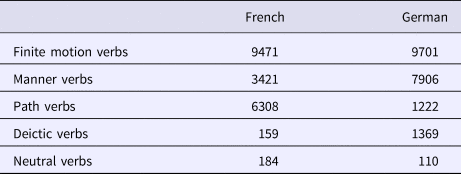
In total, 19,172 finite motion verbs were coded: 9,471 in French and 9,701 in German (see Table 1). However, the verbs differed in the types of semantic components they expressed in either French or German. In German clauses, there were more manner and deictic verbs than in French. In French clauses, 5,086 more verbs encoding Path information were identified. Neutral verbs did not show up often in either language.
Number of motion verbs in French and German.

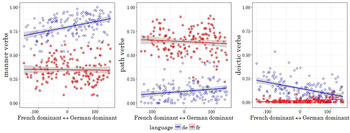
The distribution of manner and path verbs across the participants’ language dominance scores is plotted in Figure 1. Each circle represents the mean proportion of the motion verbs (y-axis) for a participant in German – regardless of the mode condition. The circle's position on the x-axis represents the participant's dominance score ranging from French-dominant on the left to German-dominant on the right. Star-symbols represent the mean proportions for each participant in French.
Proportion of manner and path verbs across dominance scale in German and French.

The graph for manner verbs suggests that dominance exerts more influence on German manner verbs than French manner verbs, since proportion of manner verbs tends to increase as German dominance increases. For French, the graph suggests a null effect of dominance, visualized by the smoothed conditional mean line, which is nearly horizontal. The figure shows that the effect of dominance was weaker for path verbs than for manner verbs. Furthermore, it shows a slight dominance effect for French path verbs as the proportion decreases with increasing German dominance. Contrary to the prediction concerning the influence of the French pattern of using more path verbs (H2a), there is a slight increase of proportion of German path verbs with increasing German dominance. This counterintuitive finding of greater use of path verb with increasing German dominance, replicates Berthele and Stocker's (Reference Berthele and Stocker2016) findings.
To inferentially test the predictions outlined in section 2.4, two models are reported in the following sections: a model for the dependent variable of manner verbs and a model for the dependent variable of path verbs.
4.1. Manner verbs
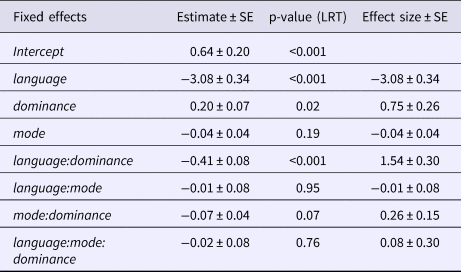
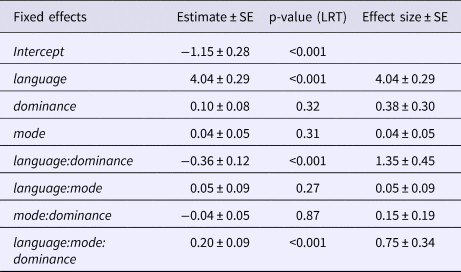
In Table 2, there are certain variables showing an effect on the probability of using a manner verb while others do not. The variable of language shows a highly significant effect confirming the cross-linguistic differences. Given that the models fit the outcome variable in both French and German, the main effect of dominance alone is irrelevant, as it is underestimated for German and overestimated for FrenchFootnote 5. The fact that the effect of dominance differs across language is confirmed in the interaction effect between dominance and language. Considering the variable of language, the effect of dominance for German is thus underestimated and overestimated for French.
Fixed effects for manner verbs.

As can be drawn from Table 2, the estimate for language mode is rather low for manner verbs and the p-value does not indicate a significant effect of this factor. The outcome for the interaction effects between language and language mode or dominance and language, or the three-way interaction between language, mode and dominance speak against an effect of these factors, as well.
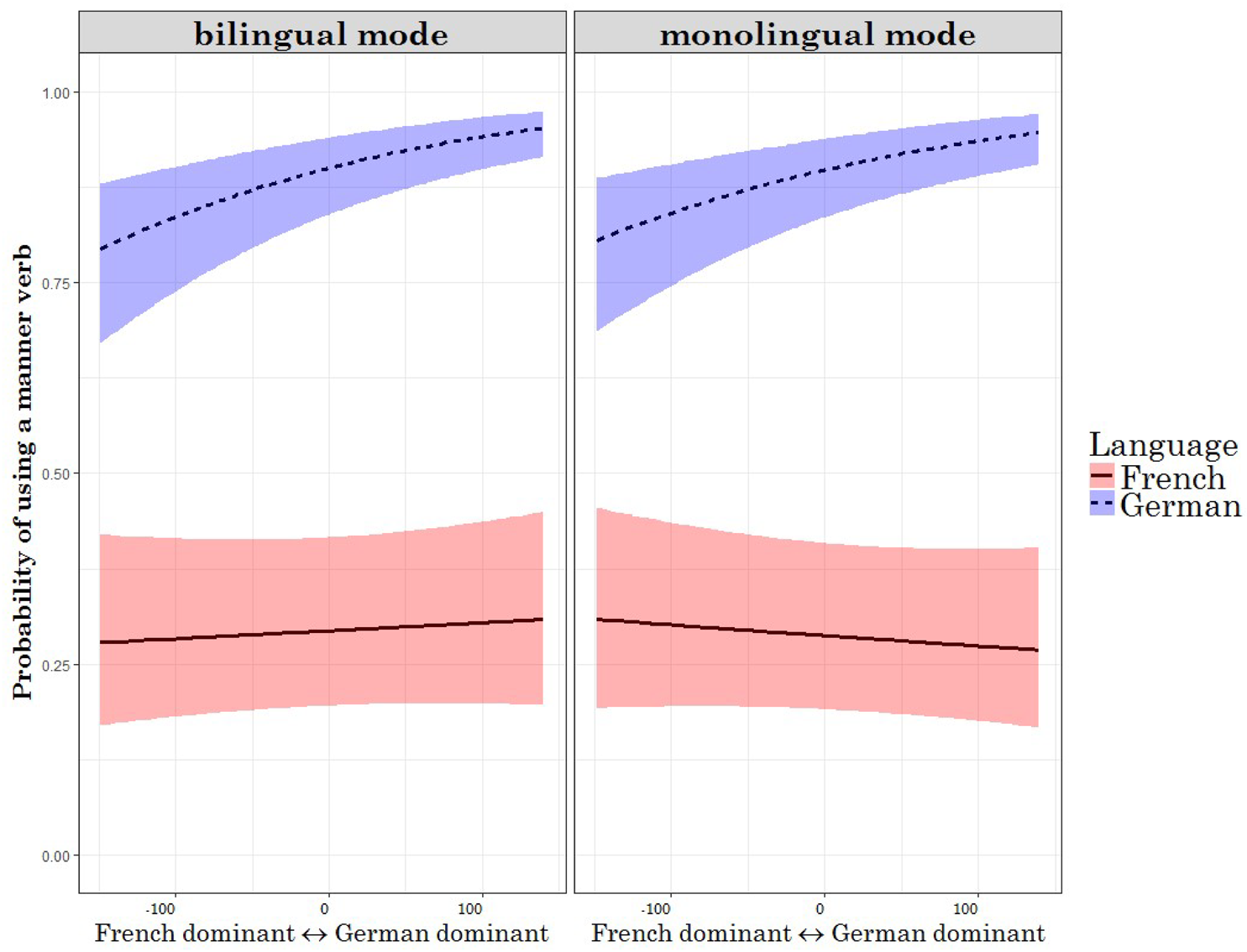
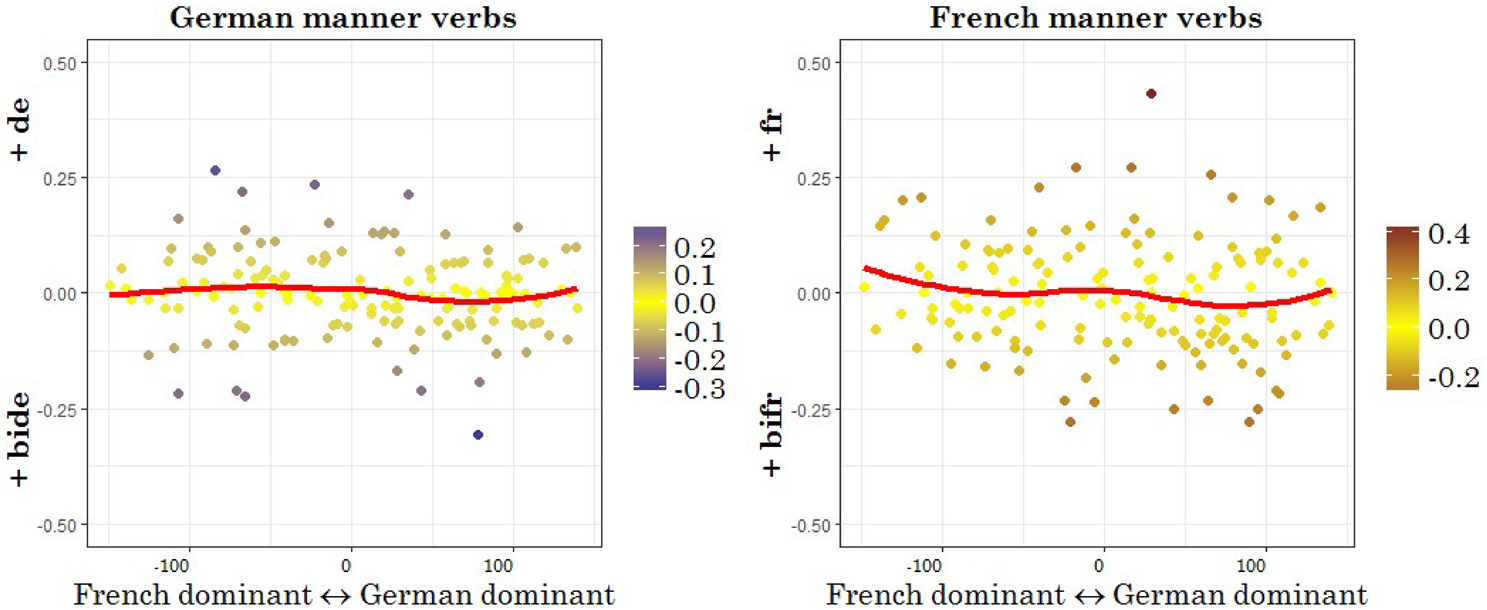
The absence of a language mode effect is visualized by the model plot in Figure 2: the graph on the left, displaying the results for the bilingual mode, largely mirrors the graph on the right, showing the results for the monolingual mode. The probability of using a German manner verb increases with increasing German dominance (cf. Figure 1) but remains largely the same for French manner verbs regardless of participants’ dominance configurations. When looking at the conditional mean for French manner verbs, there seems to be a slight increase of the probability in the bilingual mode with increasing German dominance and an increase with increasing French dominance in the monolingual French mode. However, the confidence bands indicate that this difference is not statistically borne out.
Model plot for manner verbs.

An interaction between language mode manipulation and language dominance conforming to the predictions would manifest if there were a difference between the graph on the left, the graph on the right and the distribution across the dominance score as follows. In the bilingual language mode on the left, we would expect the probability of using a German manner verb to become smaller, of using a French manner verb to become higher and a difference in distribution across the dominance scale. In other words, the lines would be closer to each other and steeper in the bilingual mode than in the monolingual mode, because more balanced and dominant speakers in the target-language would be expected to increase or decrease in this probability.
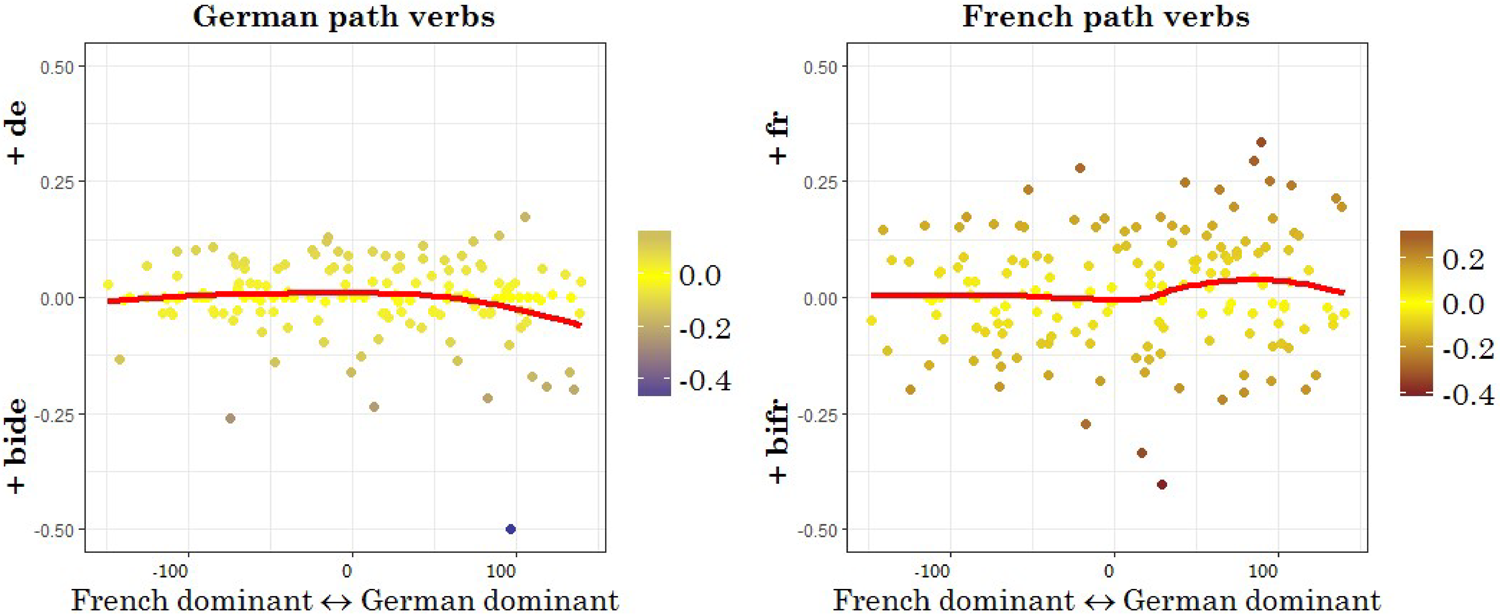
To explore how the language mode effect differs across participants, Figure 3 illustrates the mode differences across the dominance scale. The figure is built as follows: for each participant the mean proportion of manner verbs for the German bilingual mode (bide) was subtracted from the mean proportion of manner verbs for the German monolingual mode (de). The dots representing this value are distributed across the dominance scale (on the x-axis). Dots below zero (on the y-axis) indicate a higher proportion of manner verbs in the monolingual mode. The lighter (yellower) the dots, the closer they are to zero and thus the smaller the difference between the monolingual and bilingual modes. The plot on the right of Figure 3 follows the same logic: dots above zero on the x-axis indicate more manner verbs were used in the monolingual French mode, and dots below zero indicate a higher use of manner verbs in the bilingual French mode. If there were a clear interaction between mode and dominance, there would be a difference between the left and right sides. The figure shows interindividual differences: however, there is no systematic difference across language mode in terms of manner verb use, whether a participant is dominant in German or French or rather balanced between the two languages.
Mode differences across the dominance scale for manner verbs. Bide refers to the German bilingual mode, de to the German monolingual mode, bifr to the French bilingual mode, fr to the French monolingual mode.

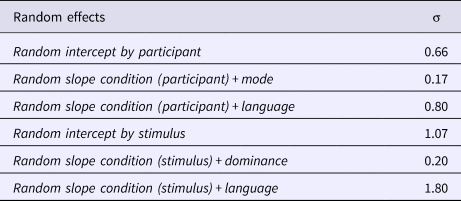
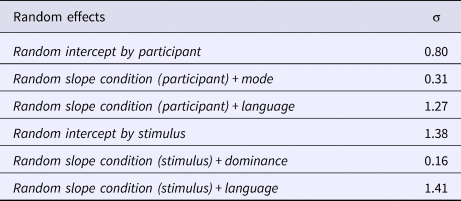
The fact that certain participants were more responsive to language mode manipulation and differed more strongly cross-linguistically is modeled in the random slope adjustment of the mixed models (Table 3). Systematic by-participant differences, which are not entirely covered by the fixed effects – including idiosyncrasies unrelated to the dominance effects – are modeled by the random intercept by participant. Given that some participants, with regard to their dominance configurations and the differences between the languages might be more sensitive to certain stimuli, by-item adjustments were modelled as well. The modelled standard deviations (σ) for the by-item intercepts are higher for all dependent variables than the standard deviation for the by-participant intercepts, suggesting greater variation due more so to the items than to the participants.
Random effect adjustment for manner verbs.

4.2. Path verbs
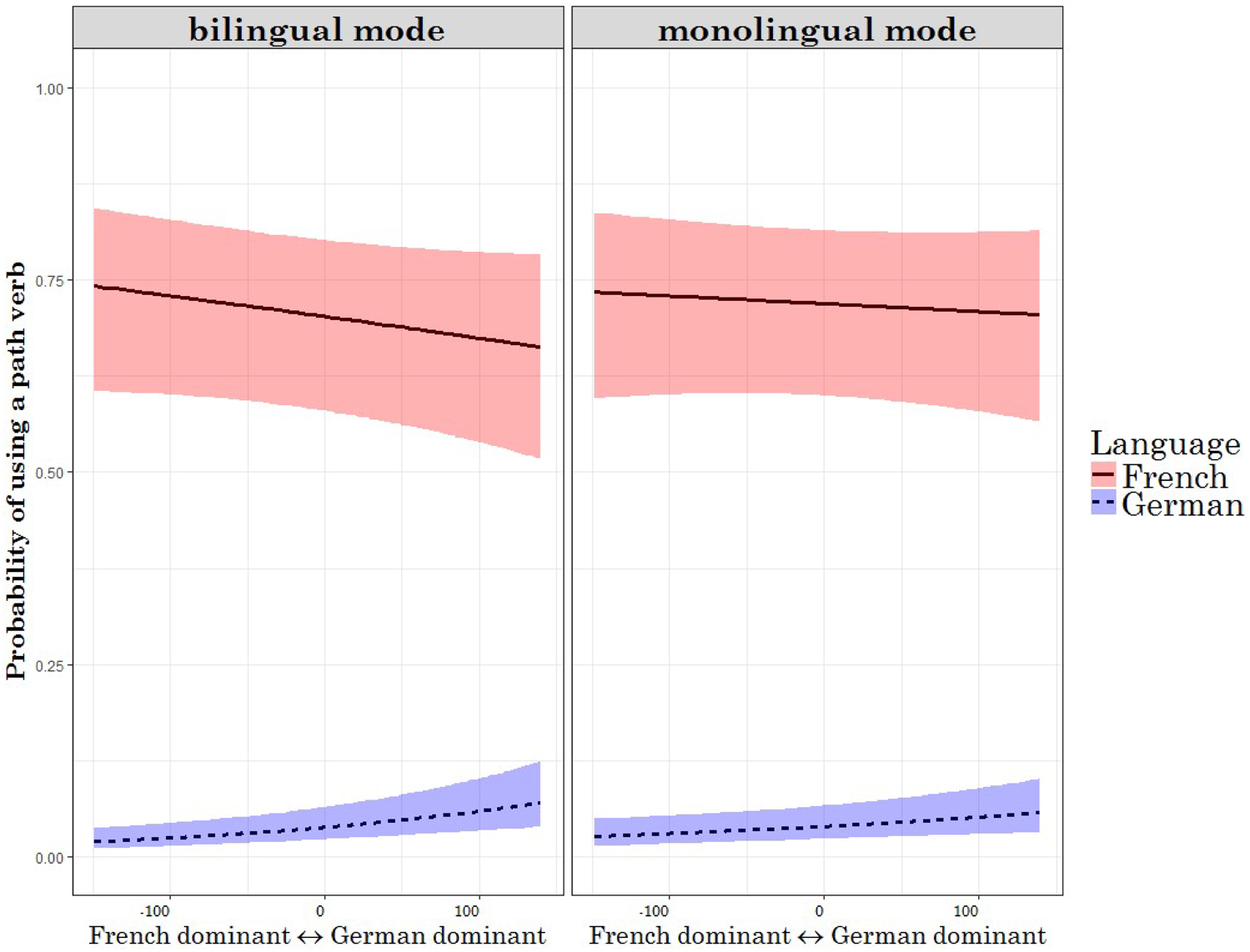
In terms of path verbs, the outcome of the GLMM (Table 4) confirms the cross-linguistic differences visualized in Figure 1. Again, there is an interaction between language and dominance: the dominance effect is stronger for German than for FrenchFootnote 6.
Fixed effects for path verbs.

Random effect adjustment for path verbs.

The effect of language mode according to the predictions was not present for path verbs either. When plotting the model for path verbs (Figure 4), however, there seems to be some difference across the modes for French. French path verbs seem to decrease with increasing German dominance more considerably in the bilingual mode. The probability of using a French path verb seems to be the same for French-dominant speakers but shows a slight mode difference in German-dominant speakers: Given the wide confidence intervals however, this difference does not seem significant. For German path verbs, the general trend remains the same for both modes: a slight increase of path verbs with increasing German dominance. The fact that there might be a slight mode-dominance interaction, but only for French, may explain the three-way interaction indicated in Table 4Footnote 7.
Model plot for path verbs.

Following Figure 5, there seems to be a slight trend toward more frequent German path verb use in the bilingual mode with increasing German dominance. This mode difference seems stronger than for French-dominant speakers. This tendency runs counter to the predictions that speakers dominant in the target language will show less difference between language modes. However, the tendency is weak and seems to result from an outlier. The same is true for French path verbs (left graph of Figure 5). A slight change in the data pattern toward the German-dominant end of the BLP, this time conforming to the prediction of a language mode difference for German-dominant speakers in French, seems to be due to a couple of outliers. All in all, the discrepancy between the modes appears to be more considerable in French path verbs than for German path verbs, as the dots representing the language mode difference in path verbs are more widely spread and darker.
Mode differences across the dominance scale for path verbs. Bide refers to the German bilingual mode, de to the German monolingual mode, bifr to the French bilingual mode, fr to the French monolingual mode.

5. Discussion
The analysis of 30 descriptions of motion events by 154 speakers in four mode conditions has shown different uses of manner and path verbs in French and German. As predicted, path verbs appear significantly more often in French constructions than in German ones, and manner verbs appear more often in German clauses than in French ones.
Consistent with Berthele (Reference Berthele2017), German manner verbs vary across the dominance configurations of the speakers: an increasing use of German manner verbs was found with increasing German dominance. The effect of language dominance on French manner verbs, on the other hand, was not significant, which is also consistent with the preceding studies.
In terms of path verbs, the effect of language dominance did not follow the expected patterns of increased path verb use with increasing French dominance. On the contrary, the use of German path verbs seemed to decrease with increasing French dominance. Given that this result is in line with similar findings reported in Berthele and Stocker (Reference Berthele and Stocker2016), evidence now suggests that the straightforward assumption that the lexicalization pattern of the dominant language will lead to convergence of the dominated language in the repertoire cannot be confirmed for the path verb domain. As discussed in this preceding study, the counter-intuitive tendency of dominance effects for German path verbs could be explained by vocabulary size: several German path verbs pertain to a higher register (e.g., durchqueren ‘to cross sth’) and occur less frequently than certain generic and manner verbs. With increasing dominance, vocabulary size usually increases. Hence, there may be two competing factors that are both governed by language dominance pushing in opposite directions during language production. On the one hand, there are different encoding patterns in French and German, leading to the influence of one pattern on the other in the description of a motion event. On the other hand, there is the factor of vocabulary size and lexical sophistication that influences the lexical choices of the bilinguals. Thus, while such German path verbs would offer a neat solution to bilinguals in that they provide a way to keep the lexicalization patterns uniform across both languages, these verbs pertain to a higher register and are usually only used by individuals mastering formal, literate registers of the language in question. Arguably, this makes their use by bilingual individuals overall less likely.
In Berthele (Reference Berthele2017), French motion descriptions seem rather resistant to language dominance effects with regard to the variables investigated. This outcome is interpreted as the result of the simplicity of the French default pattern in comparison to the German pattern. In French, a small set of highly frequent path verbs can cover most expressive requirements. This relatively simple and convenient system seems to be more entrenched than patterns in German and thus seems more resistant to restructuring processes. Accordingly, there might be system-related psycholinguistic factors, such as the lexico-constructional simplicity, contributing to French's relative immunity to language dominance effects. Besides simpler constructions, the French system arguably imposes more constraints, which may lead to reduced interference from German. The German system may be more prone to dominance effects because it is more flexible and less rigid than French. Additionally, relative normative pressure, which is by definition higher in standardized languages (such as French) compared to dialects (such as dialectal Swiss-German), might also contribute to relative malleability or rigidity of usage patterns in bilinguals. Certainly, in the case of the Swiss German responses, the lower normative pressure on linguistic patterns can be considered an intervening factor that is consonant with the larger range of response variants produced by our participants.
Language mode manipulation did not lead to a significant difference in the variables investigated – neither in German nor in French. Moreover, language dominance configurations did not interfere with effects of this language mode manipulation either. Additional analysisFootnote 8 – such as considering stimuli order, the number of the session, or self-assessed practice in code-switchingFootnote 9 as co-variates in the model – did not show an effect of the language mode manipulation either. Model-robustness checks, by including only the ten stimuli showing the largest discrepancies across the language modes or models featuring only the ten participants most susceptible to language mode effects, did not show mode effects in the expected direction. While the language mode effect was subtle in Berthele and Stocker (Reference Berthele and Stocker2016), it proved statistically significant. Thus, the results of the preceding study were not replicated.
Cross-study comparison should not be impeded by the research design, which was nearly identical. However, a difference between the present study and the preceding experiment that may explain the absence of a mode effect centers on the question of formality. While the 44 participants of the preceding study were mostly acquainted with the data collectors, the 154 participants in the current study usually were not, which may have led to different degrees of formality. Besides the difference in formality, the language mode manipulation in the study reported here was optimized by conforming more to Grosjean's propositions of having different experimenters, larger time intervals between the sessions and inducing the modes with additional tasks such as reading a text before starting the main experiment (see section 2.4). In contrast to the control for language mode, language mode manipulation has presently not been the subject of many empirical investigations. With only two empirical examinations of the language mode hypothesis in the domain of bilingual motion event encoding, the inconclusive outcome calls for further research with control for formality of the elicitation setting.
Our study certainly does not allow us to discard across the board any possibility of different states of activation in a bilingual's language system. However, we expected the domain of motion event descriptions to be a promising site for shedding light on the effects of such differences in activation – since there are robust differences in preferential constructional patterns across the languages while at the same time both languages involved also license the use of the other language's pattern. Our null result of the language mode factor certainly does not confirm our hypothesis that the competing constructional patterns in production will be activated or deactivated by the immediately preceding activation of the languages. Different explanations lend themselves to explain this finding: our method of activating languages in the bilingual mode might not be effective; language mode might affect other domains or aspects of the linguistic system than those investigated here; or, in the extreme case, the language mode theory might simply be wrong. We hope future research will address these questions so that the language mode theory can be confirmed, refined, or discarded.
6. Conclusions
This study set out to explore the role of language dominance configurations and language mode as well as the interaction between these variables in bilingual motion event descriptions. A general goal was to systematically investigate two central constructs in bilingualism theory, dominance and language mode. Our investigation aimed at shedding light on the impact of these two factors as constraints on bilinguals’ motion descriptions in both languages. Based on previous research, it was assumed that language dominance and language mode are shaping the bilinguals’ constructional choices, and it was therefore hypothesized that they explain the great range of variation generally found in motion event description data. The findings partially support the impact of dominance; but, in particular with respect to language mode, they do not support our hypotheses. These partially inconclusive findings both enrich and complicate the understanding of crucial factors in bilingual production and certainly leave room for future research.
Acknowledgements
The project received financial support from the Swiss National Science Foundation (project number 156121, granted to Raphael Berthele). A grant awarded by the University of Fribourg covered salaries of the collaborators in data collection, and the Institute of Multilingualism in Fribourg generously compensated the speakers for their participation. Special thank is due to all 154 speakers who participated in the study. We also thank Jan Vanhove for his comments on an earlier version of this paper, as well as his help with the data analysis, and Flavio Manetsch, Simon Gauthier and Laure Chaignat for helping with the data collection.
Appendix
The stimuli are available at http://tinyurl.com/stoberman (Berthele & Stocker, Reference Berthele and Stocker2014–2017), Critical items are categorized across the five different path types. The following table indicates furthermore whether the item involves the crossing of a spatial boundary or not (i.e., for the ‘across’, ‘out of’ and ‘in/into’ path category).

The scenes of the filler items all appeared twice, but were mirror-inverted. The figure is always to the left or to the right of the object which is placed somewhere. The category ‘angle’ in the following table indicates the position of the figure on the screen. The ‘put-category’ refers to the typical German placement verb describing the scene.