Introduction
Otitis externa and chronic suppurative otitis media (CSOM) are among the most common infections encountered in otolaryngology practice and represent frequent causes of outpatient visits. Otitis externa is also recognised as one of the most common causes of ear-related consultations in ambulatory care.Reference Medina-Blasini and Sharman1, Reference Wiegand, Berner, Schneider, Lundershausen and Dietz2 CSOM remains a significant contributor to hearing impairment globally,Reference Huang, Lin, Li, Tang, Fan and Lu3 and national survey data from Korea indicate a persistent burden among adults.Reference Park, Lee, Lee, Oh and Park4
Current clinical guidelines recommend topical therapy as the mainstay of treatment, which in Korean primary care practice primarily consists of fluoroquinolone-based otic drops with or without corticosteroids.Reference Bhutta, Head, Chong, Daw, Schilder and Brennan-Jones5–7 Systemic antibiotics are generally reserved for selected situations, including spreading infection, immunocompromised status or suspected complications.Reference Chong, Head, Webster, Daw, Richmond and Snelling6, 7
Evidence from randomised trials and systematic reviews suggests that topical antibiotics are at least as effective as systemic antibiotics in achieving short-term resolution of ear discharge.Reference Chong, Head, Webster, Daw, Richmond and Snelling6, Reference Macfadyen, Acuin and Gamble8 Topical quinolones are commonly favoured because they avoid unnecessary systemic exposure and are considered safe for use in the middle ear, with minimal risk of ototoxicity.Reference Chong, Head, Webster, Daw, Richmond and Snelling6, Reference Macfadyen, Acuin and Gamble8 Accordingly, routine use of systemic antibiotics in uncomplicated otitis externa or CSOM is generally discouraged in guideline-based care.
However, real-world clinical practice frequently involves patients who fall outside the scope of these recommendations. In Korean primary care settings, otolaryngologists often encounter patients with otologic symptoms persisting for one month or longer despite repeated courses of topical agents and systemic antibiotics prescribed across multiple healthcare facilities.
The Korean primary care environment presents additional structural challenges in this regard. Universal health coverage and high accessibility to outpatient services are associated with frequent healthcare utilisation and repeated antibiotic exposure.9–Reference Kim11 Within this system, many primary care otolaryngology clinics operate in high-volume clinical settings,9–Reference Kim11 where continuity of care and follow-up adherence may be variable among patients with chronic ear symptoms.
In treatment-refractory cases, repeated antimicrobial exposure and chronic infection may contribute to the selection of resistant organisms and persistence of pathogenic biofilm communities.Reference Morris12 Beyond bacterial resistance, fungal involvement represents an additional diagnostic consideration in patients with persistent otologic symptoms. Fungal organisms such as Aspergillus and Candida species have been reported in association with chronic or treatment-refractory otologic infections.Reference Sangaré, Amona, Ouedraogo, Zida and Ouedraogo13, Reference Pereira, Rao, Sharin, Tanweer, Mair and Rea14 While filamentous fungi often demonstrate characteristic otoscopic findings, fungal involvement—particularly with yeast organisms—may be clinically non-specific.Reference Sangaré, Amona, Ouedraogo, Zida and Ouedraogo13–Reference Kühbacher, Burger-Kentischer and Rupp15
In the context of structural and clinical challenges inherent to primary care otolaryngology practice, microbiological culture is occasionally performed in patients with persistent otologic symptoms despite prior antimicrobial exposure. However, microbiological data derived from primary care otolaryngology settings remain limited. In this descriptive study, we sought to characterise the ear discharge culture findings observed in a high-volume primary care clinic in Korea.
Materials and methods
Study design and setting
This study was a retrospective, descriptive observational study conducted at a single primary care otolaryngology clinic in South Korea. Medical records from 1 September 2025 to 20 February 2026 were reviewed.
Study population
Patients were identified among individuals who underwent ear discharge culture during routine clinical care for persistent or recurrent otologic symptoms. Inclusion criteria required a symptom duration of at least one month, such as otorrhea, pruritus, otalgia or aural discomfort. Patients were also required to have a documented history of prior treatment for the same condition at one or more healthcare facilities, with exposure to ototopical agents and/or systemic antibiotics.
Recent antibiotic exposure was operationally defined as the use of systemic antibiotics or ototopical agents within two weeks before specimen collection. The two-week interval was chosen to reduce the short-term influence of prior therapy on culture yield and antimicrobial susceptibility results.
Only cases with available microbiological identification and antibiotic susceptibility results were included in the analysis. Patients were excluded if culture results were unavailable or incomplete, or if key clinical variables required for analysis were missing.
Specimen collection and microbiological analysis
Ear discharge specimens were collected using sterile mini-tip swabs from the external auditory canal or middle ear, depending on the clinical presentation. Specimens were obtained using an Amies gel–based transport system (Transystem™, Copan, Italy).
To minimise operator-dependent variability, all specimen collections were performed by a single physician. Collected specimens were sent to an external certified laboratory (Seoul Medical Science Institute, Yongin, South Korea) for microbiological analysis. Bacterial identification and antibiotic susceptibility testing were performed using standard culture techniques and an automated broth microdilution system (VITEK 2®, bioMérieux), according to routine protocols. Minimum inhibitory concentrations were interpreted as susceptible, intermediate or resistant in accordance with the Clinical and Laboratory Standards Institute (CLSI) guidelines.
Given that otologic symptoms had persisted for more than one month, fungal culture was routinely included as part of the ear discharge evaluation and processed according to standard laboratory protocols.
Results
Study population and baseline characteristics
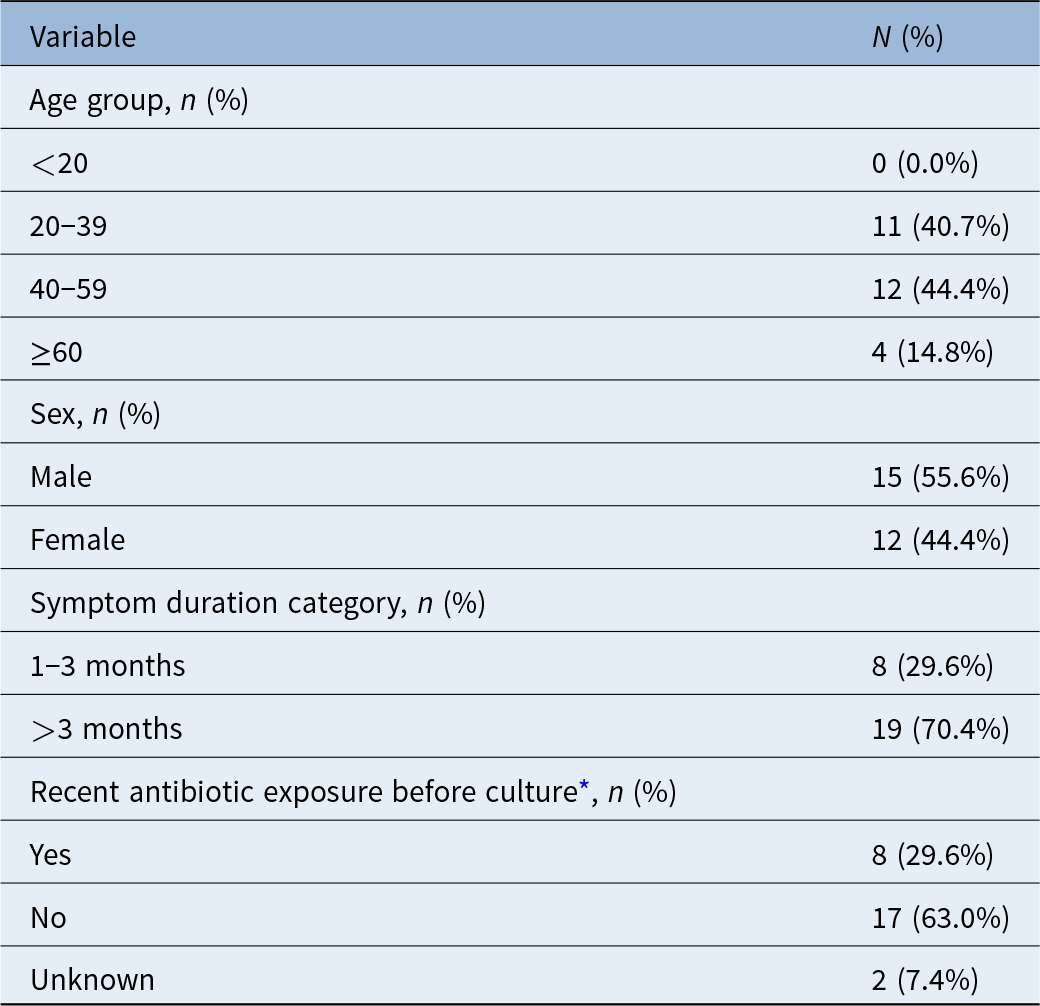
All counts and percentages are presented at the specimen level unless otherwise specified. A total of 24 patients were included in the analysis, from whom 27 ear discharge specimens were obtained (Table 1). Three patients contributed bilateral ear discharge specimens collected during the same clinical visit, which were analysed independently at the specimen level.
Baseline characteristics of included specimens (N = 27)

Table 1 Long description
Baseline specimen characteristics are summarized for 27 specimens, including age group, sex, symptom duration category, and recent antibiotic exposure before culture. Ages were concentrated in midlife: 44.4% were 40 to 59 and 40.7% were 20 to 39, with 14.8% age 60 or older and none under 20. Sex distribution was 55.6% male and 44.4% female. Symptoms most often lasted longer than 3 months (70.4%), compared with 29.6% lasting 1 to 3 months. Recent antibiotic exposure was reported for 29.6%, while 63.0% reported none and 7.4% were unknown. Age and sex reflect the associated patients, and antibiotic exposure is based on patient recall, so misclassification is possible.
Note: Data are presented at the specimen level. Age and sex are assigned to specimens according to the characteristics of the corresponding patients.
* Recent antibiotic exposure was defined as use of ototopical or systemic antibiotics within two weeks before specimen collection and was assessed based on patient recall.
No specimens were obtained from patients younger than 20 years. Specimens were most frequently derived from patients aged 20–39 years (11 specimens; 40.7 per cent) and 40–59 years (12 specimens; 44.4 per cent), while four specimens (14.8 per cent) were obtained from patients aged 60 years or older. Specimens were obtained slightly more often from male patients (15 specimens; 55.6 per cent) than from female patients (12 specimens; 44.4 per cent).
Regarding symptom duration, most specimens were obtained from patients with symptoms lasting more than three months (19 specimens, 70.4 per cent), whereas eight specimens (29.6 per cent) were associated with symptom durations of 1–3 months. Recent antibiotic exposure was reported in eight specimens (29.6 per cent). In 17 specimens (63.0 per cent), no antibiotic use was reported within the two weeks preceding culture, despite a history of prior antimicrobial treatment for the same condition. For two specimens (7.4 per cent), information on recent antibiotic exposure was unavailable.
Otologic characteristics
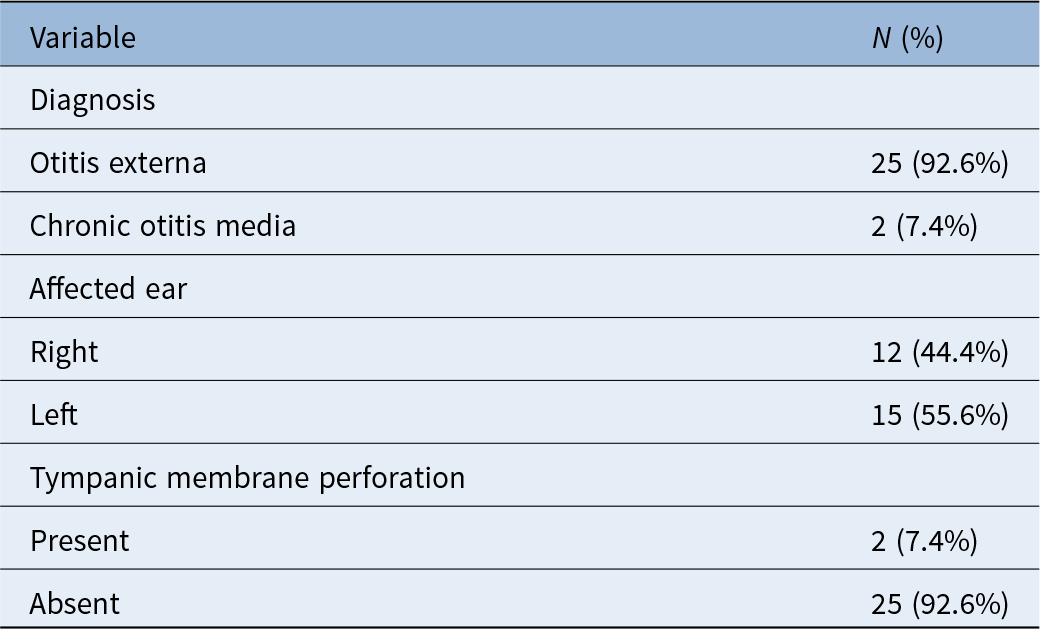
Otologic diagnoses and clinical characteristics are summarised in Table 2. Among the 27 specimens, the majority were obtained from patients diagnosed with otitis externa (25 specimens; 92.6 per cent), whereas chronic otitis media accounted for a smaller proportion (two specimens; 7.4 per cent). Specimens were obtained slightly more frequently from the left ear (15 specimens; 55.6 per cent) than from the right ear (12 specimens; 44.4 per cent). Tympanic membrane perforation was identified in two specimens (7.4 per cent), while the remaining 25 specimens (92.6 per cent) showed no evidence of perforation.
Otologic characteristics of included specimens (N = 27)

Table 2 Long description
Otologic characteristics are summarized for 27 specimens, reporting counts and percentages for diagnosis, affected ear side, and tympanic membrane perforation status. Otitis externa was the primary diagnosis in 25 specimens (92.6%), while chronic otitis media occurred in 2 specimens (7.4%). The affected ear was left in 15 specimens (55.6%) and right in 12 specimens (44.4%), indicating a small left-side predominance. Tympanic membrane perforation was present in 2 specimens (7.4%) and absent in 25 specimens (92.6%), suggesting perforation was uncommon in this set. Percentages reflect specimen-level reporting and may not generalize beyond the included specimens.
Note: Data are presented at the specimen level.
Prior treatment exposure and post-culture clinical decisions
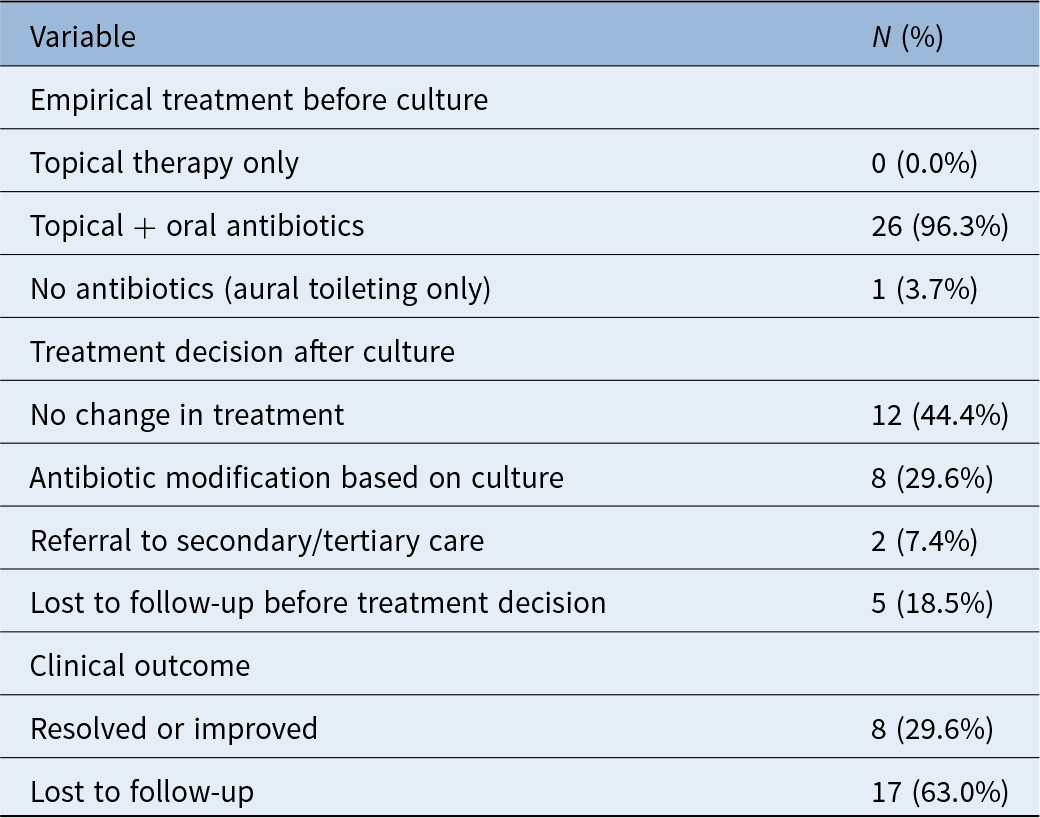
Patterns of empirical treatment prior to culture and post-culture clinical decisions are summarised in Table 3. Most specimens had been obtained from patients who had received both ototopical agents and systemic antibiotics prior to culture (26 specimens; 96.3 per cent). Only one specimen (3.7 per cent) was obtained from a patient who underwent aural toileting without concurrent antibiotic therapy before culture. No specimens were obtained from patients treated with ototopical therapy alone.
Clinical course and outcomes of included specimens (N = 27)

Table 3 Long description
Specimen-level counts and percentages summarize treatments before culture, treatment decisions after culture, and clinical outcomes for 27 specimens. Before culture, topical plus oral antibiotics were used for 26 specimens, while 1 specimen had no antibiotics and none received topical therapy only. After culture, treatment was unchanged for 12 specimens and modified based on culture for 8 specimens; 2 were referred to higher-level care and 5 were lost to follow-up before a treatment decision. For outcomes, 8 specimens were recorded as resolved or improved, while 17 were lost to follow-up. Loss to follow-up is the most common endpoint, which limits interpretation of treatment effectiveness and outcome rates.
Note: Data are presented at the specimen level.
Following availability of culture results, antibiotic modification based on microbiological findings was implemented in eight specimens (29.6 per cent). In 12 specimens (44.4 per cent), treatment was continued without change. Referral to secondary or tertiary care was made for two specimens (7.4 per cent), while five specimens (18.5 per cent) were lost to follow-up before a post-culture treatment decision could be made. In cases where fungal organisms were detected, topical azole-based antifungal therapy was administered as part of routine clinical management. This decision was based on microbiological findings and clinical judgement.
Regarding overall clinical outcomes, resolution or improvement was documented in eight specimens (29.6 per cent), whereas 17 specimens (63.0 per cent) were lost to follow-up. Referral to secondary or tertiary care ultimately occurred in two specimens (7.4 per cent).
Microbiological findings
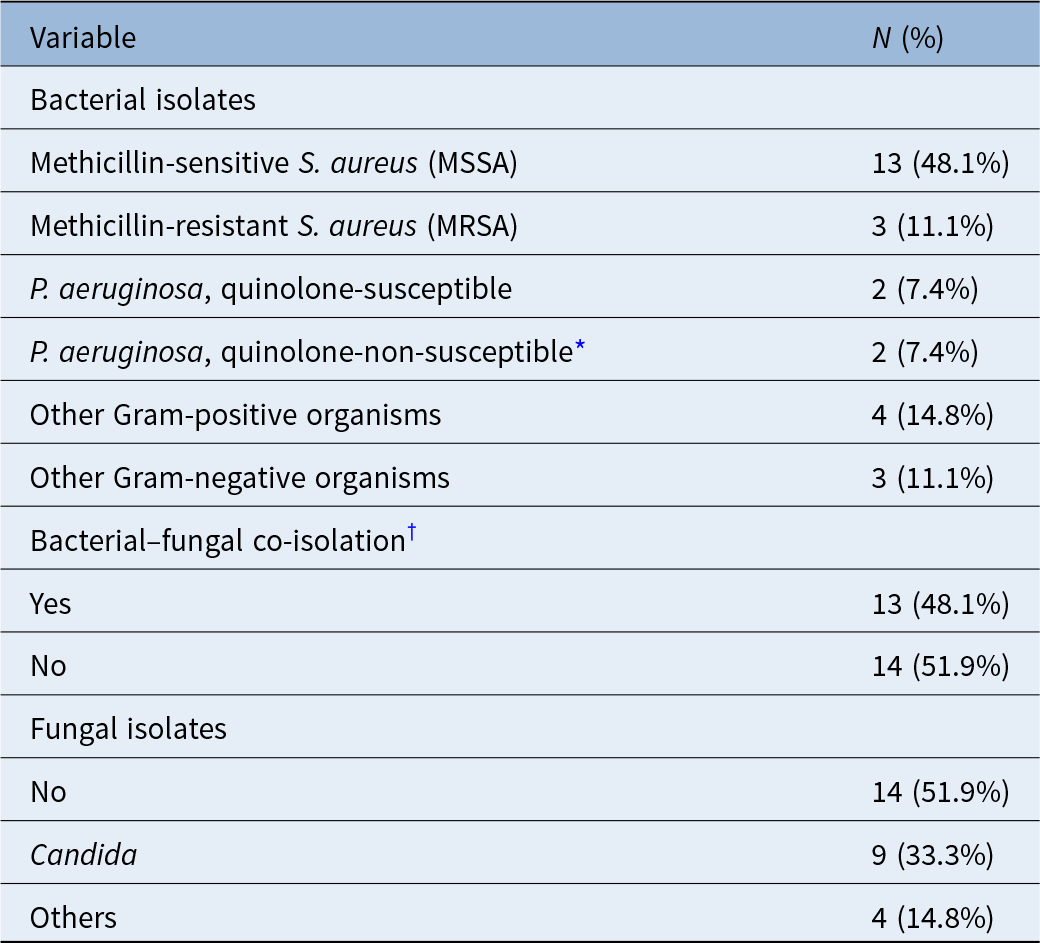
Microbiological findings are summarised at the specimen level in Table 4. Among the 27 specimens, Staphylococcus aureus was the most frequently isolated organism, including methicillin-susceptible S. aureus (MSSA) in 13 specimens (48.1 per cent) and methicillin-resistant S. aureus (MRSA) in three specimens (11.1 per cent). Pseudomonas aeruginosa was isolated in four specimens (14.8 per cent); among these, reduced susceptibility to fluoroquinolones was observed in two specimens (7.4 per cent). Other Gram-positive organisms were identified in four specimens (14.8 per cent), and other Gram-negative organisms in three specimens (11.1 per cent).
Microbiological findings of included specimens (N = 27)

Table 4 Long description
Microbiological results are summarized for 27 specimens, reported as counts and percentages per specimen. Methicillin-sensitive Staphylococcus aureus was the most frequent bacterial isolate at 13 specimens, 48.1%, followed by other Gram-positive organisms at 4 specimens, 14.8%. Methicillin-resistant Staphylococcus aureus accounted for 3 specimens, 11.1%, and other Gram-negative organisms also accounted for 3 specimens, 11.1%. Pseudomonas aeruginosa was found in 4 specimens total, split evenly between quinolone-susceptible and quinolone-non-susceptible at 2 specimens each, 7.4% each. Bacterial–fungal co-isolation was nearly evenly split, with 13 specimens, 48.1%, showing co-isolation and 14 specimens, 51.9%, not showing co-isolation. For fungal findings, no fungus was isolated in 14 specimens, 51.9%, while Candida was isolated in 9 specimens, 33.3%, and other fungi in 4 specimens, 14.8%. Percentages reflect specimen-level reporting, and each specimen contributed only one bacterial species.
Note: Data are presented at the specimen level.
* Defined as intermediate or resistant to ciprofloxacin.
† Bacterial–fungal co-isolation was defined as the concurrent isolation of bacterial and fungal organisms from a single specimen. Each specimen yielded a single bacterial species.
No specimens yielded more than one bacterial species. Bacterial–fungal co-isolation was observed in 13 specimens (48.1 per cent). Fungal isolates were identified in 13 specimens (48.1 per cent), with Candida species detected in nine specimens (33.3 per cent) and other fungi in four specimens (14.8 per cent).
Antibiotic susceptibility patterns
Detailed antibiotic susceptibility results are presented in Supplementary Tables S1 and S2. Fluoroquinolone resistance was a prominent finding across major bacterial pathogens isolated in this study. Among S. aureus isolates, ciprofloxacin and levofloxacin resistance was observed in nine of 16 (56.3 per cent) and eight of 16 isolates (50.0 per cent), respectively. In contrast, all isolates with available susceptibility data remained susceptible to linezolid, vancomycin, teicoplanin, tigecycline, rifampin and penicillin G (15 isolates each). A similar pattern of reduced fluoroquinolone susceptibility was observed in P. aeruginosa, with two of four isolates (50.0 per cent) demonstrating decreased susceptibility to ciprofloxacin. All P. aeruginosa isolates were fully susceptible to ceftazidime, cefepime, carbapenems, tobramycin and piperacillin–tazobactam (four isolates; 100 per cent).
Other Gram-positive and Gram-negative organisms identified in small numbers are summarised in Supplementary Table S3. These included S. capitis, Enterococcus faecalis, Escherichia coli, Serratia marcescens and Klebsiella aerogenes (formerly Enterobacter aerogenes), each isolated in one or two specimens. Notable resistance patterns were observed among these organisms. S. capitis exhibited macrolide resistance with concurrent fluoroquinolone resistance. E. coli demonstrated a phenotypic pattern consistent with extended-spectrum β-lactamase production. S. marcescens showed intrinsic resistance to ampicillin and first-generation cephalosporins, as did K. (Enterobacter) aerogenes. Finally, Enterococcus faecalis demonstrated macrolide resistance accompanied by high-level streptomycin resistance. Because of the limited number of isolates, these organisms were described descriptively rather than analysed using susceptibility percentages.
Fungal isolation
Fungal organisms were detected in 13 of the 27 specimens (48.1 per cent), as summarised in Supplementary Table S4. Candida species were identified in 9 specimens (33.3 per cent), while other fungal organisms were identified in four specimens (14.8 per cent). Fungal co-isolation occurred most frequently in specimens yielding S. aureus or other Gram-positive organisms.
Discussion
In this descriptive study conducted in a primary care otolaryngology clinic, we examined the microbiological profiles of ear discharge specimens from patients with persistent otologic symptoms and substantial prior antimicrobial exposure. A key finding was the predominance of S. aureus isolates, with a substantial proportion demonstrating reduced susceptibility to fluoroquinolones. The high proportion of fluoroquinolone–non-susceptible isolates observed in this cohort suggests that repeated empirical exposure in community settings may contribute to selective pressure. Among S. aureus isolates, susceptibility to vancomycin, teicoplanin, linezolid and rifampin was preserved, likely because these agents are rarely used in routine primary care otologic practice.
Pathogen profiles in chronic otologic infections differ substantially between primary and tertiary care settings. In tertiary care hospital–based cohorts, P. aeruginosa and S aureus are frequently reported as major pathogens.Reference Lee, Jeong, Lee, Byun, Lee and Chung16 In the present primary care–based study, specimens were characterised by a predominance of S. aureus. These differences likely reflect variation in disease severity, referral pathways and cumulative antimicrobial exposure before culture.
From a clinical management perspective, culture results led to modification of antimicrobial therapy in approximately one-third of specimens, indicating that microbiological data influenced treatment decisions in a meaningful proportion of cases. In specimens without treatment modification, documented clinical improvement was observed in a subset of cases; however, interpretation of overall outcome patterns is limited by the substantial proportion of specimens lost to follow-up. This finding likely reflects the episodic and high-volume nature of primary care practice, where continuity of care may be variable. Nevertheless, these data remain consistent with guideline recommendations that suggest considering microbiological culture in treatment-refractory or recurrent otologic infections.Reference Chong, Head, Webster, Daw, Richmond and Snelling6, 7
Notably, E. coli, S. marcescens and K. (Enterobacter) aerogenes were identified in this study. Such organisms are not typically regarded as common causative pathogens in otologic infections, highlighting the role of microbiological culture in their identification. In particular, detection of an extended-spectrum β-lactamase (ESBL)–producing E. coli isolate may assist clinicians in determining referral needs based on the antibiotic susceptibility profile.
Fungal organisms were co-isolated with bacterial pathogens in nearly half of the analysed specimens, most commonly Candida species. No specimen yielded fungal growth alone, and bacterial monoculture was observed in all cases. These findings suggest that fungal detection in this cohort more likely reflects bacterial–fungal co-isolation rather than primary fungal infection.
Prolonged or repeated exposure to ototopical antibiotics has been reported as a predisposing factor for otomycosis.Reference Sangaré, Amona, Ouedraogo, Zida and Ouedraogo13, Reference Pereira, Rao, Sharin, Tanweer, Mair and Rea14 Such exposure may disrupt the local microbial balance and facilitate fungal overgrowth. In this context, the high frequency of fungal co-isolation observed in our study may represent secondary colonisation or overgrowth following extensive antibacterial therapy. In our clinical practice, topical azole-based antifungal therapy was administered when fungal organisms were identified. However, given the observational design and substantial loss to follow-up, the independent clinical contribution of antifungal therapy could not be determined.
These findings support the selective use of ear discharge culture in primary care. Culture may be particularly helpful in patients with prolonged symptoms and repeated prior antimicrobial exposure when empirical therapy has not achieved clinical resolution.
Limitations
This study has several limitations. First, it was conducted at a single primary care otolaryngology clinic with a limited number of specimens, which may limit the generalisability of the findings. Selection bias is also possible, as ear discharge cultures were performed selectively at the discretion of the treating clinician and may preferentially represent patients with more refractory or clinically complex disease. Second, microbiological analyses were conducted at the specimen level, whereas certain clinical decisions are made at the patient level, introducing potential clustering effects. Third, a substantial proportion of specimens were lost to follow-up, which limits interpretation of clinical outcome measures and precludes definitive conclusions regarding the effectiveness of culture-guided treatment modification. Although such follow-up patterns may be characteristic of high-volume community-based practice, they restrict the ability to assess sustained clinical outcomes. Fourth, fungal organisms were identified based on culture-based co-isolation. Although antifungal therapy was used when fungal organisms were detected, the study design did not allow distinction between pathogenic infection and colonisation or evaluation of treatment impact. Finally, long-term clinical outcomes following culture-guided treatment modification were not systematically assessed, precluding evaluation of the sustained impact of culture-informed management. Future studies involving larger, multicenter primary care cohorts and more detailed microbiological characterisation are warranted to further elucidate the epidemiology and clinical relevance of pathogens encountered in refractory otologic infections.
Conclusion
In patients with persistent otologic symptoms managed in Korean primary care settings, extensive prior antimicrobial exposure is common. Microbiological findings frequently include fluoroquinolone-non-susceptible bacterial pathogens and bacterial–fungal co-isolation. In this clinically challenging population, selective microbiological culture may support more individualised management. It may be particularly useful when empirical therapy fails to achieve clinical resolution, prompting treatment modification or referral.
Supplementary material
The supplementary material for this article can be found at https://doi.org/10.1017/S002221512610526X.
Data availability
The datasets used and/or analysed during the current study are available from the corresponding author on reasonable request.
Financial support
This research received no specific grant from any funding agency, commercial or not-for-profit sectors.
Competing interests
The authors declare none.
Ethical standards
This study was reviewed and confirmed as exempt from formal ethical review by the Public Institutional Review Board designated by the Ministry of Health and Welfare of the Republic of Korea (Exemption Confirmation No. P01-202602-01-062; Notification No. 2026-0484-001). The study was conducted in accordance with the Bioethics and Safety Act of Korea. The research was based on retrospective review of medical records, and no direct patient contact or intervention was involved.