Introduction
Staphylococcus aureus is an opportunistic Gram positive pathogen and the causative agent of many diseases ranging from skin lesions to septicaemia or meningitis. Certain strains of Staph. aureus can produce staphylococcal enterotoxins (SEs) in foods and cause staphylococcal food poisonings (SFP). SEs are formed in foods during growth of Staph. aureus. The symptoms of SFP, abdominal cramps, nausea, vomiting and diarrhoea, develop 2–4 h after food intake and their seriousness depends on individual health status. To date, 21 antigenic serotypes of SEs have been described. Among SEs, the classical serotypes SEA, SEB, SEC and SED are most often isolated in SFP outbreaks (Balaban & Rasooly, Reference Balaban and Rasooly2000). The occurrence of Staph. aureus strains producing SEs in raw milk or cheeses has been reported in many countries (Hein et al. Reference Hein, Jorgensen, Loncarevic and Wagner2005; Cremonesi et al. Reference Cremonesi, Perez, Pisoni, Moroni, Morandi, Luzzana, Brasca and Castiglioni2007; El-Sharoud & Spano, Reference El-Sharoud and Spano2008). SFP outbreaks due to consumption of cheese products have also been reported worldwide (Balaban & Rasooly, Reference Balaban and Rasooly2000), and in Greece as well (Jelastopulu et al. Reference Jelastopulu, Venieri, Komninou, Kolokotronis, Constantinidis and Bantias2006).
Feta and Galotyri are two traditional Greek cheeses. Feta cheese is made from ovine milk or mixtures of ovine and caprine milk, with the latter not exceeding 30%. Galotyri cheese is also made from ovine or caprine milk or mixtures of both. According to European Union regulation 1107/96, Feta and Galotyri cheeses are designated as cheeses of Protected Denomination of Origin (PDO).
The fate of Staph. aureus and the production of SEs have been studied in various cheese types during manufacturing, ripening and storage (Meyrand et al. Reference Meyrand, Boutrand-Loei, Ray-Gueniot, Mazuy, Gaspard, Jaubert, Perrin, Lapeyre and Vernozy-Rozand1998; Vernozy-Rozand et al. Reference Vernozy-Rozand, Meyrand, Mazuy, Delignette-Muller, Jaubert, Perrin, Lapeyre and Richard1998; Hamama et al. Reference Hamama, El Hankouri and El Ayadi2002; Rilla et al. Reference Rilla, Martinez and Rodriguez2004, Delbes et al. Reference Delbes, Alomar, Chougui, Martin and Montel2006; El-Sharoud & Spano, Reference El-Sharoud and Spano2008). The results obtained have varied due to various factors such as cheese characteristics, starters or Staph. aureus strains. For this reason, no generalisations should be made about the fate of Staph. aureus in different cheese products (Vernozy-Rozand et al. Reference Vernozy-Rozand, Meyrand, Mazuy, Delignette-Muller, Jaubert, Perrin, Lapeyre and Richard1998). Besides, the toxigenic ability of Staph. aureus strains, isolated from raw ovine milk, have not been yet investigated in cheeses produced from ovine milk.
Feta and Galotyri are two different cheese types with different starter cultures, pH, and moisture and may offer the opportunity to investigate the effects of different competitions in the cheese ecology for the growth of food-borne pathogens like Staph. aureus. In addition, Feta cheese requires a maturation step of at least 2 months, while Galotyri cheese may be consumed fresh. Therefore, these cheeses are good models for studying Staph. aureus survival through cheese making process and subsequent storage. The aim of present work was to investigate the fate of enterotoxigenic Staph. aureus strains isolated from raw ovine milk, as well as the fate of produced SEs in Feta or Galotyri cheeses during manufacturing, ripening and storage.
Materials and Methods
Bacterial strains
Staph. aureus LHA, LHB, LHC and LHD strains from our Laboratory stock were used. All Staph. aureus strains were isolated from raw ovine milk produced in local farms. Each of the four Staph. aureus strains was toxigenic by producing a different type of SE. The Staph. aureus LHA, LHB, LHC and LHD strains were chosen, since they were toxigenic by producing the most common classical SEs (Balaban & Rasooly, Reference Balaban and Rasooly2000) of SEA, SEB, SEC and SED, respectively. The toxigenic ability of Staph. aureus strains was examined, as described below.
Each strain was grown separately in 50 ml Brain Heart Infusion broth (BHI) (Oxoid, Basingstoke, UK) for 24 h at 37 °C, with two consecutive transfers. The bacterial cells were pelleted by centrifugation at 5000 g for 15 min at 5 °C and washed twice with 10 ml 0·1 m phosphate buffer saline (PBS) (Oxoid), pH 7·0, and diluted to 1·0 × 108 cfu/ml in PBS. Cell counts were determined by serial dilution and subsequent enumeration on Baird-Parker agar (Merck, Darmstadt, Germany) supplemented with egg yolk tellurite emulsion (BPA + EYT), (Merck). The final suspension was serially diluted in PBS for the preparation of two levels of inocula. A low (ca. 103 cfu/ml) or a high (ca. 106 cfu/ml) level inoculum of each strain was used for the low or high contamination trials of the milk or cheese, respectively.
A mesophilic starter culture (lyophilized type R 704, Chr. Hansen A/S, Horlom, Denmark) of a mixture of lactic acid strains (Lactococcus lactis subsp. lactis and Lc. lactis subsp. cremoris, 1:1) was used for the manufacture of Feta cheese. A thermophilic starter culture (lyophilized type CH-1, Chr. Hansen) of a mixture of lactic acid strains (Lactobacillus delbrueckii subsp. bulgaricus and Streptococcus salivarius subsp. thermophilus, 1:1) was used for the manufacture of Galotyri cheese. The starter cultures were prepared according to manufacturer's instructions.
Ovine milk
Raw ovine milk with total viable counts (TVC) of ca 5·1 log cfu/ml from a selected local farm was used for the initial screening tests of SEs production of our Staph. aureus strains, as well as the manufacture of Feta and Galotyri cheeses. The absence of Staph. aureus in the raw ovine milk was verified by microbiological analysis, as described below.
Detection of toxigenic ability of Staph. aureus strains in in-vitro tests and ovine milk
Staph. aureus LHA, LHB, LHC and LHD strains were examined for toxigenic ability during their growth in BHI broth and in raw or pasteurized (65 °C for 30 min) ovine milk, for the in-vitro and ovine milk tests, respectively. Each Staph. aureus strain was inoculated (ca 3 log cfu/ml) in BHI and raw or pasteurized ovine milk and grown at 37 °C, under static conditions. Analysis for the presence of SEs was made, and verified by PCR, as described below. The toxigenic Staph. aureus strains, which proved to produce SE in ovine milk, were used for the contamination trials in Feta or Galotyri cheeses.
Detection of Staph. aureus virulence genes by PCR
The Staph. aureus LHA, LHB, LHC and LHD strains were screened by PCR for the presence of sea, seb, sec and sed genes, encoding the production of SEA, SEB, SEC and SED, respectively. Analysis for presence of the SEs genes was carried out by using previously published primer sequences for sea (Tsen & Chen, Reference Tsen and Chen1992) and seb–sed genes (Johnson et al. Reference Johnson, Tyler, Ewan, Ashton, Pollard and Rozee1991). DNA extraction from the Staph. aureus strains was conducted using the QIAamp DNA minikit (Qiagen, Hilden, GmbH) according to the manufacturer instructions. DNA amplification was performed in a Perkin–Elmer GeneAmp 2400 thermo cycler (Applied Biosystems, Warrington, UK). The amplification conditions and reagents for the PCR assays were those described by Akineden et al. (Reference Akineden, Hassan, Schneider and Usleber2008). PCR products were analysed by agarose gel electrophoresis and separated DNA bands were visualised using ethidium bromide staining under UV illumination.
Manufacture of cheeses and contaminations trials
Raw ovine milk obtained the same day was split into six portions for the manufacturing of three batches for each type of cheese. The three batches of Feta or Galotyri cheeses were made from pasteurized toxic ovine milk, pasteurized ovine milk with a low inoculum of Staph. aureus, pasteurized ovine milk with a high inoculum of Staph. aureus.
Toxic milk with SE was obtained by contaminating the raw ovine milk with high inoculum of Staph. aureus (ca 6 log cfu/ml) and incubation for 2 h at 37 °C. Both cheeses were manufactured in the pilot plant of a local cheese factory (Tyras SA, Trikala, Greece). Established methods were used for the manufacture of Feta (Govaris et al. Reference Govaris, Papageorgiou and Papatheodorou2002) and Galotyri cheeses (Kondyli et al. Reference Kondyli, Katsiari and Voutsinas2008). Both cheeses were prepared in stainless double-jacketed cheese vats with a milk capacity of 150 litres. The milk (raw or toxic) was pasteurized at 65 °C for 30 min. After pasteurization, the milk was cooled at 35 °C and the mesophilic and thermophilic starter cultures were added for the manufacturing of Feta and Galotyri cheeses respectively. At the same time, the low or high inocula of toxigenic Staph. aureus strains were also added to the milk, for the batches of low or high contamination trials, respectively. The toxigenic strains were selected among our Staph.aureus strains, as described above.
After 30 min of incubation at 35 °C, the milk of both cheese types was curdled using a rennet (Hala, Chr. Hansen) at a dose of 2·5 g/100 l milk. After the completion of curdling, drainage of the curd was carried out with different procedures for each type of cheese. The curd of Feta cheese was cut after 30 min and drained in polypropylene hoops until next morning (24 h) at 20 °C. The Feta cheese blocks (21 × 11 × 8 cm) of ca 2 kg were placed in a tin pack (24 × 24 × 32 cm) in four layers, filled with 3 l 5·6% salt brine and placed at 16 °C. Ripening at 16 °C continued until the pH of the cheese blocks decreased to 4·60 (16 d), and then the cheese packs were stored at 4 °C. The curd of Galotyri cheese was cut, after 6 h. Then the curd was placed in a cloth bag and drained at 20 °C for ca 6 h. After the whey drainage, the curd of Galotyri cheese was kept at 20 °C until its pH reached 4·30 (ca 24 h). Then, the Galotyri cheese (2 kg) was salted (1·7%w/w), packed in plastic containers and stored at 4 °C.
Analysis of SEs
In in-vitro and ovine milk tests, samples of BHI broth and raw or pasteurized ovine milk were obtained for SEs analysis at 0 h and at 2 h intervals up to the 12 h incubation. In Feta or Galotyri cheeses tests, samples of cheese milk, curd and cheese were taken for SEs analysis at the same sampling times as those described in microbiological analysis of Feta or Galotyri cheeses.
Samples of BHI broth (25 ml), milk (25 ml), curd (25 g) or cheese (25 g) were examined for the presence of SEs by using an ELISA test kit for combined detection of Staph. aureus enterotoxins SEA, SEB, SEC, SED and SEE (RIDASCREEN® SET Total, R4105, R-Biopharm AG, Darmstadt, Germany), according to manufacture's recommendations. Samples found positive for the presence of SEs were further examined for the determination of the toxin type (A-E), by using an ELISA test kit (RIDASCREEN® SET A,B,C,D,E, R4101, R-Biopharm AG), according to manufacture's recommendations. The detection limit of both test kits was labelled as 0·25 ng/g.
Microbiological analysis
Staph. aureus, and TVC populations were estimated at 2 h intervals up to 12 h incubation, in BHI broth and raw or pasteurized ovine milk.
In Feta cheese tests, Staph. aureus and LAB populations were estimated at: milk (0 h), curd before cutting (2 h), curd in hoops after 2 h of cutting (4 h), curd after salting and drainage (10 h), cheese after 24 h, and then 4 d intervals up to the end of ripening (16 d), and on 30 and 60 d of the refrigerated storage. In Galotyri cheese tests, Staph. aureus and LAB populations were estimated at: milk (0 h), curd (2 h), curd before cutting (6 h), curd after six hours of whey drainage (12 h), cheese after 24 h, cheese on 5 d and then 5 d intervals up to the end of the refrigerated storage (30 d).
At each sampling time, samples of BHI broth (25 ml), milk (25 ml), curd or cheese (25 g) were placed in the stomacher bags and aseptically filled with 225 ml peptone water 0·1%. The content was macerated in the stomacher for 2 min at room temperature. Resulting slurries were serially diluted (1:10) in 0·1% sterile peptone water and plated on appropriate growth media. Staph. aureus populations were counted on Baird-Parker agar (Merck, Darmstadt, Germany) supplemented with egg yolk tellurite emulsion (Merck) (BPA + EYT) according to FIL-IDF standard n. 45 (International Dairy Federation, 1990). When Staph. aureus populations were below the detection limit (102 cfu/g), the presence or absence of the pathogen was verified by enrichment of the cheese sample (25 g) in (225 ml) Baird Parker broth (Merck) at 37 °C for 48 h, and subsequent plating (0·1 ml) on (BPA + EYT) agar. LAB were estimated by plating appropriate dilutions (0·1 ml) on deMan Rogosa Sharpe agar (Oxoid), as described by Govaris et al. (Reference Govaris, Papageorgiou and Papatheodorou2002), at 40 or 28 °C for thermophilic and mesophilic LAB, respectively. Selected colonies from plates with the higher dilution were confirmed with API 50 CH test strips (Biomerieux, Marcy l’ Etoile, France). TVC were enumerated on Plate Count Agar (Oxoid), after incubation at 30 °C for 48 h.
Physicochemical analysis
Standard methods were used for the determination of fat, moisture, and sodium chloride in Feta or Galotyri cheese samples (APHA, Reference Michael Wehr and Frank2004). Samples for the chemical analysis were obtained on 16 d (after ripening), 30 and 60 d for the Feta cheese, and 24 h, 10 and 30 d for the Galotyri cheese. At each sampling time, pH values of cheese samples were also determined with a pH meter (WTW, type 525, Wissennchaftlich – Technische Werkstatten, GmbH, D 82 362 Weilheim, Germany).
Statistical analysis
Data were subjected to analysis of variance in the general linear model using the SPSS 10·05 statistical package (SPSS Ltd., Woking, UK). A probability level of P < 0·05 was used in testing the statistical significance of all experimental data.
Results
Physicochemical analysis
The chemical composition of Feta and Galotyri cheeses (Table 1) was typical for these cheese types (Greek Codex Alimentarius, 2003). The moisture, fat, and NaCl contents estimated on 16 d and 24 h did not change significantly (P > 0·05) up to the end of storage, for the Feta and Galotyri cheeses, respectively. The pH values were decreased to 4·6 on 16 d or 4·3 at 12 h with no significant changes (P < 0·05) up to the end of storage for the Feta and Galotyri cheeses, respectively. It is important to note that pH at each sampling time did not show significant differences (P < 0·05) between low and high inoculum trials in Feta and Galotyri cheeses, during manufacturing and up to the end of storage.
Composition of Feta and Galotyri cheeses

† Mean of six separate analyses of each cheese±sd
Detection of toxigenic ability of Staph. aureus strains in in-vitro tests and by PCR
During growth in BHI, Staph. aureus LHA, LHB, LHC and LHD strains were found toxigenic by producing SEA, SEB, SEC and SED, respectively. All Staph. aureus strains showed production of SEs, when populations exceeded 7 log cfu/g (data not shown).
PCR tests confirmed the presence of the toxigenic genes sea, seb, sec and sed encoding SEA, SEB, SEC and SED in Staph. aureus LHA, LHB, LHC and LHD strains, respectively. PCR showed that Staph. aureus LHB strain also possessed the sec gene, which was not expressed in the BHI tests.
Examination of toxigenic ability of Staph. aureus strains in ovine milk
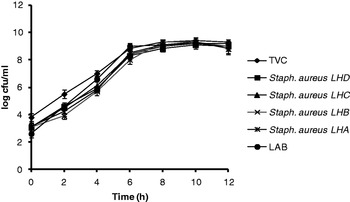
The growth of Staph. aureus LHA, LHB, LHC and LHD strains in raw or pasteurized ovine milk at 37 °C is shown in Figs. 1 & 2, respectively. All Staph. aureus strains showed a similar growth pattern in raw and pasteurized ovine milk. The SED was detected as soon as populations of Staph. aureus LHD strain reached ca 7 log cfu/ml, after 6 h and 8 h for raw and pasteurized ovine milk, respectively. Subsequently, SED was also detected up to the end of the incubation time (12 h), with the populations of Staph. aureus LHD ranged between ca 7–9 log cfu/ml. In contrast, SEA, SEB and SEC were not detected throughout raw and pasteurized ovine milk tests, even when populations of Staph. aureus LHA, LHB and LHC strains reached the maximum growth level (ca 8–9 log cfu/ml). Growth of bacteria present initially in the raw milk (TVC ca 5·1 log cfu/ml; LAB ca 3·5 log cfu/ml) and pasteurized milk (TVC ca 3·8 log cfu/ml ; LAB ca 2·6 log cfu/ml) at 37 °C did not affect growth of Staph. aureus strains.
Growth of Staph. aureus LHA, LHB, LHC and LHD strains TVC and LAB in raw ovine milk at 37 °C. Each data point represent the mean of six separate analyses of each cheese±sd

Growth of Staph. aureus LHA, LHB, LHC and LHD strains, TVC and LAB in pasteurized ovine milk at 37 °C. Each data point represent the mean of six separate analyses of each cheese±sd

Therefore, only Staph. aureus LHD strain was used for the cheese contamination trials, since this strain was the only one found to produce enterotoxin (SED) in ovine milk.
Fate of Staph. aureus LHD and SED in Feta and Galotyri cheeses
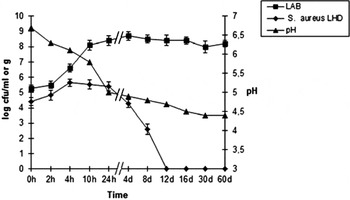
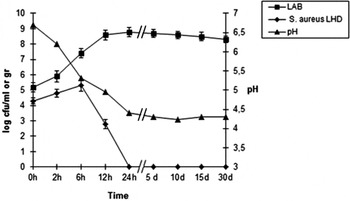
The changes in Staph. aureus LHD populations in Feta and Galotyri cheeses, produced from toxic milk, during the manufacture and up to the end of storage are shown in Figs.3 & 4, respectively. Populations of the pathogen, survived after the pasteurization of the milk, and decreased to undetectable levels after 24 h or 12 d for the Galotyri and Feta cheese, respectively. SED was detected in Feta and Galotyri cheeses, produced from toxic milk, during manufacture and up to end of storage of both cheeses.
Changes in Staph. aureus LHD and LAB populations and pH in Feta cheese, produced from toxic milk, during the manufacture, ripening and storage. Each data point represent the mean of six separate analyses of each cheese±sd

Changes in Staph. aureus LHD and LAB populations and pH in Galotyri cheese, produced from toxic milk, during the manufacture and storage. Each data point represent the mean of six separate analyses of each cheese±sd

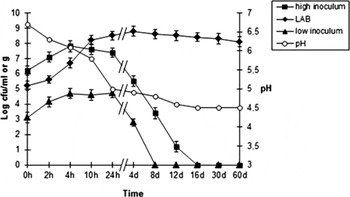
The changes in Staph. aureus LHD populations during manufacture, ripening and storage of Feta cheese for the low or high inoculum trials are shown in Fig. 5. Staph. aureus LHD populations increased in the curd (4 h) and decreased to undetectable levels on 12 and 16 d of storage for the low and high inoculum trials, respectively. For the low inoculum trials, SED was not detected in the curd or the Feta cheese during manufacture, ripening and storage. For the high inoculum trials, SED was detected in the curd (2 h), when Staph. aureus LHD populations reached ca 7 log cfu/g, and in Feta cheese up to the end of storage.
Changes in Staph. aureus LHD populations during manufacture, ripening and storage of Feta cheese for the low or high inoculum trials. Each data point represent the mean of six separate analyses of each cheese±sd

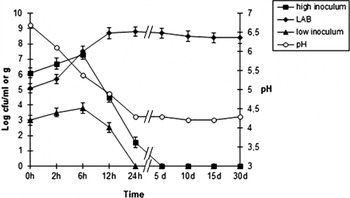
The changes in the Staph. aureus LHD populations during manufacture and storage of Galotyri cheese for the low or high inoculum trials are shown in Fig. 6. During the initial steps of the Galotyri manufacture, the populations of Staph. aureus LHD increased in the curd (6 h) to 3·8 and 7·3 log cfu/g for the low and high inoculum trials, respectively. Subsequently, the pathogen decreased to undetectable levels by 24 h and 5 d for the low and high inoculum trials, respectively. For the low inoculum trials, no SED was detected in the curd or the Galotyri cheese during manufacture and storage. For the high inoculum trials, SED was initially detected in the curd (2 h) with toxigenic levels of Staph. aureus LHD populations estimated at ca 7 log cfu/g, as in Feta cheese. SED was also detected during subsequent sampling times and up to the end of storage.
Changes in the Staph. aureus LHD populations during manufacture and storage of Galotyri cheese for the low or high inoculum trials. Each data point represent the mean of six separate analyses of each cheese±sd

The LAB populations (ca 5·2 log cfu/ml) in both cheese milks for the low or high inoculum trials, increased to (ca 8·6 log cfu/g) or (ca 8·8 log cfu/g) at 4 d and 12 h and kept almost stable up to the end of storage for the Feta and Galotyri cheeses, respectively. It is important to note that LAB populations at each sampling time did not show significant differences (P < 0·05) between low and high inoculum trials in Feta and Galotyri tests. A similar growth pattern of LAB was also observed in Feta or Galotyri cheeses produced from toxic milk.
Discussion
According to PCR tests, all our Staph. aureus strains possessed the relative toxigenic genes of SEs. The non- phenotypic expression of sec gene of Staph. aureus LHB strain is in accordance with observations in previous studies (Cremonesi et al. Reference Cremonesi, Perez, Pisoni, Moroni, Morandi, Luzzana, Brasca and Castiglioni2007; Poli et al. Reference Poli, Guglielmini, Sembeni, Spiazzi, Dellaglio, Rossi and Torriani2007). This finding may be due to lower sensitivity of immunoassay methods (Morandi et al. Reference Morandi, Brasca, Lodi, Cremonesi and Castiglioni2007), or to the fact that se gene detection in Staph. aureus strains does not necessarily indicate enterotoxin production (Loncarevic et al. Reference Loncarevic, Jorgensen, Lovseth, Mathisen and Rorvik2005).
Staph. aureus strains showed a different toxigenic ability in ovine milk than in BHI. Among examined toxigenic Staph. aureus strains, only Staph. aureus LHD was able to produce detectable amounts of SED in ovine milk. In our views, such a toxigenic behaviour of Staph. aureus strains of raw ovine milk origin, during their growth in BHI and ovine milk, has not been yet observed in previous studies. The inability of our toxigenic Staph. aureus LHA, LHB and LHC strains to produce SEs in ovine milk could be due to factors like antagonistic activity of milk microflora, competition for nutrients or production of hydrogen peroxide by the milk lactoperoxidase system (Vernozy-Rozand et al. Reference Vernozy-Rozand, Meyrand, Mazuy, Delignette-Muller, Jaubert, Perrin, Lapeyre and Richard1998).
The toxigenic ability of Staph. aureus isolates from raw bovine milk, during their growth in laboratory media as well as in raw or pasteurized milk, has not been adequately studied (Loncarevic et al. Reference Loncarevic, Jorgensen, Lovseth, Mathisen and Rorvik2005). Donnelly et al. (Reference Donnelly, Leslie and Black1968) reported the production of SEA in raw or pasteurized milk, after inoculation with a Staph. aureus strain of cheese origin (104–106 cfu/ml) and incubation at 20, 25, 30 and 35 °C. Medvedova et al. (Reference Medvedova, Valik, Sirotna and Liptakova2009a) examined the toxigenic activity of three Staph. aureus strains during their growth in ultra-pasteurized milk at 12, 15, 18 and 21 °C and observed that one strain of human origin was only able to produce SED. It is also important to note that SED and SEA are most frequently isolated from cheeses implicated in cases of food poisoning (Balaban & Rasooly, Reference Balaban and Rasooly2000; Normanno et al. Reference Normanno, La Salandra, Quaglia, Corrente, Parisi, Santagada, Firinu, Crisetti and Celano2007). Poli et al. (Reference Poli, Guglielmini, Sembeni, Spiazzi, Dellaglio, Rossi and Torriani2007) found that the gene encoding SED was among the predominant SEs genes in the Staph. aureus isolates from dairy products in Italy.
Present findings for the toxigenic ability Staph. aureus LHD at a population level of ca 7 log cfu/g are in agreement with previous observations for SE production in growth media (Pereira et al. Reference Pereira, Salzberg and Bergdoll1991; Le Loir et al. Reference Le Loir, Baron and Gautier2003) or cheese products (Gomez-Lucia et al. Reference Gomez-Lucia, Goyache, Orden, Domenech, Hernandez, Quiteria, Lopez, Blanco and Suarez1992; Meyrand et al. Reference Meyrand, Boutrand-Loei, Ray-Gueniot, Mazuy, Gaspard, Jaubert, Perrin, Lapeyre and Vernozy-Rozand1998; Vernozy-Rozand et al. Reference Vernozy-Rozand, Meyrand, Mazuy, Delignette-Muller, Jaubert, Perrin, Lapeyre and Richard1998; Hamama et al. Reference Hamama, El Hankouri and El Ayadi2002). The addition to cheesemilk of the mesophilic starter culture of (Lc. lactis subsp. lactis and Lc. lactis subsp. cremoris, 1:1) for the Feta cheese and thermophilic starter culture (Lb. delbrueckii subsp. bulgaricus and Str. salivarius subsp. thermophilus, 1:1) for Galotyri cheese proved sufficient to keep population of Staph. aureus LHD below the toxigenic level (7 log cfu/g) only for the low inoculum trials. The initial ratio of population levels of Staph. aureus LHD to starter cultures in the milk could affect the growth of the pathogen to toxigenic levels for both examined cheeses and is in accordance with previous observations in other cheese products (Meyrand et al. Reference Meyrand, Boutrand-Loei, Ray-Gueniot, Mazuy, Gaspard, Jaubert, Perrin, Lapeyre and Vernozy-Rozand1998; Hamama et al. Reference Hamama, El Hankouri and El Ayadi2002; Lindqvist et al. Reference Lindqvist, Sylven and Vagsholm2002; Charlier et al. Reference Charlier, Cretenet, Even and Le Loir2009). According to our results, the initial 6 h of cheesemaking for both cheeses products were crucial for the production of SED. Other workers also observed that SEs were usually produced during the initial 6 h of cheesemaking of cheese types like French cheeses Saint Nectaire and Saler (Delbes et al. Reference Delbes, Alomar, Chougui, Martin and Montel2006), camembert type cheeses (Meyrand et al. Reference Meyrand, Boutrand-Loei, Ray-Gueniot, Mazuy, Gaspard, Jaubert, Perrin, Lapeyre and Vernozy-Rozand1998), or Turkish Herby cheese from pasteurized milk (Akkaya & Sancak, Reference Akkaya and Sancak2007).
In Feta cheese, populations of Staph. aureus LHD were rather stable between 4–24 h of manufacturing. This fact may be due to a rather slow decrease of Staph. aureus LHD and the entrapment of the pathogen in the curd, after the whey drainage at this time. Other workers also observed that Staph. aureus was more heavily concentrated in the curd than the whey of goat's milk lactic cheeses (Vernozy-Rozand et al. Reference Vernozy-Rozand, Meyrand, Mazuy, Delignette-Muller, Jaubert, Perrin, Lapeyre and Richard1998) or camembert type cheeses (Meyrand et al. Reference Meyrand, Boutrand-Loei, Ray-Gueniot, Mazuy, Gaspard, Jaubert, Perrin, Lapeyre and Vernozy-Rozand1998).
The decrease in Staph. aureus LHD populations during the ripening time of Feta cheese and the end of manufacturing of Galotyri cheeses may be due to combined effect of different microbial hurdle factors like the inhibitory effect of LAB, low pH, NaCl content or low water activity (a w). The inhibitory effect of LAB on Staph. aureus has also been attributed to metabolic end products such as organic acids, diacetyl, hydrogen peroxide, and bacteriocins as well as the decrease in pH and competition for nutrients (Charlier et al. Reference Charlier, Cretenet, Even and Le Loir2009). Various LAB (Millette et al. Reference Millette, Luquet and Lacroix2007; Alomar et al. Reference Alomar, Loubiere, Delbes, Nouaille and Montel2008; Le Marc et al. Reference Le Marc, Valík and Medvedova2009) Lc. lactis (Alomar et al. Reference Alomar, Loubiere, Delbes, Nouaille and Montel2008; Charlier et al. Reference Charlier, Even, Gautier and Le Loir2008) or Lc. lactis subsp. cremoris (Nicolaou et al. Reference Nicolaou, Xu and Goodacre2011) showed an inhibitory activity against Staph. aureus in milk. Lc. lactis proved to be an efficient inhibitor of Staph. aureus in Cameros cheese (Olarte et al. Reference Olarte, Sanz, Gonzalez-Fandos and Torre2000), Portuguese-style traditional ewe's cheeses (Pereira et al. Reference Pereira, Graca, Ogando, Gomes and Malcata2009), or Moroccan Jben cheese (Hamama et al. Reference Hamama, El Hankouri and El Ayadi2002) during ripening.
The pathogen was also eliminated in a shorter time in Galotyri cheese than Feta cheese, for the high (5 d vs. 16 d) or the low (1 d vs. 12 d) inoculum trials. This difference in the decrease rate of Staph. aureus LHD, may be due to the lower pH values observed in Galotyri cheese than Feta cheese, although other factors like the antagonistic activity of LAB may also be involved. Previous workers reported that growth of Staph. aureus was completely inhibited at a pH of 4·4–4·5. Charlier et al. Reference Charlier, Even, Gautier and Le Loir2008, Reference Charlier, Cretenet, Even and Le Loir2009). In agreement with present work, populations of Staph. aureus were rapidly decreased in pH lower than 4·5 in other cheese products like lactic goat cheese (Meyrand et al. Reference Meyrand, Boutrand-Loei, Ray-Gueniot, Mazuy, Gaspard, Jaubert, Perrin, Lapeyre and Vernozy-Rozand1998), Moroccan Jben cheese (Hamama et al. Reference Hamama, El Hankouri and El Ayadi2002) or Afuega'l pitu cheese (Rilla et al. Reference Rilla, Martinez and Rodriguez2004). Although Staph. aureus is salt tolerant, NaCl can act antagonistically against the pathogen in the low a w and low pH of the cheese products (Charlier et al. Reference Charlier, Cretenet, Even and Le Loir2009; Medvedova et al. Reference Medvedova, Valik and Studenicova2009b).
SED was not detected in Feta and Galotyri cheeses when the milk had been contaminated with Staph. aureus LHD at 103 cfu/ml, but it was detected when the milk had been contaminated with the pathogen at 106 cfu/ml. These results lead support to the European Union standards (EC regulations no. 2073/2005, 1441/2007) concerning the presence of SEs in cheeses from milk contaminated with Staph. aureus.
The work was supported by the Research Committee, University of Thessaly and the Dairy Plant Tyras SA, Trikala, Greece.