Introduction
This article will explore how older Swedish people who have an intellectual disability (ID) and live in group accommodation describe their experience of ageing and later life. The individuals belong to a unique generational group. Never before have individuals with this kind of disability reached the age where society considers them to be old (World Health Organization 2001). The study focuses on individuals' recollections of episodes, which they relate to old age, and to their feelings about, and understanding of, ageing and later life. Their accounts are interpreted as part of their life-world, and as perceptions made in everyday life. The everyday life of a person with ID differs from the life of others when it comes to living conditions such as work, family life, housing and health status (Bigby Reference Bigby2004). This may be particularly true of people with ID who live in group accommodation. They share the need for 24-hour professional support and service in everyday routines, which is characteristic of this type of accommodation and its specific social and physical environment.
There is a need to address the challenges involved in understanding what it means to be old for individuals who have lived with ID their whole life (Perkins and Moran Reference Perkins and Moran2010; Thorsen Reference Thorsen2005; World Health Organization 2001). Despite a number of recent contributions to this field of research (Bigby Reference Bigby2004; Jeppsson Grassman and Whitaker Reference Jeppsson Grassman and Whitaker2013; Thorsen and Jeppsson Grassman Reference Thorsen and Jeppsson Grassman2012), the combination of being old and living with a lifelong disability has been generally neglected (Kelley-Moore Reference Kelley-Moore, Dannefer and Phillipson2010; Putnam Reference Putnam2002). This study strives to fill the knowledge gap regarding how this specific population experiences ageing and later life in general, how they experience their own ageing process and how their everyday life as older people should be understood. This knowledge may be important in terms of giving adequate support to ageing people with ID. In addition, this study may contribute to a critical social gerontology, which challenges the traditional image of a normative and homogeneous ageing process (see e.g. Phillipson Reference Phillipson2008).
Ageing and intellectual disability
Intellectual disability can be understood as an incomplete development of the brain in the prenatal, perinatal or postnatal period before the age of 18. The contemporary understanding of ID is also focusing on biomedical, social, behavioural and educational risk factors. Compared to the general population, people with ID have significant restrictions in intellectual functioning and adaptive behaviour (Schalock et al. Reference Schalock, Borthwick-Duffy, Bradley, Buntinx, Coulter, Craig, Gomez, Lachapelle, Luckasson, Reeve, Shogren, Snell, Spreat, Tassé, Thompson, Verdugo-Alonso, Wehmeyer and Yeager2010). These limitations may include a reduced ability to perceive, comprehend, integrate and/or adapt to the surrounding world. ID is considered to reduce ability to use experiences in thinking about, and carrying out, everyday activities in a social and cultural context (Kylén Reference Kylén1997), resulting in a risk for reduced participation (Bigby and Frawley Reference Bigby and Frawley2010).
ID introduces a need for supports throughout the lifecourse in order to enable participation in everyday life and society. These supports aim to promote development, education, everyday functioning and personal interests, health and life satisfaction (Schalock et al. Reference Schalock, Borthwick-Duffy, Bradley, Buntinx, Coulter, Craig, Gomez, Lachapelle, Luckasson, Reeve, Shogren, Snell, Spreat, Tassé, Thompson, Verdugo-Alonso, Wehmeyer and Yeager2010). However, people with ID are a diverse group in terms of limitations and needs for supports in everyday life (Bigby and Frawley Reference Bigby and Frawley2010; Hurst, Goodman and Locke Reference Hurst, Goodman, Locke, Hurst, Goodman and Locke2009; Kjellberg Reference Kjellberg2002a).
There is a relationship between the construction of disability and the construction of age, since both are commonly seen as related to a decline in function and participation (Priestley Reference Priestley2003; Sandvin Reference Sandvin, Söder and Grönvik2008). Nevertheless, in terms of everyday life, there is a tendency to consider ID itself more important than ageing or later life in interpreting these people's living conditions (Thorsen Reference Thorsen2005). Ageing and later life are rarely considered significant factors by disability activist groups or policy makers in Sweden, and older people with ID are generally excluded from the political agenda (Jönsson and Taghizadeh Larsson Reference Jönsson and Taghizadeh Larsson2009; Kåhlin Reference Kåhlin, Abrahamsson, Hagberg, Lukkarinen Kvist and Nord2010). However, according to statistics from the Swedish National Board on Health and Welfare (Socialstyrelsen 2012), since 2005 there has been a 30 per cent increase in people over the age of 65 who receive ID-related services.
According to the reserve capacity theory, people with ID have a premature biological ageing process (Kemp Reference Kemp2005), a point of view also supported by the World Health Organization (2012). Research has revealed that specific diagnosis groups have significant patterns of ageing, mirroring a combination of impairment and age-related changes (Bigby Reference Bigby2008; Burt et al. Reference Burt, Primeaux-Hart, Loveland, Cleveland, Lewis, Lesser and Pearson2005; Kemp Reference Kemp2005). However, others (see e.g. Holland Reference Holland2000) claim that the ageing process affects people with ID in the same way as it affects the population in general. According to Heller et al. (Reference Heller, Miller, Hsieh and Sterns2000), people with ID seem to lack knowledge and understanding of issues related to ageing, and how their life can change in terms of work and health in later life. On the other hand, it has been shown that people with ID are able to develop skills and knowledge as they age, as long as they are given appropriate support (Heller et al. Reference Heller, Factor, Sterns and Sutton1996, Reference Heller, Miller, Hsieh and Sterns2000; Lifshitz, Merrick and Mourad Reference Lifshitz, Merrick and Mourad2008).
People with ID seldom have indicators or roles, which take account of ageing and later life (Bigby Reference Bigby2004; Thorsen Reference Thorsen2005). This could be because there is no legal retirement age for those attending work-related activities on a daily basis, or due to the fact that people with ID do not have children and grandchildren to the same extent as the general population. People with ID seem to have restricted access to what Närvänen (Reference Närvänen, Öberg, Närvänen, Näsman and Olsson2004) describes as a social timetable for the lifecourse. According to Thorsen (Reference Thorsen2005), this can make life seem timeless and ageless.
The lifecourse of older people with intellectual disability living in Sweden
Today, policy on disability is regarded as a cross-sectoral political concern, and disability issues are regarded as an integral part of Swedish society, though this is a relatively new feature. The current population of older people with ID has experienced continuously changing policy for the disabled throughout their lifecourse, and they have seen the consequences of this policy in their everyday lives. Along with social and medical improvements and innovations, policy changes have contributed to people living longer (Thorsen Reference Thorsen2005), and have influenced the experience of ageing and later life for this population (Bigby Reference Bigby2004).
The lifecourse perspective is important for understanding how variables such as age and disability interact (Sandvin Reference Sandvin, Söder and Grönvik2008), as it regards ageing as a dynamic process brought about by an interaction between individual, social and historical factors over time. This places the dynamic process of ageing in a context, which shows the relationship between ageing and society at both individual and social levels (Bengtson, Elder and Putney Reference Bengtson, Elder, Putney and Johnson2005; Dannefer and Settersten Reference Dannefer, Settersten, Dannefer and Phillipson2010; Närvänen Reference Närvänen, Öberg, Närvänen, Näsman and Olsson2004).
In the first half of the last century, most people with ID lived in large institutions, separated from their families and from society. Many people of this generation started their life in an environment characterised by Goffman (Reference Goffman1961) as a ‘total institution’, and throughout their lifespan they have been stigmatised by being outsiders in terms of social norms and expectations (Goffman Reference Goffman1990). During the 1960s, pedagogical ideas began to replace the earlier, predominantly medical view on disability (Kjellberg Reference Kjellberg2002b; Tössebro et al. Reference Tössebro, Bonfils, Teittinen, Tideman, Traustadottir and Vesala2012). One turning point was the formulation of the normalisation principle by Nirje (Reference Nirje, Kugel and Wolfensberger1969), which influenced the development of social security systems both nationally and internationally (Tössebro et al. Reference Tössebro, Bonfils, Teittinen, Tideman, Traustadottir and Vesala2012). In the following years, the focus of Swedish disability policy turned from exclusion and marginalisation to inclusion and participation, through the right to ‘normal’ living conditions, ‘normal’ daily routine and ‘normal’ lifecycle (Nirje Reference Nirje, Kugel and Wolfensberger1969).
As a result of normalisation, many people with ID during the 1970s were able to move from large-scale institutions to smaller accommodation units, which were integrated into society. During this time, daily, work-related activities outside the home were also developed. At the beginning of the 1990s, an important turning point in policy for the disabled was when responsibility for disability issues was transferred from the medical and health-care system to a community-based service for Swedish citizens (Kjellberg Reference Kjellberg2002b).
The progress in disability policy contributed to changes in work and housing conditions for this group of people, and also continued to provide more formal opportunities for participation (SFS 1993:387). These policy changes, along with other individual life events such as health status or family relationships, have been part of the lifecourse that has formed the lived experiences for the current generation of older people with ID. These experiences make them a unique generation in Swedish disability policy history and development, and also in relation to the overall ageing population.
Research on the experience of ageing and later life in people with intellectual disability
People with ID seem to see later life as characterised by a number of changes such as loss of family and friends, retirement or changes in services (Judge et al. Reference Judge, Walley, Anderson and Young2010; Thompson Reference Thompson2002; Wilkinson, Kerr and Rae Reference Wilkinson, Kerr and Rae2003). Moreover, old age is often defined by referring to the decline in an individual's physical health and abilities (Erickson, Krauss and Seltzer Reference Erickson, Krauss and Seltzer1989; Lifshitz Reference Lifshitz2002; Wilkinson, Kerr and Rae Reference Wilkinson, Kerr and Rae2003). According to Lifshitz (Reference Lifshitz2002), these attitudes are based on stereotypes and negative images, though awareness of the positive characteristics of old age increases as people get older. However, more recent studies show that people with ID have a positive view of ageing, which contradicts the negative stereotypes in society (Bigby and Knox Reference Bigby and Knox2009; Buys et al. Reference Buys, Boulton-Lewis, Tedman-Jones, Edwards, Knox and Bigby2008; Dew, Llewellyn and Gorman Reference Dew, Llewellyn and Gorman2006; Judge et al. Reference Judge, Walley, Anderson and Young2010; McCarron et al. Reference McCarron, Swinburne, Burke, McGlinchey, Mulryan, Andrews, Foran and McCallion2011). Social support and a sense of belonging seem to be important for the experience of ageing well (Bigby and Knox Reference Bigby and Knox2009; Wilkinson et al. Reference Wilkinson, Kerr and Rae2003), and it has been shown that later life can be experienced as a phase characterised by empowerment and increased participation (Buys et al. Reference Buys, Boulton-Lewis, Tedman-Jones, Edwards, Knox and Bigby2008; Judge et al. Reference Judge, Walley, Anderson and Young2010).
The aim of the study
There have so far been few studies on the experience of ageing and later life in this group of people from a life-world perspective. The aim of this study is to explore how older people with ID who live in group accommodation describe their lived experience of ageing and later life. Two research questions formed the basis for the study. Firstly, how do individuals with ID, who are already old or beginning to age, describe their experiences of ageing? Secondly, how do they describe later life as a general phenomenon?
Methodology
It is important that research which aims to improve living conditions for people with ID is based on the experience of the people concerned. These people are seldom represented in research, however, largely because of their reduced skills in terms of communication and interaction (Umb-Carlsson Reference Umb-Carlsson2007). The phenomenological approach used in this study relies on the belief that, based on the philosophy of Merleau-Ponty (Reference Merleau-Ponty2012 [1945]), it is possible for these people to share with others their experiences of ageing and later life, taking concrete, everyday life as a starting point. Lived experience is an important perspective in services for the disabled, and challenges traditional ways of understanding what it is like to live with a disability (Gustavsson Reference Gustavsson2001). However, using phenomenological interviews with people with ID is challenging, as the informants' ability to relate and reflect on the subject of study can be affected by their impairment. This is not an insurmountable barrier, however, and people with ID are, in fact, capable of talking about their everyday lives (see e.g. Stalker Reference Stalker1998; Walmsley Reference Walmsley2001).
The context of the study
The study is part of a project concerning older people with ID who live in group accommodation, and their participation in everyday life at home. Four different residential arrangements with special services, each in compliance with the Swedish Support and Service for Individuals with Specific Functional Impairment Act (SFS 1993:387) were included in the project. According to the Act (SFS 1993:387), all residential arrangements must ensure good living conditions for each individual, through the right to self-determination, empowerment and integrity, in order to encourage participation (SFS 1993:387). A residential arrangement must be adequate, without giving the impression of being an institution, and must contain internal space and facilities for personal care, cooking, social activities, sleep and rest (Socialstyrelsen 2003). In 2011, 12 per cent of people living in these residential arrangements were over the age of 65 (Socialstyrelsen 2012).
According to the Act (SFS 1993:387), residential arrangements can be made in a number of ways. All housing arrangements in this study can be described as group accommodation, which is the most common residential alternative for individuals with ID in Sweden (Socialstyrelsen 2012). Group accommodation involves a small number of separate, but linked flats in an ordinary housing area. The tenants have access to communal activities, and staff are available 24 hours a day.
Data were collected from September 2011 to March 2012. The accommodation was located in two municipalities in southern Sweden with approximately 150,000 and 30,000 inhabitants. Two were located in the same building as a nursing home for older people, one was part of an ordinary housing area with apartment blocks and one was a detached building. A total of 32 tenants with ID (aged 39–90 years) lived in the group accommodation during the data collection period.
Each separate flat in the accommodation contained a small kitchen, which offered tenants the opportunity to do their own cooking. On the whole, however, tenants in this study took all their meals together, along with neighbours and staff, in the communal dining room. They also chose to spend much of their time at home with staff and neighbours in the communal living room, watching TV, listening to music and reading together. Some of the tenants were active in planning and preparing meals and other activities, but some only participated in the activity itself. Most tenants had lived in group accommodation for a long time, though some had only moved in recently.
Informants
The informants were selected by criterion sampling (Patton Reference Patton2001). The criteria for inclusion were that the tenant should be older than 45 years of age and have the communication and interaction skills required for participating in an interview. The reason for the age criterion was that there are indications that people with ID have an earlier biological ageing process than other people (Kemp Reference Kemp2005; World Health Organization 2012).
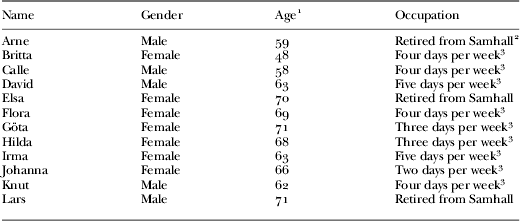
Of the 32 tenants in the group accommodation, 12 individuals, five men and seven women, met the age criterion and agreed to participate in the interview study. Their ages ranged from 48 to 71 (see Table 1). The criterion regarding communication and interaction skills meant that informants had moderate to mild intellectual disabilities (Granlund and Bond Reference Granlund and Bond2000; Kylén Reference Kylén1997). Most of the informants were involved in daily, work-related activities in accordance with the Act (SFS 1993:387).
Characteristics of the informants

Notes: 1. Mean age=64. 2. Samhall is a state-owned Swedish company which was established to provide meaningful work for people with disabilities. 3. In work-related daily activities in compliance with the Act (SFS 1993:387).
Half of the informants lived in group accommodation within a nursing home for old people. However, each group accommodation was a separate unit and the residents had their own staff. In practice, there were few interactions between the residents at the group accommodation and the residents at the nursing home.
Ethical considerations
The study was approved by the Regional Research Ethics Committee in Linköping (No. 2011/116–31), and followed the ethical guidelines from the Swedish Research Council (2011).
Potential informants were given oral and written information regarding the aim and performance of the study and regarding confidentiality (Swedish Research Council 2011). Written information given to informants was adapted in accordance with the informants' intellectual limitations using guidelines from the Centre for Easy-to-Read (2012) and the directives described by Granlund and Bond (Reference Granlund and Bond2000) and Booth and Booth (Reference Booth and Booth1996). Written information was also given to the residents' guardians, and to the staff and managers at the group accommodation.
Consent was obtained from the informants, their guardians and the managers of the group accommodation according to the process of obtaining informed consent, described by the World Health Organization (2013) and Swedish Research Council (2011). Oral informed consent from each informant was also obtained and recorded at the time of the interviews. For confidential reasons the names of the informants have been altered in the study.
Data collection
Individual semi-structured interviews were used to collect data. The interviews were conducted by the first author, who has several years' experience of work as an occupational therapist with people with ID. The specific methodological challenges involved in interviewing people with ID have been discussed by several authors (Booth and Booth Reference Booth and Booth1996; Folkestad Reference Folkestad2000; Gustavsson Reference Gustavsson2001; Kjellberg Reference Kjellberg2002b; Lewis Reference Lewis2002; McVilly Reference McVilly1995; Nind Reference Nind2008; Ringsby Jansson Reference Ringsby Jansson2002). Issues in interviewing people with ID include acquiescence (Matikka and Vesala Reference Matikka and Vesala1997; Sigelman et al. Reference Sigelman, Budd, Spanhel and Schoenrock1981), inability to articulate, unresponsiveness and difficulties arising from experience (Booth and Booth Reference Booth and Booth1996). The interviewer therefore needed to take these challenges into account and address them.
All interviews were conducted after a three-week introductory period, during which the interviewer observed, interacted with and talked to the informants in a conversational way. This made it possible for the interviewer to gather significant information about the informants' communication and interaction skills, personal situation and preferences. The information was used in preparing and carrying out the interviews as an essential methodological complement in terms of the life-world approach (Giorgi Reference Giorgi2009).
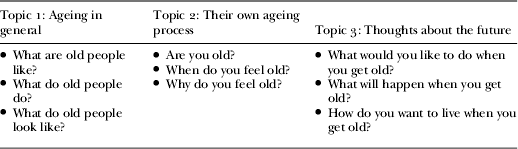
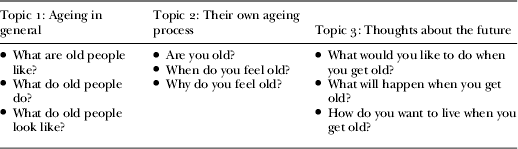
The semi-structured interview guide consisted of broad topics relating to experiences of ageing and later life. The topics focused on the informants' lived experience of these phenomena in general, their own ageing process and their thoughts about the future. The informants were asked to relate their experiences of these topics (for examples of questions, see Table 2).
Interview topics and examples of questions
In keeping with a phenomenological approach, the interviewer asked open questions with the aim of obtaining as complete a description as possible of the informants' experiences of ageing and later life (Giorgi Reference Giorgi2009). As the intellectual limitations of people with ID often influence their ability to communicate, the interviewer often needed to ask the questions in a more concrete way in order to direct the informants to the phenomenon of interest, a method supported by Giorgi (Reference Giorgi2009). Other strategies were used to support the informants in understanding and answering the questions. For example, pictures were used in several of the interviews. This approach is supported by a number of studies (Brewster Reference Brewster2004; Folkestad Reference Folkestad2000; Kjellberg Reference Kjellberg2002b; Lewis, Newton and Vials Reference Lewis, Newton and Vials2008; Ringsby Jansson Reference Ringsby Jansson2002). In some interviews, the informant was given written questions, and in one case the informant's personal photo album was used. The interviewer's pre-understanding of ID in general, and specifically of each informant, was significant in this context.
Before the interview, the informant was given the opportunity to decide where the interview should be conducted and if staff or other supporting persons should be present during the interview. However, all interviews took place in the informants' own flats in the group accommodation, with only the interviewer and the informant present. Each interview lasted between 20 and 50 minutes. During the interview probing was used (Taylor and Bogdan Reference Taylor and Bogdan1998) in order to clarify and make sure that the interviewer understood what the informant meant.
Data analysis
In order to document the descriptions of the phenomena, all interviews were recorded and transcribed verbatim. The descriptions were analysed using Giorgi's (Reference Giorgi2009) descriptive phenomenological method. This life-world approach consists of three steps, as follows. Firstly, the informants' responses were read through several times to give an overall picture of the material. Secondly, shifts in meanings were noted, and units of meaning were captured and established. Similarities between the descriptions were merged together in categories. Thirdly, the merged units of meaning were translated from the informants' own vocabulary into phenomenologically sensitive expressions which also, according to Giorgi (Reference Giorgi2009), should be influenced by the author's own disciplinary attitudes and language.
Once this had been done, the accounts were used to create a structure for the phenomenon, which was to be studied. The structure was expressed as themes and sub-themes, which placed the descriptions of the informants' lived experience of ageing and later life in an overall context.
Findings
When the informants' descriptions had been translated into phenomenologically sensitive expressions, two major themes and six sub-themes were revealed. These provided an overview of how the informants saw their lived experience of ageing and later life (see Figure 1).
Themes which encapsulate the informants' lived experience of ageing and later life.

In general, the informants mainly referred to significant others, such as neighbours with ID and staff working in the group accommodation. The informants also referred to some extent to family members or relatives, and to more general images of ageing, without referring to a concrete person. Accounts of their own ageing process were intended to reveal individual perspectives on the experience of growing older, but when they were asked to talk about this, several informants continued to describe it from a perspective of significant others.
The theme ‘ageing as a process of change’ describes changes the informants associated with ageing and later life in general, as well as with their own ageing process. This theme consists of three sub-themes, ‘bodily functions and health’, ‘activity and participation’ and ‘the supporting environment’.
The theme ‘existential aspects of ageing’ indicates ambivalence in the material in terms of how the informants saw the role of ageing in general compared to their own image of it, and how they experienced its current and future impact on them. This theme consists of three sub-themes, ‘being old’, ‘becoming like others’ and ‘death and dying’.
Ageing as a process of change
Bodily functions and health
The informants described ageing as characterised by changes in physical, psychological and intellectual functioning, and they also mentioned changes in the state of their health. Some informants said that their own ageing had resulted in decreased strength and increased pain, and they considered that the body was ‘not doing its work’. To a large extent, general changes in bodily functions were related to observable physical changes, such as wrinkles, varicose veins and the fact that the body was bent and buckled. Calle, who was in his late fifties, said that older people were ‘wrinkled, dotted and blue under their eyes’. Irma and Johanna also described wrinkles. Irma said that old people had wizened faces, hands and legs, and Johanna said that they were ‘striped’ on their cheeks. Arne and Hilda both said that old people had difficulty moving their body as quickly as they once did. Some informants also described increased physical tiredness, the onset of ailments, and that the body became ‘worn out’ and ‘said no’.
The informants' descriptions revealed changes in psychological and intellectual function. One example was loss of motivation. Older people were described as not wanting to do things to the same extent as earlier in life. Some informants also connected fear, loss and fright to the experience of ageing. Irma said that older people were ‘not on the train’ and Britta, the youngest informant, said that they were ‘sad’. She used sign language to express tears.
Descriptions of change in the state of older people's health included being ill and in greater need of medicine and other medical interventions than before. Some informants also said that it was more important to think about health issues in old age and not to indulge in unhealthy habits. Calle said: ‘You should not smoke … no, and you should not use snuff either, when you get old … no, because that is unhealthy, isn't it?’ Hilda said that, now when she was older, she would rather have porridge for breakfast as she thought it was better for her stomach. Another example of changes in health involved pain and stiffness. Lars, one of the oldest informants, said: ‘You feel your age … your body doesn't feel well’.
Activity and participation
Many of the changes described by the informants could be related to participation in daily activities. They suggested that old people in general had reduced capacity for activities. When old people were unable to do the same activities as they could when they were younger, the informants thought this reduced their chances of participation, both in a general sense and in terms of their own ageing process. Arne said that old people would have difficulty going for a walk, cleaning their house, going shopping and paying bills. Other informants gave examples of old people no longer being able to take part in leisure activities, which had been important to them earlier in life. When they talked about changes to their own everyday life, the informants gave examples, such as the fact that getting old had meant they had stopped working, stopped taking walks in the neighbourhood and stopped cleaning their flats.
The informants also suggested that reduced capacity could lead to a need for old people to adapt their activity performance. Informants gave examples of old people having to walk slowly, go to bed earlier in the evening and divide their activities up to make them easier. The changes in activity pattern, i.e. how activities are carried out, were related primarily to a reduction in physical or psychological functions, but some informants also related ageing to no longer needing to undertake activities, which had been necessary when they were younger. Advanced age was given as a reason for no longer needing to participate in social activities, in terms of both work and leisure.
Ida (interviewer): Why do you think the staff said you could not stay at home [instead of going to a party]?
Arne: I should have been as old as Olle [neighbour in the group accommodation] … then I could have stayed at home … if I were 77 years old.
Changing activity patterns was also described in terms of changes in current activity arenas, e.g. environments where the elderly take part in activities. The informants said that ageing means people stop working. In this context, several informants also mentioned the retirement age of 65. Calle said: ‘When I get old I want to retire’.
With the shift to retirement comes more time to spend at home. In old age, there seems to be a greater emphasis on group accommodation as an activity arena. The accounts commonly referred to ageing as a move to different accommodation in the form of special housing for older people.
Ida: How do you think people should live when they get old?
Flora: In an old people's home…
Ida: What is an old people's home?
Flora: Old people live there … They get help.
Moving to a home for old people was mentioned by several informants as a change in their area of activity. This was often related to a greater need for care and service. A few of the informants also suggested that, as they got older, they wanted to move from the group accommodation to a home for older people. Irma said that she wanted to move to a retirement home, and only then would she be ‘properly retired’.
They also suggested that the changing activity pattern was a result of new activities. The informants said that ageing and later life could lead to new interest. In this context, the informants presented the idea that senior citizens were typically interested in certain activities, and these became more important after retirement.
Ida: What do you do then (when you get old)?
Knut: You go over to the senior citizens…
Ida: What does that mean, going over to the senior citizens?
Knut: You are out there and … join an association … get together…
Several informants described their later years as a time of comfort, a time for sitting around more, reading and resting.
Ida: What would you like to do when you retire?
Irma: I'll be at home then, and have a nice time … and rest and be comfortable, read magazines, sew and do those things you do when you're retired … go to women's clubs and watch the ladies sew. I like that kind of thing…
A few informants noted that their capacity increased with age. They associated this with greater knowledge and experience of carrying out an activity. Some informants claimed it was important for them to maintain their patterns of activity later in life. Several said that they wanted to keep working as long as possible, and that after retirement they intended to replace work-related activities with other things. Knut said: ‘I want to do something with my hands if I stop working … I don't want to stop completely if I stop working’.
The supporting environment
A few of the informants associated ageing with a changing need for physical and social support in everyday life. Many of them mentioned concrete physical objects as a support in later years. The objects they described were mainly devices, which helped to preserve mobility, such as sticks, crutches, wheelchairs and walkers. Glasses and items related to health were also mentioned, such as medication. Britta referred to a neighbour with ID as old because she was now using a wheelchair. Lars said that he had considered getting a walker because of the pain he felt in his legs nowadays. Hilda told us about her problems finding suitable glasses now that she was older.
Changes in social support were mainly associated with a general increased need for care. In this context, the informants mentioned that older people could be taken care of by the staff in the group accommodation, by staff at a home for old people or by other types of medical staff.
Ida: When people are old, Knut, what do they do then?
Knut: Go to the doctor.
Ida: You go to the doctor … why?
Knut: Get help.
More importance was given to the staff in the group accommodation in old age. Arne said that the old people living in his accommodation needed more help, and that it was therefore important that the staff helped them more. A few of the informants considered other types of social support important as they got older. They mentioned neighbours, and having a partner to share their love life with. They also considered other old people an important part of their life as they got older. Hilda said: ‘Old people's homes are good, I think … and you get some company’.
Existential aspects of ageing
Being old
Several informants described ageing as something inevitable, a part of life for everyone. Their descriptions of the role of elderly people emerged as an image of something they had not asked for, a phase in life they saw as hard, and which they did not want to have to take part in. ‘You do not want to be old … They want you to be young’, said Göta, the oldest woman. David, who was in his early sixties, said that it was nicer to be young, and Lars, the oldest man, did not like getting old.
Ida: Getting old … what do you think that would be like?
Lars: No, I don't particularly like the idea. No. You get worse with age. Your arms and legs hurt. It's pretty tough actually.
In contrast to this negative view of ageing and later years, a few informants noted that some things had become easier with age. They mentioned certain activities, and also that they were prepared to speak up for themselves. Calle said that getting old was good, as he was able to be a creature of habit. Arne thought he had got better and better at peeling potatoes, and Irma said that life had become easier now that she was older.
Ida: Has anything become easier?
Irma: Easier … life is easier, I think.
Ida: What do you mean?
Irma: Well, I can look at what others are doing, and say what I think myself … That, I think, is easier…
Some informants associated ageing, and later life in general, with being a grandparent. When Flora, who was in her late sixties, was asked if she knew anyone who was old, she immediately mentioned her grandmother, who had been dead for several years. On the other hand, she did not define her own mother or mother-in-law as old. For some informants, old age seemed to be associated with wisdom and kindness. When Britta was asked to describe an old person, she referred to Santa Claus and his long, white beard.
In their descriptions of old age, the informants mostly referred to specific individuals in their close surroundings, and to their actual age. ‘At 59 you are not so old’, said Arne. ‘My dad was old; he was 70’, Calle said. Elsa thought she was old as she was going to be 71, but Knut did not see his 70-year-old neighbour (with ID) as old, though he claimed it would have been quite another thing if he had been 80.
Half of the informants identified themselves as old. Irma, 63 years old, Knut, 62 and Lars, 71, related this to physical pain. Johanna, who was 66, said: ‘I am an old lady’. Irma, at 63, identified herself as old because she was a mother and grandmother.
The other half of the informants did not see themselves as old. A few in this group reasoned that this was because they could still do the activities they wanted to do.
Ida: When you say you don't feel old, what do you mean by that?
Arne: That I go out for walks and I can still walk fast where the others can't…
David had problems relating to ageing at all. He thought that neither he nor his sister would ever get old, and he also claimed he did not know any old people. However, he was able to define his father as old. Another informant, Elsa, had a similar way of talking about ageing.
Becoming like others
A few informants mentioned that ageing allowed them to become like other old people. This theme was revealed in three descriptions. The informants who mentioned it said that all old people would end up having reduced skills and abilities, which would result in a need for support in their daily life. ‘It will be okay. It will be the same for the others, for the other people too’, Arne said. Irma put it like this:
Ida: Is there anything good about getting old?
Irma: Yes … we all get there … we become old and ugly and pitiful. You will, too…
Arne, Irma and Calle thought that when they got older, they would move from the group accommodation to another institution, along with other old people.
Death and dying
In almost every description, death was associated with ageing and later life. The informants described death as a natural end to life, something that would happen to everyone sooner or later. ‘If you get old there is no turning back. You cannot breathe or anything’, Irma said. Some of the informants described death as a consequence of ageing, while others described it as a result of illness.
Britta, Flora and Göta described the afterlife as a Christian concept, where dead people were with God and Jesus in heaven. Others had a more pragmatic way of looking at their dead parents and friends, either symbolically or actually there in the cemetery or the place of remembrance.
Lars: The place of remembrance, they are lying there. My sister says that I should follow her and watch, but I don't want to…
Ida: Why not?
Lars: No, I don't want to see them.
Lars did not want to visit the place of remembrance, and described it as something painful. Several informants, including Lars, suggested that they had felt sad and a sense of loss when a significant other had died. Calle told this story about losing one of his parents:
Calle: He died … when I walked in to talk to him he didn't answer me. He didn't answer me. He was already dead then, already gone.
Ida: What did you feel then, Calle?
Calle: Then I went up to … him, eh, the doorkeeper, and I said that he was already gone, and then I got off work because you get to be off work when a relative has passed away.
Ida: What do you think about death?
Calle: What I think … It was sad, I thought then, I was alone. Yes, that's the way it is.
A few informants also described death as something frightening and fearful. Johanna, who had lived with her mother until she passed away a few years ago, described death as scary, and this was why she had not attended her mother's funeral. For some informants, their negative feelings about death stopped them from visiting the cemetery.
Ida: Do you usually go there [to the cemetery]?
Knut: No, I don't. I get nightmares if I go there.
Discussion
This study provides an insight into the life-world of people ageing with ID. The findings of the study are based on the informants' experiences of ageing and later life as they lived and related them. The content and emphasis of the informants' descriptions were diverse and varied, but all the informants talked within the two themes in one way or another.
The informants' experiences of ageing or being old, and of later life in general, were characterised by a number of changes, which correspond to the conclusions of earlier research (Judge et al. Reference Judge, Walley, Anderson and Young2010; Thompson Reference Thompson2002; Wilkinson et al. Reference Wilkinson, Kerr and Rae2003). Looking at ageing as a process with a number of stages or phases has a long history within social gerontology. However, there is a tendency, in both research and society in general, to see the ageing process as a negative phenomenon. The findings of this study question this view. Though there were suggestions of decline and reduced physical function, health, activity and participation, the informants also gave examples of increased activity and participation. This contrary view is in line with the introductory section above (see e.g. Dew, Llewellyn and Gorman Reference Dew, Llewellyn and Gorman2006; Erickson, Krauss and Seltzer Reference Erickson, Krauss and Seltzer1989; Judge et al. Reference Judge, Walley, Anderson and Young2010; Wilkinson et al. Reference Wilkinson, Kerr and Rae2003).
In trying to understand the changes described by the informants, the body appears to be significant in understanding the experience of ageing or being old. The changes they mentioned were largely physical ones. They described what Priestley (Reference Priestley2003) defined as an impaired body, which has been regarded as a typical sign of ageing in western societies. They described a body, which needed support from its environment in order to function. The informants' considerable focus on the body as central to the experience of ageing is an interesting contrast to the tradition within social gerontology, which neglects the ageing body in favour of the social and cultural dimensions of ageing (Katz Reference Katz, Dannefer and Phillipson2010; Twigg Reference Twigg2006). This tradition is also apparent in disability studies (Jeppsson Grassman Reference Jeppsson Grassman, Jeppsson Grassman and Hydén2005; Priestley Reference Priestley2003; Shakespeare Reference Shakespeare2006). The findings of this study show that the body is of significance in the way people with ID understand ageing and later life, in both a physical and psychological sense. Merleau-Ponty (Reference Merleau-Ponty2012 [1945]) uses the concept of the lived body to describe the integration of the physical body and the soul. The lived body is the human tool used to experience the world, always present in everyday life and in continuous interaction with the surrounding world. When Lars said, ‘You feel your age … your body doesn't feel well’, he was giving an example of the process of ageing as a physical phenomenon. It seems that age was not only experienced but also expressed through the body. The body became an organising principle in the way the informants described ageing (Hydén Reference Hydén, Jeppsson Grassman and Hydén2005). This can be related to earlier studies, which show that the body is a significant concept in understanding the lived experience of disability in everyday life (Berndtsson Reference Berndtsson2001; Tham, Borell and Gustavsson Reference Tham, Borell and Gustavsson2000). It is also associated with a discourse in gerontological research, which considers the body important (Katz Reference Katz, Dannefer and Phillipson2010).
The changes in body described by the informants limited their ability to act and participate in the surrounding world. As a consequence, the informants described their need for increased physical and social support in daily life, which has also been identified in studies on the general ageing population (Alftberg Reference Alftberg2012). However, it seems to have been natural for the informants to talk about, and reflect on the tense relationship between their decreased capacity and activity, and increased environmental support. For people in general, integrating new or increased physical and social support into their lives is an implicit recognition that they are old (Alftberg Reference Alftberg2012). This may not be an issue for older people with ID. Perhaps the fact that they have had a disability all their life, and have always been involved with services for the disabled, has given these people skills which make it easier for them to come to terms with the support they require in old age. With this in mind, it could be argued that the need for support, both physical and social, resides in the lived body, and that it is therefore natural for them to talk about it.
The body also featured in the existential aspects of ageing. Although they talked about ageing and later life, half of the informants did not identify themselves as old. However, not seeing themselves as old, even though their chronological age was defined as old by society, is not unusual in the gerontological field of knowledge. Kaufman (Reference Kaufman, Gubrium and Holstein2000) coined the expression ‘the ageless self’ to indicate the general tendency to see oneself as unchanged. A finding of this current study, however, is the presence of the body in the informants' image of their ‘ageless self’. ‘I can still walk fast’, Arne said in response to why he did not identify himself as old. He was relating to a body, which was still functioning in the way he wanted it to. The physical functioning of the body prevented him from seeing himself as old. The body also played a part in the informants' thoughts about death. When Calle was asked what he felt when he found his father dead, he answered by saying how he acted in this situation, as well as mentioning his feelings of sadness and loss. The body is present as the vehicle of action as well as feelings. However, as Alftberg (Reference Alftberg2012) concluded in terms of ageing in the general population, the process of getting older seems to involve a relationship between the body and the surrounding world. This was also one of the findings of our study.
The informants described experiences, which could be associated with a cultural dimension of their life-world, where images of ageing and later life were regarded as stereotypes common in society (Hazan Reference Hazan, Gubrium and Holstein2000; Nelson Reference Nelson2004). Older people were described as incompetent actors. Ageing and later life were described as adverse phenomena related to sickness, death and dependence. However, along with these descriptions were other, more positive images. Ageing was also described in terms of new interests and extended activity performance, a feeling of becoming competent actors in their own everyday lives and as citizens. In contrast to these negative stereotypes, and in agreement with earlier studies (e.g. Lifshitz Reference Lifshitz2002), the informants also experienced later life as a period of increased activity and participation. ‘I'll be at home then, and have a nice time’, Irma said. This corresponds to more recent studies within this area of research (e.g. Judge et al. Reference Judge, Walley, Anderson and Young2010). This study therefore supports a multifaceted image of the ageing life-world of older people with ID, reflecting archetypical characteristics of old age and later life in society (Achenbaum Reference Achenbaum, Dannefer and Phillipson2010), as well as in the field of gerontology.
The findings of this study show that specific conditions apply when people have lived in group accommodation and been part of the system of services for the disabled throughout their lives. In their accounts, the informants referred to neighbours with ID and the staff working in the group accommodation, and they related to the specific physical environment, which involved both communal and private spaces. This was made explicit when they talked about the supporting environment. The importance of staff was mentioned by several informants. Age-related activities in the group accommodation were also mentioned when they talked about activity and participation. In one sense, people with ID who live in group accommodation could be regarded as experiencing a collective life-world, described as a merging of the specific environment and norms in the surrounding social, cultural and historical world. Because of their ID, they have similar living conditions, social situations and lifecourses (Thorsen Reference Thorsen2005). They have a more limited chance of influencing their physical, social and cultural surroundings. Most social interactions in their daily life are based on relationships connected to their ID, such as neighbours and staff in the group accommodation, and not to relationships they have formed by themselves (Tideman Reference Tideman and Tössebro2004). Their opportunities for acting and participating in their everyday life are affected by norms and legislation related to living in group accommodation. These experiences give them a collective routine influenced by their ID and living in group accommodation.
An interesting finding is that the informants described ageing as an opportunity to become like others. They noted that everyone would have the same living conditions towards the end of their life, and would experience the same loss and the same need for help and support on a daily basis. The voices of these people who have lived with ID all their lives are interesting in relation to the normalisation and development of policy for the disabled. The informants belong to a generation which has been given more opportunities to act and participate in society through social policy reforms, and specifically disability policy. These changes have come successively over the course of their lifetime, and they may not have internalised the right to integration and participation into their understanding of citizenship as naturally as younger generations with ID growing up today (Kjellberg Reference Kjellberg2002b). They may not have experienced a sense of having the same living conditions as others until later in life. At this point, help and support are suddenly perceived as a collective concern for all older people, whether they have had a lifelong disability or not. In this context, the culturally constructed otherness and reduced participation, which characterise both ageing and disability (Priestly Reference Priestley2003; Sandvin Reference Sandvin, Söder and Grönvik2008), become a common denominator for normalisation.
The findings of this study can help to influence professionals who organise services for the disabled, as well as policy makers and politicians. It is one of the first studies of its kind, and challenges the view in which people with ID are seen as disabled, rather than as citizens with a diversity of experience formed by their lifecourse, ageing and age, not by disability alone. This study has been performed in a Swedish disability policy context. This context has for several decades been characterised by normalisation, deinstitutionalisation and integration of people with ID in society (Tössebro et al. Reference Tössebro, Bonfils, Teittinen, Tideman, Traustadottir and Vesala2012). However, there are major similarities in the western world when it comes to disability policy and practice (Race Reference Race2007), which supports the transferability of this study's findings into a wider western context.
Methodological considerations
The method used in this study gave the informants the opportunity to tell and discuss their experience of ageing and later life and this opportunity was taken by the informants. Our conclusion is that this approach was useful in exploring how people with ID experience their life, an existential question, which traditionally has been regarded as difficult to investigate (e.g. Booth and Booth Reference Booth and Booth1996; Kjellberg Reference Kjellberg2002b; McVilly Reference McVilly1995; Nind Reference Nind2008; Ringsby Jansson Reference Ringsby Jansson2002).
The study has some limitations that need to be addressed. Firstly, the informants in this study have life experience, health and living conditions that are comparable to most people with ID in Sweden (Umb-Carlsson Reference Umb-Carlsson2007). The study consists, however, of a small group of informants and the findings must be carefully considered when discussing older people with ID in general. Secondly, the inclusion criterion regarding communication and interaction skills led to informants having moderate to mild intellectual disabilities. This methodological limitation highlights the importance of including several research methods in studies regarding the living situation of people with ID, not exclusively relying on interviews.
Conclusion
In this study, ageing and later life are described as a process of change, where the body is in constant interaction with the environment, and the activities of everyday life result in changes in activity performance, activity patterns and activity arenas. This process of change also involves a greater need for physical and social support in everyday life.
The study also finds social, cultural and historical dimensions of the life-world to be important factors in the informants' experience of ageing and later life. The findings reflect negative, as well as positive archetypical characteristics of elderly people and ageing, but the informants also regarded later life as a normalising phase, where disability and need for support become a common experience for all old people.
The findings also reveal the existence of a collective life-world, which involves the unique experiences the informants share because of their ID and its consequences for their lifecourse. However, although the informants may have had similar historical, cultural and social backgrounds, their life-worlds are also formed by their unique individual experiences, such as chronological age, intellectual capability and the events they have witnessed in life. This tension is important in terms of the findings of this study, and in discussing living conditions for people with ID in general.
The experiences of ageing and later life revealed in this study are in many ways similar to the experience of older people in general. The informants' life-worlds are influenced by the cultural context they share with the overall population. On the other hand, it has been shown that older people with ID also have different experiences from other people, and that they therefore belong to a unique group in the ageing population.
The intersection of ageing and lifelong disability should be given more attention in research. This study is a critical contribution to social gerontology, as it is based on diversity and reinstates the body as a core concept in this field of research.
Acknowledgements
We would like to thank all the informants in this study for generously sharing their experiences. We would also like to thank Professor Eva Jeppsson Grassman for her support during the process of writing this article.