Introduction
The clay sealings from Seleucia on the Tigris, the mega-city founded in central Babylonia at the very end of the fourth century b.c., are of particular interest because of the information they provide about several aspects of daily life in the city.
Excavations were conducted at the site by two major expeditions: the American joint expedition of the University of Michigan and the Museums of Toledo and Cleveland, which worked continuously from 1927 to 1936 (Waterman Reference Waterman1931, Reference Waterman1933; Hopkins Reference Hopkins1972); and the Italian expedition of the Centro Scavi di Torino, which worked from 1963 to 1976 and resumed its activity from 1985 to 1989. Thousands of clay sealings were found by both expeditions, but particularly by the Italian archaeologists. During the American excavations two small private archives (conventionally named A and B) were found in the context of the dwelling block G6 (McDowell Reference McDowell1935); during the Italian excavations more than 25,000 sealings were brought to light, in the course of six campaigns, in the largest archive building of the Hellenistic period known so far at any site (Invernizzi Reference Invernizzi1968; Reference Invernizzi1972; Reference Invernizzi1973–74).
Almost all the sealings discovered at Seleucia have been published: those found by the American archaeologists appeared just before the end of the fieldwork, under the auspices of Robert H. McDowell (Reference McDowell1935); those found by the Italians were published many decades after the archive building was unearthed, under the supervision of Antonio Invernizzi (Bollati and Messina Reference Bollati and Messina2004a, Reference Bollati and Messina2004b; Messina and Mollo Reference Messina and Mollo2004). A small number of sealings discovered during the last Italian campaigns on the site were not published, however, for they remained uncatalogued in the storerooms of the Italian expedition at the beginning of the first Gulf War (1990–91): only in 2000 and 2001 did it become possible for a small team of Iraqi and Italian archaeologists to resume their cataloguing and deliver them, together with other materials, to the Iraq Museum.Footnote 1 These sealings, found in the North Agora of Seleucia on the Tigris, are the subject of the present paper.
The North Agora of Seleucia on the Tigris
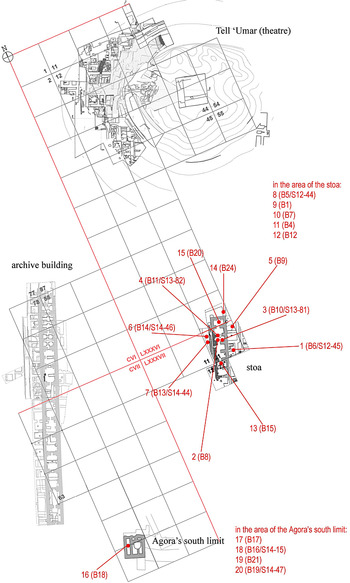
The North Agora is a wide rectangular square extending for about 19,000 m2, located at the northern boundaries of the city. The space is delimited on three sides by public buildings: the theatre, to the north, the archive building, to the west, and the stoa, to the east (Fig. 1). It was one of the most important public spaces of the city, probably planned at the moment of its foundation or soon after, in the context of the “Babylonianized” policy of Seleucus I and Antiocus I: its layout seems to reveal the conscious attempt to place buildings of Greek and Mesopotamian tradition in the same urban context (Messina Reference Messina2011: 160–65; Reference Messina, Matthews and Curtis2012: 173–75). The agora's north and west sides, where the theatre and the archive building have been unearthed, were investigated by the Italian expedition, under the direction of Antonio Invernizzi, from 1963 to 1972.
Seleucia on the Tigris. North Agora. Find spots of the clay sealings from the 1985, 1987 and 1989 campaigns

The theatre was identified at Tell ‘Umar, the main mound of the site (Invernizzi Reference Invernizzi1991: 339–59): its cavea was supported by mudbrick substructures, rising at least 13 metres from the ground level and built following the local building technique. The orchestra was located to the south, allowing the spectators to look at the agora beyond the scene-building, while a small Mesopotamian temple flanked the theatre's west side, being part of the same complex (Messina Reference Messina2010: 114–60). The building's stratigraphy allows us to date its most ancient phase to the period of the city's foundation and to postulate that it was completed during Antiochus III's reign, remaining in use and being restored until the end of the Parthian period.
The archive building is a long and narrow structure that extends for about 140 metres in length and 10 metres in width; it consists of a single suite of fourteen modular rooms that do not have independent accesses from the outside and could be entered only through openings on the building's axis. The archive was in use from at least the reign of Antiochus III, and was devastated by a great fire in the last quarter of the second century b.c.: the abundant traces of burnt wood, ashes and overfired clay sealings found in its ruined structures attest that in each room two pairs of opposing niches contained wooden shelves for keeping rolled documents sealed by bullae or attached sealings (Messina Reference Messina2006: 50–69). The 30,000 seal impressions still preserved on the surface of the clay sealings provide important information on the artistic production of the city workshops (Bollati and Messina Reference Bollati and Messina2004a, Reference Bollati and Messina2004b; Messina and Mollo Reference Messina and Mollo2004). However, the information on the sealing practices and administration procedures that may be acquired when statistical and distribution analyses are completed holds even greater potential, because the sealings discovered in the archive building of Seleucia were found in situ. The archive was a public building made with the purpose of keeping an enormous number of sealed documents, and its suite of axial modular rooms may be compared to the precincts of the Mesopotamian sanctuaries, the so-called “Zingel”, for both show the same characteristic alignment of rooms and extension in length (Messina Reference Messina2011: 160–65). There is no direct connection between the function of the archive building of Seleucia and the function of a Zingel, for this archive is not part of a sanctuary: nevertheless, it is interesting that the Zingels often contained archives of cuneiform tablets and that, in some cases, the arrangement of the inner space of their rooms was similar to that of the archive found at Seleucia in the presence of two pairs of opposing niches.
The fact that the great majority of the documents kept in the archive concerned the salt trade, one of the most important economic activities of the city, is demonstrated by the occurrence on attached sealings of stamps belonging to a Seleucid salt-tax department (Mollo Reference Mollo, Boussac and Invernizzi1996).
Excavation of the agora's east and south sides
Excavations on the agora's east side were conducted under the direction of Elisabetta Valtz in 1985, 1987 and 1989 (the last three campaigns of the Italian expedition), with the main purpose of defining the square layout and investigating the front facing the archive building. There, a dwelling house with storage rooms and shops of the Parthian period, and a public building of the Seleucid period, facing and mirroring the archive, were progressively brought to light. The Seleucid building revealed a continuous pillared front on the square, decorated with baked antefixes and lion-headed gargoyles that allowed the excavators to recognize the northernmost part of a Greek stoa, with tiled sidewalks and, possibly, a portico (Valtz Reference Valtz1986, Reference Valtz1988, Reference Valtz1990). The building was not completely excavated, but its chronology appeared well defined by stratified potsherds and coins to the third to second century b.c. (in the period of Antiochus III's reign). This seemed to be confirmed by the fact that the stoa possessed the same proportions and wall-alignment of the archive building, as they were built following the same urban project (Messina Reference Messina2006: 50–54). Behind the pillared front, the layout of the stoa was characterized by a row of modular rectangular rooms and a row of larger rooms or courtyards of unclear purpose.
The agora's south side was excavated from 1972 to 1976, and in 1989. The area exposed was less extensive than on the other sides, and the structures brought to light were not well preserved, to the extent that their function still remains largely unclear. The fact that, at least at a certain time (not before the second century b.c.), the whole area was used as a kind of dump for fragments of terracotta figurines and similar rough materials seems to point to the presence of workshops on this side of the agora in the Parthian period, even if no structures of this type were clearly recognized (Menegazzi Reference Menegazzi2009). In any case, the Seleucid layout of the square remains unknown.
Find spots and types of sealings
The most outstanding discoveries of sealings made by the Italian expedition were those in the archive building (campaigns from 1967 to 1972); however, clay sealings were also found in other areas of the North Agora during the 1985, 1987 and 1989 campaigns, particularly in the context of the stoa, but also at the agora's southern limit (Fig. 1). In the registers of the last three campaigns of the Italian expedition, still kept in the Centro Scavi di Torino, twenty-two sealings are recorded among other finds: fifteen were found in the area of the stoa (out of these, only ten can be precisely positioned in the stoa's rooms, while general indications on the area are provided for the remaining five specimens); five were found at the agora's southern limit (of which only one can be precisely positioned); two are catalogued as sporadic findings and may even come from outside the agora.
The clay sealings found at Seleucia on the Tigris by the American and Italian expeditions can be divided into two basic types: (1) bullae and (2) attached sealings (see also Messina Reference Messina, Bellotto and Ponchia2009: 176–79).
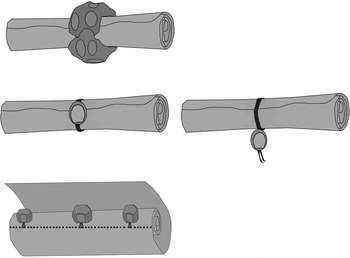
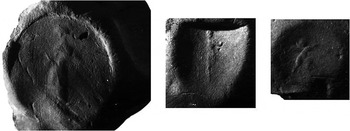
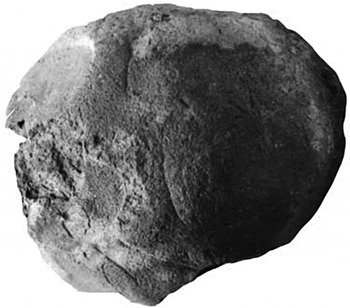
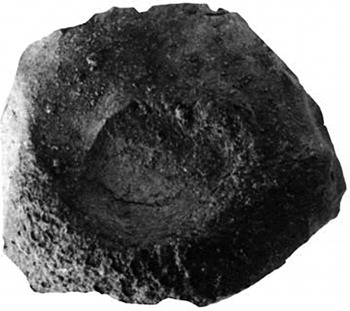
A bulla is a spheroidal lump of clay with a large hole through it, wrapped around the strings tightening a folded or rolled document (usually a parchment), as a kind of a napkin ring (Fig. 2), and bearing on its surface from two to several seal impressions (in some cases, up to twenty). Bullae are peculiar to the Mesopotamian archives and can be compared to sealed clay tablets for the number and arrangement of the seal impressions on their surface. On the basis of cuneiform sources, it may be inferred that certain clay tablets were considered equivalent to documents sealed by bullae even by the Seleucid administration (Wallenfels Reference Wallenfels and Perna2000: 334–35), for in the texts of some clay tablets from Babylon these two kinds of document appear to have been assimilated by the corresponding determinatives, im/kuš (Oelsner Reference Oelsner and Brosius2003: 295 particularly refers to documents that may or may not have been sealed). Considering that the contents of clay tablets and parchments sealed by bullae could have been equivalent, it may be inferred that the latter concerned for the most part prebends or private transactions guaranteed by witnesses, who impressed their seals on the bullae surface, sometimes under the control of Seleucid offices or officers (according to Doty Reference Doty1977: 323, certain transactions could be written in cuneiform if not required to be taxed): indeed official seals with Greek captions often occur on bullae together with those of the witnesses.
Types of clay sealings: Bulla, flat sealings and saddle sealings

An attached sealing is a lump of clay applied on part of the strings tied round a folded or rolled document (a parchment or, sometimes, a papyrus) and, as a general rule, adhering to the surface of the document itself. Attached sealings are quite common in the Near East and Mediterranean and, on the basis of their shape and the number of seal impressions on their surface, they can be divided into two subtypes:
Subtype 1: flat sealings. These are small and flat lumps of clay bearing only one seal impression and recalling, in their shape, a modern wax sealing (Figs. 2, 5 and 17). It has been suggested that they could have been applied only to the loose ends of the binding strings, hanging and not adhering to the document surface; indeed, sealings also referred to as clay medallions or clay tags, and pierced lengthwise by a string hole, have also been found at Uruk (Wallenfels Reference Wallenfels1994: 1–2). However, the back surfaces of several flat sealings bear small horizontal grooves, which resulted from the impression on the still undried clay of the texture of papyrus sheets and attest that, at least in these cases, the sealings adhered to the document. Official seals are attested on flat sealings, but given the occurrence of anepigraphic figurative seals, it is assumed that this kind of sealing was also used for binding private documents or letters.
Subtype 2: saddle sealings. These are quite uneven lumps of clay bearing more than one seal impression and corresponding to what R. H. McDowell called “convex sealings” (1935: 3–9), even if they rather recall a saddleback in their shape: this is likely due to the action of impressing two or more seals on the still undried lump of clay, thus creating their characteristic sloping outer surface (Fig. 16). As far as it is possible to see from the thousands of fragments of these sealings known from Seleucia on the Tigris, their inner surface, bearing the impressions of the strings tied around the document, is smooth and quite convex: it therefore seems possible to assume that they did not adhere to one of the outer surfaces of the document (in this case, a parchment), but rather within the rolled document itself. The reason for this positioning is still debated, and it has been suggested, though not finally demonstrated, that saddle sealings were used for binding a particular type of document, the so-called “two versions” parchment: this may have been a single sheet bearing two written versions separated by a series of holes; one of the halves of the parchment was rolled and tied up by strings passing through the holes (Fig. 2). Lumps of clay were attached to the strings close to the row of holes and then to the folder's bend, to be sealed; finally, the outer half of the sheet was folded around the inner portion (see for all McDowell Reference McDowell1935: 3–4, who argues, on the basis of an experiment, that saddle—or “convex”—sealings were always used for the inner part of the same documents finally bound with bullae; but see contra Brown Reference Brown1938: 609–10). In any case, the documents bound with saddle sealings must have concerned tax collections or exemptions in particular, because, for the most part, these sealings bear on their surfaces the impressions of seals of professional witnesses and stamps with Greek inscriptions, which belonged to tax departments.
Catalogue
The catalogue includes twenty-two entries, listed by location of discovery. In each entry, the type of sealing, state of preservation, dimensions, date and find spot are provided, together with other peculiarities, such as fingerprints and impressions of strings or fingernails. Entries are divided into subentries: each relates to a single seal impression recognized on the sealing's surface, and describes its shape, dimensions, state of preservation, characteristics and peculiarities. The subjects represented on the seal impressions and comparisons with published materials are then discussed. Measurements are given in centimetres.
Eastern side: Area AB
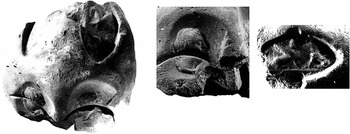
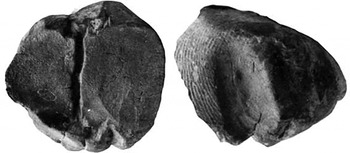
1. Bulla (B6/S12-45). Fig. 3. Fragmentary and overfired. 2.8 × 2.5 × 0.8 cm. North Agora, Eastern side: Area AB (on wall M2). Discovered on October 27, 1985. Impressions of strings on the inner surface. 1 seal impression (possibly bearing 2 impressions of the same seal).
-
1:1. Oval. Concave. > 0.8 × >0.8 cm. Incomplete. Fingernail impressions (?) or small cracks on the edge. Dolphin to right.
Bulla no. 1 (inner surface) and seal impression 1:1

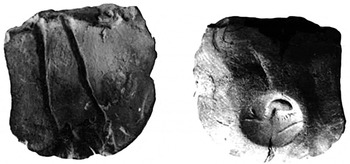
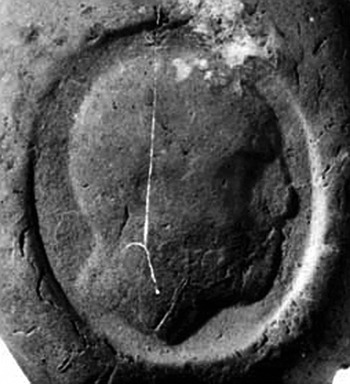
2. Attached sealing—subtype 2 (B8). Fig. 4. Fragmentary and overfired. 4.0 × 3.8 × 1.7 cm. North Agora, Eastern side: Area AB. Room 10 (layer 33). Discovered on October 27, 1985. Impressions of strings on the back surface. 3 seal impressions (possibly bearing more impressions). Impression 2:1 above, impressions 2:2 and 2:3 below, placed side by side.
-
2:1. Oval or circular. Flat. > 2.0 × >2.0 cm. Almost complete. Two fingernail impressions (?) or small cracks on the edges. Bull-horned head of Seleucus I facing to left, slightly in foreshortening. Oval face with large protruding bull horns. The identification with Seleucus I is proposed on the basis of well known bull-horned portraits reproduced both on coins and official Seleucid seals (Fleischer Reference Fleischer1991: 18–19, 35; Lindström Reference Lindström2003: 48; Messina Reference Messina2004 and selected bibliography; partially disputed by Iossif Reference Iossif2012: par. II).
-
2:2. Oval. Flat. >1.8 × 1.3 cm. Almost complete. Winged (?) thunderbolt. Comp. with seal impressions on clay bullae from the archive building of Seleucia on the Tigris (Bollati and Messina Reference Bollati and Messina2004b: nos. OG 34, 45) and sealings from the area of Block G6 (McDowell Reference McDowell1935: pl. IV:78).
-
2:3. Oval. Concave. 0.9 × 1.4 cm. Complete. Subject completely eroded.
Bulla no 2 and seal impressions 2:1 and 2:2

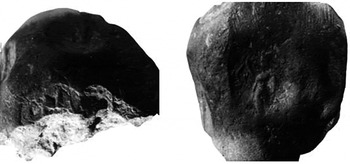
3. Attached sealing—subtype 2 (B10/S13-81). Fig. 5. Complete. Buff Clay. 1.9 × 1.1 × 1.4 cm. North Agora, Eastern side: Area AB. Room 10 (layer 67). Discovered on November 28, 1987. Impressions of strings on the back surface. 3 seal impressions (possibly bearing more impressions). All impressions placed side by side: impression 3:1 in the middle.
-
3:1 Oval. Concave. 1.9 × 1.2 cm. Complete. Worshipper or priest in right profile, wearing a full length robe and pointed cap, with long staff in his right hand. Cornucopia (?) and wreath at left. Comp. with seal impressions on bullae from the archive building of Seleucia on the Tigris (Bollati and Messina Reference Bollati and Messina2004b: nos. SA7–8, 11, 15) and on clay tablets or bullae from Uruk (Wallenfels Reference Wallenfels1994: nos. 58–61; Lindström Reference Lindström2003: no. 226–10).
-
3:2 Oval (?). Concave. >0.7 × >0.4 cm. Incomplete. Subject completely eroded. Fingernail impression on the edge.
-
3:3 Oval (?). Concave. >0.8 × >0.3 cm. Incomplete. Subject completely eroded.
Seal impression 3:1

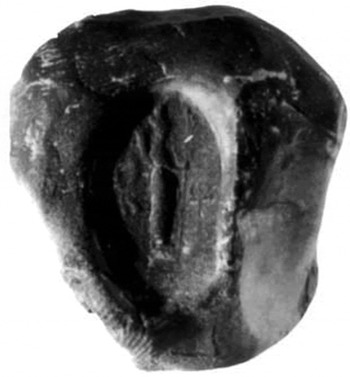
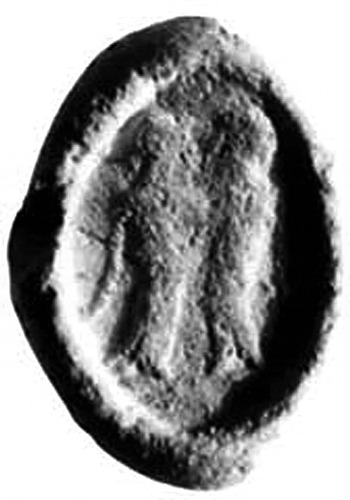
4. Attached sealing—subtype 1 (B11/S13-82). Fig. 6. Fragmentary. Partially fired. Reddish clay. 1.0 × 1.4 × 1.6 cm. North Agora, Eastern side: Area AB. Room 10 (layer 67). Discovered on November 24, 1987. Fingerprints on the edge. 1 seal impression.
-
4:1. Pointed ellipse. Flat. 1.4 × 1.0 cm. Complete. pair of humans in profile. Pair of (male?) figures in knee-length kilts facing full front. Possibly beardless with heads turned towards each other. Arms along their bodies. Comp. with seal impressions on clay tablets or bullae from Uruk (Wallenfels Reference Wallenfels1994: nos. 110–11; Lindström Reference Lindström2003: no. 200-4). Seal impressions of larger size from the archive building of Seleucia on the Tigris are interpreted as a pair of priests in a gesture of salute (Bollati and Messina Reference Bollati and Messina2004b: nos. SM 1–2).
Sealing no. 4

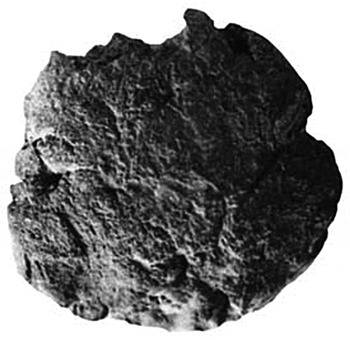
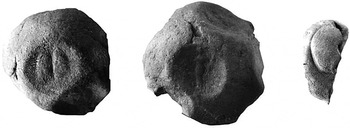
5. Sealing of undefined type (B9). Fig. 7. Fragment completely overfired. 2.3 × 2.1 × 0.8 cm. North Agora, Eastern side: Area AB. Room 12, North of grave T1 (layer 38). Discovered on October 27, 1985. Impressions of strings on the back surface. No seal impressions remain.
Sealing no. 5

6. Attached sealing—subtype 1 (B14/S14-46). Fig. 8. Almost complete. Partially fired. Reddish and grey clay. 1.6 × 1.9 × 1.2 cm. North Agora, Eastern side: Area AB. Front on the square (layer 84). Discovered on April 27, 1989. Impressions of strings on the back surface. 1 seal impression.
-
6:1. Oval. Flat. 1.6 × 0.8 cm. Almost complete. Monogram. Similar monograms, but not the same, can be found on seal impressions on bullae from the archive building of Seleucia on the Tigris (Bollati and Messina Reference Bollati and Messina2004b: nos. MO 3–5) and Uruk (Lindström 200: no. 89-1).
Sealing no. 6

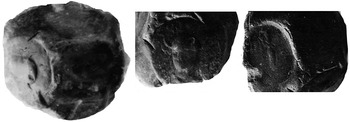
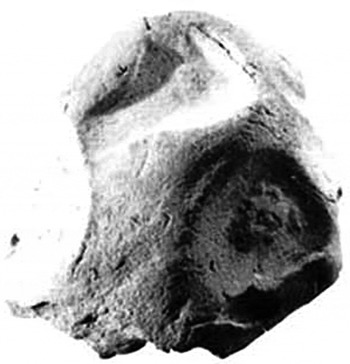
7. Bulla (B13/S14-44). Fig. 9. Fragmentary. Partially fired. Reddish and grey clay. 3.3 × 3.6 × 1.9 cm. North Agora, Eastern side: Area AB. Front on the square (layer 84). Discovered on April 26, 1989. Impressions of strings on the inner surface. 4 seal impressions; 2 pairs of impressions: impression 7:1 side by side with 7:2, impression 7:3 side by side with 7:4.
-
7:1. Oval. Concave. 1.3 × 1.6 cm. Almost complete. Head of a woman in right profile. Unveiled hairs, with a flat bun at the back of the head and a large eyeball between linear eyelids. Schematic draped chlamys at the base of the neck. Fingernail impression on the subject. Comp. with seal impressions on clay sealings from the archive building of Seleucia on the Tigris (Messina and Mollo Reference Messina and Mollo2004: nos. TF 88-90, 107 and, particularly for the style of the eyeball and eyelids, no. TF 14).
-
7:2. Same seal as 7:1. Fingernail impression on the subject.
-
7:3. Pointed elipse. Flat. >1.9 × >1.0 cm. Almost complete. Human-headed sphinx with outstretched wings at left, seated in righ profile, confronting a dog at right, seated in left profile. Below the figures, horizontal line. Comp. with seal impressions on clay tablets and bullae from Uruk (Wallenfels Reference Wallenfels1994: nos. 284–88; Lindström Reference Lindström2003: nos. 134-2, 149-2, 228-7; *36-2, *59-5).
-
7:4. Same seal as 7:3. Only the right half remains.
Bulla no. 7 and seal impressions 7:1 and 7:3

8. Attached sealing—subtype 2 (B5/S12-44). Fig. 10. Fragmentary. Pink-buff clay. 2.8 × 2.6 × 1.4 cm. North Agora, Eastern side: Area AB. Surface. Discovered on October 6, 1985. Impressions of string and holes on the back surface. 4 seal impressions: impression 8:1 above, impressions 8:2, 8:3 and 8:4 below and placed side by side, with 8:3 in the middle.
-
8:1. Circular. Concave. >0.8 × >0.9. Incomplete. Pair of poloi or miters. An impression of the same seal seems to occur on a bulla from the archive building of Seleucia on the Tigris (Bollati and Messina Reference Bollati and Messina2004b: no. Og 112), where many impressions with the same subject have been found (ibid.: nos. Og 102–77). Comp. also with seal impressions on bulle from the so-called “Archive A”, a room of the Block G6 (McDowell Reference McDowell1935: pl. IV:82), and from Uruk (Lindström Reference Lindström2003: nos. 53-2, 63-2, 228-1,2, 291-4). The same subject also occurs on sealed clay tablets from Uruk (Wallenfels Reference Wallenfels1994, nos. 1030-1032).
-
8:2. Oval or circular. Concave. >0.9 × >0.9 cm. Almost complete. Subject completely eroded.
-
8:3. Circular (?). Concave. >1.0 × >1.0. Incomplete. Tyche standing three-quarter left holding a cornucopia in her left hand. Comp. with seal impressions on bullae from the archive building of Seleucia on the Tigris (Bollati and Messina Reference Bollati and Messina2004a: nos. Tk 37, 42, 46, 49, 91) and Uruk (Lindström Reference Lindström2003: nos. 2-3, 123-1, 267-3).
-
8:4. Oval (?). Flat. >1.1 × >0.4. Incomplete. Head of a bearded (?) man in right profile.
Seal impressions nos. 8:1, 8:3 and 8:4

Eastern side: Area B
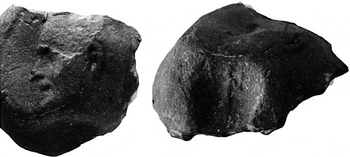
9. Bulla (B1). Fig. 11. Fragmentary and overfired. 3.0 × 2.6 × 1.2 cm. North Agora, Eastern side: Area B. Zone E (layer 2). Discovered on September 23, 1985. Impressions of strings on the inner surface. 2 seal impressions (possibly bearing more impressions): impression 9:1 above, 9:2 below.
-
9:1. Oval or circular. Flat. >1.2 × >1.7. Incomplete. Portrait of a bearded mature man in left profile. Naturalistic. Short hair and very short beard. Pointed and protruding nose, short moustache. Impressions of the same seal occur on bullae found in the archive building of Seleucia on the Tigris (Messina and Mollo Reference Messina and Mollo2004: no. TM 463) and in the so-called “Archive A” of Block G6 (McDowell Reference McDowell1935: pl. I:11; who also, ibid.: 46, 214–20, identifies the represented subject with Timarchus or Heracleides on the basis of largely indirect and unconvincing evidences, and proposes that it may be an official seal).
-
9:2. Oval or circular. Concave. >0.9 × >1.0. Incomplete. Artemis or Hekate standing frontal and holding two torches in both hands. Comp. with seal impressions on bullae from the archive building of Seleucia on the Tigris (Bollati and Messina Reference Bollati and Messina2004a: nos. Ar 48, Hk 1–5).
Seal impressions nos. 9:1 and 9:2

10. Bulla (B7). Fig. 12. Fragmentary and overfired. 3.3 × 2.5 × 1.4 cm. North Agora, Eastern side: Area B (layer 4). Discovered on September 28, 1985. Impressions of strings on the inner surface. 4 seal impressions (possibly bearing more impressions): impression 10:1 above, impressions 10:2, 10:3 and 10:4 below and placed side by side, with 10:3 in the middle.
-
10:1. Oval or circular. Flat. >1.4 × >2.0. Incomplete. Bearded head of Dionysus, with ivy wreath, in right profile. Naturalistic. Short hair and full beard with very small nose. At least 175 impressions of the same seal occur on bullae found in the archive building of Seleucia on the Tigris (Bollati and Messina Reference Bollati and Messina2004a: no. DsT 6) and it is noteworthy that even the association with the seal 10:3 is frequent (see below 10:3).
-
10:2. Oval or circular. Concave. >1.0 × >1.0. Incomplete. Standing Athena Promachos with Corinthian helmet, three-quarter to right, holding a shield in her left hand and raising a spear in her right. Schematic style. Comp. with seal impressions on bullae from the archive building of Seleucia on the Tigris (Bollati and Messina Reference Bollati and Messina2004a: nos. At 193–94, 200).
-
10:3. Oval. Concave. >1.8 × >1.0. Incomplete. Head of a bald and bearded man in right profile. At least 203 impressions of the same seal occur on bullae found in the archive building of Seleucia on the Tigris (Messina and Mollo Reference Messina and Mollo2004: no. TM 447), often associated with the seal 10:1 (DsT 6).
-
10:4. Oval or circular. Concave. >0.8 × >0.7 cm. Incomplete. Subject completely eroded.
Seal impressions nos. 10:1, 10:2 and 10:3

Eastern side: Area D
11. Bulla (B4). Fig. 13. Fragmentary and overfired. 2.2 × 1.9 × 1.0 cm. North Agora, Eastern side: Area D. Zone E (layer 14). Discovered on October 2, 1985. Impressions of strings on the inner surface. 2 seal impressions (originally bearing more impressions): impression 11:1 above, impression 11:2 below.
-
11:1. Oval or circular. Concave. >1.9 × >1.0 cm. Incomplete. Subject eroded: head (?).
-
11:2. Oval or circular. Concave. >0.5 × >1.1 cm. Incomplete. Standing figure.
Bulla no. 11 (inner surface) and seal impression 11:2

Eastern side: Area E
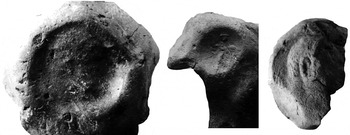
12. Attached sealing—subtype 2 (B12). Fig. 14. Fragmentary. Grey-Reddish Clay. 2.8 × 2.4 × 1.2 cm. North Agora, Eastern side: Area E (layer 87). Discovered on April 4, 1989. Impressions of strings on the back surface. 3 seal impressions: 2 impressions of the same seal (possibly bearing more impressions): impression 12:1 above, impressions (of the same seal) 12:2 and 12:3 below and placed side by side.
-
12:1. Shape undetermined. Flat (?). >0.4 × >0.8. Extremely fragmentary. Subject undetermined (possibly a head). Only the upper part remains.
-
12:2. Oval. Concave. >0.9 × >1.0 cm. Incomplete. Standing Nike three-quarter to left, holding a wreath in her right hand. Schematic style.
-
12:3. Oval. Concave. >0.8 × >1.1. Incomplete. Same seal as 12:2.
Seal impressions nos. 12: 1 and 12:2

13. Bulla (B15). Fig. 15. Fragmentary. Buff clay. 3.5 × 3.7 × 1.5 cm. North Agora, Eastern side: Area E. Room 16 (layer 90). Discovered on April 16, 1989. Impressions of strings on the inner surface. 3 seal impressions (originally bearing more impressions): impression 13:1 above, impressions 13:2 and 13:3 below and placed side by side.
-
13:1. Oval or circular. Flat. >1.8 × >1.6 cm. Incomplete. Subject completely eroded.
-
13:2. Rectangular (?). Concave. >1.1 × >1.4 cm. Incomplete. Subject completely eroded.
-
13:3. Circular. Concave. >1.1 × >1.1 cm. Incomplete. Small head of a woman three-quarter to left.
Bulla no. 13

Eastern side: Area N
14. Attached sealing—subtype 2 (B24). Fig. 16. Fragmentary. Reddish Clay. 2.8 × 2.4 × 1.3 cm. North Agora, Eastern side: Area N (on wall M14). Discovered on June 7, 1989. Impressions of strings on the back surface. 4 seal impressions: impression 14:3 above, impressions 14:2 and 14:4 in the middle, placed side by side, impression 14:1 below.
-
14:1. Oval. Flat. >1.6 × >1.9 cm. Incomplete. Standing and nude Apollo (?), three-quarter to left holding a draped chlamys in his right hand.
-
14:2. Shape undetermined. Flat. >1.1 × >1.1 cm. Incomplete. Subject completely eroded.
-
14:3. Probably rectangular. Flat (?). >1.0 × >0.7 cm. Incomplete. Almost totally eroded. Official Seleucid stamp, bearing Greek inscription at least on two lines, possibly of the “Alikè Onè” Department and dated, on the basis of the comparison with the several stamps occurring on the sealings from the archive building of Seleucia on the Tigris (Messina and Mollo Reference Messina and Mollo2004: nos. alk 37–40), to the period 204–202 b.c., corresponding to the years 109–110 of the Seleucid era. In the upper line, it seems possible to read “(AΛI)KHΣ”, in the lower, which corresponds to the second line, the date “ΘP” or “(I)P”.
-
14:4. Shape undetermined. Flat. >1.4 × >1.1 cm. Incomplete. Head in right profile (?).
Seal impressions nos. 14:1 and 14:3

15. Sealing of undefined type (B20). Small fragment overfired. 1.6 × 2.1 × 0.8 cm. North Agora, Eastern side: Area N. Room 23 (layer 117). Discovered on May 21, 1985. 1 seal impression (possibly originally bearing more impressions).
-
15:1. Shape undetermined. Flat (?). >0.9 × >0.6 cm. Fragmentary. Subject almost completely eroded: head in right profile (?).
Southern side: Area M
16. Bulla (B18). Fragmentary and overfired. 2.6 × 2.3 × 1.3 cm. North Agora, Southern side: Area M (at the corner of walls M1 and M2). Discovered on May 14, 1989. 3 seal impressions (possibly bearing more impressions). Relevant position of the seal impressions on the surface undetermined.
-
16:1. Oval. Flat. >1.0 × >1.4 cm. Fragmentary. Standing Artemis (?) in right profile holding a torch (?) in her right hand.
-
16:2. Circular (?). Flat. >1.4 × >1.4 cm. Incomplete. Standing figure in right profile.
-
16:3. Undetermined shape. Flat. >1.3 × >1.1 cm. Fragmentary. Standing Nike three-quarter to right holding a wreath.
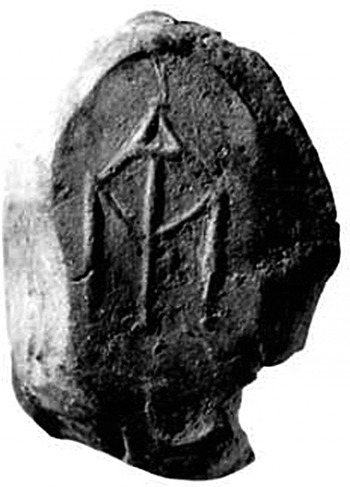
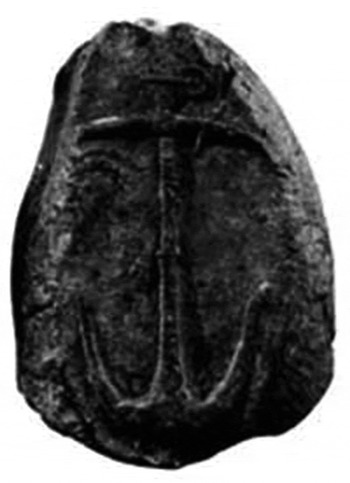
17. Attached sealing—subtype 1 (B17). Fig. 17. Complete. Partially fired. Gray clay. 1.3 × 1.8 × 0.7 cm. North Agora, Southern side: Area M (layer 3). Discovered on May 11, 1989. Vertical hole passing through the sealing and originally containing the end of the string tightening the rolled document. 1 seal impression.
-
17:1. Oval. Flat. >1.8 × >1.0 cm. Almost complete. Vertical anchor. Official Seleucid seals representing anchors occur on many attached sealings found in the archive building of Seleucia on the Tigris (Messina and Mollo Reference Messina and Mollo2004: nos. SU 3–19), where they are usually associated with horses’ heads, and in the so-called “Archive A” of Block G6 (Mc Dowell Reference McDowell1935: pl. I:5), or at Uruk (Rostovtzeff Reference Rostovtzeff1932: no. 80; Lindström Reference Lindström2003: nos. 258-1, 268-1), Callipolis (Pantos Reference Pantos1985: no. 94), Delos (Boussac Reference Boussac1992: no. SP8) and Tel Kedesh (Herbert and Berlin Reference Herbert and Berlin2003: fig. 28). Same seal as 20:1 (?). See below.
Sealing no. 17

18. Bulla (B16/S14-15). Fig. 18. Fragmentary. Buff clay. 3.7 × 3.7 × 1.9 cm. North Agora, Southern side: Area M (layer 2). Discovered on May 9, 1989. Impressions of strings on the inner surface. 1 seal impression (originally bearing 2 impressions of the same seal).
-
18:1. Oval. Flat. 1.8 × 2.2 cm. Complete. Portrait of a beardless man in right profile. Short hairs, full cheeks and small nose. Low relief. Naturalistic.
Seal impression no. 18:1

19. Bulla (B21). Fig. 19. Fragmentary and overfired. 4.0 × 4.0 × 2.0 cm. North Agora, Southern side: Area M (surface). Discovered on May 9, 1989. Impressions of strings on the inner surface. 3 seal impressions (possibly bearing more impressions). All impressions placed side by side.
-
19:1. Oval. Flat. >2.2 × >2.3 cm. Incomplete. Standing woman three-quarter to left. Possibly offering an object now completely eroded.
-
19:1. Triangular with curved sides. Concave. >1.6 × 1.2 cm. Almost complete. Standing woman (?) in right profile.
-
19:1. Circular or oval. Flat. >1.3 × >1.3 cm. Incomplete. Eros flying upward in right profile holding a wreath in his raised hands. Comp. with seal impressions on bullae from the archive building of Seleucia on the Tigris (Bollati and Messina Reference Bollati and Messina2004a: nos. Er 101–103).
Seal impressions nos. 19:1, 19:2, 19:3

Southern side: Area L
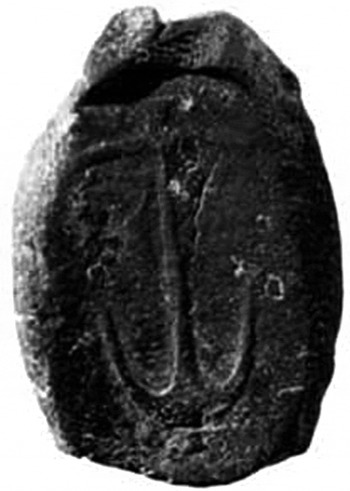
20. Attached sealing—subtype 1 (B19/S14-47). Fig. 20. Complete. Overfired. 1.7 × 2.4 × 0.6 cm. North Agora, Southern side: Area L (layer 3). Discovered on May 11, 1989. Two vertical holes passing through the sealing and originally containing the end of the string tightening the folded document. Horizontal grooves impressed on the back surface, likely left by a papyrus document. 1 seal impression.
-
20:1. Oval. Flat. 2.1 × >1.3 cm. Complete. Vertical anchor. Same seal as 17:1 (?). See above.
Sealing no. 20

Sporadic finds
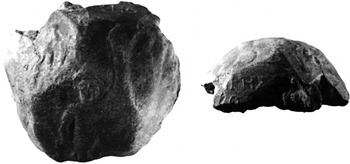
21. Bulla (B2). Fig. 21. Fragmentary and overfired. 3.6 × 2.8 × 1.1 cm. Unknown date and place of discovery. Impressions of strings on the inner surface. 2 seal impressions (originally bearing more impressions). Impressions placed side by side.
-
21:1. Oval. Flat. >1.2 × >1.0 cm. Incomplete. Subject eroded.
-
21:2. Shape undetermined. Concave (?). >0.4 × 0.3 cm. Extremely fragmentary. Subject undetermined.
Sealing no. 21

22. Bulla (B3). Fig. 22. Fragmentary and overfired. 3.2 × 2.0 × 1.4 cm. North Agora. Unknown date and place of discovery. Impressions of strings on the inner surface. 1 seal impression (possibly originally bearing 2 impressions of the same seal).
-
22:1. Oval. Concave (?). > 1.4 × >1.6 cm. Incomplete. Dolphin (?) to right.
Sealing no. 22

Concluding remarks
On the surfaces of the twenty-two sealings listed above, forty-eight seal impressions have been recognized. The impressions mostly reproduce subjects that are known at Seleucia on the Tigris and can be compared with published materials. Two seals (nos. 4:1 and 7:3) show subjects attested at Uruk but not at Seleucia. However, there are also subjects not previously attested, or attested with slight differences in their iconography and style, which increase our knowledge of the production of the city workshops (nos. 2:1, 6:1, 14:1, 16:3, 18:1 and 19:1–2).
By far the most interesting of the previously unknown subjects is the seal impression no. 2:1, where a heroized bull-horned portrait of Seleucus I is represented in slight foreshortening: this is indeed nothing but the synthetic representation of a full-figure statue of the king now lost, as comparison with a well known seal impression from Uruk, showing the corresponding full-figure prototype, clearly attests (Messina Reference Messina, Matthews and Curtis2012: 171–72). Bull-horned posthumous portraits of Seleucus I, which after Antiochus I became symbols of the Seleucid kingship, were known, until now, exclusively in right profile on official seals and are widely reproduced on coins, whereas heads of the same type in foreshortening scarcely occur, and only on coins (Fleischer Reference Fleischer1991: 6–8).
The standing Apollo and Nike holding a wreath (nos. 6:1and 14:1) conform to the iconography of the Greek gods widely reproduced on seals and popular in the city, while a naturalistic portrait of a beardless man (no. 18:1) is quite surprising, for it has been executed in low relief. The two standing women impressed on the same sealing (nos. 19:1–2) could be considered as offering figures and raise interesting questions regarding the occurrence of this subject on seals of quite large size, which seems more proper for official types.
It is possible to see that the sealings conform to the types already known at Seleucia; however, it is interesting that at least one specimen reveals the same sealing practice attested in the context of the archive building (nos. 10:1–3), since this implies that the documents bound with this procedure were of the same type; such must also be the case for the two documents bound with the official Seleucid symbol of the vertical anchor (nos. 17:1 and 20:1), also attested in the archive building.
Can the sealings analysed here be contextualized in a particular archive? Out of twenty-two specimens, fifteen were found in the area of the stoa, five at the agora's southern limit and two are sporadic finds. However, it seems very hard to argue that the two groups of finds, or at least the most numerous of them—that found in the stoa—can come from a small archive located there, because most of the sealings were scattered in non-relevant layers or positions: in the area of the stoa, only sealings nos. 3 and 4 were found in the same room and level; nos. 6 and 7 come from the same layer but from an open area and more precise indications cannot be provided, while nos. 13 and 15 come from deep layers, but were found in different rooms. At the agora's southern limit, only no. 16 can be surely positioned close to a wall. In short, the sealings listed above were not found in situ and cannot prove the existence of small archives in the stoa's context or at the agora's south limit. Furthermore, a high proportion of them are overfired: eight out of fifteen in the stoa's context and three out of five at the agora's southern limit. This is useful information for postulating the place where the sealings were originally kept: given that in the excavation journals of the Italian expedition there is no mention of diffused traces of fire in the layers where the sealings were found, it seems logical to argue that the latter were kept elsewhere and thereafter displaced, for some reason or accidentally, to the position in which they were excavated. The most probable place of storage for these sealings is the great archive building located on the west side of the North Agora, where abundant traces of fire and thousands of overfired sealings have been found on the ground of at least eight of its fourteen rooms. The reason for their displacement to other points of the agora is a matter of speculation, but it is not surprising: indeed it must be stressed that during the rebuilding of the agora, carried out progressively during the Parthian period, different classes of materials could easily have been moved from their original positions.