

Undoubtedly, the imperial coinage of Faustina the Younger is the largest surviving primary source for the portraiture and public image of the empress, and excellent work on the subject has already been done.Footnote 1 Martin Beckmann (B.) sets out to reevaluate the coinage, portraits, and public image of Faustina the Younger, primarily based on a die study of her gold coinage (aurei) from the imperial mint in Rome.Footnote 2 Die studies are a time-consuming and tedious task, but the results often allow us to better understand the workings of the mint and the (relative) chronology of coins and the images they carry. This is of primary importance for the coins of imperial women, as they are not dated. Moreover, the attribution and chronology of the sculptured portraits almost entirely depends on the coins. Only a correct interpretation of the numismatic evidence allows us to securely establish the relative and absolute chronology of Faustina’s portraiture.
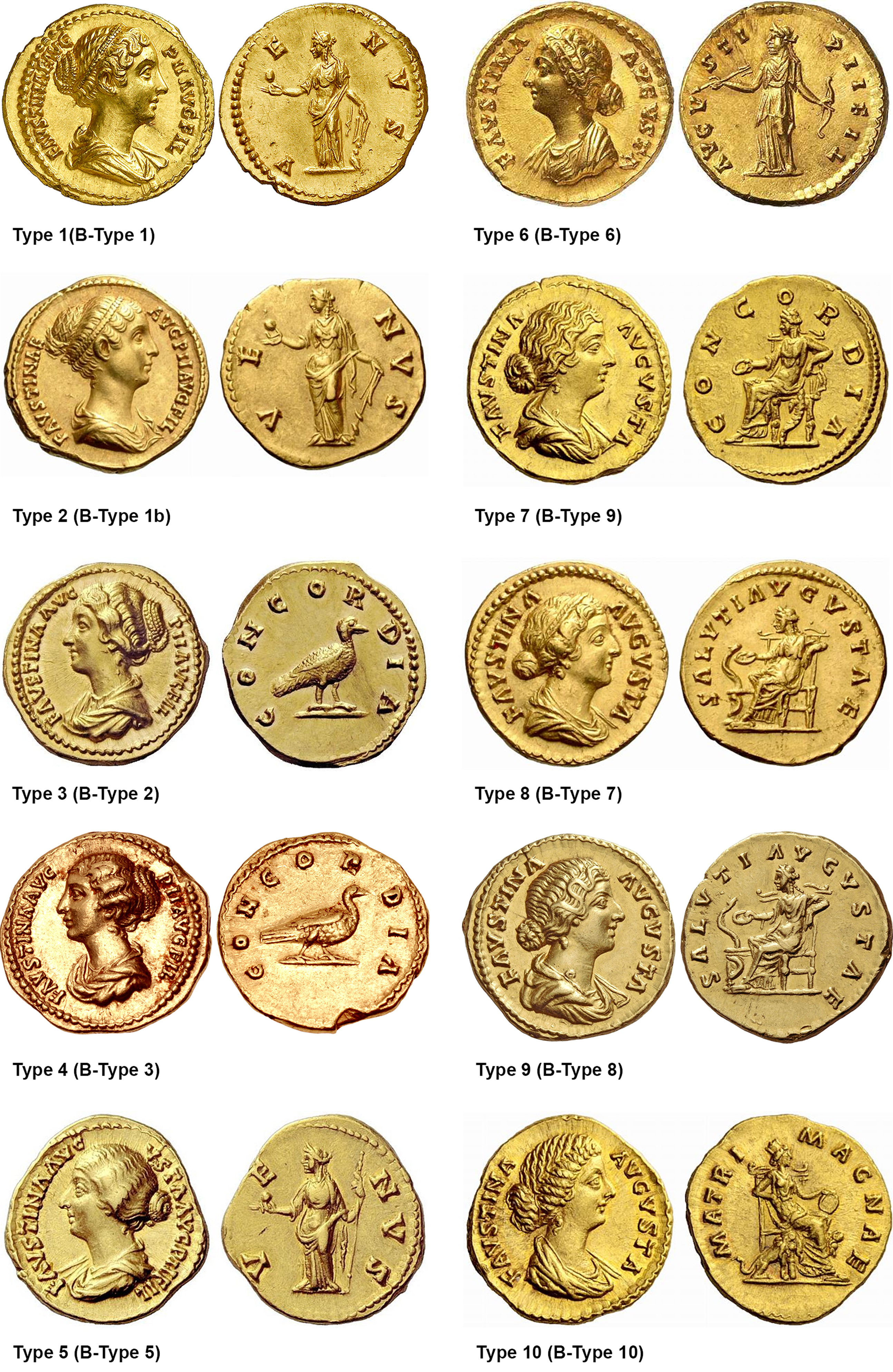
The book under review consists of a general introduction, a methodological introduction and presentation of the die study (Chapters 1–4), a discussion of the portraiture of Faustina (Chapters 5–7), and a conclusion. This is followed by two appendices, a die catalogue, die link charts, and plates. Some of B.’s interpretations and his portrait typology are adjusted in this review. His types are in the following called “B-Types”, while the revised typology, illustrated in Fig. 1, simply employs the term “Type”.
Portrait types of Faustina the Younger on coins. Courtesy of: (Type 1) Áureo & Calicó, Auction 241, 8 Feb 2012, Lot 125; (Type 2) Numismatica Ars Classica NAC AG, Auction 31, 26 Oct 2005, Lot 57; (Type 3) Numismatica Ars Classica NAC AG, Auction 91, 23 May 2016, Lot 25; (Type 4) Classical Numismatic Group, Auction Triton 14, 4 Jan 2011, Lot 733; (Type 5) Numismatica Ars Classica NAC AG, Auction 52, 7 Oct 2009, Lot 1127; (Type 6) From Leu Numismatik AG (1992–2005), Auction 93, 10 May 2005, Lot 37; (Type 7) Numismatica Ars Classica NAC AG, Auction 51, 5 Mar 2009, Lot 314; (Type 8) Numismatica Ars Classica NAC AG, Auction 31, 26 Oct 2005, Lot 58; (Type 9) Numismatica Ars Classica NAC AG, Auction 100, 29 May 2017, Lot 520; (Type 10) Numismatica Ars Classica NAC AG, Auction 51, 5 Mar 2009, Lot 316.

Methodology
Chapter 1 introduces various theories and questions surrounding the Roman mint and the coins it issued. In the case of Faustina, the obverse legend of the coins with the filiation identifying her as daughter of Antoninus Pius (PII AVG FIL in various forms) changes in a chronological order, before the filiation is entirely dropped and she is simply called FAVSTINA AVGVSTA on the coins (8). Importantly, over time, her coiffure also changes and, to a lesser degree, her physiognomy.Footnote 3
B. briefly explains the method of die study, its complexities, and its relevance for our understanding of the internal processes of the mint in Rome (13–16). Determining chronology from die linkage is not as straightforward as it may seem, as B. rightly points out. The die linkage chains (long sequences of linked dies), groups (shorter sequences), and pairs (two linked dies) have to be arranged in the correct “direction” and relative chronological order. Criteria for such an order are, for example, the continuation of a legend, portrait, or reverse type from one chain to another (16–18).
Equally important are absolute chronological “anchoring points,” that make it possible to connect certain parts of the chains with specific dates or date ranges. These can, for example, be the historical interpretation of a reverse type (as shown later), or “parallels between reverse types used on the coinage of Faustina and types used on the dated coinage of Antoninus Pius or Marcus Aurelius” (17). These “anchoring points,” however, often depend on complex assumptions and interpretations, which have to be carefully examined and verified in every single case – the correct order and chronology is critical for a correct historical interpretation of the material.
B.’s approach to establishing a “rough indication of chronology” within a die chain, based on the assumption of a relatively constant die use (18), is particularly challenging. This method is tempting but can be problematic. We cannot know for sure how continuous production was within a certain period, especially when it comes to coins of imperial women.
The number of Faustina’s children (some 11, 13, or even 15) and their dates of birth, to a certain degree depending on the coinage, are still disputed (18–19 and 111–13), an issue that cannot be resolved here as the evidence is often ambiguous and the interpretation rests on complex – and frequently competing – assumptions.Footnote 4
The early coinage of Faustina the Younger
In Chapter 2, B.’s analysis of the coinage of Faustina the Younger starts with a detailed examination of a relatively long die-linkage chain (Chain 1). The first coins struck in Faustina’s name in Rome are to be connected with the birth of her first child, Domitia Faustina, and the subsequent bestowal upon her of the title Augusta in 147 CE. The obverse legends are all in the dedicatory dative case FAVSTINAE AVG PII AVG FIL (24). The three reverse types of the early part of this chain are entirely devoted to the theme of childbirth (VENERI GENETRICI, IVNONI LVCINAE, and LAETITIAE PVBLICAE). The first coins struck for Faustina already carry her portrait on the obverse. The high-quality obverse dies employed for these first issues (fa3, fa9, and fa6) are very “naturalistic” and probably directly refer to a portrait model available to the mint in 147 CE (25–27). The “original” three-dimensional model (“prototype”) of this first portrait type of Faustina (Type 1 = B-Type 1), however, had probably already been created in 145 CE, as a portrait identity for the young princess was needed after her marriage to Marcus Aurelius.Footnote 5
The fact that most of the known Venus, Juno, and Laetitia dies link into the early part of Chain 1 further supports B.’s assumption that there was a period of intense but relatively short-lived coin production right at the start of Faustina’s coinage (27). These coins clearly allude to Faustina’s firstborn child, probably depicted as the swaddled infant cradled in the left arm of Venus Genetrix. This historical moment was commemorated on Faustina’s coinage only (29).
The subsequent part of Chain 1 is dominated by a new VENVS reverse, featuring the goddess holding apple and rudder, that soon replaced all other reverse types. B. states that “at the same time […] a tendency to abstract and/or misunderstand and misrepresent certain details of the portrait begins, leading to the creation of variants of portrait Type 1” (31). B.’s Variant 1a of Type 1 with its more ornamental interpretation of the hair style, however, is by no means a misunderstanding or misrepresentation, but a successful conversion – a thoughtful adaption – of the sculptured type into coin format. It is a visually very convincing rendering of the characteristics of the type, now predominantly with marked pupils, conferring “life” upon the small coin portraits.
B.’s Variant 1b of Type 1 (31–32) has been recognized as an independent type – Faustina’s Type 2 – in previous scholarship, first described by Paul Strack in 1937, followed by Max Wegner and Klaus Fittschen.Footnote 6 Rather than a gradual change, Chain 1 shows an abrupt discontinuation of Type 1 when Type 2 (B-Type 1b) was introduced on obverse dies fa11, fa12, and fa23. Moreover, Type 2 is not an abstracted version of Type 1, but “striking in its appearance and sometimes rendered in high, careful detail,” as B. himself argues. The portrait is strongly recognizable and consistent in its features: the forehead is framed by tight rows of curls, separated by a braid from the undivided hair directly behind. The bun sits now on the crown of the head and is larger than before. The physiognomy, also, is now frequently more mature. Clearly, Type 2 is an independent conception altogether, and B.’s reattribution of it as a variant of Type 1 (B-Type 1b) should be reconsidered.
Faustina’s coinage continued: new themes and portraits
The next part of B.’s die study (Chapter 3) focuses on the sequence of Chain 2, Groups 4 to 9, and Chain 3. The chapter attempts to trace the complicated development from the evolving Type 3 portrait (B-Type 2) to the appearance of the long-lived and very common Type 5 (B-Type 5) on the coinage of Faustina. This second phase of Faustina’s coinage is connected with the first phase by the reverse type featuring VENVS with apple and rudder. It starts with a new portrait type on the obverse, Type 3 (B-Type 2). A little later, it seems, a new birth-related reverse type depicting IVNO seated with two children is introduced (35–37).
The parallels B. draws between the IVNO reverse type and dated coins of Marcus Aurelius and Antoninus Pius with child-related reverses (149 CE, TRP III and TRP XII, respectively) are not entirely convincing, and the author probably gives his assumptions too much weight by dating the IVNO reverse of Faustina to 149 CE and connecting it with the birth of Lucilla (38–40). Coins of Marcus dated to 149 CE, for example, indeed show Pietas with two children (RIC III 449, 1274, and 1280), but bronzes of the same issue also feature Pietas with one child only, holding a scepter (RIC III 1281, 1294) or a box of perfumes (RIC III 1293). Other reverse types mentioned by B. are equally difficult to interpret, and their precise meanings are still subject to discussion. All these reverses allude to the importance of producing heirs, but too close an interpretation should probably be avoided.
The next important reverse type changes are the transition from the CONCORDIA reverse with the standing goddess, which first occurs at the “end” of Chain 2, to the short-lived VENERI FELICI reverse with a dove, and finally to the reverse type CONCORDIA with a dove. This last type indeed dominates the reverses of the gold coinage of Faustina for a substantial period, as B. rightly states (42). On the obverse, the legend changes from the dative case FAVSTINAE to the nominative FAVSTINA, and B. assumes that the obverse legend FAVSTINA AVG PII AVG FIL briefly appeared before the legend FAVSTINA AVG ANTONINI AVG PII FIL, which was used for some time before switching back to the former legend FAVSTINA AVG PII AVG FIL (42).
The dropping of ANTONINI as part of the legend on the obverse and the return to the former legend FAVSTINA AVG PII AVG FIL is documented in B.’s Group 8. At this point, Faustina’s new portrait Type 4 (B-Type 3) makes its appearance, with only four aureus dies known to B. The reverse typology (CONCORDIA with dove) stays unchanged, while the obverse legend switches back, after only one die with ANTONINI (fc3), to FAVSTINA AVG PII AVG FIL. Portrait Type 4 (B-Type 3) was soon abandoned, as B.’s Group 9 suggests, and interestingly, no new portrait type was introduced, but the mint returned to Type 3 (B-Type 2) (44). That is to say, Type 3 was employed by the mint before and after Type 4 (B-Type 3) was in use, and it is likely that both types were even employed concurrently.
After the abandonment of Type 4 (B-Type 3) and the somewhat fragmented die groups, a long die chain occurs (Chain 3). It is dominated by the obverse legend FAVSTINA AVG PII AVG FIL and the reverse type CONCORDIA with dove. At the lower “end” it documents the transition from Type 3 (B-Type 2) to Type 5 (B-Type 5) (44–45). A single obverse die in Chain 3 with a portrait that features a somewhat different hairstyle (fd14) is seen by B. as a new portrait type, B-Type 4. He states that “it is superficially similar to Type 5” and that “it might be understood as an intermediary type […] except that the die links show that Type 4 (B-Type 4) made its unique appearance in this chain long before Type 5 was introduced” (45). A dense period of production with complex die-use, as B. describes it and as can be seen from the die chain, does not, however, allow for firm chronological conclusions. Moreover, a unique obverse die does not establish a new portrait type firmly, especially if the hairstyle is close to existing types. Accordingly, B.’s new portrait type has, for the moment, to remain hypothetical.
The second half of Faustina’s coinage
Chapter 4 starts with the discussion of B.’s Chain 4, which exclusively features portraits of Type 5 (= B-Type 5) on the obverse. The CONCORDIA reverse with dove is quickly replaced by VENVS, showing the goddess with apple and staff. At this stage, the obverse legend also changes to FAVSTINA AVGVSTA AVG PII F/FIL (49–51). The focus of this chapter, however, is on the second half of Faustina’s coinage, after the filiation was dropped and she is simply called FAVSTINA AVGVSTA on the obverse. These coins feature portraits of Types 5–10 (B-Types 5–10, but in a different order). The evidence of this period, beginning in the later 150s CE and extending up to Faustina’s death in 175/76 CE, is complex, with different portrait types in use simultaneously. The die link sequence for aurei during this period is less complete, as B.’s study clearly reveals.
With the next change of the obverse legend to FAVSTINA AVGVSTA, the VENVS reverse type is completely abandoned. A new reverse type with Diana standing, holding bow and arrow, is introduced, continuing Faustina’s name on the obverse (FAVSTINA AVGVSTA) with her filiation AVGVSTI PII FIL on the reverse. Probably about the same time, the new portrait Type 6 (= B-Type 6) makes its first appearance; however, Type 5 (= B-Type 5) also continues in use, as the die link chains (Chains 5 and 6) show. The two portrait types were employed simultaneously, with the same obverse legend and the same Diana reverse, as B. notes. Chains 5 and 6, with obverse dies featuring Type 5 and 6 portraits respectively, are apparently not die-linked (or no die-links have been identified so far) and seem to run parallel. Chronologically, they are tightly connected by the disappearance of Faustina’s filiation in both die chains. That is to say, Type 5 and Type 6 were probably employed in separate “workshops” (51), or at least the dies were kept separately.
With the discontinuation of Faustina’s filiation on the reverse, new reverse types were introduced – FECVNDITATI AVGVSTAE connected with Type 5 and DIANA LVCIF(ERA) connected with Type 6 – and again, the dies were apparently kept separate, at least at the beginning (52–53). An absolute date as early as 157 CE for the discontinuation of the filiation is suggested by a hoard of aurei from Egypt that included, beside other coins, a large number of coins of Antoninus Pius, many dated to 156 CE and 157 CE, as well as five aurei of Faustina with filiation on the reverse (DIANA with bow and arrow) and two aurei without filiation (FECVNDITAS seated) (53).Footnote 7
The dropping of the filiation and the coins with the reverse type FECVNDITATI AVGVSTAE with a female personification holding a naked boy and surrounded by two further children, can probably be connected with the birth of a boy of unknown name in 157 CE. By analogy to the conferral of the title Augusta in 147 CE, the day after the birth of her first child, this would represent a further advance in rank following an imperial birth.Footnote 8
Chains 5 and 6 are followed by Groups 12 and 13, based on the employment of Type 5 and Type 6 portraits in these groups and the new shared reverse type IVNONI LVCINAE showing Juno with three children. B. notes that his two proposed “workshops” now began sharing dies, as Group 12 features portraits of Type 5 (fm42) and Type 6 (fm61 and fm77) (53–55).
The reverses IVNONI LVCINAE with three children and, later, FECVND(ITATI) AVGVSTAE with four children, both documented in Group 13, probably reflect the births of Fadilla in 159 CE and Cornificia in 160 CE. Their proposed years of birth rest solely on a comparison with the dated coins of Antoninus Pius and Marcus Aurelius that feature on the reverse Pietas with three or four children, respectively.Footnote 9
The next phase of Faustina’s coinage, as documented in Groups 14 and 15, Pair 13, and Chain 7, involves the employment of Portrait Types 7, 8, and 9 in the new order presented here for reasons explained below (B-Types 9, 7, and 8, respectively). The die link chains are now more fragmentary than in the preceding periods (57).
The main absolute chronological “anchoring point” for the earliest part of this phase of Faustina’s coinage is obverse dies carrying a legend with large letters that surround the portrait without leaving a gap above the head. These “all-round legends,” as B. labels them, are a distinctive peculiarity of dated aurei and denarii of Marcus Aurelius and Lucius Verus in the years from ca. 161 to 163 CE, allowing us, by analogy, to date the coins of Faustina with this stylistic feature to approximately the same time span (58).Footnote 10
Group 14 includes two obverse dies with Type 5 (fm8 and fm18), connecting it with the preceding Group 13, which exclusively employed a Type 5 portrait on the obverse. The majority of the obverse dies of Groups 14 and 15 (fm22, fm29, and fm37), however, feature portraits of Type 7 (B-Type 9). Furthermore, Groups 14 and 15 include two obverse dies with the “all-round legend” (fm8 and fm29), connecting it with the beginning of B.’s Chain 7, which also includes obverses with this distinctive feature (fm1 and fm9).
More can be ascertained in terms of an absolute chronological date for the introduction of Type 7 (B-Type 9) in the mint. The “all-round legend” allows us to narrow the chronological frame to approximately 161–163 CE. Furthermore, two dies in Group 14 feature the reverse type TEMPOR(VM) FELIC(ITAS), showing Felicitas with six children; this is probably a continuation and further development of the FECVND(ITATI) AVGVSTAE reverse type with four children of 160 CE. A small but important detail casts further light on this matter: some bronze coins and denarii with the Felicitas-with-six-children reverse type show a star above the head of each of the two children on the arms of Felicitas. These stars are sometimes also to be found on the new reverse type SECVLI FELICIT(AS), featuring a throne on which two small children are seated. This distinctive reverse type has convincingly been interpreted as alluding to the birth of the twin brothers Commodus and Fulvus Antoninus on August 31, 161 CE, and the stars associate them with the Dioscuri.Footnote 11 The two children on the arms of Felicitas should therefore also certainly be interpreted as the imperial twins.
This small bit of evidence closely connects the reverse of B.’s Pair 13 – SAECVLI FELICIT(AS) with throne – with the two TEMPOR(VM) FELICI(TAS) reverses (T1 and T2) in Group 14, thus confirming that the group should be positioned after Group 13 and before Group 15 and Chain 7, as B. assumed (59).Footnote 12 It is sufficiently clear from the evidence, then, that Type 7 (B-Type 9) was probably introduced in the mint in 161 CE. These two reverse types that relate to children are followed by the almost exclusive employment of the new type SALVTI AVGVSTAE, with Salus seated, in Groups 14 and 15 and Chain 7.
The subsequent Chain 7 begins with three portraits of Type 8 (B-Type 7) (fm74, fm1, and fm45), soon followed by Type 9 (B-Type 8) (fm12, fm19, fm7, and fm23). Interestingly, the relatively long Chain 7 documents a return to an exclusive use of Type 7 portraits (B-Type 9) after the employment of Types 8 and 9 (B-Types 7 and 8) (61).
B.’s rather short Chain 8 is interesting, as it introduces three new reverse types that do not occur in Chain 7: HILARITAS, VENVS VICTRIX, and CONCORDIA. Chain 8 exclusively employs obverse dies with Type 7 portraits (B-Type 9). The exact chronology of this die chain is difficult to assess (61–64). It is indeed probable, as B. assumes, that Chain 8 succeeds Chain 7, but the exact chronological position and date are difficult to assess. To connect the VENVS VICTRIX reverse with the Parthian victory in 166 CE is an interesting and tempting theory, but it rests on many assumptions (63–64). A terminus ante quem for Chain 8 of 166 CE, based on aurei of Faustina in the great Trier hoard, is equally challenging, especially because the chronological interpretation of the Trier hoard itself involves uncertainties.Footnote 13
The final die chain (Chain 9) exclusively features portraits of Faustina’s Type 10 (B-Type 10) and the reverse MATRI MAGNAE, with Magna Mater seated. Type 10 is also paired with two other rare reverse types, VENVS FELIX (Pairs 17 and 18) and MATRI CASTRORVM (Pair 19). Furthermore, the Type 10 portrait is employed on all coins struck after Faustina’s death and deification in 175/76, proving beyond doubt that the portrait type and Chain 9 belong to the end of the chronology of Faustina’s coinage minted during her lifetime (64–65).
An adjusted typology of Faustina’s portraits
In Chapter 5, the complex theory of portrait types is presented and the importance of combined numismatic and portrait studies is rightly stressed: imperial portraits on coins and in sculpture depend on now lost centrally defined models. These shared models are called portrait types. They were made available to the mint and the sculpture workshops in Rome by mechanisms we do not fully understand, then revised and adapted for reasons we cannot know for sure. In the mint, these types were converted into coin format and further adapted.
The conversion of a three-dimensional sculptured portrait into the small coin format inevitably resulted in a loss of detail and a simplification of the portrait relative to the sculptured model. Accordingly, the key features of a type are less clearly marked on coins. The most readily comparable feature from coin portraits of imperial women is the hairstyle. To a lesser degree, the much more variable physiognomy can also be of a certain relevance.
In Chapter 6, B. endeavors to reevaluate the typology of Faustina’s portraits and analyses how her portraits were employed in the Roman mint. He gives examples of sculptured portraits for most of his 10 Types (B-Types 1–10) and relies on Fittschen’s assessments and portrait lists.Footnote 14
Starting with Type 1 (B-Type 1), the introduction of a portrait type in the mint should not be confused with its creation. The first appearance of a portrait on coins is only a terminus ante quem. Faustina’s Type 1 had probably been created in 145 CE, in connection with her marriage to Marcus Aurelius, and was introduced in the mint only two years later, in 147 CE, when her coinage started. There might be no need, therefore, to assume the existence of an earlier portrait type of Faustina (77). The variation in the hairstyle – three versus four “bangs” or loops of hair at the front – observed by B., and Markus Trunk before him,Footnote 15 is a variation in the design elements of the type, not a real change in the motif that would constitute a new type.
B.’s Variant 1b of Type 1 is strongly recognizable and appears suddenly. It has long been agreed, as we have seen, that it is an independent type, Faustina’s Type 2. The portrait does not simplify the rendering of Faustina’s likeness, as B. assumes (78–79), but is a complex composition. It is important to note, that we may not expect the components of a hairstyle on coins to always “relate logically to each other” in the same way as real-life coiffures – hairstyles on coins often work in a more ornamental way.
Portrait types 1 and 2 on coins are highly sophisticated and very convincing depictions of fine style and detail. The corresponding dies were cut by skilled die-cutters, and the portraits are among the very best known on coins. There is probably no need to assume an “obvious ease of execution brought by the simplification of the complicated Type 1 design,” and it is difficult to see in these portraits, as B. tends to, a misunderstanding of components of the hairstyle or a lack of experience on the part of the engravers explaining observable variations around the design elements of the types (79).
Type 3 (B-Type 2) is relatively common on coins but rare in sculpture, with only two versions. The sculptured versions, and the closely corresponding coins, depicting a rigid bun consisting of a distinct double row of large plaits likely follow the original model closely, while B.’s Variants a and b (2a and 2b in his sequence) feature a more loosely coiled bun with a double or single wave of hair at the front, respectively. These variants were developed in the mint after the introduction of the type, and they represent different interpretations of the model. Between these variants, a certain shift is perceivable, making it clear that we are observing a variation around the design elements of Type 3 rather than a real change of motif. Accordingly, it is probably not very likely that “these variants reflect changes in Faustina’s actual appearance,” as B. assumes (80). Again, we see that portrait types could – within a certain range – take on their own “life” in the mint after their introduction.
Type 4 (B-Type 3) is rare on coins and unknown in sculpture. The two sculptured versions suggested by Fittschen and mentioned by B. are better excluded from the discussion, as they are not versions of the same type, nor do they correspond to the coin portraits closely.Footnote 16 A further possible sculptured version from Athens illustrated by B. (his fig. 6.9) is in fact one of the portraits suggested by Fittschen previously.Footnote 17
B-Type 4, B.’s new type (81–83), must remain hypothetical, as we have seen. A single aureus die does not firmly establish a new type, and the portrait is very close to the existing Types 3 and 5 (B-Types 2 and 5). The medallions B. connects with his B-Type 4, for example, in fact show an early variant of Type 5, as was first observed by Strack in 1937 and confirmed by Fittschen in 1982.Footnote 18 The possible sculptured version of B-Type 4 mentioned by B. (his fig. 6.13), from the Agora in Athens, bears only a vague resemblance to Faustina; the hairstyle is different and the large double row of rigid plaits at the back of the head, in particular, differs distinctly from the coin portrait.
Type 5 (B-Type 5) features a very plain hairstyle with a compact bun (83–84). The bun on the coins differs in its rendering from the sculptured portraits, but its position and size correspond well. The medallions with an early variant of Type 5 mentioned directly above and a single sestertius in the British Museum, however, show a flat and interwoven bun that more closely corresponds to the sculptured versions of Type 5.Footnote 19 What we observe again is the flexibility of the mint. It could follow a sculptured model very closely in a “naturalistic” manner, or more freely adapt the portrait for the coin format. At least on the aurei and larger bronze denominations, this is a matter of choice rather than of technical difficulties and time-consuming processes when cutting the dies, as B. assumes (84).
Faustina’s Type 6 (B-Type 6) on coins features a complex hairstyle that is difficult to understand in its composition (84–86). The sculptured versions suggested by B. (his figs. 6.19 and 6.20) show only a general resemblance to the portraits of Faustina and are better not connected with the coin portraits: in particular, the hairstyle with its rigid bun of coiled plaits at the back of the head has little to do with Faustina’s later types. This leaves us with the coins and medallions as the only evidence for Type 6.
B.’s Types 7, 8, and 9 are out of sequence, as we have seen, because the author ordered them according to their suggested “peak popularity in the mint” (86). The way portrait types are employed in the mint is certainly interesting and casts light on the mint’s internal processes. It is, however, of primary importance to know when a type was first introduced in the mint and, therefore, probably most useful to order the types in the sequence of their first appearance on the coins. The adjusted sequence is as follows: Type 7 (B-Type 9) was introduced first, likely in 161 CE, followed by Types 8 and 9 (B-Types 7 and 8). Types 7, 8, and 9 appear to have been employed concurrently for a while, and later, surprisingly, Type 7 prevailed again.
Type 10 (B-Type 10) clearly takes the final position in the sequence of portrait types as it is the only type that is also employed for the posthumous coinage of Faustina.
Faustina’s portraits: message and meaning
At the core of Chapter 7 are the reasons for the creation of portrait types. Fittschen first systematically expressed that portrait types were probably conceived in connection with specific historical events, and he came forward with the bold hypothesis that Faustina’s types were created to mark the births of her many children (93–94).Footnote 20 This theory – portrait types for births – has been questioned by numerous scholars and is also convincingly refuted by B. (99–100). This leaves us with the question of why Faustina’s portrait types were created (95).
B. assumes that portrait types were created to keep the image of the emperor or empress up to date. This is evident when the portrait types are differentiated by the subject’s age, such as, for example, in the case of Marcus Aurelius or Commodus.Footnote 21 It is less evident in the case of Faustina, although there is a broad development from a young and lean-faced physiognomy to a fuller and more rounded face. Female self-representation and changing elite styles must surely have played an important role at the court in Rome (100–3). Someone thought Faustina’s changing hairstyles important and must have initiated the frequent updating of her image. Faustina herself or someone close to her may have wished her image to follow changing fashions (106–7). Some adjustments, however, may also have been initiated by someone in the mint or close to it. This theory does not exclude that some portrait types coincided with or were even created for specific historical moments.
Conclusion
B.’s study concludes with the assessment that Faustina’s public image was closely connected with her motherhood. She first appears on the coins after the birth of her first child and the subsequent bestowal of the title Augusta, as we have seen. This birth was important to Antoninus Pius, as it assured the continuation of the dynasty and marked the end of the tradition of previous emperors adopting successors (105).Footnote 22
B.’s work is an important contribution to research on the portraiture and public image of Faustina the Younger, especially because a die study of her coinage has so far been missing. It is not an easy book to read, but it certainly adds to our understanding of Faustina’s coinage, portraits, and public image, and the related processes in the mint. The biggest achievement of B.’s study is the proposed relative chronology of the obverses and reverses of aurei. Although the die link charts and illustrations of die connections are somewhat scattered throughout the book, it is possible to obtain a complete picture.Footnote 23 It also clearly emerges that portrait types, once introduced in the imperial mint, were adapted and could be further adjusted over time. When a new type was introduced, this cycle started again, but the old portraits did not lose their validity. Several portrait types could be used at the same time, testifying to the flexibility of the mint.