

5-aminosalicylic acid (5-ASA) or mesalazine is well known for its specific anti-inflammatory effect in chronic bowel ulcerative colitis and Crohn's diseases and because it exhibits a chemopreventive effect in colorectal cancer (Hauso et al., Reference Hauso, Martinsen and Waldum2015; Qiu et al., Reference Qiu, Ma, Wang and Zhang2016; Sokollik et al., Reference Sokollik, Fournier, Rizzuti, Braegger, Nydegger, Schibli and Spalinger2017). Consequently, it has been formulated as the active moiety in the common orally administered commercial products Olsalazine®, Balsalazide® and Sulfasalazine®. In order to avoid therapeutic deficiencies and undesirable side effects of the 5-ASA drug, optimized drug delivery systems are used to control the minimum effective dosage and toxic concentrations. Hence, a beneficial drug carrier is important in order to optimize the drug-loading capacity and to facilitate those mechanisms that are mainly based on the drug's physicochemical and biopharmaceutical characteristics (Awad et al., Reference Awad, López-Galindo, Setti, El-Rahmany and Iborra2017). In these solid-dosage forms, active 5-ASA has been loaded on 4-aminobenzoyl-β-alanine, sulfapyridine and acrylic-based Eudragit-S and Eudragit-L as inert organic and polymeric carriers (Laursen et al., Reference Laursen, Stokholm, Bukhave, Rask-Madsen and Lauritsen1990; Pruitt et al., Reference Pruitt, Hanson, Safdi, Wruble, Hardi, Johanson, Koval, Riff, Winston, Cross, Doty and Johnson2002; Ye & Langenberg, Reference Ye and Langenberg2015). 5-ASA has been used worldwide for more than 30 years. Its consumption is estimated to exceed US$1.5 billion in the still-growing market of the USA. In the European Community, 88% of ulcerative colitis patients were treated with 5-ASA in 2010 (Bohm & Kruis, Reference Bohm and Kruis2014).
Because of their ubiquity, low-cost and surface properties, the naturally nanosized clay minerals have been used recently as excipients in pharmaceutical preparations as well as therapeutic agents in biomedical applications. Recent studies have shown that these phyllosilicates of various sizes and morphologies as well as their polymer-based composites exhibit high loading capacities of organic molecules with controlled release, and hence they are used as drug carriers in pharmaceutical dosage forms (Viseras et al., Reference Viseras, Aguzzi, Cerezo, Viseras and Valenzuela2008; Aguzzi et al., Reference Aguzzi, Viseras, Cerezo, Salcedo, Sánchez-Espejo and Valenzuela2013; Rautureau et al., Reference Rautureau, Gomes, Liewig and Katouzian-Safadi2017; Borrego-Sanchez et al., Reference Borrego-Sánchez, Carazo, Aguzzi, Viseras and Sainz-Díaz2018b).
The natural resources of platy kaolinite belonging to the kaolin group are widespread and abundant geologically. Hence, attention has been paid recently to the use of kaolinite as a pharmaceutical carrier (Awad et al., Reference Awad, López-Galindo, Setti, El-Rahmany and Iborra2017). The drug-loading capacity of kaolinite particles may be improved with some modifications, such as expansion of the interlayer spaces by intercalation with organic chemicals (Tan et al., Reference Tan, Yuan, Bergaya, Liu and He2014).
Computational molecular modelling is a method for predicting behaviours related to interactions of molecules with solid surfaces (Sainz-Díaz, Reference Sainz-Díaz, Brigatti and Mottana2011; Kubicki, Reference Kubicki2016), such as the adsorption mechanisms of metals, organic compounds or biomolecules on silicate minerals or other material surfaces (Heinz et al., Reference Heinz, Lin, Mishra and Emami2013). In pharmaceuticals, molecular simulations have been used to study the mechanisms and interactions between therapeutically active ingredients and biologically inactive materials that can be used as carriers in drug-delivery systems (Ouyang & Smith, Reference Ouyang and Smith2015). At present, few molecular modelling studies have been performed on phyllosilicate surfaces with respect to interactions with drugs, proteins, organic molecules, humic substances and metals (Yu et al., Reference Yu, Norman, Newton, Miller, Teppen and Schäfer2000, Reference Yu, Newton, Miller, Teppen and Schäfer2001; Sainz-Díaz, Reference Sainz-Díaz, Brigatti and Mottana2011; Patwardhan et al., Reference Patwardhan, Emami, Berry, Jones, Naik, Deschaume, Heinz and Perry2012; Orsi, Reference Orsi2014; Bello et al., Reference Bello, Junior, Vieira, Dias, de Sousa, Castro, Rodrigues and Cabral2015; Li et al., Reference Li, Li and Yang2015; Brigatti et al., Reference Brigatti, Sainz-Díaz, Borsari, Bernini, Castellini and Malferrari2017; Francisco-Márquez et al., Reference Francisco-Márquez, Soriano-Correa and Sainz-Díaz2017).
In the present study, the adsorption of the 5-ASA molecule on the aluminol and siloxane surfaces of kaolinite was investigated by methods based on atomistic force fields for molecular modelling and quantum mechanics calculations. The results aim to explain the interactions between 5-ASA and kaolinite surfaces for predicting the phyllosilicate-loading capacity and to validate 5-ASA as a pharmaceutical carrier.
Models and computational methodology
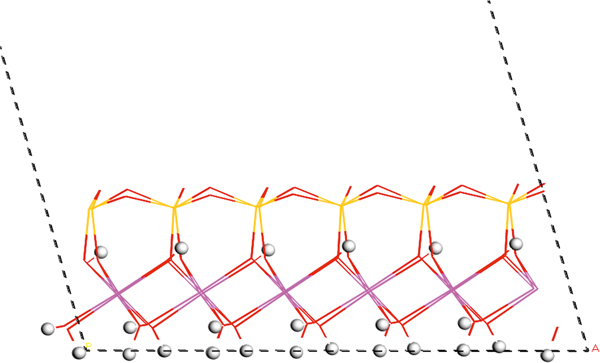
The crystal structure of kaolinite was obtained from experimental neutron powder diffraction and Rietveld refinement (Bish, Reference Bish1993). Two possible surfaces of kaolinite were considered: the first, named the (001) surface, with the hydrophilic aluminol groups with hydroxylic bonds; and the second, named the (001) surface, with hydrophobic siloxane termination (Fig. 1). These surfaces were generated by introducing a vacuum space along the c axis, c = 30 Å, above or below the (001) plane of the crystal lattice of kaolinite. This empty space was created in order to represent an external surface without interactions between kaolinite layers, allowing the study of the adsorption process. In certain cases, a model with c = 15 Å was used for exploring layer separation.
Optimized kaolinite aluminol and siloxane surfaces. The H, Si, Al and O atoms are in white, yellow, pink and red colours, respectively. This scheme will be extended to the rest of figures in this work.

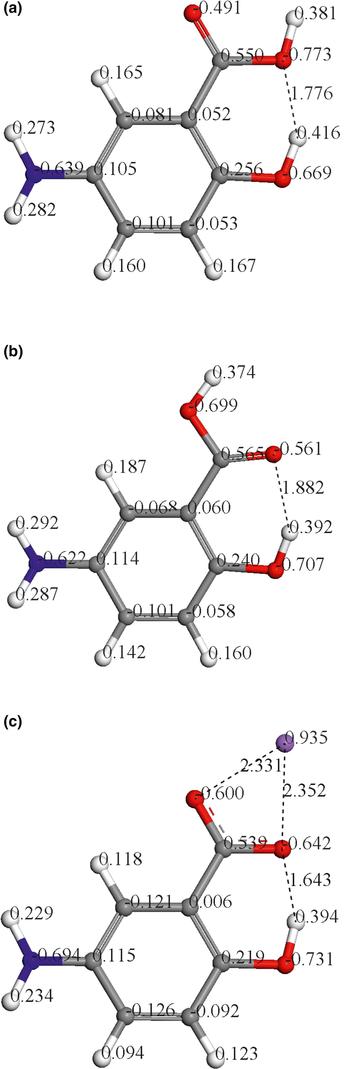
The possible molecular structure of 5-ASA, C7H7NO3, was created graphically by hand with the Materials Studio™ package (BIOVIA, 2016). The atomic charges of the 5-ASA molecule and mineral were calculated by the QEq equilibrium method (BIOVIA, 2016). Three molecular structures were considered – two neutral and one ionized – to compare the adsorption of several possible 5-ASA forms. Two possible conformers were considered for the neutral forms: F1, where the C = O carboxylic group is oriented towards the hydroxybenzenic substituent; and F2, where the C = O carboxylic group is on the opposite side of the hydroxyl group. The ionized form (F3) has the carboxylate group forming a salt with one Na+ cation (Fig. 2). The molecular structure of 5-ASA was also optimized within a periodical box of 30 Å × 30 Å × 30 Å to avoid interactions with vicinal molecules. On the other hand, a (3 × 2 × 1) supercell of kaolinite was used for the adsorption, offering an area of 2.8 nm2. This simulated phyllosilicate surface is large enough to avoid intermolecular interactions with drug molecules of the vicinal cells during its adsorption in a periodical model. Therefore, the kaolinite supercell was composed of 204 atoms distributed within the composition Al24Si24O60(OH)48.
Molecular structure of 5-ASA optimized with CVFFH, conformers (a) F1, (b) F2 and (c) the anion form F3. The H, C, O, N and Na atoms are in white, grey, red, blue and fuchsia colours, respectively. This scheme will be extended to the rest of figures in this work. Net atomic charges are included. The main non-bonding distances are included (Å).

Atomistic calculations, based on empirical interatomic potentials force fields (FFs), were performed for the optimization and total potential energy calculations of the molecular structures studied using the Discover program. A modified version of the consistent valence FF (CVFFH) was used with periodical boundary conditions (Heinz et al., Reference Heinz, Vaia and Farmer2006; Martos-Villa et al., Reference Martos-Villa, Francisco-Márquez, Mata and Sainz-Díaz2013). The Ewald summation method was applied for the non-bonding van der Waals and electrostatic coulomb interactions with a cut-off of 15 Å. The CVFFH was used satisfactorily for the study of the interactions of organic molecules with phyllosilicate surfaces (Martos-Villa et al., Reference Martos-Villa, Mata and Sainz-Díaz2014). The optimization calculations were performed with energy and force convergence tolerances of 2.0 × 10⁻⁵ kcal/mol and 0.001 kcal/mol/Å, respectively.
Sometimes, the calculations with FF are very dependent on experimental data in the FF parameterization. In those cases, quantum mechanics calculations were performed for comparison purposes. The geometries of the 5-ASA molecule, mineral crystal structure and adsorption complex were optimized by means of the Dmol3 code based on density functional theory (DFT) methods. The generalized gradient approximation and the Perdew–Burke–Ernzerhof (PBE) exchange correlation functional were used (BIOVIA, 2016). The electronic calculations were carried out using a double-ζ basis set augmented with polarization functions. The orbital cut-off quality was determined with a 0.1 eV atom–1 of energy accuracy threshold. We used DFT semi-core pseudopotentials. The convergence criterion for the self-consistent field was 1 × 10⁻⁶. The geometry optimizations of various structures were performed at 0 K. This methodology has been used previously to describe the adsorption process successfully (Escamilla-Roa et al., Reference Escamilla-Roa and Sainz-Díaz2014, Reference Escamilla-Roa, Huertas, Hernádez-laguna and Sainz-Díaz2017). In order to estimate the contribution of the weak van der Waals interactions in the adsorption complexes, corrections with the semi-empirical formalisms of Tkatchenko & Scheffler (Reference Tkatchenko and Scheffler2009) or Grimme (Reference Grimme2006) for weak dispersion forces were included in some optimizations.
Dry conditions were used in the present calculations in order to focus on the specific interactions between the drug and the mineral surface, avoiding other variables related to water molecule interactions. This approach may also be used for comparing FF and quantum mechanics calculations, which require significant computational effort.
The adsorption energy, E, was calculated using the formula in equation 1:
 $$E = E_{{\rm kaol} \, + \, 5-{\rm ASA}} - (E_{{\rm kaol}} + E_{5-{\rm ASA}})$$
where E kaol + 5-ASA is the energy of the drug–kaolinite complex, E kaol is the energy of the optimized kaolinite (3 × 2 × 1) supercell and E 5−ASA is the energy value of the optimized drug molecule.
Results and discussion
The 5-ASA molecule
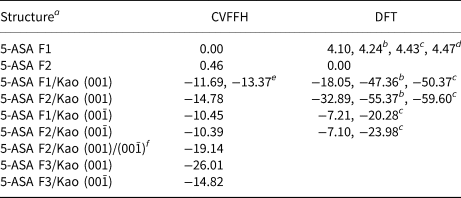
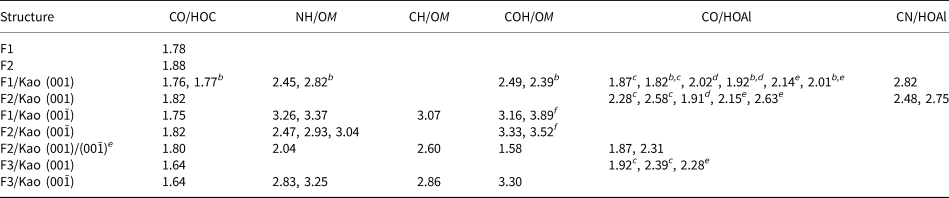
Both conformers of the 5-ASA molecule were optimized with CVFFH and a similar energy was found for both of them, with F1 being only 0.46 kcal/mol more stable than F2 (Table 1). In both conformers, an intramolecular hydrogen bond formed between the hydroxyl H atom and the O atom of the carboxylic OH group in F1 and the carbonyl O atom in F2. The C = O group appears to be a better hydrogen bond acceptor than the OH group and the hydrogen bond in F2 – d(OH···O = C) = 1.882 Å. However, in F1, the intramolecular hydrogen bond is slightly shorter – d(COH···O(H)C) = 1.776 Å – probably due to geometrical constraints. Both effects are compensated for and hence both conformers may be considered as iso-energetic forms. In both conformers, most atoms are coplanar. In the carboxylic group, the O–H bond has the same orientation as the carbonyl bond due to the attractive electrostatic interactions between both dipoles, C = O/O–H, in opposite senses. When including the electronic effects in DFT calculations, F2 was calculated to be 4.1 kcal/mol more stable than F1. However, the energy barrier between both conformers is 16.34 kcal/mol for the rotation of the arC–COOH bond, taking into account the energy difference between the initial F1 conformer and the transition state of this rotation. This is consistent with previous theoretical studies of 2-hydroxybenzoic acid (Aarset et al., Reference Aarset, Page and Rice2006). The application of the dispersion correction in this molecule did not affect the energy difference between conformers because of the lack of intermolecular interactions (Table 1). The use of all electrons instead of pseudopotentials yielded a similar energy difference between both conformers. In both conformers optimized with DFT, the amino H atoms are slightly out of the ring plane due to the atomic electronic configuration of the N atom with a non-bonding electron pair.
Relative energies (in kcal/mol) of the optimized structures of 5-ASA and the adsorption energies of complexes on the kaolinite (Kao) surfaces.

a Conformers F1 and F2 of the 5-ASA molecule and anionic form F3 of 5-ASA; siloxane (001) and aluminol (001) surfaces of Kao.
b With the dispersion correction of Grimme (Reference Grimme2006).
c With the dispersion correction of Tkatchenko & Scheffler (Reference Tkatchenko and Scheffler2009).
d With all electrons instead of pseudopotentials.
e On one layer of kaolinite with c = 15 Å.
f Adsorption in the interlayer space between the aluminol and siloxane surfaces with c = 15 Å.
Kaolinite surface
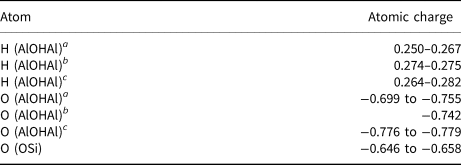
The optimization of the kaolinite crystal structure with CVFFH FF – a = 5.18 Å, b = 8.98 Å, c = 7.29 Å, α = 87.2°, β = 105.3°, γ = 90.0°, d(001) = 7.03 Å – reproduced the experimental lattice cell parameters – a = 5.15 Å, b = 8.94 Å, a = 7.39 Å, α = 91.9°, β = 105.0°, γ = 89.8°. This is a satisfactory result for validation of the FF used. The hydroxyl OH groups are oriented perpendicularly to the (001) plane, except for one that is oriented towards the vicinal octahedral O atoms, as was found experimentally (Fig. 1). The d(O–H) bond distance is close to 0.92 Å, which is similar to that of the experimental crystal. For the adsorption study, a monolayer of kaolinite was used when we introduced an empty space on the (001) surface. This layer separation breaks the internal hydrogen bonds between the aluminol H atoms and the siloxane O atoms with d(AlOH···OSi) = 2.763 Å, thereby increasing the energy of this crystal structure to 60.47 and 72.29 kcal/mol for c = 15 and 30 Å, respectively. Hence, the swelling process will require additional energy for layer separation, in accordance with the experimental low swelling capacity of kaolinite (Awad et al., Reference Awad, López-Galindo, Setti, El-Rahmany and Iborra2017).
Adsorption of the 5-ASA molecule
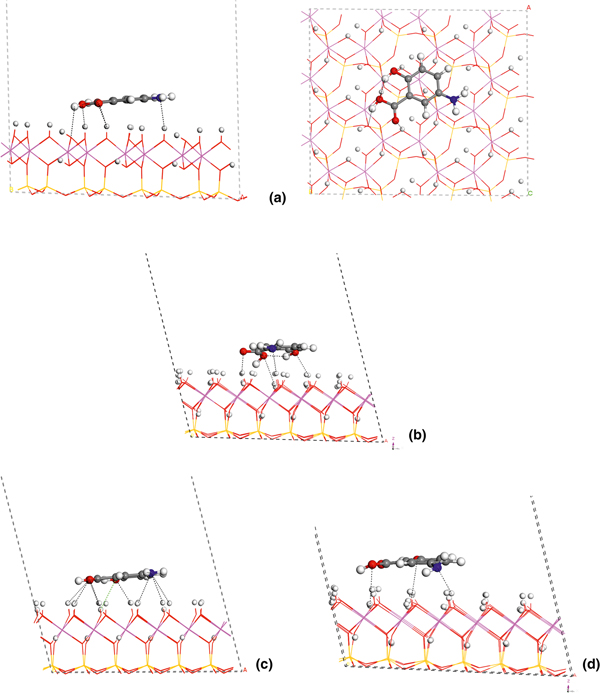
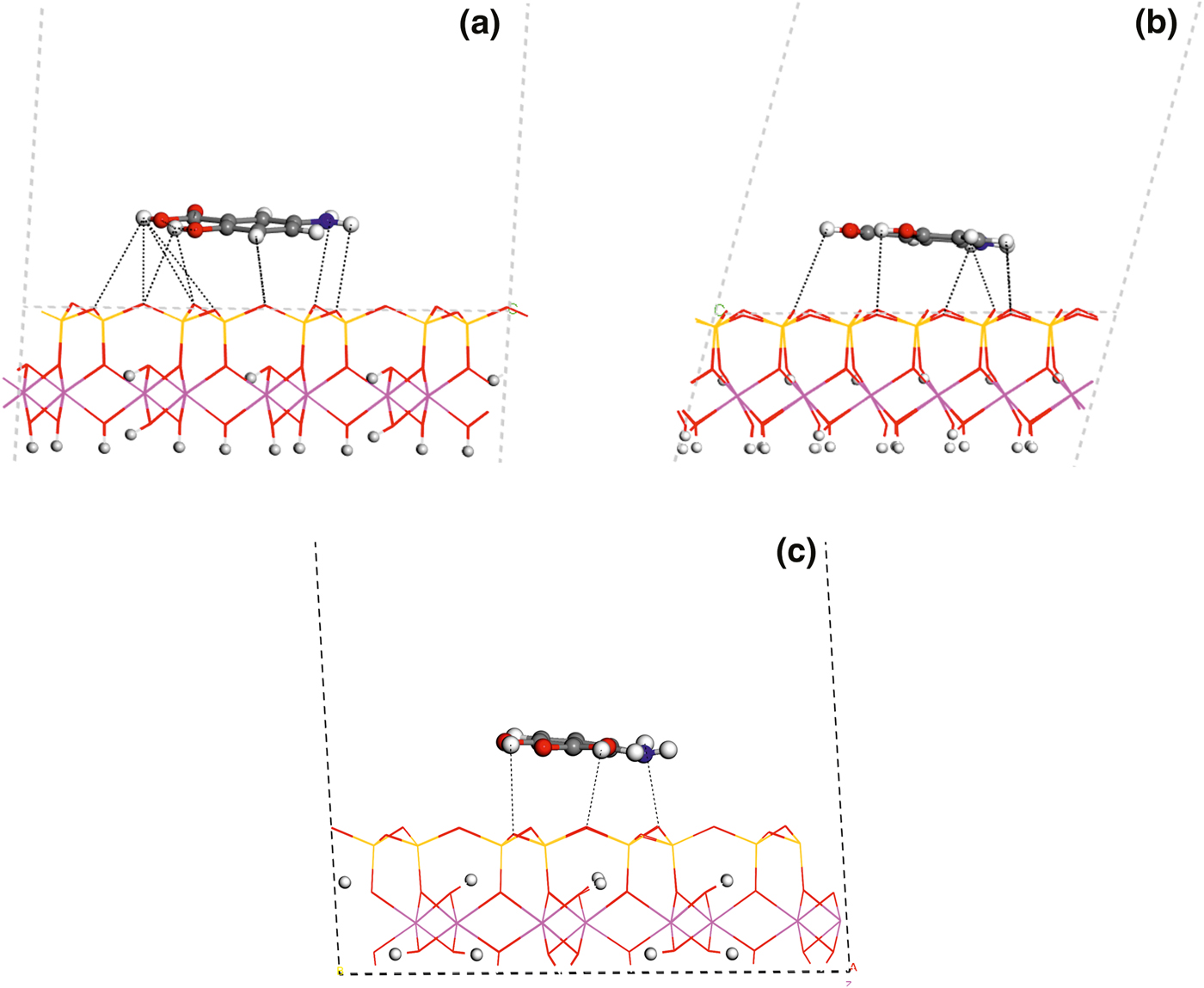
The adsorption complexes were generated by placing the adsorbate in a parallel orientation with respect to the surface and at 4 Å from the surface, because the parallel orientation provides a greater adsorption energy, as was determined recently (Borrego-Sánchez et al., Reference Borrego-Sánchez, Awad and Sainz-Díaz2018a). After the optimization, both conformers yielded negative adsorption energies (Table 1). This means that the adsorption process is likely to be favourable and exothermic. The adsorption energy is slightly higher for the F2 conformer. However, the non-bonding interatomic distances between adsorbate and mineral surface are similar for both conformers. Hence, the main interactions will be hydrogen bonds and electrostatic forces. The strongest hydrogen bonds are between the O atoms of 5-ASA and the H atoms of the aluminol groups of the mineral surface (Table 2). The atomic charges of the mineral surface atoms involved in the adsorption process are listed in Table 3. The H atoms oriented parallel to the surface have higher positive charges due to the interactions with vicinal tetrahedral O atoms. The siloxane O atoms show lower charges than the aluminol O atoms (Table 3). This may be related to the lower adsorption energy in the siloxane surface than in the aluminol surface (Table 1). In the adsorption complexes, the 5-ASA molecule remains in a parallel configuration with respect to the mineral surface. In the adsorption complexes on the aluminol surface optimized with CVFFH, the zone with hydroxyl and carboxylic groups is slightly closer to the mineral surface than the rest of molecule (Fig. 3a,c). However, the carboxylic and hydroxy groups lose their coplanarity when approaching the surface in the adsorption complexes of F1 optimized with DFT (Fig. 3b), whereas in the adsorption of F2 with DFT, the amino group loses its coplanarity when approaching the mineral surface (Fig. 3d). The intramolecular hydrogen bond of 5-ASA remains unaltered with adsorption (Table 2). The O and N atoms of the adsorbate are placed over the aluminol H atoms of the mineral surface and the amino and hydroxyl H atoms are placed over the aluminol O atoms, where the AlO–H bonds are oriented more parallel to the (001) plane. In the adsorption on the siloxane surface, the F1 complex remains completely parallel to the surface (Fig. 4a), whereas the F2 complex has the amino group approaching the surface maintaining the coplanarity of the molecule for both CVFFH and DFT calculation levels (Fig. 4b,c).
Adsorption complexes of the 5-ASA conformers (a,b) F1 and (c,d) F2 on the kaolinite aluminol surface optimized with (a,c) CVFFH and with (b,d) DFT.

Adsorption complexes of the 5-ASA conformers (a) F1 and (b,c) F2 on the kaolinite siloxane surface optimized with (a,b) CVFFH and with (c) DFT.

Main non-bonding distances (Å) of the adsorbate and adsorption complexes calculated with CVFFHa.

a CO/HOC means the intramolecular distance d(C = O···HOC); NH/OM is the d(NH···OM) distance where M can be Al in the aluminol surface or Si in the siloxane surface of the mineral; CH/OM is d(CH···OM); COH/OM is d(COH···OM); and CO/HOAl means the d(CO···HOAl) distance.
b With a Kao monolayer with c = 15 Å.
c Carbonyl O atom of the carboxylic group.
d Hydroxyl O atom of the carboxylic group.
e O atom of the aromatic hydroxyl group.
f d(CO–H···OM) distance of the carboxylic group.
Kao = kaolinite.
Atomic charges calculated with the QEq method of the main atoms of the kaolinite surface involved in the adsorption process.

a Hydroxyl groups oriented perpendicular to the surface.
b Hydroxyl groups oriented parallel to the surface.
c Inner hydroxyl groups oriented towards the siloxane surface.
When the kaolinite layers are closer with c = 15 Å, the adsorption energy of F1 is slightly higher than with c = 30 Å (Table 1). This is due to the weak electrostatic interactions of the adsorbate with the upper layer of kaolinite, which is 6.17 Å from the closest atom of 5-ASA.
The adsorbate molecule remains in a parallel configuration with respect to the siloxane surface and at a greater distance from the surface atoms. However, the adsorption energy is lower on the siloxane surface than on the aluminol surface due to the lack of hydrogen bonds existing in the aluminol surface. In this surface, the adsorption interaction is mainly electrostatic, and certain π–π interactions may take place between the aromatic ring and the basal O atoms of the mineral surface.
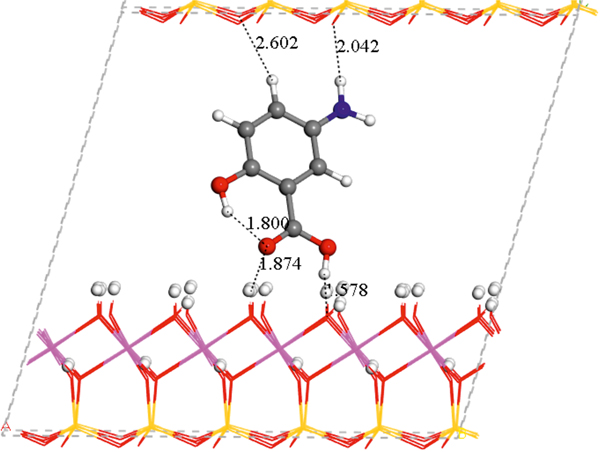
Another possible configuration of 5-ASA may be perpendicular with respect to the mineral surface and may interact simultaneously with both the aluminol and siloxane surfaces (Fig. 5). This configuration yielded a greater adsorption energy than in the external monolayer of kaolinite (Table 1). A strong hydrogen bond exists between the carboxylic H atom and the O atoms of the aluminol groups of the mineral surface – d(COH···O(H)Al) = 1.58 Å – where the O–H bond is in a parallel orientation with respect to the (001) plane of the mineral surface. The amino H atoms form weak hydrogen bonds with the siloxane O atoms of the mineral surface, with d(NH···OSi) = 2.04 Å.
Intercalation of one molecule of 5-ASA (conformer F2) between the aluminol and siloxane surfaces of kaolinite.

In general, the adsorption energies calculated with DFT are greater than those from CVFFH calculations. Nevertheless, the trends of the relative adsorption energies between conformers and between mineral surfaces are similar to those obtained from CVFFH calculations: F2 adsorbs more strongly than F1 and the adsorption energy is higher in the aluminol surface than in the siloxane surface. The use of dispersion corrections increases significantly the adsorption energy values. This effect is greater in the aluminol surface than in the siloxane surface, because these semi-empirical corrections overestimate the binding interactions when hydrogen bonds are present in the system, as was also observed previously in other systems (Liu et al., Reference Liu, Zhao, Li and Chen2013). Nevertheless, the adsorption energies observed in the siloxane surface are consistent with those obtained recently for the adsorption of an organic pesticide on montmorillonite surfaces with similar siloxane surfaces (Belzunces et al., Reference Belzunces, Hoyau, Benoit, Tarrat and Bessac2017). In the adsorption complexes, the adsorbate is in a parallel configuration with respect to the (001) plane of the mineral. Most of the adsorbate atoms are coplanar with the aromatic ring, except the H atoms of the OH groups, which are closer to the surface due to the H bond interaction (Figs 3, 4).
The 5-ASA molecule as an anion
The pKa of 5-ASA is 3.0 for the deprotonation of acidic OH (Allgayer et al., Reference Allgayer, Sonnenbichler, Kruis and Paumgartner1985). Therefore, the 5-ASA will be in an anionic form in the aqueous physiological range of pH (7.5), where the carboxylic group will be dissociated forming a salt with a counterion, such as Na+. In the optimized molecule, the Na+ cation coordinates with the carboxylate group symmetrically to both O atoms – d(C–O···Na) = 2.33–2.36 Å. A strong intramolecular hydrogen bond exists between the carboxylate O atom and the hydroxyl H atom, with d(OH···O–C) = 1.64 Å (Table 2).
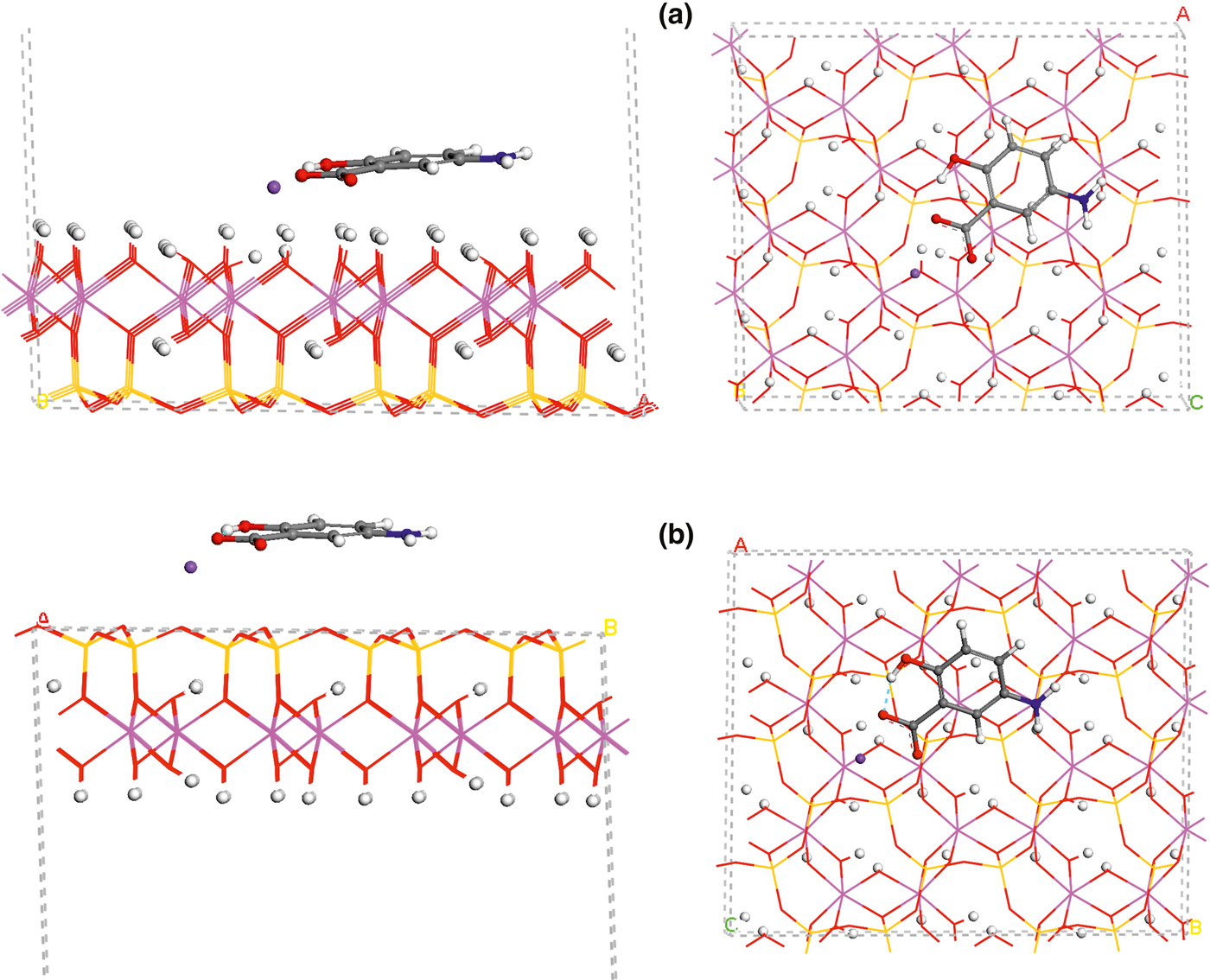
The adsorption energies are also negative and greater than those of the neutral molecule for both surfaces, being more negative in the aluminol surface than in the siloxane surface (Table 1). This means that this adsorption is highly favourable. The hydrogen bonds and the electrostatic interactions are probably stabilized better than in the above neutral conformer of 5-ASA. In both surfaces, the adsorbate remains in a parallel configuration with respect to the mineral surface with the Na+ cation closer to the surface, with d(C–O···Na) = 2.36–2.37 Å and 2.34–2.36 Å on the aluminol and siloxane surfaces, respectively (Fig. 6).
Adsorption of the anion 5-ASA with the Na+ cation on kaolinite (a) aluminol and (b) siloxane surfaces.

Conclusions
Two conformers should be considered in the neutral 5-ASA molecule – F1 and F2 – whereby the F2 conformer with the carbonyl group forms an intramolecular H bond with the vicinal hydroxyl group and is more stable than F1. The rotational barrier between both conformers is 16.34 kcal/mol. This was not observed in the anion form F3 of 5-ASA.
The adsorption of 5-ASA will take place on the external surfaces of kaolinite, because the separation of the layers requires significant energy. Both conformers and the anion are likely to be adsorbed favourably on the kaolinite surfaces in an exothermic process. The adsorption is more favourable on the aluminol surface than on the siloxane surface. The main interactions are hydrogen bonds between the O atoms of the carboxylic and hydroxyl groups of 5-ASA and the aluminol H atoms of the mineral surface, as well as the electrostatic forces between the aromatic electron cloud and the surface H atoms.
Author ORCIDs
Mahmoud E. Awad, 0000-0002-9207-6584