





Fe deficiency (ID) and poor psychosocial health may have a devastating impact on pregnancy and its outcomes. During pregnancy, mothers go through many physiological, nutritional and emotional changes and adjustments(Reference King1). Fe is one important nutrient whose requirement increases during pregnancy, mainly due to the rapid fetal growth and cell division, expansion of plasma volume, growth of the fetal placental unit and the fulfillment of the maternal requirements(Reference Raza, Sarwar and Munazza2). Maternal ID is a risk factor for poor maternal and child outcomes particularly preterm delivery, low birth weight and poor child cognitive and motor development(Reference Lozoff, Beard and Connor3). Maternal anaemia has been associated with maternal and infant mortality, mood changes, emotional disturbances and psychological distress during pregnancy(Reference Stoltzfus4). Additionally, psychosocial disturbances including depression, anxiety and low quality of life (QoL) may be exacerbated during pregnancy due to the various hormonal changes (oestrogen and progesterone) that occur(Reference Studd5). Depression and anxiety are associated with a woman’s social and biological function and can lead to self-harm and suicide(Reference Remes, Mendes and Templeton6). Psychosocial outcomes have broad implications for maternal and child mental and physical health, with long-lasting negative social and economic impacts(Reference Bloom7).
The mechanism by which Fe is related to psychosocial well-being is not well understood; however, it has been proposed to be linked to the known requirement of Fe for neurotransmitter production and function(Reference Kim and Wessling-Resnick8). Fe is required for the synthesis of serotonin, norepinephrine and dopamine(Reference Beard and Han9). Fe is also required for the degradation of these neurotransmitters via its role in monoamine oxidase(Reference Lopez, Cacoub and Macdougall10). Insufficient Fe will, therefore, limit the production, degradation and clearance of these neurotransmitters, which may consequently lead to poor psychosocial outcomes. Another proposed mechanism is associated with chronic or severe psychological stress exposure which activates the hypothalamic–pituitary–adrenocortical axis, increasing proinflammatory cytokines, thus disrupting Fe absorption and utilisation, which eventually may lead to ID(Reference Reid and Georgieff11).
Existing literature suggests that ID individuals have higher depressive and anxiety scores but lower QoL scores than Fe sufficient individuals(Reference Albacar, Sans and Martín-Santos12–Reference Dama, Van Lieshout and Mattina16). Several intervention studies indicate that treatment with Fe can improve these outcomes,(Reference Beard, Hendricks and Perez17,Reference Verdon, Burnand and Stubi18) while others do not support these findings(Reference Su, Gu and Yu19,Reference Lever-van Milligen, Vogelzangs and Smit20) . Differences in findings may be due to the heterogeneity of the studies (different questionnaires to assess outcomes of interest, different Fe biomarkers to determine Fe status and different interventions used as treatment). Additionally, most of the studies done to date, even though longitudinal in nature, were conducted in high-income countries and were among postpartum women but not pregnant women(Reference Albacar, Sans and Martín-Santos12,Reference Beard, Hendricks and Perez17) . The existing literature on the relation between Fe status and psychosocial outcomes during pregnancy is sparse. Despite the devastating consequences of both psychosocial disorders and ID on pregnancy and its outcomes, very little is known about the relation between ID and psychosocial well-being during pregnancy, especially in developing countries. Longitudinal studies in low-income countries are needed to determine if this relation persists.
Therefore, this study aimed to determine the associations between Fe status and psychosocial well-being (including depressive symptoms, anxiety symptoms and QoL) in Ghanaian women during pregnancy. The hypothesis postulated that improvement in Fe status from the first to second, first to third or second to third trimester would correlate with better psychosocial outcomes within the respective trimesters.
Methods
Study design
A longitudinal study was carried out from October 2017 to September 2018. Women were recruited at <13 weeks gestation, when they reported for their first antenatal visit in clinics and hospitals which form the major health centres in the Cape Coast and Elmina Metropolis. Multistage sampling was employed to select healthcare facilities. Initial data on antenatal attendance throughout the year were gathered from the regional Ministry of Health office to identify suitable health facilities. Nine facilities were purposefully selected based on previous antenatal attendances that aligned with our research requirements. Simple random sampling was subsequently applied to select seven health facilities for the study, which comprised Moree Clinic, Cape Coast Teaching Hospital, Cape Coast Metropolitan Hospital, Ewim Polyclinic, University of Cape Coast Hospital, Elmina Urban Health and Abura Dunkwa District Hospital.
Screening and recruitment
At their first antenatal visit, prospective participants were informed about the study by the nurses on duty, and interested pregnant women were directed to the research team. A screening form was used to determine eligibility, which included attendance at any of the seven selected prenatal clinics in Central Region of Ghana; aged between 18 and 38 years at enrolment; <13 weeks gestation at enrolment (determined by last menstrual period or ultrasound); expecting a singleton pregnancy with no known congenital anomalies and no known history of diabetes mellitus or hypertension. Participants were excluded if they did not attend any of the seven selected prenatal hospitals/clinic, were under 18 or above 38 years at enrolment, had gestational age exceeding 13 weeks, were carrying multiple pregnancies, had congenital anomalies or had a history of hypertension or diabetes at enrolment. Eligible and interested participants gave written informed consent. Data on socio-demographic characteristics (age, socio-economic status, income level, years of schooling, parity, marital status and food insecurity), psychosocial well-being (depression, anxiety and QoL), anthropometry, blood pressure and collection of blood samples occurred immediately, unless the woman requested to come back at a later date. Four trained field assistants helped with data collection at each of the three time points. After the first visit was completed, each participant was provided with a date for her second trimester visit. The same participants were then followed into their second (13–27 weeks) and third trimesters (28–36 weeks). At the end of the first two visits, each participant received a bar of soap plus money to cover transportation cost, as incentives, and at the end of the third visit, each participant received a baby onesie in addition.
Data collection procedures
Participants were asked basic socio-demographic information such as age, marital status, parity and food insecurity which were recorded on a tablet. An FFQ was used to evaluate the consumption of Fe-rich foods (red meat), vegetables and fruit (orange, pineapples, mangoes and pawpaw) during the week prior to data collection(Reference Moustarah and Daley21). Information on health status such as diabetes, hypertension and malaria were asked. Food insecurity was assessed using an eight-item version of the US Household Food Security Survey Module(Reference Garcia, Hromi-Fiedler and Mazur22). Weight and height measurements were collected at each trimester visit using a Seca scale and portable stadiometer, respectively.
Sample population
Out of the initial 119 participants recruited in the first trimester with complete data, forty-six pregnant women withdrew from the study due to reasons such as miscarriage, spouse refusal and being unreachable by phone. Seventy-three pregnant women were tracked into their second trimester. By the third trimester, seventy-two pregnant women remained in the study, with fifteen dropping out between the second and third trimesters due to reasons such as relocation, delivery or refusal to continue participation. Fourteen pregnant women who were absent during the second trimester visit returned for the third trimester visit. However, the number of participants with complete socio-demographic data used for analyses was 116, 71 and 71, while 111, 68 and 65 participants provided a blood sample for the first, second and third trimesters, respectively.
Blood draws
Approximately 4 mL of venous blood was drawn from the participant at each of the three time points during pregnancy. Trained phlebotomists at the hospitals/clinics collected the blood samples, and Hb levels were determined on the spot via a hemocue (HB201; HemoCue America, Brea). The blood samples were stored on ice and delivered to the Cape Coast Teaching Hospital within 30 min of collection. Blood samples were centrifuged and serum aliquoted by a laboratory technician at the University of Cape Coast and subsequently stored in a –800C freezer prior to shipping to The Pennsylvania State University, USA, where Fe status biomarkers (serum Fe, total Fe-binding capacity (TIBC) and serum Ft) and inflammatory biomarkers (alpha-1-acid glycoprotein and C-reactive protein) were determined. Serum ferritin was determined via ELISA (Ramco Laboratories), calibrated against WHO standards. Serum Fe and TIBC were determined using a colorimetric method(Reference DeMaeyer23). Transferrin saturation (TSAT) was calculated [(serum Fe/TIBC)×100]. Alpha-1-acid glycoprotein and C-reactive protein were measured using radial immunodiffusion tests (Kent Laboratories Inc.) and used to adjust the Ft concentrations when inflammation was present using the Thurnham adjustment(Reference Thurnham, McCabe and Haldar24). Ft values reported have therefore been adjusted for inflammation, where necessary.
Assessment of psychosocial well-being
Depressive symptoms were assessed using the Center for Epidemiological Studies Depression Scale (CES-D)(Reference Radloff25). Anxiety was assessed using the Beck Anxiety Inventory (BAI)(Reference Beck, Epstein and Brown26). QoL was assessed using the RAND 36-Item Short Form Health Survey (SF-36)(Reference Hays, Sherbourne and Mazel27) at each of the three trimesters during pregnancy. A detailed description of these methods is described elsewhere(Reference Pobee, Setorglo and Kwashie Klevor28). In brief, pregnant women were asked to rate their depressive symptoms on a scale of 0–3 for each item. A cut-off ≥ 16 on the CES-D is indicative of elevated depressive symptoms(Reference Radloff25). Pregnant women rated their anxiety symptoms on a scale of 0–3 for each item. The cut-off point used for anxiety was ≥ 16(Reference Beck, Epstein and Brown26). The RAND SF-36 measures eight health constructs: physical functioning, role physical, bodily pain, social functioning, role emotional, general mental health (psychological distress and psychological well-being), vitality (energy/fatigue) and general health perceptions(Reference Ware, Kristin and Kosinski29). A cut-off of < 50 indicates low QoL.
Follow-up visits for seconnd and third trimesters
During the second (13–27 weeks) and third trimester (28–36 weeks) visits, all measurements were repeated, with the exception of the socio-economic status questionnaire (which was only administered at the first visit).
Statistical analysis
Demographic, food frequency and clinical data were presented as frequencies for categorical data and means for continuous variables. Factor analysis was employed for the psychosocial data. This approach was adopted due to the origin of the psychosocial well-being questionnaires used in the study (CES-D, BAI and SF-36), which were developed within a Western cultural framework. Consequently, factor analysis was applied to the scales to evaluate the cultural suitability of these scales and ascertain the relevance of their scores and ensure the underlying constructs were valid within our population. A detailed description of the procedures can be found elsewhere(Reference Pobee, Setorglo and Kwashie Klevor28). In brief, exploratory factor analysis with principal axis factoring and promax rotation was used to determine the CES-D, BAI and RAND SF-36 factor solutions, using first trimester scores. Before factor analysis was considered, correlations between the items were checked and Kaiser–Meyer–Olkin test, and Bartlett’s test of sphericity was used to determine appropriateness for factor analysis(Reference Van Wyk30). Subsequently, scree plot, parallel analysis and minimum average partials were used to determine the number of factors to retain(Reference Velicer31). Exploratory factor analysis was chosen since the psychometric measures have not been assessed for these scales in Ghana. For a factor to be considered adequate, pattern coefficients ≥ 0·30 were considered salient on a factor, and a minimum of three salient items were required for each factor(Reference Pendergast, Vandiver and Schaefer32). Internal consistency for each factor was examined using Cronbach’s alpha ≥ 0·70 to determine adequacy, while communality showed the proportion of variance in each variable accounted for by each factor(Reference Tavakol and Dennick33). SAS software version 9·4 (SAS Institute, Inc.) was used for data analysis. See online supplementary material, Supplemental Tables 1–3 for results on factor analysis.
Difference-in-difference analyses were used to determine the associations between change in Fe status and change in psychosocial outcomes between trimesters. After calculating change in Fe status between trimesters, participants were categorised as Fe improvers or non-improvers, based on the known day-to-day variation for each Fe biomarker. ‘Improvers’ were those who experienced a positive change in Fe status (Hb, Ft, Fe, TSAT or TIBC) greater than the known day-to-day variation and ‘non-improvers’ were those who experienced changes in Fe status less than the known day-to-day variation as well as negative changes in Fe status beyond the known day-to-day variation(Reference Borel, Smith and Derr34). To determine if change in psychosocial measures were associated with change in Fe status, we controlled for covariates such as change in food insecurity, change in psychosocial outcomes (except the one used as predictor), parity and marital status. Age, socio-economic status, income level, years of schooling, parity, marital status and food insecurity were explored as potential covariates and those which correlated with the outcome variables assessed (anxiety, depression and QoL) were included in the analyses (food insecurity, parity, marital status and other psychosocial outcomes (except the one used as predictor)). The eight-item version of the US Household Food Security Survey Module ranged from 0 (food secure) to a maximum of 8 (highest level of food insecurity). This was included as a continuous variable in analyses.
Results
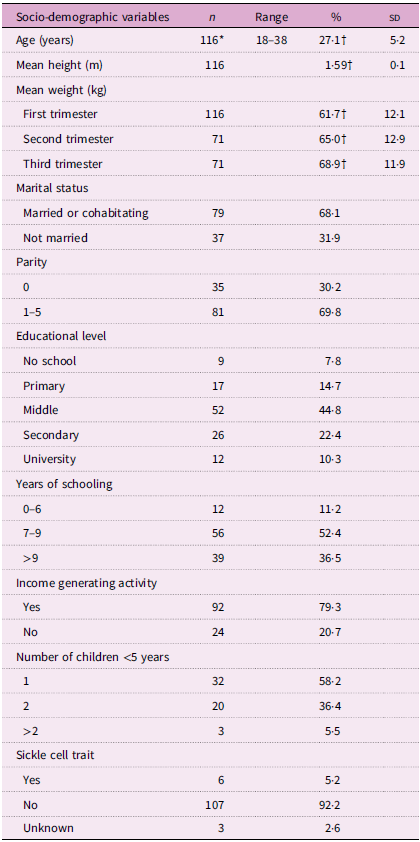
The average age of participants was 27 ± 5 years with mean height of 1·59 ± 0·1 m. Mean weight was 61·7 ± 12·1 kg, 65·0 ± 12·9 kg and 68·9 ± 11·9 kg for first, second and third trimesters, respectively (Table 1). About 68 % of participants were either married or coexisting with a husband or partner while 32 % were not married. About 8 % of the women had no formal education, while 45 % had up to a middle school education, with only 10 % having a university degree. The majority (79 %) of the women had an income-generating activity. Forty-seven percent of participants had children <5 years of age in their households, with 36 % having two children <5 years in the household. Most participants (70 %) had between 1 and 5 children, while 30 % had no child prior to their current pregnancy. About 5 % of the pregnant women had sickle cell traits (Table 1).
Socio-demographic characteristics of pregnant Ghanaian women in their first trimester (n 116)

* n (range).
† mean (sd).
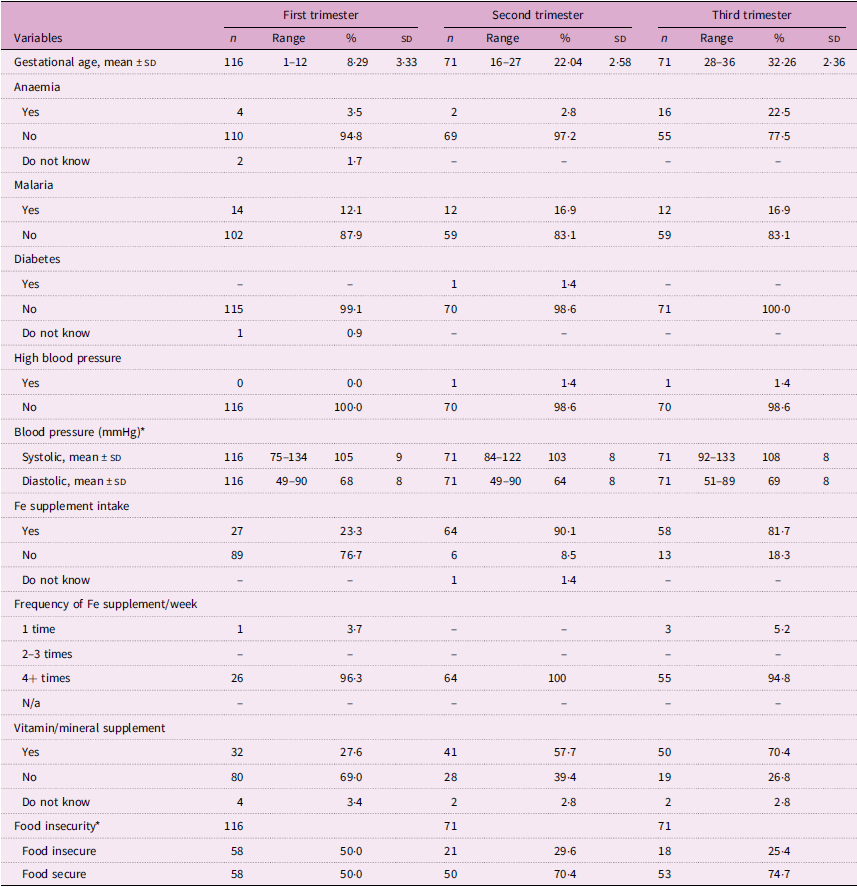
The prevalence of self-reported anaemia was 4 %, 3 % and 23 %; while malaria was 12 %, 17 %, 17 % for first, second and third trimesters, respectively. No woman self-reported as diabetic or hypertensive in the first trimester. However, in the second trimester, 1 % reported hypertension and diabetes diagnoses while 1 % reported hypertension but not diabetes diagnoses in the third trimester (Table 2). The mean systolic blood pressure (mean ± sd) was 105 ± 9 mmHg, 103 ± 8 mmHg and 108 ± 8 mmHg, and the mean diastolic blood pressure was 68 ± 8 mmHg, 64 ± 8 mmHg and 69 ± 8 mmHg for first, second and third trimesters, respectively (Table 2). About 23 %, 90 % and 58 % of pregnant women reported taking Fe supplements, while 28 %, 58 % and 70 % reported taking vitamin or mineral supplements during the first, second and third trimesters of pregnancy, respectively. About 50 %, 30 % and 25 % of the women were food insecure in their first, second and third trimesters, respectively (Table 2).
Prevalence of disease, high blood pressure and supplement use among women during pregnancy

* Blood pressure and food insecurity were measured in the study, all other variables were based on self-report.
Measured prevalence of iron deficiency
The prevalence of anaemia (Hb <11·0 g/dl) was 37 %, 63 %, 58 %; ID (Ft <15 μg/l) was 16 %, 20 %, 38 %; ID (TIBC ≥ 400 μg/l) was 19 %, 29 % and 40 %; ID (TSAT < 16 %) was 12 %, 9 % and 17 %. About 30 %, 22 % and 32 % of pregnant women had inflammation based on C-reactive protein (≥5·0 mg/l), while 29 %, 6 % and 2 % had inflammation based on alpha-1-acid glycoprotein (≥1·0 mg/l) for first, second and third trimesters, respectively. These values are based on assessment of Fe status by the study, see Pobee et al., 2021.(Reference Pobee, Setorglo and Klevor35)
Exploratory factor analysis
Factor analysis of the psychosocial scales revealed a one-factor solution with thirteen items for the CES-D scale. This one-factor solution accounted for 100 % of the variance, with a Cronbach’s alpha of 0·84 and an eigenvalue of 8·78. The items included in this factor are bothered, blues, mind, depressed, effort, restless, happy, lonely, unfriendly, enjoy, cry, sad and dislike. These items describe depressive affect and interpersonal concerns, with two items reflecting positive affects (see online supplementary material, Supplemental Table 1).
A four-factor solution with eighteen items was obtained for the BAI which accounted for 98·9 % of the cumulative variance. Factor I had a Cronbach’s alpha of 0·84 and an eigenvalue of 16·22, explaining about 57·75 % of the variance. This factor was named the ‘fear-factor’ because it included items such as scared, fear of dying, terrified and fear of the worse. Factor II had a Cronbach’s alpha of 0·70 and an eigenvalue of 5·42, explaining about 19·30 % of the variance. This factor was named the ‘nervous-factor’ because it included items such as numbness, wobbling legs, unable to relax, face -flushing and hot/cold sweats. Factor III had a Cronbach’s alpha of 0·76 and an eigenvalue of 4·10, explaining about 14·61 % of the variance. This factor was named the ‘panic-factor’ because it included items such as unsteady, shaky, choking and fear of losing control. Factor IV had a Cronbach’s alpha of 0·72 and an eigenvalue of 2·34, explaining about 8·35 % of the variance. This factor was named the ‘somatic-factor’ because it included items such as faint, dizzy, heart pounding and hand trembling (see online supplementary material, Supplemental Table 2).
The RAND SF-36 had a four-factor solution with twenty-six items. The four-factor solution accounted for 100 % of the cumulative variance. Factor I had a Cronbach alpha of 0·86 and an eigenvalue of 14·39, and it explained about 52·38 % of the variance. Factor I was named the ‘physical health’ factor because it included items such as performing vigorous activities, lifting and climbing stairs. Factor II had a Cronbach alpha of 0·84 and an eigenvalue of 6·44, and it explained 23·45 % of the variance. Factor II was named the ‘role physical’ factor because it included items such as accomplish less and cut down on work. Factor III had a Cronbach alpha of 0·79 and an eigenvalue of 3·62, and it explained 13·17 % of the variance. Factor III was named the ‘role emotional’ factor because it included items such as emotions limiting your work as a result of emotional problems or did not do work as carefully as usual as a result of emotional problems, etc. Factor IV had a Cronbach alpha of 0·73 and eigenvalue of 3·02, and it explained about 11 % of the variance. Factor IV was named the ‘general health/vitality’ factor because it included items such as energy, pep, worn-out and excellent health (see online supplementary material, Supplemental Table 3). For additional information on factor analysis, see Pobee et al., 2022(Reference Pobee, Setorglo and Kwashie Klevor28).
Difference-in-difference analysis
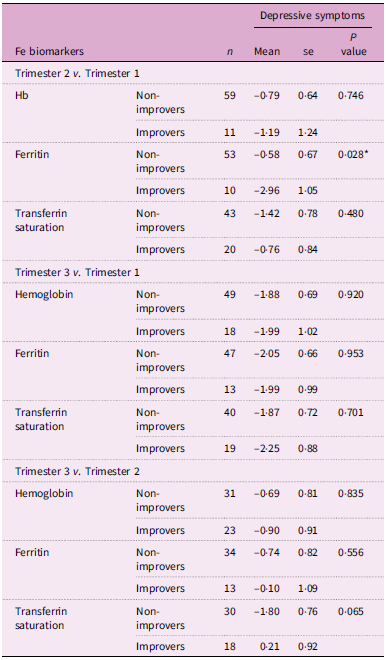
We observed an improvement in depressive symptoms with improvement in Ft concentration. After controlling for covariates, women who experienced a significant increase in Ft concentrations between the first and second trimesters (Ft ‘improvers’) also experienced a significantly greater decrease in depressive symptoms during this time period, compared with women labeled as Ft ‘non-improvers’ (–2·96 v. –0·58, P = 0·028) (Table 3). Being an ‘improver’ or ‘non-improver’, based on changes in other Fe biomarkers from first to second trimester, was not associated with any difference in depressive symptom scores (Table 3). Between the first and third as well as between the second and third trimesters, there were no significant differences observed in change in depressive symptoms scores between improvers and non-improvers for all Fe biomarkers, after controlling for covariates (Table 3).
Change in depressive symptoms scores relative to changes in iron biomarkers, comparing improvement v. non-improvement between trimesters

Change in depressive symptoms v. change in Fe biomarkers, controlling for covariates (psychosocial outcome at trimester 1 and Fe variable trimester 1, change in food insecurity, change in anxiety and quality of life), parity and marital status.
* P value < 0·05. Ferritin: adjusted for C-reactive protein and alpha-1-acid glycoprotein using Thurnham adjustment (24).
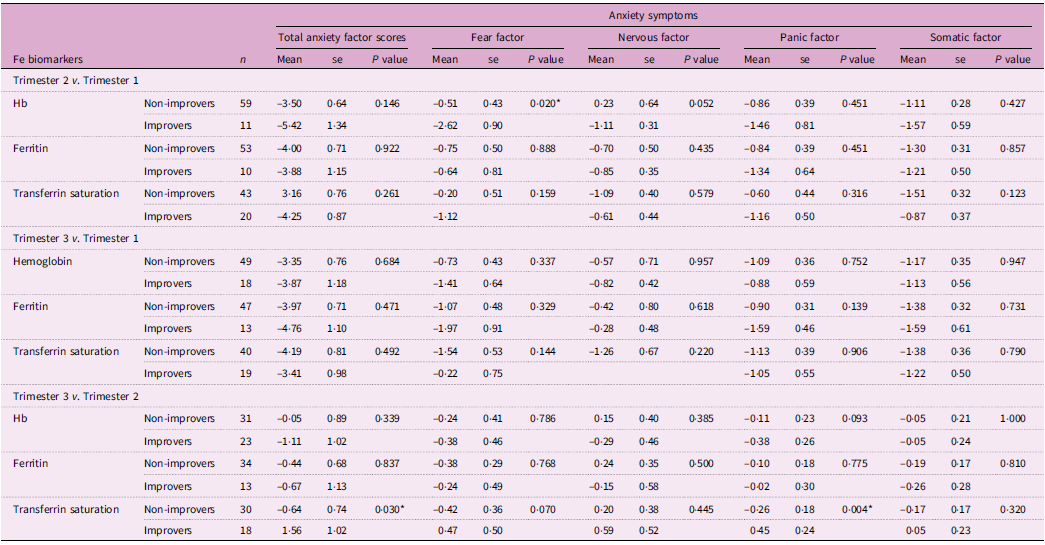
Regarding anxiety and changes between the first and second trimesters, fear scores decreased significantly more in Hb improvers, compared to Hb non-improvers (–2·62 v. –0·51, P = 0·020). Changes in Fe biomarkers between the first and third trimesters were not differentially related to changes in anxiety for those classified as improvers v. non-improvers (Table 4). However, between the second and third trimesters, total anxiety scores (1·56 v. –0·64, P = 0·030) and its subscale, panic factor scores (0·45 v. –0·26, P = 0·004), increased significantly more in TSAT improvers compared with TSAT non-improvers (Table 4).
Change in anxiety symptoms scores and their subscales relative to changes in iron biomarkers, comparing improvement v. non-improvement between trimesters

Change in anxiety symptoms v. change in Fe biomarkers, controlling for covariates (psychosocial outcome at T1 (continuous) and Fe variable T1 (continuous), change in food insecurity, change in depressive symptoms and quality of life), parity and marital status).
* P value < 0·05. Ferritin: adjusted for C-reactive protein and alpha-1-acid glycoprotein using Thurnham adjustment (24).
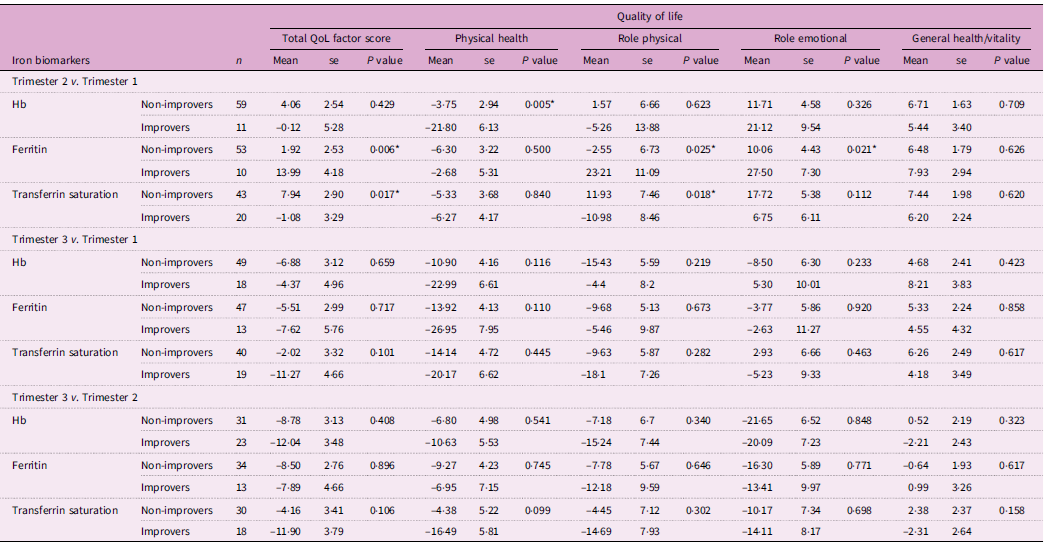
Furthermore, associations between changes in Fe biomarkers and QoL were observed. From first to second trimester, physical health scores (–21·80 v. –3·75, P = 0·005) decreased significantly more in Hb improvers compared with Hb non-improvers controlling for covariates (Table 5), whereas total QoL (13·99 v. 1·92, P = 0·006), and its subscales, role physical (23·21 v. –2·55, P = 0·025) and role emotional (27·50 v. 10·06, P = 0·021) scores increased to a significantly greater extent in Ft improvers than Ft non-improvers, after adjusting for covariates (Table 5). Total QoL (–1·08 v. 7·94, P = 0·017) and role physical scores (–10·98 v. 11·93, P = 0·018) significantly decreased in TSAT improvers compared with TSAT non-improvers (Table 5). Between the first and third and the second and third trimesters, no significant differences were seen between changes in QoL scores for those labeled as improvers or non-improvers, regardless of Fe biomarker assessed (Table 5).
Change in quality-of-life scores and their subscales relative to changes in iron biomarkers, comparing improvement v. non-improvement between trimesters

Change in quality of life v. change in Fe biomarkers, controlling for covariates (psychosocial outcome at T1 (continuous) and Fe variable T1 (continuous), change in food insecurity, change in anxiety and depressive symptoms, parity and marital status).
* P value <0 ·05. Ferritin: adjusted for C-reactive protein and alpha-1-acid glycoprotein using Thurnham adjustment (24).
Discussion
To our knowledge, this is the first study to simultaneously examine the relation between Fe status and depression and anxiety symptoms and QoL throughout pregnancy. Relatively few studies have examined women’s health in terms of Fe status and psychosocial outcomes. Our study has added to the scarce literature available on the association between Fe status and psychosocial outcomes during pregnancy and has shown that improvements in Fe status at the early stages of pregnancy may have a greater impact on psychosocial well-being compared with improvements in Fe status later in pregnancy. Our findings should help inform future programmes aimed at Fe supplementation during pregnancy to improve depressive symptoms and QoL.
Association between iron status and depressive symptoms
Our study found an association between Ft and depressive symptoms. Pregnant women whose Ft levels improved from first to second trimester experienced a decrease in depressive symptoms, suggesting that Fe stores at the beginning of pregnancy may play a crucial role in the progression of depressive symptoms during pregnancy. Therefore, it is important for women to begin pregnancy with adequate Fe stores to help prevent depressive symptoms.
So far, only one study examined the association between Fe status and depressive symptoms during pregnancy and found no correlation(Reference Armony-Sivan, Shao and Li36). The contrasting findings could be due to the timing of the assessments; we examined the relation early in the first trimester (<13 week), while Armony-Sivan and colleagues assessed it during mid and late pregnancy, potentially missing the importance of early Ft stores. Additionally, while we assessed depressive symptoms using the CES-D scale, Armony-Sivan and colleagues used the Edinburgh Postnatal Depression Scale, which may also account for the differing results. Furthermore, we used psychometric analyses to validate our scores, which was not done by Armony-Sivan et al.
Of note, the literature on the association between Fe status and depressive symptoms in non-pregnant women of reproductive age, has mixed findings. Some studies did not find associations between Fe status and depressive symptoms(Reference Su, Gu and Yu19,Reference Lever-van Milligen, Vogelzangs and Smit20,Reference Yi, Nanri and Poudel-Tandukar37) while others did(Reference Albacar, Sans and Martín-Santos12,Reference Vahdat, Vahdat and Moshtaaghi38,Reference Noorazar, Ranjbar and Nemati39) . Of those that found an association, most were intervention studies(Reference Beard, Hendricks and Perez17,Reference Verdon, Burnand and Stubi18,Reference Vahdat, Vahdat and Moshtaaghi38) and cross sectional. These studies reported either a significant negative association between Hb and depressive symptoms or between Ft and depressive symptoms(Reference Albacar, Sans and Martín-Santos12,Reference Beard, Hendricks and Perez17,Reference Verdon, Burnand and Stubi18) . Our finding of a negative association between Ft and depressive symptoms contributes to the existing literature and provides additional insight into this association during pregnancy.
Association between iron status and anxiety symptoms
To our knowledge, no study has looked at the association between anxiety symptoms and Fe status during pregnancy. We found an association between the fear factor subscale and hemoglobin concentrations and between total anxiety scores, the panic subscale, and transferrin saturation. Pregnant women whose Hb improved from the first to second trimester experienced a significantly greater decrease in fear compared with those whose Hb did not improve, and a higher Hb concentration during the second trimester was associated with lower fear scores. On the other hand, pregnant women whose TSAT improved from second to third trimester experienced an increase in total anxiety and panic symptoms, while TSAT non-improvers experienced a decrease in these scores. This is in contrast with our hypothesis. The literature, however, suggests an association between anxiety and Fe status among women of reproductive age, especially during the post-partum period(Reference Beard, Hendricks and Perez17,Reference Verdon, Burnand and Stubi18,Reference Lever-van Milligen, Vogelzangs and Smit20) . These studies on anxiety have been conducted mostly in combination with assessments of depressive symptoms. Unlike our study, findings by Lever-van et al., did not show an association between Hb and anxiety(Reference Lever-van Milligen, Vogelzangs and Smit20). However, an intervention study by Verdon et al. found that anxiety symptoms decreased more in the Fe treatment group(Reference Verdon, Burnand and Stubi18), whereas Beard et al. did not find changes in anxiety symptoms with Fe supplementation(Reference Beard, Hendricks and Perez17).
Our findings regarding TSAT were unexpected; however, a possible explanation for the predominant finding being opposite our original hypothesis is that psychosocial outcomes have two components: physiological and psychological. The physiological component of anxiety may require a certain amount of energy. Therefore, a pregnant woman may need energy to experience anxiety, and those who are Fe sufficient might report higher anxiety due to having more energy. This could explain why better Fe transport was associated with increased anxiety, as observed in this study.
Association between iron status and quality of life
Our results for QoL were similar in direction, and variability to the results we obtained from our anxiety scores. For change between trimesters 1 and 2, we found that Hb improvers decreased significantly in physical health scores, while TSAT improvers decreased significantly in total QoL (TQoL) and role physical scores, compared to non-improvers, and Ft improvers increased significantly in TQoL, role physical and role emotional scores, compared to Ft non-improvers. The fact that our findings in relation to Hb and TSAT are in the opposite direction of our original hypothesis could be due to similar reasons as outlined for anxiety. We found that better Fe stores are not beneficial to QoL in the second and third trimesters. However, Ft-improvers increased in TQoL, role physical and role emotional scores, while Hb improvers decreased in physical health compared to non-improvers. If we are speculating that a pregnant woman needs energy to be anxious, then better Fe stores may lead to more anxiety and if the pregnant woman becomes aware of her anxiety, then the emotional aspects of anxiety may set in, causing her to think and worry constantly about her anxiety, thus affecting her QoL. These are mere speculations, and more research is clearly warranted to better understand these associations.
When we compare our findings to existing literature (with the caveat that the previous studies were not conducted during pregnancy), we find that there is still much to understand about these relations. In a cross-sectional study, Fordy and Benton found no association between Ft and mood using the General Health Questionnaire among males and females in Wales, UK(Reference Fordy and Benton40). Their study was, however, cross sectional and involved male and female students and, as such, may not be generalisable. A similar study by Rangan et al., involving female students in Australia, found no relation between ID and QoL except for in anaemic subjects(Reference King41). Anaemic subjects in this study, however, scored significantly higher on general health questions than non-anaemic subjects. Another study in France, among a population of menstruating women, found no significant impact of ID on any component of the Duke score(Reference Raza, Sarwar and Munazza42). Two other studies in New Zealand among female students aged 18–44 years(Reference Beck, Epstein and Brown26) and in Australia male and female blood donors who were between 26 and 53 years(Reference Lozoff, Beard and Connor43) did not find a relationship between Fe status and QoL. The New Zealand study authors reported that they used a convenience sample of students; as such, their results might not be generalisable. The Australian study authors reported that there could be selection bias in their sample of blood donors chosen for their study since only healthy blood donors may have reported for blood donation. Contrary to the studies above, two studies in Australia among women of reproductive age reported a relation between Fe and QoL(Reference Patterson, Brown and Roberts14,Reference Patterson, Brown and Powers44) . The first study was on a cohort of young- and middle-aged women,(Reference Patterson, Brown and Powers44) while the other study was a randomised controlled trial involving women (18–50 years) who were given either supplements or a dietary regimen(Reference Patterson, Brown and Roberts14). In the cohort study, ID was associated with decreased general health and well-being and increased fatigue. In the intervention group, mental component and vitality scores were lower and physical functioning scores were higher for Fe-deficient women, compared to Fe replete women. Similarly, a study by Grondin et al. in France among female students (17–38 years) found ID to be associated with lower perceived general health(Reference Grondin, Ruivard and Perrève13).
Our findings agree with the studies that found a relationship between Fe status and QoL. In general, we did not find a relation between Fe status and QoL in the second and third trimesters. However, between the first and second trimesters, Ft improvers increased in TQoL, role physical and role emotional scores, while Hb improvers decreased in physical health scores compared with non-improvers. Similarly, TQoL and role physical scores decreased in TSAT improvers compared with TSAT non-improvers. Our findings show mixed results, and they must be interpreted with caution since our sample size was small and ID was not highly prevalent throughout pregnancy, except for the third trimester. Moreover, this is the first study to look at the association between Fe and QoL during pregnancy. As such, there is a need to conduct more studies in a highly prevalent ID population with a large sample size to confirm this finding throughout pregnancy.
In summary, the most significant changes in psychosocial health between Fe improvers and non-improvers (particularly in Ft and Hb) occurred between the first and second trimesters. Ft improvers showed a decrease in depressive symptoms and an increase in TQoL, role physical, and role emotional scores compared to Ft non-improvers. Conversely, Hb improvers experienced a decrease in physical health compared to Hb non-improvers. No significant changes were observed between the first and third trimesters or between the second and third trimesters for any psychosocial variables except for anxiety. TSAT improvers showed an increase in total anxiety and panic factors, whereas TSAT non-improvers showed a decrease.
The biological underpinnings of these findings may relate to changes in neurotransmitters as a result of ID and/or to changes in Fe absorption as a result of chronic or severe psychological stress(Reference Reid and Georgieff11).
A few strengths of this study include its longitudinal design, which assesses both Fe biomarkers and symptoms of depression and anxiety during pregnancy. Currently, Fe supplementation is primarily aimed at treating ID and anaemia. However, results of this study suggest that such supplementation should also be considered as a potential mechanism for improving psychosocial well-being. The findings from this study may be applicable to both high-income and low- and middle-income countries with similar social and economic backgrounds. Another strength is that this study was conducted in a population and culture that has not been extensively studied. Also, psychometric analyses were performed on the CES-D, BAI and SF-36 scales, as such we are confident in the reliability of these questionnaires in Ghanaian pregnant women. We used factor loadings to examine the association between Fe status and psychosocial variables, a method that is rarely used in nutrition studies. Typically, psychometric analyses are employed to test the reliability of questionnaires, but the factor loadings are often not utilised in subsequent statistical analyses. Using raw scores instead of factor loadings can undermine the nuanced insights provided by psychometric analyses.
The main limitation of this study was the high dropout rate of 37·8 % from the first to second trimesters, which reduced our sample size substantially during the second and third trimesters. Factors such as miscarriage, relocation, delivery, unanswered phone calls and refusing participation led to this high dropout rate. Also, even though the intake of Fe rich foods, particularly red meat, was assessed, assessing other Fe sources such as chicken and fish may have been beneficial for a more comprehensive view of Fe intake and is warranted for future studies.
Conclusions
Our data support the hypothesis that ID, as indicated by ferritin levels during early pregnancy, is associated with poorer psychosocial well-being. This suggests that Fe supplementation in early pregnancy could potentially benefit women’s mental health. These findings should alert stakeholders to the importance of screening for psychological issues during pregnancy – a practice that is not currently standard in many developing countries, including Ghana. We recommend replicating this study in areas with a higher prevalence of ID and with a larger sample size to address unanswered questions.
Supplementary material
For supplementary material accompanying this paper visit https://doi.org/10.1017/S1368980024002088
Acknowledgements
We express our gratitude to George Quaye for supervising data collection in the field. We are also grateful to the field workers for recruiting participants and conducting all assessments. We would like to thank Mr. Leslie Pobee for setting up the ONA software on the tablets for data collection. We are grateful to the administrative staff of the Department of Clinical Nutrition and Dietetics, University of Cape Coast for contribution in establishing logistics and supplies as well as liaising with hospital administration on this project. Finally, we would like to thank Tyler Blake for his help with lab analyses of Fe biomarkers and Carissa Gaasche and Jessica Irwin for their help with literature searches. Special thanks go to study participants who volunteered their time and committed to this research.
Financial support
This work was supported by the College of Health and Human Development, Pilot Funding, The Africana Research Center, John Beard Endowment Award, Mary Frances Picciano Endowment Award at The Pennsylvania State University and American Association of University Women. None of the funders had any role in the design, analysis or writing of this article.
Competing interests
There are no conflicts of interest.
Authorship
R.A.P. designed research, conducted research, supervised field work, analysed data and wrote initial draft of manuscript. J.S. and M.K. conducted research and supervised field work, while L.E.M.-K. designed research, obtained funding for research and participated in manuscript development. All authors read and approved the final manuscript.
Ethics of human subject participation
Ethical approval was obtained from the Ghana Health Service Ethical Review Committee, University of Cape Coast Institutional Review Board, Cape Coast Teaching Hospital Ethical Review Committee and The Pennsylvania State University Institutional Review Board.


 Open access

