





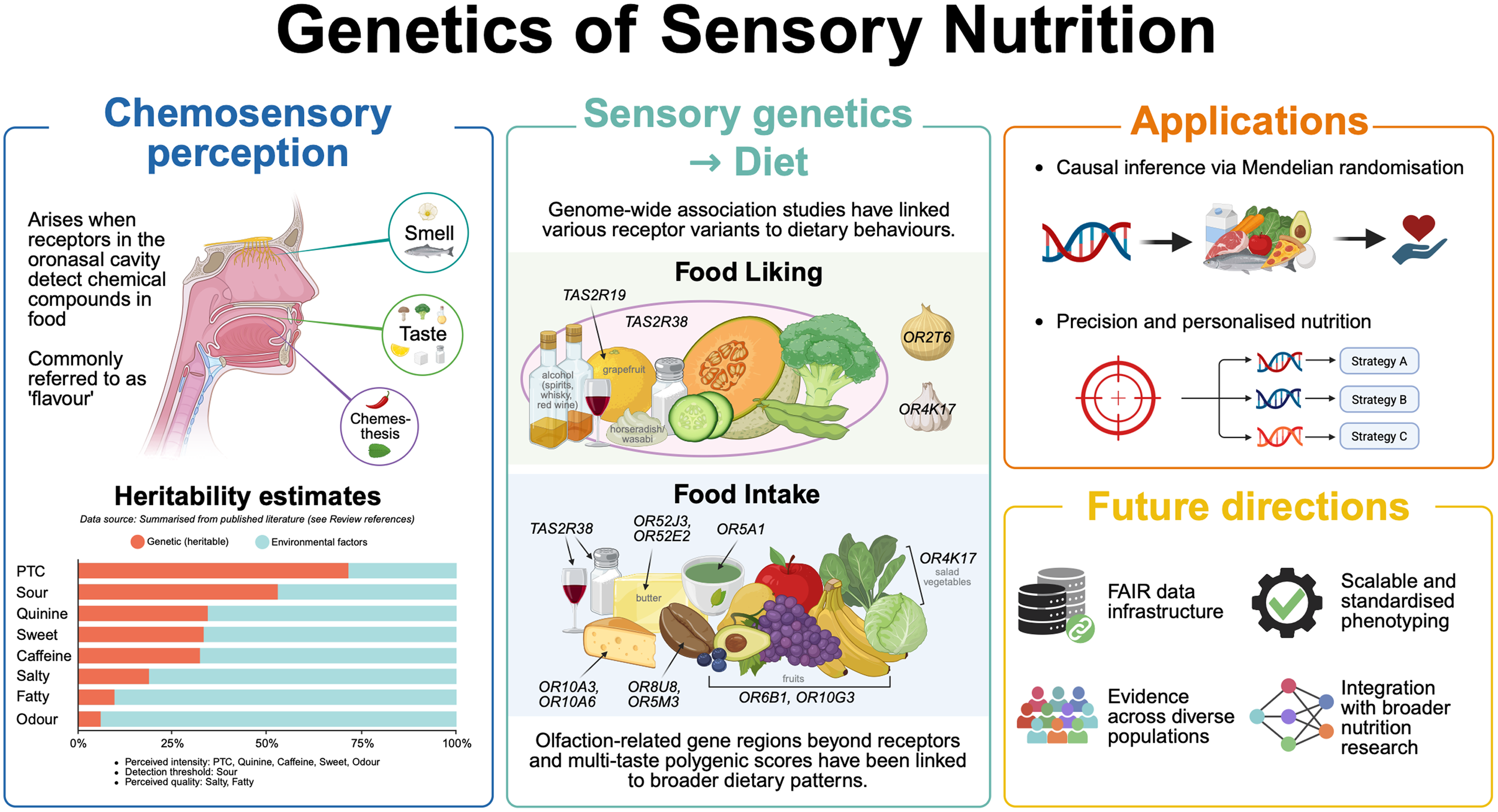
Chemosensory perception – encompassing taste (gustation), smell (olfaction), and chemesthesis (detection of chemical irritants) – shapes how we perceive food flavours and, consequently, our food preferences and dietary intake(Reference Reed, Alhadeff and Beauchamp1,Reference Feeney, McGuinness and Hayes2) . Individuals can vary substantially in their perception of the same food. For example, coriander is described as foul and soapy by some but fresh and zesty by others(Reference Eriksson, Wu and Do3), while some bitter compounds are intensely unpleasant to some people but barely detectable to others(Reference Feeney, McGuinness and Hayes2). While chemosensory perception is acknowledged as an individual-level barrier to dietary changes in clinical settings, it is seldom systematically measured or considered at the population level. These perceptual differences are in part genetically determined, which may offer an explanatory layer for why individuals respond differently to the same dietary advice, beyond what conventional measures and social determinants can account for. Moreover, genetic variants influencing chemosensory perception may offer a novel approach to understanding the causal effects of dietary exposures on disease risk, leveraging techniques from genetic epidemiology such as Mendelian randomisation (MR). This review summarises evidence from genomic approaches on the relationships between chemosensory perception and dietary intake, and explores applications of sensory genetics for causal inference, and for precision and personalised nutrition. An overview of the topics covered is presented in Fig. 1.
Chemosensory genetics in nutrition: heritability, dietary associations, applications, and future directions. Heritability represents the proportion of trait variation attributable to genetic factors. TAS2Rs denote taste receptors (family 2), and ORs denote olfactory receptors. FAIR, Findable, Accessible, Interoperable, Reusable; PTC, phenylthiocarbamide. Created in BioRender.

Taste, smell, and chemesthesis
Chemosensory perception arises when chemical compounds from the environment interact with specialised receptors in the oral and nasal cavities, initiating neural signals that the brain interprets as taste, smell, and chemesthetic sensations(Reference Jaime-Lara, To, Joseph, Joseph and Duffy4). These three systems operate through distinct molecular and anatomical pathways but together translate chemical information from food and beverages into the unified percept of flavour(Reference Reed, Alhadeff and Beauchamp1,Reference Jaime-Lara, To, Joseph, Joseph and Duffy4) .
Taste buds, the primary sensory organs for gustation, are onion-shaped clusters comprising 50–100 specialised cells located within gustatory papillae on the tongue’s surface. These cells detect the five basic taste modalities: bitter, salty, sour, sweet, and umami(Reference Jaime-Lara, To, Joseph, Joseph and Duffy4), with emerging evidence for fattiness and starchiness as additional tastes(Reference Feeney, McGuinness and Hayes2,Reference Diószegi, Llanaj and Ádány5) . Salty and sour tastes are mediated by ion channels that detect, respectively, sodium and protons (acids), while bitter, sweet, and umami tastes are detected by G-protein-coupled receptors, also called taste receptors(Reference Jaime-Lara, To, Joseph, Joseph and Duffy4). In both cases, stimulus detection initiates intracellular signalling cascades that lead to cell depolarisation and the release of neurotransmitters(Reference Jaime-Lara, To, Joseph, Joseph and Duffy4). This taste information is then transmitted to the brain via three cranial nerves (CN): facial (CN VII), glossopharyngeal (CN IX), and vagus (CN X)(Reference Jaime-Lara, To, Joseph, Joseph and Duffy4).
Taste receptors comprise two families. The TAS1R family has three members, in which the common subunit TAS1R3 pairs with TAS1R2 for sweet taste and with TAS1R1 for umami taste(Reference Behrens and Schaefer6). The human TAS2R family, specialised for bitter taste perception, has approximately 25 functional members(Reference Behrens and Schaefer6,Reference Meyerhof, Batram and Kuhn7) . Each TAS2R receptor exhibits varying degrees of specificity, with some narrowly tuned to specific chemical classes. For instance, TAS2R38 responds to thiourea compounds, including propylthiouracil (PROP; a synthetic bitter compound widely used in taste research) and isothiocyanates found in cruciferous vegetables when chopped or chewed, while TAS2R16 detects β-glucopyranosides such as amygdalin (e.g., apricot kernels, peach pits)(Reference Behrens and Schaefer6). Others, such as TAS2R14, respond broadly to structurally diverse bitter compounds(Reference Behrens and Schaefer6). Meanwhile, many bitter compounds can activate multiple TAS2Rs, with quinine (a flavouring agent in tonic water) activating nine different receptors(Reference Meyerhof, Batram and Kuhn7). Recent evidence suggests that TAS2R2, previously classified as a pseudogene, encodes a 26th functional bitter receptor in some populations, suggesting that the exact number of functional bitter receptors may vary across individuals due to ancestry-specific polymorphisms(Reference Lang, Di Pizio and Risso8).
Olfactory perception occurs when volatile chemical compounds (odorants) bind to olfactory receptors, expressed on the membrane of olfactory sensory neurones (OSNs) within the nasal epithelium(Reference Jaime-Lara, To, Joseph, Joseph and Duffy4,Reference Wu, Xu and Dong9) . Each OSN only expresses one type of olfactory receptor, and the OSN itself serves as both the receptor cell and the primary sensory neurone, with its axons collectively forming the olfactory nerve (CN I)(Reference Jaime-Lara, To, Joseph, Joseph and Duffy4). Humans possess approximately 400 functional olfactory receptors, which are also G-protein-coupled receptors(Reference Wu, Xu and Dong9). Each receptor can be activated by diverse odorants, while individual odorants can also activate multiple different receptors(Reference Jaime-Lara, To, Joseph, Joseph and Duffy4,Reference Wu, Xu and Dong9) . This allows a combinatorial coding pattern through which a limited repertoire of receptors can discriminate between thousands of distinct smells(Reference Jaime-Lara, To, Joseph, Joseph and Duffy4,Reference Wu, Xu and Dong9) . Upon receptor activation, signals from OSNs expressing the same receptor type converge in the olfactory bulb before being transmitted to the olfactory cortex for processing odour intensity and to higher-order regions for recognition, reward, and memory association(Reference Jaime-Lara, To, Joseph, Joseph and Duffy4).
Chemesthesis refers to the activation of somatosensory pathways by specific chemical stimuli, producing sensations often described as irritation, heat, cooling, or tingling(Reference Linne, Simons, Joseph and Duffy10). Dietary examples include the cooling sensation of menthol (mint), burning from capsaicin in chilli peppers, and the pungency of mustard(Reference Linne, Simons, Joseph and Duffy10). Chemesthesis is mediated by mechanoreceptors, nociceptors, and thermoreceptors located in the oronasal cavity, which transmit these chemical signals to the brain primarily via the trigeminal nerve (CN V), and via the glossopharyngeal nerve (CN IX) from the posterior third of the tongue(Reference Linne, Simons, Joseph and Duffy10). Taken together, variation in perception can arise at multiple stages, including chemical-receptor binding(Reference Feeney, McGuinness and Hayes2,Reference Behrens and Schaefer6,Reference Wu, Xu and Dong9) , intracellular signal transduction within the sensory cells(Reference Jaime-Lara, To, Joseph, Joseph and Duffy4,Reference Wu, Xu and Dong9) , and subsequent neural processing in the brain(Reference Reed, Alhadeff and Beauchamp1,Reference Jaime-Lara, To, Joseph, Joseph and Duffy4,Reference Linne, Simons, Joseph and Duffy10) .
Genetic determinants of taste and smell perception
Variation in perception mechanisms can manifest as differences in the chemosensory experiences of the same stimuli, including sensitivity thresholds (minimum concentration required for detection), suprathreshold perceived intensity (subjective strength at a given concentration), identification, and hedonic responses (perceived pleasantness or liking). These differences are, in part, driven by genetic variation, including small genetic differences in taste and smell receptor genes, the extent of which has been reviewed extensively elsewhere(Reference Feeney, McGuinness and Hayes2,Reference Diószegi, Llanaj and Ádány5) . While these phenotypes are relatively well established for taste and smell, chemesthesis encompasses a broad range of sensations for which trait definitions and standardised measurement remain less developed(Reference Reed, Alhadeff and Beauchamp1). These measurement challenges are an active area of methodological development, with ongoing work seeking rapid, scalable, and ecologically relevant approaches to assessing chemesthetic function(Reference Reed, Alhadeff and Beauchamp1,Reference Munger, Zhao and Barlow11) .
Evidence for genetic contributions to taste and smell comes in part from twin studies, which compare trait similarities between monozygotic (identical) and dizygotic (fraternal) twins to estimate heritability (h2), the proportion of individual variation in the trait attributable to genetic factors. As monozygotic twins share approximately 100% of their genome while dizygotic twins share on average 50%, greater trait similarity between monozygotic twins compared to dizygotic twins suggests genetic influences on the trait.
Heritability estimates for the perceived intensity of bitter compounds vary by stimulus. PROP and the structurally similar phenylthiocarbamide (PTC) consistently showe high heritability (h 2 = 0.71–0.73)(Reference Knaapila, Hwang and Lysenko12–Reference Hwang, Breslin and Reed14), followed by quinine (h 2 = 0.34–0.40)(Reference Knaapila, Hwang and Lysenko12–Reference Hwang, Breslin and Reed14), caffeine (h 2 = 0.30–0.34)(Reference Hansen, Reed and Wright13,Reference Hwang, Breslin and Reed14) , and sucrose octa-acetate (h 2 = 0.28–0.40)(Reference Hansen, Reed and Wright13,Reference Hwang, Breslin and Reed14) , which show moderate heritability. Sweet taste perception falls within a similar range (h 2 = 0.30–0.36 for sugars and high-potency sweeteners)(Reference Hwang, Breslin and Reed14,Reference Hwang, Zhu and Breslin15) . Multivariate modelling further suggests that the perception of sweetness and bitterness shares a common genetic factor that explains 17–37% of the variance in non-PROP bitter perception and 8% of the variance in sweet perception, particularly through post-receptor transduction mechanisms common to taste G-protein-coupled receptors(Reference Hwang, Breslin and Reed14). Heritability of sour taste recognition threshold has been estimated at 0.53 using citric acid(Reference Wise, Hansen and Reed16). Heritability estimates for saltiness (sodium chloride) vary by phenotype, ranging from no detectable genetic contribution for recognition thresholds(Reference Wise, Hansen and Reed16) to modest estimates for perceived saltiness (h 2 = 0.19) and liking (h 2 = 0.38)(Reference Lin, Colquitt and Wise17). Similarly, for fat taste, heritability appears higher for liking (up to h 2 = 0.29) than for perceived fattiness (h 2 = 0.05–0.15)(Reference Lin, Colquitt and Wise17). For olfactory traits, heritability estimates appear less established than for taste. One twin study estimated heritability of odour pleasantness at 0.38–0.40, while odour intensity showed markedly lower heritability at 0.03–0.09(Reference Hunter, Lin and Nguyen18).
While heritability estimates quantify the genetic influences, they do not inform which specific genes are responsible for this variation. Genome-wide association studies (GWAS) have since enabled a hypothesis-free approach to identifying these genetic contributors, systematically testing associations between genetic variants across the entire genome, typically single-nucleotide polymorphisms (SNPs), and traits of interest(Reference Uffelmann, Huang and Munung19). By comparing the frequencies of each variant across individuals exhibiting different levels of the trait, GWAS can identify loci associated with the trait of interest without prior assumptions or knowledge of biological function(Reference Uffelmann, Huang and Munung19).
Bitter taste perception has been extensively studied at the genome-wide level, with multiple GWAS (n = 141–1,999) revealing associations for various bitter compounds within bitter taste receptor clusters on chromosomes 7 (PROP, denatonium benzoate) and 12 (quinine, caffeine, sucrose octa-acetate)(Reference Hwang, Gharahkhani and Breslin20–Reference Reed, Zhu and Breslin22). The bitter receptor gene cluster on chromosome 12 has also been associated with perceived bitterness of acesulfame potassium, an artificial sweetener that can produce a bitter aftertaste(Reference Kan, Saraiva and Hwang23). Cross-ancestry comparisons reveal both shared and population-specific genetic architecture for bitter taste perception. TAS2R38 has been consistently associated with PROP or PTC perception across populations, though both the frequency of taster haplotypes and the distributions of taster phenotypes vary considerably across ancestries(Reference Robino, Mezzavilla and Pirastu24,Reference Yang, Williamson and Hasted25) .
GWAS findings for sweet taste perception remain relatively inconsistent. Hwang et al.(Reference Hwang, Lin and Gharahkhani26) identified several suggestive associations in Australian (n = 1,757 adolescents) and US (n = 686 adults) samples regarding perceived sweet taste intensity, but these associations failed to replicate across the adolescent and adult cohorts. Previously reported associations with sweet and umami receptors (TAS1R2, TAS1R3, and GNAT3) also failed to replicate in both GWAS and candidate gene approaches in these European-ancestry cohorts, with some associations appearing to reflect population stratification rather than within-ancestry associations(Reference Hwang, Lin and Gharahkhani26). Between-ancestry variation in allele frequencies in these genes may therefore contribute to differences in sweet taste traits between ancestral populations (e.g., European versus African ancestry), whereas within-ancestry genetic variation appears to explain little variation in sweet taste perception within European populations. Similarly, GWAS on self-reported preference for sweet taste (n = 425 individuals with metabolic syndrome) did not replicate these receptor associations, but instead identified an association with variants in PTPRN2, which requires independent replication(Reference Fernández-Carrión, Sorlí and Coltell27). More broadly, disentangling ancestry-specific genetic associations in sweet taste perception remains an active area of research, including ongoing examination of how environmental sweetness exposure may interact with genetic predispositions for sweet liking in populations of African and East Asian ancestry(Reference Cheung, Hubert and Reed28).
For smell perception, GWAS have examined both identification and sensitivity to specific odorants. For odour identification, the largest meta-analysis to date, involving 21,495 European individuals, identified several age-adjusted associations within olfactory receptor gene clusters, as well as novel associations with GSX2 (involved in olfactory bulb neurogenesis) and ADCY2 (involved in G-protein-coupled receptor signalling pathways), with some showing sex-specific associations(Reference Förster, Emmert and Horn29). SNP-based heritability estimates (the proportion of variance explained by common genetic variants measured on genotyping arrays used in the respective GWAS) for odour identification ranged from 8–12%, depending on the odorant and sex(Reference Förster, Emmert and Horn29). Earlier work on odour identification in African American older adults identified loci linked to neurodegenerative (Parkinson’s disease, Alzheimer’s disease) or neuropsychiatric (schizophrenia, epilepsy) diseases(Reference Dong, Wyss and Yang30), consistent with the consensus that olfactory dysfunction is an early symptom of neurodegenerative diseases. Notably, these associations were not observed in European American participants from the same cohorts, highlighting potential ancestry-specific contributions to the genetic architecture of the sense of smell. For odour sensitivity, GWAS have identified associations near or within olfactory receptor gene clusters, particularly for perceived intensity of androstenone(Reference Knaapila, Zhu and Medland31) and detection thresholds of food-related odours, including 2-heptanone (blue cheese), isobutyraldehyde (malt), and β-damascenone (apple)(Reference McRae, Jaeger and Bava32). Genetic variation in olfactory receptor genes has also been associated with specific odorants such as cis-3-hexen-1-ol (green/grassy; OR2J3)(Reference McRae, Mainland and Jaeger33) and β-ionone (fruity/floral; OR5A1)(Reference Jaeger, McRae and Bava34), while sensitivity to these odorants has been associated with preference for foods containing them(Reference Jaeger, McRae and Bava34,Reference Jaeger, Pineau and Bava35) . A missense variant in TAAR5, a trace amine-associated receptor expressed in the olfactory epithelium, has been associated with reduced perceived intensity of fish odour(Reference Gisladottir, Ivarsdottir and Helgason36).
Other chemosensory modalities remain understudied. Using food liking as proxies for taste preferences, Haydar et al.(Reference Haydar, Karlsson and Linneberg37) identified a genome-wide significant variant on chromosome 5 associated with umami liking, albeit with no obvious biological pathway, and confirmed associations between TAS2R38 and bitter-tasting foods (rocket salad) in a Danish population. GWAS evidence for fatty, salty, sour, and starchy tastes remains limited to date and is virtually non-existent for chemesthesis.
From sensory perception to dietary behaviours
The influence of chemosensory perception on dietary intake is well-acknowledged across multiple frameworks of food choice(Reference Chen and Antonelli38). From an evolutionary perspective, this relationship conferred survival advantages, with sweet and umami tastes indicating energy-dense and protein-rich foods, and bitterness warning against potentially toxic compounds(Reference Breslin39,Reference Callaway40) . While less is understood about the two remaining tastes, it is thought that saltiness helps signal the presence of essential minerals, and sourness helps detect spoilage or unripe fruits(Reference Callaway40). In present-day contexts, chemosensory perception continues to shape food choice and intake through its influence on palatability. For example, children who are highly responsive to bitter and sour tastes (i.e., higher perceived intensity) demonstrate lower preferences for fruits and vegetables(Reference Ervina, Almli and Berget41), while adults with lower oligofructose detection thresholds tend to have higher carbohydrate and overall energy intake(Reference Costanzo, Settapramote and Utama-ang42). In terms of smell, individuals with olfactory dysfunction showed poorer diet quality, characterised by higher energy density and higher intakes of saturated fats and added sugars, potentially due to compensatory behaviours to reduce perceived flavour enjoyment, such as seeking more intense basic tastes(Reference Rawal, Duffy and Berube43). Beyond individual physiology, the food industry actively exploits chemosensory cues, such as scented product packaging, to influence consumer behaviour and intake(Reference Spence44).
Consistent with observational findings, genetic studies have linked variation in chemosensory perception to individual differences in dietary traits, as reviewed elsewhere(Reference Feeney, McGuinness and Hayes2,Reference Diószegi, Llanaj and Ádány5,Reference Robino, Mezzavilla and Pirastu24) . However, this evidence remains uneven across chemosensory modalities and populations. Candidate gene studies have predominantly focused on taste receptor variants, especially bitter taste receptors, and many have used small samples with limited power to detect the generally modest associations with complex dietary traits(Reference Feeney, McGuinness and Hayes2,Reference Diószegi, Llanaj and Ádány5,Reference Robino, Mezzavilla and Pirastu24) . Although TAS2R38 has accumulated the most evidence linking genetic variation in taste to food preferences, including vegetables, alcohol, and sweet foods(Reference Feeney, McGuinness and Hayes2,Reference Diószegi, Llanaj and Ádány5,Reference Robino, Mezzavilla and Pirastu24) , findings have often been inconsistent or unreplicated, and publication bias may inflate the apparent consistency of associations.
Recent large-scale genomic studies have expanded both the scale and breadth of this evidence, although most studies have been conducted in populations of European ancestry, limiting the generalisability of their findings. A large phenome-wide association study (PheWAS) in the UK Biobank demonstrated that bitter-sensitive TAS2R38 alleles were associated with reduced liking for alcoholic beverages, grapefruit, horseradish, and salty foods, and with lower intake of added salt and red wine, though several previously reported associations, such as coffee, Brussels sprouts, and pickles, were not replicated(Reference Brito Nunes, Lim and Dy45). An early GWAS in 23andMe cohort also identified variants within an olfactory receptor gene cluster associated with coriander perception (soapy taste) and dislike(Reference Eriksson, Wu and Do3). While OR6A2 and OR10A2 were proposed as the most plausible candidates, these associations were not replicated in a subsequent UK Biobank study, which instead identified an independent association with OR10A6 (Reference Hwang, Lin and Evans46).
This UK Biobank study systematically examined nonsynonymous variants across 425 taste and olfactory receptor genes in relation to 140 food liking traits and identified 700 associations across 117 genes(Reference Hwang, Lin and Evans46). Among the strongest signals were OR4K17 with garlic liking, TAS2R19 with grapefruit liking, and OR2T6 with onion liking. Notably, some variants exhibited broad tuning (i.e., being associated with multiple food-liking traits), whereas others showed narrower, food-specific associations(Reference Hwang, Lin and Evans46). When food-liking items were categorised empirically based on genetic correlations, associations with taste and olfactory receptor genes were concentrated in acquired-taste categories (including bitter beverages, alcoholic drinks, and pungent foods) and low-calorie foods (vegetables, fruits, wholegrains) rather than highly palatable foods such as processed, fatty, or sweet items(Reference May-Wilson, Matoba and Wade47) . The pattern suggests that chemosensory receptor variants may be more relevant to learned or aversion-driven preferences than to reward-driven liking(Reference May-Wilson, Matoba and Wade47).
In a GWAS of 85 food intake traits in the UK Biobank(Reference Cole, Florez and Hirschhorn48), several olfactory receptor gene regions emerged among the 814 associated loci identified, including OR6B1 and OR10G3 with fruit intake, a cluster including OR5A1 with tea intake, a nearby but distinct cluster containing OR8U8 and OR5M3 with coffee intake, OR52J3 and OR52E2 with butter, OR4K17 with salad vegetables, and OR10A3 and OR10A6 with cheese intake. When examining associations between nonsynonymous chemosensory receptor variants and dietary patterns derived from the same food items, however, associations were weaker and far fewer variants reached genome-wide significance(Reference Hui, Devlin and Evans49). In contrast, a GWAS of adherence to a traditional Japanese dietary pattern identified a locus on chromosome 14, annotated to genes involved in olfaction (BCL2L2, SLC22A17), suggesting that genetic variation in broader olfactory pathways, beyond receptor variation alone, may influence dietary behaviours(Reference Suzuki, Nakamura and Matsuo50).
Beyond individual SNPs, polygenic scores (PGS) – which aggregate the effect estimates of many variants into a single value representing an individual’s genetic predisposition to a specific trait – have been used to examine whether cumulative genetic predisposition to taste perception is associated with dietary behaviours. Gervis et al.(Reference Gervis, Ma and Chui51) derived taste-specific PGS for bitter, sweet, umami, and sour perception in over 6,200 participants from the Framingham Heart Study using 33 taste-related SNPs from prior taste perception-related GWAS, finding that higher bitter perception scores were associated with lower wholegrain intake and higher umami perception scores were associated with lower vegetable intake. Similarly, a sweet taste PGS constructed from 38 SNPs was inversely associated with the Dietary Approaches to Stop Hypertension score in Puerto Rican older adults, with higher genetic predisposition to sweet taste sensitivity associated with lower wholegrain and vegetable intake(Reference Julián-Serrano, Pomares-Millan and Mangano52). However, the predictive accuracy of PGS is theoretically bounded by the SNP-based heritability of the underlying trait and, in practice, by the sample size and quality of the discovery GWAS(Reference Uffelmann, Huang and Munung19). Given the inconsistent replication and sparse GWAS evidence across several chemosensory modalities, validating chemosensory PGS against directly measured perception phenotypes in large, diverse cohorts remains an important methodological priority.
Nutritional status and disease risk are important potential outcomes downstream of dietary behaviours. For genetic variation in chemosensory perception to affect these outcomes through diet, these genetic differences would need to produce changes in the relevant dietary exposure – whether specific foods or nutrients, or broader dietary patterns – that are sufficiently large and sustained to affect nutritional status and disease risk. The current evidence base supports associations between some variants related to chemosensory perception and specific dietary phenotypes, but studies generally did not examine downstream nutritional or health consequences. Nonetheless, the TAS2R38 PheWAS described above reported associations of TAS2R38 variants with renal function markers and bipolar disorder(Reference Brito Nunes, Lim and Dy45). While parallel dietary and health associations for the same perception-related variants do not establish a diet-mediated pathway, these findings provide hypotheses for future studies examining potential downstream health implications of chemosensory variation.
Leveraging sensory genetics for causal inference
Despite evidence linking chemosensory perception to dietary intake, observational associations cannot definitively establish causality due to confounding and reverse causation. Sodium restriction interventions have been shown to shift salt taste preferences towards lower concentrations within three months(Reference Bobowski53), while reduced simple sugar intake has been shown to increase perceived intensity of both low- and high-sugar foods(Reference Wise, Nattress and Flammer54). However, a larger six-month trial varying sweet taste exposure found no changes in sweet taste liking or intensity perception(Reference Čad, Mars and Pretorius55), suggesting that the plasticity of taste preferences may be more limited than indicated by shorter-term studies. Perception also changes in response to events throughout the life course, such as illness, medical treatment, or environmental exposures, including tobacco smoking(Reference Reed, Alhadeff and Beauchamp1). Moreover, unlike dietary intake, which can be modified through randomised interventions, chemosensory perception cannot be easily manipulated in the way randomised controlled trials (RCTs) require. This limits our ability to draw causal conclusions about the downstream effects of chemosensory perception itself through traditional experimental approaches.
MR uses genetic variants as proxies for modifiable exposures to create natural experiments analogous to RCTs to infer causality(Reference Davey Smith and Ebrahim56,Reference Sanderson, Glymour and Holmes57) . Using SNPs in bitter taste receptor genes as proxies for perceived bitterness – namely rs1726866 in TAS2R38, and rs10772420 and rs2597979 in the bitter receptor cluster on chromosome 12, which account for 46%, 6%, and 2% of variance in perceived intensity of PROP, quinine, and caffeine, respectively(Reference Ledda, Kutalik and Souza Destito21,Reference Reed, Zhu and Breslin22,Reference Kim, Jorgenson and Coon58) – MR analyses revealed that higher perceived caffeine intensity causally increased coffee intake and the likelihood of being a heavy coffee drinker (>4 cups/day)(Reference Ong, Hwang and Zhong59). In contrast, higher perceived intensity of PROP and quinine decreased coffee intake(Reference Ong, Hwang and Zhong59). Higher PROP bitterness was also associated with lower alcohol consumption, particularly red wine(Reference Ong, Hwang and Zhong59). These findings suggest that bitter taste perception may causally shape the consumption of certain bitter beverages, though effects vary by the bitter stimulus used to measure perception and by beverage type, and effect sizes are modest(Reference Ong, Hwang and Zhong59).
The same challenge of establishing causality extends to diet-disease relationships in nutritional epidemiology more broadly, where the number of MR studies examining food and beverage exposures has grown rapidly, with 178 MR studies identified since 2002, of which 43% were published in 2024 alone(Reference Sutton, Gervis and Jatoi60). Coffee was the most studied exposure, followed by tea, alcohol, and overall diet (defined as more than 5 food groups in one publication). However, applying MR to dietary exposures presents methodological challenges. Variants identified in dietary GWAS may reflect behavioural responses to health status rather than primary dietary preferences(Reference Hwang, Lin and Evans46). For example, FTO variants are associated with both higher BMI and healthier dietary behaviours such as low sugar intake(Reference Hwang, Lin and Gharahkhani26) (possibly reflecting reverse causation), meaning that if used as a proxy for diet, any observed association with a health outcome could reflect FTO’s direct effects on adiposity and metabolism rather than the lower sugar intake itself. Chemosensory receptor variants may provide more biologically interpretable instruments than variants selected solely on the basis of genome-wide significance, as they have a clearer mechanistic link to perception and dietary behaviours and are less likely to capture behavioural or disease-related confounding(Reference Hwang, Lin and Evans46,Reference Hui, Devlin and Evans49) . Nonetheless, biological plausibility alone does not inherently establish instrument validity, as gene-diet associations may still be weak, and extra-oronasal receptor expression may introduce pathways to disease outcomes that do not operate through perception and dietary intake. Instrument strength and potential pleiotropy must therefore always be evaluated for each causal question.
Leveraging sensory genetics for precision and personalised nutrition
While population-wide dietary guidelines and policies have been successful at preventing nutritional deficiencies, chronic disease prevention presents greater complexity and greater individual variability in response to dietary interventions(Reference Livingstone, Ramos-Lopez and Pérusse61). This has driven increasing interest in precision and personalised nutrition strategies, which leverage technological advances in genomics and other data sources to provide highly tailored interventions(Reference Livingstone, Ramos-Lopez and Pérusse61). In particular, precision nutrition targets population subgroups with shared characteristics, while personalised nutrition refers to recommendations tailored to individuals(Reference Livingstone, Ramos-Lopez and Pérusse61).
The potential for taste genetics to guide dietary recommendations and improve adherence was proposed nearly two decades ago(Reference Tanaka, Reed, Ordovas, Kok, Bouwman and Desiere62). As discussed earlier, sweet taste preferences show resistance to modification through dietary exposure, with participants spontaneously returning to baseline sweet food intake levels after the intervention(Reference Čad, Mars and Pretorius55). This suggests that individual differences in taste preferences may be partly driven by factors less amenable to environmental influences. More broadly, sensory genetics may inform the design and delivery of dietary interventions by explaining heterogeneity in responses to interventions. In a randomised controlled trial aimed at promoting vegetable intake, Calancie et al.(Reference Calancie, Keyserling and Taillie63) examined whether genetic variation in bitter taste sensitivity, indexed by the three TAS2R38 SNPs associated with PROP taster status, moderated the intervention’s effectiveness. While all participants receiving intensive dietary counselling increased vegetable intake regardless of genotype, PROP tasters showed smaller increases than intermediate tasters and non-tasters(Reference Calancie, Keyserling and Taillie63). In contrast, among participants receiving minimal counselling, vegetable consumption declined over time only among PROP tasters(Reference Calancie, Keyserling and Taillie63). These findings suggest that genetically predisposed bitter taste sensitivity may hinder sustained dietary change, and that individuals with this sensory profile may require more intensive or tailored behavioural support.
Beyond TAS2R38-mediated PROP sensitivity, however, evidence for genotype-stratified dietary interventions across other bitter compounds and receptors (e.g., quinine and caffeine) and other chemosensory modalities remains absent. While genotypes are less susceptible to measurement error and remain stable over time, future intervention studies might also consider whether direct chemosensory phenotyping (e.g., using tastant solutions)(Reference Munger, Zhao and Barlow11) offers complementary stratification to genotyping alone, given that genotype explains only a proportion of the variation in chemosensory perception. In dietary counselling, the more immediate application of the evidence reviewed herein may lie in recognising chemosensory barriers to dietary behaviour change, especially in the absence of routine genotyping. In an online study of 218 adults, Briazu et al.(Reference Briazu, Bell and Dodd64) found that participants receiving healthy-eating advice tailored to profiles combining questionnaire-assessed sensory preferences with cognitive and sociodemographic characteristics reported stronger intention to change diet than those receiving generic advice, although the contribution of sensory tailoring could not be isolated and changes in dietary behaviour were not assessed. A reported aversion to the taste or smell of a recommended food should therefore inform how advice is individualised, consistent with broader principles of patient-centred care that emphasise responsiveness to lived experiences(Reference Sladdin, Ball and Bull65). Recognising such an aversion as a genuine barrier that may not always be readily overcome does not require attributing the aversion to a particular genotype.
Future directions and conclusions
Realising the potential of sensory genetics to inform precision and personalised nutrition fundamentally depends on the quality and scale of sensory phenotype data available for genetic association studies. However, chemosensory science currently lags behind other disciplines in data sharing, standardisation, and infrastructure(Reference Parma, Mainland and Hwang66). Transitioning towards the FAIR principles – ensuring data are Findable, Accessible, Interoperable, and Reusable – is essential for the field to achieve the same level of success seen in genomics for other phenotypes, where standardised repositories have enabled meta-analyses across millions of individuals that drive breakthroughs in understanding complex traits(Reference Parma, Mainland and Hwang66). Chemosensory research would require a similar transformation, moving from small, isolated studies to coordinated, large-scale data collection that can support genetic discovery and enable validation across diverse populations(Reference Parma, Mainland and Hwang66). Critically, establishing shared repositories and adopting common data standards (e.g., naming conventions, structured file formats) will facilitate computational analyses and integration across studies(Reference Parma, Mainland and Hwang66). Similarly, developing and adopting consistent, scalable chemosensory phenotyping protocols across taste, smell, and chemesthesis would help ensure that data combined across studies reflect genuine variation in perception rather than methodological artefacts(Reference Munger, Zhao and Barlow11). Fostering a culture of data contribution across research groups will be as critical as these technical foundations in building the evidence base needed to integrate sensory genetics into nutrition research and practice(Reference Parma, Mainland and Hwang66).
The vast majority of GWAS and MR studies examining chemosensory genetics have been conducted in populations of European ancestry, as with most genomic publications. It is important to distinguish between genomic ancestry (genetic similarity reflecting shared evolutionary history) and ethnicity or race (sociocultural constructs) as both may independently influence dietary behaviours through different mechanisms. With respect to genomic ancestry, variants influencing chemosensory perception may differ in the specific variants involved, their frequencies, and their effect sizes across diverse ancestries. This has direct implications for the predictive accuracy of PGS, which deteriorates with increasing ancestral distance from the population in which it was derived(Reference Martin, Kanai and Kamatani67), and for the validity of MR findings, as the strength and specificity of genetic instruments may differ across ancestral populations(Reference Sanderson, Glymour and Holmes57). With respect to cultural diversity, dietary research should continue to strive for inclusivity in its design and measurement tools to ensure that foods and dietary practices from diverse sociocultural contexts are adequately represented in the data(Reference Tucker and Noel68).
In summary, chemosensory perception is a fundamental yet often under-measured determinant of food choice and intake. The application of genomic tools has clarified the biological basis for individual differences in taste and smell perception, with genetic variation in chemosensory receptors being associated with the consumption of specific foods and beverages. Sensory genetics has the potential to enhance the rigour of nutritional epidemiology through techniques such as MR for causal inference, or PGS to study chemosensory-diet associations at scale. Beyond informing intervention design, accounting for individual differences in chemosensory perception provides an additional lens for evaluating heterogeneity in intervention responses and effectiveness. Integrating sensory genetics into nutrition research supports a more nuanced path towards improving long-term dietary adherence and, ultimately, chronic disease prevention.
Acknowledgements
None.
Author contributions
PSCH: Writing – Original Draft, Visualization; DRR: Writing – Review & Editing, Supervision; LDH: Conceptualization, Writing – Review & Editing, Supervision, Funding acquisition. All authors reviewed and approved the final manuscript.
Financial support
PSCH is supported by a UQ Research Training Scholarship from the University of Queensland (UQ). DRR is supported by the Monell Institutional Fund. LDH is supported by an Australian Research Council (ARC) Discovery Early Career Researcher Award (DE240100014). UQ, ARC, and the Monell Chemical Senses Center had no role in the design, analysis, or writing of this article.
Competing interests
The authors declare no conflicts of interest.

 Open access

