1 Introduction
This paper pursues a set of closely related goals relevant to current phonological theory and sound change, particularly as these are framed in Evolutionary Phonology (Blevins Reference Blevins2004, Reference Blevins2006a, Reference Blevinsb). First, a growing body of recent literature deals with patterns of ‘final devoicing’. We review our own typology of final laryngeal neutralisation under the assumptions of ‘laryngeal realism’, which draws a more critical distinction among language types than much previous work on laryngeal features. Under this view, in fact, the familiar German process is treated as ‘final fortition’ rather than final devoicing. Second, the precise phonological characterisation of German final neutralisation remains controversial, and we provide an account of this process, qua final fortition, that captures the prescribed standard and the most widespread variants in terms of the alignment of prosodic units, without recourse to classes of lexical exceptions found in some recent work. Third, Evolutionary Phonology emphasises the profound, even primary role of diachrony in accounting for synchronic phonological patterning. We show here how German final fortition evolved from the marking of the ends of prosodic units, and how that history illuminates key wrinkles in the German data. Our account hinges crucially on the interplay between prosodic structure and sound change, yielding new insights into variability.
We seek, in the broadest terms, to make a theoretical and an empirical contribution here. First, while Blevins (Reference Blevins2004) cedes a role to ‘pure phonology’ in Evolutionary Phonology, particularly prosody, little work in this young framework (albeit one with deep historical roots) has pursued how such abstract structures interact with perception and other factors to shape synchronic phonology. Second, we elucidate how historical forces have shaped the celebrated pattern of German final neutralisation, including how its history has led to apparent ‘exceptions’ and regional and stylistic variants.
Before we turn to those matters, a bit of context is needed. Contrasted with Optimality Theory (McCarthy Reference McCarthy2002, Reference McCarthy2003), the Evolutionary Phonology approach to phonological patterning is decidedly historical. The historical orientation of Evolutionary Phonology is laid out explicitly in its central premise:
(1) Principled diachronic explanations for sound patterns have priority over competing synchronic explanations unless independent evidence demonstrates, beyond reasonable doubt, that a synchronic account is warranted (Blevins 2004: 23).
In this theory, innate phonology-specific knowledge is posited only when empirical evidence demonstrates the existence of such knowledge. As a consequence, there are to date no innate phonological markedness constraints in the theory, nor have any native phonology-specific predispositions been discovered which incline learners to acquire certain phonological rules over others, as in the derivational model of Natural Phonology (Stampe Reference Stampe1973). Rather, synchronic phonological structuring is fundamentally a consequence of generalisations having been adduced over ambient linguistic data, and of natural sound change arising through the language learner's perception or misperception of linguistic input. Many of these learned generalisations are reflective of ‘natural’ phonological rules or processes as opposed to ‘unnatural’ ones, but this results from how learning and sound change work under the limitations of human physiology interacting with the predilections of human perception. Phonological naturalness, then, or ‘unmarked’ status (following Haspelmath Reference Haspelmath2006), is a construct applied by linguists to language structures and patterns which are frequently observed (typologically, statistically, ontogenetically, at points of neutralisation, etc.), and these are frequently observed because the human organism is organised in a way that favours certain sound changes, and certain apprehensions, over others. Nonetheless, both natural and unnatural patterns (which may arise historically through the interplay of natural ones, or under the influence of contact with other languages, varieties and traditions) are learnable – it is just that the unnatural patterns are less common, and sometimes very rare.
As a consequence of (1), the innate and universal status of abstract phonological categories and structures, including distinctive features and prosodic constituents, must also be demonstrated. While their ubiquity suggests that these abstract phonological categories are part of ‘pure phonology’ (Blevins Reference Blevins2004: 19–20, 251–258), cross-linguistic diversity in the phonetic realisation of features and the range of prosodic domains and structures suggest significant roles for diachrony and phonological learning. Here we explore phonological features and their association with prosodic domains as they interact with the historical forces outlined above. First we lay out the basic tenets of laryngeal realism (§2) and its consequences for a typology of final laryngeal neutralisation, then in §3 show how final fortition is motivated. In §4, we follow the consequences of this view (and Evolutionary Phonology) for the well-known case of German final obstruent phonology and phonetics. Finally, §5 gives a sketch of how the contemporary German situation arose, including social and regional variability, while §6 concludes.
2 Laryngeal realism
While early generative phonology treated a wide-ranging set of languages with two-way laryngeal contrasts simply in terms of the feature [voice], more recent work distinguishes two types, ‘voice languages’ vs. ‘aspiration languages’. On the one hand are voice languages like Dutch (as well as the Romance and Slavic languages), with early voice onset time (VOT) in initial, thoroughly voiced stops, but with short-lag VOT in voiceless unaspirated stops; on the other hand are aspiration languages like German, as well as English and the other Germanic languages (less Dutch, Afrikaans and Yiddish), with short-lag VOT in initial voiced stops – which are thus phonetically really not voiced – but with long-lag VOT in voiceless, heavily aspirated stops (Lisker & Abramson Reference Lisker and Abramson1964). This naturally represents a return to the established indigenous descriptive traditions for numerous languages, like German. Following Kim's (Reference Kim1970) ground-breaking phonetic work on Korean aspiration, Iverson & Salmons (Reference Iverson and Salmons1995, Reference Iverson and Salmons2003a, Reference Iverson and Salmonsb) tap into this familiar difference to develop what has come to be called the ‘multiple feature hypothesis’ (Kager et al., Reference Kager, van der Feest, Fikkert, Kerkhoff, Zamuner, Weijer and Torreforthcoming) or simply ‘laryngeal realism’ (Honeybone Reference Honeybone, van Oostendorp and van de Weijer2005), a view which structurally distinguishes glottal phonation types according to basic feature representation. The phonological consequences of this interpretation, along with its phonetic underpinnings, are laid out for the Germanic languages in general in a position paper by Iverson & Salmons (Reference Iverson and Salmons1995) and explored further by Iverson & Salmons (Reference Iverson and Salmons1999, Reference Iverson and Salmons2003a, Reference Iverson and Salmonsb), with early parallel work by Jessen (Reference Jessen1998). That interpretation has been expanded and developed by many since, e.g. Jessen & Ringen (Reference Jessen and Ringen2002), and applied to language change by Calabrese & Halle (Reference Calabrese, Halle, Jasanoff, Craig Melchert and Oliver1998), Hinskens & van de Weijer (Reference Hinskens and van de Weijer2003) and Honeybone (Reference Honeybone, van Oostendorp and van de Weijer2005, Reference Honeyboneforthcoming), among others, to language typology by Kehrein & Golston (Reference Kehrein and Golston2004), to psycholinguistic research by Brown (Reference Brown2004) and to language acquisition by Kager et al. (Reference Kager, van der Feest, Fikkert, Kerkhoff, Zamuner, Weijer and Torreforthcoming); cf. also the broader work of Anderson & Ewen (Reference Anderson and Ewen1987), Harris (Reference Harris1994) and Spencer (Reference Spencer1996).
Laryngeal realism holds that the thoroughly voiced stops of Dutch will be represented phonologically with the privative feature [voice], leaving the voiceless unaspirated stops laryngeally neutral, whereas the voiceless, typically aspirated stops of German are marked with the feature [spread glottis], rendering the so-called voiced stops in this language as neutral or unspecified. Importantly, this contrast in basic representation is arrived at through examination of the phonetic properties of the languages themselves as well as their phonological phenomena, including biases in the directionality of laryngeal assimilation (toward segments marked for [spread glottis]) in aspiration languages, toward [voice] in voice languages; cf. Iverson & Salmons Reference Iverson and Salmons1995, Reference Iverson and Salmons1999, Reference Iverson and Salmons2003b).
In both Dutch and German, moreover, laryngeal oppositions are neutralised in final environments: in Dutch this is final devoicing (loss of [voice]) but in German it is final fortition (addition of [spread glottis]) (cf. Iverson Reference Iverson1997 on German; Iverson & Salmons Reference Iverson and Salmons2003b on Dutch).
Other languages neutralise final laryngeal distinctions in other ways. Notably, we find final lenition, i.e. the removal of [spread glottis], as in Korean, which neutralises final manner distinctions as well as the language's lax∼tense∼aspirated contrast (all stops, fricatives and affricates reduce to unreleased laryngeally neutral stops, apparently without glottal constriction; cf. Kim Reference Kim1979, Iverson Reference Iverson1989). (2) gives a typology of neutralisations in laryngeal realism, involving two privative features and both deletion and insertion. Structurally, these four types of final laryngeal neutralisation are reflected in four kinds of rules that may be learned on the basis of the input data, in which the ‘final’ environment is taken to be the end of the syllable.
(2)

Other sound changes can give rise to the opposite pattern, however, in which final stops are regularly voiced. This is very rare, apparently because, as Blevins (Reference Blevins2006b) emphasises, there is no natural phonetic or aerodynamic reason to make stops voiced in final position. But one case that has been widely reviewed is Lezgian (Blevins Reference Blevins2004, Reference Blevins2006b and references cited therein, Yu Reference Yu2004), whose plain voiceless series emerges as voiced in word-final position. This came about through separate sound changes affecting the historically voiced stops, geminating them in medial pretonic position; these voiced geminates then devoiced (and later degeminated, too), because of the aerodynamic difficulty of sustaining voicing in long stops, leaving a pattern of (new) voiceless medials alternating with (old) voiced finals. The rarity of the ‘inverted’ final voicing rule that is learned from this synchronic distribution is thus due to the absence of any direct phonetic motivation for it, as well as to the coincidental character of the unrelated sound changes that engendered it. But though rare, the pattern is learnable, on the assumptions of Evolutionary Phonology, and results in a non-assimilatory neutralisation rule which adds rather than removes the feature of [voice] from final position.
That unnatural phonological patterns are as learnable as natural ones has been driven home in recent psycholinguistic experimental work as well. Seidl & Buckley (Reference Seidl and Buckley2005), in particular, show that infants just as easily learn arbitrary phonological patterns as they do motivated or natural ones. And among adults, Pycha et al. (Reference Pycha, Nowak, Shin and Shosted2003) found that linguistically naive subjects can just as easily generalise over data that reflect a pattern of vowel disharmony (an unnatural process) as one of vowel harmony (an archetypically natural pattern). Their subjects were much less successful at tasks in which some words were unpredictably harmonic and others disharmonic, but a consistent pattern of either vowel harmony or vowel disharmony was readily acquired, without apparent learning bias toward one or the other of these generalisations. Parallel to final voicing, then, the fact that general vowel disharmony is rare (if not unknown) among languages is due to the absence of natural phonetic factors that would give rise to it, whereas the coarticulatory conditions underlying vowel harmony, like the phonetic factors inducing final devoicing, are familiar and commonplace, i.e. natural.
Formally, the generalisations in (2) appear to be identical in structure and complexity, although final devoicing (2a) and final lenition (2c) are feature delinkings, whereas final voicing (2b) and final fortition (2d) are feature additions. Theories of autosegmental phonology, especially those embellished by feature underspecification, generally explain assimilations as the spreading of a specified feature from one segment into a position that is unspecified in another (or which becomes so through delinking of a feature that is already there), as in, for example, the assimilation of unspecified coronals to the place of articulation of specified labials and velars (Iverson & Kim Reference Iverson and Kim1987, Rice Reference Rice1994). Non-assimilatory neutralisations, conversely, are described in terms of the removal or delinking of a specified feature, the result then ‘defaulting’ to the segment which is unspecified for that feature. This is the case with both final devoicing and final lenition as presented in (2a, c), and represents the formal means by which the theory seeks to capture the Trubetzkoyan insight that the direction of non-assimilatory neutralisation is to the unmarked member of an opposition – hence final devoicing in Dutch, but final lenition in Korean.
The neutralisations in (2b, d), however, involve the addition of a feature ex nihilo, placing final voicing and final fortition in a category quite different from final devoicing and final lenition. It is noteworthy, then, that the rarity of final voicing – or perhaps its lack of attestation to date – correlates with the oddity of its phonological characterisation as a non-assimilatory neutralisation, viz. the addition of a feature ([voice]) from no apparent source, and with no apparent motivation. Final voicing, if attested, would thus join the class of ‘crazy rules’ identified by Bach & Harms (Reference Bach, Harms, Stockwell and Macaulay1972) : rules which exist in a grammar, and which of course can be learned, but which are without apparent synchronic motivation, having arisen through sound changes whose initial impetus has been obscured by the development of other changes.Footnote 3
3 Motivating final fortition
Final fortition, unlike final voicing, does have synchronic motivation, specifically, the marking of prosodic boundaries. Though this, too, is a feature addition without an assimilatory source, and thus runs against the grain of expectation in autosegmental phonology, its demarcative function of signalling the end of a prosodic constituent gives it further force and presumably enhances the likelihood of its occurrence. We will return below to the importance of what is known widely in prosodic phonology and Optimality Theory as prosodic edge marking.
In the evolutionary view of Blevins, final devoicing arises qua sound change through the convergence of several phonetic, prosodic and aerodynamic factors, given in (3), from Blevins (Reference Blevins2006b).
(3) Sources of final devoicing
(a) Phonetic factors
(i) Laryngeal gestures at phrase boundaries (aspiration, glottalisation)
(ii) Phrase-final segment-lengthening
(iii) Absence of audible release finally
(b) Overgeneralising phrase-to-word domains
(c) Aerodynamic voicing constraint
Among these, Blevins points out, as have many before her (Hock Reference Hock, Fujimura, Joseph and Palek1999, for example), that some languages mark the boundaries of phonological phrases by either spreading or constricting the glottis; in the former case, phrase-final stops may be aspirated, in the latter they may be glottalised, but in both cases voicing is inhibited because vocal fold vibration in obstruents, aerodynamically difficult to begin with, is facilitated by a neutral glottis rather than a spread or constricted one (Halle & Stevens Reference Halle and Stevens1971, Avery & Idsardi Reference Avery, Idsardi and Alan Hall2001, Iverson & Salmons Reference Iverson and Salmons2003a). The resulting frequent tokens of voiceless phrase-final obstruents then serve as the basis for learners of the language to overgeneralise eventually to word-final position, yielding an edge-marking pattern of final aspiration (Kashmiri, Klamath) or final glottalisation (as may be emergent in English, especially among alveolars; Blevins Reference Blevins2006b: 137, citing recent work by Kenneth Stevens). A second phonetic factor is the frequent lengthening of phrase-final segments, which results in longer closure durations among stops. To maintain voicing in obstruent stops is difficult in its own right, because of the conflict between the need for airflow across the glottis in order to sustain vocal fold vibration and the blocking of airflow upstream in the oral cavity. Voicing is especially likely to cease in oral stops with long closure durations. Therefore, phrase-final lengthening has aerodynamic consequences which produce yet another source of phrase-final voiceless stops to serve as a basis for extending the pattern to final environments generally. And a third factor contributing to the perception of final stops as voiceless is the fact that in many languages finals are unreleased. As voicing (like other laryngeal gestures) may be difficult to discern in the absence of the acoustic cues of the burst, i.e. without audible release of closure, the apprehension can easily arise that unreleased stops are devoid of distinctive laryngeal content, or unvoiced, thus forming another basis for learners to hypothesise a general rule of final devoicing.
Individually or together, the perceptual effect of such phonetic factors is enhanced by the dominant occurrence of phrases that consist of single words in first language acquisition (up to 60% of input, Blevins reports), so that the generalisation of ambient phrase-final phenomena to word-final position is not a large leap.
From an evolutionary perspective, these considerations are based primarily on physics, physiology and perception. What is being explained, then, is the way by which final devoicing comes to be a learned rule or generalisation of synchronic grammars: aside from cases involving genetic inheritance of an earlier stage or the influence of language contact, or perhaps a prescriptive practice, that way is through natural sound change mediated by imperfect learning.
At the same time, Blevins does assign a role to ‘pure phonology’, illustrating that category with phonological features and prosody. We explore the emergence of German final fortition using those two tools, finding that its origins likely lay in the laryngeal feature marking of the end of a prosodic constituent via final aspiration. This is arguably also the synchronic form that the rule takes in German today – final fortition rather than final devoicing (Iverson Reference Iverson1997, Iverson & Salmons Reference Iverson and Salmons2003b) – even though its historical motivation as a prosodic marker has become obscured with the emergence of a prescriptive standard coloured by widespread final lenition in the dialects, so that final release is far from obligatory.
Returning to the typology, we note that Evolutionary Phonology recognises non-assimilatory neutralisations not only for the structurally unmarked member of an opposition, per commonly applied models of autosegmental phonology (e.g. Goldsmith Reference Goldsmith1990), but also for the phonologically specified member. Though apparently less often implemented, this generalisation of the theory allows for the more accurate characterisation of obstruent neutralisation in German as final fortition rather than final devoicing, and it makes a novel connection, for Evolutionary Phonology, between commonly learned patterns of neutralisation that involve structural reductions and those (some phonetically motivated, others not) which are less frequent, yet still learnable, involving feature additions. The match-up in non-assimilatory neutralisation patterns between structural reductions, which are commonplace, and structural additions, which are rather rare, thus reflects (albeit approximately) the familiar natural vs. unnatural divide.
Final fortition is not widespread in Germanic, however, characterising German but not its sisters. Even here the process seems to be cut from somewhat different cloth than the several cases identified by Vaux & Samuels (Reference Vaux and Samuels2005), e.g. in Kashmiri and Klamath, where it appears that word-finals are regularly released in order to realise the imposition of final aspiration, apparently as means of phonetically marking the word end. In fact, Vaux & Samuels suggest that voiceless aspirates in these languages are phonologically unmarked precisely because they are the product of non-assimilatory neutralisation in final position, where the expectation for such neutralisation is to unaspirated stops, not aspirated ones. The view we are developing here, by contrast, accords a higher role to final aspiration, viz. serving the function of marking the end of a phrase or word, and, in the case of German, as we shall show, marking the end of the syllable through neutralisation to the fortis series, whether released with aspiration or not. The product of these neutralisations to aspirated or fortis obstruents thus remains phonologically marked, a price the phonology appears willing and able to pay for having the grammar meet the goal of distinctive marking of the ends of prosodic units.
With this general background, then, let us turn to the phonological behaviour of final fortition in contemporary German.
4 Final neutralisation in the German standard
Almost no other phonological rule or constraint has been more widely discussed and described than final neutralisation in German. In German itself, the phenomenon is known as Auslautverhärtung, or final fortition (literally ‘final hardening’), suggesting that the phonological form the process takes is that in (2d), viz. addition of the feature [spread glottis], rather than removal of the feature [voice] in the manner of (2a). The arguments for a fortition analysis of final neutralisation in German have been central to the proposals for laryngeal realism, as sketched above, but we stress that they emerge from a lengthy tradition in German phonetics (cf. especially Kohler Reference Kohler1984, Jessen Reference Jessen1998). The synchronic details of final neutralisation in German have been comprehensively organised by Brockhaus (Reference Brockhaus1995) (reviewed from the fortition perspective by Iverson Reference Iverson1997), and the environmental conditions which trigger or determine the neutralisation have been identified in papers by Kiparsky (Reference Kiparsky and Dingwall1971), Vennemann (Reference Vennemann1972), Rubach (Reference Rubach1990) and Giegerich (Reference Giegerich, Eisenberg, Heinz Ramers and Vater1992), among others. In short, final neutralisation in standard German affects obstruents which are at the end both of a morpheme and of a syllable, as recapitulated in the data in (Reference Bach, Harms, Stockwell and Macaulay4), drawing in part on Gussenhoven & Jacobs (Reference Gussenhoven and Jacobs2005: 112–113).
(4) Final neutralisation in Standard German
Thus, whether at the end of the word (4a) or at the end of a word-internal syllable which is morpheme-final (4b), an underlying lenis (‘voiced’) obstruent emerges as fortis (‘voiceless’). But a lenis obstruent at the end of a syllable which does not coincide with a morpheme boundary retains its underlying character (4c, d), although, in varieties identified generally as North German by Vennemann (Reference Vennemann1972), the morpheme-alignment restriction is relaxed so that syllable-final neutralisation affects obstruents irrespective of their position in the morpheme. In the prescribed standard language, however, the morpheme-end restriction on syllable-final neutralisation remains in force. As Muthmann (Reference Muthmann1996: 493; see also Drosdowski et al. Reference Drosdowski, Grebe, Köster and Müller1974: 83) puts it in identifying the consonants before which syllable-final neutralisation does not take place vs. those before which it does: ‘Die Regel heißt: stimmhaft, wenn n, l, r zum Stamm gehören, stimmlos, wenn nicht und vor Ableitungssilben wie -bar, -chen, u.a. … ’ [‘The rule for pronunciation of syllable-final b, d, g is: voiced if a following n, l, r belong to the stem, voiceless if not, and voiceless as well before consonant-initial derivational morphemes like -bar ‘-able’, -chen ‘little’, etc. …’ (emphasis added)]. He also notes disparities among prescriptive sources based on differing morphological analyses, such as Söldner ‘mercenary’ [zœldnɐ] vs. [zœltnɐ], according to whether the scholars in question understand the word as more directly associated with Middle High German (MHG) soldenaere ‘mercenary’ (Söldn+er) or to Sold ‘soldier's pay’ (Söld+ner). The explicit role played by morphology in the prescribed pronunciation of the standard is thus quite clear, underscoring the learned generalisation that a syllable-final morphophonemically lenis obstruent is articulated as fortis just in case it is also final in the morpheme.
In derivational phonology, a restriction of this kind could be expected to fall out from the ‘derived environment constraint’, developed first by Kiparsky (Reference Kiparsky and Fujimura1973). As a general limitation on the application of obligatory neutralising (‘lexical’) phonological rules, the derived environment constraint requires chiefly that elements conditioning a rule be part of a different morpheme, not the same one. For example, Trisyllabic Laxing in English is free to apply to the underlying long stem vowel in divinity (div[ɪ]nity, from divine+ity) or in serenity (ser[ε]nity, from serene+ity) because the crucial three-syllable context the rule requires is morphologically composite in these words. But laxing cannot apply in monomorphemic nightingale (*n[ɪ]tingale) or stevedore (*st[ε]vedore), despite their trisyllabic structure, because the context for the rule in these words falls within the same morpheme. In accounting for final neutralisation in the German standard, similarly, the familiar derived environment constraint would seem to be the basis for the failure of Auslautverhärtung to apply morpheme-internally, too, exempting words like Adler [aːd.lɐ] because of their monomorphemic status. In fact, however, Auslautverhärtung makes no reference to a morpheme other than the one that itself contains the candidate for neutralisation: all that is required is that the obstruent to undergo fortition be both syllable-final and morpheme-final, with no regard for segments or structures that may be present in a following morpheme. Strictly speaking, then, the derived environment constraint cannot impose the necessary restriction on Auslautverhärtung in the prescribed standard pronunciation, because the rule refers crucially just to the morpheme margin, not to segments or structures which reside in a different morpheme.
Still, the spirit of the derived environment constraint suggests that it should have the required effect here, even though it does not; but it appears that a general phonological correspondence uncovered within Optimality Theory does. From the beginnings of the development of this theory (McCarthy & Prince Reference McCarthy and Prince1993, Prince & Smolensky Reference Prince and Smolensky1993), in fact, a central idea has been that there is a preference in human languages for prosodic edges (word, foot, morpheme, syllable) to ‘line up’ with each other, or to co-occur. Known as ‘generalised alignment’ or ‘prosodic alignment’, especially when applied to stress systems, a novel application of the idea is found in the work of Łubowicz (Reference Łubowicz2002), who suggested that the effects of the traditional derived environment constraint could be incorporated into Optimality Theory by ‘locally conjoining’ an otherwise lower-ranked markedness constraint with a correspondence constraint calling for alignment between the edge of a morpheme and the edge of a syllable.Footnote 4
For standard German, to continue in this idiom, the alignment condition calling for match-up between the right edges of the syllable and the morpheme would be locally conjoined with laryngeal feature faithfulness, with the result that misalignment of edges would trigger laryngeal faithfulness (which otherwise must be lower-ranked, lest Auslautverhärtung never occur). Thus, the syllable-final lenis stop in monomorphemic Adler [aːd.lɐ] remains faithful to its underlying laryngeal quality, because the edge of the syllable it is in does not align with the edge of the morpheme. When morpheme and syllable edges do align, however – but only then – laryngeal faithfulness is trumped by neutralisation (/kʰɪn +lɪç/→[kʰɪnt.lɪç]). In this, way, the markedness constraint holding that syllable-final obstruents must be fortis is validated just for those that appear at the right edge of the morpheme.Footnote 5
An alternative without constraint conjunction, and with final fortition consistently outranking laryngeal faithfulness, places Auslautverhärtung in the standard language in the lexical component of the grammar, where considerations of the alignment of prosodic units reside, assuming a layered view of the phonology (Kiparsky Reference Kiparsky2000). In the North German variants, by contrast, where syllable-final neutralisation is more general because it is not sensitive to morphological structure, the alignment restriction would not be in play. The more general, ‘across-the-board’ application of syllable-final neutralisation in varieties outside of the standard thus accords with postlexical rather than lexical status there. We summarise this generalisation in (5).Footnote 6
(5) German syllable-final fortition
Whether interpreted as constraint or rule, then, the particular limitations on final neutralisation in German fall into place automatically, with no listing of exceptions or other idiosyncrasies. Specifically, the words in (4c) and (d) are not subject to syllable-final neutralisation in the reference standard, because the finals in these words are not morpheme-marginal; but the same stops are neutralised in northern varieties, because there the process is not sensitive to morphological considerations. In the next section, which chronicles the known history of final fortition in German, a natural basis for the evolution of this difference in domains will be investigated, identifying the events that likely gave rise to the emergence of morphological sensitivity in modern standard pronunciation.
Contrast this with the most recent alternative treatment of German final neutralisation, which involves output–output correspondences among related words rather than word-internal sensitivity to morpheme edges. Hall (Reference Hall2005) relies on considerations of ‘paradigm uniformity’ in order to explain when a word-internal obstruent undergoes syllable-final neutralisation (morpheme-finally, as in (4b): kindlich /kʰɪn+lɪç/→[kʰɪnt.lɪç] or handlich /han+lɪç/→[hant.lɪç] ‘handy’) and when it does not (morpheme-internally, as in (4d): Ordnung /ɔʀn+ʊŋ/→[ɔʀd.nʊŋ] or Handlung /hanl+ʊŋ/→[hand.lʊŋ] ‘action’). Hall's explanation for the cases where syllable-final obstruents do not neutralise is that the process itself is quite unrestricted, as in the North German varieties, but that it blocks in the standard just in case the stem obstruent is laryngeally uniform throughout related paradigms. For example, the syllable-final stop which surfaces in /hanl+ʊŋ/ escapes neutralisation ([hand.lʊŋ]) because the stem /hanl/ shows no neutralisation in other paradigms, e.g. it remains intact in the verb [han.dəln] ‘to act’. But the similarly syllable-final stop in the word /han+lɪç/ is subject to neutralisation ([hant.lɪç]) because its stem, /han/ ‘hand’, is rendered as [hant] (cf. [hεndə] ‘hands’). In short, a syllable-final obstruent neutralises unless there are related paradigms in which its underlying laryngeal quality is retained throughout.
But there are many other monomorphemic words like those in (4c) in which syllable-final obstruents do not neutralise, yet do not relate to other paradigms either. Besides Wagner [vaːg.nɐ] ‘wagon maker’, there are numerous proper nouns with unneutralised syllable-finals, such as Leibniz [laɪb.nɪts] and Weidner [vaɪd.nɐ], and there are many (loan)words besides Magma [mag.ma] with medial heterosyllabic [g.m] clusters, including Segment [zεg.mεnt] and Dogma [ɔg.ma]. Adler [aːd.lɐ] is the one common noun in this group which does not contain a [g.m] cluster. All of them, though, are exceptions to the account in which syllable-final obstruents are expected to neutralise except when in stems (like /hanl-/) that appear laryngeally intact throughout related paradigms. The alternative understanding of neutralisation in the standard, by contrast, is that neutralisation affects syllable-final obstruents only when they are also morpheme-final, correctly exempting words like those just noted, as well as paradigmatically associated cases involving tautomorphemic clusters such as the /l/ in /hanl-/. The empirical superiority of the prosodic (syllable/morpheme) alignment approach is thus obvious.
Still, Hall (Reference Hall2005: 245) points out that a loanword such as Admiral [at.mi.ʀaːl] appears to show morpheme-internal neutralisation of syllable-final //, on the assumption that the ‘perceptual input from the donor language’ is /amiʀaːl/ and that this, moreover, is its underlying form in German.Footnote 7
(6)
Since the word never alternates, however, its underlying representation must be the same as its surface phonemic form (Kiparsky Reference Kiparsky and Fujimura1973), i.e. /atmiʀaːl/, with phonemic /t/ rather than //. And the evidence is quite persuasive now that loanwords are perceived directly in terms of the phonological requirements of the recipient language rather than the category distinctions of the source (cf. Peperkamp Reference Peperkamp2005, Iverson & Lee Reference Iverson and Lee2006), so that the word Admiral, with likely unreleased [d⌝] in the donor language, was perceived and structured in German to begin with as /atmiʀaːl/. In any case, its invariance in German today indicates that /atmiʀaːl/ is the underlying form, not /amiʀaːl/, just as invariant und [ʊnt] ‘and’ must be underlyingly /ʊnt/, not /ʊn/.Footnote 8
We conclude this section with a brief review of the prosodic characteristics of final fortition in the spoken language. As noted above, Blevins sees final devoicing patterns as having origins in phrase-final devoicing. For a language like German, then, where fortition is found in codas, the path would have run presumably from utterance- or phrase-final position through word-final position, generalising finally to syllable codas. In apparent synchronic reflection of this kind of historical development, König (Reference König1989, vol. 1: 108–115, vol. 2: 82–85) found that, in formal interviews conducted across West Germany, speakers produced audible release in final b, d, g about 60% of the time in word-final position, but only rarely in word-internal syllable codas.Footnote 9 Moreover, König's method likely resulted in the highest percentage of release, as it focused on word lists and a recording situation aimed at eliciting the most formal pronunciation (cf. his title: Aussprache des Schriftdeutschen [Pronunciation of written German]).
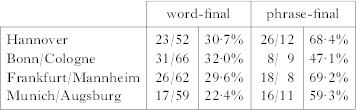
As argued by Beckman et al. (Reference Beckman, Michael and Ringen2006), in colloquial German (Umgangssprache) the patterns naturally vary more, but clear patterns emerge. Andy Kraiss, in assisting us with this project, examined conversational samples from the Pfeffer-Korpus recordings housed at the Institut für Deutsche Sprache, Mannheim. The four speakers studied came from different regions, and audible release was tracked for approximately 100 final stops by each speaker. All speakers used audible release far more often at a higher prosodic level, namely phrase-final position over word-final, as the results in Table I show.
Percentage of audible release in final stops (released/unreleased) for four speakers.
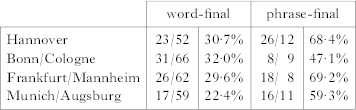
Both these data-sets indicate that contemporary German speakers release stops more often at higher levels of the prosodic hierarchy: phrase-finally more than word-finally (as above), and word-finally more than syllable-finally (as in König's findings). Still, to characterise the German neutralisation process as a prosodic edge marking in the form of ‘final aspiration’, as has been reported for Kashmiri or Klamath, would not be accurate, because release of final stops (in the form of audible aspiration) is not obligatory in any variety of the language. Rather, syllable-final fortition in German, i.e. the regularity expressed in (5), is a reflection of the language's natural phonological evolution, to a description of which we now turn.
5 The diachrony of final neutralisation in German and its dialects
The demarcative function of final fortition in modern German is less fixed (because final release is not obligatory) than it presumably was when it first arose or than it is claimed to be in at least some other languages which evince this phenomenon. Though the considerable phonological literature on German final neutralisation focuses on the prescribed variety, Standard German itself is famously the product of a complex social and political process of normalisation.Footnote 10 A look into the history of Auslautverhärtung provides key support for its origins in prosodic marking and, at the same time, reveals a rich set of competing systems which continue down to the present day across the dialects, thus informing our understanding of synchronic variation in modern spoken German.
The earliest major text preserved in Old High German is a translation of Isidor of Seville's De fide catholica, probably from the last quarter of the 8th century and showing west central (Franconian) dialect features. In initial and medial position, obstruents in this text show contrasts between lenis and fortis, while in final position these are generally spelled as fortis (s, p, t, k, etc.), a pattern reflected in morphophonemic alternations like selp∼selbo ‘self’ (cf. Penzl Reference Penzl1970: 70–74). Similar evidence is found across a broad region in the OHG period, including both central and southern texts, while OHG's northern cousin, Old Saxon, may show at most some traces of the process (see Mihm Reference Mihm2004: 145 for references). The choice of fortis graphemes in neutralisation may suggest introduction of the [spread glottis] feature here, and thus prosodic marking via aspiration, but the phonetics naturally remain uncertain.
More dramatic Old High German evidence for the insertion of a spread glottis gesture comes from Notker Teutonicus, a prolific Alemannic writer of the early 11th century. In his texts, sentence- and clause-initial obstruents are spelled as fortis, and likewise generally in final position (lánt, lándes ‘land (nom, gen)’). The initial fortition pattern suggests that Notker was marking the beginnings of higher-level prosodic units (sentences and clauses), in addition to the more familiar marking of their ends, or right edges. Tellingly, initial position shows a progressive sandhi-level spread of fortis character, where an initial lenis is written as lenis after a sonorant consonant or vowel, but as fortis after any fortis obstruent, including those arising via final fortition of phonologically lenis stops (which itself is not represented orthographically): p, t, k; pf, z [ts], ch; b, d, g; f, h, Ʒ, s (see Braune Reference Braune1987: 100–101):
(7) Notker's Anlautgesetz
As argued in Iverson & Salmons (Reference Iverson and Salmons1999), this pattern in Notker's dialect indicates rightward spread across word boundaries in which an articulatory property present in finals influences the realisation of adjoining laryngeally unmarked obstruents. For Notker, in short, a [spread glottis] gesture is inserted to mark both beginnings and endings of prosodic units.
This evidence, striking though it is, might be less than compelling but for the fact that modern dialects from the same southwestern region still attest such patterns a millennium later. Schild (Reference Schild1891: 30–31), for example, gives a number of pairs including those in (8) from the dialect of Brienz, in the Bernese Oberland of central Switzerland:
(8)
Writing about the city dialect of Basle, Heusler (Reference Heusler1888: 27) interprets Notker's orthography as proof ‘dass schon damals der gleiche Lautbestand von stimmhaften und stimmlosen Consonanten vorhanden war wie in den heutigen hochalem. Mundarten' [‘that even then the same inventory of voiced and voiceless consonants was present as in the contemporary High Alemmanic dialects’]. Like Schatz (Reference Schatz1897), Heusler is particularly concerned with parallels to Notker's writing of lenis obstruents as fortis in sentence-initial position. Wilkens (Reference Wilkens1891: §§42–43; see also Heusler Reference Heusler1893) addresses modern dialect parallels to Notker, and also documents a broader pattern of Notkeresque laryngeal alternations in early manuscripts from St Gall.
Our best evidence for the earliest amply attested stage of German and from modern regional dialects still spoken in those areas, then, suggests that the dialects we know showed final fortition rather than final lenition, i.e. neutralisation to the marked rather than the unmarked series. All this points to the origins of modern final fortition in signalling finality.
Middle High German also shows fortis spellings in final position, and is therefore widely regarded as having continued the tradition of final fortition. In the transition to the Early Modern period, however, such spellings begin to disappear, so that MHG lop∼lobes ‘praise (nom∼gen)’ comes to be written more often lob∼lobes. The standard handbook view of this development from Ebert et al. (Reference Ebert, Reichmann, Solms and Wegera1993: 23) is as follows:
Im Konsonantenbereich hat die Nichtkennzeichnung der Auslautverhärtung etymologischer b, d, g morphologische Gründe. Es handelt sich dabei um eine Erscheinung, die bereits in den Handschriften des Mhd. (nicht dagegen in normalisierten Textausgaben) begegnete, im 14. Jh. eine deutliche Tendenz zur Regelhaftigkeit erkennen läßt und sich bis ins 16. Jh. als Regel durchsetzt.
[In the realm of consonants, the non-marking of final fortition of etymological b, d, g has a morphological basis. This phenomenon, which is in evidence already in Middle High German manuscripts (but not in normalised editions), shows a clear tendency to regularity in the 14th century and becomes established as the rule by the 16th.]
That is, over the course of this period the MHG tradition of spelling fortition (MHG lop∼lobes) came to be replaced by an orthographic practice based not on the surface pronunciation, but rather on a morphophonological principle reflecting underlying structure (/lob/, with later vowel lengthening to yield Modern German /loːb/, written Lob). Mihm shows that this process unfolded along complex lines of evolution, with numerous regional differences (disappearing less quickly in the north) as well as phonological ones (disappearing less quickly among fricatives and varying by place of articulation in stops).
Even if we assume, as most do, that this was a spelling change and not a phonological one, modern German final fortition is no mere continuation of an ancient tradition. We note now that there are at least three different systems of word-final laryngeal phonology across the German-speaking world. The most notable and widespread was obstruent lenition in medial and final position in Upper and Central German dialects. As Mihm argues (2004: 176), early modern poets (in his examples, from Upper Saxony) rhymed pairs like Kleid∼weit and Berg∼Werk, but crucially, he argues, by means of neutralisation to the lenis member of the pair, via final lenition rather than fortition.Footnote 11 As with historical patterns of final fortition, some modern dialects, especially central German ones, continue the pattern of final lenition. For the Hessian dialect of the Odenwald (as described by Freiling Reference Freiling1914), Holsinger (Reference Holsinger, Brandão de Carvalho, Scheer and Ségéralforthcoming) summarises the relevant facts as follows:
As in the majority of German dialects, it has a fortis/lenis distinction in stops, but in this dialect, the fortis realization is present only in prevocalic onsets and neutralized elsewhere to a lenis (phonologically unmarked) stop – final fortition is not present, and coda laryngeal oppositions are fully neutralized.
In the southeast, we find another change in the so-called ‘Bavarian quantity relations’, where the laryngeal quality of a final obstruent associates with vowel quality. In this prosodic reorganisation of the syllable rhyme, a long or tense nucleus requires a lax or lenis coda obstruent, while a short or lax nucleus correlates with a tense or fortis coda obstruent (see Bannert Reference Bannert1976).
Unexpectedly, a third system is also attested, viz. retention of final contrast. Mihm (Reference Mihm2004) gives evidence that the prestige model for spoken German in the 18th century, Meissen (Saxony), actively distinguished lenis from fortis in word-final position, and that neutralisation was regarded as a ‘provincialism’. Some notable figures, including Goethe, actually insisted that actors should produce laryngeal distinctions in final position. This advice, in fact, was often prescribed as standard until the end of the 19th century.
Two of these systems – final lenition and renegotiation in terms of overall rhyme structure – reflect later developments, dating from the late medieval and early modern periods. The history of the third, retention of laryngeal distinctions in final position, is perhaps less clear. The relevant point, however, is that by the time a written standard began to emerge for Modern German, the spoken language included all three phonological patterns.
No systematic attempt to regularise Standard German pronunciation took hold until the turn of the 20th century, but prior to this, pronouncements of various kinds can be found, including on the matter at hand. The social process of language standardisation is most often ultimately about choosing between available and structurally viable options, and in this case standardisers pushed hard for the variant (final fortition) that happened to serve another role (signalling constituent boundaries).
Compare this to the requirement in a number of editions of the (now superseded) prescriptive Siebs pronunciation manual (Bühnenaussprache) that p and t should be aspirated after s, so that Stadt should be pronounced with both t's aspirated, as [ʃtʰatʰ] (cf. Siebs Reference Siebs1944: 80).Footnote 12 While this might be helpful from the stage for listeners in the back rows, no dialect shows this pattern to our knowledge and no historical evidence suggests that it ever existed beyond social affect (as ‘upper class pronunciation of a Northern and its ironic inversion: gay-talk’, as a reviewer of this paper puts it).
In fact, the failure of both Grimm's Law and the Second Sound Shift in s+stop clusters strongly suggests that these never were widely aspirated (Iverson & Salmons Reference Iverson and Salmons1995, Reference Iverson and Salmons2003b). Few languages have aspiration in this position, and it would be relatively difficult for German speakers to produce, given the timing of the spread glottis gesture relative to stop release in Germanic languages (Iverson & Salmons Reference Iverson and Salmons1995). In this case, then, efforts at prescribing pronunciation have failed, in the absence of the social and structural pressures favouring aspiration that we saw above for final fortition. Indeed, even the most standard pronunciations among educated speakers today reflect considerable regional variation – as confirmed by recent work like Fuchs & Perrier (Reference Fuchs, Perrier and Solé2003), Piroth (Reference Piroth and Solé2003) and Piroth & Janker (Reference Piroth and Janker2004) – including incomplete neutralisation for certain speakers from some areas. While this is not the place to explore it in detail, we understand such contemporary variation as the utterly expected outcome of a (recently) prescribed standard being superimposed on regional varieties, particularly in areas like the south, where, broadly stated, most people continue to acquire dialects or regional colloquial varieties quite far from the standard as first languages and learn some form of standard only in school.
But what of the few morpheme-internal codas that are so widely regarded as exceptional, like Adler and the others in (4c)? The ‘eagle’ word is a 12th-century compound from adel ‘noble’ and are ‘large bird of prey’ (cf. the now obsolescent Aar), and the Grimms' Deutsches Wörterbuch still includes the form adeler, noting ‘so schreibt Luther gewöhnlich für adler, des Sinnes der letzten Silbe unkund’ [‘Luther spells Adler ‘eagle’ this way, unaware of the meaning of the last syllable’]. Well into the Early Modern period, then, as the standard language was beginning to emerge, even the most highly regarded author in the language still showed a medial vowel in this word, leaving its lenis /d/ in syllable-initial position. While the particular etymological path is perhaps unique, the exceptional modern forms with lenis codas typically contained medial vowels after the obstruent in question, so that it was unambiguously in an onset rather than a coda. Early Modern German dictionaries, like Götze (Reference Götze1967), list variants with and without syncope for words like hand(e)lung, hand(e)ler and so on, and proper names today still show robust variation, like Wagner vs. Wagener, even where Götze lists only the syncopated form wagner for the common noun ‘wagon-maker’. During this period of general coda fortition, then, learners were exposed to forms where the ‘eagle’ word was pronounced with d because it still was in onset position; this then later alternated with rapid-speech forms in which the vowel was elided, placing the /d/ into the coda but exempting it from syllable-final fortition due to the late, fast-speech nature of the elision (cf. the similar casual speech reduction affecting triliteral coronal clusters in English plurals like tests [tʰεss]<[tʰεsts], which does not feed into otherwise obligatory schwa epenthesis that breaks up final sibilant clusters (busses /ʌs+z/>[ʌsəz], but not /tʰεst+z/>*[tʰεsəz]).Footnote 13 As a stylistic option, in other words, elided variants like adler (alongside the full pronunciation adeler) retain their morphophonemic integrity in the emergent prescriptive standard, whereas in northern German the reduced variants were subject to the general, there still postlexical, process of marking syllable-final position.
In sum, a set of independent changes (syncope in adeler>Adler, handeler>Händler), along with the borrowing of any number of foreign words (Greek -gm- clusters, Slavic -nitz and -litz names), coincide to create surface forms in the standard which are no longer true to the function that Auslautverhärtung otherwise serves of marking the end of syllables. These developments caused syllable-final fortition to become partially opaque and thus, parallel to the narrowing of once exceptionless phonological rules elsewhere (cf. Kiparsky Reference Kiparsky and Fujimura1973), to migrate up into the lexical component of the phonology, automatically subject to the morpheme-edge restriction. As detailed in Blevins (Reference Blevins2006a), moreover, ‘unnatural’ patterns can survive and be promoted through standardisation, an effect which, in the present case, we attribute to the ongoing interplay between evolutionary and sociolinguistic pressures.
6 Summary and conclusions
We have brought into focus here a number of points with regard to the issue of laryngeal neutralisation, its prosodic motivation and its particular historical evolution in German.
First, we have filled out the typology of final neutralisation under the assumptions established by ‘laryngeal realism’. Final devoicing (Dutch) is joined by final lenition (Korean, southern Icelandic) as an anticipated process of final laryngeal neutralisation via weakening. The other possibilities, final voicing and final fortition, as feature addition, are both less common than feature loss. Nonetheless, final fortition is prosodically and diachronically motivated, as a way of signalling the end of a prosodic constituent, and so does not represent the typological oddity that final voicing does.
Second, this view changes our perspective on German final neutralisation. Final fortition in northern spoken Standard German consistently serves the function of marking the ends of syllables. In the prescribed standard, Auslautverhärtung includes an additional restriction calling for the ‘prosodic alignment’ of syllable and morpheme boundaries. This analysis is descriptively more adequate than an appeal to paradigm uniformity, and eliminates the need to create any classes of exceptions to fortition. Moreover, historical evidence shows that prosodically motivated final fortition is an ancient pattern, forming one part of the input into the standardisation of pronunciation. While the standard has incorporated final fortition as the norm, the previously problematic absence of fortition in unaligned medial clusters like the /d/ of Adler or Handlung finds straightforward historical motivation in patterns of syncope and lexical borrowing.
Finally, work to date within Evolutionary Phonology has emphasised the historical processes which lead to and underlie synchronic phonological behaviour, with relatively little to say about the role played by abstract phonological structure (though Blevins Reference Blevins2004 develops two categories of ‘pure phonology’, features and prosody). The present paper has focused on how abstract prosodic structures interrelate with the historical phonetic mechanism of laryngeal neutralisation, which is already well described in Evolutionary Phonology. As Blevins and others suggest, word-final laryngeal neutralisation often has origins in phonetically motivated phrase- or clause-final neutralisation, a development which in the case of German now seems especially clear: Old High German as written by Notker and others shows bidirectional patterns of fortition; over the centuries, this process migrated down the prosodic hierarchy eventually to mark syllable codas generally – across the board in northern varieties but with an evolved morpheme-final restriction in the standard.
Blevins (Reference Blevins2006b: 139–140) anticipates this development: ‘for sound changes originating with phrase-final laryngeal gestures … the direction of final-devoicing sound patterns is predicted to be utterance>phrase>word>syllable’. We would extend this, under laryngeal realism, to final fortition, and we have indicated at several points above just how the prosodic migration may have taken place. Numerous scholars writing from quite different perspectives (Hock Reference Hock, Fujimura, Joseph and Palek1999, Blevins Reference Blevins2004, among others) propose that the strongest motivations for final devoicing or fortition are found at the utterance (and then phrase) level, as detailed in (3) above. Blevins motivates the migration to the word level primarily in terms of language acquisition. The final step, to the syllable level, rests surely in part on factors presumably always at work throughout the migration, from Blevinsian ‘choice’ to simple overgeneralisation (likely given the absence of final release in many languages at even the syllabic level – including German for word-internal codas for most speakers). Furthermore, Juliette Blevins (personal communication) raises the question with us of whether syllables might constitute ‘minimal gestural units’ in some sense. The present paper has merely initiated inquiry into this line of thought, and it naturally awaits further investigation.
In sum, then, an examination of the history as well as the synchronic structure of German confirms the general developmental scenario that is anticipated in Evolutionary Phonology, a theory which recognises the full, if restricted, range of final neutralisation possibilities listed in (2).