INTRODUCTION
The interaction between a parasite and its host does not take place in an ecological vacuum. In nature, transmission and infection processes occur with varying efficiency under a wide range of environmental conditions, and it is easy to imagine that infection levels could go up or down, following a change in these conditions. At present, natural habitats are undergoing rapid and extensive changes caused by human activities, including deforestation and habitat destruction, translocation of species, toxic pollution, and the well-publicised impacts that may lead to global climate change (Vitousek, Reference Vitousek1994; Thomas et al. Reference Thomas, Cameron, Green, Bakkenes, Beaumont, Collingham, Erasmus, de Siqueira, Grainger, Hannah, Hughes, Huntley, van Jaarsveld, Midgley, Miles, Ortega-Huerta, Peterson, Phillips and Williams2004; Mooney et al. Reference Mooney, Mack, McNeely, Neville, Schei and Waage2005; Primack, Reference Primack2006). From the parasite's perspective, these changes have immediate effects on the conditions experienced during transmission and infection. Both the abiotic and biotic conditions of any given locality are likely to be altered by the large-scale anthropogenic impacts. It is crucial to understand how these altered conditions will modulate the transmission and infection success of parasites in natural communities if we want to anticipate potential effects on disease dynamics as well as host populations and communities.
Here, we review the documented effects of environmental conditions on the transmission success of endohelminth parasites. After a brief summary of what is known about the effects of natural abiotic factors and anthropogenic pollutants on free-living endohelminth stages, we focus on biotic factors that may influence transmission processes. The potential importance of biotic factors in the transmission processes of free-living endohelminth stages has been recognized (Morley and Lewis, Reference Morley and Lewis2004), but there has been no comprehensive review of the literature. We classify the biotic factors into 6 general types, each discussed in turn. Beyond their qualitative nature, we also provide an account of the quantitative effects that biotic factors can have on transmission success, based on the available evidence.
TRANSMISSION IN AN ABIOTIC WORLD
Free-living stages occur in different groups of endohelminths: (1) eggs, miracidia, cercariae and metacercariae in digenean trematodes, (2) eggs, oncospheres and coracidia in cestodes, (3) eggs and juveniles in nematodes and (4) eggs in acanthocephalans. Once released into the environment from the up-stream host, they are either immobile and await ingestion by a down-stream host, or are mobile and actively reach their down-stream hosts. During this free-living stage, the infective propagules are exposed to a multitude of environmental factors that modify their transmission success by altering their survival and/or infectivity. These factors can cause a reduction of the local pool of infective stages and may ultimately lead to reduced infection levels in the down-stream hosts. Alternatively, some environmental factors may lead to an increase in infection success and increased infection levels in the down-stream hosts.
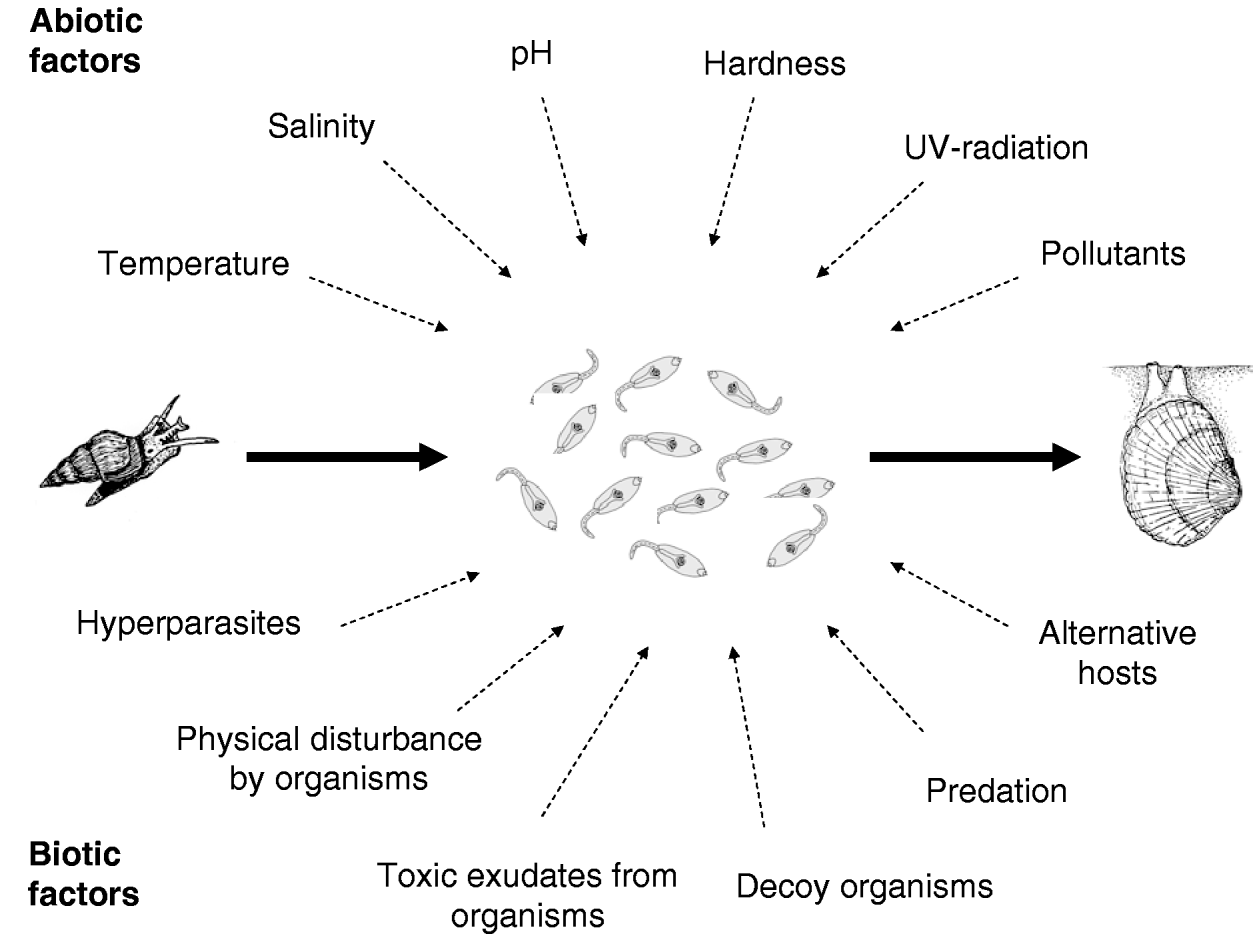
The effects that natural abiotic factors can have on the transmission success of free-living endohelminth stages have been well studied, especially in trematodes. In this group, temperature is a particularly important abiotic factor. Production and shedding of infective cercarial stages from up-stream hosts and infection success in the down-stream host are usually positively correlated with temperature (Pietrock and Marcogliese, Reference Pietrock and Marcogliese2003; Poulin, Reference Poulin2006). Other abiotic factors known to affect survival and infectivity of free-living endohelminth stages include, for example, salinity, pH, water hardness, UV-radiation, desiccation, oxygen levels and water pressure (see Pietrock and Marcogliese, Reference Pietrock and Marcogliese2003 for further information) (Fig. 1). In general, almost all studies have used laboratory approaches, manipulating single factors and measuring their effects on survival and, to a lesser extent, on infectivity (Pietrock and Marcogliese, Reference Pietrock and Marcogliese2003). The most relevant measures of the actual importance of a factor for parasite transmission can be obtained from experimental comparisons of infection levels in down-stream hosts between treatments with and without the factor in question because, for a parasite, what matters is whether or not it actually manages to infect the down-stream host. It is also the most relevant measure for the hosts, because it allows the quantification and prediction of infection dynamics.
Examples of abiotic factors known to influence the transmission of free-living infective helminth stages (above) and 6 types of biotic factors (below) likely to play an important role in transmission processes. The figure illustrates the transmission of cercariae shed from a snail up-stream host on their way to infect a bivalve down-stream host, thereby encountering a multitude of abiotic and biotic hazards.

Anthropogenic pollutants are also known to affect parasite-host relationships either via effects on the hosts or on the parasites themselves (Möller, Reference Möller1987; Khan and Thulin, Reference Khan and Thulin1991; Poulin, Reference Poulin1992; MacKenzie et al. Reference MacKenzie, Williams, Williams, McVicar and Siddall1995; Lafferty, Reference Lafferty1997; Pietrock and Marcogliese, Reference Pietrock and Marcogliese2003) (Fig. 1). In general, it is assumed that free-living endohelminth stages are vulnerable to most anthropogenic substances (Poulin, Reference Poulin1992; Overstreet, Reference Overstreet, Couch and Fournie1993; MacKenzie, Reference MacKenzie1999; Pietrock and Marcogliese, Reference Pietrock and Marcogliese2003). However, sometimes very high concentrations of pollutants are necessary for an effect, and survival of infective stages may even be prolonged in some situations (Pietrock and Marcogliese, Reference Pietrock and Marcogliese2003). Again, most studies have been conducted in the laboratory and focused mainly on survival and to a lesser extent on infectivity (Pietrock and Marcogliese, Reference Pietrock and Marcogliese2003). Both natural abiotic factors and anthropogenic pollutants probably act together in complex interactions, especially in the field but, so far, experiments investigating these aspects are lacking (Morley and Lewis, Reference Morley and Lewis2004).
SWIMMING IN A SEA OF OTHER ORGANISMS
Even more complexity is added to transmission processes in free-living endohelminth stages by the fact that the infective stages are never alone on their way to their down-stream hosts, but are instead surrounded by complex communities of ambient organisms. These organisms may alter the transmission process through a variety of species interactions, for example via predation on the free-living stages. We surveyed the available literature for studies of the effects of such biotic factors on parasite transmission from various parasitological and ecological research areas and classified the biotic effects that we identified into 6 types (Fig. 1). We only considered biotic effects acting on the free-living stages during the period between release from the up-stream host and infection of the down-stream host. Of course, biotic factors may also be at work within the down- and up-stream hosts (e.g., competition with other parasites and host-related factors), but this topic would deserve a review on its own. The results of our literature survey are summarized in Table 1. Quantitative data on the magnitude of the reduction in the number of infective stages or transmission success are included only for studies that provided these data. We calculated reduction rates as ratios between treatments and control groups (or between treatments when controls were absent) in cases where only prevalence or intensities of different treatments were given. In cases where no mean values for experimental reductions were given in the original publications, we calculated the necessary values from the raw data given in the text. If the experiments included several treatments using different ‘densities’ of the biotic factors, then the full range of effect sizes are reported. This results in zero values for low density treatments in some examples. For a rough quantitative comparison of the different biotic factors, we calculated mean reduction rates using the data from Table 1. When ranges were given we used median values for the calculation. Due to the low sample sizes in some cases and the different nature and quality of the data, we refrained from any statistical analysis. In the following, we discuss the different types of biotic factors in more detail.
Examples of biotic factors influencing transmission processes in free-living stages of endohelminths taken from the literature
(Where data are available, we indicate the percentage of reduction in prevalence or intensity in the down-stream hosts or in the pool infective stages caused by the presence of a biotic factor (see text for details). In two cases the presence of a biotic factor caused an increase in down-stream host prevalence and intensity, noted as the factor of the increase in the table. Most studies determined prevalence and intensity in down-stream hosts by host dissection and counting individual parasites. However, a few studies measured intensities as the amount of radioactivity in down-stream hosts after exposure to radioactively labelled infective stages which we note with an 1) in the data columns. The column ‘Parasite group’ indicates if Trematodes (Trem), Nematodes (Nem), Cestodes (Cest) or Acanthocephalans (Acanth) were investigated. The column ‘Habitat’ provides information on the type of habitat where studies were conducted: terrestrial (T), freshwater (F) or marine (M). The column ‘ToI’ indicates the type of investigation, i.e. whether the results are based on observations (O), laboratory experiments (L) or field experiments (F).)

PHYSICAL DISTURBANCE
Free-living stages may be affected simply by the physical presence of other organisms. For example, stems and leaves of water plants as well as algae have been shown to represent physical barriers for schistosome cercariae, reducing or even preventing infections in the down-stream hosts (Christensen, Reference Christensen1979). The physical presence of organisms may also affect transmission when these organisms serve as alternative prey for the host, thus distracting down-stream hosts from preying on infective stages. For example, copepods are less likely to become infected with cestode coracidia when alternative food is available (Pasternak et al. Reference Pasternak, Pulkkinen, Mikheev, Hasu and Valtonen1999). However, the presence of other organisms serving as food for the down-stream hosts can also enhance the transmission of free-living helminth stages. Some acanthocephalan eggs entangle in algae which serve as food for the down-stream amphipod hosts and thus increase their transmission rate. In their absence, the transmission success of the eggs is greatly reduced or not possible at all (Barger and Nickol, Reference Barger and Nickol1998). In nematodes of livestock, the type of forage plants present on a pasture determines the number of eggs developing into infective juveniles, probably due to differences in the microclimate provided by different plant species as a result of their different morphologies (Moss and Vlasshoff, Reference Moss and Vlasshoff1993; Niezen et al. Reference Niezen, Charleston, Hodgson, Miller, Waghorn and Robertson1998). This can lead to reductions in intensities of infection in the down-stream hosts, depending on the type of pasture the host feeds on (Knapp, Reference Knapp1964).
TOXIC EXUDATES
Other organisms may affect the transmission of free-living endohelminth stages via toxic exudates. For example, algae and higher plants sometimes produce toxic substances which kill infective stages. Schistosome cercariae are killed by a substance released from the stems of Hedychium coronarium (Warren and Peters, Reference Warren and Peters1968) and in the Mediterranean Sea, the introduced alga Caulerpa taxifolia seems to secrete a cercaricidal substance and thus reduces prevalence and intensity of trematode infections in down-stream fish hosts living within Caulerpa-meadows (Bartoli and Boudouresque, Reference Bartoli and Boudouresque1997). Animals can also produce substances that are toxic to infective stages. For example, toxic exudates from planarians and adult toads have been shown to kill schistosome miracidia and cercariae (Chernin and Perlstein, Reference Chernin and Perlstein1971; Christensen, Reference Christensen1979). Another group of organisms producing toxic exudates are bacteria. Lethal effects on nematode eggs due to toxins have been observed, for example, in Bacillus thuringiensis (Bottjer et al. Reference Bottjer, Bone and Gill1985).
HYPERPARASITISM
Although parasites themselves, free-living stages of endohelminths may be subjected to hyperparasitism (parasites parasitizing parasites) by other organisms. Fungi have been reported to infect eggs and miracidia of trematodes as well as oncospheres of cestodes, thus decreasing their survival and infectivity (Butler and Buckley, Reference Butler and Buckley1927; Fagbemi, Reference Fagbemi1984). Fungi have also been found to infect nematode eggs in dung pats from livestock. These fungi have a large nematophagous capacity and kill eggs and juveniles before they can migrate to the pasture where they are taken up by the down-stream hosts. By this mechanism, the fungi can reduce nematode loads in livestock and thus serve as a potential biological control agent by adding fungi to the food of livestock (Waller and Thamsborg, Reference Waller and Thamsborg2004; Ketzis et al. Reference Ketzis, Vercruysse, Stromberg, Larsen, Athanasiadou and Houdijk2006). Other hyperparasitic agents include microsporidians which have been reported to commonly infect adult as well as larval stages of platyhelminths (Canning, Reference Canning1975). In trematodes, infected cercariae released from sporocysts and rediae suffer from distorted tails and are unable to encyst in the down-stream hosts (Knapp et al. Reference Knapp, Baldwin and Presidente1972; Canning et al. Reference Canning, Barker, Hammond and Nicholas1983).
DECOY ORGANISMS
On their way to their down-stream hosts, free-living endohelminth stages can be ‘distracted’ by organisms not suitable as hosts, known as decoy organisms. The mechanisms by which these decoy organisms affect the transmission process vary widely. Infective stages may try to penetrate non-hosts but fail, becoming damaged and have their limited energy resources depleted, or successfully penetrate but do not develop in the non-host tissue. For example, miracidia and cercariae of trematodes have been shown to attempt penetration of various non-hosts, such as plants, snails and tadpoles, thus leading to reduced infection levels in the appropriate down-stream hosts (Warren and Peters, Reference Warren and Peters1968; Upatham and Sturrock, Reference Upatham and Sturrock1973). Other organisms accidentally filter or ingest infective stages of trematodes, cestodes or acanthocephalans without becoming infected and thus remove infective stages from the infective pool (Uglem and Larson, Reference Uglem and Larson1969; Lethbridge, Reference Lethbridge1971; Fagbemi, Reference Fagbemi1984). In some cases, other organisms may become infected by the free-living stages but act as dead ends, since they are not consumed by down-stream hosts. For example, introduced Pacific oysters in the European Wadden Sea are infected by cercariae of a native trematode species, but since they are not consumed by the bird final hosts they are dead ends for the parasites (Krakau et al. Reference Krakau, Thieltges and Reise2006).
PREDATORS
Numerous free-living stages also serve as food for other organisms which can be considered as predators. Freshwater schistosome miracidia and cercariae have been shown to be preyed upon by oligochaete worms, dipteran larvae, cladocerans, copepods, ostracods, shrimps and fish (Michelson, Reference Michelson1964; Christensen, Reference Christensen1979; Christensen et al. Reference Christensen, Frandsen and Nansen1980). In marine systems, anemones consume cercariae (Mouritsen and Poulin, Reference Mouritsen and Poulin2003). In terrestrial habitats, earthworms and dung beetles prey on nematode eggs (Miller et al. Reference Miller, Chi-Rodriguez and Nichols1961; Grønvold et al. Reference Grønvold, Sommer, Hotter and Nansen1992). However, both earthworms and dung beetles also exert indirect effects by enhancing the dehydration of dung patches, in which eggs are deposited, thus creating unfavourable conditions for the nematode eggs, or by transporting eggs below ground where they cannot return to the surface (Grønvold et al. Reference Grønvold, Sommer, Hotter and Nansen1992).
ALTERNATIVE HOSTS
In addition to non-hosts, the transmission process of free-living helminth stages may also depend on the presence of alternative hosts. In contrast to decoy organisms and predators, alternative hosts can actually be successfully infected by the free-living parasite stages. In the alternative hosts, the parasites can develop and potentially be transmitted to the next down-stream host. While alternative hosts may have a similar effect as decoy organisms by distracting infective stages from the main target hosts, there is an important difference. The alternative transmission routes made available by alternative hosts ensure that the parasites remain in the system and are not lost from it, as in the case of true decoy organisms. For example, the presence of an alternative snail host reduces the transmission of trematode miracidia to the main target snail host. However, an alternative snail host is infected instead and the overall transmission success remains the same (Evans and Gordon, Reference Evans and Gordon1983). Another example is provided by introduced populations of the American razor clam (Ensis americanus/directus) which become infected by native trematode parasites. Although infection levels are lower in this species compared to native hosts, the newcomer serves as an alternative host and opens an additional transmission route to the final bird hosts (Krakau et al. Reference Krakau, Thieltges and Reise2006). Of course, such effects only occur in parasites with low host specificity which allows parasites to infect alternative hosts. However, the suitability of the hosts may vary, and using many alternative hosts may actually be less efficient and thus ultimately cause a reduction in transmission success (Poulin, Reference Poulin2007). Besides acting as alternative hosts, other organisms may alter transmission processes by functioning as paratenic or transport hosts. Although not acting as intermediate or final hosts themselves they can alter the transmission success of free-living stages to these hosts, often by enhancing transmission (Poulin, Reference Poulin2007). However, we are not aware of studies that investigated the effect of paratenic or transport hosts on the transmission success of free-living endohelminth stages.
BIODIVERSITY AND PARASITE TRANSMISSION
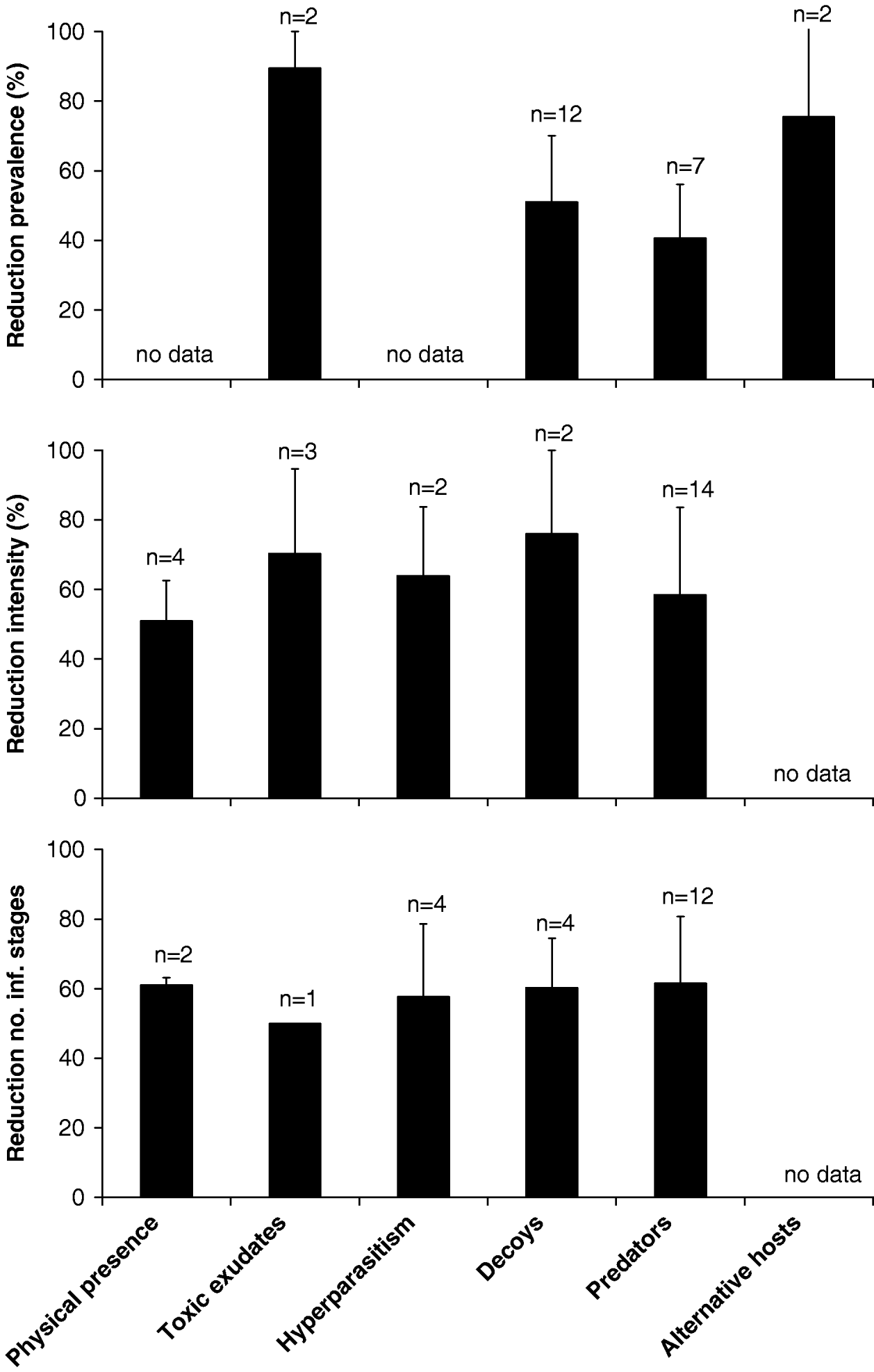
The effects of the different biotic factors on the transmission of free-living endohelminth stages observed in experiments from the literature were generally strong (Table 1; Fig. 2). As for abiotic factors (Pietrock and Marcogliese, Reference Pietrock and Marcogliese2003), most biotic studies to date have been conducted with trematodes (Table 1). However, the available examples from nematodes, cestodes and acanthocephalans suggest that the presence of other organisms exerts the same quantitative influence on their infective stages. Studies focusing on the effects of biotic factors on the pool of infective stages found that the presence of other organisms reduced the number of infective stages in experimental systems by approximately 60% on average (Fig. 2), with maximum values often approaching 100% (Table 1). Similar effect strengths were observed in studies evaluating the actual effect of biotic factors on prevalence or intensities of infections in the down-stream hosts in the presence and absence of the factor in question (Fig. 2). There were no consistent differences in the strength of the reduction in prevalence and intensity in down-stream hosts and the number of infective stages among the different biotic factors (Fig. 2). In contrast, different density treatments of ambient organisms often resulted in strong differences in the strength of the observed effects (e.g. Upatham, Reference Upatham1972; Christensen, Reference Christensen1979; see Table 1). With an increase in the density of ambient organisms, their effect on the larval pool and on infection levels in the down-stream hosts can be expected to increase. Hence, using lower or higher densities would probably generate different results in most cases. This is important to bear in mind when comparing the strengths of effects among different types of factors and among different ambient species.
Mean (+S.D.) reduction (%) in prevalence and intensity in down-stream hosts as well as in the numbers of infective stages. Data based on Table 1 and median values when ranges are given.

The generally strong effects on all parasite groups suggest that biotic factors are an underestimated but very important determinant in the transmission ecology of free-living endohelminth stages. To be relevant under natural conditions, effects of biotic factors must be additive instead of simply compensatory. There is probably a high mortality of free-living stages anyway, regardless of any biotic factors. However, our data compilation suggests that biotic factors have a strong share in this mortality and may be a dominant factor in many situations. In most circumstances, the causes of mortality of infective stages cannot be measured under field conditions, so that we must rely on experiments where mortality in a treatment with the biotic factor is compared with mortality in the control without the biotic factor. Since mortality in the treatment is almost always greater than in the control, then the mortality caused by biotic factors is clearly additive, at least under the simplified conditions of an experiment. Given that this difference in mortality is often substantial in quantitative terms, we might expect it to remain additive in natural situations, though its impact might be dampened by other causes of mortality. However, a variety of field experiments (see Table 1) suggest that the strength of the effects remains under natural conditions because they recorded strong reductions of down-stream host infection levels in the field.
Since different biotic agents alter the transmission processes via different mechanisms, it can be assumed that multi-species assemblages should have an additive or interactive effect on the transmission of free-living endohelminth stages. A logical hypothesis, based on this assumption, is that ambient diversity should have significant effects on the transmission ecology of free-living endohelminth stages. Since most studies observed a strong reduction in transmission success in the presence of ambient organisms, a negative relationship between ambient diversity and transmission success is proposed. Ambient diversity should thus exert a strong dilution effect. This hypothesis has a parallel in terrestrial microparasites where dilution effects due to ambient diversity have been reported (Ostfeld and Keesing, Reference Ostfeld and Keesing2000; Keesing et al. Reference Keesing, Holt and Ostfeld2006). For macroparasites, this hypothesis remains to be tested. Since experiments are logistically feasible in many endohelminth host-parasite systems, this proposal could be tested in future experiments manipulating ambient diversity. Ideally, this should be done in the field since most of our present knowledge rests only on laboratory experiments (Table 1). In the future, it will also be interesting to try to link the association between biotic diversity and infection processes documented here, with the theoretical arguments that ecosystem stability is coupled with biodiversity (e.g., McCann, Reference McCann2000; Thébault and Loreau, Reference Thébault and Loreau2005). If local biodiversity generally acts to moderate parasitic infection levels, then its influence on the stability and resilience of an ecosystem could be enhanced. However, the opposite might also happen as recent studies suggest that parasites may actually have a stabilizing role in ecosystems (Lafferty et al. Reference Lafferty, Dobson and Kuris2006).
CLIMATE CHANGE AND PARASITE TRANSMISSION
The discussion above suggests that the fate of free-living endohelminth stages, once released into the environment, is determined by biotic factors in addition to natural abiotic factors and anthropogenic pollutants. Although usually treated separately in laboratory studies, it is highly likely that all three modulators act simultaneously in the field and thus expose free-living endohelminth stages to a complex array of hazards on their way to their down-stream hosts. Various interactions between the different modulators are also likely with important consequences for the transmission ecology of free-living infective stages. However, complex experiments combining the different modulators are lacking so far. Again, the feasibility of experimentation with many free-living stages of endohelminths offers a promising ground for future research in this direction.
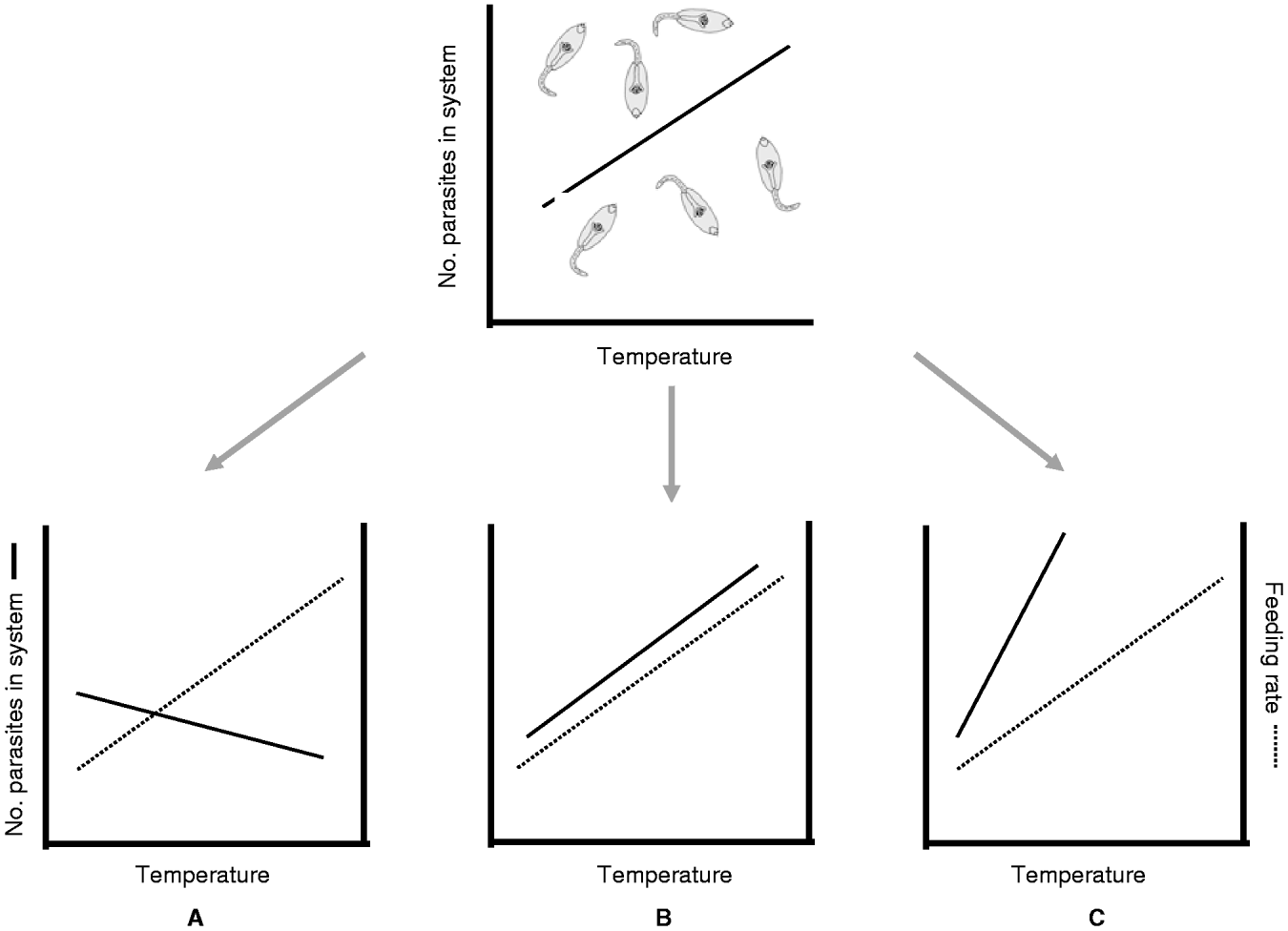
Interactions of abiotic and biotic factors may also have important implications for attempts to forecast future changes in parasitism in the course of climate change, which are expected to be profound (Marcogliese, Reference Marcogliese2001; Harvell et al. Reference Harvell, Mitchell, Ward, Altizer, Dobson, Ostfeld and Samuel2002). For example, the shedding rates of trematode cercariae are strongly positively related to temperature and a larger pool of infective stages is expected in a warmer world (Poulin, Reference Poulin2006; Fig. 3). This may in turn lead to higher parasite burdens in the down-stream hosts, as well as in the other hosts within the complex life-cycles of the parasites. However, the ambient communities surrounding the infective stages will also be affected by climate change. The metabolism of organisms is temperature dependent with feeding demands of predators increasing with temperature (van der Meer, Reference van der Meer2006). If free-living stages of endohelminths serve as food for predators, increased temperatures may actually lead to a reduction in the number of infective stages in a given system due to an increase in predation activity (Fig. 3A). Only if other sympatric organisms do not affect free-living stages at all, can an increase in the pool of infective stages occur (Fig. 3B). It is also likely that the presence of ambient organisms increases the number of infective stages in a system in a warmer world (Fig. 3C). For example, predators may increasingly switch to other food sources with increasing temperatures, or predators may negatively affect another predator of the parasites and thus indirectly release parasites from predation pressure. Organisms may also have to operate above their thermal optima, resulting in poor performance. This may lead, for example, to a reduced predation on infective stages and increased transmission success. Hence, considering only abiotic factors when trying to predict the effects of climate change on parasitism is an oversimplification. It will be necessary to include the interactive effects of abiotic and biotic factors in future climate change scenarios concerning parasitism and to examine these questions on an ecosystem by ecosystem basis.
Hypothetical interactions between abiotic and biotic factors in the face of climate change scenarios. As an example, a warmer world is expected to result in higher numbers of trematode cercariae within a given system due to positive correlations between shedding rates and infection success (above). However, temperature increases may also alter the effects of biotic factors on parasite transmission (below). A temperature-induced increase in predator feeding rates may for example reduce the numbers of infective stages (Fig. 2A). If predators of infective parasite stages increasingly switch to other food sources with increasing temperatures, a predator release may lead to a stronger increase in the numbers of infective stages (Fig. 2C). The numbers of infective stages will increase as expected from temperature alone only when biotic factors do not interfere with parasite transmission at all (Fig. 2B).

Climate change is just one component of multiple global changes (Vitousek, Reference Vitousek1994). Other global changes include the extinction and translocation of species (Novacec and Cleland, Reference Novacek and Cleland2001; Mooney et al. Reference Mooney, Mack, McNeely, Neville, Schei and Waage2005). Considering the potentially strong effects of biotic factors, changes in the biotic compartment of ecosystems may have profound effects on parasite-host systems. Introduced species may act as alternative hosts, thus increasing the population size of parasites, or they may act as decoys or predators of infective stages. Species extinctions may also strongly affect transmission patterns, for example, by releasing parasite infective stages from predation by a predator or limiting down-stream host availability. To understand the complexity of transmission processes in free-living endohelminth stages and to anticipate changes in the future due to global change, we will need studies integrating natural abiotic factors, biotic factors and anthropogenic pollutants.
CONCLUSION
The information and data reviewed from the literature indicate strong effects of biotic factors on parasite transmission and suggest that these factors are an important and underestimated determinant in the transmission ecology of free-living endohelminth stages. These findings suggest the hypothesis that ambient diversity has a strong dilution effect on parasite transmission and population dynamics. This hypothesis can be tested, ideally in field experimental approaches in various systems to validate the generality of the potential phenomenon. Since biotic factors are likely to interact with natural abiotic factors and anthropogenic pollutants, multifactorial experiments, manipulating these factors and generating quantitative assessments of the relative importance, will be a promising approach. Such investigations will not only be crucial for a thorough understanding of parasite transmission processes but will also be a prerequisite to forecast the effects of climate and global change, such as species introductions and extinctions, on helminth parasites and their host communities. In addition, data on the magnitude of the effects of biotic and abiotic factors in parasite transmission will be of great importance to be included in modelling approaches of parasite population dynamics.
We thank the members of Otago University's Ecological Parasitology Laboratory and two anonymous reviewers for thoughtful comments on the manuscript. D. Poszig is thanked for providing the drawings in Fig. 1. D. W. T. acknowledges support by a fellowship from the Postdoctoral Programme of the German Academic Exchange Service (DAAD) and a fellowship from the Deutsche Forschungsgemeinschaft (DFG) (Th 1361/1-1).